
30 × 40 ft House Plan in Mumbai — A 2026 Warm-Humid Coastal Reference
Mumbai's coastal warm-humid climate is unforgiving: 2,400 mm of monsoon rain, 80%+ year-round humidity, salt-laden sea air, and a building stock historically built for shorter cycles. The Verandah Pavilion plan answers it the way 200 years of Bombay vernacular did — wrap-around verandahs, steep Mangalore-tile gables, lime mortar, and cross-ventilation as the only comfort strategy worth investing in. DCPR 2034 compliance, MahaRERA notes, and 2026 cost realities, in one place.
Governing framework: Development Control and Promotion Regulations 2034 (DCPR 2034)
Working reference tables
Print or screenshot these for the studio wall. Cross-check against the current authority notification before any specific filing.
BMC / DCPR 2034 plot envelope for a 30 × 40 ft (≈ 111 sqm) Mumbai plot
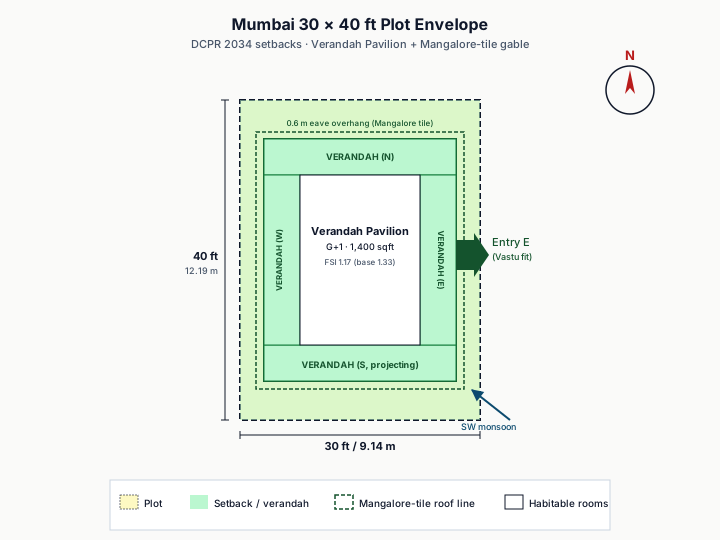
Setback, FSI, and height permitted on a typical 30 × 40 ft residential plot in the Greater Mumbai jurisdiction under DCPR 2034. Plots in slum-rehab areas (DCPR Section 33), coastal-regulation zones (CRZ), or planning-authority lands (MMRDA, MIDC, CIDCO) carry distinct overlays — this entry covers the standard BMC-jurisdiction residential plot.
| Parameter | DCPR 2034 (R-zone) | This Plan (Verandah Pavilion) |
|---|---|---|
| Plot area | 100–250 sqm band | 111 sqm (1200 sqft) |
| Permissible FSI (basic, no TDR) | 1.33 | 1.17 (within base) |
| FSI with TDR + premium (effective) | Up to 2.7–3.5 with payment | Not used |
| Ground coverage | 60% (no fungibility) | 55% achieved |
| Front setback | 1.5 m (≤ 9 m road) | 1.8 m (verandah projecting + planted) |
| Rear setback | 1.5 m | 1.8 m (utility yard + drying) |
| Side setback | 0.6 m (≤ 16 m height) | 0.9 m + verandah wrap on east |
| Building height max | 15 m for ≤ 12 m road (G+4) | 8.5 m (G+1 + gable ridge) |
| Verandah / staircase / lift FSI exemption | Up to 7.5% per DCPR | Verandahs designed to claim exemption |
Mumbai DCPR 2034 permits substantial FSI uplift through purchase of Transferable Development Rights (TDR) or by paying the premium. This plan deliberately stays within the base FSI to preserve plot biophilic + climate performance; TDR purchase is an option for owners seeking up to ~1,900 sqft built-up.
Mumbai warm-humid-climate strategy summary
How the Verandah Pavilion envelope responds to coastal Maharashtra's two seasons — monsoon and not-quite-monsoon — plus the year-round 75%+ humidity that defines the comfort problem.
| Season | Climate Reality | Design Response | Cost Driver |
|---|---|---|---|
| SW Monsoon (Jun–Sep) | 26–32 °C; 2,400 mm rain in 100 days; 90% RH | Wrap verandah on E + N + W; steep 35° Mangalore tile + 600 mm eaves; lime mortar; internal downpipes | Mangalore tile + carpentry + lime |
| Post-monsoon (Oct–Nov) | 25–32 °C; 80% RH; salt-laden sea breeze | Cross-ventilation N–S; all openings double-tracked | Stainless or brass hardware |
| Winter (Dec–Feb) | 18–28 °C; clear, 60–70% RH; pleasant | Free-running; ceiling fans; no envelope changes | (no premium) |
| Summer (Mar–May) | 26–35 °C; 70%+ RH; building stock under-ventilated | Same verandahs shade west sun; sea-breeze ventilation pre-evening | (strategy, not cost) |
Mumbai's defining climate enemy is humidity, not temperature. A sealed AC home in Mumbai is a mould generator. The Verandah Pavilion's open-section strategy keeps relative humidity inside ~5–10% lower than outdoors by continuous through-flow, which is the difference between mould and not-mould.
Mumbai 2026 cost band — 1400 sqft built-up Verandah Pavilion
Per-sqft and total cost for the Verandah Pavilion plan at three finish tiers, indicative for 2026 Greater Mumbai labour and material market. Vasai / Mira / Bhayandar / Karjat ~10–15% lower; central / island city ~25–40% higher.
| Tier | ₹/sqft | Total (₹ L) | Inclusions |
|---|---|---|---|
| Basic | 1,750 | 24.5 | Brick + lime + cement render, terracotta tile, jackwood, single glaze, basic gutter |
| Recommended | 2,250 | 31.5 | Lime mortar, Mangalore tile + exposed teak rafters, Indian green marble first floor, copper / brass hardware, 5,000 L tank |
| Premium | 2,800 | 39.2 | Hand-laid Mangalore tile + ridge details, full Burma teak frames + doors, marble + IPS, sea-corrosion-grade stainless hardware, 3 kWp solar, full rainwater |
Salt-air corrosion in Mumbai is real — galvanised steel hardware fails within 5 years on plots within 5 km of the coast. The recommended tier specifies brass or marine-grade stainless; the premium tier upgrades to sea-corrosion-grade stainless fasteners and aluminium-zinc-magnesium coatings on any steel work.
Mumbai-specific regulatory + planning overlays
Beyond standard BMC sanction, Mumbai's coastal + dense regulatory environment adds five common overlays. CRZ + MahaRERA are the two that most affect 30 × 40 ft self-builds.
| Overlay | Authority | When triggered | Architect action |
|---|---|---|---|
| Coastal Regulation Zone (CRZ) | Maharashtra Coastal Zone Management Authority (MCZMA) | Plots within 500 m of HTL | CZMP zonal check + MCZMA clearance |
| MahaRERA registration | Maharashtra RERA | Sale of 8+ apartments OR plot area > 500 sqm | Not typical for owner-built 30 × 40 — verify with lawyer |
| MahaRERA — Project Document | Maharashtra RERA | If selling later within registered period | Owner-built homes typically exempt unless multi-unit |
| MoEF clearance (large) | MoEFCC EIA notification | Built-up > 20,000 sqm | Not applicable to 30 × 40 ft single home |
| Heritage zone facade approval | Heritage Conservation Committee | Plots in heritage precincts (e.g., Bandra Bandstand, Fort) | Pre-sanction facade approval; 3–6 months |
| MMRDA / MIDC / CIDCO land overlay | Respective planning authority | Plots on planning-authority land | Authority-specific sanction in addition to BMC |
The Mumbai monsoon (June–September) practically shuts down construction for 2–3 months — site work is uneconomic in heavy rain. Plan construction sequencing so foundation + plinth are cast before May, and the roof is on before June; finishing trades work through monsoon under cover.
The working reference, in full
A 30 × 40 ft (~111 sqm) plot is small but viable in Mumbai's outer suburbs — Vasai, Virar, Mira Road, Bhayandar, Karjat, Neral, Khopoli — and in older suburbs that retain pockets of plotted land at this size. Building on this plot is governed by the Maharashtra Regional and Town Planning Act 1966, the Development Control and Promotion Regulations 2034 (DCPR 2034) of Greater Mumbai, and BMC's permit issuance system. The design problem to solve is the warm-humid coastal climate — Mumbai's defining design constraint and the one most builders short-change.
The Mumbai climate problem — humidity, not heat
Mumbai sits squarely in the warm-humid coastal climate zone per NBC 2016 / SP 41 (BIS, 1987). Annual mean temperature 27 °C with diurnal swings rarely exceeding 8 °C. The defining variable is humidity: 75% relative humidity is a normal weekday, and the four months of monsoon (June–September) routinely sit at 85–90% RH. The temperature problem is solvable with a fan; the humidity problem is not. The only durable comfort strategy is continuous cross-ventilation — moving air across skin to keep evaporative cooling active. Sealing the home and running AC fights humidity into wall cavities, where it becomes mould. The Bombay vernacular knew this — verandahs, gables, lime mortar, openable everything — and the Verandah Pavilion is its modern restatement.
The Verandah Pavilion plan — climate response, summarised
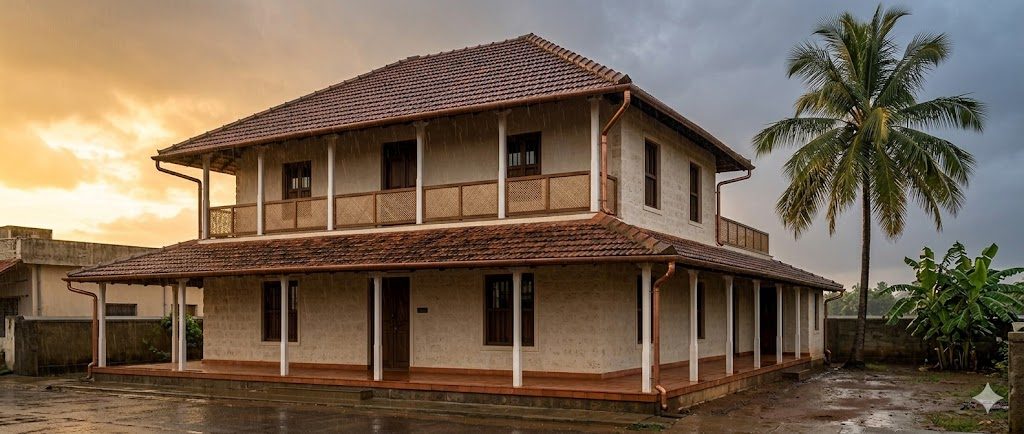
The Verandah Pavilion is a 30 × 40 ft, G+1, 3 BHK plan oriented with the long axis north-south so the long facades face east + west, with a wrap-around verandah on east + north + west providing shade + monsoon shelter, a steep 35° Mangalore-tile gable roof with 600 mm eaves to shed 2,400 mm of annual rainfall, lime mortar throughout (cement mortar spalls in 80%+ RH), and N–S cross-ventilation as the primary comfort strategy. Brass or marine-stainless hardware for sea-air corrosion. Internal downpipes in copper or GI. Full plan with floor schedules and materials.
FSI + setback compliance on a Mumbai 30 × 40 ft plot
DCPR 2034 permits a base FSI of 1.33 on residential plots in the 100–250 sqm band, with substantial uplift available via Transferable Development Rights (TDR) or by paying the premium — up to an effective FSI of 2.7–3.5 in some zones. This plan deliberately stays within the base FSI (using 1.17) to preserve plot biophilic + climate performance. Owners who want to maximise built-up can purchase TDR through the BMC marketplace to push to ~1,900 sqft; the climate strategy still works but the planted setbacks shrink. Setbacks: 1.5 m front + 1.5 m rear + 0.6 m sides (this plan extends to 0.9 m + verandah wrap). DCPR 2034 also exempts open verandahs + staircases + lifts from FSI counting up to 7.5% — designed to claim this exemption. See the Mumbai setback entry for the matrix and the Mumbai FSI entry for the TDR economics.
Cost realities — Mumbai 2026
A 1,400 sqft built-up Verandah Pavilion comes in at ₹24.5 L (basic) to ₹39.2 L (premium) in outer-Mumbai 2026 prices. Cost varies enormously by sub-region: Vasai / Mira / Bhayandar / Karjat / Neral 10–15% below this band; Thane / Navi Mumbai at the band; suburban (Andheri / Borivali / Mulund) ~20% above; central / island city (Bandra / Worli / Dadar) ~30–40% above. The cost drivers above basic: Mangalore tile + carpentry (₹350/sqft over flat RCC), full Burma teak frames (₹250/sqft over jackwood), and sea-corrosion-grade hardware (~₹50,000 lump sum). The savings vs. an AC-dependent sealed build: ₹2.5–4.0 L over 25 years in cooling-electricity-equivalent. Lifecycle cost is decisively lower for the climate-appropriate envelope.
Vastu in Mumbai — east-or-north entry, both climate-friendly
Mumbai homebuyers care about Vastu but historically accept a wider range of orientations than north Indian buyers. The Verandah Pavilion's east entry is Vastu-positive (gentle morning sun, prevailing SW monsoon hits the rear), with north-east entry as the auspicious alternative for plots oriented diagonally. Kitchen on the south-east (Vastu fit). Master bedroom on the south-west of first floor — Vastu-fit + climate-fit (heavy thermal mass on SW). Pooja NE — exact fit. The plan satisfies all major Vastu directional rules and is rated Excellent by the Vastu Compliance Checker.
Monsoon construction sequencing — Mumbai's hidden cost driver
Mumbai's monsoon practically halts outdoor construction for two to three months (peak weeks of July–August). A poorly-sequenced project that hits monsoon at foundation or wall stage pays in extended-rent + idle-contractor + concrete-curing-failures. The right sequence: break ground in November or December, complete the plinth before May, raise walls + cast slabs by end-May, install the roof before the second week of June. Finishing trades (plaster, tile, paint, joinery) work through the monsoon under the now-installed roof. Salt-air-sensitive items (hardware, paint, polish) are installed in the dry October–May window. Plan a 16–20 month total construction timeline.
CRZ + heritage — the two regulatory disqualifiers
Mumbai's Coastal Regulation Zone (CRZ) applies to any plot within 500 metres of the High Tide Line. CRZ-II (developed areas) permits residential construction with restrictions; CRZ-I (eco-sensitive intertidal) prohibits most construction. The architect must run the Coastal Zone Management Plan (CZMP) check at concept stage. Heritage zones (Bandra Bandstand, Khotachiwadi, Fort, parts of Walkeshwar) require Heritage Conservation Committee facade approval before BMC sanction — 3 to 6 months of additional process. Neither overlay is flagged on the standard 7/12 extract or Property Card — the architect's pre-design check must include the CZMP query and the heritage-precinct map.
Buildability — what to verify before the contractor breaks ground
Mumbai soils vary enormously: Vasai / Virar reclaimed coastal soils (60–120 kPa, often needing pile foundations), Salsette interior basalt (200+ kPa), Karjat / Neral lateritic (150–200 kPa). Soil testing (₹15,000–₹50,000) is mandatory. Foundation type may shift from raft to under-reamed piles depending on soil — affecting cost by ₹1.5–4 L. MEP layout must include high-flow rainwater downpipes (sized for 100 mm/hour peak rainfall intensity), full house surge protection (monsoon lightning strikes are routine in Greater Mumbai), and provision for inverter + battery (BSES + Adani Electric outages of 2–8 hours during monsoon are common). See the full plan page for the buildability checklist.
Common pitfalls
- Importing Bengaluru or Delhi detailing — Bengaluru's lightweight envelope leaks in monsoon, Delhi's sealed cavity wall moulds in 80% RH; neither works coastally.
- Cement mortar on external walls — cement holds moisture, spalls within 5 monsoons; lime mortar is the climate-correct choice.
- Flat RCC roof — fails coastally within 5–8 years; sloped Mangalore tile is the only durable answer.
- Galvanised steel hardware in salt air — fails in 3–7 years; brass / marine-stainless is non-negotiable within 10 km of coast.
- Construction breaking ground in May–June — monsoon catches foundation; sequence Oct–Apr core work, monsoon under-roof finishing.
- Skipping CRZ check — plots within 500 m of HTL may fall in CRZ I (no-build); query CZMP at concept stage.
Frequently asked questions
›What is the maximum FSI on a 30 × 40 ft plot in Mumbai?
›Can a Mumbai home actually avoid air-conditioning?
›What about salt-air corrosion?
›Will the Mangalore-tile roof really shed 2400 mm of rain?
›Is MahaRERA registration needed for an owner-built 30 × 40 ft home?
›What is the timeline from purchase to occupancy on a Mumbai 30 × 40 ft Verandah Pavilion?
Sources & references
Maharashtra Regional and Town Planning Act, 1966
Act No. 37 of 1966 — statutory framework for DCPR 2034 and BMC planning authority
Development Control and Promotion Regulations 2034 (DCPR 2034)
Government of Maharashtra notification dated 8 May 2018; BMC implementation rules for Greater Mumbai
Maharashtra Real Estate (Regulation and Development) Act + Rules (MahaRERA)
Maharashtra RERA Rules 2017 — registration thresholds and exemptions for owner-built homes
Coastal Regulation Zone Notification 2019 (MoEFCC)
S.O. 39(E) of 18 January 2019 — CRZ I–IV definitions, prohibited and permitted activities
National Building Code of India 2016
Bureau of Indian Standards, NBC 2016 — Volume 1 Part 3 Development Control Rules
SP 41 — Handbook on Functional Requirements of Buildings
Bureau of Indian Standards, SP 41 (1987) — Climate Zone Map of India
ECBC Residential — Eco-Niwas Samhita 2018
Bureau of Energy Efficiency, Government of India, ECBC Residential 2018
BMC Heritage Conservation Committee Regulations
BMC Notification on Heritage Precincts of Greater Mumbai — facade approval procedure
Disclaimer: Regulatory rates and dimensional rules change frequently and may be modified by mid-year notifications. Values reflect the framework as of 2026-05-15; verify against the current authority notification before any specific filing. This page is informational and is not legal or planning advice — engage a registered architect and a qualified planning consultant for project-specific compliance.
Related guides from the library
The companion deep-dives that practising architects keep alongside this reference.
Passive Design Strategies for Indian Climate Zones
A Climate-Zone-by-Zone Working Reference for Indian Architects
24 min read · Open Room PlanningCross Ventilation in Indian Homes
Science, Physics, and Planning — A Professional Guide for Architects
28 min read · Open SustainabilitySustainable Home Design in India
A Practical Guide to Climate, Craft, and Conscience in the Indian Home
15 min read · Open Design StylesVastu Shastra for Modern Homes
A Scientific Approach — Directions, Room Planning, Colours & Architect's Guide
26 min read · Open SustainabilityRainwater Harvesting for Indian Urban Homes
A Complete Guide — Design, Regulations, Costs & ROI
22 min read · Open ConstructionWaterproofing Guide for Indian Homes
Complete Zone-by-Zone Guide — Terrace, Bathroom, Basement, Walls & Tanks
28 min read · OpenCompare across cities
The same House Plan 30×40 topic, different regulatory frameworks, different city quirks. Architects practising across metros should bookmark the adjacent reference.
House Plan 30×40 in Bengaluru
BBMP Building Bye-laws 2003 + Revised Master Plan 2031 (RMP 2031)
Open DDA · Delhi (NCT)House Plan 30×40 in Delhi
Master Plan for Delhi 2021 (MPD 2021) + Unified Building Bye-laws 2016
Open CMDA · Tamil NaduHouse Plan 30×40 in Chennai
Tamil Nadu Combined Development & Building Rules 2019 (TNCDBR 2019)
Open HMDA · TelanganaHouse Plan 30×40 in Hyderabad
Telangana Building Rules 2012 + GO Ms No. 168
OpenWhich 30 × 40 ft House Plan is Right for You
A Climate-Zone Decision Framework for Indian Homeowners — Across Six Zones, Six Typologies, One Plot Size
Read the deep-dive Mumbai compliance mapThe Architect's Compliance Map — Mumbai
MCGM, MMRDA, SRA, MahaRERA, MPCB, CRZ — DCPR 2034, Premium and Fungible FSI, TDR, Heritage Overlays, and the Operational Workflow for Residential Practice in 2026
Read the city map