
30 × 40 ft House Plan in Bengaluru — A 2026 Temperate-Climate Reference
Bengaluru is India's most forgiving climate — and Bengaluru builds are routinely the most over-engineered. The Garden Pavilion plan opens the house up on three faces, plants the ground floor, wraps the first floor in a herb-spiral balcony, and runs zero air-conditioning all year. BBMP bye-laws, RMP 2031 setback compliance, lake-buffer overlays, and 2026 cost realities in one place.
Governing framework: BBMP Building Bye-laws 2003 + Revised Master Plan 2031 (RMP 2031)
Working reference tables
Print or screenshot these for the studio wall. Cross-check against the current authority notification before any specific filing.
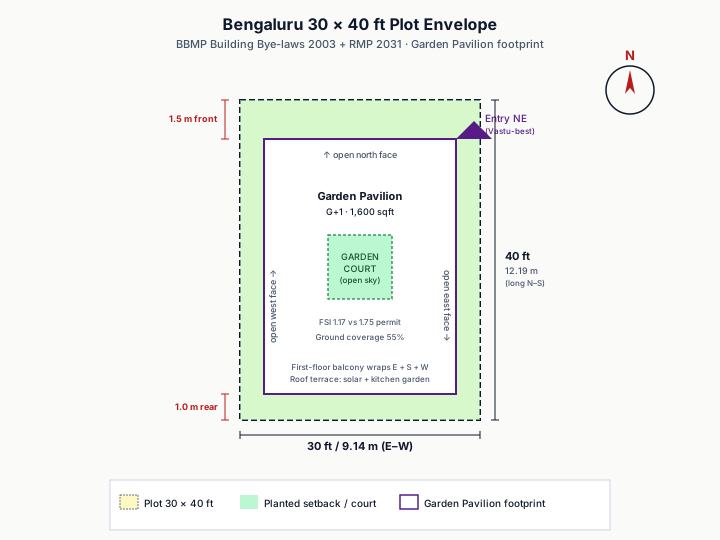
BBMP / RMP 2031 plot envelope for a 30 × 40 ft (≈ 111 sqm) Bengaluru plot
Setback, FAR, and height permitted on a typical 30 × 40 ft residential plot in Bengaluru under BBMP Building Bye-laws 2003 + RMP 2031. Verify against current zonal notification for your plot before sanction.
| Parameter | BBMP / RMP 2031 (Residential Main) | This Plan (Garden Pavilion) |
|---|---|---|
| Plot area | 100–240 sqm band, < 9 m road | 111 sqm (1200 sqft) |
| Permissible FAR | 1.75 | 1.17 (well under limit) |
| Ground coverage | 65% max | 55% achieved |
| Front setback | 1.5 m (≤ 9 m road) | 1.8 m (verandah + planted strip) |
| Rear setback | 1.0 m | 1.2 m (utility yard + drainage) |
| Side setback (north) | 0.9 m | 1.2 m (planted strip) |
| Side setback (south) | 0.9 m | 0.9 m (parking access) |
| Building height max | 11.5 m for road < 9 m (G+3 typical) | 8.6 m (G+1 + roof terrace + pergola) |
| Sun-shade / chajja projection | 0.6 m over setback, 2.4 m clearance | Compliant |
RMP 2031 height-coupling supplement (setback ≥ height ÷ 5) applies on buildings above the height threshold — at G+1 with 8.6 m total, the supplement (8.6 ÷ 5 = 1.72 m) is non-binding against the matrix front-setback floor.
Bengaluru temperate-climate strategy summary
How the Garden Pavilion envelope responds to Bengaluru's two monsoons and overall mild profile. The pattern is opposite of hot-dry: open up, plant generously, design lightly.
| Season | Climate Reality | Design Response | Cost Driver |
|---|---|---|---|
| Pre-monsoon (Mar–May) | 24–32 °C; clear, gentle heat | Three open faces; verandahs shade ground floor | (no premium — climate-permitted) |
| SW monsoon (Jun–Sep) | 22–28 °C; 700 mm rain | Mangalore tile roof; deep eaves; lime mortar (anti-fungal) | Mangalore tile + eaves carpentry |
| NE monsoon (Oct–Nov) | 20–26 °C; 280 mm rain; humid | Same as above; planted garden court watered by rain | (same) |
| Winter (Dec–Feb) | 16–22 °C; cool clear | Single glaze sufficient; no heater needed; light shawl in morning | (no premium) |
Bengaluru's climate is so balanced that air-conditioning is functionally unnecessary in a well-designed home. The dominant comfort strategy is cross-ventilation + ceiling fan + the central garden court for evaporative cooling on the rare hot day.
Bengaluru 2026 cost band — 1600 sqft built-up Garden Pavilion
Per-sqft and total cost for the Garden Pavilion plan at three finish tiers, indicative for 2026 Bengaluru labour and material market. Pune ~5% higher, Hyderabad ~5% lower for the same plan.
| Tier | ₹/sqft | Total (₹ L) | Inclusions |
|---|---|---|---|
| Basic | 2,200 | 35.2 | Fly-ash brick + lime, vitrified tile, jackwood frames, 6 mm single glaze, basic balcony planters |
| Recommended | 2,600 | 41.6 | Fly-ash + lime, terracotta + Indian green marble first floor, teak frames, balcony herb spiral, 3 kWp solar |
| Premium | 3,000 | 48.0 | Premium teak frames, kota stone selectively, shower garden, 5 kWp solar, automated rain-guard screens, EV charger |
Bengaluru's labour premium (~₹100/sqft over Bhopal / Nagpur) reflects the skilled-trade market for teak / jackwood frame work, Mangalore tile roofing, and the city's general construction-quality expectation in newer BDA / BMRDA layouts.
Bengaluru-specific construction overlays
Beyond standard BBMP sanction, five Bengaluru-specific overlays affect a 30 × 40 ft project. Lake-buffer + tree-preservation are the two that most often delay 30 × 40 ft projects.
| Overlay | Authority | When triggered | Architect action |
|---|---|---|---|
| Lake-buffer + valley zone | KTCDA + BBMP RMP 2031 GIS | Plots within 75 m of notified lake | Pre-design BDA RMP layer query (not on Khata) |
| Tree-felling permission | BBMP + Forest Department | Any existing tree ≥ 250 mm girth on plot | Online application 30–60 days before sanction |
| BWSSB water + sewer connection | Bangalore Water Supply | All new constructions | Apply at sanction stage; meter install at OC |
| BESCOM solar net-metering | Bangalore Electricity Supply | Solar PV install | Pre-install application 4–8 weeks before |
| Heritage / Cubbon-precinct facade | BBMP heritage cell + INTACH | Plots in core heritage zones | Facade approval pre-sanction; 2–6 month process |
Bengaluru's lake-buffer overlay is the silent disqualifier — the Khata does not flag overlays, and the architect must initiate the BBMP RMP 2031 GIS layer query at concept-design stage to confirm plot eligibility. See the city's full setback entry for the lake-buffer detail.
The working reference, in full
A 30 × 40 ft (≈ 111 sqm) plot is the most common middle-class residential allocation across Bengaluru's BBMP, BDA, and outer-BMRDA layouts — from older neighbourhoods like Malleshwaram and Jayanagar to newer BDA layouts like Banashankari and the post-2000 plotted layouts in HSR, Sarjapur, Whitefield, Hennur, and Yelahanka. Building on this plot is governed by the Karnataka Town and Country Planning Act 1961, the BBMP Building Bye-laws 2003, and the Revised Master Plan 2031 (RMP 2031). The right design question for any Bengaluru plot is not how do I keep the climate out? — it is how do I trust the climate to do the work?
The Bengaluru climate gift — and why most builders miss it
Bengaluru sits squarely in the temperate climate zone per NBC 2016 / SP 41 (BIS, 1987) at 920 m elevation on the Deccan plateau. Annual mean temperature 23 °C. Two monsoons (SW from June + NE from October). Summer maxes rarely exceed 32 °C; winter minimums rarely drop below 16 °C. This is the only Indian climate where you can design lightly and have it work all year. The problem is that most Bengaluru construction imports Mumbai detailing (heavy, sealed, AC-dependent — wrong climate) or Chennai detailing (warm-humid, low overhang — wrong rainfall pattern). The Garden Pavilion is a permission slip to design for what Bengaluru actually is.
The Garden Pavilion plan — climate response, summarised
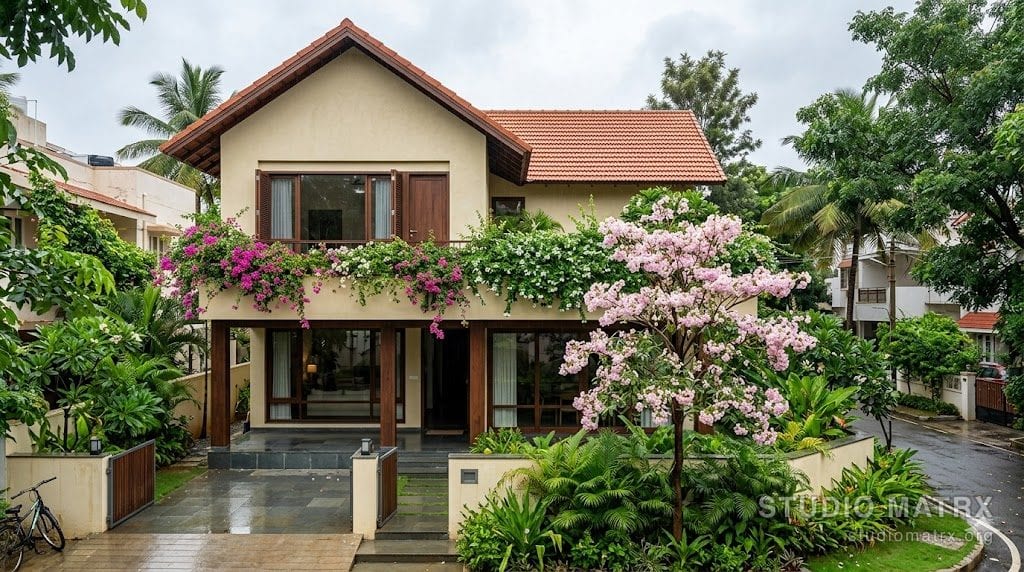
The Garden Pavilion is a 30 × 40 ft, G+1, 3 BHK plan oriented with the long axis north-south so the long facades face east + west, with three open building faces (E, N, W) carrying full-height openings, a central planted ground-floor garden court open to sky (8 × 8 ft), a wrap-around first-floor balcony with a herb spiral on the south parapet edge and a flower cascade on the west, and a productive roof terrace with tomato / brinjal / banana / lemon plus 3 kWp solar PV. The envelope is intentionally light — fly-ash brick + lime render — because the climate doesn't ask for insulation. Full plan with floor schedules and materials.
FAR + setback compliance on a Bengaluru 30 × 40 ft plot
BBMP Building Bye-laws 2003 + RMP 2031 permits an FAR of 1.75 on residential plots ≤ 240 sqm with a road width below 9 m — the typical 30 × 40 ft scenario. The Garden Pavilion uses an FAR of 1.17 — substantial 0.58 FAR headroom for a future extension or a roof gazebo. Ground coverage 55% (against the 65% ceiling); 45% of the plot reserved for planted setbacks, central garden court, and the front + side planted strips. The plan satisfies the standard setback matrix (1.5 m front, 1.0 m rear, 0.9 m sides) generously, with the planted strip widths extended to 1.2 m on the north and west. See the Bengaluru setback entry for the multi-row matrix, height-coupling, and overlay logic.
Cost realities — Bengaluru 2026
A 1,600 sqft built-up Garden Pavilion comes in at ₹35.2 L (basic) to ₹48.0 L (premium) in Bengaluru 2026 prices. The largest single cost driver is teak / jackwood window frames + Mangalore tile roof on verandahs over the equivalent UPVC + flat-RCC alternative — adding ₹270/sqft (~₹4.3 L). This is the climate-fidelity premium: the right materials for the temperate-Bengaluru typology, vs. the wrong ones for a sealed Mumbai-import build. Lifecycle pays back fast: a Garden Pavilion at ₹41.6 L with zero AC + zero net electricity bill (3 kWp solar) is cheaper over 25 years than a sealed glass-box at ₹28 L with ₹35,000/year AC + grid electricity. Bengaluru's labour premium (~₹100/sqft over Bhopal) is real but pays back via construction quality + faster build timeline.
Vastu in Bengaluru — NE entry, climate-positive
Bengaluru homebuyers care about Vastu but accept climate-driven adjustments more readily than in north Indian cities. The Garden Pavilion's NE entry is the most Vastu-auspicious orientation per Mayamatam and Manasara traditions, and is also climate-positive (NE catches morning sun + cool SW monsoon wind hits the rear rather than the entry). Kitchen at SW is an acceptable variant (orthodox prefers SE but SE is the master balcony); the burner is placed facing east on the platform to mitigate. Pooja niche NE — exact Vastu fit. The plan is rated Excellent by the Vastu Compliance Checker.
Lake-buffer and tree-preservation — the two pre-sanction filters
Bengaluru's two silent regulatory disqualifiers are the KTCDA lake-buffer overlay and the BBMP tree-preservation mandate. The lake-buffer applies if any part of the plot sits within 75 m of a notified lake (Bengaluru has 200+ notified lakes within BBMP limits). The 0–30 m strip is zero-construction; 30–75 m carries supplemental setbacks of 1.5–3.0 m beyond the standard matrix. Neither the A-Khata nor the e-Aasthi flags the overlay — the architect must run the BDA RMP 2031 GIS query at concept-design stage. Tree-preservation: any tree on the plot with girth ≥ 250 mm requires Forest Department clearance to fell — a 30–60 day online process. Both filters are non-negotiable. See the Bengaluru setback entry for the full lake-buffer table.
Solar + rainwater — the two passive systems that pay back
BBMP mandates rainwater harvesting on plots ≥ 60 sqm — the 30 × 40 ft plot is well over threshold. The plan integrates a 5,000-litre underground tank fed by the sloped terrace's two internal downpipes, with overflow to a soak pit. Cost ₹50,000–₹1.5 L depending on tank, plumbing run, and soak-pit detail. Solar PV: Bengaluru's 12 kWh/day-per-kWp yield (annual average) makes 3 kWp the economic sweet spot for a 3-person family — net-metering through BESCOM brings the electricity bill to near zero. Install cost ₹1.8–₹2.4 L for 3 kWp turnkey; payback 4–6 years; 25-year system life. See Solar Power for Homes India for sizing.
Buildability — what to verify before the contractor breaks ground
Bengaluru soil is typically red murum at 150–200 kPa bearing capacity — straightforward foundations. Some peripheral areas (HSR Layout valley pockets, parts of Sarjapur) have clay-loam soils that may need extended footings; soil testing (₹15,000–₹35,000) is mandatory regardless. BBMP plan sanction via Sakala portal: 30–60 days for clean submissions; longer if lake-buffer or tree-felling clearance is in scope. Construction timeline: 12–16 months for the Garden Pavilion (foundation through OC). BWSSB connection 4–8 weeks at sanction; BESCOM solar net-metering 6–10 weeks. See the full plan page for the buildability checklist.
Common pitfalls
- Treating Bengaluru like Mumbai — sealed glass-box detailing wastes the climate gift and condemns the family to AC dependency they don't need.
- Flat RCC roof without provision for terrace + solar — the terrace becomes inaccessible dead-weight; sloped Mangalore tile on verandahs + flat usable RCC on main roof is the right mix.
- Skipping lake-buffer query — the Khata doesn't flag it; missing it means rejection at sanction or worse, demolition at plinth verification.
- Felling existing trees without Forest Department clearance — Bengaluru BBMP has prosecuted for unpermitted felling; the design preserves what's there.
- Single-glaze on east + west without overhang depth audit — Bengaluru's afternoon western sun is mild but persistent; 600 mm overhang or jaali on the west is non-negotiable.
- Under-sizing rainwater tank for the 980 mm annual rainfall — 5,000 litres is the practical minimum; smaller tanks overflow and waste the resource.
Frequently asked questions
›What is the maximum FAR allowed on a 30 × 40 ft plot in Bengaluru?
›Can a 30 × 40 ft Bengaluru home avoid air-conditioning entirely?
›Is the planted garden court a fire / structural risk?
›Does BBMP require a separate solar / EV-ready installation at sanction?
›How do I check if my Bengaluru plot is in a lake-buffer or valley zone?
›What is the timeline from purchase to occupancy on a Bengaluru 30 × 40 ft Garden Pavilion?
Sources & references
Karnataka Town and Country Planning Act, 1961
Act No. 11 of 1963, as amended; Sections 14A, 17, 76 governing master-plan dimensional controls
BBMP Building Bye-laws 2003
Bruhat Bengaluru Mahanagara Palike, Building Bye-laws 2003 (as amended), Schedules I–V
Revised Master Plan 2031 (RMP 2031)
Bangalore Development Authority, RMP 2031 — Volume II Zoning Regulations and Volume III Land Use Plan
Karnataka Tank Conservation and Development Authority (KTCDA) Act, 2014
Act No. 41 of 2014 — lake-buffer + supplemental setbacks within notified tank areas
National Building Code of India 2016
Bureau of Indian Standards, NBC 2016 — Volume 1 Part 3 Development Control Rules and General Building Requirements
SP 41 — Handbook on Functional Requirements of Buildings
Bureau of Indian Standards, SP 41 (1987) — Climate Zone Map of India
ECBC Residential — Eco-Niwas Samhita 2018
Bureau of Energy Efficiency, Government of India, ECBC Residential 2018
Karnataka Sakala Services Act, 2011
BBMP plan-sanction service timelines and escalation framework
Disclaimer: Regulatory rates and dimensional rules change frequently and may be modified by mid-year notifications. Values reflect the framework as of 2026-05-15; verify against the current authority notification before any specific filing. This page is informational and is not legal or planning advice — engage a registered architect and a qualified planning consultant for project-specific compliance.
Related guides from the library
The companion deep-dives that practising architects keep alongside this reference.
Passive Design Strategies for Indian Climate Zones
A Climate-Zone-by-Zone Working Reference for Indian Architects
24 min read · Open SustainabilitySustainable Home Design in India
A Practical Guide to Climate, Craft, and Conscience in the Indian Home
15 min read · Open Design StylesVastu Shastra for Modern Homes
A Scientific Approach — Directions, Room Planning, Colours & Architect's Guide
26 min read · Open Room PlanningCross Ventilation in Indian Homes
Science, Physics, and Planning — A Professional Guide for Architects
28 min read · Open SustainabilityRainwater Harvesting for Indian Urban Homes
A Complete Guide — Design, Regulations, Costs & ROI
22 min read · Open SustainabilitySolar Power for Homes
ROI, Feasibility & the Indian Home Architecture Imperative
22 min read · OpenCompare across cities
The same House Plan 30×40 topic, different regulatory frameworks, different city quirks. Architects practising across metros should bookmark the adjacent reference.
House Plan 30×40 in Mumbai
Development Control and Promotion Regulations 2034 (DCPR 2034)
Open DDA · Delhi (NCT)House Plan 30×40 in Delhi
Master Plan for Delhi 2021 (MPD 2021) + Unified Building Bye-laws 2016
Open CMDA · Tamil NaduHouse Plan 30×40 in Chennai
Tamil Nadu Combined Development & Building Rules 2019 (TNCDBR 2019)
Open HMDA · TelanganaHouse Plan 30×40 in Hyderabad
Telangana Building Rules 2012 + GO Ms No. 168
OpenWhich 30 × 40 ft House Plan is Right for You
A Climate-Zone Decision Framework for Indian Homeowners — Across Six Zones, Six Typologies, One Plot Size
Read the deep-dive Bengaluru compliance mapThe Architect's Compliance Map — Bengaluru
BBMP, BDA, BMRDA, BWSSB, BESCOM, Karnataka RERA, KSPCB — the Permit Chain, Khata Disambiguation, and the Operational Workflow for Residential Practice in 2026
Read the city map