
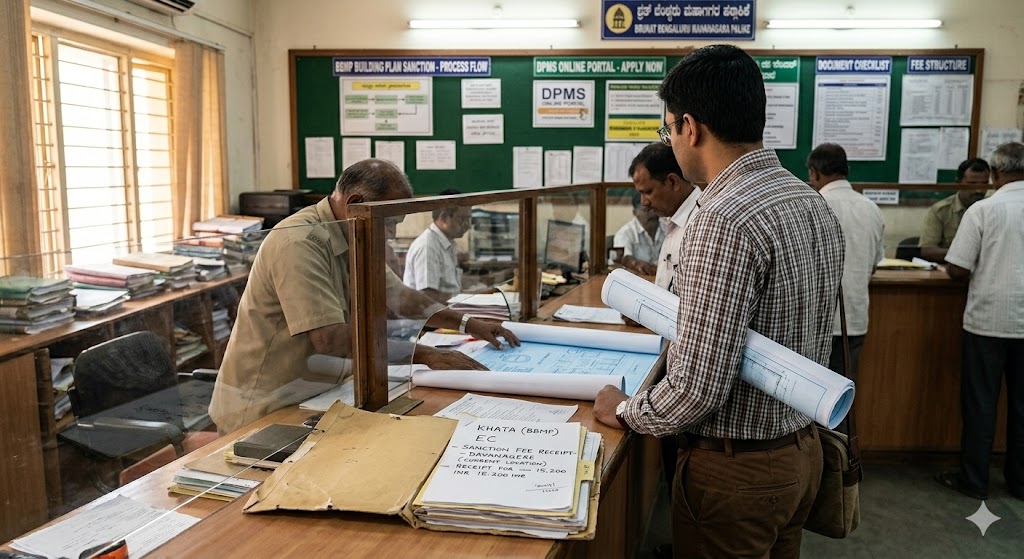
Building Plan Approval Process in India
State-Wise Guide — BBMP, BMC, CMDA, GHMC, MCD, PMC & 14 More Cities
Building plan approval is the single most bureaucratic step in the house-building journey — and also the most critical. Without an approved plan, you cannot legally start construction, get utility connections, obtain an Occupancy Certificate, sell the property, or get a home loan against it.
India's building plan approval system has improved dramatically in the last decade. Most major cities now have online submission portals with automated bylaw checking (AutoDCR, eBPAS). Hyderabad's TS-bPASS even offers auto-approval within 21 days for plots under 500 sq.m. Yet the process remains confusing — every state has its own rules, every city has its own portal, and the documentation requirements vary significantly.
This guide covers the complete building plan approval process — from documents to submission to sanctions — for 20+ major Indian cities, with portal links, fee structures, bylaw summaries, and tips for avoiding the most common rejection reasons.
The General Approval Process
While each city has its own portal and specific rules, the overall process follows a common structure: documents → drawings → online submission → scrutiny + NOCs → fees → sanction.
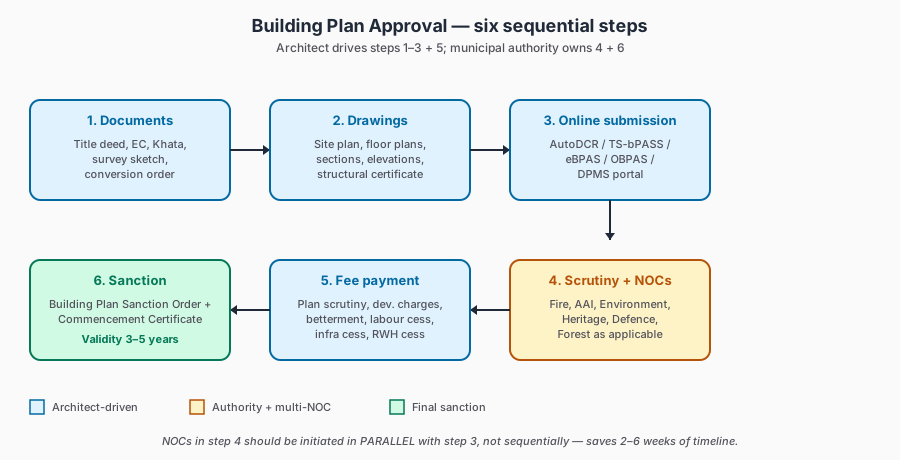
The six steps are sequential at the architect-side hand-offs but the NOCs in step 4 should be initiated in parallel with step 3 — sequencing them serially adds 2–6 weeks of dead waiting time.
Step 1: Document Collection
Before approaching the planning authority, gather:
| Document | Source | Purpose |
|---|---|---|
| Title deed (Sale deed / Gift deed) | Sub-Registrar | Proves ownership |
| Encumbrance Certificate (EC) | Sub-Registrar (30 years) | Proves property is free of encumbrances |
| Khata Certificate & Extract | Municipal body | Proves property is in municipal records |
| Tax paid receipts | Municipal body | Property tax up to date |
| Survey sketch / Tippan | Survey department | Actual site dimensions |
| Land use certificate | Revenue / Development authority | Confirms residential zoning |
| Conversion order | Deputy Commissioner (if agricultural land) | Proves land conversion to non-agricultural |
| Layout approval | Development authority (BDA, DTCP, etc.) | If plot is in an approved layout |
| NOC from apartment association | Applicable if in a group housing | Permission for modifications |
Step 2: Architectural Drawing Preparation
Your architect prepares the following drawings for submission:
| Drawing | What It Shows |
|---|---|
| Site plan | Plot boundaries, setbacks, parking, access road, north direction |
| Floor plans | Room layouts for each floor with dimensions, door/window positions |
| Sections | Vertical cut through the building showing floor heights, staircase, foundation |
| Elevations | Front, rear, and side views of the building |
| Setback plan | Required setbacks marked on the site plan |
| Parking plan | Car parking spaces as per bylaws |
| Drainage plan | Rainwater harvesting, sewage, and stormwater drainage |
| Service plan | Water supply, septic tank / STP, borewell (if applicable) |
| Structural stability certificate | From a licensed structural engineer |
Step 3: Online Submission
Most cities now accept online submission through their respective portals:
| System | Technology | Cities |
|---|---|---|
| AutoDCR | Automated Development Control Rules checking | Pune, Nagpur, many Maharashtra cities |
| eBPAS | Electronic Building Plan Approval System | Karnataka (BBMP, BDA) |
| TS-bPASS | Telangana State Building Permission Approval and Self-Certification System | Hyderabad, all Telangana |
| OBPAS | Online Building Plan Approval System | Multiple states |
| DPMS | Development Permission Management System | Tamil Nadu (CMDA, DTCP) |
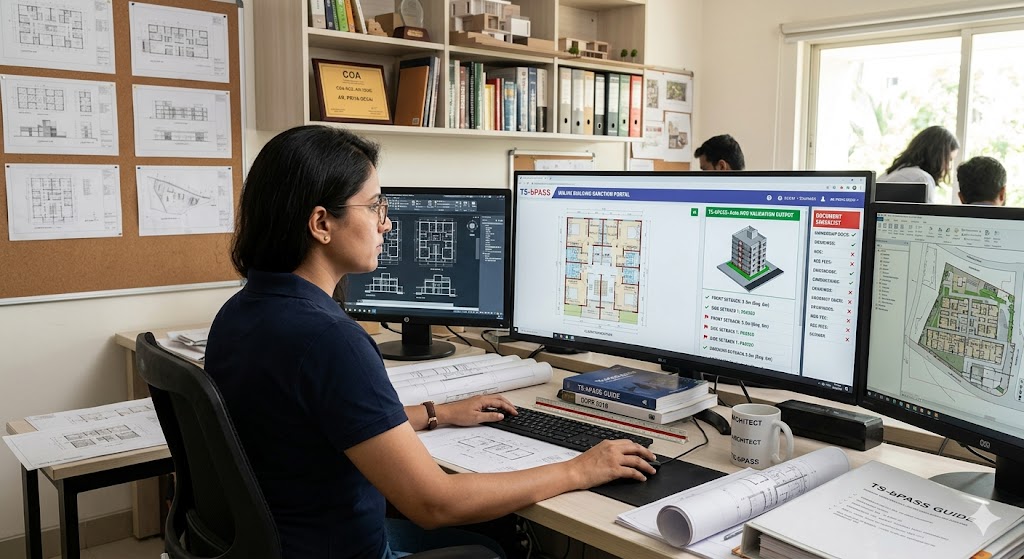
The architect is the registered submitter on every online sanction portal — the digital signature on the upload carries professional liability through any subsequent audit.
Step 4: Scrutiny & NOCs
| NOC | When Required | Authority |
|---|---|---|
| Fire NOC | G+3 and above, or area >500 sqm in many states | State Fire Department |
| Airport / AAI NOC | Within airport funnel zone (height restriction) | Airports Authority of India |
| Environmental NOC | Near eco-sensitive zones, wetlands, or above threshold area | State Pollution Control Board |
| Heritage NOC | Near heritage structures (100m in some states) | Archaeological Survey / State Heritage Dept |
| Defence NOC | Near cantonment or defence installations | Ministry of Defence |
| Traffic NOC | Large commercial or institutional projects | Traffic Police / Transport Dept |
| Forest NOC | Near forest land | Forest Department |
Step 5: Fee Payment
Fees vary by city, zone, and built-up area. Common components:
| Fee Component | Typical Range | Basis |
|---|---|---|
| Plan scrutiny fee | ₹5-25/sqft | Built-up area |
| Development charges | ₹100-500/sqft | Varies by zone and road width |
| Betterment charges | ₹50-300/sqft | Applicable in development authority areas (BDA, BMRDA) |
| Labour cess | 1% of construction cost | Building and Other Construction Workers Act |
| Infrastructure cess | Variable | Some states levy additional infrastructure charges |
| Rainwater harvesting cess | ₹5-15/sqft | If not providing RWH on site |
Step 6: Approval / Sanction
Upon successful scrutiny, the authority issues:
- Building Plan Sanction Order — the approved plan with conditions
- Commencement Certificate (CC) — permission to start construction
- Validity — typically 3-5 years (varies by state). Must be renewed if expired.
State-Wise Detailed Guide
India's plan-approval landscape is genuinely fragmented — every state runs its own portal, with materially different timelines, self-certification regimes, and audit models. The map below summarises the major platforms.
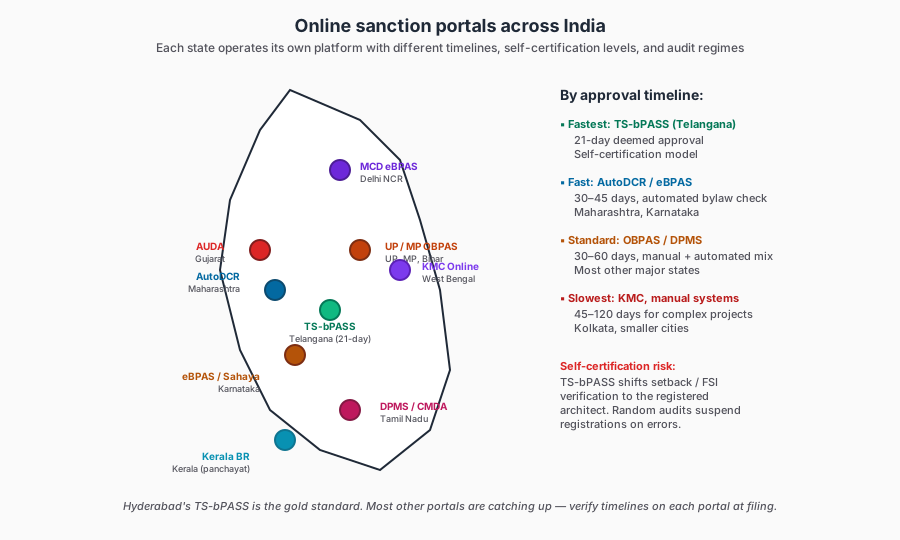
Hyderabad's TS-bPASS is the gold standard at 21-day deemed approval. Most other portals are catching up — but the architect must verify the current portal version and timeline at each filing.
Karnataka — BBMP / BDA / BMRDA
| Parameter | Details |
|---|---|
| Authority | BBMP (Bruhat Bengaluru Mahanagara Palike) for city limits; BDA (Bangalore Development Authority) for BDA layouts; BMRDA for metropolitan region |
| Portal | BBMP Sahaya — sakala.kar.nic.in; BDA online portal |
| Bylaw basis | Karnataka Revised Town Planning Rules, BBMP Building Bye-Laws 2019 |
| Typical duration | 30-45 days (online), 60-90 days (complex cases) |
| Auto-approval | Residential plots up to 2400 sqft (G+1) in some zones |
Key Bylaws — Bengaluru:
| Parameter | Regulation |
|---|---|
| FAR / FSI | 1.75 (roads <12m), 2.25 (12-18m), 2.50 (18-24m), 3.00 (24-30m), 3.25 (>30m) |
| Ground coverage | 65% (up to 2400 sqft plot), 55% (2400-4000 sqft), 50% (>4000 sqft) |
| Front setback | 3m (roads <12m), 4.5m (12-18m), 6m (18-24m), 8m (>24m) |
| Side setback | 1.5m (up to G+2), 2m (G+3), 3m (G+4 and above) |
| Rear setback | 1.5m (up to G+2), 2m (G+3 and above) |
| Height | Based on road width: road width × 1.5 + front setback (general formula) |
| Parking | 1 car space per dwelling unit (minimum). ECS = 2.5m × 5.5m |
| RWH | Mandatory for all sites ≥1200 sqft (40×30) |
| Solar | Mandatory for built-up area >1500 sqft |
Documents specific to Bengaluru:
- Khata Certificate and Extract (A-Khata for BBMP, B-Khata conversion required for BDA allotted sites)
- Betterment charges receipt (for BDA/BMRDA layouts)
- Up-to-date property tax receipt
- Conversion order (DC order) if land was agricultural
- Structural engineer's certificate
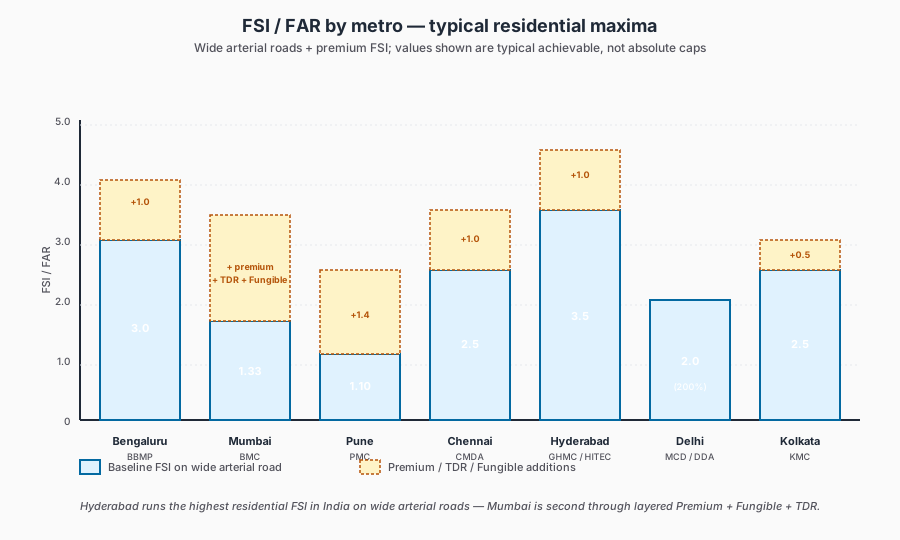
Hyderabad on the wide-arterial HITEC corridor offers the highest residential FSI in India; Mumbai's layered Premium + Fungible + TDR stack reaches similar deliverable values. Delhi's percentage-notation FAR translates to 2.0 in decimal — the architect's submission notation must match the city's bye-laws convention.
Maharashtra — BMC / PMC / NMMC
| Parameter | Details |
|---|---|
| Authority | BMC (Brihanmumbai Municipal Corporation), PMC (Pune Municipal Corporation), NMMC (Navi Mumbai), PCMC, TMC |
| Portal | AutoDCR (automated), BMC MCGM Portal |
| Bylaw basis | UDCPR 2020 (Unified Development Control and Promotion Regulations) |
| Typical duration | 30-60 days (AutoDCR), 60-120 days (manual for complex projects) |
Key Bylaws — Mumbai (BMC):
| Parameter | Regulation |
|---|---|
| FSI | 1.33 (Island city), 1.00 (Suburbs) + fungible FSI + TDR + premium FSI |
| Total permissible FSI | Can go up to 3.0-5.0 with premium FSI in some zones |
| Ground coverage | Based on plot area and FSI |
| Front setback | As per DP (Development Plan) road alignment |
| Side/Rear margin | Based on building height (1/5th of height or minimum 3m) |
| Parking | Based on use and area — 1 per 100 sqm for residential |
| RWH | Mandatory for plot area >1000 sqm |
Key Bylaws — Pune (PMC):
| Parameter | Regulation |
|---|---|
| FSI | 1.10 (general), 1.50 (congested areas), up to 2.50 with TDR and premium |
| Ground coverage | 40-50% depending on plot area |
| Front setback | 3m (roads <9m), 4.5m (9-12m), 6m (12-18m) |
| Side setback | 1.5m minimum (increases with height) |
| RWH | Mandatory for plot >500 sqm |
Tamil Nadu — CMDA / DTCP / GCC
| Parameter | Details |
|---|---|
| Authority | CMDA (Chennai Metropolitan Development Authority), DTCP (Directorate of Town and Country Planning), GCC (Greater Chennai Corporation) |
| Portal | CMDA Online (cmda.tn.gov.in), DTCP Online |
| Bylaw basis | Tamil Nadu Combined Development and Building Rules, 2019 (TNCDBR) |
| Typical duration | 30-45 days (online), 60-90 days (manual) |
Key Bylaws — Chennai:
| Parameter | Regulation |
|---|---|
| FSI | 1.50 (roads <18.3m), 2.00 (18.3-30.5m), 2.50 (>30.5m) |
| Ground coverage | Residential: 55% (roads <9.15m), 50% (9.15-18.3m), 45% (>18.3m) |
| Front setback | 1.5m (roads <7.3m), 2.4m (7.3-9.15m), 3m (9.15-12.2m), 4.5m (>12.2m) |
| Side setback | 1m minimum (up to 7m height), 1.5m (7-10m height) |
| Rear setback | 1m minimum (up to 7m height) |
| Height | 1.5 × road width + front setback |
| Parking | 1 ECS per 120 sqm of residential floor area |
| RWH | Mandatory for ALL buildings (not just new construction — existing too) |
Telangana — GHMC / HMDA
| Parameter | Details |
|---|---|
| Authority | GHMC (Greater Hyderabad Municipal Corporation), HMDA (Hyderabad Metropolitan Development Authority) |
| Portal | TS-bPASS (tsbpass.cgg.gov.in) — India's most progressive approval system |
| Bylaw basis | Telangana Building Rules 2012 (as amended) |
| Typical duration | 21 days auto-approval for plots <500 sqm (residential); 45 days for larger |
TS-bPASS — How It Works:
- Self-certification by the applicant and architect
- Building plan uploaded with digital signature
- Automated bylaw checking — instant feedback
- If no objection raised within 21 days, permission is deemed approved
- Post-approval random audit (10% of cases)
Key Bylaws — Hyderabad:
| Parameter | Regulation |
|---|---|
| FSI | 1.75 (roads <12m), 2.10 (12-18m), 2.50 (18-24m), 3.00 (24-30m) |
| Ground coverage | 65% (plot <300 sqm), 55% (300-500 sqm), 50% (>500 sqm) |
| Front setback | 3m (roads <12m), 5m (12-18m), 6m (>18m) |
| Side setback | 1.2m minimum (G+1), 1.5m (G+2), 2m (G+3+) |
| Parking | 1 ECS per 100 sqm of residential area |
| RWH | Mandatory for all plots ≥200 sqm |
Delhi — MCD / DDA / NDMC
| Parameter | Details |
|---|---|
| Authority | MCD (Municipal Corporation of Delhi), DDA (Delhi Development Authority), NDMC (New Delhi Municipal Council) |
| Portal | MCD Building Plan Portal (mcdonline.nic.in) |
| Bylaw basis | Unified Building Bye-Laws 2016, MPD-2041 (Master Plan Delhi) |
| Typical duration | 30-60 days (online submission) |
Key Bylaws — Delhi:
| Parameter | Regulation |
|---|---|
| FAR | 200 (residential, roads <24m), 250 (roads 24-30m), 300 (roads >30m) — expressed as percentage |
| Ground coverage | 50% (plot >350 sqm), 66.6% (plot <175 sqm), varies by plot size |
| Front setback | 3m (roads <13.5m), 6m (roads >13.5m) |
| Side setback | 3m (plot >500 sqm), none required for smaller plots (party wall permitted) |
| Height | 15m (roads <24m), 17.5m (24-30m), 22m (>30m) |
| Parking | 1 ECS per dwelling unit + visitor parking |
Kerala — Local Bodies
| Parameter | Details |
|---|---|
| Authority | Municipal Corporations, Municipalities, Panchayats |
| Portal | Kerala Building Rules Portal (sanction.lsgkerala.gov.in) |
| Bylaw basis | Kerala Municipality Building Rules 2019 |
| Typical duration | 30-45 days |
| Special feature | Panchayat-level approval for many residential buildings |
Key Bylaws — Kerala:
| Parameter | Regulation |
|---|---|
| FAR | 1.50 (general), 2.00 (National Highways) |
| Ground coverage | 50% (general), 60% (plots <5 cents) |
| Front setback | 3m minimum from plot boundary |
| Side setback | 1m minimum (up to 7m height), 1.5m (7-10m) |
| Height | Based on road width and zone |
| RWH | Mandatory for all buildings >100 sqm |
Other Major Cities — Quick Reference
| City | Authority | Portal | FSI | Approval Time |
|---|---|---|---|---|
| Ahmedabad | AMC / AUDA | AUDA Online | 1.2-1.8 + premium | 30-45 days |
| Kolkata | KMC / KMDA | KMC Online | 2.5-3.0 (residential) | 45-90 days |
| Jaipur | JDA / JMC | JDA Online | 1.33 (general) | 30-60 days |
| Lucknow | LDA / LMC | UP-OBPAS | 1.5-2.0 | 30-45 days |
| Chandigarh | CTP / MC | CHB Portal | 1.75 (residential) | 30-45 days |
| Bhopal | BDA / BMC | MP OBPAS | 1.25-1.75 | 30-45 days |
| Patna | PRDA / PMC | PRDA Portal | 1.5 (general) | 45-60 days |
| Kochi | GCDA / KMC | Kerala BR Portal | 1.5 (general) | 30-45 days |
| Nagpur | NMC / NIT | AutoDCR | 1.0 + TDR | 30-45 days |
| Coimbatore | CCMC / DTCP | DTCP TN | 1.5 (general) | 30-45 days |
| Visakhapatnam | GVMC / VUDA | TS-bPASS variant | 1.75 | 21-30 days |
| Indore | IMC / IDA | MP OBPAS | 1.25 (general) | 30-45 days |
| Goa | TCP Goa | TCP Portal | 1.0-1.5 | 45-90 days |
| Mysuru | MCC / MUDA | Karnataka eBPAS | 1.75 (general) | 30-45 days |
Common Reasons for Rejection
| Reason | How to Avoid |
|---|---|
| Setback violation | Double-check all setbacks against current bylaws. Bylaws change — use latest version. |
| FSI exceeded | Calculate FSI carefully. Include all floors, staircases, and common areas per local definition. |
| Incorrect land documents | Get EC for 30 years. Ensure Khata is current. Verify survey numbers match. |
| Missing NOCs | Check all applicable NOCs before submission. Airport NOC is commonly missed. |
| Drawing errors | Dimensions must match between plan and site plan. North direction must be consistent. |
| Parking shortfall | Calculate parking as per bylaws — each city has different ratios. |
| Height exceeds limit | Height is typically linked to road width. Verify road width from municipal records, not assumption. |
| Conversion not done | Agricultural land must be converted before plan submission. |
| Road width dispute | Verify actual road width from the municipal authority. Don't assume from physical measurement. |
| Structural engineer certificate missing | Mandatory for G+1 and above in most states. |
After Approval — During and Post Construction
Inspections During Construction
| Inspection | When | Authority |
|---|---|---|
| Plinth level inspection | After foundation and plinth construction | Municipal body |
| Superstructure inspection | After each slab (in some cities) | Municipal body |
| Pre-completion inspection | Before applying for Completion Certificate | Municipal body |
| Fire safety inspection | Before OC (for G+3 and above) | Fire Department |
| Electrical inspection | Before permanent electricity connection | State Electrical Inspectorate |
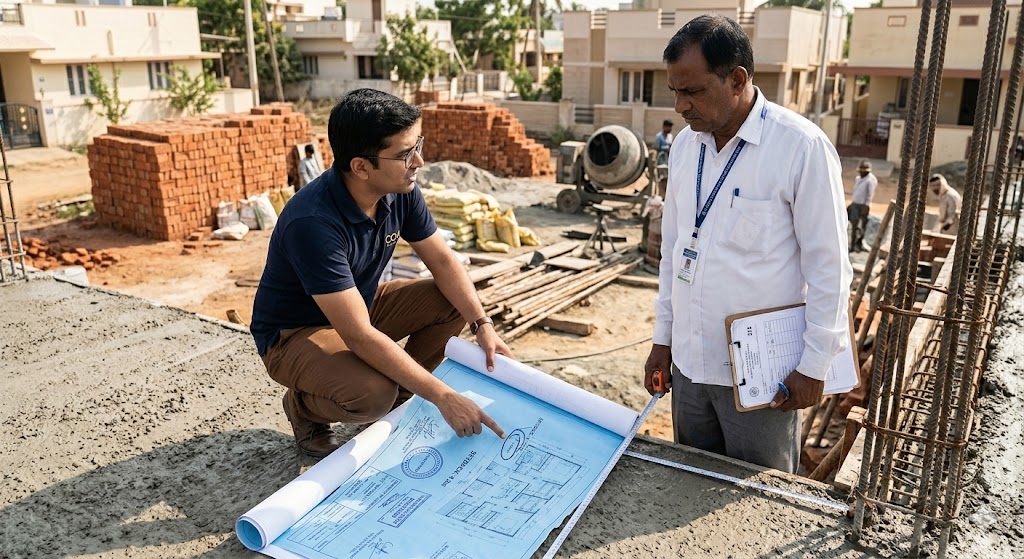
The plinth-level check is the most consequential mid-construction gate — a 100–150 mm setback discrepancy here triggers a stop-work notice that halts the project until rectification or compounding is approved.
Completion Certificate (CC) and Occupancy Certificate (OC)
| Certificate | When | What It Means |
|---|---|---|
| Completion Certificate | After construction is fully complete | Building is constructed as per approved plan |
| Occupancy Certificate (OC) | After CC + all inspections + all NOCs | Building is safe and legal for habitation |
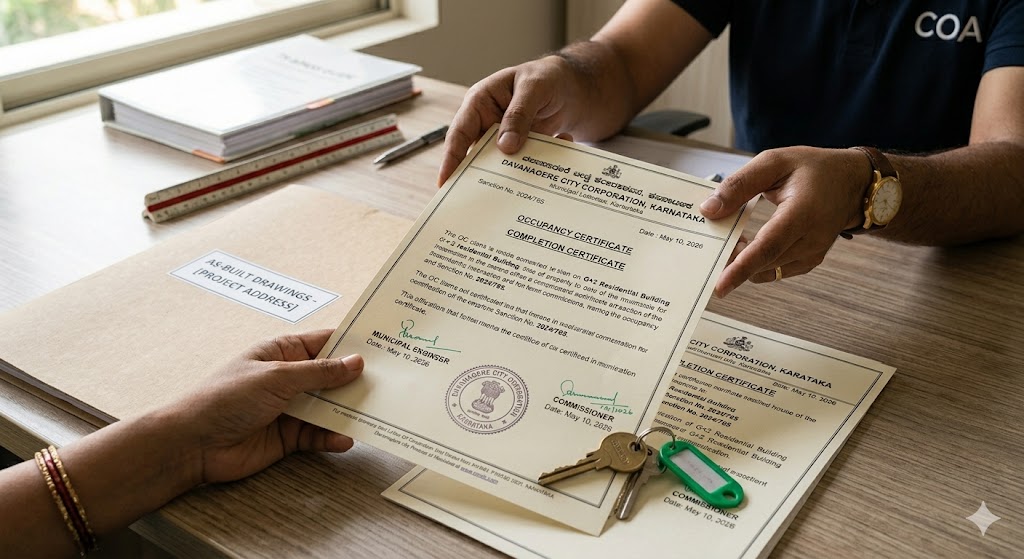
The OC is the document on which everything legal — bank loan, resale, registration, insurance, utility connections — rests. Without it, the building cannot be defended in court as legal habitation.
Documents for OC:
- Completion certificate from architect
- Structural stability certificate
- Plumbing and drainage completion
- Electrical inspection certificate
- Fire safety certificate (if applicable)
- RWH completion certificate
- Solar installation certificate (if mandatory)
- Lift safety certificate (if applicable)
- As-built drawings (if any deviations from approved plan — requires revision sanction)
Tips for Smooth Approval
1. Hire a COA-registered architect. They know the bylaws and the approval process. This alone saves months.
2. Use online portals. Avoid manual submission wherever possible. Online systems have transparent tracking.
3. Get documents right the first time. Most rejections are due to incomplete or incorrect documentation.
4. Check bylaws before designing. Don't design first and check bylaws later. Start with the bylaws as constraints.
5. Verify road width officially. Don't assume road width from physical measurement — get it from the municipal records.
6. Apply for NOCs in parallel. Don't wait for plan approval to start NOC applications. Start them simultaneously.
7. Keep copies of everything. Every submission, every receipt, every communication — maintain a project file.
8. Don't deviate from approved plan. Any deviation during construction requires a revision sanction — which is another approval cycle.
9. Budget for approval fees. Fees can range from ₹50,000 to ₹5,00,000+ depending on city, zone, and built-up area.
10. Plan for time. Allow 2-4 months for the entire approval process in your project timeline.
Penalty for Unapproved Construction
| Consequence | Details |
|---|---|
| Demolition order | Authority can order demolition of unauthorized construction |
| Fine | Heavy penalties — varies by state (₹25,000 to several lakhs) |
| No utility connections | Cannot get permanent water, electricity, gas connections |
| No OC | Without OC, the building is not legally habitable |
| No home loan | Banks will not lend against unapproved property |
| No resale | Cannot sell or register the property without OC |
| RERA non-compliance | If part of a larger project, builder faces RERA penalties |
| Criminal prosecution | In some states, unauthorized construction is a criminal offence |
Regularisation schemes are offered periodically by some states (Karnataka's Akrama-Sakrama, for example), but they are uncertain, time-bound, and involve heavy penalties. Never rely on future regularisation — get approval before construction.
Key Takeaways
- Building plan approval is legally mandatory — unapproved construction is illegal and carries severe consequences
- Every city has its own bylaws, portal, and process — verify the latest bylaws for your specific city before designing
- Online portals (AutoDCR, TS-bPASS, eBPAS) have made the process faster — use them instead of manual submission
- Hyderabad's TS-bPASS is the gold standard — 21-day deemed approval for small residential plots
- FSI, setbacks, height, and parking are the four most common rejection points — get them right in design itself
- Your architect handles the entire process — this is one of the key services you pay for
- NOCs can add 2-6 weeks each — apply in parallel, not sequentially
- Never deviate from the approved plan during construction — any change needs revision sanction
- Keep 10-15% of your timeline as buffer for the approval process
References:
- Karnataka Town and Country Planning Act, 1961
- BBMP Building Bye-Laws 2019
- Maharashtra UDCPR 2020 (Unified Development Control and Promotion Regulations)
- Tamil Nadu TNCDBR 2019 (Combined Development and Building Rules)
- Telangana Building Rules 2012 (as amended)
- Delhi Unified Building Bye-Laws 2016
- Master Plan Delhi 2041
- Kerala Municipality Building Rules 2019
- National Building Code of India (NBC) 2016, Part 3 — Development Control Rules
- Hyderabad TS-bPASS — tsbpass.cgg.gov.in
- BBMP Sahaya Portal — sakala.kar.nic.in
- BMC MCGM Portal — mcgm.gov.in
- CMDA Online — cmda.tn.gov.in
- AutoDCR — Maharashtra automated building plan approval
- Ministry of Housing and Urban Affairs — Model Building Bye-Laws 2016
Export this guide
Related Guides — Deep-dive reading
Common Approval Mistakes That Delay Projects in India
The avoidable errors that stall building-plan sanction and possession, and how first-time builders can sidestep each one
Building Regulations & ComplianceBuilding Plan Sanction Process, Step by Step (India) (2026)
Before a single brick is laid, your house plan must be approved by the local authority. Here is who prepares it, what documents it needs, how it is submitted and scrutinised, and what a sanctioned plan actually buys you.
Building RegulationsGram Panchayat Building Approval in India: Rural and Peri-Urban Permissions, and the Unapproved-Layout Trap (2026)
How a home permission works outside municipal limits - who approves in a gram panchayat, the documents and process, and how to tell a genuine panchayat plot from an unapproved layout sold as "panchayat approved".
Building RegulationsRelated Tools — Try Free
Property Tax Calculator — 10 Indian Cities
Estimate annual municipal property tax across BBMP / MCD / MCGM / GHMC / GCC / KMC / PMC / AMC / TMC / PCMC — with self-occupied, tenanted, and age-rebate adjustments.
Property TaxBuilding Bylaw Checker
Check FAR, setbacks, and height limits for 12 Indian cities (BBMP, CMDA, BMC, DDA, and more).
ArchitectAIRainwater Tank Sizer
How big should your rainwater tank be? Computes annual harvest, recommended tank capacity in litres, water-bill savings, and payback — for 10 Indian cities.
RWH Calculator