
Verandah Pavilion — 30 × 40 ft Warm-Humid Home
1200 sq ft plot · G+1 · 3 BHK · Mangaluru · Kochi · Goa · Visakhapatnam
Plot
40 × 30 ft
1200 sqft
Built-up
1400 sqft
G+1
Config
3 BHK
2 bath
Facing
SE
Vastu: good
Strategy
Verandah-led
Predominantly natural/local
Cost
₹28–39 L
₹2,000–2,800/sqft
Suits: Mangaluru · Udupi · Kochi · Thrissur · Calicut · Mapusa · Panaji · Visakhapatnam · Ratnagiri
Climate zone — Warm-Humid: Year-round humidity, monsoon-heavy, moderate temperature range. Verandahs, deep overhangs, cross-ventilation, raised plinths and roof pitch.
Interactive Floor Plan · 40 × 30 ft · 1200 sq.ft plot
Verandah Pavilion — 30 × 40 ft Warm-Humid Home
Ground floor · 760 sq ft built + 200 sq ft verandah
A 1200 sq ft plot in the warm-humid zone has the opposite design problem of the hot-dry zone: the building isn't fighting heat, it's fighting humidity, rain, and the mould that follows them. Mangaluru sees 3,500 mm of rain a year. Kochi sees 3,000 mm. Goa sees 2,900 mm. For four months — June to September — most of that arrives in horizontal sheets pushed by 40 km/h monsoon winds.
The Indian warm-humid vernacular — the Kerala nalukettu, the Mangalore house with double verandah, the Goa villa — answers this with three moves: a deep wraparound verandah that lets you live partly outdoors even in monsoon, a steep pitched roof with 2 ft overhangs that throws water clear of the walls, and a raised plinth that keeps the floor 18–24 inches above ground for monsoon flood lines. This design ports those moves into a contemporary 30 × 40 ft, 3 BHK G+1 plan.
Site & Orientation
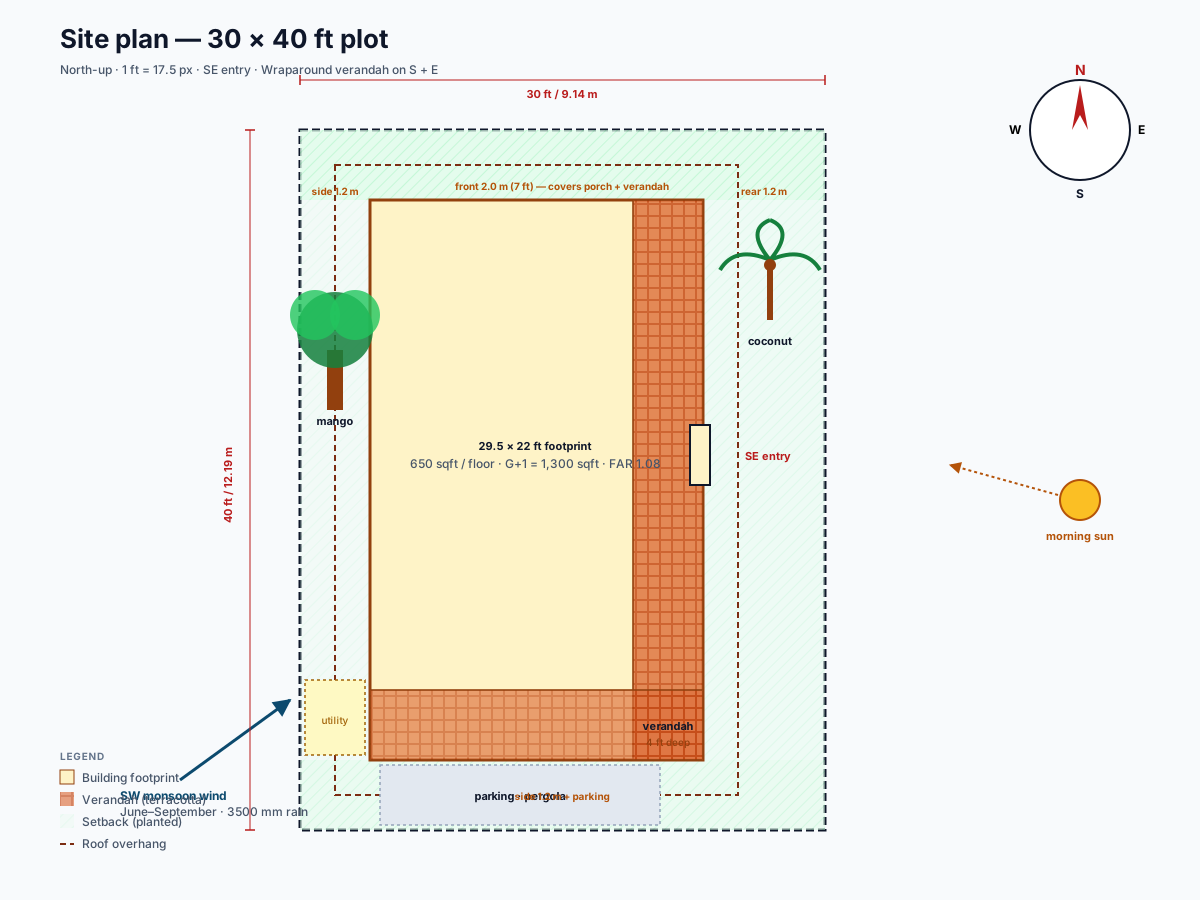
The plot is 30 ft wide × 40 ft deep, again with the long dimension east-west. Entry is on the south-east — catches the prevailing south-west monsoon breeze as it curves around the building, and aligns with Vastu's "auspicious south-east entry with mitigation" reading.
Setbacks (per Mangaluru City Corporation DCPRMC 2017 for plots ≤ 150 sqm):
| Setback | Required | This Design |
|---|---|---|
| Front (south-east) | 1.5 m | 2.0 m (porch + verandah extension) |
| Rear (north-west) | 1.0 m | 1.2 m (utility yard) |
| Side (north-east) | 0.9 m | 1.2 m (planted strip + tree) |
| Side (south-west) | 0.9 m | 1.2 m (parking + green buffer) |
Buildable: (40 − 6.5 − 4) × (30 − 4 − 4) = 29.5 × 22 ft ≈ 650 sqft per floor, 1,300 sqft over G+1. FAR consumed ≈ 1.08, well under DCPRMC 1.5.
Ground Floor Plan
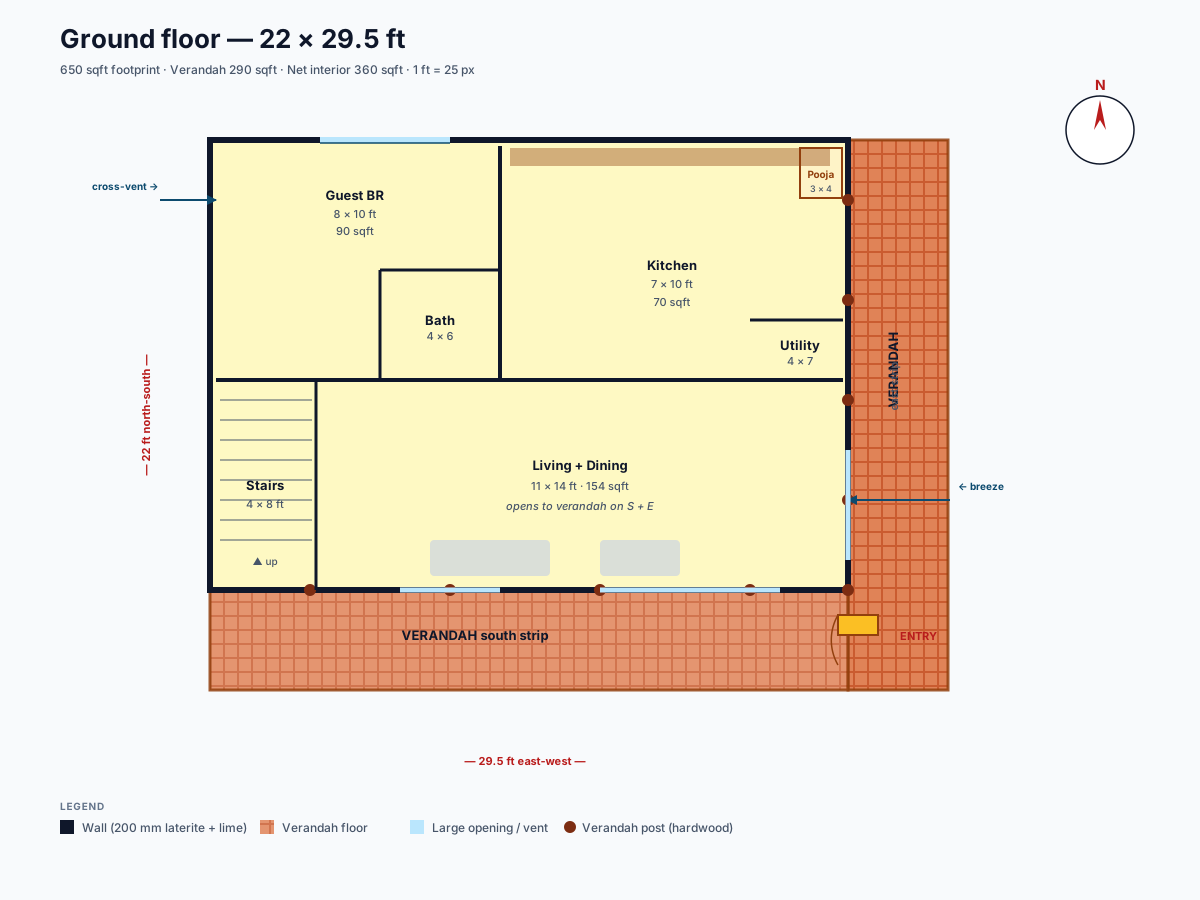
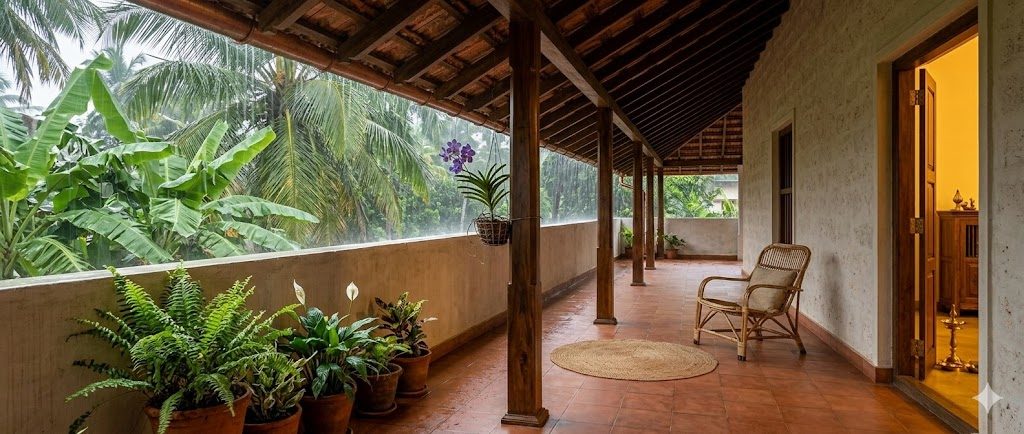
The plan organises around a wraparound verandah running the south and east faces — 4 ft deep, with terracotta tile floor, a low parapet, and timber rafters under the roof overhang. The verandah replaces what the hot-dry plan put in a central courtyard: it's the climatic + spatial heart, the place where the family actually spends most of its informal time during the long monsoon.
Room Schedule (Ground Floor)
| Space | Size | Notes |
|---|---|---|
| Wraparound verandah | 4 ft × ~80 ft run | Terracotta floor, timber posts, low parapet, planters |
| Entry foyer | 5 × 6 ft | SE corner — shoe rack, umbrella stand, jute mat |
| Living + dining | 11 × 14 ft | Single large volume, opens to verandah on E and S |
| Kitchen | 7 × 10 ft | North-east, smoke-pipe exhaust, monsoon-proof drying |
| Utility | 4 × 7 ft | Adjacent to kitchen, wash + drying |
| Guest bedroom | 8 × 10 ft | North-west corner, attached bath |
| Guest bath | 4 × 6 ft | Includes wet shower (no tub) |
| Stairs | 4 × 8 ft | South-west corner, hardwood treads |
| Pooja niche | 3 × 4 ft | NE corner; see Pooja Room Design guide |
First Floor Plan
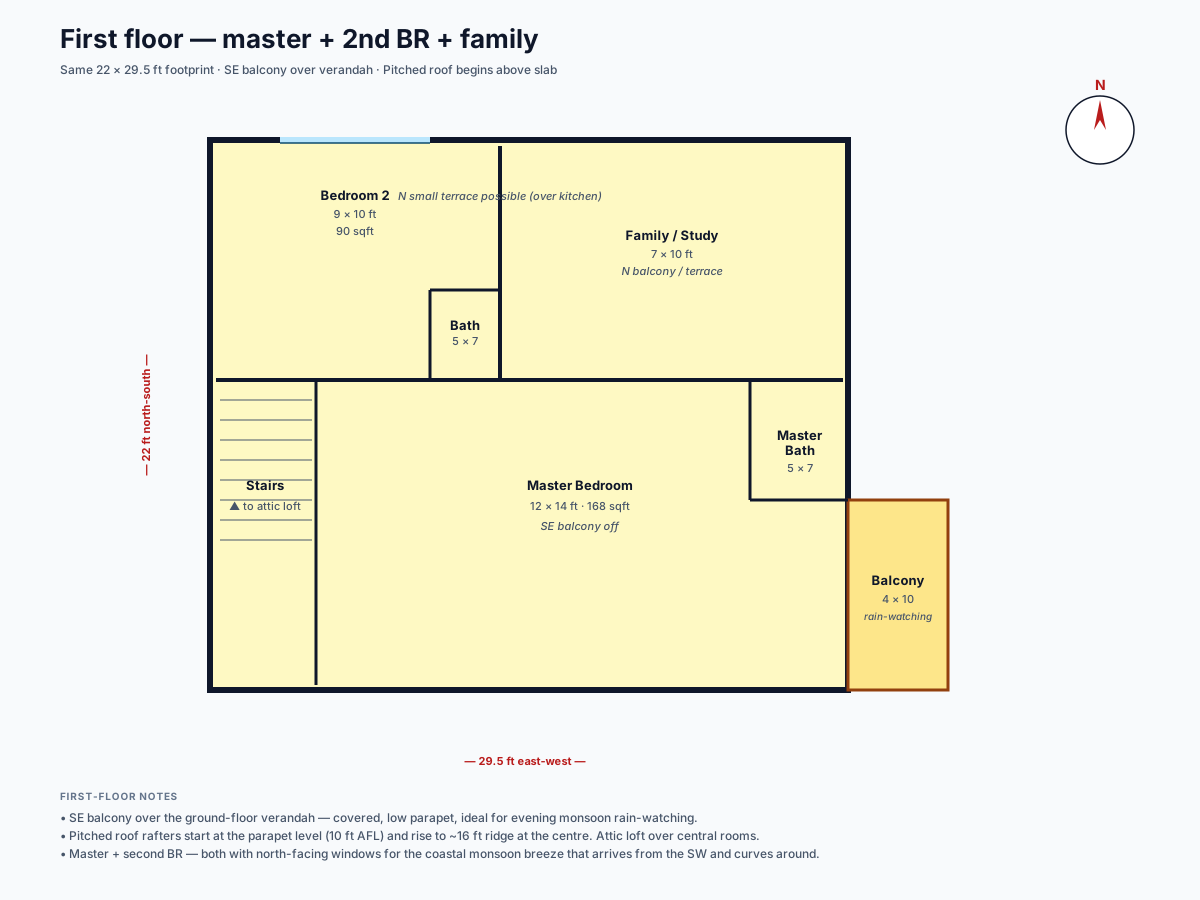
The first floor mirrors the ground but with a smaller setback for the first-floor verandah balcony on the south-east — an evening rain-watching space that is a touchstone of Mangalore and Goa houses.
| Space | Size | Notes |
|---|---|---|
| Master bedroom + attached bath | 12 × 14 ft + 5 × 7 bath | South-east, balcony off |
| First-floor verandah balcony | 4 × 10 ft | Rain-watching corner |
| Second bedroom | 9 × 10 ft | North-west, north-facing window |
| Shared bath | 5 × 7 ft | Off corridor |
| Family / study | 7 × 10 ft | North-east, opens to north balcony or terrace |
| Stairs to attic loft | 4 × 8 ft | Storage loft under pitched roof |
Facade — Street View
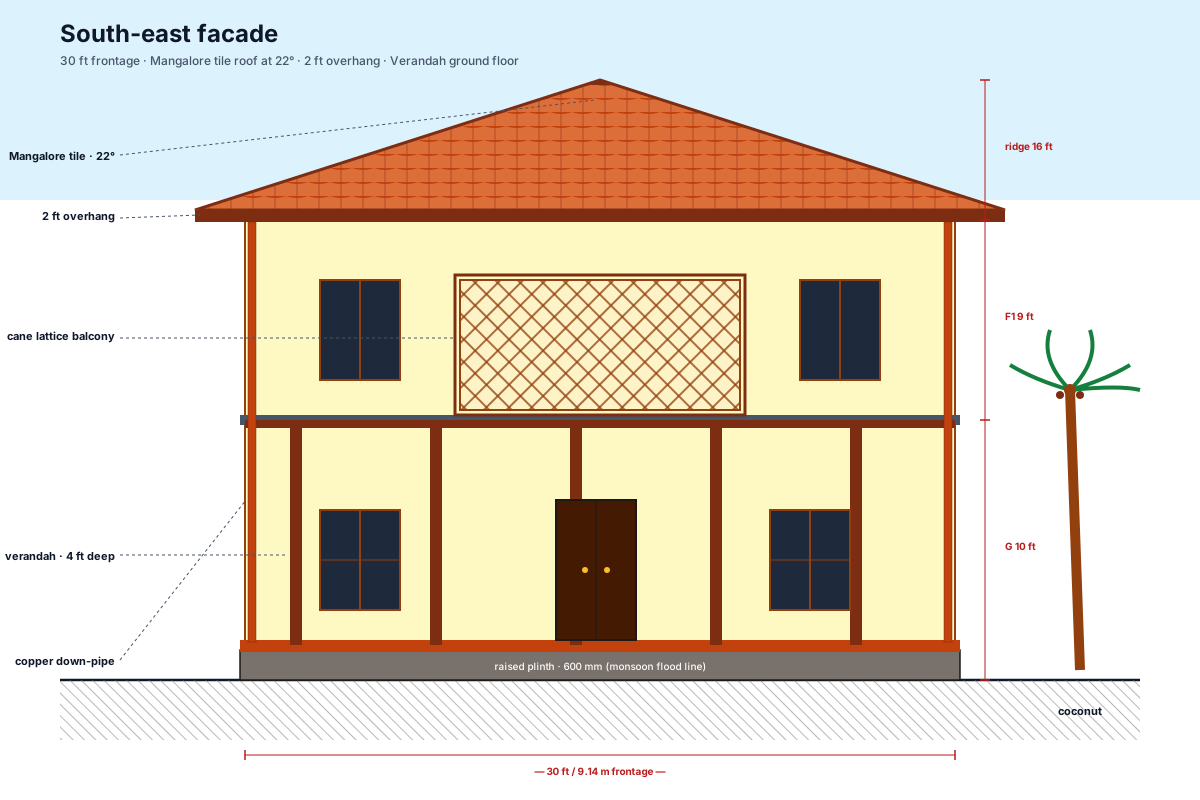
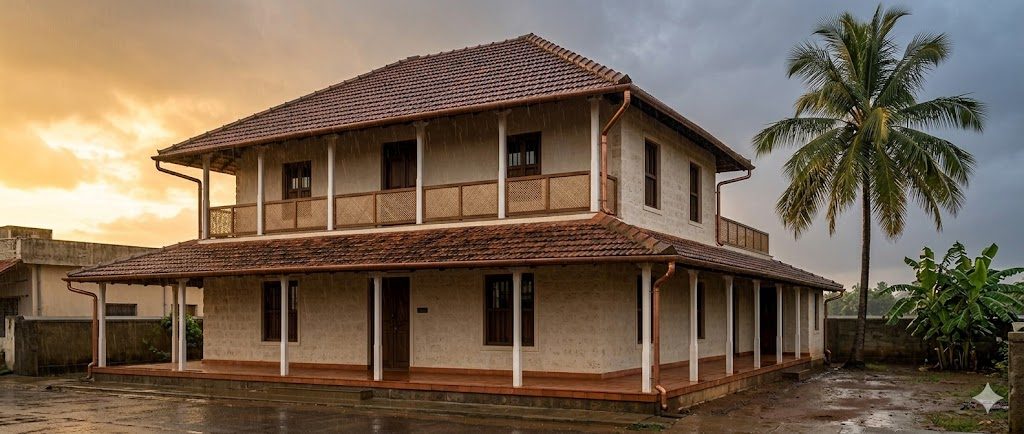
The south-east facade reads as quintessentially coastal — steep Mangalore tile roof, deep overhangs, wraparound verandah, white-washed laterite walls. The composition is restrained, with the natural materials and the roof geometry doing most of the architectural work.
Materials palette (facade):
- Walls — 200 mm laterite block (Goa / coastal Karnataka local) + lime wash, breathable
- Roof — Truss + Mangalore tile (IS 654) at 22° pitch, 2 ft overhangs
- Verandah floor — 20 mm terracotta tile, broken-edge finish
- Posts — Hardwood (jackfruit / teak) 100 × 100 mm, oiled
- Balcony screen — Cane lattice or laser-cut MS in a rope-leaf pattern
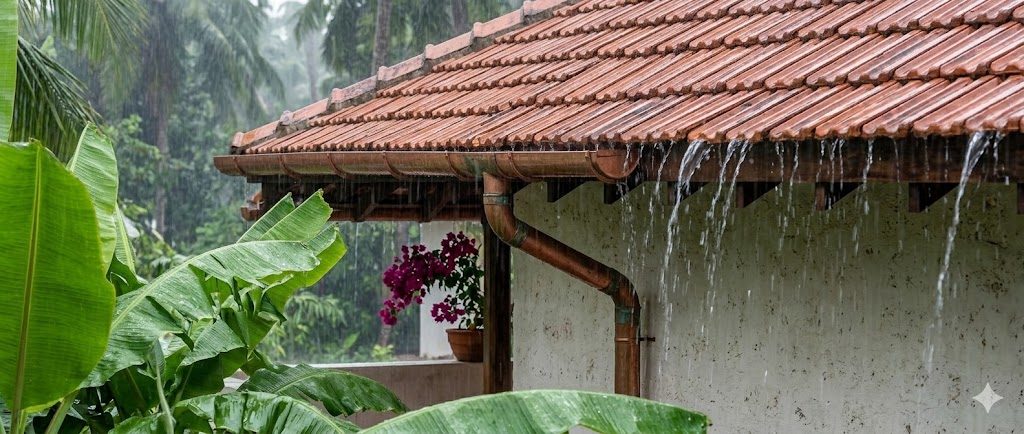
- Down-pipes — Copper, exposed, 4-inch diameter for monsoon discharge
Section — Monsoon & Cross-Ventilation Logic
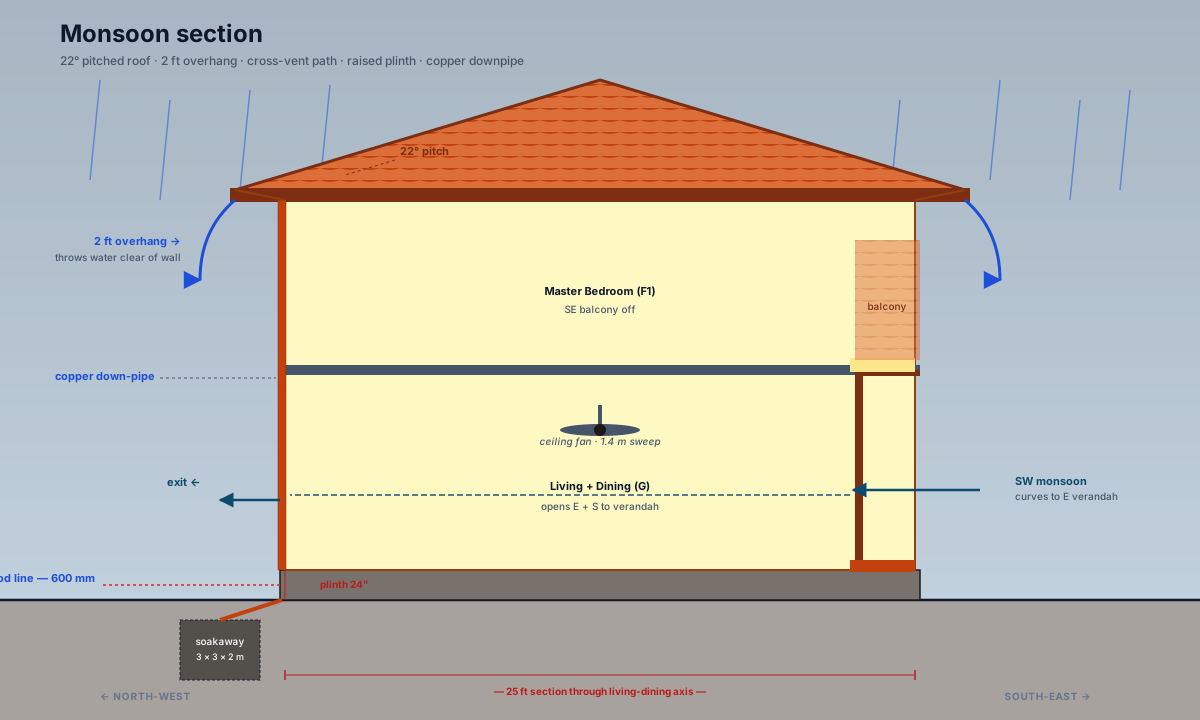
Monsoon Logic
| Element | Function |
|---|---|
| 22° roof pitch | Sheds water fast; Mangalore tiles interlock for wind resistance up to 60 km/h |
| 2 ft overhang on all four sides | Throws rainfall clear of the walls, keeps verandah floor dry in vertical rain |
| Raised 24" plinth | Above the 1-in-50-year monsoon flood line in most coastal Indian towns |
| Wraparound verandah | Habitable buffer space during 4 months of monsoon |
| Copper down-pipes (exposed) | Visible, easy to clean, no concealed pipe rot |
| Soakaway pit (3 m × 3 m × 2 m) | Receives rainwater from down-pipes; recharges groundwater |
Cross-Ventilation
The warm-humid climate priority is moving air, not cold air. A 28 °C / 80% humidity room feels 4–6 °C cooler with 1.5 m/s air movement.
- Through-and-through openings — every habitable room has windows on at least two opposite faces
- High-level vents above each interior door allow stack ventilation when external windows are closed for rain
- Ceiling fans with 1.4 m sweep diameter in living + bedrooms — non-negotiable in this zone
- Verandah breeze — south-west monsoon wind hits the verandah, redirected into the living-dining through full-height openings
Biophilic Score — 78 / Strong
This design scores 78 / 100 on the 16-criterion biophilic framework.
| Dimension | Score | Highlights |
|---|---|---|
| Nature in the Space | 35 / 40 | Strong daylight, exceptional cross-ventilation, indoor greenery (verandah planters), passive thermal comfort via overhangs and verandah |
| Natural Analogues | 24 / 30 | Laterite, terracotta, hardwood, cane, lime — all local; missed on biomorphic patterns (lower NAA03) |
| Nature of the Space | 19 / 30 | Strong verandah threshold (NOS03 = 5), refuge in window seats, lower mystery and courtyard scores |
Strategy classification: Verandah-led · Predominantly natural/local. The verandah is the climatic and biophilic heart — different typology from the hot-dry courtyard model, equally legitimate.
FAR / Setback Compliance Snapshot
| City | FAR Used | FAR Allowed | Notes |
|---|---|---|---|
| Mangaluru (DCPRMC 2017) | 1.08 | 1.50 | Verandah counts as 50% in FAR — verify with the corporation |
| Kochi (KMBR 2019) | 1.08 | 2.50 | Generous FAR; could go G+2 if the family grows |
| Panaji (Goa Town and Country Planning) | 1.08 | 1.80 | Heritage zone may need tiled roof — already specified |
| Visakhapatnam (VMRDA 2021) | 1.08 | 1.50 | Higher cyclone wind load (basic 50 m/s); roof tie-down per IS 875-3 |
The roof structure must be designed for the local basic wind speed per IS 875-3 — 50 m/s in Visakhapatnam and Andhra coast (cyclone-prone), 39–47 m/s in Kerala / Karnataka coast. Roof tile fixing per IS 654 manufacturer guidelines for cyclone zones.
Cost — Indicative
For 1,400 sqft built-up at warm-humid zone 2026 prices:
| Tier | Per sqft (₹) | Total (₹ L) | Includes |
|---|---|---|---|
| Basic | 2,000 | 28.0 | Standard finishes, ceramic flooring, lime wash, Mangalore tile |
| Recommended | 2,400 | 33.6 | Terracotta verandah, laterite exposed, hardwood doors, copper pipes |
| Premium | 2,800 | 39.2 | Kota inlay, cane-lattice details, 3 kWp solar, RWH soakaway |
Warm-humid construction is 10–15% costlier than hot-dry because of: pitched-roof carpentry, hardwood treatment against humidity (boric–borax + neem oil), and more frequent painting / lime-wash cycle.
Materials Schedule
| Element | Specification | Reason |
|---|---|---|
| External walls | 200 mm laterite block + 25 mm lime plaster + lime wash | Breathable, regional, ages well |
| Internal walls | 115 mm laterite + 12 mm POP + paint | Light, fast |
| Roof | Steel/timber truss + Mangalore clay tiles (IS 654) at 22° | Sheds rain; vernacular |
| Insulation under roof | 50 mm rockwool above false ceiling | Reduces solar gain in summer |
| Ceiling | False ceiling with PVC sheet (humidity-tolerant) | Common in coastal Indian homes |
| Flooring (ground) | 18 mm kota stone, polished | Cool, mould-resistant |
| Flooring (first) | 22 mm Burmese teak planks | Premium, regional |
| Verandah floor | 20 mm terracotta tile, broken-edge | Vernacular, slip-resistant when wet |
| Bathroom | Anti-skid ceramic + Mangalore granite | Wet conditions |
| Doors | 40 mm BWP plywood + teak veneer (interior); 50 mm solid teak (exterior) | IS 710 + IS 1003 |
| Windows | UPVC casement + insect mesh + cyclone-rated fittings | Easy to operate, monsoon-tight |
| Posts | Jackfruit / teak 100 × 100 mm, oil-treated | Verandah structure |
Plant Palette
Monsoon-loving, salt-tolerant (coastal), low-maintenance:
- Verandah planters: Anthurium, peace lily, philodendron, money plant, fern collection
- Front setback: Coconut palm (Cocos nucifera), Plumeria (frangipani), curry leaf, hibiscus hedge
- Rear utility yard: Banana (Musa), drumstick (Moringa), turmeric, ginger
- First-floor balcony: Vandas (orchid), bougainvillea cascade
Vastu Notes
| Element | Direction | Rating |
|---|---|---|
| Entry | South-East | Acceptable (Vastu-cautious for SE but mitigated by SE-facing verandah, which softens the directional energy) |
| Kitchen | North-East | Vastu compromise — see note |
| Pooja niche | North-East | Good |
| Master bedroom | South-East (first floor) | Acceptable |
| Stairs | South-West | Good |
| Brahmasthan | Verandah-side (open) | Open to sky on south face — partial fulfillment |
Rating: Good. Some Vastu adaptations are necessary because the climate priority pushes the entry south-east, opposite of the Vastu-ideal north-east. Many coastal Indian homes have done this for 200+ years. See Vastu for Modern Homes for the trade-off framework.
Note on the kitchen: placing the kitchen in the NE corner is a Vastu compromise (Vastu prefers SE). The reason in this plan: north-east morning light is desirable for cooking in the cool morning hours of warm-humid climate, and SE here is the entry verandah. If Vastu compliance is the priority, swap kitchen ↔ guest bedroom positions.
Buildability Notes
Before construction:
1. Foundation — likely strip footing on coastal alluvial soil (bearing 80–150 kPa); verify with soil test.
2. Plinth — 24 inches above ground, with damp-proof course (DPC) on all external walls.
3. Roof structure — steel or seasoned hardwood truss per IS 875-3 wind load; cyclone-zone designs need over-spec.
4. Termite treatment — pre- and post-construction soil treatment per IS 6313; warm-humid termite pressure is severe.
5. Rainwater harvesting — mandatory in Karnataka and Tamil Nadu for residential plots; design a 3 × 3 × 2 m soakaway pit + a 10,000 L storage tank.
6. Lightning protection — coastal homes are exposed; install IS/IEC 62305-compliant arrester.
Reading Pairings
- Sustainable Home Design India
- Passive Design — India Climate Zones
- Cross-Ventilation in Indian Homes
- Rainwater Harvesting
- Waterproofing Guide
- Vernacular Architecture India — Modern Homes
Tools to Use With This Plan
Author's note: The warm-humid 1200 sqft plot has more design freedom than the hot-dry equivalent because the climatic priority is on building skin (roof + walls + openings) rather than mass. The verandah does the spatial work of the courtyard at lower cost and with better usability in monsoon. The single biggest mistake in modern coastal Indian houses is replacing the verandah with a balcony or eliminating it altogether to gain interior floor area — at 1200 sqft, the temptation is strong but the cost is a less comfortable, less culturally legible home.
Disclaimer: This is a reference design. Local building bye-laws, soil conditions, wind loads, and statutory approvals must be verified by a licensed architect and structural engineer before construction. Costs are indicative for 2026 in the cited coastal regions and vary by site, contractor, and finish choices.
Related Guides — Deep-dive reading
Window Design for Villas (India): Using the Freedom of All Four Sides
With walls free on all four sides, you can tune every window to its sun: north light for studies, east for bedrooms, shaded south for living, minimal west, plus feature windows, dual-aspect rooms and stairwell glazing.
Windows & GlazingUnderstanding Sun Path Analysis for Your Home
How the sun actually moves over an Indian site through the day and the year — and why that single fact quietly decides where your kitchen, bedroom and living room should sit.
Site PlanningOrientation, Light & Views: Designing With Your Space, Not Against It
How reading your plot's sun, breeze and views — and placing each room on the right face — gives an Indian home that is cooler, brighter and quietly right, instead of one that fights its site forever.
Design PrinciplesRelated Tools — Try Free
Cross-Ventilation Analyzer
Estimate airflow and air changes per hour (ACH) from room size, window areas, layout, and local wind — with NBC 2016 Part 8 compliance check.
Ventilation CalculatorRainwater Tank Sizer
How big should your rainwater tank be? Computes annual harvest, recommended tank capacity in litres, water-bill savings, and payback — for 10 Indian cities.
RWH CalculatorHome Building & Interior Cost Calculator — 20 Cities
Construction + interior costs for 20 Indian cities across kitchen, wardrobes, flooring, painting, ceiling.
Cost Calculator