

Seismic Zones of India — A Design Guide
IS 1893 Part 1:2016, Zone Lookup, Design Base Shear, Ductile Detailing, and City-Specific Earthquake Risk — A Comprehensive Guide for Architects and Structural Engineers
Earthquakes do not kill people. Buildings do. This truism — attributed variously to Nicholas Ambraseys and to the Dutch seismologist Frank Press — encapsulates the central design problem of Indian construction. In the eighty years since India gained independence, the country has endured at least twelve major earthquakes with death tolls exceeding 1,000: the Bihar earthquake of 1934 before independence (10,000 deaths), Assam 1950 (1,500), Uttarkashi 1991 (2,000), Killari-Latur 1993 (10,000), Jabalpur 1997 (40), Chamoli 1999 (100), Bhuj 2001 (over 20,000), Kashmir 2005 (1,400 Indian side), and Sikkim 2011 (97). Each confirmed the same lesson: the structural integrity of the buildings, not the magnitude of the shaking, determines who lives.
This guide is written for architects, structural engineers, and informed clients who need to understand India's seismic zone classification, how it translates into design decisions, and what it asks of every residential and commercial project. It covers the regulatory framework of IS 1893 Part 1:2016, the history of Indian zone revisions, the design implications of each zone, the special cases of Indian cities with elevated risk, and the technical provisions of IS 13920 ductile detailing that give effect to the seismic design philosophy.
"The earthquake does not kill people — buildings do. Every earthquake confirms that non-engineered construction remains the single largest cause of death." — A.S. Arya, T. Boen and Y. Ishiyama, Guidelines for Earthquake Resistant Non-Engineered Construction (Arya, Boen and Ishiyama, 2014)

1. Why India Is a Seismic Country
The Indian subcontinent collides with the Eurasian plate at roughly 50 mm per year — the fastest continental convergence on Earth (Bilham, Gaur and Molnar, 2001). This collision, begun 50 million years ago, created the Himalayas and continues to release elastic strain energy through earthquakes. The 2,500-kilometre Himalayan arc from Kashmir to Arunachal Pradesh is expected, on the basis of current strain measurements, to produce several magnitude-8 or greater earthquakes over the coming century — events that have not occurred for long enough that the geological record indicates they are overdue (Bilham, 2004).
Beyond the Himalayan arc, India has three additional tectonic sources of seismic hazard: the Kutch seismic zone in western Gujarat (site of the 2001 Bhuj earthquake and the 1819 Rann of Kutch earthquake, both exceeding magnitude 7.5), the Indo-Burmese arc along the north-eastern border (generating the 1897 Assam earthquake of magnitude 8.1 and the 1950 Assam earthquake of 8.6), and the intraplate Indian shield in peninsular India (site of the 1967 Koyna earthquake triggered by reservoir impoundment and the 1993 Killari-Latur earthquake in a region previously considered seismically inert).
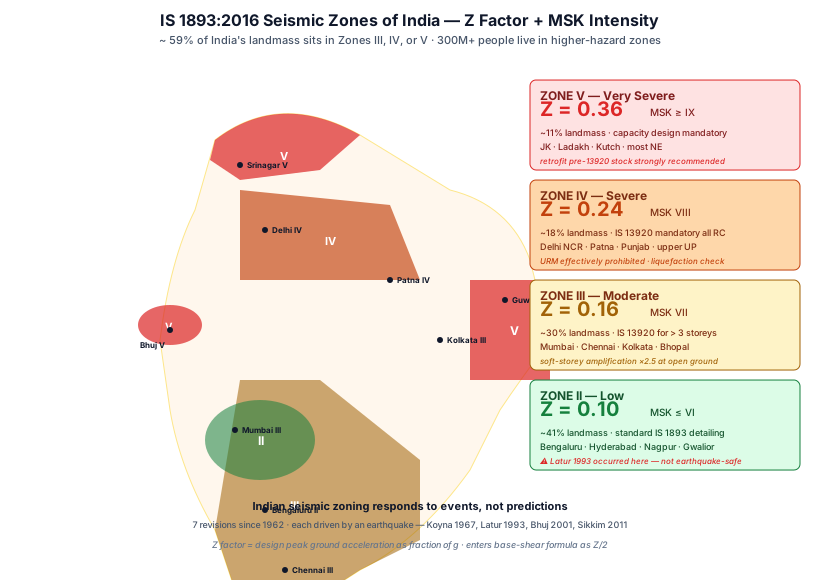
The cumulative effect of these four source regions is that approximately 59% of India's landmass falls in seismic zones III, IV, or V — the moderate-to-very-severe categories of IS 1893 classification (Bureau of Indian Standards, 2016). More than 300 million people live in these higher-hazard zones; the majority occupy non-engineered masonry buildings that would not survive the design earthquake. The gap between India's seismic hazard and its built environment's seismic capacity represents one of the great silent risks of the subcontinent.
"India cannot afford to wait for the next devastating earthquake to learn lessons that are already available from past events. Every building constructed without seismic provisions is a potential death trap." — Prof. Sudhir K. Jain, former Director, IIT Gandhinagar, lead author of IS 1893 revisions (Jain, 2016)
2. The Evolution of Indian Seismic Zoning
The IS 1893 seismic zone map has undergone seven major revisions since its first publication in 1962, each driven by a significant earthquake that revealed inadequacies in the prevailing classification:
- IS 1893:1962 (1st edn) divided India into seven zones (0 to VI) on the basis of observed historical earthquakes. The classification was essentially descriptive, with limited design prescription.
- IS 1893:1966 (2nd edn) introduced the zone factor as a design coefficient and reduced the number of zones to five (I to V). Design base shear methodology became operational.
- IS 1893:1970 (3rd edn) refined zone boundaries based on the 1967 Koyna earthquake, which occurred in what had previously been classified as a low-hazard zone and caused dam damage and 200 deaths.
- IS 1893:1975 (4th edn) further revised the peninsular zoning and introduced response spectrum concepts.
- IS 1893:1984 (5th edn) consolidated the classification into four zones (I–V with I merged into II) and expanded design provisions for multi-storey buildings.
- IS 1893:2002 (Part 1, 6th edn) followed the 1993 Latur and 2001 Bhuj earthquakes. Latur struck a region then classified as Zone I (the lowest) and produced 10,000 deaths, forcing upward reclassification of much of peninsular India. Bhuj confirmed Zone V for Kutch and exposed inadequacies in Gujarat's pre-2001 zoning.
- IS 1893:2016 (Part 1, current) is the operative standard. It refined zone boundaries using the BMTPC Vulnerability Atlas data, introduced capacity-based design methodology, and tightened ductile detailing requirements through its companion standard IS 13920:2016.
The pattern is clear: Indian seismic zoning responds to events, not predictions. The Latur earthquake in 1993 killed 10,000 people in buildings designed for the lowest zone class; six years later the zone was raised, but the buildings already constructed remained. Retrofitting has been minimal. This historical pattern represents a compounding risk — every year that passes with sub-standard construction adds another cohort of buildings that will eventually face earthquakes they were not designed to survive.
IS 1893 Revision History Summary
| Edition | Year | Number of Zones | Key Driver |
|---|---|---|---|
| 1st | 1962 | 7 (0–VI) | Historical observation-based; limited design prescription |
| 2nd | 1966 | 5 (I–V) | Introduction of zone factor; operational base shear |
| 3rd | 1970 | 5 | Koyna 1967 response |
| 4th | 1975 | 5 | Response spectrum methodology |
| 5th | 1984 | 4 (I merged into II) | Multi-storey building provisions |
| 6th | 2002 | 4 | Latur 1993, Bhuj 2001, Jabalpur 1997, Chamoli 1999 |
| Current | 2016 | 4 | BMTPC Atlas, capacity-based design, IS 13920:2016 alignment |
Source: Bureau of Indian Standards historical records and Jain (2016).
3. The Four Zones — What Each Means
IS 1893:2016 divides India into four seismic zones. Each zone is defined by a numerical zone factor Z representing the design peak ground acceleration as a fraction of gravitational acceleration g, and by a qualitative MSK intensity (Medvedev-Sponheuer-Karnik scale) describing the expected severity of shaking.
Zone II — Low Seismic Hazard (Z = 0.10, MSK ≤ VI)
Covers approximately 41% of India's landmass. Includes most of the central Indian shield — Karnataka (Bengaluru, Mysuru, Hubli-Dharwad), Telangana (Hyderabad, Warangal), Andhra Pradesh interior (Kurnool, Tirupati, Visakhapatnam), most of Odisha and Chhattisgarh, Jharkhand interior (Ranchi, Jamshedpur), Madhya Pradesh interior (Gwalior, Rewa, Satna), southern Rajasthan (Udaipur, Jodhpur), Tamil Nadu interior (Madurai, Tiruchi, Tirunelveli), and Maharashtra's Vidarbha region (Nagpur, Amravati).
Zone II is the lowest hazard category but is not a zone without risk. The 1993 Killari-Latur earthquake (magnitude 6.3) occurred in what was then classified as Zone I (the lowest zone of the 1984 edition) and killed approximately 10,000 people. The event led directly to the upward revision of peninsular India and to the merging of Zone I into Zone II in 2002. IS 1893:2016 now explicitly requires seismic design provisions for all buildings in Zone II — the common belief that Zone II cities are "earthquake-safe" is historically incorrect.
Zone III — Moderate Seismic Hazard (Z = 0.16, MSK VII)
Covers approximately 30% of the landmass and includes most of India's major coastal cities and urban centres: Mumbai, Chennai, Kolkata, Ahmedabad, Surat, Vadodara, Bhopal, Indore, Jabalpur, Lucknow, Kanpur, Varanasi, Ranchi (part), Raipur (part), Bhubaneswar, Thiruvananthapuram, Kochi, Mangaluru, and the coastal strip of Tamil Nadu and Andhra Pradesh. Goa, most of Kerala, and the plains of West Bengal also fall in Zone III.
Zone III compliance shifts the regulatory bar substantially. Unreinforced masonry (URM) buildings are limited to two storeys; above that, confined masonry with IS 4326 seismic bands is required. For RC frame buildings greater than three storeys, IS 13920 ductile detailing becomes mandatory. Response-spectrum analysis is required for buildings over 40 m or with irregular plans. Soft-storey open-ground-floor buildings require explicit amplification of design storey shear by 2.5× at the soft level.
Zone IV — Severe Seismic Hazard (Z = 0.24, MSK VIII)
Covers approximately 18% of India's landmass. Dominated by Delhi NCR (Delhi, Gurugram, Noida, Ghaziabad, Faridabad), Punjab (Amritsar, Ludhiana, Chandigarh), most of Uttar Pradesh north of Kanpur (Meerut, Saharanpur, Muzaffarnagar, Moradabad, Bareilly, Gorakhpur), most of Bihar (Patna, Muzaffarpur, Darbhanga, Purnia, Bhagalpur), the Indo-Nepal border, northern West Bengal (Siliguri, Darjeeling), Sikkim (Gangtok), Dehradun and Haldwani in Uttarakhand, Shimla and Solan in Himachal Pradesh, Jammu, and parts of Gujarat around the Kutch periphery.
The Delhi case is particularly important. The Indian capital sits on the Aravalli thrust system and has experienced five earthquakes of magnitude 5.5 or greater in the past 300 years. The 1720 Delhi earthquake damaged the imperial monuments and produced liquefaction across the Yamuna floodplain; a comparable event today would cause catastrophic losses given Delhi's 20 million-strong population in predominantly Zone IV seismic conditions (Mohanty, 2012). Yet Delhi's building stock includes a large fraction of non-engineered masonry and soft-storey RC apartments constructed before IS 13920 became mandatory.
Zone IV design requires IS 13920 ductile detailing for all RC frame buildings (not just those above a storey threshold). URM is effectively prohibited — confined masonry with IS 4326 bands is the masonry floor. Strong column–weak beam design per IS 13920 Clause 8 becomes mandatory. Foundation design must consider liquefaction for saturated cohesionless soils.
Zone V — Very Severe Seismic Hazard (Z = 0.36, MSK IX+)
Covers approximately 11% of the landmass and is the most hazardous classification. Includes Jammu & Kashmir (Srinagar, Baramulla, Kupwara, Anantnag), Ladakh (Leh, Kargil), the Kutch region of Gujarat (Bhuj, Gandhidham, Mundra, Mandvi, Anjar), parts of Himachal Pradesh (Dharamshala, Kullu, Manali, Chamba), upper Uttarakhand (Uttarkashi, Rudraprayag, Chamoli, Pithoragarh), almost all of the North-Eastern states (Guwahati, Silchar, Dibrugarh, Tezpur, Jorhat, Nagaon in Assam; Itanagar, Tawang, Pasighat in Arunachal Pradesh; Imphal in Manipur; Kohima and Dimapur in Nagaland; Aizawl in Mizoram; Shillong and Tura in Meghalaya; Agartala in Tripura), and the Andaman & Nicobar Islands (Port Blair).
Zone V is the most demanding design regime. Capacity-based design per IS 13920 is mandatory for RC frames. URM is essentially prohibited; even confined masonry is strongly discouraged for buildings above two storeys. Dynamic analysis (response spectrum or time history) is required for any building above 30 metres or with any plan irregularity. Base isolation and supplemental damping systems are increasingly used for tall structures and critical facilities. Most critically, retrofitting of existing pre-IS 13920 construction is strongly recommended — not just new construction, because the probability of a design-level earthquake over a 50-year building life in Zone V is significantly higher than in lower zones.
The North-East of India deserves particular mention. The 1897 Assam earthquake (magnitude 8.1) produced the highest historically recorded ground accelerations in India; the 1950 Assam earthquake (magnitude 8.6) remains one of the largest continental earthquakes ever instrumentally recorded globally. The region has experienced approximately ten earthquakes of magnitude 7 or greater since 1900. Yet Guwahati — the economic capital of the North-East with a population approaching 1 million — contains extensive unreinforced masonry construction, including the state government complex itself (Sharma et al., 2016). The gap between design standards and as-built practice in the North-East represents perhaps the largest concentrated seismic risk in India.
"The earthquake does not check whether your design is compliant with IS 1893. It tests whether your building can survive the ground motion. The two are related but not identical." — C.V.R. Murty, IIT Madras, co-author of IS 1893:2016 (Jain and Murty, 2011)
4. The Design Base Shear Equation
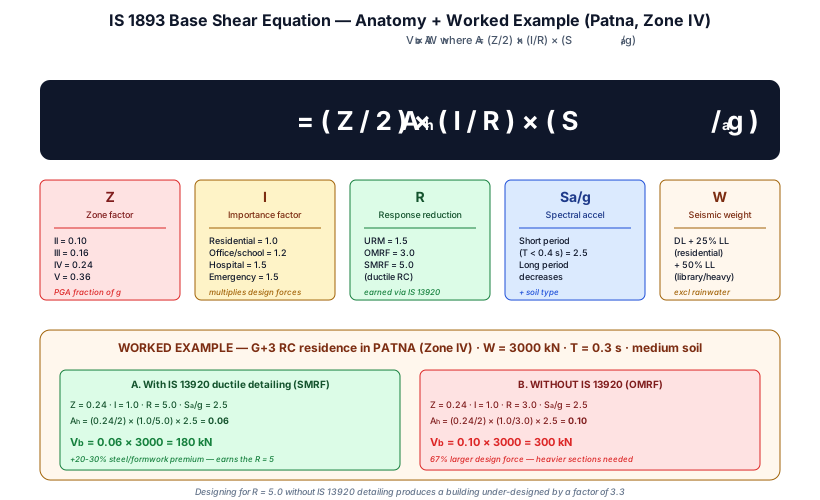
IS 1893 Part 1:2016 Clause 7.5 prescribes the total design horizontal base shear Vb for a building as:
Vb = Ah × W
where Ah is the design horizontal seismic coefficient:
Ah = (Z / 2) × (I / R) × (Sa / g)
Each variable has an engineering meaning worth understanding:
Z — Zone factor. Ranges 0.10 to 0.36. Represents the design peak ground acceleration (PGA) as a fraction of g. The Z/2 division in the Ah formula reflects the fact that the design is for the maximum considered earthquake — the 475-year return-period event for ordinary structures, reduced by 2 to yield the design basis earthquake expected to produce some structural damage but no collapse.
I — Importance factor. Ranges 1.0 to 1.5 per IS 1893:2016 Table 8. Residential and commercial buildings use 1.0; schools, office buildings with large occupancy use 1.2; hospitals, fire stations, emergency response facilities, and historical monuments use 1.5. The importance factor multiplies design forces — a hospital in Zone IV is designed for 1.5× the base shear of a residential building on the same site.
R — Response reduction factor. Ranges 1.5 to 5.0 per IS 1893:2016 Table 9. Represents the ductility, over-strength, and redundancy of the structural system. An unreinforced masonry building (R = 1.5) is designed for one-third the forces of a ductile RC moment-resisting frame (R = 5.0) because the latter can safely dissipate seismic energy through controlled plastic deformation while the former cannot. The R value must be earned through actual ductile detailing — designing for R = 5.0 without IS 13920 compliance produces a building under-designed by a factor of 3.3 relative to its intended performance.
Sa/g — Spectral acceleration coefficient. A function of the building's fundamental natural period and the soil type beneath it, read from IS 1893 Figures 2a–2c. For short-period (stiff, low-rise) buildings on hard soil, Sa/g reaches its maximum of 2.5; for long-period (flexible, tall) buildings or soft soils, it decreases. This is where site-specific geotechnical investigation enters the seismic calculation.
W — Seismic weight. The effective weight of the building that participates in seismic response. IS 1893:2016 Clause 7.4 specifies: full dead load + 25% of imposed load for residential floors, 50% for floors with heavy live loads like libraries or archives. W does NOT include water in rainwater harvesting tanks or swimming pools when these are at or below ground level.
A Worked Example
Consider a G+3 reinforced concrete framed residence in Patna (Zone IV, Z = 0.24), seismic weight W = 3,000 kN, fundamental period T = 0.3 s, medium soil:
- Z = 0.24
- I = 1.0 (residential)
- R = 5.0 (ductile RC frame, assuming IS 13920 compliance)
- Sa/g = 2.5 (short period, T < 0.4 s)
- Ah = (0.24/2) × (1.0/5.0) × 2.5 = 0.06
- Vb = 0.06 × 3,000 = 180 kN total horizontal force at base
If the same building were designed without IS 13920 (taking R = 3.0 for ordinary RC frame per IS 1893 Table 9):
- Ah = (0.24/2) × (1.0/3.0) × 2.5 = 0.10
- Vb = 0.10 × 3,000 = 300 kN — 67% larger
This worked example illustrates the leverage of ductile detailing: a 20–30% premium on steel and formwork for IS 13920 compliance reduces the required lateral resistance of the structure by nearly half. The economics consistently favour ductile detailing; what prevents its universal adoption in India is not cost but craft knowledge and supervisory capacity at the construction site.
"The response reduction factor R is where seismic design becomes a contract between engineer and constructor. The engineer reduces the design forces by R; the constructor must provide the ductile behaviour that R assumes. If the detailing is skimped, the promise is broken — and the building falls when tested." — P. Agarwal and M. Shrikhande, Earthquake Resistant Design of Structures (Agarwal and Shrikhande, 2006)
5. The IS 13920 Ductile Detailing Regime
IS 13920:2016 Ductile Design and Detailing of Reinforced Concrete Structures Subjected to Seismic Forces is the companion standard to IS 1893. Where IS 1893 prescribes the design forces, IS 13920 prescribes the construction details that mechanically produce ductile behaviour. Compliance with IS 13920 is mandatory for all RC frame buildings in Zones III, IV, and V; optional for Zone II but strongly recommended.
Key IS 13920 Provisions
Minimum dimensions. Columns: minimum 230 × 230 mm in Zone III, 300 × 300 mm in Zone IV, 300 × 450 mm in Zone V (or 15 times the largest beam bar diameter passing through). Beams: minimum 200 mm width. Slabs: minimum 125 mm for two-way spans.
Longitudinal reinforcement. Columns: minimum 0.8% and maximum 6% of gross cross-section (2.5% at lap splices). Beams: minimum 0.24·sqrt(fck/fy) and maximum 0.025. Minimum 8 longitudinal bars in columns of Zone IV/V buildings.
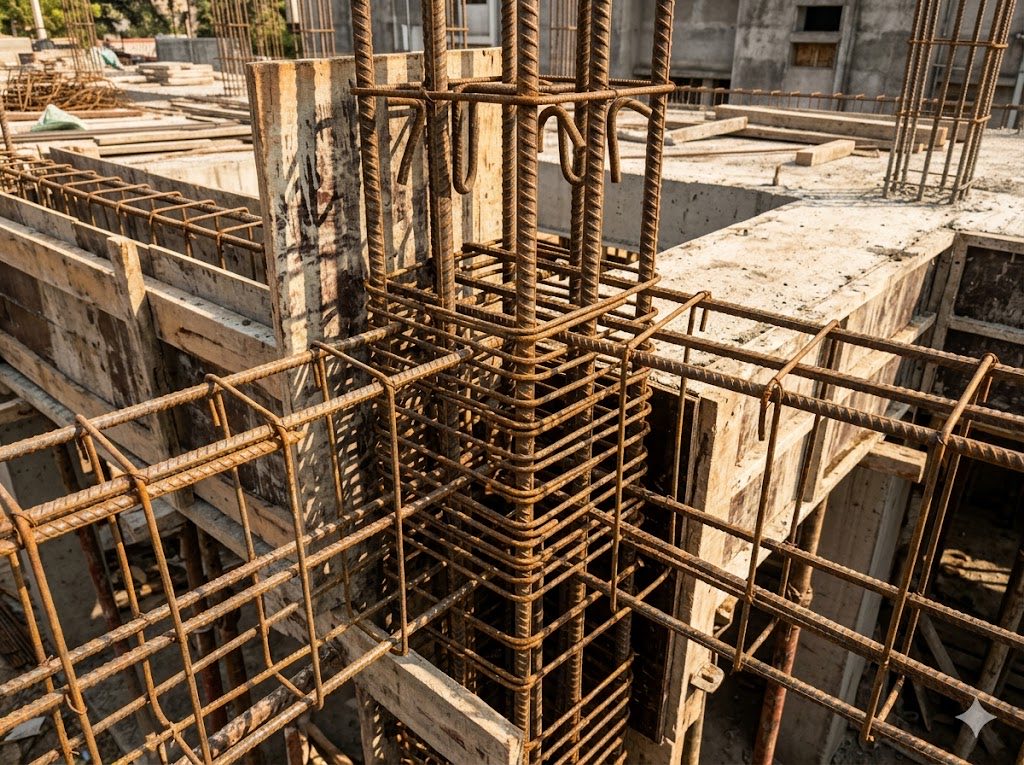
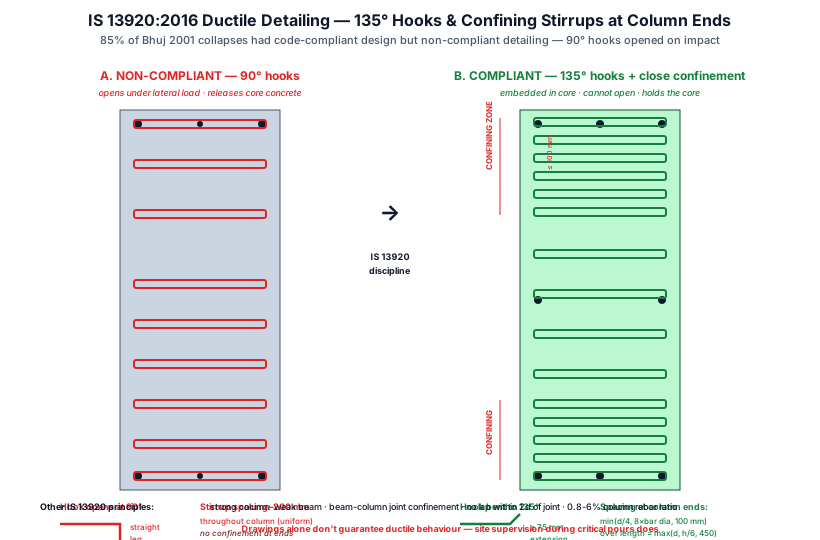
Transverse reinforcement (stirrups and hoops). Spacing at column ends over a length of max(column depth, clear height/6, 450 mm): ≤ min(column depth/4, 8 × longitudinal bar diameter, 100 mm). All hoops must have 135° hooks with minimum 75 mm extension — the 90° hooks commonly used in non-seismic construction open under lateral load and release the core concrete.
Beam-column joints. The joint must be stronger than the members framing into it — the essence of capacity design. Special confining reinforcement in the joint region, with hoops continued through the joint; in Zone V, columns at any joint must have at least 1.1 times the total moment capacity of the beams framing into that joint (strong column – weak beam).
Beam-column joint shear. Must be designed for the shear forces corresponding to the development of plastic hinges in the adjacent beams. This is a significantly higher shear than pre-2016 practice and distinguishes IS 13920:2016 compliance from earlier editions.
Lap splices. Not permitted within the joint region or within a distance equal to twice the member depth from the face of the joint. Staggered in alternate bars where possible.
Why Detailing Matters
Post-earthquake forensic investigations in India consistently identify detailing failures as the proximate cause of collapse, not design failures. Kaushik, Rai and Jain (2007) studied 400 RC frame buildings damaged in the 2001 Bhuj earthquake and found that 85% had code-compliant design forces but non-compliant detailing — principally inadequate stirrup spacing at column ends, 90° rather than 135° hooks, and discontinuous corner reinforcement. These are not design errors; they are construction quality errors that undermine an adequately-designed structure.
The implication for architectural practice is that seismic safety requires supervision during critical pours, not just drawings. A structural engineer's sealed drawing does not guarantee an IS 13920-compliant building; only site presence during footing, column, and beam-column joint pours does. This imposes a professional obligation that is not universally observed in Indian practice, particularly for residential projects below the scrutiny threshold for corporate developers.
"Detailing is where design meets craft. A beautifully calculated frame with poorly detailed joints is a well-dressed corpse. Earthquakes expose the deception." — Saibal Ghosh, founder, Indian Concrete Institute (Ghosh, 2011)
6. Liquefaction — The Hidden Hazard
Liquefaction is the loss of soil strength during cyclic earthquake loading when saturated loose cohesionless soils (typically medium-dense sand and silt) lose contact between grains and behave as a dense fluid. The building above does not fall because of shaking; it tilts, sinks, or overturns because its foundation has literally liquefied beneath it.
Liquefaction is a dramatic phenomenon. The 1964 Niigata earthquake in Japan produced four-storey reinforced concrete apartment buildings lying horizontally on the liquefied ground, undamaged in their structure but comprehensively useless as housing. The 2011 Christchurch earthquake produced 170 km² of liquefied soil across the central business district. In India, the 1897 Assam and 1934 Bihar earthquakes both produced extensive liquefaction in the Brahmaputra and Ganga floodplains; the 2001 Bhuj earthquake produced spectacular liquefaction across the salt flats of the Rann of Kutch (Rai et al., 2006).
IS 1893 Part 1:2016 Clause 6.3.5 requires liquefaction assessment for saturated cohesionless soils in Zones III, IV, and V when SPT N-values are below depth-dependent thresholds (typically N < 15 in the upper 10 m; higher thresholds at greater depth). The assessment follows the Seed-Idriss simplified procedure (Seed and Idriss, 1971), computing the Cyclic Stress Ratio (CSR) induced by the earthquake and comparing it with the Cyclic Resistance Ratio (CRR) of the soil. Where CSR > CRR, liquefaction is predicted and foundation redesign is required.
Indian Cities at Elevated Liquefaction Risk
| City | State | Zone | Reason |
|---|---|---|---|
| Guwahati | Assam | V | Saturated Brahmaputra alluvium; 1897 precedent |
| Srinagar | J&K | V | Dal Lake bed and saturated Jhelum alluvium |
| Mumbai (reclaimed) | Maharashtra | III | Backbay, Churchgate, Colaba reclaimed marine clay-silt |
| Ahmedabad | Gujarat | III | Sabarmati floodplain; observed liquefaction 2001 Bhuj |
| Patna | Bihar | IV | Ganga floodplain; 1934 precedent at Monghyr nearby |
| Muzaffarpur | Bihar | IV | Saturated alluvium; 1934 precedent |
| Kolkata | West Bengal | III | Hooghly floodplain; shallow water table |
| Chennai | Tamil Nadu | III | Coastal alluvium and filled marshland |
| Kochi | Kerala | III | Backwater marine deposits |
| Kakinada | Andhra Pradesh | III | Godavari delta marine clay |
| Paradip | Odisha | III | Mahanadi delta reclaimed |
| Port Blair | Andaman | V | Saturated coastal sand |
| Puducherry | UT | III | Coastal filled ground |
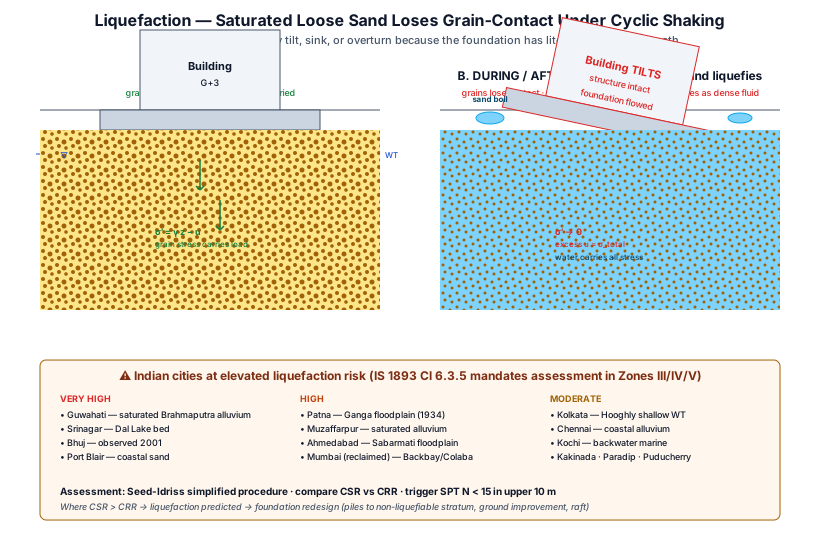
Synthesised from BMTPC (2019), IS 1893 Part 1:2016 Clause 6.3.5 commentary, Rai et al. (2006), and post-earthquake reconnaissance reports.
Mitigation options in liquefiable sites include: deep foundations (piles to competent strata), ground improvement (stone columns, vibro-compaction, dynamic compaction, compaction grouting), or structural adaptation (raft foundation with edge beams, reduced building weight, plan compactness). None of these is cheap; all are more cost-effective at design stage than as post-event remediation.
7. Soft Storey — India's Architectural Vulnerability
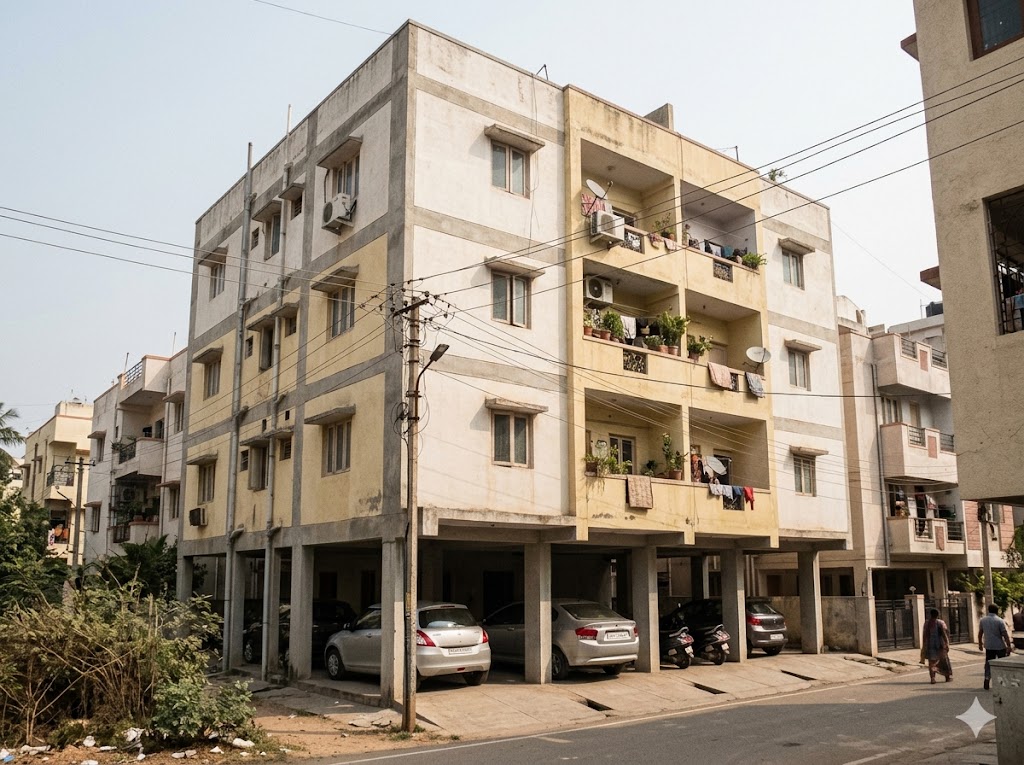
The open ground floor for parking — ubiquitous in Indian urban apartment buildings — creates what seismic engineers call a soft storey or weak storey. When the ground storey has no infill walls but the upper storeys do, there is a dramatic stiffness discontinuity. Under lateral earthquake loading, nearly all the deformation concentrates at the soft storey, producing column failure and pancake collapse.
The 2001 Bhuj earthquake demonstrated this phenomenon at scale. Over 130 multi-storey RC apartment buildings in Ahmedabad alone — located 400 km from the epicentre — collapsed or were damaged beyond repair (Sinha and Goyal, 2004). Almost all exhibited the same failure mode: intact upper floors stacked on a crushed ground storey that had offered insufficient lateral resistance when it bore the full lateral demand alone.
IS 1893 Part 1:2016 Clause 7.10 now contains explicit provisions for soft-storey buildings:
- The design storey shear and moments at the soft level must be amplified by 2.5× the values from ordinary analysis.
- Alternatively, the soft level must be provided with stiff bracing elements (RC shear walls, steel bracing) with sufficient strength to eliminate the stiffness discontinuity.
- For Zone IV and V, soft-storey construction is effectively discouraged in favour of shear-wall-stabilised ground floors.
Architects designing Indian apartment buildings need to understand this requirement as a design driver, not a retrofit fix. The open ground floor is not free — it costs 2.5× the structural weight at the critical level, or it requires shear walls that constrain plan flexibility. Either response is legitimate; ignoring the requirement is not.
"India's open ground floor is an architectural folk custom that, over two decades, has produced more seismic vulnerability than any other single design decision. The remedy is known. The adoption is slow." — H.B. Kaushik, IIT Guwahati (Kaushik, Rai and Jain, 2007)
8. Masonry in Seismic Zones — What Is Permitted Where
Unreinforced masonry (URM) — brick or stone walls without steel reinforcement — is the traditional construction system of India and remains the dominant residential typology across most of the country. URM is also, by performance metrics, the most seismically vulnerable construction system. Its lateral capacity is low, its ductility is near zero, and its failure is brittle and sudden.
IS 1893:2016 and IS 4326:2013 jointly restrict URM construction as follows:
Masonry Type Permissibility by Zone
| Masonry Type | Zone II | Zone III | Zone IV | Zone V |
|---|---|---|---|---|
| Unreinforced masonry (URM) | ≤ 3 storeys with lintel band | ≤ 2 storeys with plinth + lintel + roof bands | Prohibited (confined masonry only) | Prohibited |
| Confined masonry (URM + RC tie-columns and bands per IS 4326) | ≤ 4 storeys | ≤ 4 storeys | ≤ 4 storeys | ≤ 3 storeys |
| Reinforced masonry (vertical steel in cells at corners/openings, plus bands) | ≤ 4 storeys | ≤ 4 storeys | ≤ 4 storeys | ≤ 4 storeys |
Sources: IS 1893 Part 1:2016 Clause 6.5; IS 4326:2013 Clause 8 (Bureau of Indian Standards, 2013).
Seismic Bands — The Mandatory Detail
IS 4326:2013 mandates the following horizontal seismic bands in all masonry buildings in Zones III, IV, V (and strongly recommended in Zone II above two storeys):
- Plinth band at ground level, continuous around the perimeter and along internal load-bearing walls
- Lintel band at the top of door/window openings
- Gable band on gable ends of pitched-roof buildings
- Roof band at the top of walls, just below slab or rafter
- Sill band (optional, enhances performance) at the base of openings
Each band is typically 75 mm thick, reinforced with 2–4 bars of 8–12 mm diameter tied together with 6 mm stirrups at 150 mm spacing. The total steel consumption for a G+1 residence with full band treatment is approximately 400–600 kg — a cost that varies with local steel prices but typically represents 2–3% of the construction budget.
The evidence for the effectiveness of band construction is now overwhelming. Post-Bhuj surveys consistently found that buildings with complete band treatment survived or sustained only non-structural damage, while adjacent URM buildings without bands collapsed entirely (Jain, Murty et al., 2002). The cost is trivial; the life-safety benefit is decisive. There is no reasonable argument against full band treatment for any masonry building in any Indian seismic zone, and IS 4326:2013 makes this standard rather than optional.
9. The Retrofit Question
The seismic zone classification of a site applies to new construction and to existing construction equally — the earthquake does not distinguish. Yet the vast majority of India's building stock predates IS 13920:2016, many structures predate IS 1893:2002, and some date to before the first IS 1893:1962. These buildings are not exempt from seismic hazard; they are simply not engineered for it.
Retrofit — the seismic strengthening of existing construction — is addressed in IS 13935:2009 (Seismic Evaluation, Repair and Strengthening of Buildings). The standard distinguishes between:
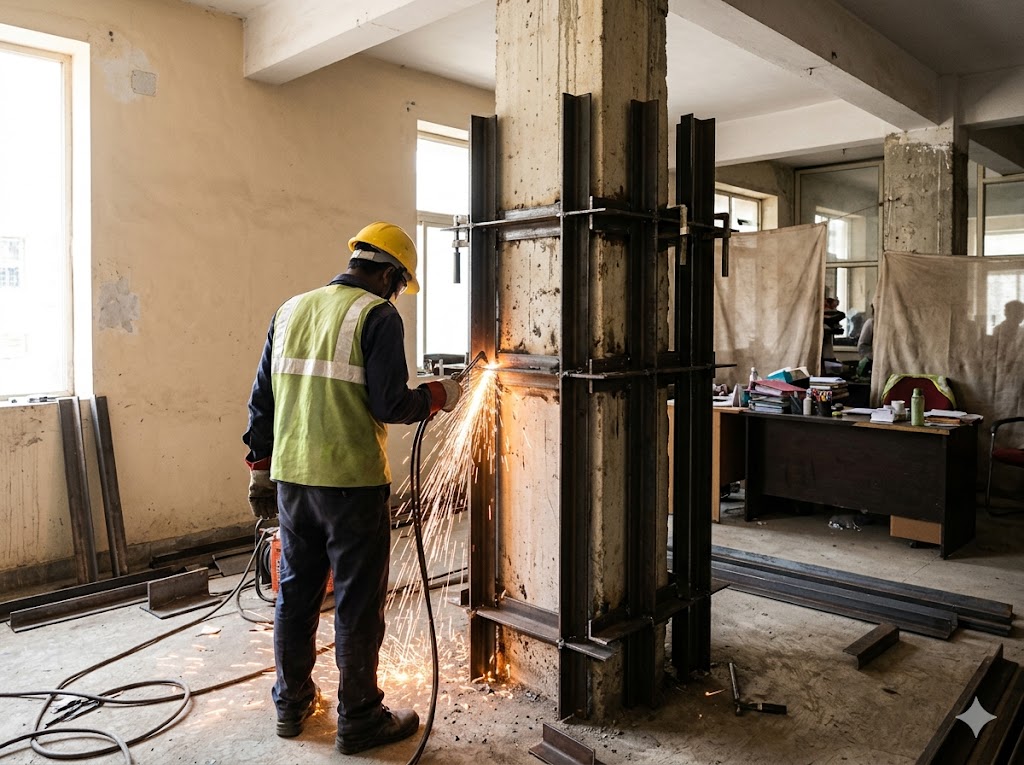
- Retrofit for life safety — minimum intervention to prevent collapse under the design basis earthquake. Typically involves adding confined masonry bands retrospectively, jacketing columns, and adding RC shear walls at strategic locations.
- Retrofit for immediate occupancy — more extensive intervention targeting limited damage under the design earthquake. Suitable for critical facilities (hospitals, schools, emergency response centres) that must remain functional after an earthquake.
For Indian residential projects, retrofit is a specialist activity requiring structural engineering judgement and typically involves:
1. Visual and instrumented survey of the existing structure to document its as-built condition, including material testing (rebound hammer, core samples) where necessary.
2. Seismic evaluation using the simplified method of IS 13935 Annex A, computing the building's demand-capacity ratio.
3. Retrofit design targeting the identified weaknesses — typically soft storey, inadequate joint detailing, insufficient shear walls, poor foundation tie.
4. Construction with appropriate quality control and disruption to occupancy.
Retrofit costs typically range from 10–25% of reconstruction cost for life-safety retrofit, 25–50% for immediate occupancy retrofit. For heritage buildings and buildings of historical significance, retrofit may be the only viable option. For ordinary residential buildings nearing the end of economic life, reconstruction may be more cost-effective.
The public policy case for retrofit is strong but political action has been limited. The NDMA Guidelines on Earthquake Safety in Schools (NDMA, 2010) recommended systematic retrofit of pre-1990 school buildings in Zones III–V; progress in implementation has been uneven across states. For architects, retrofit work is a growing practice area and likely to become more significant as Indian cities mature.
10. The Special Case of the North-East
The seven North-Eastern states — Assam, Arunachal Pradesh, Manipur, Meghalaya, Mizoram, Nagaland, and Tripura — plus Sikkim occupy approximately 8% of India's landmass and represent perhaps the most concentrated seismic hazard on the subcontinent. The 1897 Assam earthquake (magnitude 8.1) and the 1950 Assam earthquake (magnitude 8.6) are among the largest continental earthquakes ever recorded. The region produces a magnitude 6+ earthquake roughly every 3–5 years.
Yet the region has the lowest density of engineered construction of any part of India. A 2013 survey by IIT Guwahati found that less than 10% of residential construction in Guwahati, Shillong, and Imphal had formal structural engineering input; the figure is even lower in smaller towns and rural areas (Sharma et al., 2016). Government buildings, including the Assam Secretariat complex, are dominated by URM construction that would not survive the design earthquake.
Four factors compound the risk:
Saturated soils. The Brahmaputra and its tributaries have deposited thick layers of saturated alluvium across Assam. These soils are highly liquefiable; the 1897 earthquake produced liquefaction damage extending tens of kilometres from the epicentre.
Steep terrain. Arunachal, Mizoram, Meghalaya, Manipur, and Nagaland are hill states with construction on steep slopes. Slope instability and slope-influenced ground motion amplification add to the hazard.
Heavy timber-and-corrugated-iron roofs. Traditional NE construction uses heavy sloped roofs that increase the seismic mass at the top of the wall — inverting the principle of light roof / heavy base that traditional earthquake-resistant construction relies on.
Distance from testing infrastructure. IIT Guwahati and NIT Silchar are the only major seismic engineering laboratories in the NE region. Most NE construction is designed and supervised at a distance from specialist expertise.
The response, as of 2026, is a combination of NDMA guidelines, state government programmes (notably Assam's Earthquake Safe Construction Initiative), and rising professional awareness. Architects working in the NE should consider themselves operating in the highest-risk design environment in India and adjust their practices accordingly — particularly in specifying complete band treatment for any masonry work, insisting on RC frame for any building above single-storey, and retaining geotechnical expertise for any site with saturated soil conditions.
11. Architects' Seismic Design Checklist
The following checklist distils IS 1893:2016 + IS 13920:2016 + IS 4326:2013 into operational steps for any Indian residential or commercial project:
Concept Stage
- [ ] Confirm site seismic zone via IS 1893 Annex E or the Studio Matrx Seismic Zone Checker
- [ ] Identify liquefaction risk if saturated cohesionless soils are expected
- [ ] Select structural system appropriate to zone (URM/confined masonry/RC frame)
- [ ] Plan compact, symmetric, regular form — avoid re-entrant corners, plan irregularities
- [ ] Avoid soft storey by design — either infill ground floor or provide RC shear walls
Preliminary Design
- [ ] Compute approximate base shear Vb = Ah × W
- [ ] Size columns per IS 13920 minimum dimensions for applicable zone
- [ ] Locate shear walls to resist torsion and provide lateral stiffness
- [ ] Confirm foundation type considers bearing, settlement, AND liquefaction
- [ ] If masonry, plan seismic band layout per IS 4326
Detailed Design
- [ ] IS 13920 ductile detailing for all RC frames in Zones III, IV, V
- [ ] Confirm strong column – weak beam ratio ≥ 1.1 in Zones IV, V
- [ ] Design beam-column joints for capacity-based shear
- [ ] Specify 135° hooks for all hoops and stirrups
- [ ] Confirm stirrup spacing at column ends complies with IS 13920 Clause 7
Construction Stage
- [ ] Structural engineer present at critical pours (footings, columns, beam-column joints)
- [ ] Verify rebar placement against bar bending schedule before each pour
- [ ] Check cover, lap lengths, hook details
- [ ] Ensure confined masonry bands are poured as specified (not skipped to save time)
- [ ] Test concrete cubes per IS 456 and check results before proceeding
Handover / Retrofit
- [ ] Include seismic design report in handover documentation
- [ ] Provide client with earthquake safety notes for building use and minor alterations
- [ ] For retrofit projects, document baseline condition with photographs and instrumented survey
- [ ] Register building with local NDMA list if it is a critical facility
12. The Future of Indian Seismic Engineering
Three developments will reshape Indian seismic practice over the coming decade:
Performance-based design adoption. IS 1893:2016 already incorporates elements of performance-based design (PBD) through its importance factor and response reduction framework. A full PBD framework — where design targets are expressed as probabilistic damage states rather than uniform design forces — is under development through the Ministry of Home Affairs' National Disaster Management Authority. Expected publication: IS 1893 Part 1 revision, 2028.
Base isolation and supplemental damping. Previously restricted to bridges and a handful of prestige buildings, base isolation has become cost-competitive for tall structures in Zone V thanks to the emergence of Indian manufacturers of lead-rubber bearings and fluid viscous dampers. Several hospital projects in Guwahati and Srinagar now incorporate base isolation as standard.
Seismic retrofit mandate. NDMA has proposed a national mandate for seismic evaluation of all pre-2002 government buildings in Zones IV and V, with retrofit or reconstruction required by 2035. If implemented, this would generate a major retrofit market and transform the resilience of public infrastructure. Parliamentary approval and state implementation remain pending.
Architects who understand these trends can advise clients on buildings that will remain compliant and safe not just today but across the expected lifetime of the structure. Indian seismic engineering has come a long way from the descriptive zoning of 1962; the next two decades will see it reach performance-based maturity comparable to Japan and California.
References
- Agarwal, P. and Shrikhande, M. (2006) Earthquake Resistant Design of Structures. New Delhi: PHI Learning.
- Arya, A.S., Boen, T. and Ishiyama, Y. (2014) Guidelines for Earthquake Resistant Non-Engineered Construction. Paris: UNESCO.
- Bilham, R. (2004) 'Earthquakes in India and the Himalaya — tectonics, geodesy and history', Annals of Geophysics, 47(2–3), pp. 839–858.
- Bilham, R., Gaur, V.K. and Molnar, P. (2001) 'Himalayan seismic hazard', Science, 293(5534), pp. 1442–1444.
- BMTPC (2019) Vulnerability Atlas of India. 3rd edn. New Delhi: Building Materials and Technology Promotion Council, Ministry of Housing and Urban Affairs.
- Bureau of Indian Standards (2013) IS 4326:2013 — Earthquake Resistant Design and Construction of Buildings — Code of Practice. 3rd rev. New Delhi: BIS.
- Bureau of Indian Standards (2016) IS 1893 (Part 1):2016 — Criteria for Earthquake Resistant Design of Structures: General Provisions and Buildings. 6th rev. New Delhi: BIS.
- Bureau of Indian Standards (2016) IS 13920:2016 — Ductile Design and Detailing of Reinforced Concrete Structures Subjected to Seismic Forces. New Delhi: BIS.
- Bureau of Indian Standards (2009) IS 13935:2009 — Seismic Evaluation, Repair and Strengthening of Buildings — Guidelines. New Delhi: BIS.
- Dowrick, D.J. (2009) Earthquake Resistant Design and Risk Reduction. 2nd edn. Chichester: John Wiley & Sons.
- Duggal, S.K. (2013) Earthquake Resistant Design of Structures. 2nd edn. New Delhi: Oxford University Press.
- Ghosh, S.K. (2011) 'Seismic detailing — Indian practice and international comparison', Indian Concrete Journal, 85(7), pp. 18–26.
- Jain, S.K. (2016) 'Earthquake safety in India: achievements, challenges and opportunities', Bulletin of Earthquake Engineering, 14(5), pp. 1337–1436.
- Jain, S.K. and Murty, C.V.R. (2011) 'Earthquake design practice in India — evolution and challenges', Journal of the Indian Institute of Science, 91(4), pp. 589–604.
- Jain, S.K., Murty, C.V.R. et al. (2002) IITK-BMTPC Earthquake Tips — Learning Earthquake Design and Construction. Kanpur: Indian Institute of Technology Kanpur.
- Kaushik, H.B., Rai, D.C. and Jain, S.K. (2007) 'Stress-strain characteristics of clay brick masonry under uniaxial compression', Journal of Materials in Civil Engineering, ASCE, 19(9), pp. 728–739.
- Mohanty, W.K. (2012) 'Seismic hazard in Delhi — a review', Natural Hazards, 63(2), pp. 915–932.
- Murty, C.V.R. (2004) Earthquake Tips — Learning Earthquake Design and Construction. Kanpur: IIT Kanpur and Building Materials and Technology Promotion Council.
- National Disaster Management Authority (2010) Guidelines on Earthquake Safety in Schools. New Delhi: NDMA, Government of India.
- Paulay, T. and Priestley, M.J.N. (1992) Seismic Design of Reinforced Concrete and Masonry Buildings. New York: John Wiley & Sons.
- Rai, D.C., Murty, C.V.R., Jain, S.K. et al. (2006) 'Post-earthquake performance of reinforced concrete and masonry construction during the Kashmir Earthquake of 8 October 2005', Report of IIT Kanpur reconnaissance team. Kanpur: IIT Kanpur.
- Seed, H.B. and Idriss, I.M. (1971) 'Simplified procedure for evaluating soil liquefaction potential', Journal of the Soil Mechanics and Foundations Division, ASCE, 97(SM9), pp. 1249–1273.
- Sharma, M.L., Maheshwari, B.K. and Singh, Y. (2016) 'Earthquake vulnerability of North-East India — a comprehensive assessment', Natural Hazards, 82, pp. 167–192.
- Sinha, R. and Goyal, A. (2004) A National Policy for Seismic Vulnerability Assessment of Buildings and Procedure for Rapid Visual Screening of Buildings for Potential Seismic Vulnerability. Report to the Disaster Management Division, Ministry of Home Affairs, Government of India.
Author's Note: Seismic design is a specialised branch of structural engineering; this guide is intended to orient architects and informed clients to the zone classification and design implications, not to substitute for professional structural engineering services. All IS codes cited are subject to periodic revision; readers should verify current editions via the BIS website (bis.gov.in). The Studio Matrx Seismic Zone Checker implements the most common cities from IS 1893 Part 1:2016 Annex E; for any city not listed, consult the full standard or the BMTPC Vulnerability Atlas of India 2019.
Disclaimer: This article is for informational and educational purposes only. It does not constitute structural engineering advice. Seismic design must be undertaken by a licensed structural engineer based on site-specific investigation and current applicable codes. Studio Matrx, its authors, and its contributors accept no liability for decisions made on the basis of the information contained in this guide.
Interactive · Seismic zone map (IS 1893)
KA · Zone II — Low · Z = 0.10
Seismic intensity
MMI ≤ VI
Z (zone factor) = 0.10 — used in IS 1893 base-shear formula.
Coverage
Most of southern peninsula — interior Karnataka, AP, Tamil Nadu, Kerala interiors, southern MP, Odisha (interior).
Architect / engineer notes
- • Standard IS 1893 detailing applies — no special ductile detailing mandated for low-rise residential.
- • RCC frame OK without confinement reinforcement augmentation.
- • Importance factor I = 1.0 for normal occupancy; raise to 1.2 for hospitals/schools.
Export this guide
Related Guides — Deep-dive reading
Disaster-Resilient Lifeline Hospital Design in India
An Architect's Working Reference — IS 1893 Seismic with Importance Factor 1.5 · NDMA Hospital Safety Guidelines · Multi-Hazard Site Selection (Earthquake / Cyclone / Flood / Landslide / Tsunami) · Non-Structural Anchoring · Mass Casualty Surge · Critical Lifeline Redundancy · Hospital Safety Index
Healthcare ArchitectureRoofing in Seismic Zones
In India’s high-earthquake belts — the Himalaya, the North-East, Kutch, the Andaman & Nicobar and parts of the Indo-Gangetic plain (BIS Seismic Zones IV–V) — the counter-intuitive rule is that a lighter roof is a safer roof, and how the roof ties to the walls matters more than what it is made of. A plain-language, India-grounded guide to how earthquakes shape roof design.
RoofingCompound Wall Piers and Columns in India: Spacing, Reinforcement and Stability (2026)
Why a long, free-standing boundary wall needs intermediate piers or RCC columns to stay up — the physics of overturning in plain terms, thickened masonry piers vs reinforced-concrete columns on footings, indicative spacing that an engineer sets to your height and wind zone, the coping or tie beam that braces the top, and where to break a long run with movement joints.
Compound WallsRelated Tools — Try Free
Rainwater Tank Sizer
How big should your rainwater tank be? Computes annual harvest, recommended tank capacity in litres, water-bill savings, and payback — for 10 Indian cities.
RWH CalculatorProperty Tax Calculator — 10 Indian Cities
Estimate annual municipal property tax across BBMP / MCD / MCGM / GHMC / GCC / KMC / PMC / AMC / TMC / PCMC — with self-occupied, tenanted, and age-rebate adjustments.
Property TaxAcoustic Privacy (STC) Visualizer
Indian healthcare acoustic visualizer — compare wall assemblies and noise sources, see received SPL after STC attenuation, and check FGI 2018 / IS 1950 / NABH speech-privacy compliance with live dual-canvas waveform.
Acoustic Tool