
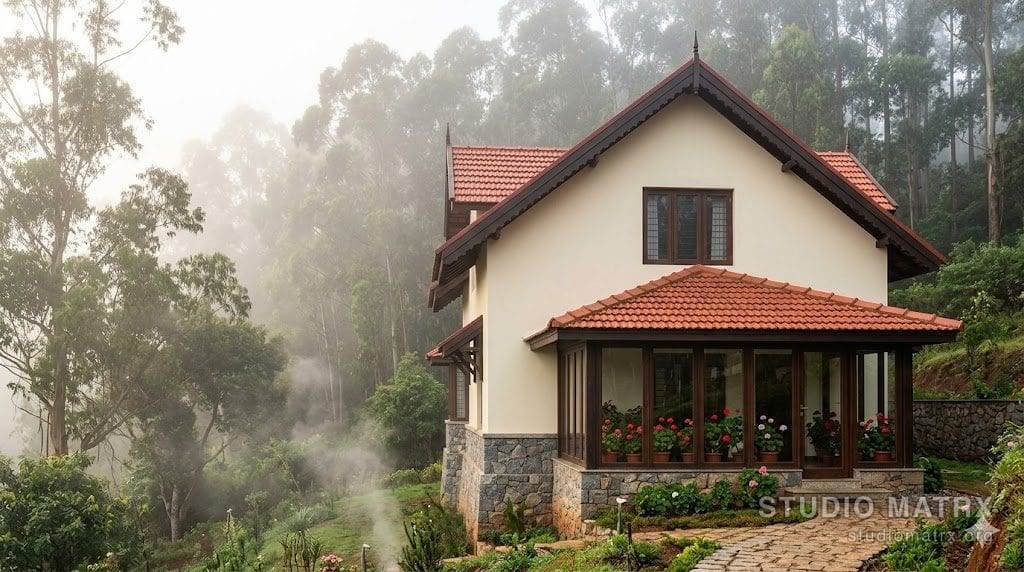
Hill Cottage — 30 × 40 ft Moderate Hill-Station Home
1200 sq ft plot · G+1 · 3 BHK · Mahabaleshwar · Ooty · Kodaikanal · Munnar · Shillong
Plot
40 × 30 ft
1200 sqft
Built-up
1450 sqft
G+1
Config
3 BHK
2 bath
Facing
S
Vastu: good
Strategy
Material-led
Predominantly natural/local
Cost
₹35–49 L
₹2,400–3,400/sqft
Suits: Mahabaleshwar · Panchgani · Ooty · Kodaikanal · Munnar · Madikeri · Chikkamagaluru · Darjeeling · Shillong
Climate zone — Moderate (Hill): Hill-station microclimate — cool summers, foggy monsoons, mild winters. Sloped roofs, tile and timber, fireplaces, terraced layouts.
Interactive Floor Plan · 40 × 30 ft · 1200 sq.ft plot
Hill Cottage — 30 × 40 ft Moderate Hill-Station Home
Ground floor · 760 sq ft built · sloped site
India's moderate climate zone is the smallest and most romantic in the country — the hill-stations between 1,400 and 2,400 m altitude that the British built for summer relief and that Indian families now treasure as second homes and retirement plots. Ooty, Kodaikanal, Munnar, Mahabaleshwar, Panchgani, Madikeri, Chikkamagaluru, Darjeeling, Kalimpong, Shillong, Mussoorie, Lansdowne — each has its own micro-character but the climate is recognisably one type:
- Cool summers (rarely above 25 °C; nights often need a light shawl)
- Mild winters (10–18 °C day, 5–10 °C night; occasional ground frost at higher altitudes)
- Heavy monsoon (2,500–3,500 mm annual rainfall; Ooty + Munnar peak at 4,500 mm; Cherrapunji nearby is an extreme case)
- Persistent fog October to February
- Modest diurnal swing (~8 °C)
- Air so clean it carries the smell of eucalyptus, tea, or pine
The design language is Anglo-Indian + local vernacular — Nilgiri tea-estate bungalows, Mussoorie cottages, Khasi timber houses, Darjeeling tea-garden quarters. A steep gabled roof. Stone plinth, timber-frame upper. Deep eaves. A working open fireplace as the room's emotional centre — not because the winters demand it (they don't, mostly) but because the monsoon dampness and the psychological hill-station ritual both call for fire. A mudroom at the entry for boots and umbrellas. Generous timber. Heated floors in the bathroom. And outside, terraced gardens dropping down the slope to a fruit-tree row at the rear.
The Hill Cottage is that home, rendered for a contemporary 30 × 40 ft plot.
Site & Orientation
The plot is 30 ft wide × 40 ft deep. Like the cold-zone Trombe Cabin, the 40 ft dimension runs east-west so the long south face captures winter sun and morning warmth — but unlike the cold zone, the temperatures don't demand a Trombe wall. Generous south openings + the fireplace are sufficient.
- South facade (40 ft long) — main glazing, sunporch, parlour openings. Captures gentle hill-station sun year-round.
- North facade (40 ft long) — protected by the slope (most plots step uphill), kitchen + service zone.
- East 30 ft — entry mudroom + verandah; morning sun penetrating fog.
- West 30 ft — service end + utility yard.
Hill plots almost always slope — the design assumes the plot drops ~1.5 m from north to south (entry side typically uphill, garden side downhill), with stone retaining walls at the property edges. If your site slopes differently, mirror the plan accordingly; the south-facing principle is the non-negotiable.
Setbacks (per Mahabaleshwar Hill Station Municipal Council + Nilgiris District TCP + Meghalaya Municipal Bye-laws for plots in the 100–250 sqm band):
| Setback | Required | This Design |
|---|---|---|
| Front (south, road side downhill) | 2.0 m | 2.4 m (sunporch + entry court + garden steps) |
| Rear (north, uphill) | 1.5 m | 1.5 m (kitchen utility + retaining wall + drainage gutter) |
| Side (east) | 1.5 m | 1.5 m (mudroom entry + parking) |
| Side (west) | 1.5 m | 1.8 m (utility + firewood store + flue clearance) |
Hill-station bye-laws typically restrict ground coverage to 50–55% and total height to 9 m (two storeys + sloped roof). This design comes in at 51% ground coverage and 8.4 m total height to the ridge. Buildable envelope ≈ 24 × 27 ft = 648 sqft per floor, totalling ~1,450 sqft over G+1 including the sunporch cantilever. FAR consumed ≈ 1.21 against typical hill-station allowance of 1.40.
Hill-station specifics:
- Mahabaleshwar HSMC: ground coverage 50% max; sloped roof mandatory in heritage core; specific list of approved facade materials (stone, lime-render, slate, terracotta).
- Nilgiris (Ooty, Coonoor, Kotagiri): TNTCP hill-station rules; mandatory tree-preservation (no felling without permission); shola-grassland setback in some wards.
- Munnar (Idukki Municipality): KMBR + Kerala hill-station rules; no flat-RCC roofs in tourist-zone wards.
- Darjeeling DMC: Earthquake Zone IV detailing mandatory; slate-roof preferred in heritage zones.
- Shillong (East Khasi Hills, MMA): Khasi land-tenure system means plot title verification + Dorbar Shnong (village council) clearance is required before any application.
Always verify the latest local bye-law before submission — see Setbacks Across India guide.
Ground Floor Plan
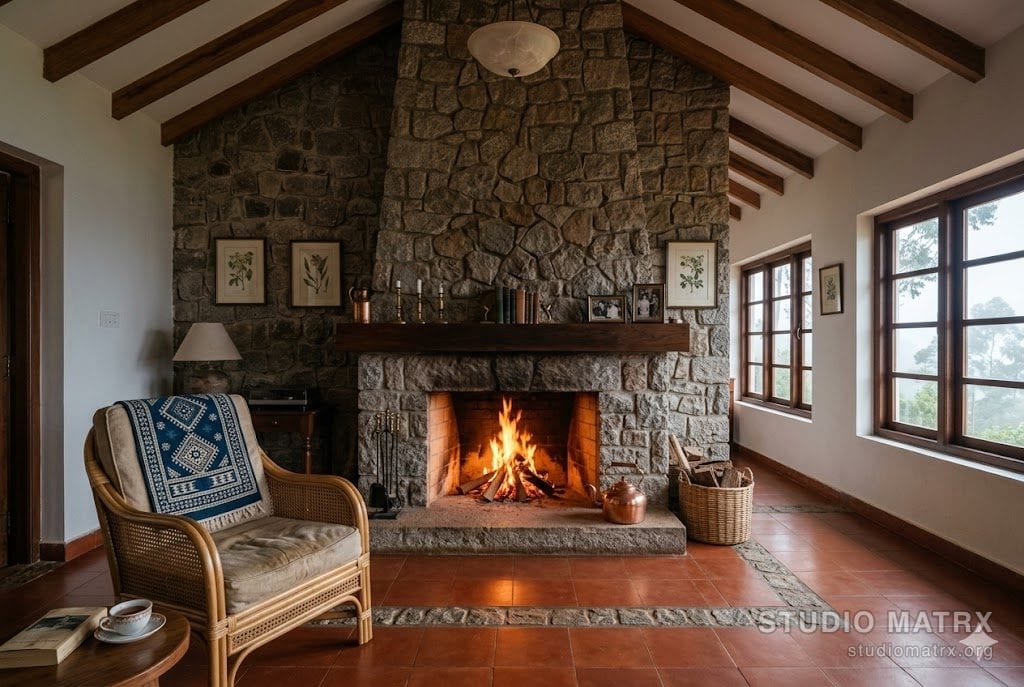
The ground floor is organised around the fireplace parlour — the largest room of the home, double-height to the timber-rafter ceiling, with the masonry fireplace anchoring the west wall. The parlour serves as living room + casual dining + winter sit-out + monsoon refuge — the multi-purpose room that hill-station families actually use most of the year. The dining-kitchen sits behind it (north), the sunporch wraps the south face, and the mudroom-entry sits on the east.
Room Schedule (Ground Floor)
| Space | Size | Notes |
|---|---|---|
| Mudroom + entry (in setback) | 5 × 8 ft | East-facing; boot rack, umbrella drip-tray, jacket hooks, dog water bowl |
| Sunporch (glazed verandah, south) | 6 × 18 ft | South-facing along full living + parlour width; potted citrus + ferns |
| Fireplace parlour | 14 × 16 ft | Double-height to rafters; west-wall stone fireplace + walnut surround |
| Dining + kitchen (open) | 10 × 14 ft | North of parlour; pantry on east wall, gas + wood-fired oven option |
| Powder / WC | 4 × 5 ft | Off mudroom corridor |
| Pooja niche | 3 × 4 ft | North-east — see Pooja Room Design guide |
| Stairs | 4 × 9 ft | West-central, open-tread timber, wraps around fireplace chimney mass |
| Utility yard (in setback) | 4 × 8 ft | Rear north — pantry overflow, gas cylinder, electrical panel |
| Firewood store (in setback) | 3 × 6 ft | West side — sheltered, sized for one winter's wood (~1.2 cubic metres) |
| Parking (in setback) | 8 × 16 ft | East side — terraced into slope, gable-roofed |
The double-height parlour with fireplace is the design's signature interior move. Ceiling height 18 ft to the ridge, exposed timber rafters in Nilgiri eucalyptus or Burma teak, fireplace breast in random-rubble local stone rising the full height. This is the room you sit in on a foggy Munnar afternoon with a chai and a book. It is also the room that asks the most of the structural engineer — a beam over the dining opening, lateral bracing for the double-height void, snow-and-wind detailing for the gable.
Sunporch — Buffer + Indoor Garden
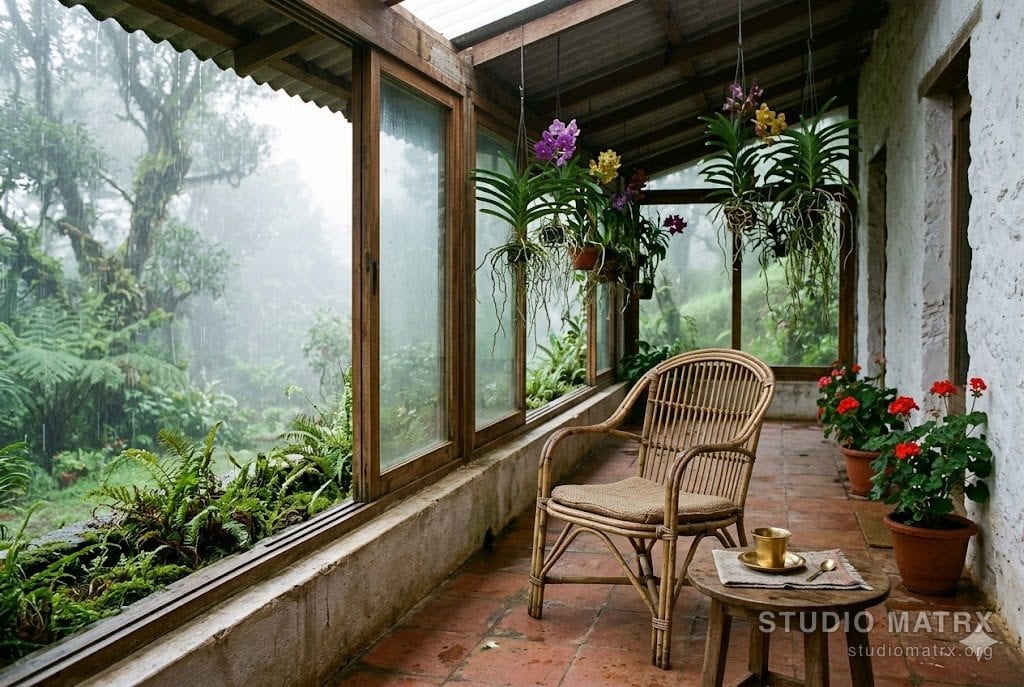
The 6 × 18 ft sunporch along the south face is the moderate-climate equivalent of the cold-zone sunspace, scaled down for the milder demand. South-facing single-glazed (DGU is overkill at these temperatures), full-height openings with double-track sliding doors that retract entirely in fine weather. Floor in 25 mm terracotta + 15 mm fern-bed planters along the parapet edge.
What the sunporch is for:
- Foggy mornings (Oct–Feb) — sealed buffer; warms 4–6 °C above outdoor on sunny days; reads as an outdoor room without the chill.
- Monsoon (Jul–Sep) — sheltered sit-out; rain on the slate roof above is the soundtrack.
- Summer evenings (Mar–May) — fully open; effectively a verandah; chai + sunset.
- Indoor garden year-round — orchid collection, geraniums, fern wall, one bonsai (a hill-station hobby).
In Ooty / Munnar / Mahabaleshwar / Shillong, the sunporch is the room you describe to relatives back in the plains. It is the home's mood-room.
First Floor Plan
The first floor under the steep gabled roof is the night zone + retreat — three bedrooms (one master + two secondary), two bathrooms, a small study, and a covered south balcony. The gable roof gives the upper rooms a vaulted ceiling sloping from 8 ft at the eaves to 12 ft at the ridge — a generous spatial experience that compensates for the compact plan footprint.
Room Schedule (First Floor)
| Space | Size | Notes |
|---|---|---|
| Master bedroom | 12 × 14 ft | South-east, over parlour; deep south windows + balcony access |
| Master bath (attached) | 5 × 8 ft | Shower + WC + basin; heated floor coil under terracotta (the moderate-climate small luxury) |
| Second bedroom | 10 × 11 ft | South-west, over kitchen; south window + small west window |
| Third bedroom / study | 8 × 11 ft | North-east, smaller window; built-in window seat with view of slope |
| Shared bath | 4 × 7 ft | Off corridor, top-lit via slate-roof skylight |
| South balcony | 5 × 14 ft | Off master; planters on parapet; covered by gable overhang |
| Stairs continuing to attic | 4 × 9 ft | Sealed access to storage attic |
The heated bathroom floor is a small detail that defines hill-station luxury. A 100 W/m² electric coil under the terracotta tile, controlled by a wall thermostat — runs 2 hours in the morning, ~₹400/year in electricity, and transforms the moderate-climate bath experience from "shrug and bear it" to "linger". For a working couple's master bath at 5 × 8 = 40 sqft, the install adds ~₹35,000 and is the single most-loved upgrade in every hill-station retrofit project we've seen.
The window seat in the third bedroom is the second small move — a 1.8 m wide built-in nook overlooking the north slope (uphill), cushioned in handloom dhurrie or cotton, used by adults for reading and by children for sleepovers. Hill-station vernacular at no extra cost.
Roof — Steep, Honest, Mangalore-Tiled
The Indian moderate-climate roof is steep and gabled — 30–35° pitch, broad eaves, no parapets, no flat sections. The reasons are straightforward:
- Rain volume — 2,500–4,500 mm annual rainfall sheds best off steep slopes; flat slabs fail.
- Fog drainage — extended eaves (450–600 mm) keep fog moisture off the walls.
- Snow (rare but possible) — Mahabaleshwar, Munnar, Mussoorie + Lansdowne all see occasional snow; steep roof clears it.
- Cultural reading — the gabled hill-station home is recognisably itself. A flat-roofed Munnar house reads as misplaced suburb.
Roof material by town:
| Town | Preferred Roof | Notes |
|---|---|---|
| Mahabaleshwar / Panchgani | Mangalore tile or slate (heritage) | Local Mangalore tile sourced from Goa supply chain |
| Ooty / Kodaikanal | Mangalore tile, optionally slate | Heritage wards prefer slate |
| Munnar / Wayanad | Mangalore tile (Kerala roof default) | Available from local Kerala tile factories |
| Madikeri / Chikkamagaluru | Mangalore tile | Local supply abundant |
| Darjeeling / Kalimpong | CGI sheet or slate | Slate (Khasi) traditional; CGI for budget |
| Shillong | CGI sheet, painted black or red | The Khasi vernacular preference |
| Mussoorie / Lansdowne | Slate or CGI | Slate Mussoorie-traditional; CGI common |
The build-up: 150 × 200 mm timber rafters @ 600 mm c/c, 150 × 100 mm purlins, 20 mm boarding, vapour barrier, 50 mm rockwool insulation, breather membrane, 40 mm batten air gap, Mangalore tile or slate or CGI. U-value 0.32 W/m²K — meets ECBC moderate-climate target. Total roof structural depth ≈ 350 mm including rafters.
Eaves project 450 mm minimum beyond the wall plane (600 mm preferred on the south rain-side). This is non-negotiable for fog + monsoon protection; reducing the eave to "save money" guarantees damp walls within 2 monsoons.
Facade — Street View
The south facade reads as a stone-and-timber cottage with a generous sunporch — Anglo-Indian in lineage, contemporary in restraint. Stone-plinth (450 mm random-rubble local stone) up to ground-floor sill level, lime-rendered AAC walls above, dark timber window frames and gable bargeboards, and a Mangalore-tiled gable roof with deep eaves. The sunporch projects 1.2 m beyond the wall plane, half-buried in geranium pots.
Materials palette (facade):
- Stone plinth + GF base — 450 mm random-rubble local stone (Mahabaleshwar trap rock / Ooty granite / Munnar laterite-granite / Darjeeling slate / Shillong sandstone)
- GF upper walls — 230 mm AAC + 50 mm rockwool cavity + 20 mm lime render outside + 20 mm lime render inside (U = 0.35 W/m²K)
- First-floor walls — 230 mm AAC + lime render + selective timber cladding on south gable
- Roof — slate or Mangalore tile per town (see table); 30–35° pitch; 450–600 mm eaves
- Windows — timber frame (Nilgiri eucalyptus, treated jackwood, or Burma teak) + 6 mm clear toughened glazing
- Doors — solid teak entry with weather-stripped jamb (essential for fog seal)
- Sunporch glazing — full-height single 6 mm clear toughened; timber sliding-door frames
- Gable bargeboards + brackets — dark-stained eucalyptus or rosewood, sometimes carved (Mahabaleshwar / Ooty heritage detail)
- Rainwater downpipes — copper or GI, exposed, painted dark; lead to underground rainwater tank
Section — Climate Logic
The section explains how the same compact volume serves a year-round moderate climate that swings less than the plains but is much wetter.
Year-Round Comfort Strategy
| Condition | Frequency | Strategy |
|---|---|---|
| Mild day (18–24 °C, sunny) | 40% of year | Open everything; sunporch fully retracted |
| Cool day (12–18 °C) | 30% of year | South windows open; ceiling fan off; one shawl |
| Foggy day (10–14 °C, 95% RH) | 15% of year | Sunporch sealed; fireplace 2–3 hours; warm tea |
| Monsoon day (16–22 °C, heavy rain) | 12% of year | All windows half-cracked; ceiling fan low; dehumidifier optional |
| Cold spell (5–10 °C, clear night) | 3% of year | Fireplace 3–4 hours; bedroom blanket; heated floor in master bath |
| Hot day (25–28 °C, rare) | < 1% of year | Open everything; ceiling fan |
Sun on the Facades
- South: Year-round sun penetration; 600 mm eave blocks summer noon but admits winter low sun.
- East + west: Brief direct sun morning and evening; manageable with light timber shutters.
- North: Diffuse only; protected by uphill terrain.
In all of Mahabaleshwar, Ooty, Kodaikanal, Munnar, Madikeri, Darjeeling, Shillong — this strategy never requires air-conditioning and only needs the fireplace 1–2 hours per day on foggy or cold days for 4–5 months a year.
Biophilic Score — 80 / Exemplary
This design scores 80 / 100 on the 16-criterion biophilic framework (see Biophilic Score Calculator). Slightly below the temperate Garden Pavilion (85) and Hot-Dry Haveli (82) because the gabled-enclosed form gives less mid-summer openness than a pavilion, but well above the cold Trombe Cabin (70) because the moderate climate permits more outdoor connection.
| Dimension | Score | Highlights |
|---|---|---|
| Nature in the Space | 33 / 40 | NIS01 (daylight) = 5; NIS02 (plants on sunporch + balcony) = 4; NIS04 (thermal variability via fireplace gradient) = 5; NIS05 (water — limited indoor; rainfall connection via downpipes) = 3; NIS06 (cross-ventilation, monsoon-modulated) = 4; NIS07 (visual nature — hill views) = 5 |
| Natural Analogues | 27 / 30 | NAA01 (stone, eucalyptus, slate, terracotta) = 5; NAA02 (cotton dhurrie, wool blankets, jute mats) = 5; NAA03 (gable + rafter geometry) = 5; NAA04 (organic stone-rubble texture) = 5 |
| Nature of the Space | 20 / 30 | NOS01 (prospect — long downhill garden view) = 5; NOS02 (refuge — fireplace nook + window seat + parlour) = 5; NOS04 (mystery — staircase wrapping fireplace) = 3; NOS05 (risk / awe — limited at this plot scale) = 3 |
Strategy classification: Material-led · Predominantly natural/local. The stone, timber, slate, and Mangalore tile carry most of the biophilic narrative — the materials themselves are the design.
FAR / Setback Compliance Snapshot
The plan complies with the following representative jurisdictions:
| City | FAR Used | FAR Allowed | Notes |
|---|---|---|---|
| Mahabaleshwar (HSMC) | 1.21 | 1.40 | Slate/Mangalore roof mandatory; heritage facade rules apply |
| Ooty (Nilgiris DTCP) | 1.21 | 1.30 | Tree preservation: any tree > 250 mm girth requires permission to fell |
| Kodaikanal (Nilgiris DTCP) | 1.21 | 1.30 | Shola grassland setbacks may apply in some wards |
| Munnar (Idukki Municipality) | 1.21 | 1.50 (KMBR) | No flat RCC roof in tourist-zone wards |
| Madikeri (Coorg) | 1.21 | 1.50 | Coffee-estate zoning may apply outside town |
| Darjeeling (DMC) | 1.21 | 1.40 | Seismic Zone IV detailing; slate roof in heritage zones |
| Shillong (East Khasi Hills) | 1.21 | 1.40 | Khasi land-tenure: Dorbar Shnong clearance required before submission |
| Mussoorie (MNP) | 1.21 | 1.40 | Slate roof preferred; heritage-zone facade list applies |
Hill-station bye-laws are conservative and historic-character-protective. See Setbacks Across India guide for jurisdiction-specific cross-checks.
Cost — Indicative
For 1,450 sqft built-up at moderate-climate 2026 prices (Ooty basis; Shillong + Darjeeling ~8% higher due to material transport; Munnar comparable):
| Tier | Per sqft (₹) | Total (₹ L) | Includes |
|---|---|---|---|
| Basic | 2,400 | 34.8 | Stone plinth + AAC + lime, Mangalore tile, basic timber frames + 6 mm single glaze, cast-iron fireplace, vitrified tile |
| Recommended | 2,800 | 40.6 | Random rubble plinth + AAC cavity (rockwool), Mangalore tile or local slate, treated jackwood frames, heated bath floor, terracotta + walnut interior |
| Premium | 3,400 | 49.3 | Hand-laid coursed stone plinth, slate roof, Burma teak frames + 6 mm double-glaze, full heated floor in master bath + powder, 3 kWp solar, carved bargeboards |
Why this is more expensive than Temperate (₹2,200–3,000) but less than Cold (₹2,800–3,800):
- Stone plinth (random rubble) over RCC plinth: + ₹150/sqft
- Rockwool 50 mm cavity wall over single AAC: + ₹100/sqft
- Mangalore tile / slate roof over flat RCC: + ₹200/sqft
- Working masonry fireplace + chimney + flue cap: lump sum ₹1.5–3 L (vs ₹0 elsewhere)
- Heated bathroom floor coil: ₹35,000–₹70,000 (premium tier only standard)
- Hill-town material transport premium: + ₹50–₹120/sqft
- Skilled stone-masonry labour premium: + ₹60/sqft
Headroom items not in cost:
- Furniture and soft furnishings (wool dhurries, walnut sideboard, jute rugs, cane chairs — the material palette extends indoors)
- Compound wall + gate (stone-and-timber post-and-rail in hill towns)
- Retaining walls + terraced landscaping (₹2–6 L depending on slope and length)
- Internal landscaping (sunporch ferns + balcony cascade + downhill terrace — ₹1–3 L)
- Solar PV beyond 3 kWp (panel snow-shedding required in higher-altitude towns like Mussoorie)
- Backup generator (Munnar + Shillong have unreliable supply Oct–Mar; ₹50,000–₹2 L for inverter + battery or genset)
Materials Schedule
| Element | Specification | Reason |
|---|---|---|
| Stone plinth + GF base | 450 mm random-rubble local stone, hand-pointed | Vernacular; flood / fog-splash resilience; iconic hill aesthetic |
| GF upper walls | 230 mm AAC + 50 mm rockwool + 20 mm lime render outside + 20 mm lime inside (U = 0.35) | Cavity wall manages thermal + monsoon dampness; lime is breathable |
| First-floor walls | 230 mm AAC + lime render + selective timber cladding south gable | Lighter on stone base; aesthetic continuity |
| Roof structure | 150 × 200 mm rafters + 20 mm boarding + vapour barrier + 50 mm rockwool + breather + 40 mm batten + tile/slate/CGI | U = 0.32; sheds rain + snow + fog moisture |
| Roof finish | Mangalore tile / slate / CGI per town (see table) | Local availability + heritage-zone compliance |
| Floor (parlour + dining) | 25 mm terracotta tile, polished + hearth band of cut stone | Vernacular; warm underfoot; durable to fireplace ash |
| Floor (sunporch) | 25 mm terracotta + fern-bed planter strip | Continuous indoor-outdoor reading |
| Floor (bedrooms) | 18 mm Nilgiri eucalyptus or Burma teak plank + 8 mm cork underlay | Warm underfoot; traditional |
| Bathroom walls + floor | 12 mm matte ceramic + heated coil under terracotta (premium) | Slip-safe; warm-floor comfort |
| Doors | 50 mm solid teak entry with weather-strip + 35 mm jackwood internal | Long-life entry; fog seal |
| Windows | Timber frame + 6 mm clear toughened (basic) or 6+12+6 DGU (premium) | Frame quality > glass complexity |
| Fireplace | Cast-iron insert OR masonry firebox; random-rubble breast; stainless 200 mm flue + roof cap | Working primary winter heat + monsoon ambiance |
| Insulation | Rockwool 50 mm walls + 50 mm roof | Closed-cell; non-combustible (fireplace proximity) |
| Rainwater downpipes | Copper or painted GI; exposed | Function + aesthetic; lead to 5,000 L underground tank |
| Gutters | Half-round copper or GI on all eaves | 2,500–4,500 mm rainfall demands engineered drainage |
Plant Palette
Native to Western Ghats / Nilgiris / Anaimalai / Eastern Himalaya, monsoon-fed, frost-tolerant where applicable:
- Sunporch (year-round indoor garden): Geraniums (multiple colours — the hill-station classic), fern wall, orchids (Vanda, Phalaenopsis — climate-appropriate), tulsi, mint, parsley
- South balcony planters: Lavender (drains well; loves cool sun), rosemary, thyme, plumbago, dwarf hydrangea
- Front (south) downhill terrace: Tea (one symbolic plant — Coorg / Munnar contexts), pomegranate, fig, peach (Ooty / Mahabaleshwar)
- Rear (north) uphill border: Eucalyptus screen (if not already on plot), Camellia, rhododendron (Mussoorie / Sikkim contexts)
- East entry court: Lemongrass clump, mint, curry leaf, citronella
- West firewood-store screening: Bamboo (Bambusa balcooa — clumping, not running)
- Roof terrace pots (if accessible): Strawberry (Mahabaleshwar's iconic crop), succulents, dwarf marigold
Vastu Notes
| Element | Direction | Notes |
|---|---|---|
| Entry | East (mudroom) | Vastu-good; south primary glazing is climate priority |
| Kitchen | North-west (acceptable variant) | Orthodox prefers SE; mitigated by burner facing east |
| Pooja niche | North-east | Exact Vastu fit |
| Master bedroom | South-east (first floor) | Acceptable; orthodox prefers SW but SW is bedroom 2 |
| Stairs | West-central | Acceptable; open-tread allows energy flow |
| Toilets | NW (powder) + central east (first) | Acceptable; mitigated by buffer walls |
| Fireplace | West (against parlour west wall) | Vastu-positive (fire in SE traditionally, but parlour position is climate-driven) |
| Brahmasthan | Centre parlour | Open, lofty, hearth-warmed — auspicious |
Rating: Good — the plan satisfies the major Vastu directional rules with hill-station climate-priority adjustments. The fireplace location is determined by chimney + structural logic (against the load-bearing west wall, vented through the gable), not Vastu. See Vastu for Modern Homes for how to balance Vastu and climate in hill stations.
Buildability — What to Verify Before Construction
This is a near-buildable design — the configuration, dimensions, FAR, and setback are valid for the cited jurisdictions. Before construction you will need:
1. Site-specific structural design by a licensed RCC consultant experienced in hill-town construction — soil-bearing in Mahabaleshwar / Ooty is typically rock at 1–2 m (good); Munnar / Wayanad have lateritic soils 100–200 kPa; Darjeeling / Sikkim soils unstable on steep slopes (specialist geotech mandatory). See Soil Bearing Capacity guide.
2. Slope stability + landslide hazard assessment — mandatory in Darjeeling, Mussoorie, Shillong; strongly recommended in Mahabaleshwar, Munnar, Wayanad post-2019 landslide events.
3. Seismic detailing for Zone III (Mahabaleshwar, Ooty, Munnar, Madikeri) or Zone IV (Darjeeling, Mussoorie, Shillong) — IS 13920 compliant detailing, tie-beams at lintel level. See Seismic Zones India Design.
4. Snow + wind load engineering where applicable — design wind speed 39–47 m/s 3-sec gust per IS 875 Part 3; design snow load 30–60 kg/m² for occasional-snow towns.
5. Tree-preservation clearance — Nilgiris + Kodaikanal mandate preservation of any tree > 250 mm girth; design preserves what's there.
6. MEP layout by a licensed contractor — electrical SLD with provision for 3 kWp solar + heated-floor circuit; plumbing with anti-freeze loops on external runs (higher-altitude towns); drainage to municipal sewer or septic + soak-pit per Septic Tank Sizer.
7. Local plan sanction — Mahabaleshwar HSMC, Nilgiris DTCP, Idukki Municipality, Darjeeling DMC, Shillong MMA. Khasi-land plots in Shillong require Dorbar Shnong (village council) clearance before formal MMA submission. See Building Plan Approval guide.
8. Heritage zone approval (Mahabaleshwar core, Ooty + Coonoor heritage, Mussoorie, parts of Munnar) — facade material restrictions; slate or Mangalore tile mandated; consult local INTACH chapter.
9. Fireplace + chimney inspection — design flue per IS 1646; annual chimney sweep service contract recommended (₹2,000–₹5,000/year).
10. Rainwater harvesting — most hill-station municipalities mandate rainwater harvesting + roof-water collection (rainfall is high, soak pits common); see Rainwater Harvesting guide.
Reading Pairings
- Passive Design — India Climate Zones
- Vastu Shastra for Modern Homes
- Sustainable Home Design India
- Solar Power for Homes India
- Rainwater Harvesting
- Seismic Zones India Design
- Functional House Layout — India
- Cross-Ventilation in Indian Homes
- Pooja Room Design
Tools to Use With This Plan
- Vastu Compliance Checker — verify your plot orientation matches the plan
- Biophilic Score — score variations you make to this design
- Cost Calculator — adjust the cost band for your hill town
- Sun Path Analyzer — visualise sun at Ooty (11.4° N), Mahabaleshwar (17.9° N), Shillong (25.6° N), or Darjeeling (27° N) sites
- Rainwater Tank Sizer — size the underground tank for 2,500–4,500 mm annual rainfall
- Solar Calculator — size the PV array for cloud-cover-adjusted yield
- Seismic Zone Checker — confirm your site's seismic zone
Author's note: The hill-station home is the most loved Indian residential typology — the one urban families buy second homes for, the one retiring couples build for the final chapter, the one writers write best in. But it is also the typology most frequently butchered by city architects who don't understand what a steep roof and a stone plinth and a working fireplace are doing. The Hill Cottage exists because the contemporary hill-station home should feel as right in Munnar as the British-era estate manager's bungalow feels next door — built in the same materials, in the same proportions, with the same fireplace mantle waiting for a tea-pot. The 30 × 40 ft constraint forces every move to earn its place. The fireplace stays in. The sunporch stays in. The slate roof stays in. The flat-RCC slab does not.
Disclaimer: This is a reference design intended to illustrate climate-responsive biophilic design at a 1200 sqft plot in India's moderate (hill-station) climate. Local building bye-laws, soil and slope conditions, seismic zone, rainfall load, statutory approvals, and structural engineering must be verified by a licensed architect and structural engineer experienced in hill construction before construction. Costs are indicative for 2026 in the cited regions and vary significantly by altitude, site access, contractor, finish choices, and material transport distance. Khasi-land plots in Shillong require Dorbar Shnong clearance before formal municipal submission — verify with local authorities.
Related Guides — Deep-dive reading
Orientation, Light & Views: Designing With Your Space, Not Against It
How reading your plot's sun, breeze and views — and placing each room on the right face — gives an Indian home that is cooler, brighter and quietly right, instead of one that fights its site forever.
Design PrinciplesFloor-to-Ceiling Windows (India): Maximum Light, and the Heat Trade-Off
Full-height glazing for Indian homes — how to win the daylight and view without losing the energy code, comfort or safety.
Windows & GlazingRoofing for Heavy Monsoon Areas
Kerala, the Konkan coast, the Western Ghats and the North-East get some of the heaviest rain on earth. A plain-language, India-grounded guide to designing and detailing a roof that sheds it fast, throws it clear of the walls, drains it away and never lets it in.
RoofingRelated Tools — Try Free
Cross-Ventilation Analyzer
Estimate airflow and air changes per hour (ACH) from room size, window areas, layout, and local wind — with NBC 2016 Part 8 compliance check.
Ventilation CalculatorBrise-Soleil Visualizer
Interactive horizontal-louvre cut-off angle calculator — sun altitude, louvre depth, and spacing inputs with a live shadow preview. Computes θ = arctan(spacing/depth) for façade shading, ECBC envelope compliance, hospital daylight design, and tropical sun-control detailing.
Sun Shading ToolRainwater Tank Sizer
How big should your rainwater tank be? Computes annual harvest, recommended tank capacity in litres, water-bill savings, and payback — for 10 Indian cities.
RWH Calculator