
Sustainable Furniture in India: Eco Materials, Certifications & Low-VOC (2026)
How to choose eco-friendly, healthy furniture for an Indian home — why durability is the biggest lever, which materials are genuinely responsible, how to read formaldehyde and VOC labels, and how to tell a real certification from greenwashing.
"Sustainable furniture" is one of the most greenwashed phrases in Indian retail. A leaf logo, the word "eco", a line about "natural wood" — and the price goes up while nothing about the piece is actually better for the planet or your lungs. This guide cuts through that. Sustainable furniture is not a material you buy; it is a set of decisions you make — about how long the piece lasts, where its material came from, what it off-gasses into your home, whether it can be taken apart at the end, and how far it travelled to reach you.
The single most important idea, before any material or certificate: the greenest piece of furniture is the one you already own, kept and repaired, and the second greenest is a well-made piece you will still want in twenty years. Everything else is a distant third. Read this alongside the pillar guide to furniture, and if you want the building-scale picture, the sustainability and green buildings hub.
Scope & how to read this. This is a homeowner's buying-and-living guide, not a lab spec. Emission classes, certification names and material notes here are general and indicative to help you ask better questions and budget — confirm the exact grade, certificate number and IS-code compliance with the seller and the issuing body before you rely on a claim. Costs are relative bands, never firm prices — get local quotes. Where indoor-air health is involved (formaldehyde, VOCs) we flag it seriously: treat low-emission choices as a health decision, not a nicety.
What actually makes furniture sustainable
Five levers decide how sustainable a piece really is. They are not equal — durability dwarfs the rest.
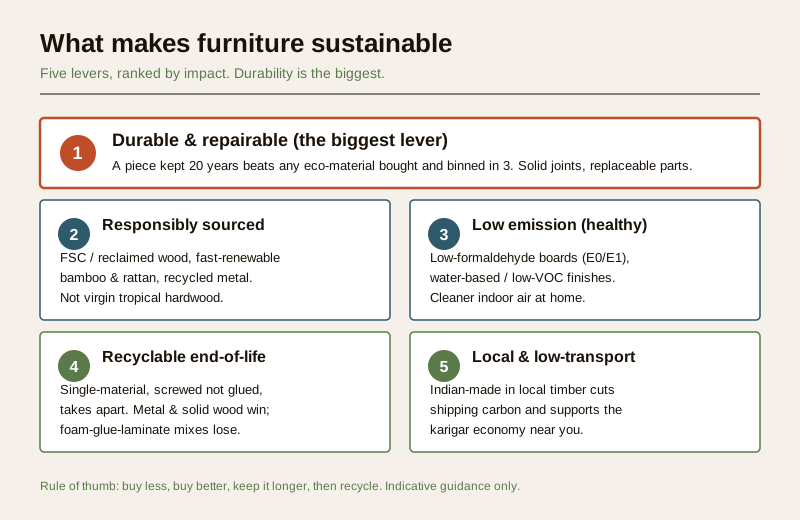
- Durable and repairable — the biggest lever by far. A solid-wood bed kept for 25 years and reglued twice has a tiny yearly footprint. A trendy board-and-laminate unit binned in three years does not, no matter how "eco" the brochure. Longevity beats material every time, so buy for the joint, the hinge and the fixability first.
- Responsibly sourced material. Where the wood, cane, metal or fabric came from: certified or reclaimed timber, fast-renewable bamboo and rattan, recycled metal and plastic — rather than virgin tropical hardwood of unknown origin.
- Low-emission (healthy). What the piece releases into your air — formaldehyde from board glues, VOCs from finishes and adhesives. This is the health lever, covered in its own section below.
- Recyclable at end-of-life. Whether the piece can be taken apart and its materials recovered. Screwed-together single-material pieces win; foam-glue-laminate composites are near-impossible to recycle.
- Local and low-transport. Indian-made in regionally available timber, by a nearby karigar, avoids container-shipping carbon and keeps skills alive. "Imported solid oak" carries freight most Indian species do not — the imported vs Indian furniture trade-off is partly a carbon one.
Rank these for your purchase. For most homeowners the honest order is: keep it long, buy it well-made and local, then optimise the material and finish. The sustainable material selector and the furniture carbon footprint calculator turn this into rough numbers you can compare.
Eco materials — what is genuinely responsible
Material matters, but "natural" is not the same as "sustainable". A slow-growing hardwood logged illegally is natural and terrible; recycled steel is industrial and excellent. Here is an honest read for Indian homes.
| Material | Why it can be sustainable | Watch-outs (India context) |
|---|---|---|
| FSC-certified solid wood | Responsibly managed forestry; repairable, long-lived, recyclable | Certificate must be genuine and cover this product; see solid wood furniture |
| Reclaimed / salvaged wood | Reuses existing timber; zero new felling; character | Check for old nails, treatment chemicals; may cost more, not less |
| Bamboo & rattan / cane | Fast-renewable grass and vine; light; low-input; local in many states | Needs a low-VOC finish; humidity care — see cane and rattan furniture |
| Recycled metal (steel/aluminium) | High recycled content; endlessly recyclable; durable frames | Powder-coat finish quality varies; heavier transport |
| Recycled plastic / PET | Diverts waste; weather-proof outdoor use | Still fossil-derived; prefer high recycled content and single-polymer |
| Low-formaldehyde engineered board | Uses fast-grown / waste wood fibre efficiently | Insist on E0/E1 grade and check moisture-resistance — see engineered wood and MDF vs particle board |
| Natural fabrics (cotton, jute, wool, linen) | Renewable, biodegradable, breathable, often local | Dye and blend matter; pure synthetics shed microplastics and are oil-based |
A few honest calls. Solid wood is the most repairable and recyclable choice but only sustainable if the source is responsible — origin beats species. Engineered boards are not the villain: made from waste fibre, they use timber efficiently, and a low-formaldehyde board can be a sound eco choice — the problem is only the high-emission glue in cheap grades. Natural fabric beats synthetic on biodegradability and microplastic shedding, but a natural fabric you replace yearly loses to a hard-wearing one that lasts a decade. Durability wins again.
Indoor air & health — formaldehyde and VOCs
This is the part to take seriously, because it affects the people who live with the furniture, not a distant forest. New board furniture and freshly finished pieces release formaldehyde and volatile organic compounds (VOCs) into your indoor air — the "new furniture smell" is largely off-gassing. Formaldehyde is a recognised indoor-air irritant; sustained high levels are a genuine health concern, especially in closed, air-conditioned Indian bedrooms and children's rooms.
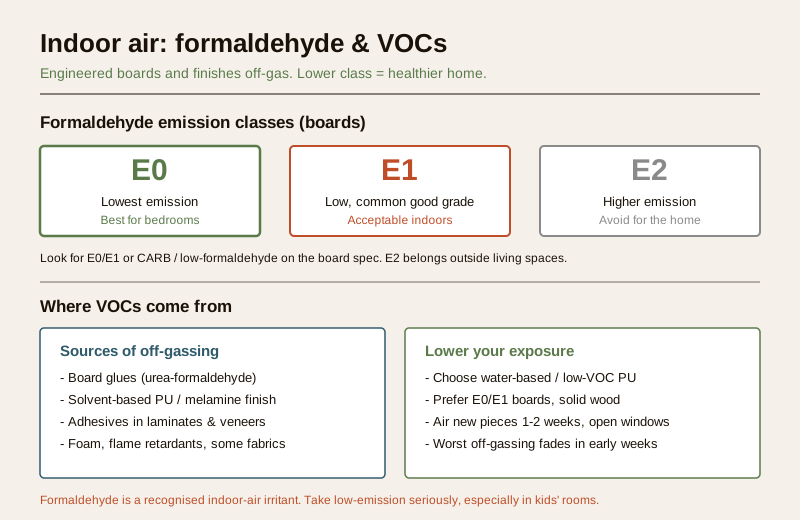
Formaldehyde emission classes. Engineered boards are graded by how much formaldehyde they release. In descending order of emission you will see E2 (highest), E1 (low, the common good grade), and E0 (lowest); internationally you may also see CARB-compliant boards, which cap emissions similarly. The rule is simple: for anything inside the home, prefer E1 or E0; keep E2 out of living and sleeping spaces. Ask for the board's class in writing — a reputable supplier will name it.
| Emission class | Relative formaldehyde | Where it belongs |
|---|---|---|
| E0 | Lowest | Ideal for bedrooms, kids' rooms, closed spaces |
| E1 | Low | Acceptable general indoor use; common good grade |
| E2 | Higher | Avoid indoors; not for living or sleeping areas |
| CARB / low-emission mark | Tightly capped | A useful cross-check on top of the E-class |
VOCs from finishes and adhesives. The board is only half the story — the finish matters just as much. Solvent-based PU, melamine and NC finishes, and the adhesives in laminates and veneers, release VOCs as they cure. This is why water-based and low-VOC finishes are worth paying for: a water-based PU or a low-VOC lacquer off-gasses far less into your home while still protecting the surface. When you brief a carpenter or read a spec, ask specifically for low-VOC / water-based systems — the PU finish vs laminate comparison and best laminate finishes cover the finish trade-offs.
Off-gassing new furniture — always ventilate. Emissions are highest when a piece is new and fall over the following weeks. So with any new board or freshly polished furniture: unwrap it, let it air — ideally a week or two, in a well-ventilated space, before it goes into a closed bedroom — and keep windows open early on. Cross-ventilation and a few indoor plants help; the healthy homes hub covers indoor-air quality more broadly. This one habit meaningfully lowers your exposure at no cost.
Certifications — what to look for, and greenwashing
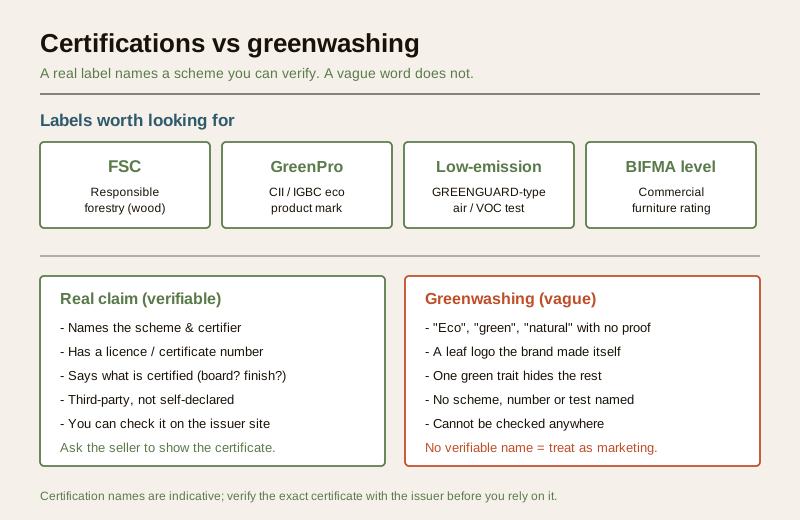
A real eco-claim names a scheme you can verify. A greenwashed one uses a warm word and a leaf. Learn to tell them apart and most marketing fog clears.
| What to look for | What it signals | How to read / verify it |
|---|---|---|
| FSC (or equivalent forestry mark) | Wood from responsibly managed forests | Ask for the certificate / licence number; confirm it covers this product |
| CRI GreenPro / IGBC (Indian Green Building Council) | Third-party eco-product certification, India | Check the product listing on the certifier's own site |
| GREENGUARD-type low-emission mark | Tested low chemical / VOC emissions | Confirms indoor-air performance; note what was tested |
| BIFMA level (commercial furniture) | Sustainability + durability rating for office furniture | Most relevant for commercial furniture; tiered levels |
| E0 / E1 / CARB board declaration | Low formaldehyde emission | Named on the board spec sheet, not the brochure |
How to spot greenwashing. A trustworthy claim (a) names the specific scheme and certifier, (b) carries a licence or certificate number, (c) states exactly what is certified — the whole product, just the board, just the finish — and (d) can be checked on the issuer's website. A greenwashed claim does none of this: it says "eco", "green" or "natural" with no proof, shows a leaf logo the brand invented, or highlights one green trait (bamboo legs) while ignoring a high-VOC finish and throwaway build. The test is one question to the seller: "Which certification, and can you show me the certificate?" A genuine one is produced happily; a marketing one evaporates. Beware the single-attribute trap too — one recycled component does not make an un-repairable, high-emission piece sustainable.
Buy less, buy better — repair, reuse, circular
Because durability is the biggest lever, the most sustainable strategy is behavioural, not material.
- Buy less, buy better. One well-made piece that lasts beats three that don't. Spend the sustainability budget on joinery, frame and finish quality — the furniture buying guide and cost guide help you place that spend.
- Repair before replace. A wobbly joint, a tired finish or a sagging seat is fixable. See furniture repair and restoration, wooden furniture care and polishing and refinishing.
- Reupholster, don't rebuy. A sound sofa frame can live on with new foam and fabric — choose natural or low-impact fabric — via upholstery replacement and looked after per fabric upholstery care. This is one of the highest-leverage green choices in the home; upholstered pieces are covered in upholstered furniture.
- Upcycle and repurpose. An old door becomes a table; a trunk becomes storage. Character plus zero new material.
- Buy second-hand / circular. Pre-owned solid-wood and metal furniture is abundant in Indian resale markets and carries near-zero new footprint. In small homes, multi-use pieces do more with less — see storage solutions for compact apartments.
- Plan for end-of-life. Favour pieces that come apart (screwed, single-material) so wood, metal and fabric can be recovered rather than sent to landfill as a fused composite. Donate or resell usable pieces; segregate materials for recycling only at the true end.
How it connects
- Start at the complete guide to furniture, then choose responsibly by material: solid wood, engineered wood, MDF vs particle board and cane and rattan.
- Keep pieces alive — the real sustainability move: furniture repair and restoration, wooden furniture care, polishing and refinishing and upholstery replacement.
- On health and safety, pair this with furniture safety and regulations and the healthy homes hub; on the big picture, the sustainability and green buildings hub.
- Weigh sourcing and freight with imported vs Indian furniture and buy well with the furniture buying guide.
- Put numbers on it with the sustainable material selector and the furniture carbon footprint calculator; students can go deeper in furniture construction and detailing.
Key takeaways
- Durable and repairable is the biggest sustainability lever — a piece kept and fixed for decades beats any "eco" material bought and binned in a few years.
- Responsible sourcing beats "natural" — FSC or reclaimed wood, fast-renewable bamboo and rattan, and recycled metal, not virgin hardwood of unknown origin.
- Take indoor air seriously — prefer E0/E1 low-formaldehyde boards and water-based / low-VOC finishes, and always ventilate new furniture for a week or two before it enters a closed bedroom.
- A real certification is verifiable — it names the scheme (FSC, GreenPro/IGBC, GREENGUARD-type, BIFMA level), carries a number, and can be checked; vague "eco/green" words with no scheme are greenwashing.
- Buy less, buy better, then reuse — repair, reupholster, upcycle, buy second-hand, and choose pieces that come apart so materials can be recovered at end-of-life.
- Every figure and grade here is indicative — confirm the exact emission class, certificate and IS-code compliance with the seller and issuer, and get local quotes for cost.
References
- Formaldehyde emission classes E0 / E1 / E2 and CARB-type low-emission requirements for wood-based panels — named generally; confirm the grade on the board's declaration.
- IS plywood, particle board, MDF and blockboard standards (IS 303 / IS 710, IS 3087 / IS 3097, IS 12406, IS 1659) — board grades, moisture resistance and test methods, named generally.
- The IS furniture standards for strength, stability and durability — named generally; relevant to how long a piece lasts.
- CRI GreenPro and IGBC (Indian Green Building Council) eco-product certification; GREENGUARD-type low-emission certification; BIFMA sustainability levels for commercial furniture — named generally; verify each certificate with the issuing body.
- FSC responsible-forestry certification for wood — named generally; confirm the licence covers the specific product.
All emission classes, certification names, material notes and cost bands here are indicative planning aids only; confirm the exact grade, certificate number and IS-code compliance with the seller and the issuing body, get local quotes for cost, and treat any indoor-air-quality concern as a health matter worth professional advice.
Export this guide
Related Guides — Deep-dive reading
The Complete Guide to Furniture for Indian Homes (2026)
The start-here master guide for furnishing an Indian home — what furniture actually does, the five families of pieces, the decisions in the order you face them (space and needs, loose vs modular vs built-in, materials, size and layout, budget, buy, maintain), an honest read on plywood, humidity and termites, and where every choice hands off to the carpenter, the brand or the fixer.
FurnitureLow VOC Bathroom Materials India: Healthy Paints, Sealants & Boards for Better Indoor Air
An India-first guide to low-VOC and formaldehyde-free bathroom materials — paints, sealants and adhesives whose fumes matter in a small unventilated room, E1/E0 boards for vanities, recycled and natural finishes, and the GreenPro, IGBC and GRIHA certifications worth checking before you buy.
BathroomsEco-Friendly Door Materials: A Sustainability Guide (India 2026)
Rubberwood, bamboo, agri-fibre board, reclaimed timber, FSC plywood and recycled WPC scored on renewability, carbon, emissions, durability and recyclability.
Home Doors & EntrancesRelated Tools — Try Free
Window Material Comparison Tool
Compare uPVC, aluminium, wood, steel and composite windows on cost, life, upkeep and insulation.
CompareCross-Ventilation Analyzer
Estimate airflow and air changes per hour (ACH) from room size, window areas, layout, and local wind — with NBC 2016 Part 8 compliance check.
Ventilation CalculatorApartment vs Villa Interior Planning Guide
Compare ceiling height, structural flexibility, lighting, storage, and services between apartments and villas.
Planning Guide