
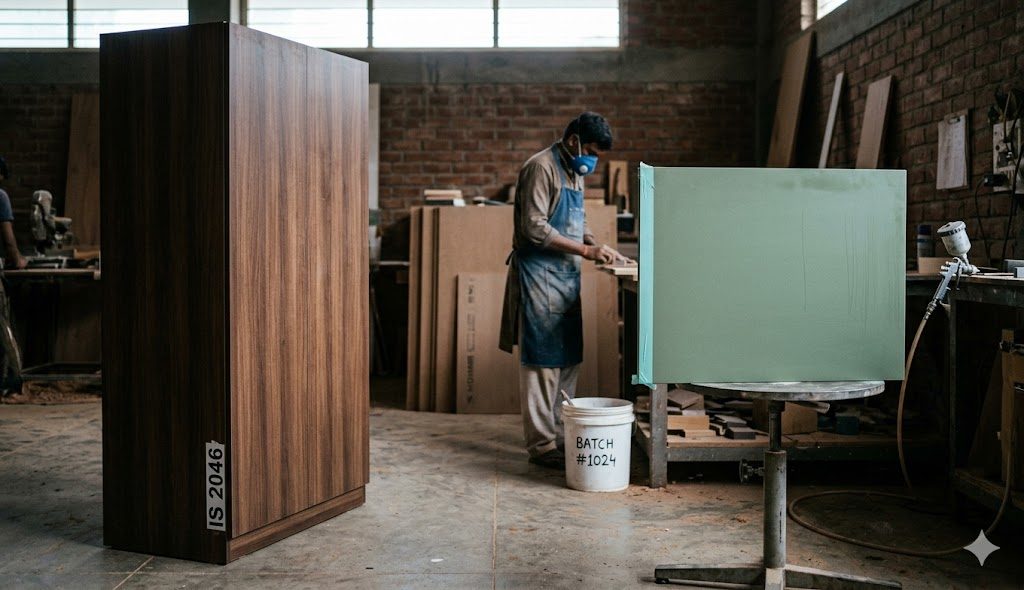
PU Finish vs Laminate Cost Comparison
Spray-paint premium versus factory-pressed sheet — the all-in cost, the look, the durability and the zones where each one earns its keep
The PU-versus-laminate decision is the most consequential finish call in an Indian interior. It is the line between a quote that lands at ₹220 per sqft of shutter and one that lands at ₹620 per sqft of shutter. It is the line between a factory-pressed sheet with visible 2 mm edge bands and a monolithic spray-painted shutter with no joint anywhere. It is the line between predictable ten-year ageing and a finish that yellows in the wrong sunlight but can be patch-repaired in zones. Most homeowners are quoted both and asked to choose, with very little of the underlying engineering explained.
This guide is the costed comparison — what PU actually is, what laminate actually is, the cost-per-square-foot at three tiers, the look difference, the ten-year ownership math, the brand landscape, and the zones where the PU premium earns its keep versus the zones where laminate wins on every dimension that matters.
It is a deep-dive companion to our complete guide to plywood grades in India — because both finishes are nothing without the substrate they sit on.
What PU finish actually is
Polyurethane (PU) finish is a multi-coat liquid paint system, sprayed onto a primed substrate and cured by chemical reaction. The full system is typically:
1. Substrate prep — sand the HDHMR or MDF substrate, fill any pinholes with a polyester filler, sand again to 320-grit.
2. Primer coats — two coats of PU primer-surfacer, sanded between each coat. This builds the smooth base that the topcoat will sit on.
3. Topcoats — two to four coats of pigmented PU topcoat, sprayed by HVLP gun in a controlled dust environment, with light sanding between coats.
4. Cure — air-dry over 24–72 hours, or oven-cured at 40–60 °C for a tighter film and a higher gloss-stability.
The chemistry is a two-component reaction between a polyol resin (the colour, the body) and an isocyanate hardener (the cure). The two parts are mixed minutes before spraying, and once cured, the film is chemically cross-linked into a hard, glossy or matte surface that is monolithic — there are no joints, no visible edges, no sheet-to-sheet shadows.
A 3-coat air-dry PU system has a finished film thickness of roughly 120–180 microns. A 4-coat oven-cure premium system runs 200–260 microns. The thicker film is harder, smoother, and far better at hiding the substrate texture underneath.
What laminate is, by contrast
A laminate is a factory-pressed thermoset sheet bonded to a plywood substrate with white glue (urea-formaldehyde) or PUR adhesive. The full system is:
1. Substrate selection — 19 mm BWR ply for kitchen carcase, MR for dry, BWP for wet.
2. Laminate selection — a 1 mm IS 2046 decorative sheet in the chosen finish family.
3. Bonding — white glue or PUR adhesive applied to the substrate, the laminate pressed by hand or hot-press for ply-shutter manufacture.
4. Edge banding — 2 mm ABS edge banding, applied with PUR adhesive on a CNC bander.
The finished shutter has visible joints — at every panel edge, there is a 2 mm ABS edge band in a matched colour. With good edge banding, the joint is subtle but visible at close range. With poor edge banding, the band lifts or shows a darker glue line within two years.
For the deeper anatomy of the laminate sheet itself, see the best laminate finishes guide.
The look difference — monolithic versus joined
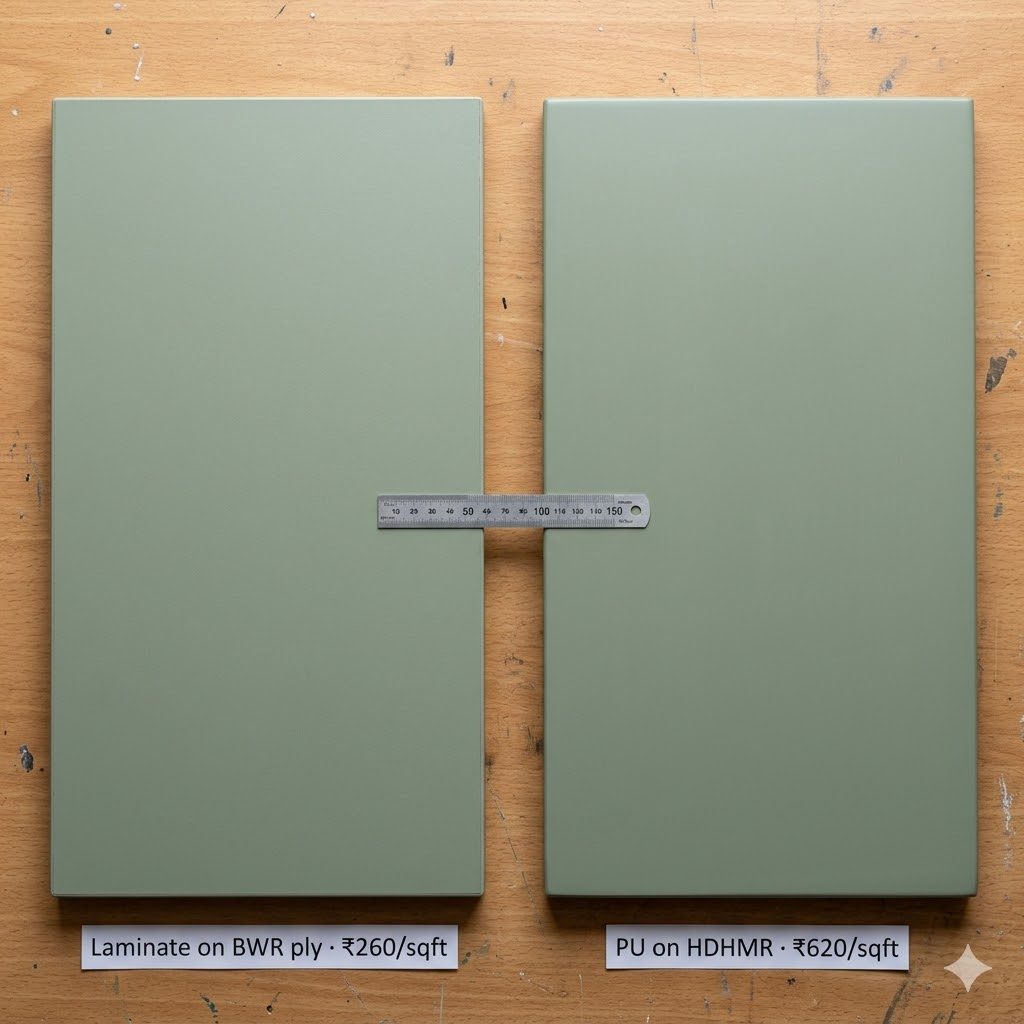
This is the single biggest reason homeowners choose PU. A PU-finished shutter, carcase or panel reads as one continuous surface. A complex curved island, a single-piece tall unit, a rounded wardrobe corner — these are all possible in PU and impossible in laminate, because laminate is a flat 8 × 4 ft sheet that has to be cut, bonded and banded around every edge.
Laminate, even at its best, always shows a faint shadow line where the edge band meets the face. The eye reads it as a panel construction. PU has no such line — it reads as a solid object. For a living-room media wall, a freestanding island, or a feature joinery piece in a foyer, the visual difference is significant. For a kitchen carcase you open and close fifty times a week, the visual difference is invisible — both look fine after a few months of use.
Cost per square foot — three tiers
Here are the real 2026 Indian-market rates, all-in for finished joinery (substrate + finish + edge band where applicable + labour). Compare across the same tier, not across tiers.
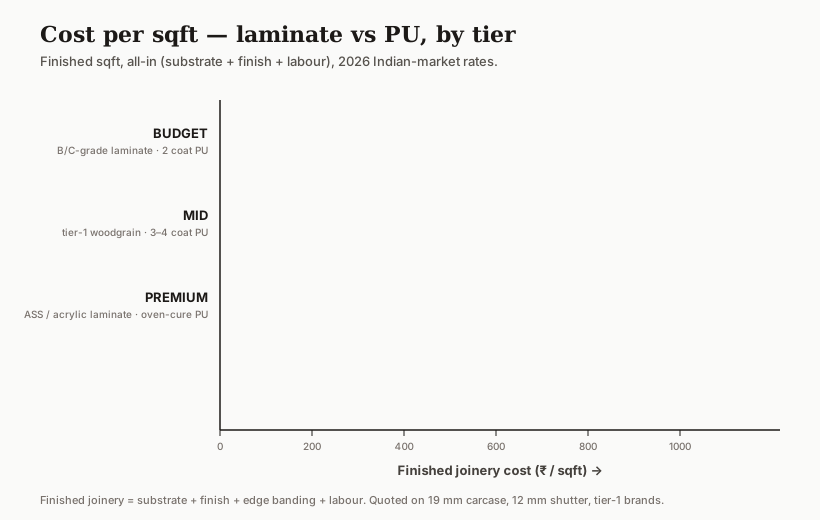
| Tier | Laminate (on ply) | PU (on HDHMR) | PU premium |
|---|---|---|---|
| Budget | ₹95–180/sqft (B/C-grade laminate) | ₹400–550/sqft (2-coat PU) | ~2.5× |
| Mid | ₹180–280/sqft (tier-1 woodgrain) | ₹500–700/sqft (3–4 coat PU) | ~2.4× |
| Premium | ₹260–380/sqft (ASS / acrylic laminate) | ₹700–900/sqft (oven-cured PU) | ~2.3× |
PU runs roughly 2 to 2.5 times the cost of an equivalent-tier laminate. That premium is not buying you more durability against impact and surface scratch — laminate actually wins on those — it is buying you the monolithic look and the patch-repairability we cover below.
Durability across the dimensions that matter
Laminate and PU trade strengths on different durability axes. There is no single winner.
| Property | Laminate (IS 2046) | PU on HDHMR | Why |
|---|---|---|---|
| Impact resistance | Excellent — factory-pressed | Moderate — chips on edge impact | Hard cured film is brittle on corners |
| Surface scratch | Excellent (textured) to poor (gloss) | Moderate — scratches show on flat colour | Pore-textured laminate wins |
| Heat tolerance | 180 °C ×20 min (IP-rated) | 90–120 °C, softens above | PU film softens with sustained heat |
| Water + steam | Excellent on BWR ply | Excellent on HDHMR | Both fine for kitchen if substrate right |
| Chemical (turmeric, oil) | IP-rated stain resistance | Good but stain depends on topcoat | Laminate marginally better on curry |
| UV stability | Excellent — no yellowing | Yellows in 5–8 years without UV hardener | Cheap PU yellows visibly in sunlit zones |
| Edge integrity | Visible 2 mm ABS edge | No visible edge, monolithic | PU wins on look, laminate on edge wear |
| Repairability | Replace whole shutter | Patch-spray a zone | PU wins on field repair |
Summary call: laminate wins where you bash, drop and slam — kitchen daily-use, wardrobe shutters, work surfaces. PU wins where you want a monolithic look and accept the trade — feature joinery, monolithic islands, statement wardrobes, accent panels.
The 10-year cost of ownership
Upfront cost is only half the picture. PU and laminate age very differently, and the ten-year cumulative cost tells a more honest story.
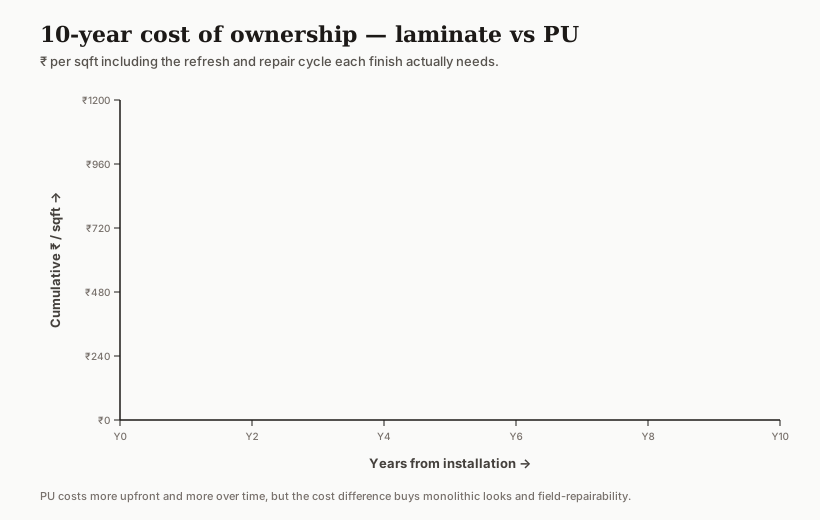
| Year | Laminate cumulative | PU cumulative | What happened |
|---|---|---|---|
| 0 | ₹220 | ₹450 | Install |
| 5 | ₹220 | ₹650 | PU re-spray refresh (yellowing, dulling) |
| 9 | ₹460 | ₹650 | Laminate shutter swap (impact damage) |
| 10 | ₹460 | ₹770 | PU UV polish + touch-up |
Across ten years, laminate costs roughly ₹460/sqft fully-loaded. PU costs roughly ₹770/sqft, including the typical refresh cycle. The ₹310/sqft difference is real money on a 6 m² kitchen-front — about ₹20,000 over the decade — but it is not catastrophic if the look matters to you.
The crucial finding: PU is not actually 2× cheaper or more expensive long-term, when refresh cycles are accounted. It is roughly 1.7× over a decade. Most homeowners assume the upfront 2× premium continues forever; in fact it narrows as laminate eventually needs swaps that PU can patch.
UV behaviour and the yellowing problem
Cheap PU yellows. Specifically, aromatic-isocyanate PU systems (the cheaper chemistry) yellow visibly under UV exposure within five to eight years. A white PU panel in a sunlit foyer or near a south-facing window goes from cool white to a slightly cream-yellow tone. The shift is small but visible against a reference white that has not been UV-exposed.
The fix is to specify aliphatic-isocyanate PU (the more expensive chemistry) for any sunlit zone, or to factor in a UV-polish refresh at year 5–7. Brands that explicitly publish aliphatic PU systems are Asian Paints SmartCare PU, MRF Coatings Premium PU, Nippon Paint Wood Premium, Berger Luxol PU, and Akzo Nobel Dulux Aquanox at the premium tier. Avoid generic "PU" from an unbranded supplier without asking which chemistry — the difference is invisible at handover and brutal at year six.
Laminate does not yellow — the decor paper is light-fast to wool scale 6+ under IS 2046, and the kraft layers underneath are protected.
Where each finish makes sense
The zones-by-finish call is the most useful piece of this entire comparison. Here is the field-tested split.
| Zone | Finish call | Why |
|---|---|---|
| Kitchen base + wall units (carcase + shutter) | Laminate on BWR | Impact, heat, water, predictable life |
| Sink-base shutter | Laminate on BWP | Wet, steam-prone, never PU here |
| Wardrobe shutters | Laminate on MR | Cost-efficient, scratch-tolerant |
| Wardrobe interior shelves | Pre-laminated MR | Dry zone, no finish premium needed |
| Living room media wall (monolithic) | PU on HDHMR | Seamless, statement, low touch |
| Kitchen island (single-piece, curved) | PU on HDHMR | Monolithic look impossible in laminate |
| Foyer + bar unit (accent) | Mirror laminate or 2-pack PU | Look-led, low touch |
| Pooja unit | Laminate on BWR | Diya heat, oil splash |
| Bathroom vanity | Laminate on BWP | Wet, no PU here |
| Bedroom headboard | PU on HDHMR or fabric | Curved monolithic feel |
| TV shelves and storage interiors | Laminate on MR | Predictable, scratch-tolerant |
The typical 3 BHK ends up roughly 80% laminate, 15% PU, 5% accent. Split that way, the PU premium stays under 20% of the joinery budget and earns its keep on the few pieces where the look really matters.
PU is not better than laminate. It is a different tool. Laminate is a workhorse — predictable, durable, cost-efficient. PU is a look — monolithic, seamless, patch-repairable. Spec each for the surface it suits and never let a single one absorb the whole quote.
The fix, in order
1. Decide every shutter's job before its finish — daily-touch and wet zones to laminate, low-touch monolithic zones to PU.
2. Quote both on the same substrate logic — BWR or BWP plywood for laminate, HDHMR for PU. Never PU on plain MDF in a humid city.
3. For PU, specify the chemistry — aliphatic-isocyanate for sunlit zones, 3–4 coat minimum, oven-cured if budget allows.
4. For laminate, demand IP-rated IS 2046 with 2 mm ABS edge banding and PUR adhesive.
5. Plan the refresh cycle for PU into year 5 — a re-spray will happen, budget for it.
6. Keep the PU spend under 20% of the joinery line-item — beyond that the look-to-cost trade-off stops being worth it.
Prevent it / Plan it: Decide finish-by-zone with the Material Decision Framework, pressure-test the quote with the Cost Reality Check, and compare brands and finishes side-by-side with Material Compare. Read the related deep-dives on acrylic vs laminate for the kitchen, best laminate finishes for Indian homes, and expensive interior choices that age poorly.
References
- Bureau of Indian Standards (2015) IS 2046: Decorative thermosetting synthetic resin bonded laminated sheets — Specification. New Delhi: BIS.
- Bureau of Indian Standards (1989) IS 303: Plywood for general purposes — Specification. New Delhi: BIS.
- Lambourne, R. and Strivens, T. A. (1999) Paint and Surface Coatings: Theory and Practice. 2nd ed. Cambridge: Woodhead Publishing.
- Wicks, Z. W., Jones, F. N., Pappas, S. P. and Wicks, D. A. (2007) Organic Coatings: Science and Technology. 3rd ed. Hoboken, NJ: John Wiley & Sons.
- Forest Products Laboratory (2021) Wood Handbook — Wood as an Engineering Material. Madison, WI: USDA Forest Service, FPL-GTR-282.
Part of the Studio Matrx Materials & Finishes series.
Export this guide
Related Guides — Deep-dive reading
The Design Decisions With the Biggest Cost Consequences
A cost-leverage map of Indian home interiors — the handful of decisions that swing your total budget the most, so you spend your attention where a single choice has an outsized rupee impact.
Cost & MoneyBest Laminate Finishes for Indian Homes
Mirror, super-matte, suede, woodgrain, metallic — which laminate finish actually survives turmeric, oil and weekly mop water
Materials & FinishesComplete Guide to Plywood Grades in India
MR, BWR, BWP, FR — the IS-code ladder, the right grade per zone, and how to verify it on site
Materials & FinishesRelated Tools — Try Free
Before vs After — Cost Reality Check
Compare what you expected to pay vs what you actually paid, category by category.
Reality CheckFull-Room BOQ — Living, Bedroom, Kitchen, Bath
Room-wise BOQ across living, bedrooms, kitchen, utility, and bathrooms with line-item pricing.
Full-Room BOQMaterial Comparison Sheet
India's interior material cheatsheet — plywood, finishes, hardware, countertops, paints, waterproofing.
Reference Guide