
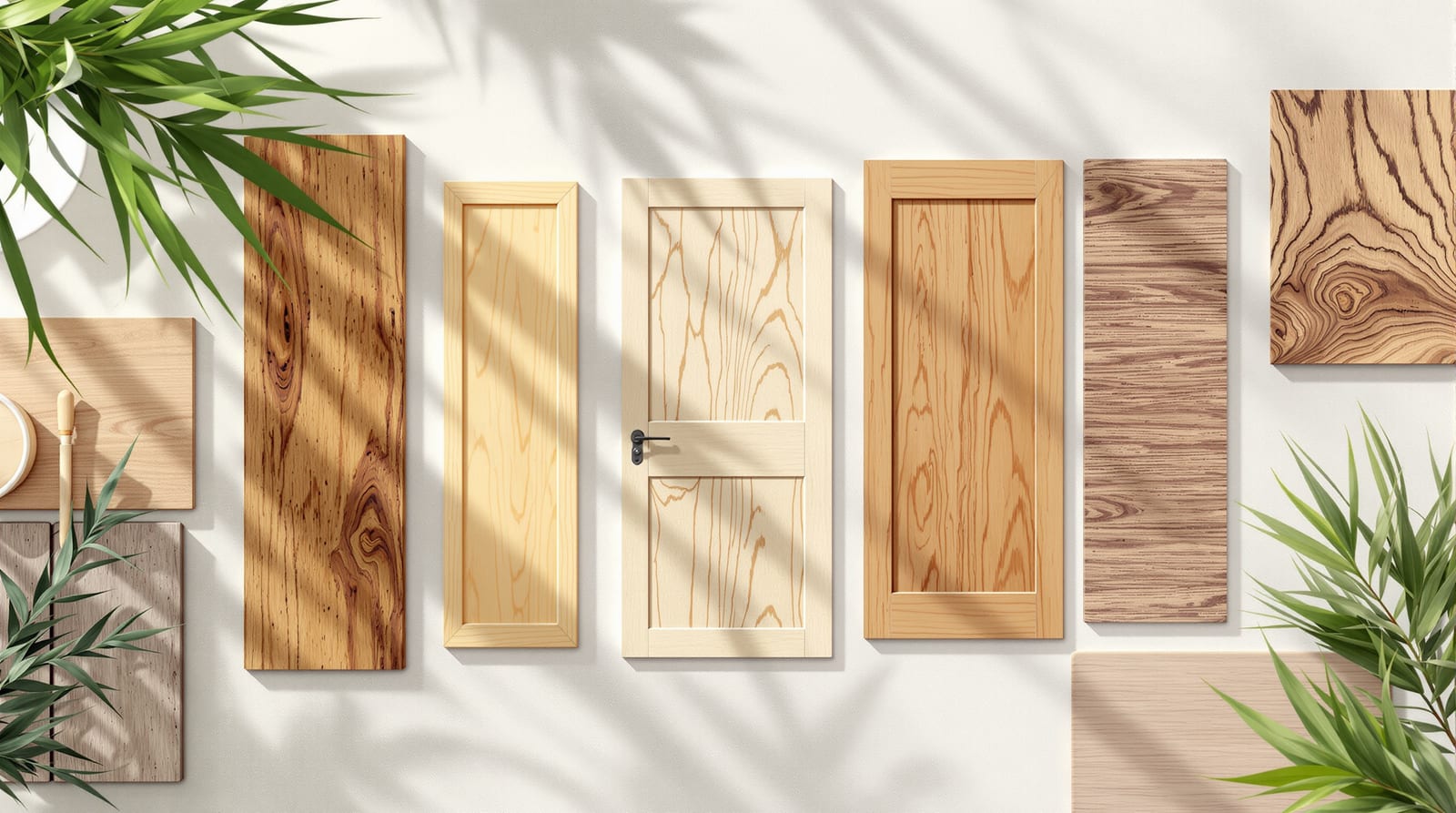
Eco-Friendly Door Materials: A Sustainability Guide (India 2026)
Rubberwood, bamboo, agri-fibre board, reclaimed timber, FSC plywood and recycled WPC scored on renewability, carbon, emissions, durability and recyclability.
Choosing eco-friendly door materials is not about a single "green" label on a showroom door — it is about scoring each material honestly across five things that matter for the planet and your home: how renewable the raw material is, how much carbon was emitted making it, what it off-gasses indoors, how long it lasts, and what happens to it at end of life. A teak door felled from old-growth forest fails the first test; a cheap flush door that warps in three monsoons fails the fourth. This Studio Matrx guide takes the sustainability lens specifically — if you simply want the all-round performance and price picture, read the general door materials comparison and best door material guides first, then come here to weigh the environmental trade-offs. For the full cluster, the complete door guide is the pillar, and sustainable doors is the Act this sits inside.
The five sustainability criteria
A material is only as "eco" as its weakest score. We rate six realistic Indian choices — plantation rubberwood, bamboo, agri-fibre boards (MDF/particleboard from rice husk, wheat straw or bagasse), reclaimed timber, FSC-certified plywood, and recycled WPC — on these five axes:
- Renewability — is the raw material a fast-growing crop, a by-product, or a felled tree that takes decades to replace?
- Embodied carbon — the cradle-to-gate kgCO2e to make the door; timber stores biogenic carbon, composites and metals emit more.
- Indoor emissions — formaldehyde and VOCs from resins, adhesives and finishes; look for E1/E0/CARB2/NAF grades, not just IS 710 bonding ratings.
- Durability — because a door that lasts 30 years beats one that lasts 10 on lifetime impact. Durability is itself sustainability.
- Recyclability / end of life — can it be reused, refurbished, recycled, or only landfilled?
The sustainability scorecard
No material wins on every axis. Reclaimed timber is the lowest-carbon option but supply is patchy; bamboo and agri-fibre are wonderfully renewable but emissions depend entirely on the resin grade; recycled WPC diverts plastic waste but is hard to recycle again. Use this table as a starting map, then verify any "eco" claim with a third-party certificate.
| Material | Renewability | Embodied carbon | Indoor emissions | Durability (rule of thumb) | End of life |
|---|---|---|---|---|---|
| Plantation rubberwood | High — by-product of latex farming | Low | Low if E1/E0 glued & water-based finish | 15–25 yrs, hates damp | Reuse / refurbish / biomass |
| Bamboo | Very high — rapidly renewable grass | Low | Depends on resin grade | 15–25 yrs if sealed | Compostable / biomass |
| Agri-fibre board | Very high — crop residue (husk, straw, bagasse) | Low–moderate | Choose NAF / E0 grades | 10–18 yrs, poor in wet | Hard to recycle; biomass |
| Reclaimed timber | Highest — no new felling | Lowest (near-zero new) | Very low (old solid wood) | 25–40+ yrs if sound | Reuse again / refurbish |
| FSC-certified plywood | Moderate — responsibly managed forest | Low–moderate | Specify E1/E0/CARB2 | 15–25 yrs | Limited; biomass |
| Recycled WPC | Moderate — recycled PVC + wood flour | Moderate | Low VOC, no formaldehyde | 20–30 yrs, rot/termite-proof | Difficult to recycle |
Material by material
Plantation rubberwood and bamboo — the renewables
Rubberwood is the quiet sustainability star: it is the timber of the rubber tree, harvested only after the tree stops yielding latex, so it is genuinely a by-product rather than a reason to fell forest. It machines well, takes finish beautifully and is low-cost. Its one weakness is moisture — untreated rubberwood swells and grows mould in humid coastal India, so insist on borax/boron treatment and a water-based seal. Bamboo, technically a grass, regrows in three to five years versus decades for hardwood, giving it the best renewability score of all. Engineered bamboo (strand-woven or laminated) makes a handsome, hard door leaf. For both, the rubberwood doors and bamboo doors deep dives cover treatment, finishes and where they suit India's climate zones.
Agri-fibre boards — turning crop waste into doors
India burns millions of tonnes of rice and wheat residue every year; pressing that husk, straw or bagasse into MDF and particleboard for flush-door faces is a real circular win — provided the binder is clean. Standard urea-formaldehyde boards off-gas; specify NAF (no-added-formaldehyde) or E0 grades and the indoor-air benefit holds. These boards are economical and dimensionally stable in dry interiors but swell badly if wet, so keep them away from bathrooms and external openings. The agri-fibre doors guide explains grades and where they belong.
Reclaimed timber — the lowest-carbon door
A salvaged old teak or rosewood door carries almost no new embodied carbon — the tree was felled generations ago, the carbon is already accounted for, and you are simply giving dense, seasoned, knot-free timber a second life. Properly restored, these doors outlast anything new. The catch is supply: sourcing, de-nailing, re-machining and treating reclaimed stock is skilled, variable work. See reclaimed wood doors for sourcing and restoration. Either way, timber door sustainability explains why long-lived solid wood beats short-lived composites on lifetime carbon.
FSC plywood and recycled WPC — certified and circular
If you want an engineered-wood flush door with a clear conscience, FSC (Forest Stewardship Council) or PEFC chain-of-custody plywood proves the timber came from responsibly managed forest. Indian FSC supply is still limited and most teak is imported, so verify the certificate, do not take a verbal claim. Recycled WPC (recycled PVC plus wood flour) diverts plastic from landfill and is utterly rot-, termite- and water-proof — ideal for bathrooms, utility and coastal homes — but it is harder to recycle again at end of life, so its circularity is weaker. The recycled-material doors and FSC-certified doors guides go deeper.
Emissions and certifications — read past the marketing
"Eco" is the most abused word in the door trade. Two things separate a genuinely healthy, sustainable door from a greenwashed one: a third-party emissions grade and a recognised eco-label. Note that IS 710 (BWP) rates only the bonding's water resistance — it says nothing about formaldehyde. For indoor air, look instead for E1/E0/CARB2/NAF.
| Label / standard | What it certifies | Issued by |
|---|---|---|
| E1 / E0 emission class | Formaldehyde ≤0.124 (E1) / ≤0.07 (E0) mg/m³ | EU/Indian baseline benchmark |
| CARB2 / NAF | Strict low / no-added formaldehyde | California ATCB (intl. benchmark) |
| FSC / PEFC | Chain-of-custody, responsibly sourced timber | FSC / PEFC |
| GreenPro | Green product certification | CII–IGBC |
| ECOMARK | Eco-labelling of products | BIS (Bureau of Indian Standards) |
| GREENGUARD | Low chemical emissions | UL (intl. benchmark) |
These low-emission, certified materials also earn material credits under IGBC Green Homes, GRIHA and LEED for FSC, regional, recycled and low-VOC content — useful if you are pursuing a green-building rating. See eco door certifications for how to read each label, and doors for indoor air quality for the health angle.
Choosing for your climate and conscience
Match the material to your climate zone and conscience together. In hot-dry and composite interiors, agri-fibre and FSC plywood flush doors are fine and economical. In warm-humid and coastal India, prioritise rot- and termite-proof recycled WPC for wet areas and well-treated rubberwood, bamboo or reclaimed teak elsewhere. For external doors, durability dominates the carbon maths — choose the longest-lasting option you can, because the door you never replace is the greenest one. To put numbers on it, score your shortlist with the eco-door material selector and estimate the cradle-to-gate footprint with the door embodied carbon calculator. For the carbon picture in depth, read door embodied carbon. GST on doors is 18%; a certified, durable door costs more upfront but pays back in lifespan, health and lower replacement carbon.
Frequently asked questions
Which is the most eco-friendly door material for an Indian home?
There is no single winner. Reclaimed timber has the lowest carbon, bamboo and agri-fibre score highest on renewability, and recycled WPC is best for wet, coastal areas. As a rule of thumb, pick the most durable option that suits your climate zone and carries a third-party emissions and sourcing certificate — the door you never replace is the greenest.
Is rubberwood really sustainable?
Yes, genuinely. Rubberwood is harvested only after the rubber tree stops producing latex, so it is a by-product, not a cause of felling. Insist on boron treatment and a water-based seal for humid regions, and an E1/E0 adhesive in any engineered version.
Does FSC certification matter in India?
It does, but supply is limited and most teak is imported, so claims are often unverified. Ask to see the actual FSC or PEFC chain-of-custody certificate rather than trusting a verbal "FSC" label. See the FSC-certified doors guide.
How do I avoid formaldehyde in a flush or plywood door?
Look for an E1, E0, CARB2 or NAF (no-added-formaldehyde) emission grade and a low-VOC, water-based finish. Remember that IS 710 (BWP) rates only the glue's water resistance, not its emissions — the two are separate certificates.
Is recycled WPC genuinely green if it cannot be recycled again?
It is a trade-off. WPC diverts plastic waste into a long-lasting, rot- and termite-proof door, which is a real benefit, but its end-of-life recyclability is weak. For wet and coastal areas where timber fails fast, its durability often makes it the lower-lifetime-impact choice anyway. See recycled-material doors.
How is this different from the general door materials comparison?
The general door materials comparison ranks materials on all-round performance, looks and price. This guide applies a strict sustainability lens — renewability, embodied carbon, indoor emissions, durability and recyclability — so you can choose with the planet, not just the budget, in mind.
Export this guide
Related Guides — Deep-dive reading
Sustainable Doors Guide: Eco-Friendly Doors (India 2026)
What makes a door genuinely sustainable in India — certified renewable material, low emissions, low embodied carbon, durability and recyclability.
Home Doors & EntrancesFSC Certified Doors in India: Verify & Buy (India 2026)
What FSC and PEFC chain-of-custody certification means for a door, why Indian supply is thin, and how to verify a claim before you pay.
Home Doors & EntrancesAgri-Fibre Doors in India: Straw & Husk Boards (India 2026)
Door boards made from rice husk, wheat straw and bagasse instead of virgin wood — how they divert crop-burning waste, their properties, formaldehyde realities and cost.
Home Doors & EntrancesRelated Tools — Try Free
Door Cost Calculator
Estimate the all-in cost of a door — leaf, frame, hardware, fitting and GST — by type, material and size.
Door CalculatorDoor Material Comparison Tool
Compare 2–4 door materials on cost, durability, maintenance, security and moisture resistance.
Comparison ToolInterior Budget Planner
Live room-wise and component-wise cost breakdown in ₹ with contingency, GST, and PDF summary.
Budget Calculator