
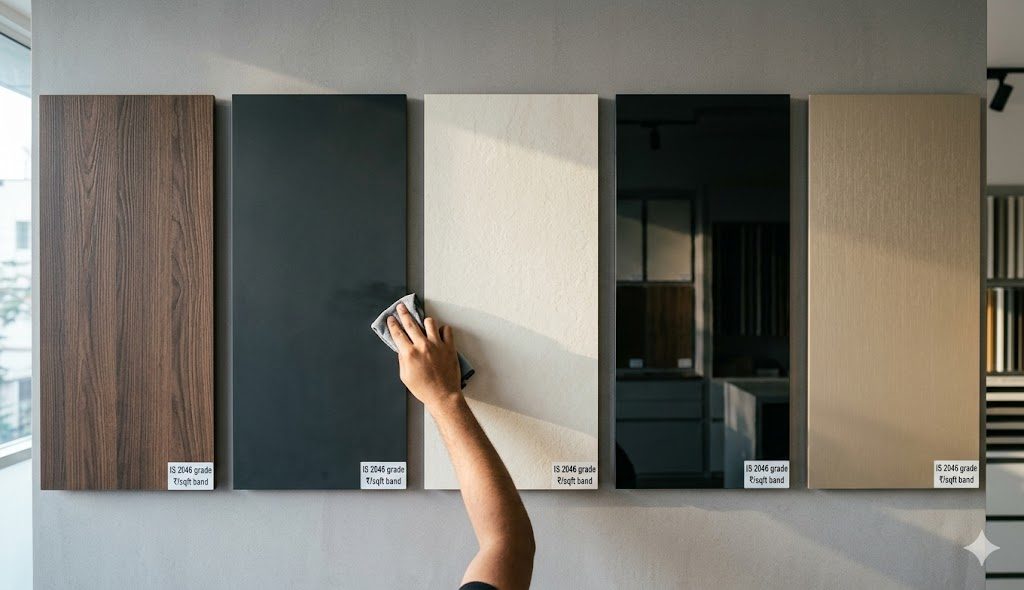
Best Laminate Finishes for Indian Homes
Mirror, super-matte, suede, woodgrain, metallic — which laminate finish actually survives turmeric, oil and weekly mop water
A laminate is the thinnest layer in your home that has to do the hardest job. The 1 mm sheet glued to the front of your kitchen shutter is the surface your hand touches a thousand times a year, the surface that catches turmeric, oil, mop water, hot tava steam and the occasional knife-tip — and the surface that decides whether your kitchen looks new in year ten or tired in year three. Choosing the right laminate finish is less about colour and more about how that 1 mm overlay behaves on day three thousand.
Indian homes punish finishes more than almost any other domestic environment in the world. We cook hot, we cook oily, we mop daily, and our shoulder seasons swing 60% relative humidity to 90% inside a week. A finish that looks stunning in a Milan showroom can be a daily chore in Bengaluru. This guide is the field manual for picking laminates that hold up, with real 2026 ₹/sqft rates, the IS 2046 grades, the finish families, the brand landscape, and a zone-by-zone map for where each finish earns its place.
It is a deep-dive companion to our complete guide to plywood grades in India — because a laminate is only ever as good as the substrate beneath it. A super-matte anti-fingerprint sheet on MR plywood under a sink still fails in two years.
What a laminate actually is
A decorative high-pressure laminate (HPL) — the type used on Indian kitchen shutters, wardrobes, panels and dadoes — is not a paint, a film, or a veneer. It is a thin engineered sheet made of four ingredients, hot-pressed into a single solid plate:
1. Decor paper — an 80–120 gsm sheet printed with the colour, woodgrain or solid that you actually see.
2. Kraft layers — six to eight phenolic-resin-impregnated brown kraft papers stacked beneath, giving the sheet its body and impact resistance.
3. Melamine overlay — a thin transparent resin layer over the decor paper that decides the finish — matte, gloss, suede, textured, metallic — and the sheen, fingerprint, and scratch behaviour.
4. Balance back — a sanded brown kraft on the rear that lets white glue or PUR adhesive bond the laminate to the plywood substrate.
The whole sandwich is pressed at 130–150 °C and roughly 70–80 bar for 30–60 minutes. The output is a hard, dimensionally stable sheet, typically 0.7 to 1.0 mm thick, sold in 8 × 4 ft sizes. The Bureau of Indian Standards governs it under IS 2046, which classifies sheets by their use (horizontal grade S, vertical grade V, post-formable grade P) and tests them for impact, abrasion, dimensional stability, and chemical resistance.
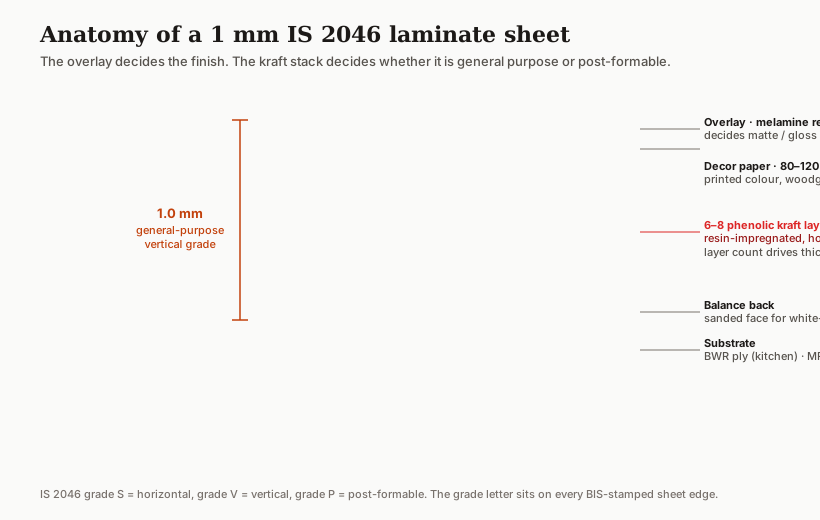
That overlay layer is the one homeowners actually argue about. It is also the one that decides whether your shutter shows every fingerprint or hides them all.
The finish families that matter
There are six finish families on the Indian market, and each one trades the same four properties differently — appearance, fingerprint behaviour, scratch hiding, and ₹/sqft. The right finish is the one that wins on the property that matters most for that surface.
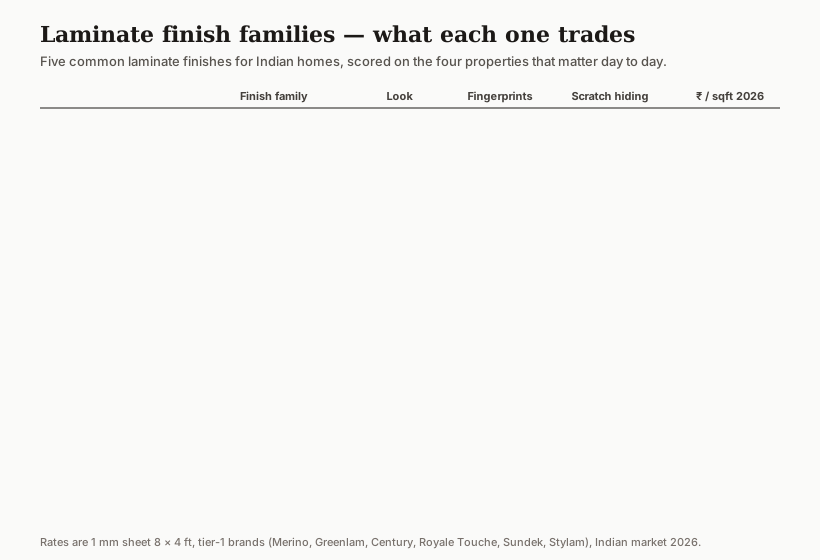
| Finish family | Look | Fingerprints | Scratch hiding | ₹/sqft (2026, tier-1) |
|---|---|---|---|---|
| High gloss / mirror | Acrylic-coated mirror reflection, LRV 70–85% | Shows every print | Very poor — every micro-scratch reads | ₹140–240 |
| Super matte (anti-fingerprint) | Sealed micro-pore velvet, LRV 30–45% | Hidden in sealed pores | Mid — pore depth masks light marks | ₹220–350 |
| Suede | Lightly textured matte, LRV 35–55% | Hidden | Mid — quiet, tactile | ₹140–230 |
| Woodgrain texture (synchronised pore) | Grain-aligned emboss, LRV 25–40% | Hidden in pore | Best in class — pore swallows scratches | ₹180–280 |
| Metallic / fabric / stone-pore | Specialty overlays, LRV varies 20–70% | Varies by texture | Texture-dependent | ₹260–520 |
| ASS — anti-scratch + anti-stain | Sealed matte with hardener | Hidden | Excellent — designed for it | ₹260–420 |
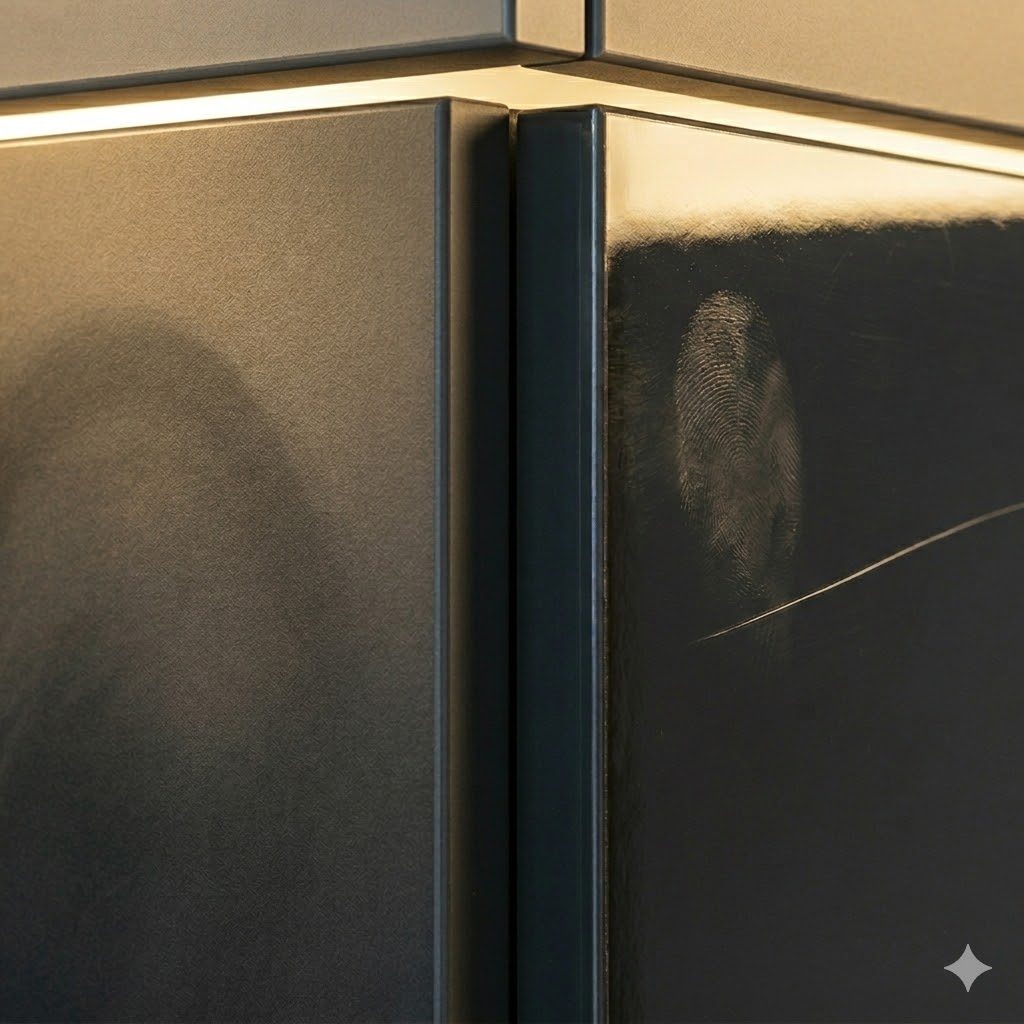
A few things are worth saying out loud. Mirror laminate scratches if you breathe on it — anything you wipe more than twice a week will read every micro-line within six months. Super matte hides nearly everything but costs 30–60% more than a standard matte, and only the sealed-pore anti-fingerprint formulations (Merino Maxima, Greenlam Vivar, Royale Touche Velluto, Sundek Nature) actually deliver the no-print performance — the cheap matte clones do not. Woodgrain textured finish is the most forgiving finish on the market for daily-touch surfaces; the synchronised pore catches and hides the inevitable hairline scratches the way no flat finish ever can.
How Indian conditions actually test a finish
Indian homes test laminates in four very specific ways, and most international finish data sheets do not account for any of them.
Turmeric staining. Curcumin — the yellow pigment in turmeric — bonds aggressively to porous surfaces. Standard matte laminate, with its open micro-pore structure, will hold a turmeric stain that survives bleach. Super-matte anti-fingerprint sheets are sealed at the overlay, and the same stain wipes off in under a minute. Test before you buy: drop a slurry of turmeric and water on a sample, leave for 30 minutes, then wipe with neutral detergent.
Oil splash. Fried-oil aerosol coats every horizontal and vertical surface within a 1.5 m arc of an Indian gas hob. On a high-gloss laminate, this builds visible film within weeks and needs degreaser to remove. On super matte or textured finishes, the oil sinks into the pore and is invisible — but if not cleaned weekly with the right cleaner, it accumulates and dulls the finish.
Weekly mop water and humidity. Mopping splashes water onto the lowest 100 mm of every shutter. Cheap laminate edges that have not been properly sealed at the factory absorb that water over years, causing the laminate to lift at the bottom edge. Edge-banding quality matters more than overlay finish for the long-term survival of a shutter — insist on a 2 mm ABS edge band, applied with PUR (not EVA) adhesive.
Diya heat and pooja oils. A pooja shutter is the silent killer in many Indian homes. Diya soot and slow ghee evaporation coat the surface, and the heat (60–80 °C) softens lower-grade overlays. Specify BWR substrate and a heat-tolerant textured woodgrain laminate here.
The finish that wins in your home is the one that hides the mistake you actually make daily — the splash you forget to wipe, the corner you brush past, the cabinet you slam shut. Match the finish to your habits, not your inspiration board.
Reading an IS 2046 spec sheet
Every laminate sample worth quoting carries a spec sheet. The numbers that matter are buried in the middle of it. Look for these:
| IS 2046 property | What it tests | Good value (1 mm sheet) |
|---|---|---|
| Thickness | Sheet caliper | 0.92 to 1.00 mm (general purpose) |
| Resistance to surface wear (taber abrasion) | Cycles to wear through | ≥ 350 cycles (IP rated) |
| Resistance to scratch | Stylus load before mark | ≥ 2.0 N |
| Resistance to staining (Group 1) | Common household | No effect |
| Resistance to staining (Group 2) | Curcumin, dyes, ink | No effect / slight |
| Resistance to dry heat | 180 °C × 20 min | No effect |
| Resistance to crack on bend (post-form) | Radius without crack | 8–12 mm |
| Dimensional stability | Movement at 40% / 90% RH | < 0.55% MD, < 0.85% CD |
| Light fastness | Xenon arc cycles | Wool scale ≥ 6 |
If a sample doesn't have the IP (improved performance) rating on staining and abrasion, walk away — the cheap unrated grades save ₹20–40 per sqft and look identical at handover, then fail visibly by year four.
The brand tiers and where they sit
The Indian laminate market is unusually crowded. Five tiers are worth knowing:
- Premium imported-feel — Merino (Maxima, Suede HQ, Stylux), Greenlam (Sturdo, Vivar), Stylam (Touchwood, Magique). These compete with Italian and German laminates on look and finish but are made in India. Expect ₹220–520/sqft.
- Strong domestic tier-1 — Century Mica (Cliche, Trendz Plus), Royale Touche (Royal Hand, Velluto), Sundek (Nature, Decora). Excellent across the range, slightly fewer specialty finishes. Expect ₹160–380/sqft.
- Mid-market workhorses — Action Tesa (Pinnacle, EuroBranco), Virgo, Crown. Reliable for wardrobes and dry-zone panels, thinner specialty range. Expect ₹110–220/sqft.
- Budget national — generic 0.8 mm sheets in standard woodgrain and solid colours. Fine for low-touch lofts and storage backs. Expect ₹75–120/sqft.
- Avoid — unbranded sheets sold by weight at the timber market. No IS 2046 certification, no stain data, no edge stability. These end up in the rework budget by year three.
Where each finish belongs in the home
The simplest way to spec laminate for a whole home is to think of every surface in terms of touch frequency and exposure, then pick the finish family that wins on those two properties.
The high-touch rule: anything you handle daily wants super-matte or textured, not gloss. The display rule: anything you only see, not touch, can take gloss. The wet rule: bathroom and utility need textured or ASS on a BWP substrate, never standard matte.
The fix, in order
1. Pick the substrate first with the plywood grade guide — BWR for kitchen, MR for dry, BWP for wet.
2. Decide the finish family by zone using the map above — super matte for kitchen, woodgrain or suede for daily-touch shutters, gloss only for accent panels.
3. Insist on IP-rated IS 2046 spec sheets and walk past anything without them.
4. Specify 2 mm ABS edge banding with PUR adhesive at every cut edge — this is what makes a shutter survive year ten.
5. Match the brand tier to the budget, not to the most-advertised name — domestic tier-1 beats imported on cost-per-year-of-life almost every time.
6. Order an extra sheet so a damaged shutter can be replaced with the original batch run five years later.
Prevent it / Plan it: Choose the right finish for your zone with the Material Decision Framework and side-by-side the brand options with Material Compare. Read the related deep-dives on acrylic vs laminate for the kitchen, matte vs glossy interiors, PU finish vs laminate cost, and the practical wardrobe finish ideas.
References
- Bureau of Indian Standards (2015) IS 2046: Decorative thermosetting synthetic resin bonded laminated sheets — Specification. New Delhi: BIS.
- Bureau of Indian Standards (1989) IS 303: Plywood for general purposes — Specification. New Delhi: BIS.
- Forest Products Laboratory (2021) Wood Handbook — Wood as an Engineering Material. Madison, WI: USDA Forest Service, FPL-GTR-282.
- Forest, P. and Sinha, A. (2019) Engineered Wood Products in Tropical Climates. Singapore: Springer.
- Ching, F. D. K. (2014) Building Construction Illustrated. 5th ed. Hoboken, NJ: John Wiley & Sons.
Part of the Studio Matrx Materials & Finishes series.
Export this guide
Related Guides — Deep-dive reading
Matte vs Glossy Interiors
The matte-versus-glossy decision across shutters, paint, tile and laminate — and how Indian conditions decide it for you
Materials & FinishesInterior Wall Paint: The Complete Guide for Indian Homes
Everything under the colour — the layers beneath the paint, the five types to choose from, why sheen matters more than you think, how much you actually need, and the order of work that separates a job that lasts from one that peels.
Wall FinishesEngineered Wood Flooring in India: Layers, Wear Layer, Install & Cost (2026)
Engineered wood is a real-wood top veneer bonded over a cross-laminated plywood or HDF core, which makes it far more dimensionally stable than solid wood in Indian humidity — the practical way to get a genuine timber floor here. This guide covers the layer build-up, wear-layer thickness, click vs glue-down install, where it suits, ₹/sq ft, brands and maintenance.
Flooring & SurfacesRelated Tools — Try Free
Full-Room BOQ — Living, Bedroom, Kitchen, Bath
Room-wise BOQ across living, bedrooms, kitchen, utility, and bathrooms with line-item pricing.
Full-Room BOQMaterial Comparison Sheet
India's interior material cheatsheet — plywood, finishes, hardware, countertops, paints, waterproofing.
Reference GuideDoor Laminate Finish Selector
Answer a few questions and get a recommended door laminate finish family — woodgrain, solid, textured, gloss or matte.
Design Selector