
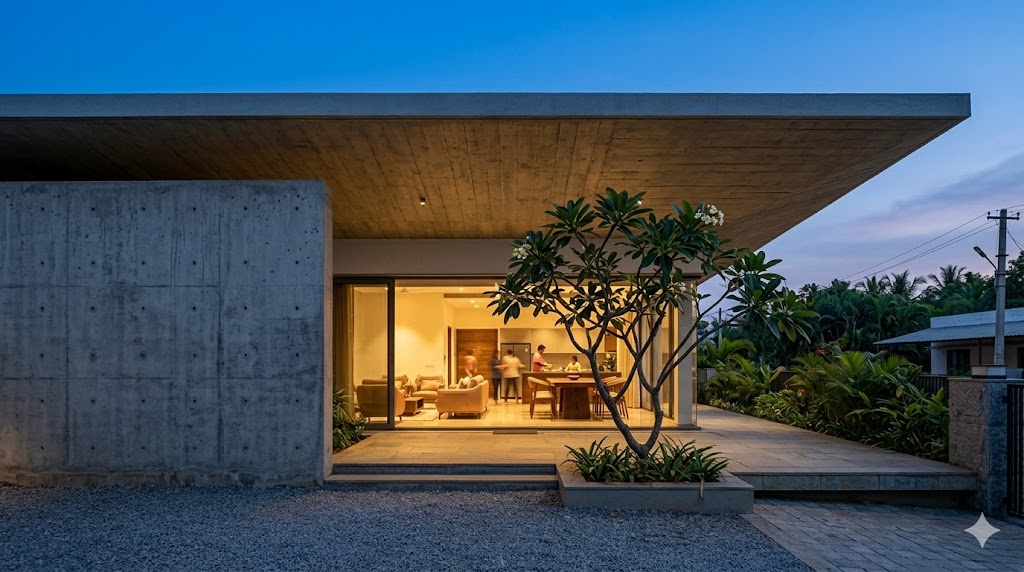
Modern House Design in India
Principles, Planning, Materials, Climate Response & Vastu Integration — A Complete Guide for Contemporary Indian Homes
What does it mean to design a "modern" house in India? The word is among the most-used and least-defined in the entire Indian residential vocabulary. Builders use it to mean "flat roof and glass". Magazines use it to mean "white-and-grey palette with a Swedish ceiling lamp". Brokers use it to mean "anything built after 2010". For homeowners about to invest the largest sum of capital they will ever commit, the word carries dangerously different meanings depending on who you ask, and what shows up in the finished building is too often a builder's interpretation dressed in a magazine's photograph.
This guide takes a working position. Modern Indian house design is not a stylistic preference, a colour palette, or a Pinterest mood-board. It is a discipline — a set of eight principles by which a contemporary Indian home is planned, materially specified, climatically engineered, and culturally reconciled. A house that clears those eight disciplines is modern regardless of whether it carries a flat or sloping roof; a house that fails them remains stylistically contemporary but structurally indistinguishable from the builder-default it tried to escape.
What follows is the working framework: the eight principles, the planning trade-offs Indian context imposes on modernist orthodoxy, the material vocabulary that ages well in this climate, four climate-response techniques every modern Indian home must deploy, the Vastu reconciliation that determines whether your house is sellable in the resale market, the sustainability and smart-home layers that should and should not be designed in, the six pitfalls of pseudo-modern Indian houses, and the 2026 costing tiers. By the end, the reader should have a defensible answer to the question their family will ask them every time they show the floor plan: "But what makes this modern?"
Modern is a thing the house does, not a thing it looks like.
The Eight Principles of Modern Indian House Design
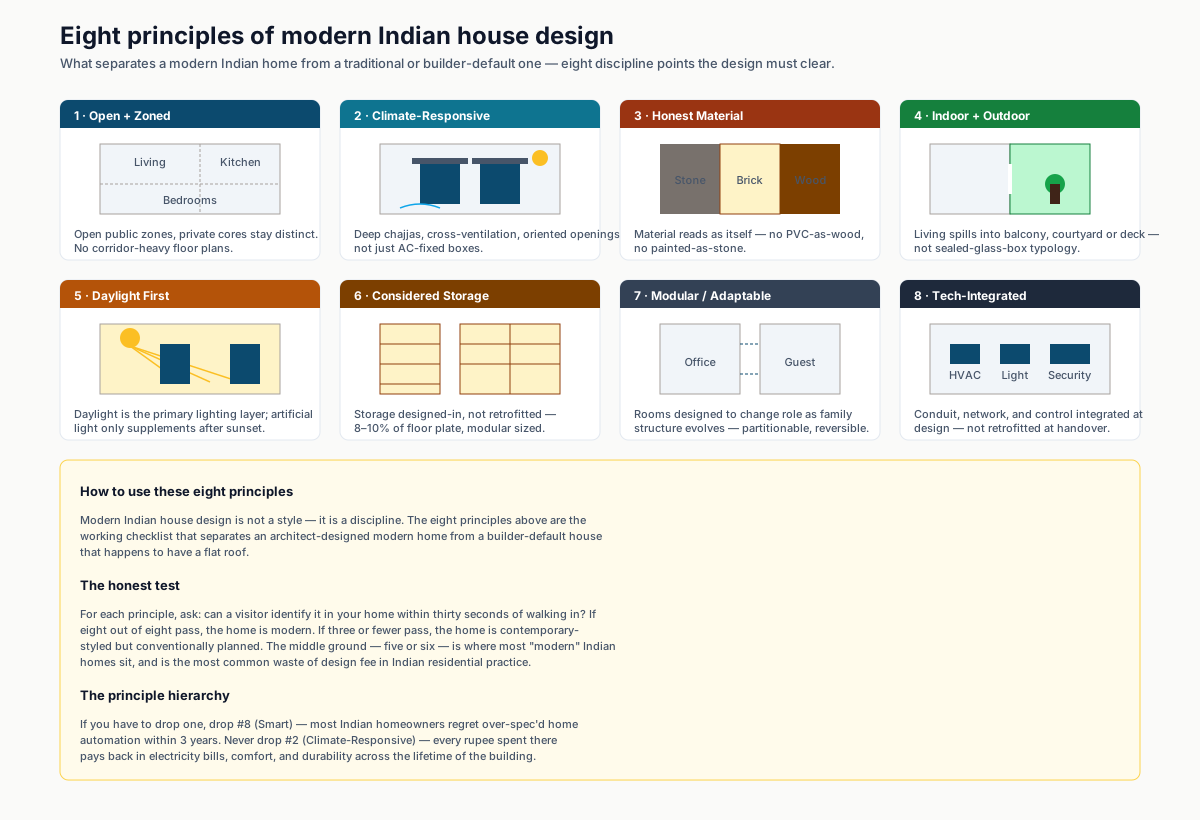
A modern Indian home clears eight discipline points. None is a style preference; each is a design decision that can be tested in the finished building. Print the matrix above and walk through your house with it — eight out of eight is rare even in published architect work, six out of eight is competent, and three or fewer marks the house as contemporary-styled but conventionally planned.
Principle 1 — Open Public Zones, Zoned Private Cores
Modern Indian planning rejects both ends of the spectrum: it neither fully opens the plan (which fails on cooking smells, multi-generational privacy, and pooja sanctity) nor fully zones it (which produces corridor-heavy, dim, dated builder plans). Instead, it isolates public functions (living, dining, foyer, entertaining) as a continuous volume and separates the private core (bedrooms, baths) behind a corridor or door threshold. The kitchen sits at the boundary, split into a dry kitchen (open to the social zone) and a wet kitchen (closed and ventilated for tadka, frying, and pressure-cooker steam).
Principle 2 — Climate-Responsive Everything
A modern Indian home that depends on air-conditioning to be habitable is not modern; it is climate-illiterate. Deep chajjas on west and south openings, cross-ventilation paths through the plan, recessed windows on harsh facades, and thermal mass on appropriate climate zones — these are non-negotiable. See Designing for the Indian Climate and Passive Design across Indian Climate Zones for the deep treatment.
Principle 3 — Honest Material Expression
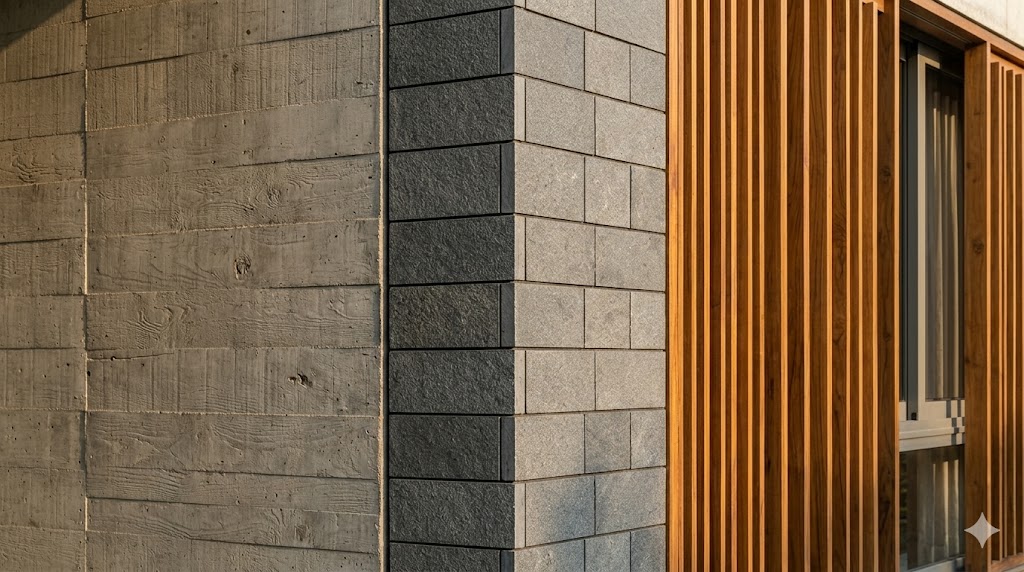
Material reads as itself. Concrete reads as concrete (not painted-as-stone). Stone reads as stone (not stone-look porcelain). Wood reads as wood (not PVC-laminate-as-teak). The discipline matters because honest materials patina over time — they age gracefully, gain texture and character, and are repairable with locally available materials. Imitation materials degrade — they peel, discolour, edge-chip, and require complete replacement on a 7-15 year cycle.
Principle 4 — Integrated Indoor-Outdoor
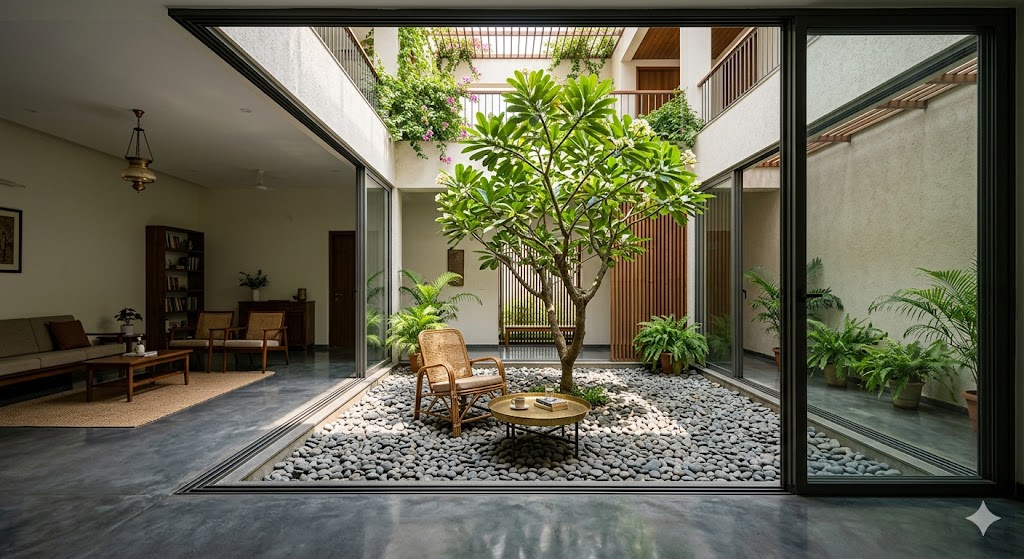
Modern Indian homes are not sealed glass boxes. The living spills into a verandah, balcony, deck, or courtyard. Sliding panels open to outdoor seating. Planters integrate into the threshold. In a country that gets eight months of comfortable outdoor weather per year, treating the home as hermetically sealed wastes the climate's gift.
Principle 5 — Daylight as Primary Layer
Artificial light only supplements after sunset. Window sizing, placement, and the depth of the room from the window collectively determine whether you need to switch on a light at 11 AM. Modern Indian homes target a daylight factor of 2-3% in habitable rooms — see the Daylighting Indian Homes and Buildings guide.
Principle 6 — Storage as a Designed System
Modern storage is designed in from the first floor plan, not retrofitted as Godrej cupboards after move-in. It accounts for 8-10% of the floor plate (a 1,200 sq ft house has 100-120 sq ft of dedicated storage), in modular dimensions, and integrated into walls — see Storage Planning.
Principle 7 — Modular and Adaptable
A modern Indian home is designed to change function as the family does. Today's children's bedroom becomes tomorrow's study; today's guest bedroom becomes tomorrow's elderly-parent suite; today's home office becomes tomorrow's nursery. Partition walls that can be removed, services rough-ins that allow re-zoning, and door positions that anticipate reversibility — these are the architectural features that future-proof the house. See Universal Design & Adaptable Homes.
Principle 8 — Technology-Integrated Services
Conduit, network, control, and renewable energy integrated at design, not retrofitted at handover. Cat-6 cable in every habitable room, smart-switch backbox in every electrical pattress, solar-ready inverter location with battery cabinet space, EV-charging conduit in the parking — all built in. See Solar Power for Homes.
Open Plan vs Zoned vs Hybrid — The Indian Trade-Off
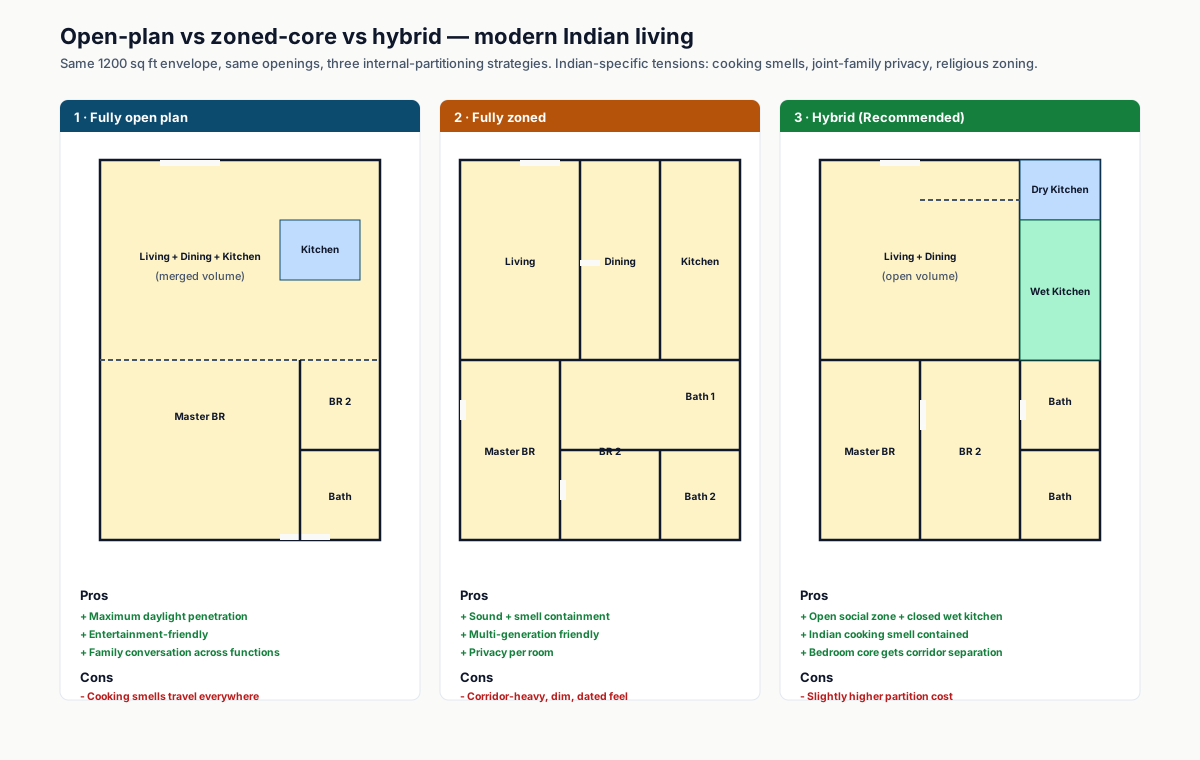
The single biggest planning decision in a modern Indian home is how open the plan is. Western modernism's default is the open plan — living, dining, and kitchen merge into a single volume. This is the look most Indian "modern" interior magazines reproduce. It is also the look that imports the worst trade-offs for the Indian context.
The figure above lays out the three options at the same scale.
Fully Open Plan
Living, dining, and kitchen as one continuous space. Reads spacious, photographs beautifully, entertains generously.
Indian-specific problems:
- Cooking smells. Indian cooking — tadka of mustard seeds in oil, fish curry, deep-fried pakoras — produces aromatic plumes that linger in fabric and migrate through the entire house. A fully open plan means the master bedroom curtain absorbs the tadka.
- Multi-generational privacy. When elders, parents, working adults, and teenagers share a home, complete acoustic and visual openness creates friction. The grandmother praying at 5 AM and the teenager video-gaming at 11 PM occupy the same volume.
- Pooja sanctity. The pooja or mandir requires a degree of acoustic and visual separation from the entertaining zone — see Pooja Room Design.
Fully Zoned
Walls between every function, corridors connecting them. The default of builder-grade Indian construction up to about 2000.
Problems:
- Daylight starvation. Internal rooms — particularly in the centre of a deep plate — lose access to windows.
- Dim, dated feel. The corridor itself is an architectural antipattern, consuming floor area without programmatic use.
- No social spillage. Friends visiting cannot watch the cook prepare a snack, conversations don't carry across functions, and the family eats meals in three different rooms.
Hybrid (Recommended)
Living + dining + dry kitchen as one open volume; wet kitchen screened with a sliding partition; bedroom core behind a corridor or solid door. This is the modern Indian compromise. The figure above shows the canonical layout.
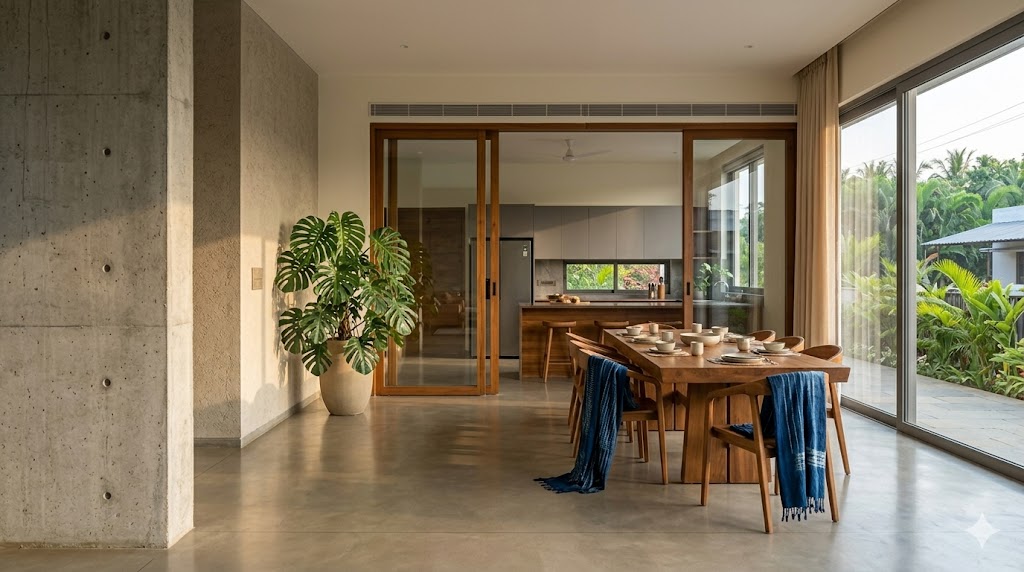
Key dimensions:
- Open living-dining: minimum 250 sq ft for a comfortable 6-person dining + 4-person seating
- Dry kitchen island: 1500 × 700 mm minimum, with seating on the social side
- Wet kitchen behind sliding doors: 80 - 100 sq ft, ducted exhaust to outside
- Bedroom corridor: 1.0 - 1.2 m wide, lit by daylight from at least one end
Material Vocabulary — Vernacular, Builder-Default, and Modern
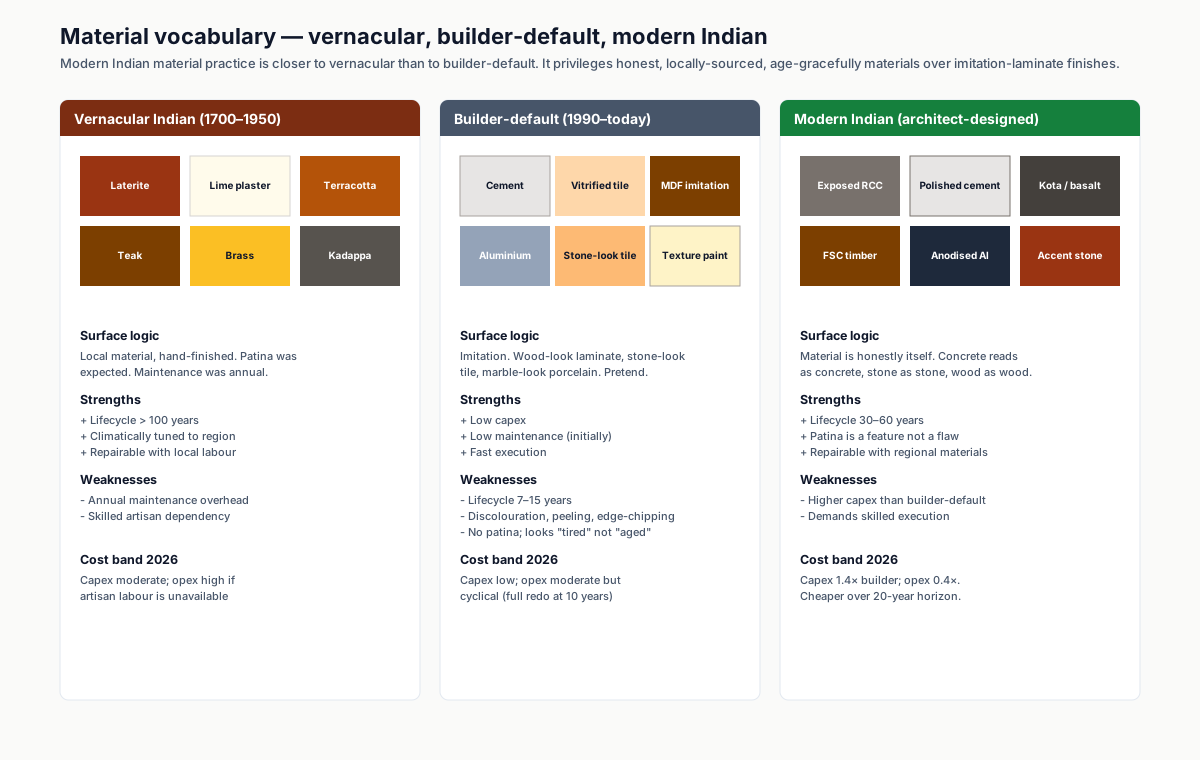
Modern Indian material practice is closer to vernacular than to builder-default. The figure above lays out the three palettes side by side. The pattern is clear: modern Indian design avoids imitation materials (laminate-as-wood, porcelain-as-marble, texture-paint-as-stone) and prefers materials that read as themselves and patina with age.
Exposed Concrete (RCC)
The modern Indian material par excellence. Properly executed exposed concrete is structural, weatherproof, fireproof, durable across 60+ years, and develops a beautiful grey-charcoal patina. Demands very high formwork quality and skilled labour — see Building Construction Quality Assessment. For poorly executed exposed concrete (visible honeycomb, formwork joint marks, colour patches), the only honest fix is to plaster over and start again.
Polished Cement Plaster (PCP / IPS)
The flooring and surface material that defines mid-budget modern Indian practice. Indian Patent Stone (IPS) is cement + colour oxide + marble dust, hand-trowelled and polished. Available in greys, earth tones, terracotta, and white. Cost ₹120 - 250 per sq ft. Lifecycle 25+ years. The opposite of vitrified tile in every way that matters — and roughly equivalent in cost.
Kota Stone, Cuddapah, Basalt
The Indian regional stones that define mid-to-upper modern practice. Kota is grey-green limestone from Rajasthan, used as flooring and cladding. Cuddapah / Kadappa is black limestone from Andhra, used for flooring and bath counters. Basalt is dark grey igneous stone from Maharashtra. All three patina to a deeper colour over years and develop a rich material density that imported Italian marble can never replicate.
FSC-Certified Timber
Teak, sal, deodar, mango, neem — sustainable Indian hardwoods specified with FSC certification. Used for doors, windows, kitchen joinery, flooring, and shutters. Cost ₹2,500 - 8,000 per cft. Lifecycle 50+ years with proper finishing. Critical: insist on FSC-certified stock — uncertified timber may be illegally logged.
Anodised Aluminium / Powder-Coated Steel
The metallic vocabulary of modern Indian fenestration. Anodised aluminium in bronze, champagne, charcoal, or black for window frames. Powder-coated steel for railings and grilles. Both develop no rust, demand minimal maintenance, and read as modern in colour and proportion.
What Modern Avoids
- Vitrified tile in stone-look or wood-look finish (looks "tired" within 5 years)
- PVC laminate wardrobes pretending to be wood
- Painted texture coats trying to look like stone
- Italian marble in monsoon-zone exteriors (water-absorbent, stains in 6 months)
- Glass-mosaic facade tiles (high-failure adhesive, dated within 10 years)
- Polyurethane paint on natural stone (seals breathability, traps moisture)
See Construction Material Quality Standards for the IS code references on each material.
Climate Response — The Four Techniques
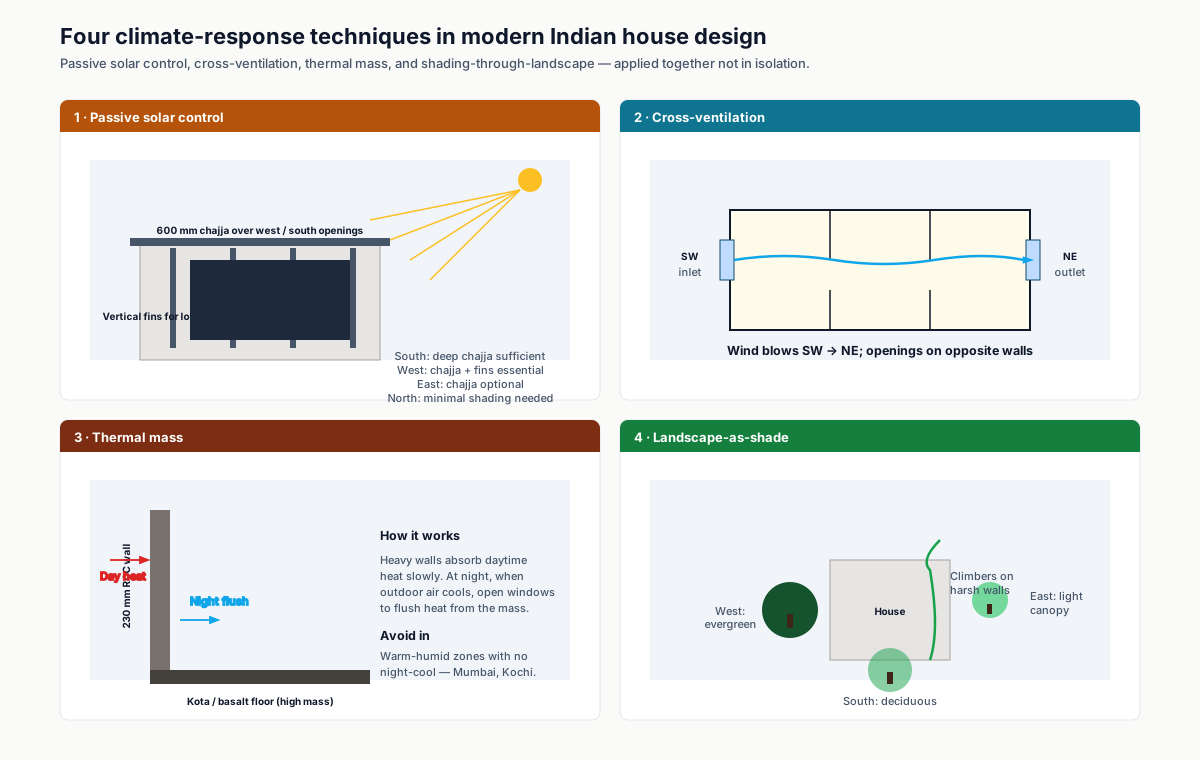
Four climate-response techniques are the working toolkit of modern Indian house design. They are not alternatives — they are deployed together.
Technique 1 — Passive Solar Control
The Indian sun is the dominant climate input across nine months of the year. Passive solar control means:
| Facade | Solar Strategy | Sizing |
|---|---|---|
| South | Deep horizontal chajja | 600 mm projection above each opening |
| West | Chajja + vertical fins | Chajja 600 mm, fins at 600 mm spacing |
| East | Light chajja | 300 - 450 mm projection |
| North | Minimal shading | Generous unshaded glazing acceptable |
The west-facade vertical fin is the single most-omitted detail in Indian residential practice. A west window without vertical fins admits 4 - 6 hours of direct afternoon sun in summer, raising indoor air temperature 4 - 7°C above the chajja-only case.
Technique 2 — Cross-Ventilation
Air entering on the windward side and exiting on the leeward side, with internal partitions designed to channel rather than block the flow. Working dimensions:
- Inlet : outlet ratio of 1 : 1.25 (slightly larger outlet creates suction)
- Floor-to-ceiling height ≥ 3.0 m for buoyancy-driven stack ventilation
- Stack openings high on each end (clerestory or jaali) for night-cool flushing
- Path length minimised — direct line-of-sight between inlet and outlet preferred
See Cross Ventilation in Indian Homes for the full sizing methodology.
Technique 3 — Thermal Mass
Heavy materials (RCC walls, stone floor, brick masonry) that absorb daytime heat slowly and re-radiate it at night. The technique works only in climates with diurnal temperature swing > 8°C — primarily composite (Delhi NCR), hot-dry (Rajasthan), temperate (Bengaluru), and moderate (Pune). It fails in warm-humid zones (Mumbai, Mangalore, Kochi) where night temperatures don't drop enough to flush the absorbed heat.
When deployed: 230 mm RCC external walls, stone flooring in 18 - 22 mm thickness, brick partition walls left exposed, masonry sun-warming on south facade in cold zones.
Technique 4 — Landscape-as-Shade
The fourth technique — and the cheapest by far. Strategic planting reduces facade heat gain more cost-effectively than any building material:
| Direction | Plant Type | Why |
|---|---|---|
| South | Deciduous (neem, mango) | Shade in summer, sun in winter |
| West | Evergreen (banyan, peepal) | Year-round dense shade |
| East | Light deciduous | Filtered morning light |
| North | Decorative | No shading requirement |
| Harsh walls | Climbers (madhumalti, jasmine) | Living facade |
A mature tree on the west face of a 1500 sq ft house can reduce summer cooling load by 18 - 24% — equivalent to two extra inches of XPS insulation.
Vastu and Modern Design — Reconciliation
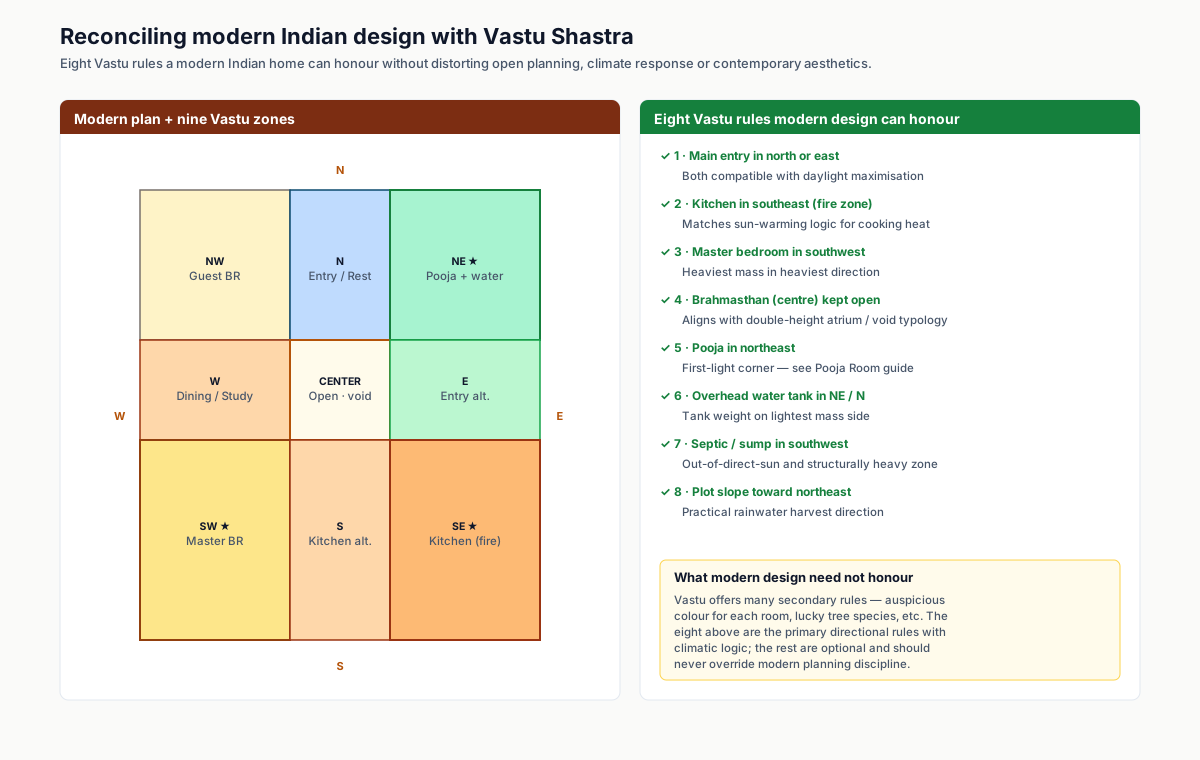
A persistent myth in Indian residential discourse is that modern design and Vastu are incompatible. They are not. Most of the primary Vastu rules carry climatic logic that aligns with modern climate-responsive design. The figure above overlays the nine-zone Vastu Mandala on a modern open-plan layout — the two reconcile cleanly.
The Eight Vastu Rules Modern Design Can Honour
1. Main entry in north or east. Coincides with the most generous daylight access — modern design wants the same.
2. Kitchen in the southeast (fire zone). The sun-warming logic matches the cooking heat — practical alignment.
3. Master bedroom in the southwest. Heaviest functional mass in the heaviest directional quadrant.
4. Brahmasthan (centre) kept open. Aligns with double-height atrium or void typology in modern design.
5. Pooja in the northeast. First-light corner — see Pooja Room Design.
6. Overhead water tank in northeast or north. Tank weight on the lightest mass side; structurally sound.
7. Septic / sump in the southwest. Out-of-direct-sun zone, ground naturally heavier here.
8. Plot slope toward the northeast. Practical rainwater drainage direction.
What Modern Design Need Not Honour
Vastu offers many secondary rules — auspicious colours for each room, lucky tree species, favourable sleep direction for individuals based on horoscope. The eight primary directional rules above are the ones with climatic logic; the secondary rules are optional and should never override modern planning, climate response, or material discipline.
See Vastu Shastra for Modern Homes for the complete treatment.
Sustainability — The Modern Imperative
Modern Indian house design treats sustainability not as a bolted-on feature but as a baseline. The five sustainability layers, in approximate priority order:
1. Passive Design (Free)
Climate response itself — the four techniques above — is the most cost-effective sustainability layer. A house that does not need air-conditioning for nine months of the year has reduced its lifetime carbon footprint by 60% before any solar panel is installed.
2. Solar Photovoltaic
A 3 - 5 kWp rooftop solar system covers 70 - 100% of household electricity demand in most Indian cities. Payback period in 2026 is 4 - 6 years including subsidies; lifecycle 25 years. The architecture must accommodate it at design — south-facing roof area, inverter location, battery cabinet — see Solar Power for Homes.
3. Rainwater Harvesting
Captures monsoon rainfall for ground-water recharge or for non-potable household reuse. Mandatory in most Indian metros for plots above 200 sq m. See Rainwater Harvesting for Indian Urban Homes for the design treatment.
4. Greywater Reuse
Bathing and washing water filtered and reused for landscape irrigation or toilet-flushing. Captures 40 - 60% of household water use. Demands a parallel plumbing run at design.
5. Low-Embodied-Carbon Materials
Specifying fly-ash cement (not OPC), locally-sourced stone, FSC timber, low-VOC paints, and recycled steel. Reduces embodied carbon of the building by 20 - 30%. See Green Building Certifications in India for GRIHA / IGBC rating frameworks.
The Smart Home Layer — What to Build In, What to Skip
Modern Indian homes vary wildly in how much "smart" they integrate. The honest position is that half of installed smart-home systems are decommissioned by the homeowner within three years. Build in only what survives the three-year test.
Build In (At Design)
- Cat-6 cable in every habitable room (terminating in a central rack)
- Smart-switch backboxes wired with neutral
- Conduit for future wiring between key rooms (futureproofing)
- Solar / inverter / battery space with isolation switching
- EV-charging conduit in the parking area (16 A or 32 A capacity)
- Doorbell camera + intercom backbone at the entry
- Security alarm sensor wiring at doors, windows, and motion zones
Optional (Add Later)
- Smart thermostats, smart blinds, voice assistants — easy to retrofit
- Whole-house audio — most decommissioned within 5 years
- Robot vacuum docking — depends on floor plan
- Smart lock at entry — requires steady WiFi to avoid frustration
Skip (Almost Never Worth It)
- Whole-house automation control panels (replaced by phone apps)
- Smart mirrors (broken within 18 months)
- Touchscreen wall-mounted control centres (decommissioned)
- Voice-activated curtains in every bedroom (excessive)
Six Pitfalls of Pseudo-Modern Indian Homes
Six failure modes appear repeatedly in Indian "modern" homes that miss the mark.
Pitfall 1 — "Modern" = "More Glass"
A common builder default: large unshaded glass on every facade, often west-facing. Result: cooling load doubles, internal temperatures spike, blinds stay drawn permanently, and the glass becomes an interior wall.
Fix: Glass percentage matched to orientation; west glazing capped at 18% WWR with shading.
Pitfall 2 — Flat Roof Without Drainage Design
Modern aesthetic demands a flat roof; flat roof demands meticulous drainage design. Half of "modern" Indian homes leak at the parapet-roof junction within 5 years.
Fix: Minimum 1:80 slope to drains, dual-membrane waterproofing, drainage outlets sized for monsoon intensity. See Waterproofing Guide for Indian Homes.
Pitfall 3 — Open Plan With No Wet Kitchen
The Pinterest open plan, executed without acknowledgement of Indian cooking, produces curtains that smell of jeera for the lifetime of the house.
Fix: Wet kitchen with sliding partition + ducted exhaust to outside.
Pitfall 4 — Imitation Materials
"Modern minimalist" sold to the client, executed with vitrified tile and MDF laminate. Lifecycle 7 - 12 years.
Fix: Material honesty per Principle 3. If budget cannot afford polished cement and natural stone, deploy them in fewer rooms rather than imitating them across the whole house.
Pitfall 5 — No Pooja Provision
The architect, schooled in International Style, forgets the pooja. Family carves out a kitchen-corner niche after move-in.
Fix: Northeast pooja niche or room sized 8 - 50 sq ft, designed in from concept stage.
Pitfall 6 — Furniture-Heavy Living Room
The client buys a 5-seater + 2 single-seater + ottoman + nest of tables + console + coffee table for a 250 sq ft living room. The modern volume disappears under furniture.
Fix: Furniture plan as part of the architectural drawing set. Maximum 60% floor coverage. One sofa + two chairs + coffee table is enough for most Indian living rooms.
Costing — 2026 Indicative Bands
Modern Indian house design carries a premium over builder-default — typically 25 - 70% higher per sq ft built-up. The premium reflects skilled labour, honest materials, climate engineering, and a documented design process. Three tier ranges:
Tier 1 — Modern Entry (₹1,800 - 2,800 / sq ft built-up)
- Polished cement plaster (PCP) flooring
- Kota stone in baths and external
- Anodised aluminium fenestration (Indian brands)
- Mid-grade FSC teak doors
- Texture-finish exterior plaster
- 1 kWp solar, basic rainwater harvesting
- Smart switches in primary rooms only
For a 1,500 sq ft house: total construction cost ₹27 - 42 L
Tier 2 — Modern Mid (₹3,000 - 4,500 / sq ft built-up)
- IPS flooring + accent natural stone
- Cuddapah / Kadappa in baths
- Premium anodised aluminium (Schüco, Reynaers Indian range)
- Teak doors with FSC certification + brass / SS fittings
- Exposed concrete accent walls
- 3 - 5 kWp solar + greywater reuse
- Full smart-home backbone (Cat-6, neutral wiring)
For a 1,500 sq ft house: total construction cost ₹45 - 67 L
Tier 3 — Modern Premium (₹5,000 - 6,500 / sq ft built-up)
- IPS + Italian terrazzo + book-matched natural stone
- Imported aluminium / steel-thermal-break fenestration
- Solid teak / oak / walnut joinery throughout
- Designer hardware (Hettich, Häfele premium lines)
- Full passive design + 10 kWp solar + battery backup
- Premium smart-home (Lutron / Crestron / KNX)
- Architectural lighting design
For a 1,500 sq ft house: total construction cost ₹75 - 100 L
Pre-Design Checklist for Homeowners
Before commissioning a modern house design, work through this checklist:
- [ ] Climate zone identified (SP 41 reference)
- [ ] Plot orientation surveyed with sun-path overlay
- [ ] Family functional brief documented — number of bedrooms, study/office needs, guest frequency, future household structure
- [ ] Vastu position taken — strict / consultative / cosmetic
- [ ] Budget tier selected (Tier 1 / 2 / 3 above)
- [ ] Architect selected with modern portfolio — see How to Choose the Right Architect or Interior Designer
- [ ] Site soil tested — see Soil Testing Before Construction
- [ ] Municipal sanction process understood — see Building Plan Approval Process in India
- [ ] Sustainability targets agreed — solar capacity, rainwater goal, certification ambition
- [ ] Smart-home scope frozen — what's in, what's out, what's just conduit
- [ ] Storage budget agreed — 8-10% of floor plate
- [ ] Material palette signed off — primary, secondary, accent
- [ ] Furniture plan locked at design stage — not bought after move-in
Cross-Links — Going Deeper
Planning and layout
- Functional House Layout Planning
- Space Zoning in Indian Homes
- Space Planning Principles for Indian Homes
- Compact Urban Home Planning
Elevation and facade
- Indian House Front Elevation Design
- Facade Design for Indian Climates
- Minimalist Architecture in the Indian Context
- Contemporary Indian Architecture — What Defines It?
- Modern vs Traditional Indian House Architecture
Climate and sustainability
- Designing for the Indian Climate
- Passive Design across Indian Climate Zones
- Cross Ventilation in Indian Homes
- Natural Light Planning for Indian Homes
- Daylighting Indian Homes and Buildings
- Solar Power for Homes
- Rainwater Harvesting for Indian Urban Homes
- Sustainable Home Design in India
- Green Building Certifications in India
Vastu and culture
- Vastu Shastra for Modern Homes
- Pooja Room Design for Indian Homes
- Courtyard Homes in India — Climate-Responsive Design
- Vernacular Architecture — Lessons for Modern Homes
Materials and execution
- Construction Material Quality Standards
- Flooring & Finishes Specification for India
- Building Construction Quality Assessment
- Working Drawings & Documentation
Process and money
- Complete Guide to Building a House in India
- How to Choose the Right Architect or Interior Designer
- Architect Fee Structures in India
- Home Loan Affordability in India — 2026 Guide
- Storage Planning
References
1. Bureau of Indian Standards (1987). SP 41 — Handbook on Functional Requirements of Buildings. New Delhi: BIS.
2. Bureau of Indian Standards (2016). National Building Code of India 2016, Part 11 — Approach to Sustainability. New Delhi: BIS.
3. Bureau of Energy Efficiency (2018). Eco-Niwas Samhita — Energy Conservation Building Code for Residential Buildings. New Delhi: Government of India.
4. Krishan, A., Baker, N., Yannas, S. & Szokolay, S.V. (2001). Climate Responsive Architecture: A Design Handbook for Energy Efficient Buildings. New Delhi: Tata McGraw-Hill.
5. Correa, C. (1985). The New Landscape: Urbanisation in the Third World. Mimar Book / Concept Media.
6. Doshi, B.V. (2019). Paths Uncharted. Vastushilpa Foundation / Mapin.
7. Manu, S., Shukla, Y., Rawal, R., Thomas, L.E. & de Dear, R. (2016). "India Model for Adaptive Comfort (IMAC)." Building and Environment, 98, 55–70.
8. MNRE (2024). Grid-Connected Rooftop Solar Programme — Phase II Guidelines. New Delhi: Ministry of New & Renewable Energy.
9. TERI (2014). Sustainable Habitat: Inspirational Building Models for India. New Delhi: TERI Press.
10. IGBC (2022). IGBC Green Homes Rating System — Version 3.0. Hyderabad: Indian Green Building Council.
11. Council of Architecture (1989, amended). Conditions of Engagement, Scale of Charges and Architectural Practice Bylaws. New Delhi: CoA.
12. Vastu Shastra mainstream consensus. Manasara, Mayamatam, Samarangana Sutradhara — primary directional and proportional rules.
See it before you build it. Browse 50 front-elevation & facade designs from across India — modern and minimalist homes, regional vernacular, compact plots, luxury villas and apartment facades — and recolour each one instantly across five exterior palettes to picture your elevation before you build.
Author's note: The word "modern" deserves to be retired from Indian residential marketing copy. It has been so over-used — by builders, brokers, magazine editors, and contractors — that homeowners no longer have a working definition. The framework in this guide proposes that modernity in the Indian residential context is not a style choice but a discipline of eight principles. A house that clears them is modern regardless of stylistic register; a house that fails them remains stylistically contemporary but, in the way it serves the life inside it, is no better than its 1990s-builder ancestor. The framework is offered not as orthodoxy but as a working test: print the eight principles, walk through your home, and ask honestly how many your house clears. The answer will tell you more about your home than any marketing copy ever could.
Disclaimer: Cost bands and material specifications in this guide are indicative for 2026 in Tier-1 and Tier-2 Indian cities and exclude land, municipal charges, statutory deposits, and external development charges. Vastu prescriptions reflect mainstream practitioner consensus across regional schools; individual practitioners and family traditions vary. Sustainability claims (solar payback period, embodied-carbon reduction, water-reuse efficiency) are 2026 indicative figures and depend on site conditions, system specification, and ongoing maintenance. Smart-home product recommendations are illustrative and not endorsements; verify product availability, warranty, and Indian-market support before specification. Studio Matrx, its authors, and contributors accept no liability for decisions made on the basis of this guide; engage a licensed architect and competent contractor for site-specific design and execution.
Export this guide
Related Guides — Deep-dive reading
Designing a Naturally Energy-Efficient Indian Home
Comfort first, gadgets last — passive design, orientation, insulation, ventilation and the climate wisdom that cuts Indian energy bills
SustainabilityClimate-Responsive Facades for India: Designing Your Home's Skin for Your Weather
A homeowner's plain-language guide to the facade strategy for every Indian climate zone — what your walls, windows, shading, and colours should actually do where you live
Building FacadesEnergy-Efficient Facades in India: How the Building Skin Cuts Your Cooling, Heating & Lighting Bills
How a building facade drives cooling, heating and lighting energy in India, the three levers of solar-heat-gain control, insulation and daylighting, U-value, SHGC, VLT and WWR in plain terms, ECBC and Eco-Niwas expectations, and real Indian green buildings.
Building FacadesRelated Tools — Try Free
Cross-Ventilation Analyzer
Estimate airflow and air changes per hour (ACH) from room size, window areas, layout, and local wind — with NBC 2016 Part 8 compliance check.
Ventilation CalculatorBrise-Soleil Visualizer
Interactive horizontal-louvre cut-off angle calculator — sun altitude, louvre depth, and spacing inputs with a live shadow preview. Computes θ = arctan(spacing/depth) for façade shading, ECBC envelope compliance, hospital daylight design, and tropical sun-control detailing.
Sun Shading ToolRainwater Tank Sizer
How big should your rainwater tank be? Computes annual harvest, recommended tank capacity in litres, water-bill savings, and payback — for 10 Indian cities.
RWH Calculator