
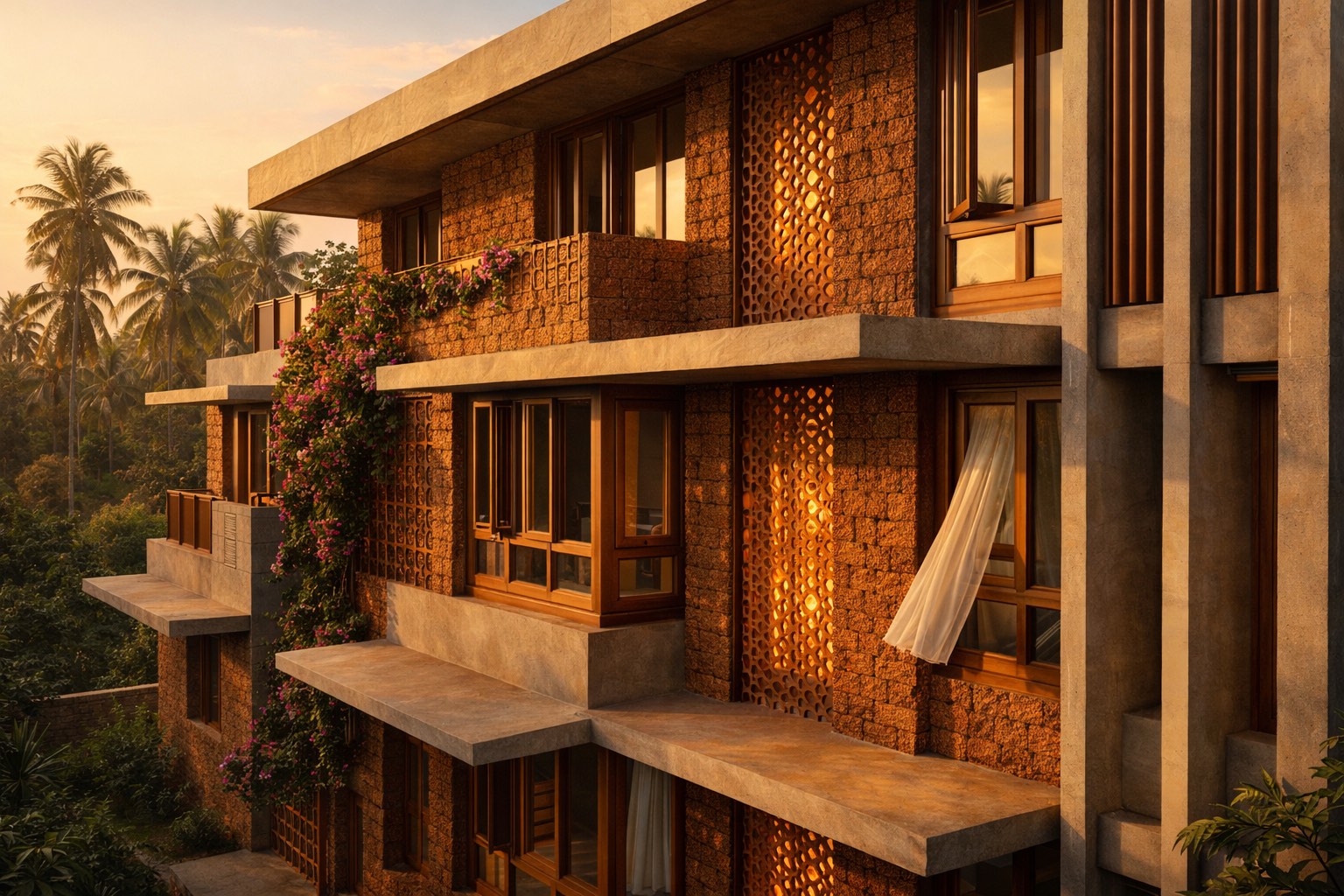
Facade Design for Indian Climates
Materials, Shading, and Ventilation Strategies — A Comprehensive Guide for Architects and Homeowners
The facade is the face a building turns to the world — but in India, it must be far more than an aesthetic statement. The building skin is the primary environmental negotiator between a family's comfort and a climate that can be extraordinarily punishing. A west-facing single-glazed window in Delhi can transmit 400–600 W/m2 of solar heat on a summer afternoon. A south-facing deep-set sandstone wall in Jodhpur can keep the interior 12 degrees C cooler than the exterior. The difference between these two conditions is not luck or location — it is design.
India's five climate zones — from the searing heat of the Thar to the monsoon-drenched Malabar coast, from the composite extremes of the Gangetic plain to the biting cold of Ladakh — demand fundamentally different facade strategies. A material that excels in Bangalore may fail catastrophically in Chennai. A window-to-wall ratio that is generous in Shimla becomes reckless in Ahmedabad. The architect who designs the same facade across India is not being consistent — they are being negligent.
This guide examines facade design through the lens of Indian climate, building science, and traditional wisdom — covering materials, shading, ventilation, and the codes (ECBC 2017, Eco-Niwas Samhita) that increasingly govern envelope performance in Indian construction.
"In a warm climate, the best friend of a building is its shadow." — Charles Correa (1930–2015), architect, from A Place in the Shade (Correa, 2010)
1. The Facade as Climate Filter
The facade must simultaneously manage five functions in the Indian context:
Heat gain control: The dominant challenge in most Indian climate zones. Heat enters through two paths — conduction through opaque walls (controlled by U-value and thermal mass) and radiation through glazing (controlled by SHGC, WWR, and shading).
Glare control: Excessive brightness from unshaded glazing causes visual discomfort and forces occupants to close curtains, negating daylight benefits. The jali screen is an indigenous solution that diffuses light while maintaining views and ventilation.
Ventilation: In warm-humid climates, air movement is essential for thermal comfort. The facade must allow controlled airflow through operable windows, ventilation panels, and jali screens.
Rain protection: India's monsoon delivers 500–4000 mm of rainfall in 3–5 months. The facade must shed water, prevent ingress, and resist moisture damage. The chajja serves dual duty as sun shade and rain shield.
Privacy: Indian residential culture requires nuanced privacy control. The jali excels — allowing views out while limiting views in, a principle refined from Rajasthani havelis to Kerala nalukettu homes.
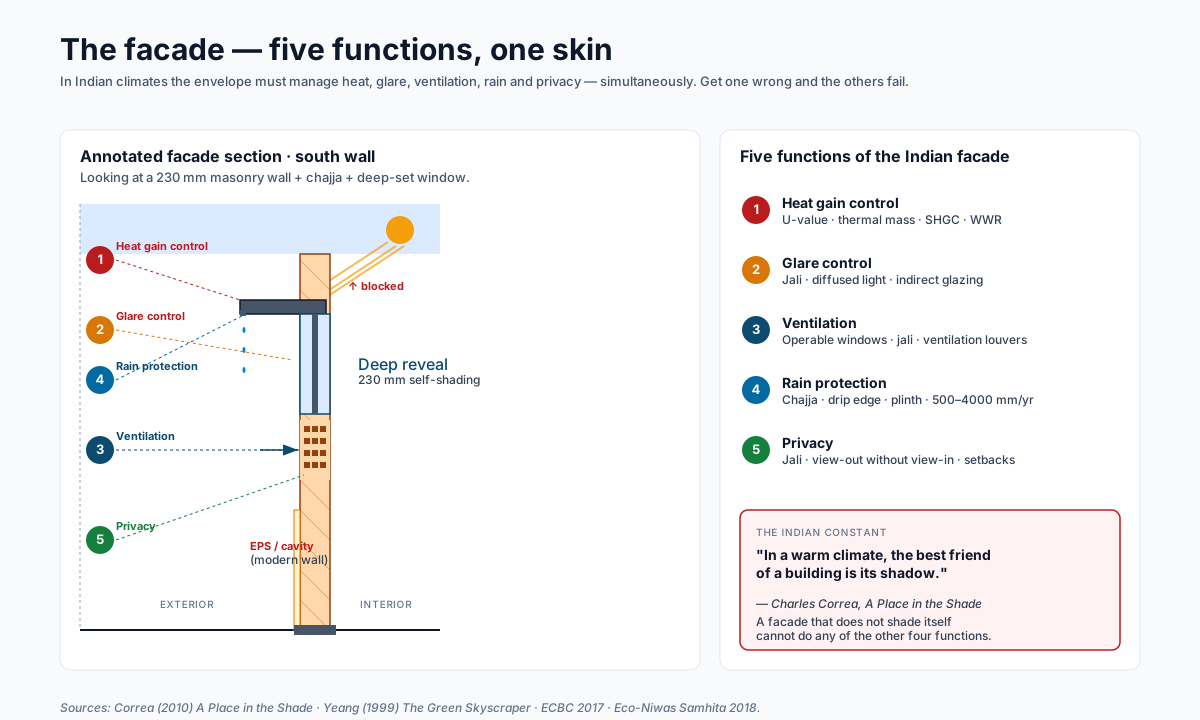
"The facade is the building's thermostat. Get the skin wrong, and no amount of mechanical systems can rescue the interior." — Ken Yeang (b. 1948), architect, from The Green Skyscraper (Yeang, 1999)
2. Building Envelope Codes: ECBC and Eco-Niwas Samhita
U-Value Requirements for Walls and Roofs (ECBC 2017 / ENS)
| Climate Zone | Wall U-value ECBC (W/m2K) | Wall U-value ECBC+ | Wall U-value SuperECBC | Roof U-value ECBC | Roof U-value ECBC+ | Roof U-value SuperECBC |
|---|---|---|---|---|---|---|
| Composite | 0.40 | 0.34 | 0.22 | 0.33 | 0.26 | 0.20 |
| Hot-Dry | 0.40 | 0.34 | 0.22 | 0.33 | 0.26 | 0.20 |
| Warm-Humid | 0.40 | 0.34 | 0.22 | 0.33 | 0.26 | 0.20 |
| Temperate | 0.40 | 0.34 | 0.22 | 0.33 | 0.26 | 0.20 |
| Cold | 0.30 | 0.26 | 0.20 | 0.26 | 0.20 | 0.18 |
Source: Bureau of Energy Efficiency (2017) Energy Conservation Building Code 2017; Bureau of Energy Efficiency (2018) Eco-Niwas Samhita.
Common Indian Wall Assemblies and Their U-Values
| Wall Assembly | Approximate U-Value (W/m2K) | ECBC Compliance |
|---|---|---|
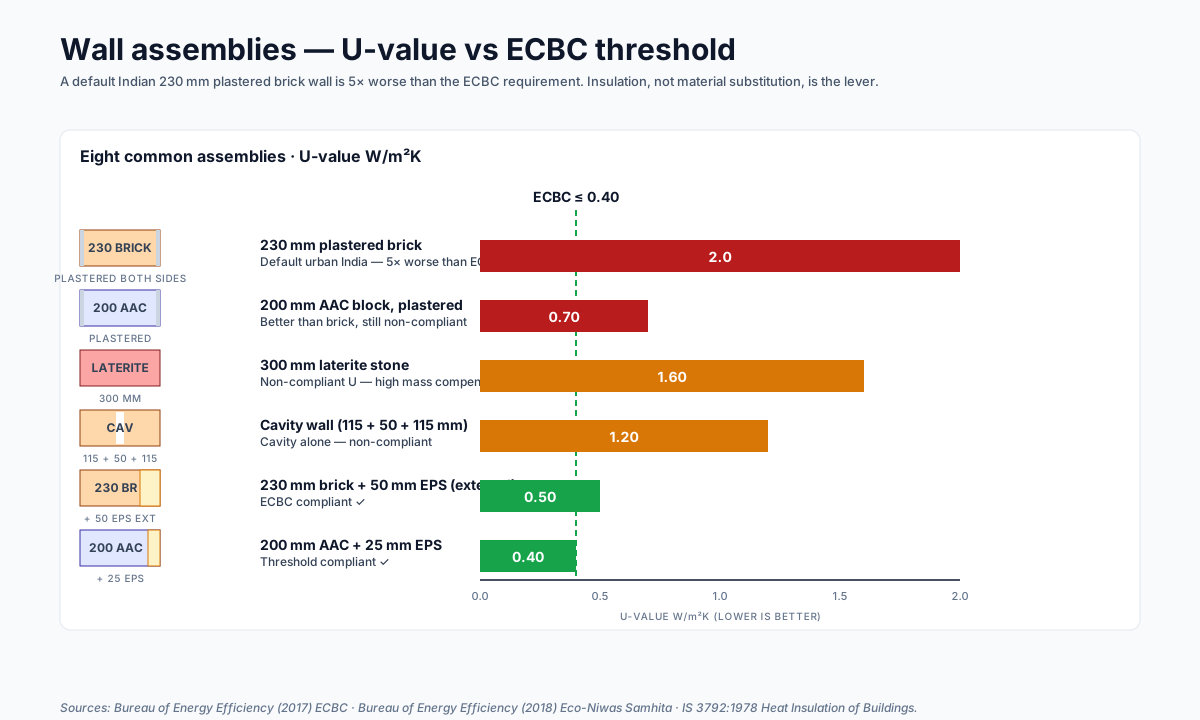
| 230 mm brick wall, both sides plastered | 2.0–2.2 | Not compliant |
| 230 mm brick + 50 mm EPS (external insulation) | 0.50–0.55 | ECBC compliant |
| 230 mm brick + 50 mm XPS | 0.45–0.50 | ECBC compliant |
| 200 mm AAC block, plastered | 0.65–0.80 | Not compliant |
| 200 mm AAC block + 25 mm EPS | 0.38–0.42 | ECBC compliant |
| Cavity wall (115+50 cavity+115 mm brick) | 1.2–1.4 | Not compliant |
| Cavity wall with 50 mm insulation in cavity | 0.45–0.55 | ECBC compliant |
| 300 mm laterite stone | 1.5–1.8 | Not compliant (but high thermal mass compensates) |
| 400 mm mud/cob wall | 1.0–1.2 | Not compliant (but excellent thermal mass) |
| Rat-trap bond wall (230 mm) | 1.6–1.8 | Not compliant (but improved over standard bond) |
The critical insight: A standard 230 mm plastered brick wall — the default construction across urban India — has a U-value of approximately 2.0 W/m2K, which is five times worse than the ECBC requirement. Meeting even basic ECBC compliance requires either insulation or a fundamental change in wall construction.
RETV — The Residential Envelope Metric
The Eco-Niwas Samhita introduced RETV (Residential Envelope Transmittance Value) as the single metric for residential envelope performance. RETV combines heat gain through walls and windows into one number (W/m2). Lower is better.
| Climate Zone | Maximum RETV (W/m2) |
|---|---|
| Composite | 15 |
| Hot-Dry | 15 |
| Warm-Humid | 15 |
| Temperate | 18 |
| Cold | Not prescribed (heating-dominated) |
Key levers to reduce RETV:
1. Reduce WWR (especially on east and west facades)
2. Use lighter wall colours (lower solar absorptance — white/pastel: 0.3–0.4 vs dark: 0.7–0.8)
3. Add wall insulation (lower U-value)
4. Use low-SHGC glazing
5. Add external shading devices (reduces effective SHGC)
3. Facade Materials for Indian Climates
Material Comparison Table
| Material | U-Value (W/m2K) | Thermal Mass | Durability | Maintenance | Cost (Rs/sqft) | Best Climate Zones |
|---|---|---|---|---|---|---|
| Exposed Brick (230 mm) | 2.2–2.5 | High | Very High (50+ yrs) | Very Low | 30–60 | All except extreme cold |
| Plastered Masonry (230 mm + plaster) | 2.0–2.3 | High | High (repaint 5–7 yrs) | Low–Medium | 40–70 | All climates |
| Sandstone Cladding (40–50 mm) | 1.8–2.2 (with backing) | High | Very High | Low | 80–200 | Hot-dry, composite |
| Granite Cladding (30–40 mm) | 1.6–2.0 (with backing) | High | Excellent | Very Low | 120–300 | All climates |
| Laterite Stone (300–400 mm) | 1.5–1.8 | Very High | Excellent (centuries) | Very Low | 40–80 (regional) | Warm-humid (Goa, Karnataka, Kerala) |
| Terracotta Cladding (hollow) | 0.8–1.2 (with cavity) | Medium–High | High | Low | 150–350 | All climates |
| ACP (4 mm panel) | 5.0–6.0 (panel alone) | Negligible | Medium (15–20 yrs) | Medium | 100–250 | Temperate only (fire risk concern) |
| HPL Panels (8–12 mm) | 4.0–5.5 (panel alone) | Low | High (25+ yrs) | Low | 180–400 | All climates |
| Glass Curtain Wall (DGU) | 1.8–2.8 | Negligible | High (sealant: 15–20 yrs) | Medium–High | 350–800 | Temperate only (problematic elsewhere) |
| Timber Cladding (teak/sal) | 0.8–1.2 | Low–Medium | Medium (needs treatment) | High | 200–500 | Warm-humid, temperate |
| Bamboo Cladding | 0.9–1.3 | Low | Medium (treated: 15–20 yrs) | Medium–High | 80–200 | Warm-humid, composite |
| GRC Panels (10–15 mm) | 3.5–4.5 (panel alone) | Low–Medium | High (30+ yrs) | Low | 150–350 | All climates |
| Corten Steel | 5.0–6.0 (panel alone) | Negligible | Very High (self-healing rust) | Very Low | 250–500 | Hot-dry, composite (not coastal) |
| Lime Plaster (20–25 mm on masonry) | 1.8–2.2 (full wall) | High | High (breathable, self-healing) | Low–Medium | 35–60 | All climates, esp. humid |
| Mud Plaster (on stabilised wall) | 1.0–1.5 (with thick wall) | Very High | Medium (needs renewal) | High | 15–30 | Hot-dry, composite |
Costs are approximate 2024–2026 market rates including installation. U-values are for complete wall assemblies where applicable.
"Materials have their own presence. When I use stone, I want it to feel like stone — its weight, its temperature, its texture against the skin." — Peter Zumthor (b. 1943), architect, from Atmospheres (Zumthor, 2006)
4. Shading Device Design
Solar Geometry for Indian Latitudes
India spans latitudes 8 degrees N (Kanyakumari) to 37 degrees N (Ladakh). This range has critical implications for shading design. At lower latitudes, the sun is nearly overhead much of the year — horizontal shading is highly effective. At higher latitudes, winter sun altitude is lower, requiring deeper overhangs to block summer sun while admitting winter sun.
The fundamental problem: East and west facades receive low-angle sun (below 30 degrees at sunrise/sunset) at all latitudes. Horizontal overhangs cannot block this low sun — vertical fins or screens are essential.
Chajja Depth Rule of Thumb
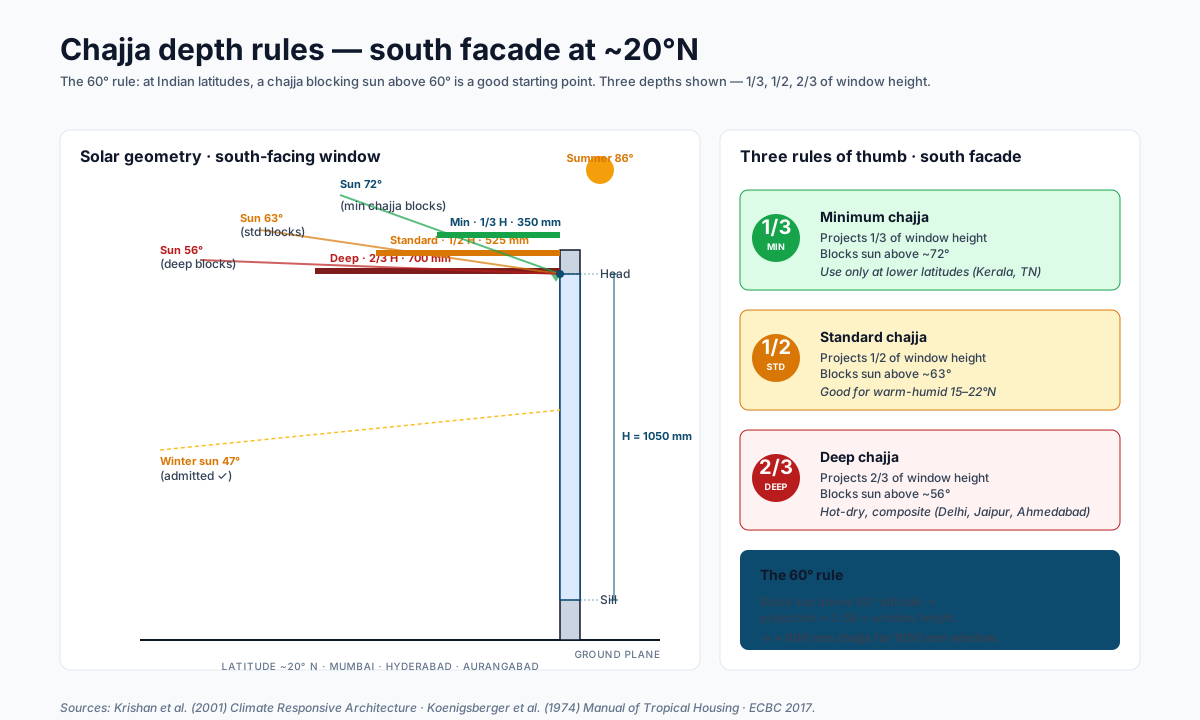
For south facades at Indian latitudes (10–30 degrees N):
- Minimum chajja: 1/3 of window height (blocks sun above ~72 degrees)
- Standard chajja: 1/2 of window height (blocks sun above ~63 degrees)
- Deep chajja: 2/3 of window height (blocks sun above ~56 degrees)
The 60-degree rule: A chajja that blocks sun above 60 degrees altitude is a good starting point for south facades. This means projection of approximately 0.58 x window height — roughly 600 mm for a 1050 mm window.
Shading Device Types and Performance
| Device | Solar Cut-off Angle | Best Orientation | Ventilation Impact | Cost (Rs/sqft of window) | Notes |
|---|---|---|---|---|---|
| Horizontal Chajja (600 mm) | Blocks above ~55–60 degrees | South (best), E/W (partial) | Neutral | 50–150 | Traditional Indian element; must be calculated for latitude |
| Horizontal Chajja (900 mm) | Blocks above ~45 degrees | South (excellent) | Neutral | 80–200 | Effective for south at latitudes 15–25 degrees N |
| Vertical Fins | Blocks low-angle side sun | East/West (best) | Slight reduction | 80–200 | Essential for E/W where sun angle is low |
| Egg-crate (horizontal + vertical) | Blocks from multiple angles | East/West, also South | Moderate reduction | 150–350 | Most effective overall; can reduce airflow |
| Pergola / Trellis | Partial shade (50–70%) | South, West (with climbers) | Good (allows airflow) | 100–300 | Excellent with climbing plants; biophilic |
| Jali / Perforated Screen | Diffused light; depends on porosity | All orientations | Good (promotes cross-ventilation) | 80–250 | Iconic Indian element; privacy + ventilation + shading |
| Fixed Louvers (horizontal) | Adjustable by blade angle | South, East/West | Good (airflow between blades) | 120–300 | Aluminium or terracotta; angle critical |
| Operable Louvers | User-controlled | All, especially West | Excellent (fully open option) | 200–500 | Higher cost but maximum flexibility |
| Brise-Soleil (deep concrete) | Blocks from multiple angles | South, West | Moderate | 200–400 | Brutalist/modernist; Corbusier tradition |
| Deep-set Windows (300 mm+ reveal) | Self-shading from wall depth | All orientations | Neutral | 30–60 (incremental) | Traditional in Rajasthan, Ladakh; thick walls provide naturally |
| Tree Shading (deciduous) | Variable by species/season | South, West | Improves microclimate | Variable | 3–5 year establishment; seasonal adaptation |
5. Glazing: WWR and SHGC by Climate Zone
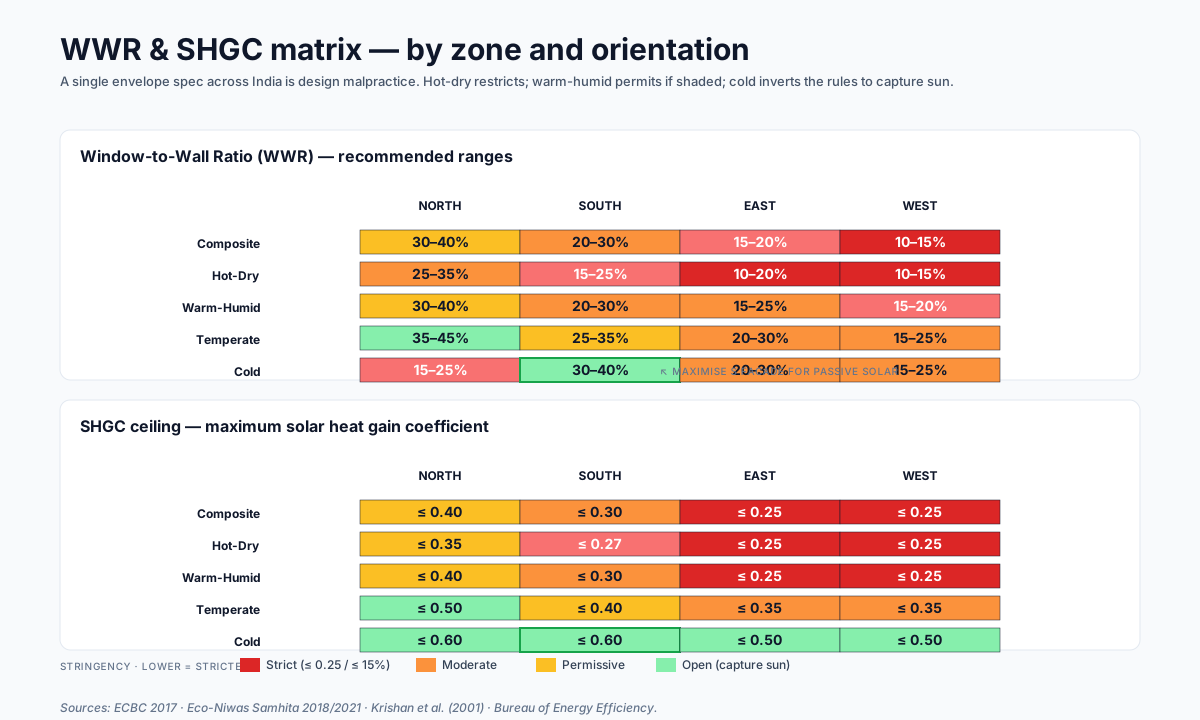
Window-to-Wall Ratio Recommendations (per ENS/ECBC)
| Climate Zone | North | South | East | West | Notes |
|---|---|---|---|---|---|
| Composite (Delhi, Lucknow) | 30–40% | 20–30% | 15–20% | 10–15% | West most problematic; minimise |
| Hot-Dry (Jaipur, Jodhpur) | 25–35% | 15–25% | 10–20% | 10–15% | Minimise overall; use deep reveals |
| Warm-Humid (Mumbai, Chennai) | 30–40% | 20–30% | 15–25% | 15–20% | Larger openings if shaded + operable |
| Temperate (Bangalore, Pune) | 35–45% | 25–35% | 20–30% | 15–25% | Most permissive; comfortable year-round |
| Cold (Shimla, Leh) | 15–25% | 30–40% | 20–30% | 15–25% | South maximised for passive solar heating |
SHGC Recommendations for Glazing
| Climate Zone | East/West Facades | North Facade | South Facade | Recommended Glazing |
|---|---|---|---|---|
| Composite | <= 0.25 | <= 0.40 | <= 0.30 | Tinted DGU or Low-E DGU |
| Hot-Dry | <= 0.25 | <= 0.35 | <= 0.27 | Low-E DGU, reflective glass |
| Warm-Humid | <= 0.25 | <= 0.40 | <= 0.30 | Low-E DGU with high VLT |
| Temperate | <= 0.35 | <= 0.50 | <= 0.40 | Clear DGU or mild tint |
| Cold | <= 0.50 | <= 0.60 | <= 0.60 | Clear DGU (maximise solar gain) |
Glazing types and typical SHGC values:
| Glazing Type | SHGC | U-Value (W/m2K) | VLT |
|---|---|---|---|
| Clear single glass (6 mm) | 0.82 | 5.7 | 0.88 |
| Clear DGU (6-12-6) | 0.70 | 2.8 | 0.80 |
| Tinted single glass (6 mm) | 0.55–0.65 | 5.7 | 0.50–0.65 |
| Tinted DGU | 0.45–0.55 | 2.8 | 0.40–0.55 |
| Low-E DGU (pyrolytic) | 0.35–0.45 | 1.8–2.2 | 0.50–0.65 |
| Low-E DGU (sputtered) | 0.25–0.35 | 1.4–1.8 | 0.45–0.60 |
| Reflective glass | 0.15–0.30 | 2.5–3.0 | 0.10–0.30 |
Sources: Bureau of Energy Efficiency (2017); Bureau of Energy Efficiency (2018).
6. The West-Facing Facade Problem
The west facade is the most thermally problematic orientation in Indian climates — and the one most frequently under-designed.
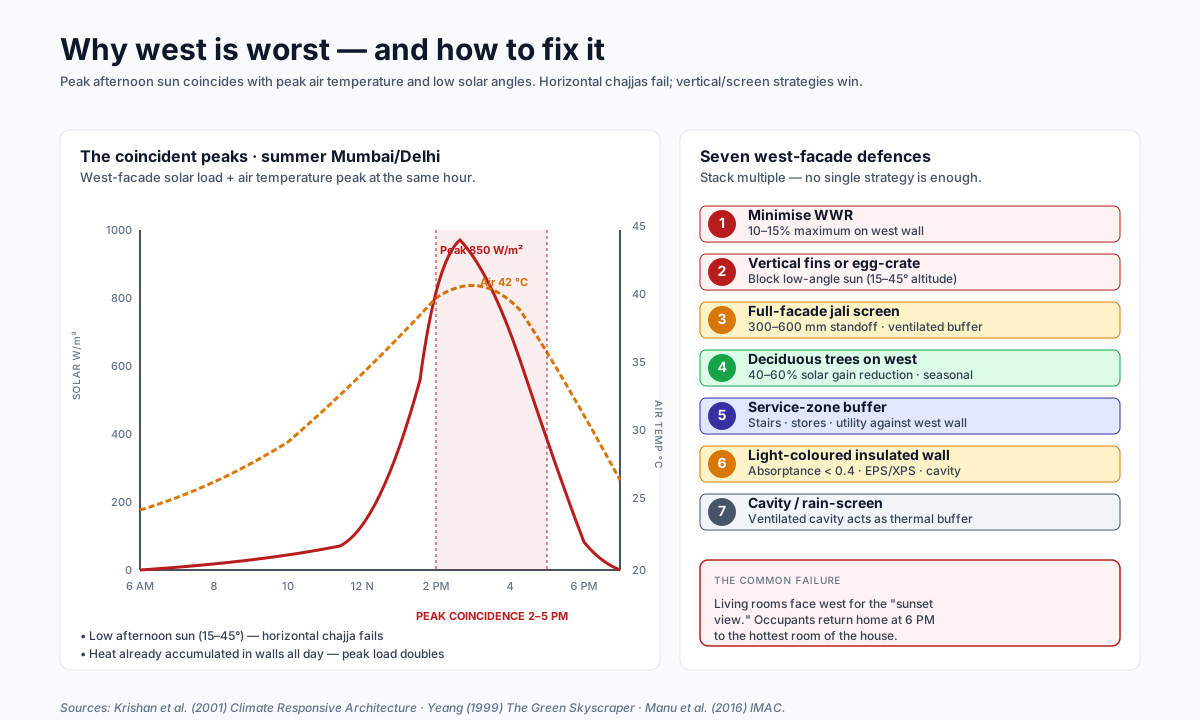
Why west is worst:
1. Peak solar radiation (700–900 W/m2) coincides with peak ambient temperature (2–5 PM)
2. Low afternoon sun angle (15–45 degrees) makes horizontal shading ineffective
3. Building materials have accumulated heat all day; west solar gain pushes thermal load to maximum
4. Living rooms often face west — occupants return home to the hottest room
Strategies:
- Minimise WWR: 10–15% maximum on west-facing walls
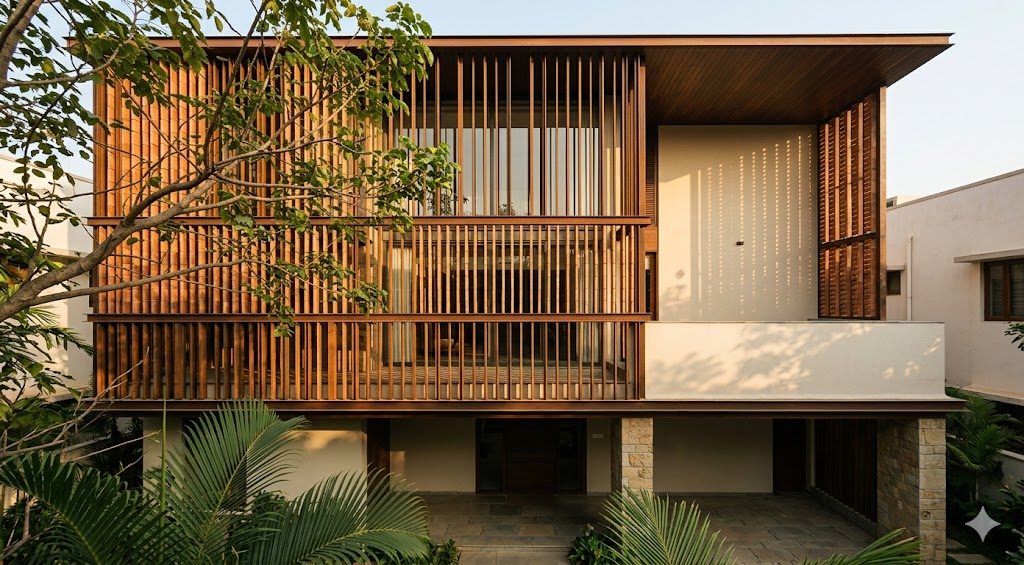
- Vertical fins or egg-crate shading: Since horizontal chajjas cannot block low-angle sun
- Full-facade jali screen: At 300–600 mm from the wall, creating a shaded, ventilated buffer
- Landscaping: Deciduous trees on the west can reduce solar gain by 40–60%
- Buffer spaces: Place service areas (stores, staircases, utility) against the west wall
- Insulated opaque walls: Where windows are not needed, use insulated walls with light-coloured finish
- Double wall / cavity wall: A ventilated cavity on the west face acts as thermal buffer
"The wall is not just a barrier; it is a breathing surface, a filter between inside and outside." — Laurie Baker (1917–2007), architect
7. Climate Zone-Specific Facade Strategies
| Parameter | Composite (Delhi) | Hot-Dry (Jaipur) | Warm-Humid (Mumbai) | Temperate (Bangalore) | Cold (Shimla) |
|---|---|---|---|---|---|
| Primary challenge | Extreme summers + cold winters | Intense radiation, dust | Humidity, rain, moderate heat | Mild year-round | Prolonged cold, high radiation |
| Wall assembly | Cavity wall or AAC + insulation | Thick masonry (300 mm+) or insulated | Rain-screen cladding or waterproofed masonry | Standard 230 mm brick adequate | Double wall with heavy insulation |
| Preferred materials | Brick, AAC, stone cladding | Sandstone, lime plaster, thick brick | Laterite, terracotta, weather-resistant plaster | Exposed brick, stone | Stone, timber, double-skin |
| Insulation | External (50 mm EPS/XPS) | External or cavity (mass inside) | Minimal (focus on waterproofing) | Usually not needed | Critical (75–100 mm) |
| Surface colour | Light (absorptance < 0.5) | Very light (< 0.4) | Light to medium | Flexible | Dark acceptable (absorb winter sun) |
| WWR (overall) | 20–25% | 15–20% | 25–30% | 30–40% | 20–25% (south: 35%+) |
| Glazing | Low-E DGU | Low-E DGU or reflective | Low-E DGU with high VLT | Clear DGU | Clear DGU (triple in extreme cold) |
| Shading | Deep chajja + vertical fins (E/W) | Deep reveals, jali, pergola | Horizontal overhangs + rain protection | Moderate chajja | Minimal (south: operable) |
| Ventilation | Cross-vent + fans; sealed in winter | Evaporative cooling, night ventilation | Maximum cross-ventilation; fans essential | Natural ventilation year-round | Sealed envelope; HRV |
| Rain protection | Moderate (monsoon: Jun–Sep) | Minimal | Critical (extended monsoon) | Moderate | Snow/ice protection |
Sources: Krishan et al. (2001); Koenigsberger et al. (1974); Givoni (1998).
8. Ventilation Facade Strategies
| Strategy | Airflow Rate (typical) | Best Climate | Key Performance | Cost Impact |
|---|---|---|---|---|
| Operable Windows (casement) | 15–25 ACH (fully open) | All, esp. warm-humid | Direct cross-ventilation; user-controlled | Baseline |
| Operable Windows (sliding) | 50% of casement | All | Compact; doesn't protrude; less effective | Baseline |
| Jali / Perforated Screens | 5–15 ACH (continuous) | Hot-dry, composite | Privacy + ventilation + reduced glare | Low–Medium |
| Ventilation Louvers (fixed) | 10–20 ACH | Warm-humid | Permanent ventilation; rain protection | Low |
| Double-skin Facade | 3–8 ACH (buoyancy) | Composite, warm-humid | Buffer zone; noise reduction; controlled vent | Very High |
| Wind Catchers (Badgir) | 10–30 ACH | Hot-dry (Rajasthan) | Passive cooling; no energy | Medium |
| Stack Ventilation Openings | 5–15 ACH (buoyancy) | All | Low inlet, high outlet; atrium/stairwell driven | Low–Medium |
| Ventilated Rain-screen | Continuous cavity ventilation | Warm-humid, composite | Moisture management; thermal buffer | High |
9. Traditional Indian Facade Wisdom
India's traditional architecture represents centuries of empirical facade design — solutions arrived at without calculation but validated by survival.
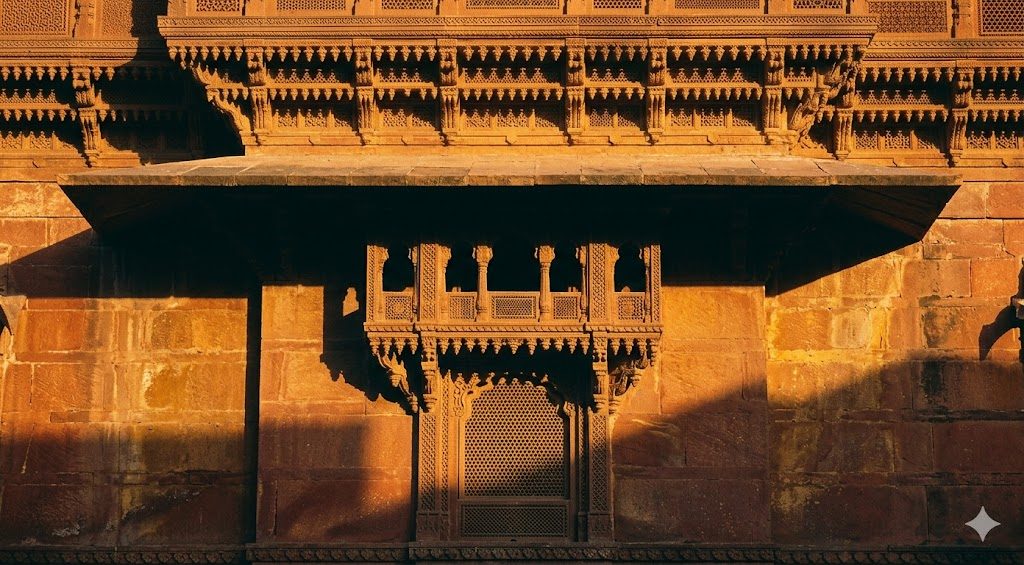
Deep-set windows in Rajasthan: Havelis in Jaipur and Jodhpur use walls 450–600 mm thick with windows recessed 300–400 mm. Combined with jharokha (overhanging balconies), this keeps interiors cool when external temperatures exceed 45 degrees C. The sandstone walls have a thermal lag of 8–10 hours — peak heat reaches the interior after sunset (Krishan et al., 2001).
Laterite walls in Goa and Karnataka: Quarried soft and hardening with atmospheric exposure, laterite creates naturally insulating walls 300–450 mm thick. Its porous structure breathes, managing humidity. Thermal conductivity: 0.7–1.0 W/mK. The warm red-orange colour weathers into an extraordinary patina over decades.
Timber facades in Kerala and Assam: Kerala's nalukettu homes use teak facades with carved ventilation panels, allowing continuous monsoon air movement. Assam's chang-ghar use bamboo-mat walls that are essentially permeable — prioritising ventilation over thermal mass in extreme humidity.
Lime-washed walls: Traditional lime wash (chunam) is breathable, reflective (absorptance as low as 0.2–0.3), mildly anti-fungal, and self-healing. It keeps walls 5–8 degrees C cooler than dark-painted surfaces.
The Chhajja tradition: The overhanging stone or concrete chhajja is India's most universal facade element — simultaneously providing sun shading, rain protection, and architectural expression. The Mughal tradition of deep chhajjas in the red sandstone of Fatehpur Sikri represents climate response elevated to art.
"The architect who builds without considering the climate is wasting half his opportunity." — Hassan Fathy (1900–1989), architect, from Natural Energy and Vernacular Architecture (Fathy, 1986)
10. The Glass Box Critique
Many recent Indian residential towers adopt glass curtain wall facades inspired by temperate-climate Western architecture — without considering Indian solar conditions.
The consequences are severe:
- A typical glass curtain wall (single glazing, SHGC 0.8) facing west in Mumbai transmits 400–600 W/m2 of solar heat on summer afternoons
- HVAC capacity (and cost) increases 2–4 times compared to a well-designed opaque facade
- Energy consumption rises 30–60% over optimally designed envelope
- Glare forces residents to permanently close curtains, negating the supposed daylight advantage
- Condensation and mould at frame junctions in humid climates
The paradox: The glass box is marketed as 'premium' and 'modern' but delivers inferior comfort, higher bills, and greater environmental impact. As ECBC commentary notes, unconstrained glazing is the single largest driver of cooling energy in Indian buildings (Bureau of Energy Efficiency, 2017).
Solutions: Limit WWR to 30–40% maximum; use high-performance glazing (Low-E DGU, SHGC < 0.30); add external shading on all glazed areas; use opaque spandrel panels between floor slabs; design balconies as shading devices — as Correa demonstrated in Kanchanjunga Apartments, where deep garden terraces act as climate filters for the apartments behind them.
"I try to find an architecture that responds to rain, to wind, to sun — not one that ignores them." — Glenn Murcutt (b. 1936), architect, Pritzker Prize laureate, 2002
11. Green Facades and Living Walls
Green facades offer measurable cooling performance:
- Surface temperature reduction: 5–15 degrees C compared to bare wall
- Air temperature reduction: 2–5 degrees C in immediate vicinity
- U-value improvement: 10–30% (still air layer + evapotranspiration)
- Additional benefits: Dust filtration, noise reduction, biodiversity
Suitable species for Indian conditions: Bougainvillea (hot-dry, composite); ficus pumila / creeping fig (warm-humid); jasmine (all climates); curtain creeper / Vernonia (fast-growing screen). Deciduous species provide the ideal combination — summer shade, winter sun.
Design considerations: Trellis/cable system standing off from wall by 100–150 mm (roots must not damage waterproofing); drip irrigation with timer; living walls weigh 30–100 kg/m2 when wet — structural implications must be assessed.
12. Facade Maintenance in Indian Conditions
| Material | Annual Maintenance | Major Maintenance Cycle | Notes |
|---|---|---|---|
| Exposed brick | Nil | Re-pointing: 20–30 years | Apply water repellent initially |
| Plastered + painted | Nil | Repaint: 3–5 years | High-quality exterior emulsion essential |
| Stone cladding | Annual wash (optional) | Re-pointing: 15–20 years | Sealant replacement: 10 years |
| Terracotta cladding | Nil | Inspect fixings: 10 years | Very low maintenance |
| ACP panels | Annual wash | Panel replacement: 15–20 years | Check fixings + sealants: 5 years |
| Glass curtain wall | Bi-annual wash | Sealant replacement: 15–20 years | Gasket replacement: 10–15 years |
| Timber cladding | Annual treatment | Re-coat/oil: 2–3 years | Use teak/sal for Indian conditions |
| Green facade | Monthly pruning/irrigation | Replanting: 3–5 years | Requires dedicated maintenance regime |
Indian conditions — intense UV, monsoon rain, dust, and urban pollution — degrade facade materials faster than in temperate climates. Exterior paint lasts 3–5 years (vs 7–10 in Europe); uPVC windows require UV-stabilised formulations; aluminium sealants degrade in 5–10 years. Maintenance planning must be factored into material selection from the outset.
References
- Bureau of Energy Efficiency (2017) Energy Conservation Building Code 2017. New Delhi: Ministry of Power, Government of India.
- Bureau of Energy Efficiency (2018) Eco-Niwas Samhita 2018: Energy Conservation Building Code for Residential Buildings. New Delhi: Ministry of Power.
- Bureau of Energy Efficiency (2021) Eco-Niwas Samhita 2021 (Part II: Electro-Mechanical). New Delhi: Ministry of Power.
- Bureau of Indian Standards (2016) National Building Code of India 2016 (SP 7:2016). New Delhi: BIS.
- Bureau of Indian Standards (1992) IS 1077:1992 — Common Burnt Clay Building Bricks — Specification. 5th rev. New Delhi: BIS.
- Bureau of Indian Standards (1978) IS 3792:1978 — Guide for Heat Insulation of Non-Industrial Buildings. 1st rev. New Delhi: BIS.
- Bureau of Indian Standards (2005) IS 2185 (Parts 1–3) — Concrete Masonry Units. New Delhi: BIS.
- Chand, I., Bhargava, P.K. and Krishak, N.L.V. (1998) 'Effect of balcony depth on natural ventilation of buildings', Energy and Buildings, 28(2), pp. 155–161.
- Correa, C. (2010) A Place in the Shade: The New Landscape and Other Essays. New Delhi: Penguin India.
- Didwania, S., Mathur, J. and Garg, V. (2019) 'Optimisation of building envelope parameters for energy efficiency in composite climate of India', Journal of Building Engineering, 21, pp. 174–183.
- Fathy, H. (1986) Natural Energy and Vernacular Architecture. Chicago: University of Chicago Press.
- Givoni, B. (1969) Man, Climate and Architecture. Amsterdam: Elsevier.
- Givoni, B. (1998) Climate Considerations in Building and Urban Design. New York: Van Nostrand Reinhold.
- Hausladen, G., de Saldanha, M. and Liedl, P. (2008) Climate Skin: Building-Skin Concepts that Can Do More with Less Energy. Basel: Birkhauser.
- Herzog, T., Krippner, R. and Lang, W. (2004) Facade Construction Manual. Basel: Birkhauser.
- Knaack, U., Klein, T., Bilow, M. and Auer, T. (2014) Facades: Principles of Construction. 2nd edn. Basel: Birkhauser.
- Koenigsberger, O.H., Ingersoll, T.G., Mayhew, A. and Szokolay, S.V. (1974) Manual of Tropical Housing and Building: Part 1 — Climatic Design. London: Longman.
- Krishan, A., Baker, N., Yannas, S. and Szokolay, S. (2001) Climate Responsive Architecture: A Design Handbook for Energy Efficient Buildings. New Delhi: Tata McGraw-Hill.
- Kumar, S., Singh, M.K. and Mathur, A. (2018) 'Thermal performance evaluation of traditional jali screens in composite climate', Energy and Buildings, 178, pp. 229–238.
- Manu, S. et al. (2016) 'Field studies of thermal comfort across multiple climate zones for the subcontinent: India Model for Adaptive Comfort (IMAC)', Building and Environment, 98, pp. 55–70.
- Rawal, R., Shukla, Y., Didwania, S. and Manu, S. (2018) 'Residential building envelope performance and code compliance in India', Proceedings of the 10th Windsor Conference, pp. 899–910.
- Shastry, V., Mani, M. and Tenber, R. (2016) 'Evaluating thermal comfort and building climatic response in warm-humid climates for vernacular dwellings in Goa', Architectural Science Review, 59(1), pp. 12–28.
- Yeang, K. (1999) The Green Skyscraper: The Basis for Designing Sustainable Intensive Buildings. Munich: Prestel.
- Zumthor, P. (2006) Atmospheres: Architectural Environments — Surrounding Objects. Basel: Birkhauser.
Author's Note: This guide draws on published Indian energy codes (ECBC 2017, ENS 2018/2021), NBC 2016, IS codes for building materials, and peer-reviewed research on building envelope performance. U-values, SHGC values, and cost figures are approximate and represent typical conditions — actual values depend on specific products, assemblies, and market conditions. The RETV and U-value requirements cited are from the prescriptive path of ECBC/ENS; the performance path allows trade-offs between parameters. Architects should verify current code requirements with BEE and use energy simulation for performance-path compliance.
Disclaimer: This article is for informational and educational purposes only. It does not constitute professional architectural or engineering advice. Facade design must be undertaken by qualified professionals with appropriate thermal modelling and structural analysis for site-specific conditions.
Export this guide
Related Guides — Deep-dive reading
Designing a Naturally Energy-Efficient Indian Home
Comfort first, gadgets last — passive design, orientation, insulation, ventilation and the climate wisdom that cuts Indian energy bills
SustainabilityClimate-Responsive Facades for India: Designing Your Home's Skin for Your Weather
A homeowner's plain-language guide to the facade strategy for every Indian climate zone — what your walls, windows, shading, and colours should actually do where you live
Building FacadesEnergy-Efficient Facades in India: How the Building Skin Cuts Your Cooling, Heating & Lighting Bills
How a building facade drives cooling, heating and lighting energy in India, the three levers of solar-heat-gain control, insulation and daylighting, U-value, SHGC, VLT and WWR in plain terms, ECBC and Eco-Niwas expectations, and real Indian green buildings.
Building FacadesRelated Tools — Try Free
Brise-Soleil Visualizer
Interactive horizontal-louvre cut-off angle calculator — sun altitude, louvre depth, and spacing inputs with a live shadow preview. Computes θ = arctan(spacing/depth) for façade shading, ECBC envelope compliance, hospital daylight design, and tropical sun-control detailing.
Sun Shading ToolCross-Ventilation Analyzer
Estimate airflow and air changes per hour (ACH) from room size, window areas, layout, and local wind — with NBC 2016 Part 8 compliance check.
Ventilation CalculatorWindow Shade Depth Calculator
Size the overhang or chajja that shades a window in summer — by orientation, latitude and height.
Window Tool