
Tropical Architecture in India — Climate, Vocabulary, Vernacular & Modern Practice
The Three Tropical Climate Zones, Eight Signature Vocabulary Elements, Six Regional Vernaculars, Material Palette & Modern Lineage
Across the breadth of India — from the Konkan and Malabar coasts through the Deccan plateau to the Brahmaputra valley — most of the country sits inside a tropical climate envelope. Roughly 75% of India's population lives in a zone classified as tropical by the BIS climate-zone framework (SP 41, 1987). Tropical architecture is therefore not a niche style; it is the dominant residential question for three-quarters of Indian homeowners.
Yet most Indian residential design conversations in 2026 are conducted in vocabulary borrowed from temperate-climate Europe, modernist Bauhaus orthodoxy, or American suburban catalogue. The result is houses that look smart in renderings but fail at the first monsoon — leaking roofs, blooming mould, AC bills three times what they should be, and finishes that need replacing every five years.
This guide is the working architect-led reference for tropical Indian residential architecture. It covers the three tropical climate zones in India (with rainfall, humidity, and temperature data for each), the eight signature vocabulary elements that define tropical building (verandah, pitched roof, raised plinth, jaali, courtyard, deep eaves, cross-ventilation, foliage), six regional vernacular variants (Kerala, Goa, Konkan, Bengal, Tamil, North-East), a fifteen-material palette suited to humid heat, the lineage of modern practitioners from Bawa to today, common mistakes, and a pre-construction checklist.
Tropical architecture is not a style — it is a climate-response discipline. Every element earns its place through measurable comfort gain. Get the vocabulary right and the building works without effort; ignore it and no amount of AC will rescue the design.
What "Tropical" Means in Indian Residential Vocabulary
The word "tropical" carries different weight in architectural and meteorological usage. Meteorologically, the tropics are defined as the zone between the Tropic of Cancer (23.5° N) and the Tropic of Capricorn (23.5° S) — a band that includes the entire Indian peninsula south of roughly Delhi. Architecturally, the tropical envelope is narrower: it covers regions where average winter temperature does not fall below 18 °C and where humidity dominates the design conversation.
By that working definition, India contains three distinct tropical sub-climates:
- Warm-Humid — the entire coastal belt (Konkan, Malabar, Coromandel, Bengal coast). Year-round humidity, heavy monsoon, salt-laden air.
- Tropical Savanna — the Deccan plateau (Bengaluru, Hyderabad, central Karnataka, Maharashtra hinterland). Hot summers, mild winters, modest humidity, distinct dry season.
- Tropical Wet — the North-East (Assam, Meghalaya, Manipur, Nagaland). Year-round high humidity, extreme rainfall (the wettest places on Earth), and complex topography.
The architectural response in each is different. Coastal Kerala does not build the same way as Bengaluru, which does not build the same way as Cherrapunji. But all three share a common vocabulary — the eight signature elements detailed below — deployed in different syntaxes.
For the broader climate-zone framework that contrasts tropical with Hot-Dry, Composite, and Cold, see the Contemporary House Elevation guide's climate adaptation matrix.
The Three Tropical Climate Zones in India
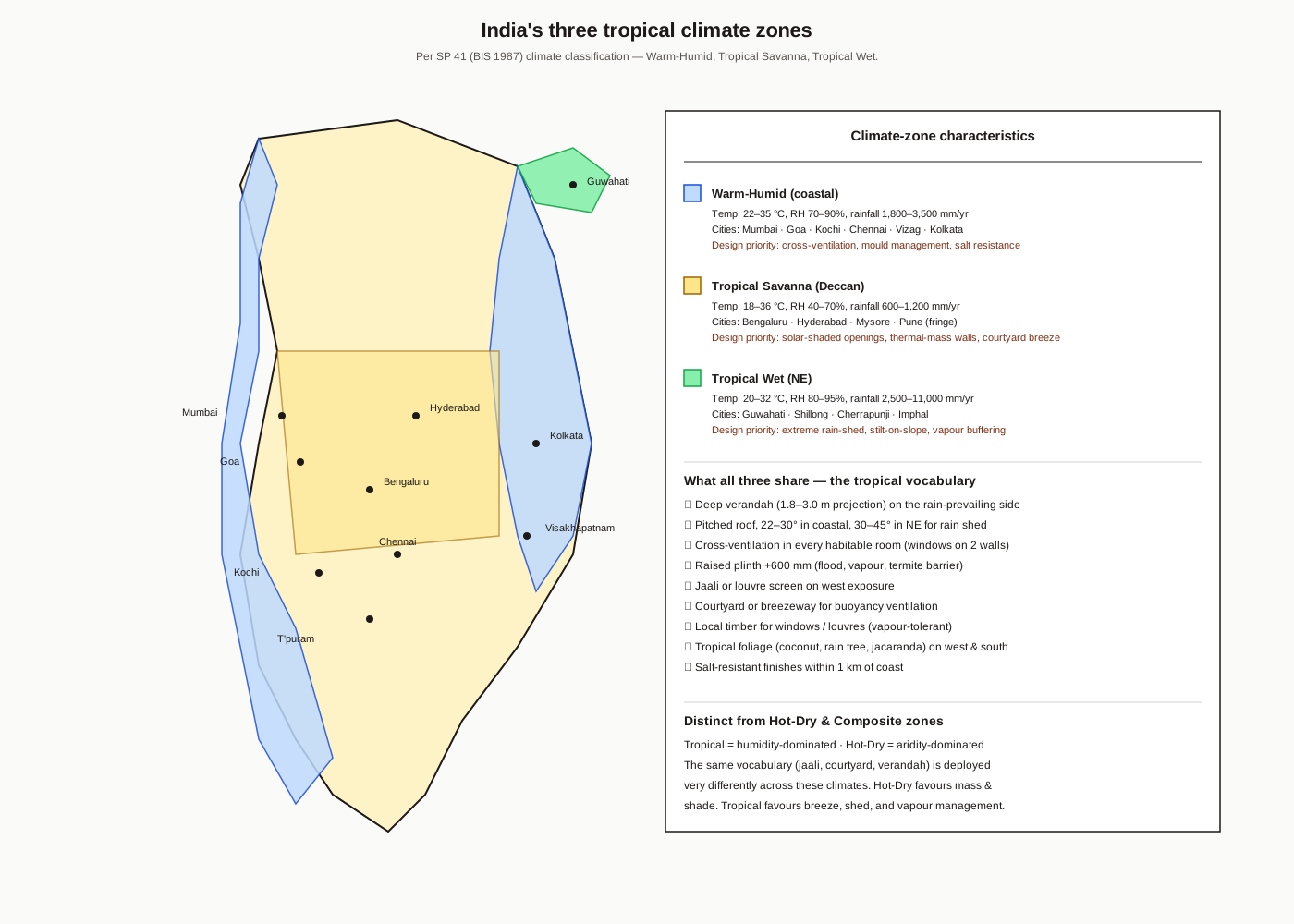
The figure above maps the three zones. Each demands a specific residential design response.
Warm-Humid (Coastal Belt)
The dominant tropical sub-climate of Indian residential design — roughly 35% of the Indian population lives within 100 km of the coast. Temperature range 22–35 °C, relative humidity 70–90%, annual rainfall 1,800–3,500 mm concentrated in 4–5 monsoon months.
Design priorities:
- Cross-ventilation in every habitable room — non-negotiable
- Salt-resistant finishes within 1 km of coast (no marble, no mild steel)
- Mould management through vapour-tolerant materials and active ventilation
- Plinth raised +600 mm above grade (flood + termite)
- Pitched or stepped roof for rapid rain shed (22–30° optimum)
Cities: Mumbai, Goa, Mangalore, Kochi, Trivandrum, Chennai, Visakhapatnam, Bhubaneswar, Kolkata.
Tropical Savanna (Deccan Plateau)
The interior tropical zone — Bengaluru, Hyderabad, Mysore, Pune fringe, central Karnataka, eastern Maharashtra. Temperature 18–36 °C (cooler than coastal), humidity 40–70% (lower), rainfall 600–1,200 mm/year (distinctly less). Distinguished from coastal warm-humid by a clear dry season and lower humidity.
Design priorities:
- Solar-shaded openings (deep eaves, chajja)
- Thermal-mass walls (laterite, stone, brick) — diurnal range up to 18 °C
- Courtyard or atrium for buoyancy ventilation
- Cross-ventilation paired windows
- Lighter rainfall demands less aggressive roof pitch (15–22°) but still pitched
Cities: Bengaluru, Hyderabad, Mysore, Mangalore (fringe).
Tropical Wet (North-East)
The wettest residential climate in the world — Mawsynram and Cherrapunji average 11,000–12,000 mm annual rainfall, ten times Bengaluru. Year-round humidity 80–95%, temperature 20–32 °C.
Design priorities:
- Extreme rain-shed (30–45° roof pitch, deep eaves 1.0–1.2 m)
- Stilt construction on slopes (flood + vapour + termite isolation)
- Vapour-buffer materials throughout (wood cladding, treated bamboo)
- Aggressive cross-ventilation (3–4 ACH minimum)
- Local timber preferred (better humidity tolerance than imported)
Cities: Guwahati, Shillong, Cherrapunji, Imphal, Kohima, Aizawl.
The shared rule across all three zones is the tropical vocabulary — eight elements that work in any of them, deployed with zone-specific tuning.
The Eight Signature Vocabulary Elements
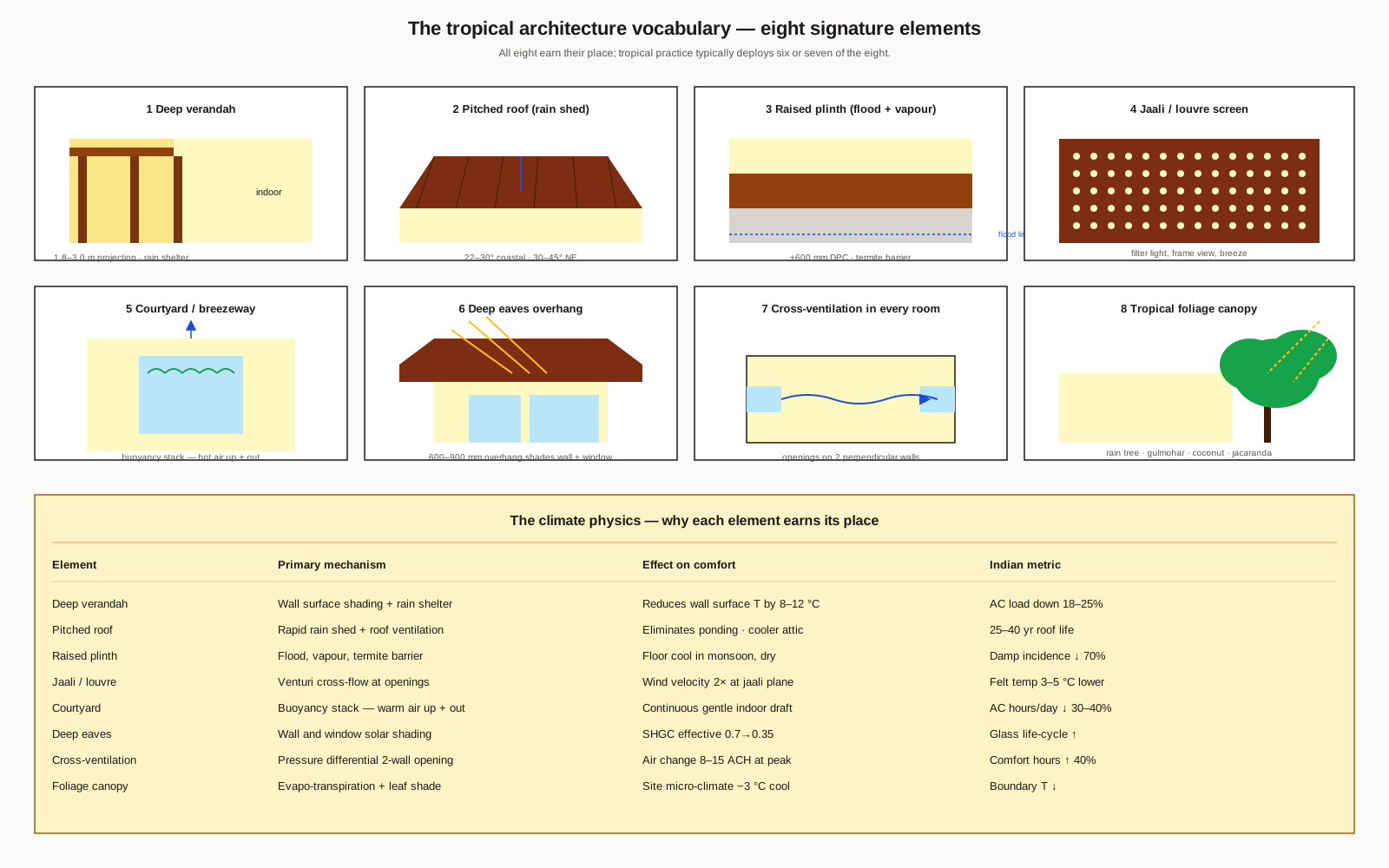
Eight elements, six or seven of which appear in any well-designed tropical Indian house.
1. Deep Verandah
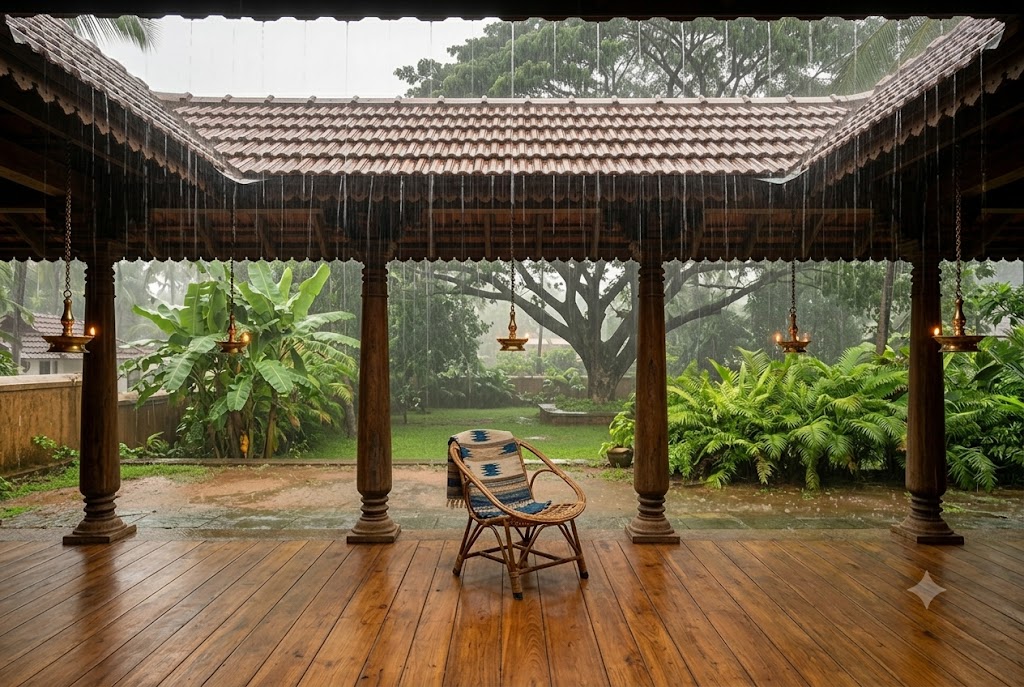
The most-recognisable tropical move. A 1.8–3.0 m roofed outdoor space along the rain-prevailing side of the house (west or south-west in most of India). Functions: shades the wall behind it, shelters from monsoon rain, provides an outdoor living room, and crucially drops the wall surface temperature 8–12 °C behind it, reducing AC load 18–25%.
The verandah is the central design move for tropical practice. Modern tropical houses by Khosla Associates and Bawa-school architects typically dedicate 15–25% of plan area to verandah and courtyard.
2. Pitched Roof (Rain Shed)
Flat roofs leak in tropical India. The pitched roof — Mangalore tile, terracotta, metal stand-seam, or laminate sheeting — sheds water actively rather than relying on waterproofing membranes that fail in 8–12 years. Roof slope of 22–30° is standard for coastal warm-humid; 30–45° for the North-East where rainfall intensity is extreme.
Modern flat-roof Indian houses (the contemporary minimalist vocabulary) compensate with multi-layer waterproofing, but the failure rate is higher and the maintenance cycle is shorter. In genuinely tropical zones, the pitched roof is the better engineering choice even where the design vocabulary tilts contemporary.
3. Raised Plinth (+600 mm)
The plinth course raises the building floor 600 mm or more above grade. Functions: keeps monsoon flood water out of the building, breaks the capillary path for ground vapour, creates a termite barrier (termites cross only short bridges), and visually anchors the building above grade.
Damp incidence in raised-plinth houses is roughly 70% lower than in slab-on-grade construction in tropical climates. The plinth is not optional — it is structural and climatic infrastructure.
4. Jaali / Louvre Screen
The Indian jaali — perforated screen — is a tropical-perfected device. Function: filters direct sun while admitting air, frames a view, manages visual privacy, and most importantly creates a Venturi cross-flow at the openings that accelerates wind velocity 2× and drops felt temperature 3–5 °C on the leeward side.
Materials vary: hand-carved sandstone (Rajasthan), terracotta (Studio Lotus pattern), perforated steel, CNC-cut corten, cast-glass jaali. The function is identical across materials.
5. Courtyard / Breezeway
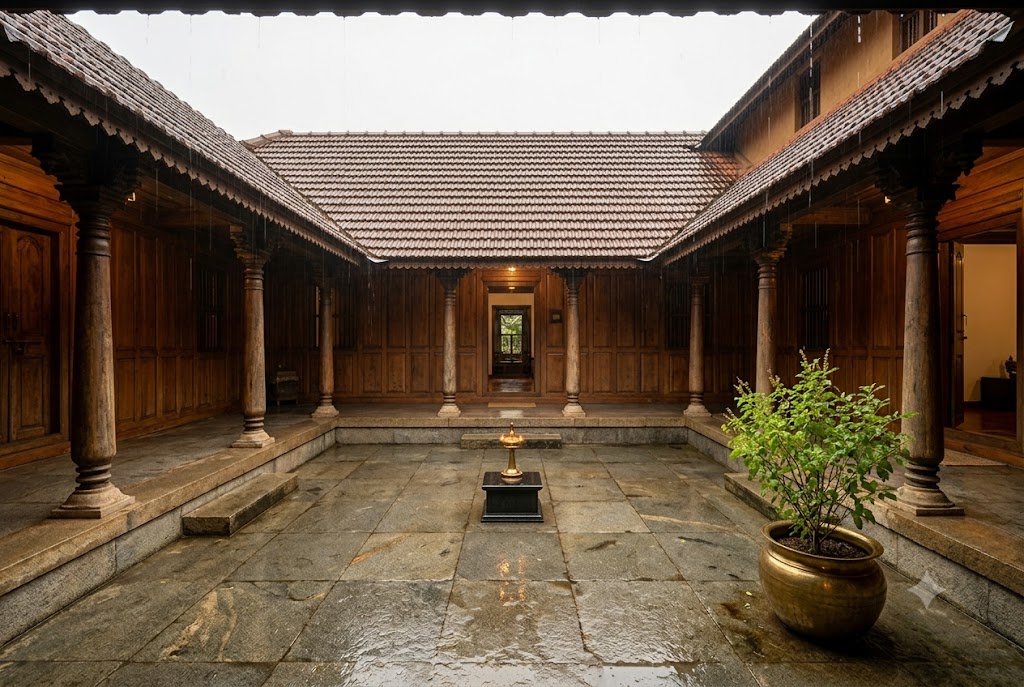
The central courtyard — nadumittam in Kerala, uthon in Bengal, mutram in Tamil Nadu — drives buoyancy ventilation: warm air rises out of the courtyard, drawing cool air in from the building perimeter through cross-ventilation paths. The effect runs continuously, day and night, without mechanical assistance.
A small courtyard (4 × 4 m) can reduce AC running hours per day by 30–40% in a coastal house, just by maintaining a continuous gentle indoor draft.
6. Deep Eaves Overhang
The eaves projection — 600 to 900 mm beyond the wall — shades the wall surface and the window glass, deflects rain away from the wall, and creates a soft drip line that protects the plinth from splash. SHGC at the window drops from an unshaded 0.7 to a shaded 0.35 — a 50% reduction in solar heat gain.
In Kerala vernacular practice, eaves project 900–1,200 mm; in Bengaluru tropical modernism, 600 mm is standard.
7. Cross-Ventilation in Every Habitable Room
A non-negotiable in tropical design: every habitable room must have openings on two perpendicular walls to enable cross-flow. Single-wall openings depend entirely on the wind direction and stall during low-pressure monsoon hours; two-wall openings create a pressure differential that drives air change at 8–15 ACH (air changes per hour) at peak wind, 2–4 ACH at light wind.
The single biggest design mistake in 2010s–2020s Indian apartment construction is windows on one wall only — it makes the room un-ventilable without AC.
8. Tropical Foliage Canopy
The site-scale climate device: a mature tree canopy (rain tree, gulmohar, jacaranda, coconut palm) on the west and south of the building drops site micro-climate temperature by 2–3 °C through evapo-transpiration and leaf shade. A single 20-year-old rain tree shades roughly 80 m² of ground and adds the cooling equivalent of two 1.5-ton AC units running continuously.
The tree is the cheapest passive cooling device on a tropical site. Plant it at concept stage, not after the house is finished.
Six Regional Vernacular Variants
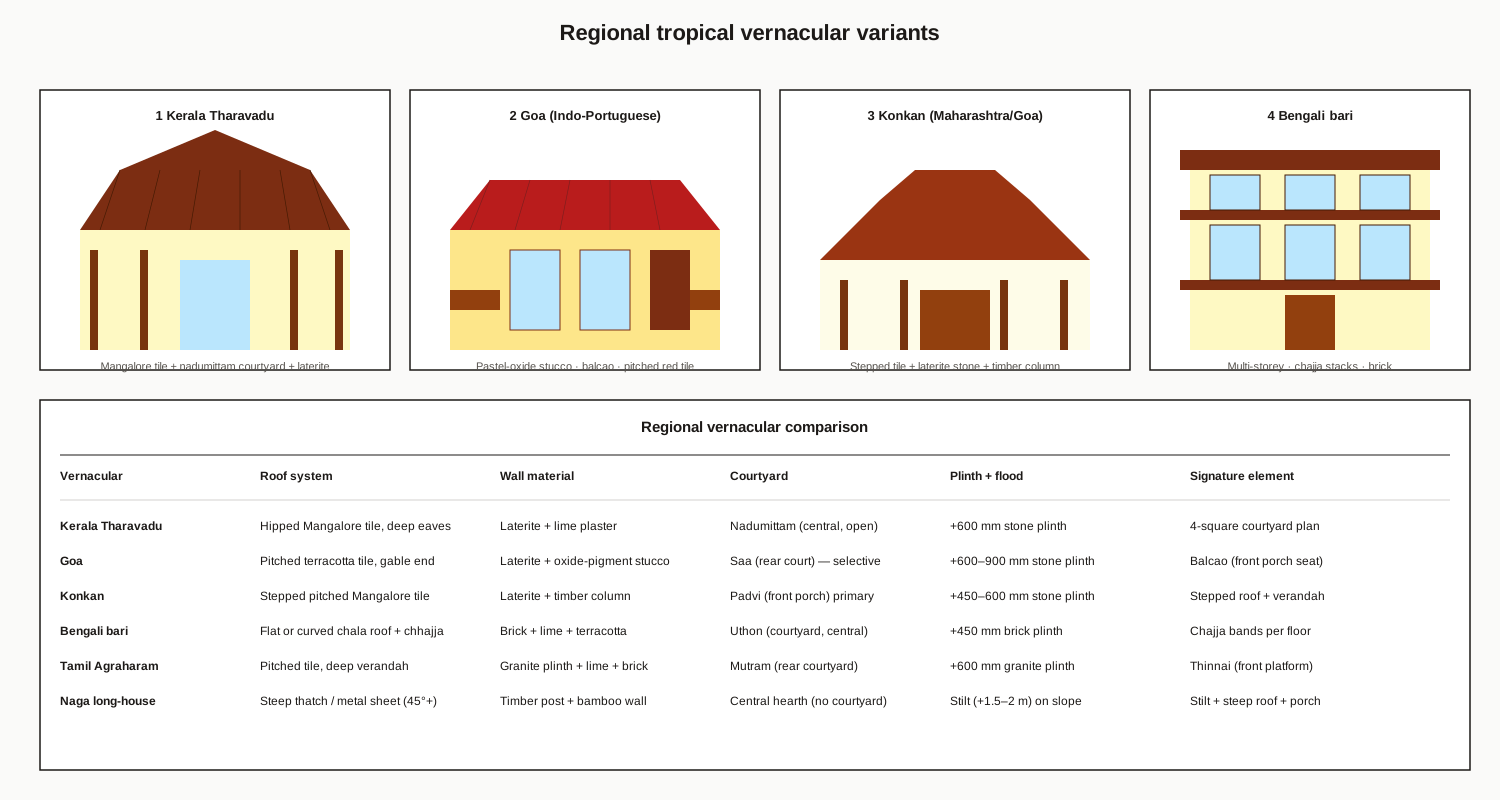
Six regional vernacular tropical variants are alive and being actively built in 2026 India, each adapted to its specific climate and culture.
Kerala Tharavadu
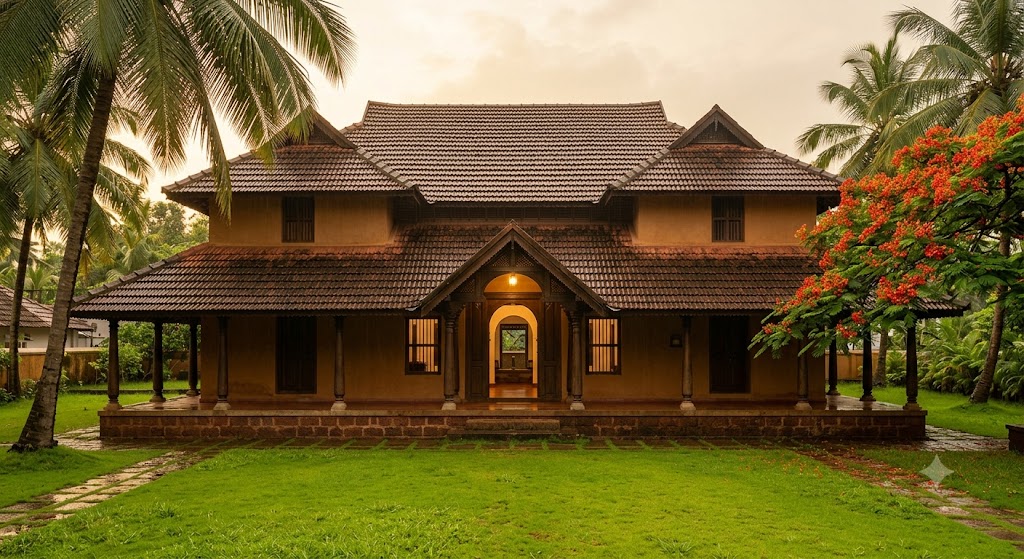
The Kerala vernacular — Tharavadu, the ancestral home of a matrilineal family — is the most-photographed tropical vocabulary in Indian residential design. Signature features: hipped Mangalore tile roof with deep eaves, central courtyard (nadumittam) as the heart of the plan, four-square or eight-square hierarchical layout, laterite stone walls with lime plaster, raised stone plinth, timber columns on verandah, oxide-pigment floor in older homes.
Modern Kerala practice (Stapati, Wallmakers) continues the vocabulary with contemporary detailing.
Goa Indo-Portuguese
The Konkan-coast vocabulary modified by 450 years of Portuguese influence. Signature features: pitched terracotta tile roof with gable ends, pastel oxide-pigment stucco walls (saffron, ochre, blue, green), front balcao (a covered porch with built-in seating benches), high ceiling rooms, oxide flooring in patterns. The vocabulary is highly distinctive — a Goan villa reads as Goan immediately.
Modern Goan practice (Funktion Design, Yatin Pandya, Studio Saraswati) deploys the vocabulary updated.
Konkan Bungalow
The Maharashtra and northern Goa coastal vernacular — distinct from full Goan Indo-Portuguese. Signature features: stepped tile roof (multiple pitched roofs at different levels), laterite stone base, timber columns on the front padvi (porch), simpler wall finishes (lime wash on laterite). The vocabulary is robust and economical, built for working-class coastal villages.
Bengali Bari
The eastern tropical vocabulary — Bengal, Bangladesh, eastern Bihar. Signature features: continuous chajja (eaves bands) at each floor, multi-storey form (often 2–3 floors), brick construction with lime, terracotta detail bands, uthon (central courtyard for women's space), traditional flat or curved chala roofs in older versions, modern bari often pitched.
Tamil Agraharam
The Tamil Nadu vernacular — the priestly-caste row-house pattern. Signature features: pitched tile roof with deep verandah, thinnai (raised front platform for sitting and visitor receiving), narrow long plan with central courtyard (mutram), granite plinth, lime + brick walls. The agraharam is row-house tropical architecture — adjacent units share walls, with private rear courtyards.
Naga Long-House (North-East)
The radically different tropical-wet vocabulary. Signature features: steep thatch or metal-sheet roof (45°+ pitch for extreme rain shed), timber post-and-beam structure on stilts (raised 1.5–2 m above slope), bamboo wall infill, central hearth (no courtyard — too wet), long horizontal plan along contour lines, front porch with carved entrance posts.
Vernacular distinct because the climate (rainfall 5–10× Kerala) demands a different response.
Tropical-Suited Material Palette
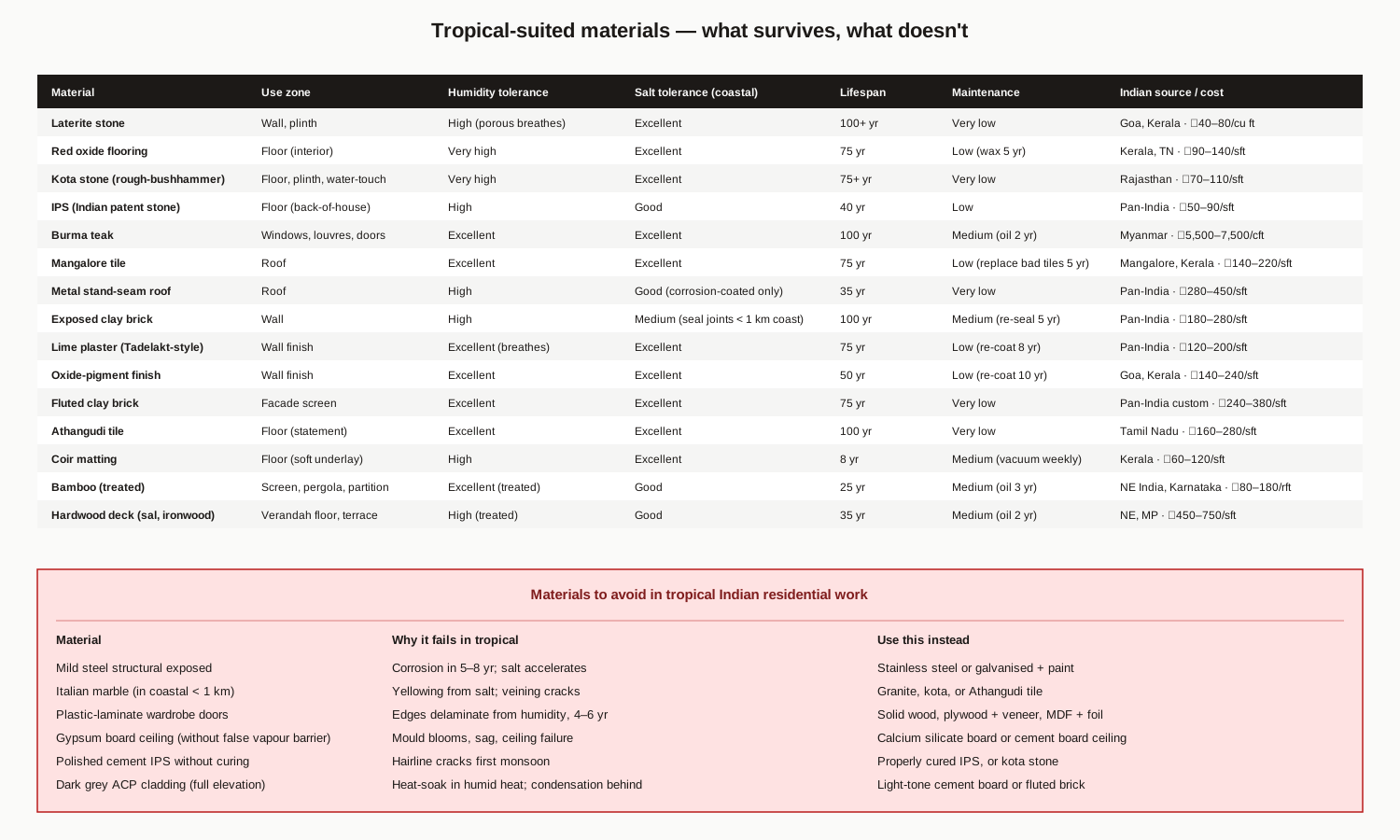
The matrix above is the rate-book and decision-book for tropical material selection. A few principles worth highlighting.
Stone and Earthen Materials Win
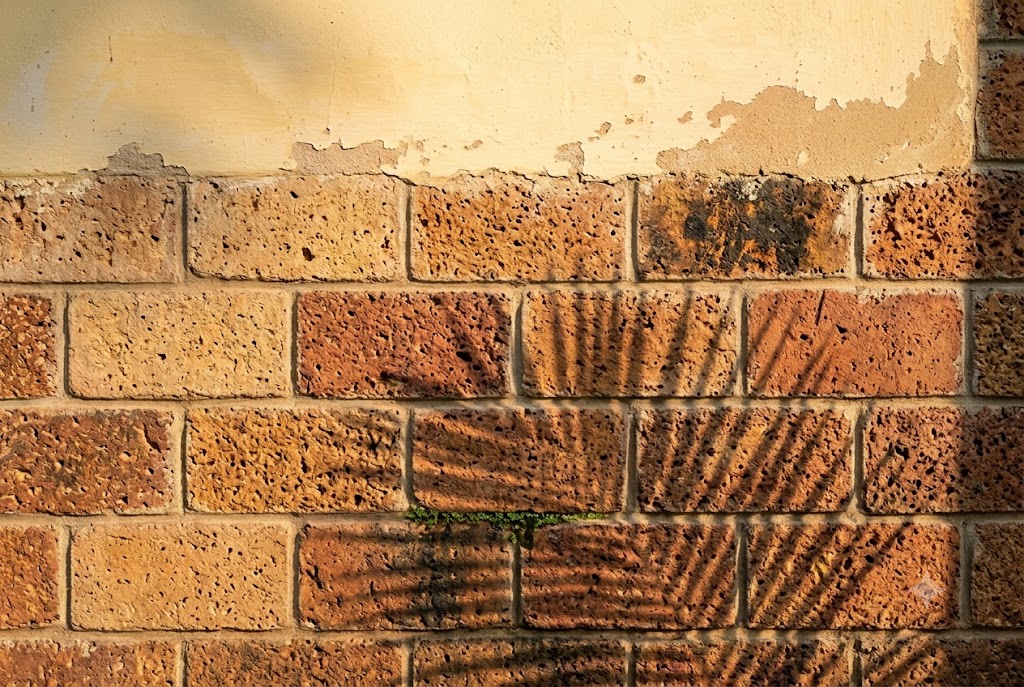
Laterite, kota, Athangudi tile, lime plaster, red oxide, oxide pigment — the earthen and stone family dominates the tropical palette. These materials are vapour-permeable (they breathe), salt-tolerant, mould-resistant, and last 75–100 years. They also reduce embodied carbon by 40–60% versus concrete-and-cement alternatives.
For the broader sustainable materials conversation, cross-link to Modern House Design in India.
Timber Matters — Choose the Right Species
Tropical India produces excellent indigenous timbers: Burma teak (the gold standard for windows and louvres), sal, mahogany, rosewood. Imported pine and engineered wood (laminate) fail in tropical humidity — edges delaminate, panels swell, surfaces blister.
The Salt-Coastal Penalty
Within 1 km of the coast, salt-laden air destroys mild steel (corrosion in 5–8 years), yellows marble, blooms efflorescence on plaster, and dulls aluminium. The palette must shift: stainless steel for any exposed structural metal, granite or athangudi tile instead of marble, fluted brick instead of plaster on long faces.
Materials to Avoid
The bottom of the figure flags six common materials that fail in tropical India:
- Mild steel structural exposed — corrodes
- Italian marble (coastal) — yellows
- Plastic-laminate wardrobe doors — delaminate
- Gypsum board ceiling (no vapour barrier) — moulds, sags
- Polished cement IPS without proper curing — cracks in first monsoon
- Dark grey ACP cladding (full elevation) — heat-soak + condensation behind
Each of these is a 2020s default in Indian retail interior contracting; each fails in the tropical context. Specify against them at concept stage.
Modern Tropical Lineage — Bawa to Today
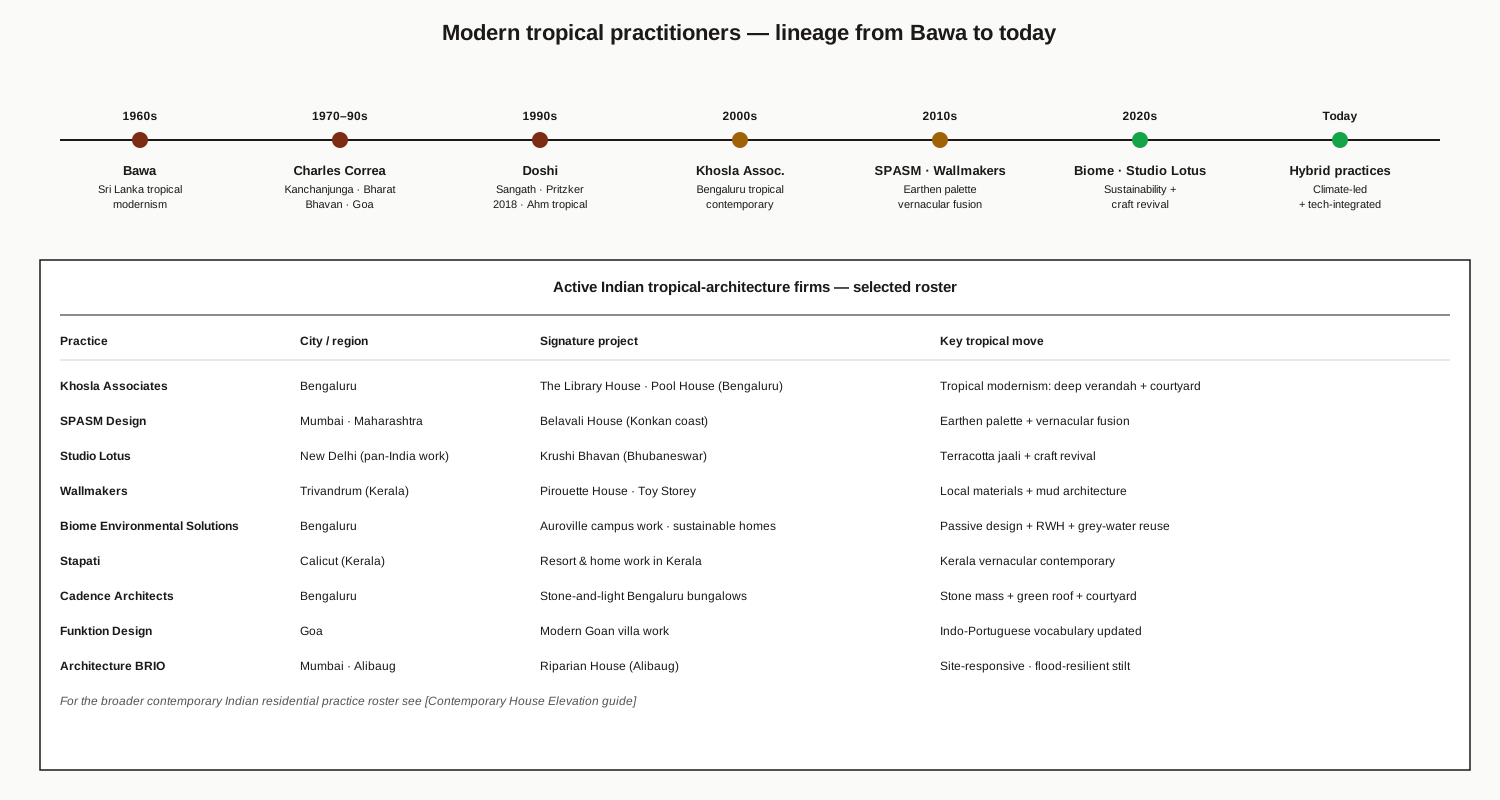
Tropical Indian architecture sits inside a lineage. Knowing the lineage helps clients commission knowingly and gives architects a shared vocabulary.
The Foundational Figure — Geoffrey Bawa
Sri Lankan architect Geoffrey Bawa (1919–2003) is the foundational figure of modern South Asian tropical practice. His Lunuganga estate, Number 11 in Colombo, and the Sri Lankan parliament building established a vocabulary that has shaped Indian tropical work for sixty years: deep verandah, courtyard, pitched roof, indoor-outdoor continuity, vernacular materials in modernist composition. Every Indian tropical architect since Charles Correa has Bawa in their lineage.
Charles Correa
The Indian master of tropical modernism — Kanchanjunga in Mumbai, Bharat Bhavan in Bhopal, multiple houses in Goa. Correa pioneered the tube house and the open-to-sky house — climate-responsive plan types that became foundational to contemporary Indian tropical practice. His writings on Indian regionalism and climate-led design (collected in A Place in the Shade) remain the canonical Indian text on the subject.
BV Doshi
The 2018 Pritzker Prize laureate. Doshi's Sangath studio in Ahmedabad is composite-climate rather than purely tropical, but his early work and his teaching at CEPT shaped the tropical practice of multiple generations. His residential work (Aranya Low-Cost Housing, Indore) demonstrates climate-led mass housing.
Active Indian Practices
The roster table in the figure lists nine currently active Indian tropical-architecture practices. Each has a signature: Khosla Associates' tropical modernism in Bengaluru, SPASM's earthen-palette fusion in coastal Maharashtra, Wallmakers' mud-architecture revival in Kerala, Biome Environmental Solutions' sustainability-led work in Bengaluru, Stapati's Kerala vernacular contemporary, Cadence Architects' stone-and-light Bengaluru bungalows, Funktion Design's Goan villas, Architecture BRIO's flood-resilient Konkan work.
Commissioning a tropical house in 2026 India means choosing within this lineage. For the broader contemporary practice roster, see Contemporary House Elevation.
Seven Common Tropical-Design Mistakes
1. Flat Roof Without Adequate Waterproofing
The contemporary-minimalist visual language demands flat roofs; tropical climate demands rain shed. The compromise — flat roof with multi-layer membrane — works for 8–12 years before the membrane fails. Fix: pitched roof concealed behind a tall parapet (visual flat from the road, actual pitch above). Or invest in best-in-class waterproofing (Sika, BASF, three-layer system) and budget for re-application at year 10.
2. Sealed AC-Only Buildings
The "modern Indian apartment" with sealed glazing, AC-only ventilation, no operable windows. In tropical humidity, this is a mould factory — the AC condenses moisture out of the air, the building envelope traps it, and within 18 months the walls bloom. Fix: operable windows in every habitable room with security-grade hardware. AC as supplement, not as the only mechanism.
3. Marble in Coastal Houses
The white-marble luxury aesthetic transplanted to coastal Mumbai, Goa, or Kerala. The marble yellows from salt within 3–5 years and the veining cracks. Fix: granite, kota, or Athangudi tile for floors and water-touch zones; marble reserved for protected interior accent walls.
4. Single-Wall Window Apartments
Apartment plans that put windows on one wall only — the "long apartment" with no cross-ventilation. The room cannot be made comfortable without AC. Fix: plan for every habitable room to have windows on two perpendicular walls. This is the single biggest planning rule in tropical practice.
5. Mild Steel Exposed Structural Members
A common cost-saving move — exposed I-beams or angle iron in pergolas, gates, awnings — corrodes in 5–8 years in coastal climates. Fix: stainless steel, galvanised steel with paint over, or hot-dip-galv with multi-layer epoxy coating.
6. Plastic Laminate Wardrobes in Bedrooms
The cheap-furniture default for 1RK/1BHK apartment fit-outs. The edge banding delaminates from humidity within 4 years. Fix: plywood with PU finish, or BWR plywood with veneer, or solid wood for high-end builds.
7. Generic Gypsum Board False Ceiling
Standard gypsum board (10 mm white) absorbs vapour and sags within 24 months in coastal climates; mould blooms on the back face. Fix: moisture-resistant gypsum (Lafarge MR, Saint-Gobain MR), calcium silicate board (for kitchens and bathrooms), or cement-board ceiling.
Sustainability and Energy Savings
A well-designed tropical Indian house with the eight-element vocabulary deployed properly typically achieves:
| Metric | Generic AC-led design | Climate-led tropical | Saving |
|---|---|---|---|
| AC running hours/day (peak summer) | 16–20 hr | 8–12 hr | 40–50% |
| AC tonnage required | 1 ton per 100 sft | 1 ton per 200 sft | 50% |
| Annual electricity bill (4 BHK, Bengaluru) | ₹ 84,000 | ₹ 42,000 | 50% |
| Wall U-value | 1.8 W/m²K | 0.6 W/m²K | 67% |
| Indoor comfort hours/year (no AC) | 2,200 | 5,800 | 2.6× |
| Roof life | 12 yr (flat membrane) | 50 yr (pitched tile) | 4× |
| 30-year operational carbon (4 BHK) | 320 tCO₂e | 140 tCO₂e | 56% |
The climate-led design typically costs 5–10% more upfront (deeper roof structure, more verandah area, better materials) and saves 40–60% in operating cost for the life of the building. Payback on the upfront premium is typically 4–6 years.
For the broader rainwater integration that pairs with tropical practice, see Rainwater Harvesting Design & Costs. For Vastu-aligned tropical planning, see Vastu House Plan — Complete Indian Layout Reference.
Pre-Construction Checklist for Tropical Houses
Climate zone & site
- [ ] Climate sub-zone identified (Warm-Humid / Tropical Savanna / Tropical Wet)
- [ ] Site rainfall data verified (annual mm, monsoon-month concentration)
- [ ] Wind-direction rose plotted for the site
- [ ] Salt distance verified (within 1 km of coast?)
- [ ] Flood risk assessed; plinth height set accordingly
- [ ] Existing mature trees identified for retention
Design
- [ ] Deep verandah planned on rain-prevailing side
- [ ] Pitched roof committed (slope appropriate to zone)
- [ ] Raised plinth specified (+600 mm minimum)
- [ ] Jaali or louvre screen on west face
- [ ] Courtyard or breezeway in plan
- [ ] Cross-ventilation in every habitable room (2-wall openings)
- [ ] Deep eaves at all openings (600–900 mm minimum)
- [ ] Tree planting plan with mature-canopy positions
Materials
- [ ] Material palette restricted to tropical-suited list
- [ ] Salt-resistant substitutions specified (coastal sites)
- [ ] Avoid-list checked against (no mild steel exposed, no marble coastal, etc.)
- [ ] Local materials preferred where available (laterite, oxide, Athangudi)
Engineering
- [ ] Roof waterproofing detail finalised (pitched OR best-in-class flat)
- [ ] DPC (damp-proof course) specified at plinth level
- [ ] Termite treatment scheduled (pre-construction soil treatment)
- [ ] Cross-ventilation analysis done (CFD or rule-of-thumb 2-wall check)
- [ ] U-value targets set for walls and roof
References
1. Bureau of Indian Standards (1987). SP 41 — Handbook on Functional Requirements of Buildings. New Delhi: BIS. (Climate-zone classification.)
2. Krishan, A. (2017). Climate Responsive Architecture — A Design Handbook for Energy-Efficient Buildings. TERI Press.
3. Correa, C. (1989). The New Landscape — Urbanisation in the Third World. Concept Media.
4. Correa, C. (2010). A Place in the Shade — The New Landscape and Other Essays. Penguin India.
5. Bawa, G., Bon, B., Robson, D. (2002). Geoffrey Bawa — The Complete Works. Thames & Hudson.
6. Robson, D. (2007). Beyond Bawa — Modern Masterworks of Monsoon Asia. Thames & Hudson.
7. Lang, J., Desai, M., Desai, M. (1997). Architecture and Independence — The Search for Identity, India 1880 to 1980. Oxford University Press.
8. Mehrotra, R. (2011). Architecture in India Since 1990. Pictor Publishing.
9. Doshi, B.V. (2014). Paths Uncharted. Vastu-Shilpa Foundation.
10. Bureau of Indian Standards (2016). NBC 2016, Part 11 — Approach to Sustainability.
11. Bureau of Energy Efficiency (2017). ECBC 2017 — Residential Building Energy Code. Ministry of Power.
12. Studio Lotus (2018). Building With Roots — Material, Craft, Climate. Mapin.
13. Khosla Associates (2018). Tropical Modernism Reinterpreted. Pictor.
14. Architecture BRIO (2020). Site-Specific Practice in Coastal India. Niyogi Books.
Author's note: Tropical architecture in India is the dominant design challenge for three-quarters of the country, yet it is taught and practised as an exception in most architecture schools. The vocabulary is mature, the climate physics are well understood, and the lineage from Bawa through Correa to today's practitioners gives a clear path forward. The mistake in 2026 Indian practice is not lack of knowledge — it is the choice to import temperate or arid-climate vocabularies and override the tropical defaults. The eight-element vocabulary works. The fifteen-material palette works. The six regional vernaculars have all earned their place. Building a house in tropical India should default to this vocabulary and deviate from it only with explicit climate-rationale arguments.
Disclaimer: Climate-zone classification follows SP 41 (BIS 1987); some practitioner schools apply different micro-zone subdivisions. Material lifespan and maintenance figures assume competent execution; outcomes vary with workmanship, substrate quality, and exposure. Cost ranges are 2025-26 indicative for Indian Tier-1 and Tier-2 cities and vary by micro-market and procurement channel. Practitioner roster reflects publicly recognised firms as of 2025; the active Indian tropical practice landscape is broader than the roster listed. Energy savings figures are illustrative for a 4 BHK 2,400 sft house in coastal warm-humid climate and vary with specific design, operation, and weather. Studio Matrx, its authors and contributors accept no liability for decisions made on the basis of this guide; engage a licensed architect with tropical experience, structural engineer, MEP consultant, and (for sustainability targets) a qualified energy modeller for site-specific application.
Interactive · Tropical passive section
Outdoor 36°C → Indoor 28°C · Comfortable
Active strategies — 8°C cooling
- Deep overhang−3°C
Horizontal projection blocks high-angle summer sun before it reaches the wall or glazing.
Kerala's chuttu-verandah, Goa's tiled-roof overhangs.
- Jaali / louvre−2°C
Perforated screen filters glare and direct sun while pulling cooler air through Venturi accelerations.
Rajasthani sandstone jaalis, Mangalore wooden louvres.
- Stack ventilation−2°C
Hot air rises and exits through a high outlet (clerestory, gable vent, ridge); cool air is drawn in low.
Toda thatched ridges, Kerala's clerestory windows.
- Verandah buffer−1°C
A shaded transition zone keeps direct radiation off the main wall and creates a temperature gradient.
Tamil thinnai, Bengali bungalow verandahs.
Realistic upper bound
Combined passive cooling in a well-designed warm-humid house typically lands 6-10°C below outdoor peak — without active AC.
Cooling deltas are typical-day estimates for warm-humid Indian conditions; actual values depend on orientation, wall mass, and adjacent vegetation.
Export this guide
Related Guides — Deep-dive reading
Designing a Naturally Energy-Efficient Indian Home
Comfort first, gadgets last — passive design, orientation, insulation, ventilation and the climate wisdom that cuts Indian energy bills
SustainabilityCharles Correa's Façade Signature: How India's Master Made the Climate-Correct Wall
How Charles Correa eroded the flat sealed wall into deep, shaded, porous layers — verandahs, terraces, pergolas and open-to-sky courts — so the Indian façade filters sun and drives air instead of sealing it out.
Building FacadesModern vs Traditional Indian House Architecture
A Comparative Architectural Analysis of Plan, Structure, Envelope, Performance, and Cost
Design StylesRelated Tools — Try Free
Brise-Soleil Visualizer
Interactive horizontal-louvre cut-off angle calculator — sun altitude, louvre depth, and spacing inputs with a live shadow preview. Computes θ = arctan(spacing/depth) for façade shading, ECBC envelope compliance, hospital daylight design, and tropical sun-control detailing.
Sun Shading ToolCross-Ventilation Analyzer
Estimate airflow and air changes per hour (ACH) from room size, window areas, layout, and local wind — with NBC 2016 Part 8 compliance check.
Ventilation CalculatorRainwater Tank Sizer
How big should your rainwater tank be? Computes annual harvest, recommended tank capacity in litres, water-bill savings, and payback — for 10 Indian cities.
RWH Calculator