
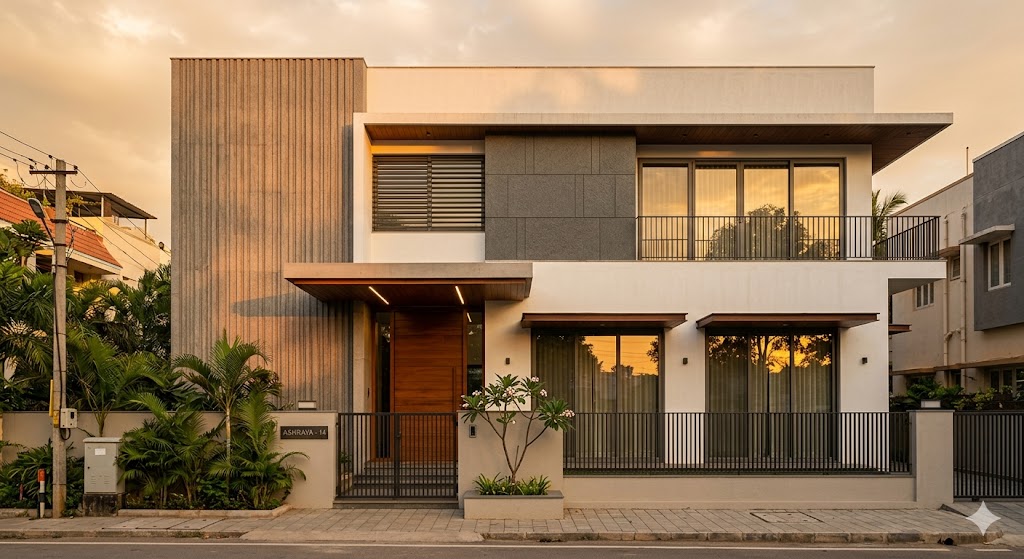
Indian House Front Elevation Design
Anatomy, Styles, Proportions, Materials & Bylaws — A Complete Architect's Guide for Indian Homes
The front elevation of an Indian house carries more burden than any other single drawing in the architectural set. It is the first thing visitors see, the principal face the homeowner is photographed in front of, the surface that takes the brunt of monsoon, summer sun and street dust, and — in a country where homes are often the largest single capital expenditure a family makes in a lifetime — the most public expression of taste, status and identity. Yet it is also the drawing that is most frequently treated as an afterthought, designed last, copied from neighbours, or auto-generated by a contractor's standard template.
This guide is written for the homeowner, architect or builder who wants the front elevation of an Indian house to do the work it is asked to do — culturally, climatically, structurally, and aesthetically — without slipping into either generic boxiness or ornamental chaos. It covers everything a competent front elevation must address: the eleven components every facade contains, the seven stylistic families that dominate contemporary Indian residential practice, the proportional rules that separate composed elevations from accidental ones, climate-specific material palettes from Jaisalmer to Mangalore, Vastu fundamentals for the entry face, municipal bylaw constraints, the six mistakes that ruin most elevations, costing bands for 2026, and the design process from initial sketch to on-site execution.
A front elevation is not the wall you put paint on. It is the agreement your house has made with the street, the weather, and the people who will walk past it for the next forty years.
What a Front Elevation Actually Is
In architectural practice, an elevation is an orthographic projection of a building's exterior face — a vertical drawing as if the eye were placed infinitely far away and looking at the building head-on. Unlike a perspective view or a 3D rendering, the elevation drawing carries no foreshortening; horizontal lines stay horizontal, vertical lines stay vertical, and dimensions are true to scale.
The front elevation specifically is the elevation of the facade that faces the principal street, road or entry side of the plot. In Indian residential context, this is almost always the side from which the main door is approached, and the side which carries the address, compound wall, gate and porch.
A complete front elevation drawing typically shows:
- The full vertical extent from ground level to the top of the parapet (or roof ridge for sloping roofs)
- The horizontal extent from one side compound wall to the other
- All openings (windows, doors, vents)
- All projections (chajjas, balconies, porches, canopies, cornices)
- All material indications (stone bands, plaster textures, claddings)
- Compound wall, gate, gate-pillar caps
- Levels of plinth, floor heights, lintel heights, balcony slabs, roof slab
- Approximate landscape: ground line, planters, paving, trees
- Setback lines from plot boundaries
The drawing is conventionally produced at 1:50 scale for a residential plot up to 60 × 80 ft, and at 1:100 for larger plots or for the municipal submission set. Sanction drawings — those submitted for building plan approval — also carry levels (ground level, plinth level, first-floor level, terrace level) explicitly noted in millimetres above mean datum.
The Eleven Components of an Indian Front Elevation
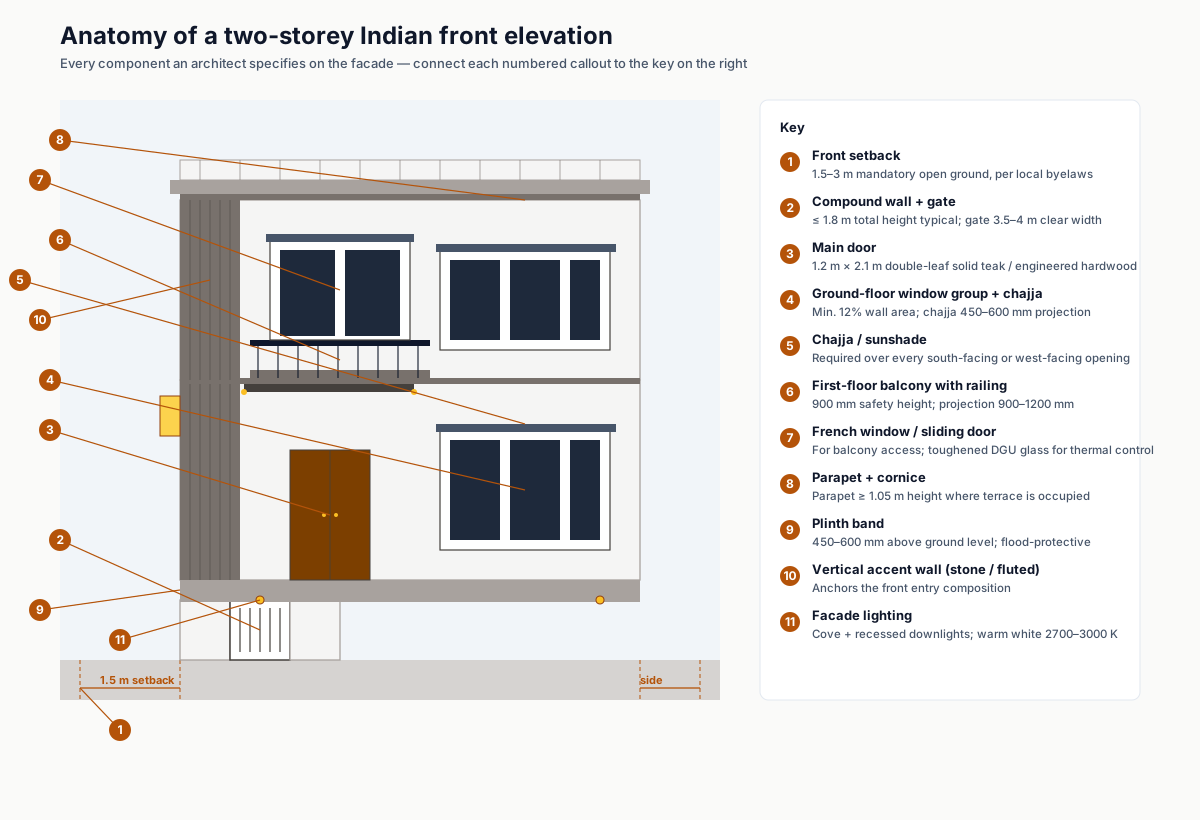
Every Indian front elevation, regardless of stylistic register, must resolve eleven distinct components. The diagram above identifies each one in its conventional position on a typical two-storey 30 × 40 ft elevation. Treat the list below as a checklist; an elevation that ignores any of these will read incomplete.
| # | Component | Typical Dimension | Bylaw / Code Reference |
|---|---|---|---|
| 1 | Front setback | 1.5 – 4.5 m | State / municipal bylaw |
| 2 | Compound wall + gate | ≤ 1.8 m total height | NBC 2016, Part 3 |
| 3 | Main door | 1.2 m × 2.1 m | NBC 2016, Part 4 (egress) |
| 4 | Ground-floor window grouping | Min. 1/7 floor area | NBC 2016, Part 8 |
| 5 | Chajja / sunshade | 450 – 750 mm projection | NBC 2016, Part 6 |
| 6 | First-floor balcony | 900 – 1200 mm projection | Bylaw projection rule |
| 7 | French window / sliding door | 1.8 m × 2.1 m typical | NBC 2016, Part 8 |
| 8 | Parapet + cornice | ≥ 1.05 m where terrace occupied | NBC 2016, Part 4 |
| 9 | Plinth band | 450 – 600 mm above ground | Flood protection bylaw |
| 10 | Vertical accent wall | 1.2 – 1.8 m wide | — |
| 11 | Facade lighting | 2700 – 3000 K warm-white | — |
The numbered diagram is worth printing out and pinning above the drawing board. Every front elevation review meeting should start with the question: "Have we resolved all eleven? If we have skipped one, why?"
Component 1 — The Front Setback
The front setback is the open ground between the front compound wall and the front face of the building. It is mandated by municipal byelaws to provide light, ventilation and access — and it has direct architectural consequence: the larger the setback, the more breathing room the elevation has, and the more landscape can soften the facade.
| City / Authority | Front Setback for 30 × 40 ft Plot | Notes |
|---|---|---|
| Bengaluru (BBMP / RMP-2031) | 1.5 m (plot width 9 m, depth 12 m) | Higher setbacks for larger plots |
| Mumbai (MCGM / DCPR-2034) | 1.5 m typical | Floor-area dependent |
| Delhi (DDA / MPD-2021) | 3.0 m for residential plots ≤ 250 sq m | Stricter on arterial roads |
| Chennai (CMDA / TNCDBR-2019) | 1.5 m for plots ≤ 300 sq m | Different for high-rise |
| Hyderabad (HMDA / GO 168) | 1.5 m typical | Setback per plot width |
| Pune (PMC / UDCPR-2020) | 1.5 m for plots ≤ 250 sq m | Coastal regulations apply |
| Kolkata (KMC) | 1.2 m typical | Heritage zone overrides |
Cross-reference: see the Architect Compliance Map — Bengaluru and Mumbai guides for exhaustive city-by-city byelaw treatment.
Component 2 — Compound Wall and Gate
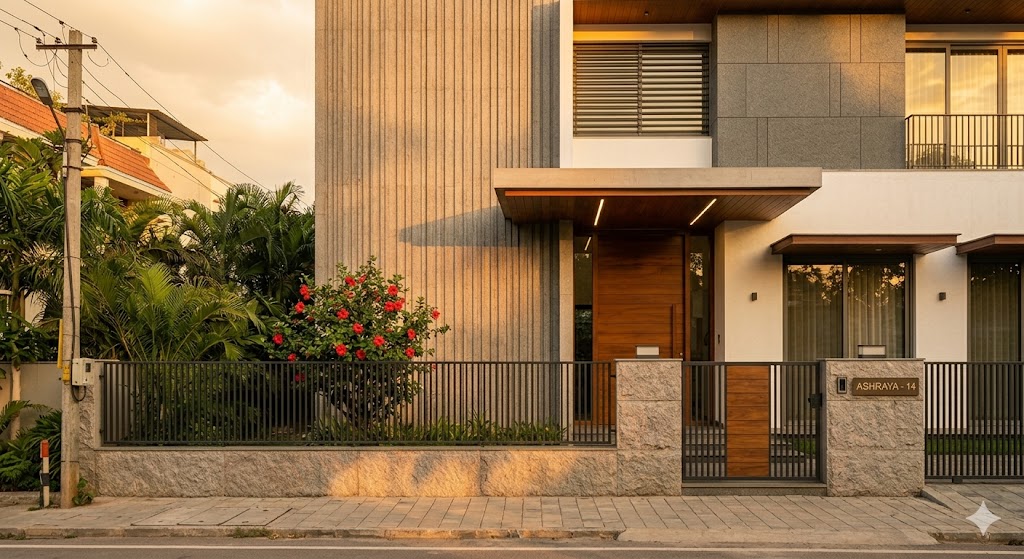
The Indian compound wall is unique in the world's residential vocabulary. Where most of Western suburbia uses low picket fences or open lawns, Indian homes universally enclose the plot — partly for security, partly for stray-animal exclusion, partly for cultural privacy norms, and partly because Indian street culture is more porous (vendors, postmen, sweepers, deliveries) and the homeowner needs a clear threshold.
Bylaws cap compound wall height between 1.5 m and 1.8 m in most Indian cities. The bottom 600 – 900 mm is solid (for security, kerb-protection and dust); above that, the wall should be at least 40% open (grille, jaali, ironwork, or pierced screen). A fully solid 1.8 m wall — especially when finished in flat grey cement — gives the elevation a prison aesthetic and is, ironically, easier for an intruder to scale unseen than a transparent one.
Gate dimensions for the principal entry should provide a clear opening of 3.5 – 4.0 m for a car-plus-pedestrian access, or 2.7 – 3.0 m for plots where the car parking is recessed inside the porch. A separate pedestrian gate of 0.9 – 1.0 m is best practice though not always provided.
Component 3 — Main Door
The main door is the single most important component of the elevation from a cultural standpoint. It is the threshold across which one transitions from the public world (street, vehicle, dust) to the household (slippers off, namaste, water for guests). Indian architectural tradition treats this threshold seriously — see the Pooja Room Design guide for the conceptual continuity between threshold and altar.
Door dimensions of 1.2 m × 2.1 m (4 ft × 7 ft) are conventional for the main door, with a 1.5 m × 2.1 m double-leaf option for larger homes. The leaf is typically 45 – 60 mm thick solid teak, engineered hardwood, or fibre-reinforced doors with hardwood trim. Indian Vastu tradition prefers an odd number of vertical panels (one, three, five) for the principal door.
Threshold detailing carries practical importance: a 75 – 100 mm raised marble or granite threshold keeps monsoon water out, prevents pest ingress, and provides the symbolic threshold step that aarti and rangoli rituals require.
Seven Stylistic Families in Contemporary Indian Practice
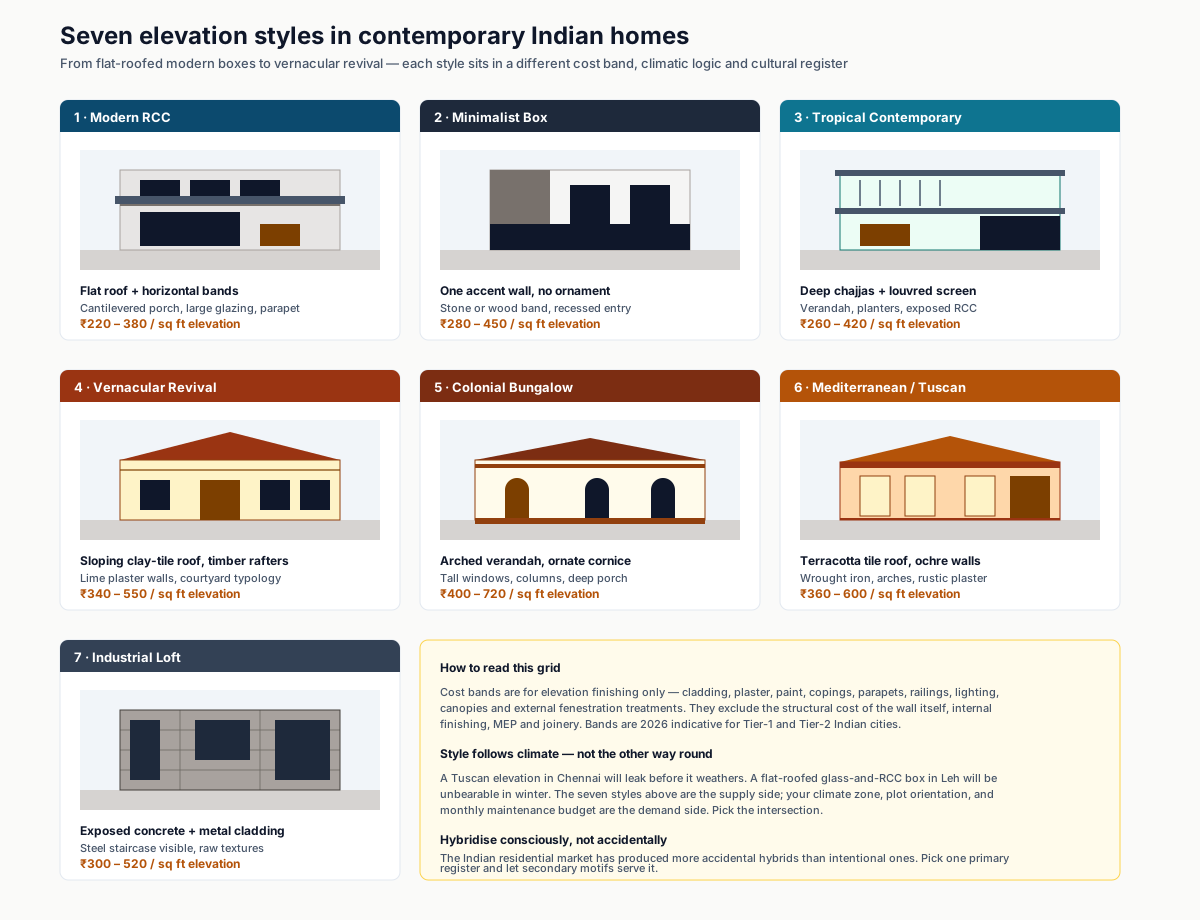
Contemporary Indian residential elevations cluster into seven recognisable stylistic families. Each carries a distinct cost profile, climatic suitability and cultural register. The matrix below organises them.
| Style | Climate Fit | Cost Band (₹/sq ft elev.) | Best For | Worst For |
|---|---|---|---|---|
| Modern RCC | All zones | 220 – 380 | Urban plots, builder-grade | Heritage neighbourhoods |
| Minimalist Box | All zones | 280 – 450 | Architect-led builds, ≤ 40 yr clients | Joint families wanting "show" |
| Tropical Contemporary | Warm & humid, temperate | 260 – 420 | Coastal cities, Bengaluru, Goa | Cold zones |
| Vernacular Revival | All zones, especially Kerala / TN | 340 – 550 | Cultural identity, vacation homes | Tight urban plots |
| Colonial Bungalow | Composite, moderate | 400 – 720 | Heritage neighbourhoods, large plots | Compact urban infill |
| Mediterranean / Tuscan | Hot & dry, composite | 360 – 600 | Buyer-aspirational housing | High-rainfall zones |
| Industrial Loft | All zones | 300 – 520 | Designer / creative clients | Conservative communities |
Modern RCC
The most common new-build elevation in urban India — flat parapet, horizontal cladding bands, large window groupings, cantilevered porch canopy. It works with reinforced-concrete frame construction (which is itself the dominant Indian residential system), and it photographs well. The risk is generic-ness — when every plot on the street has the same elevation, the architect has done nothing.
Minimalist Box
A subtype of modern but with stricter discipline: one accent material wall, no ornament, recessed entry, large openings grouped at structural-bay scale. Difficult to execute on a builder budget because every detail has to be perfect — there is no ornament to forgive misalignment.
Tropical Contemporary
Modern RCC + deep chajjas + louvred screens + verandahs + planters. The default for architect-designed homes in Bengaluru, Goa, Mangalore, Kerala, and the Mumbai western suburbs. Deep horizontal shading reads strongly on the elevation and is climatically essential — see the Designing for the Indian Climate guide.
Vernacular Revival
Sloping clay-tile roof, lime-plaster walls, timber rafters visible at the eaves, courtyard typology behind the front face. Strong cultural identity, expensive to build well, and increasingly popular as a counter-current to glass-and-aluminium. See the Vernacular Architecture — Lessons for Modern Homes guide for the design vocabulary.
Colonial Bungalow
Arched verandah, tall windows with shutters, ornate cornice, deep porch with columns, hipped tile roof. Historically a Lutyens / Anglo-Indian legacy; today often pastiched on plots that are too small for the typology. The bungalow needs at least 60 × 80 ft to read as a bungalow — anything smaller becomes a caricature.
Mediterranean / Tuscan
Terracotta tile sloping roof, ochre or cream stucco walls, arched openings, wrought-iron grilles, planters. Highly aspirational in builder marketing, climatically dishonest in monsoon zones (the tile roofs leak, the stucco peels), and culturally awkward in India because the references are entirely European.
Industrial Loft
Exposed concrete walls, metal cladding panels, large steel-and-glass windows, visible mechanical elements (ductwork, conduit). Niche but increasingly popular with architect-designed homes for younger clients. Demands very high concrete quality (see Building Construction Quality Assessment) because exposed concrete shows every defect.
The Three Proportional Rules
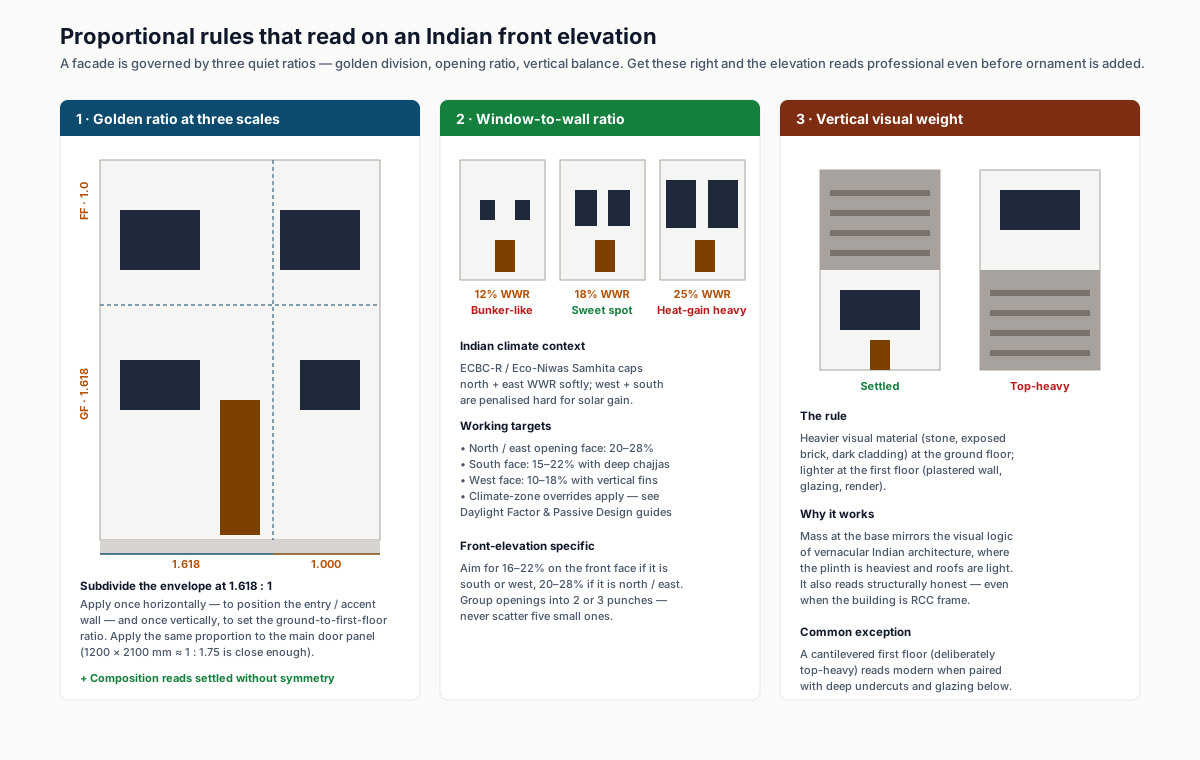
Three proportional rules separate composed elevations from accidental ones. None of them require advanced training to apply, but all three are routinely violated.
Rule 1 — Golden Ratio Subdivision
Apply the 1.618 : 1.000 ratio at three scales: the elevation envelope (horizontal division for the accent / entry side), the vertical floor-to-floor heights (ground floor 1.618, first floor 1.000), and the main-door panel (1200 × 2100 mm is close to 1 : 1.75, close enough). When applied at three scales the eye reads the elevation as settled without being able to articulate why.
Rule 2 — Window-to-Wall Ratio (WWR)
The fraction of facade area that is glazed. ECBC-Residential and Eco-Niwas Samhita (BEE, 2018) cap WWR per orientation to manage solar gain:
| Orientation | Eco-Niwas Cap | Working Target | Why |
|---|---|---|---|
| North | 50% | 20 – 28% | Diffuse light, low heat — generous OK |
| East | 40% | 18 – 25% | Morning sun, manageable |
| South | 30% | 15 – 22% with chajjas | High sun angle, deep chajja sufficient |
| West | 25% | 10 – 18% with vertical fins | Worst-case afternoon heat |
For the front elevation specifically, target 16 – 22% if the front faces south or west, 20 – 28% if it faces north or east. Group openings into 2 – 3 punches rather than scattering five small ones — see the Natural Light Planning for Indian Homes guide.
Rule 3 — Vertical Visual Weight
Heavier visual material (stone, exposed brick, dark cladding) at the ground floor; lighter material (plastered wall, glazing, white render) at the first floor. This mirrors the structural honesty of historic Indian architecture, where plinths were heaviest and roofs lightest, and reads correctly even in modern RCC frame construction.
The exception is the cantilevered upper floor, which deliberately inverts the rule — but it only works when the cantilever is deep, the undercut is shadowed, and the ground-floor glazing is generous. Get any of those wrong and the building looks top-heavy.
Material Palettes by Climate Zone
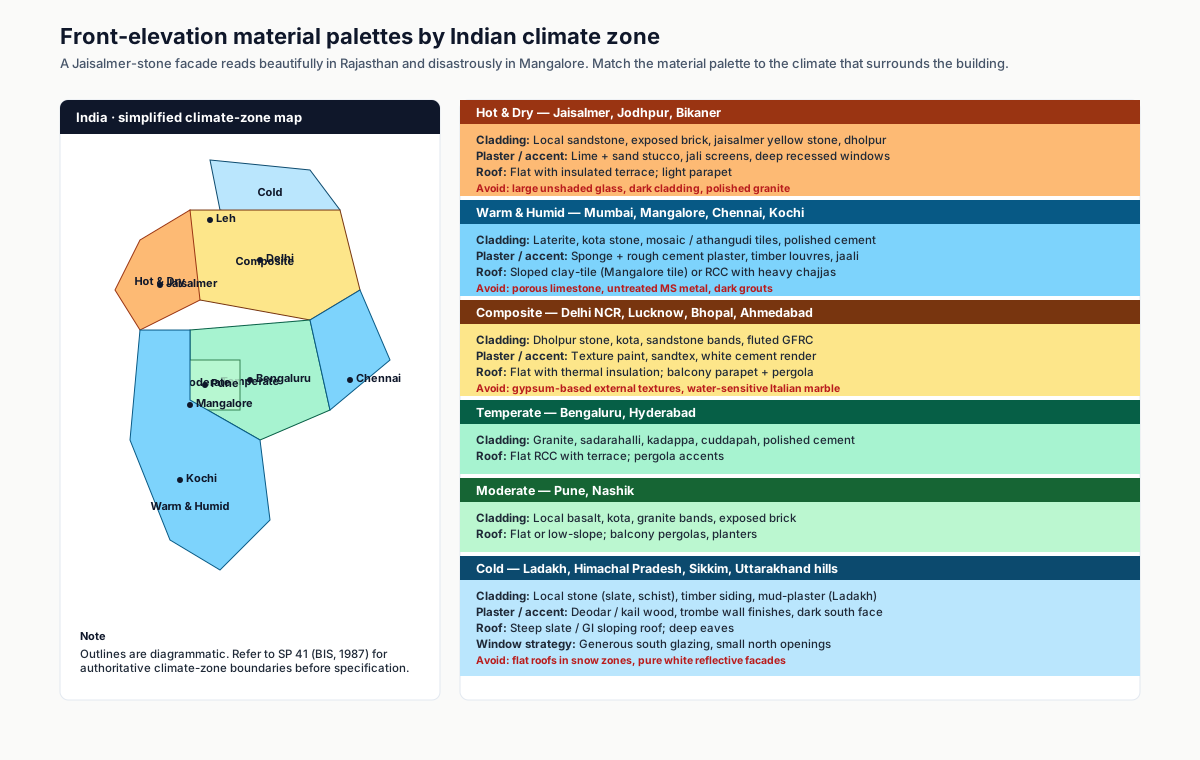
A Jaisalmer-stone facade reads beautifully in Rajasthan and disastrously in Mangalore. India's six climate zones (SP 41, BIS 1987) each demand a distinct material palette. The figure above maps the geography; the table below gives the working specifications.
Hot & Dry Zone — Jaisalmer, Jodhpur, Bikaner, parts of Gujarat
Cladding: Local sandstone (Jaisalmer yellow, Dholpur cream, Bansi paharpur), exposed clay brick with lime mortar, jali screens in jaisalmer stone.
Plaster: Traditional lime + sand stucco; modern equivalent is white cement + fine sand + acrylic polymer.
Roof: Flat with insulated terrace; light-coloured parapet capping in white marble or polished cement.
Accents: Jali screens (10 – 25% of facade area), deep window recesses (200 – 400 mm).
Avoid: Large unshaded glass, polished granite (reflective glare), dark paint colours.
Warm & Humid Zone — Mumbai western suburbs, Mangalore, Goa, Chennai coast, Kochi
Cladding: Laterite stone (Goa, Mangalore), Kota stone (Maharashtra), athangudi tiles (TN), polished cement plaster, exposed brick with deep raked pointing.
Plaster: Sponge-finish cement plaster (textured, easy to repaint), rough cast.
Roof: Sloped clay-tile (Mangalore tile, terracotta) at 30° pitch, or RCC with 600 – 900 mm chajjas on every opening.
Accents: Timber louvres, jaali screens for through-ventilation, dense planting on the front.
Avoid: Porous limestone, untreated mild-steel grilles (rust within one monsoon), dark grouts (mould), gypsum-based external finishes.
Composite Zone — Delhi NCR, Lucknow, Bhopal, Ahmedabad, Jaipur
Cladding: Dholpur sandstone, Kota stone, sandstone bands, fluted GFRC panels.
Plaster: Texture paint, sandtex finish, white cement render.
Roof: Flat with 150 mm XPS insulation under tile or grass; balcony parapet plus pergola for partial terrace shading.
Accents: Stone bands (1.2 – 1.8 m wide), fluted vertical panels.
Avoid: Water-sensitive Italian marble on the facade, gypsum-based external textures (cracks in summer), pure white reflective facades (Delhi dust shows immediately).
Temperate Zone — Bengaluru, Hyderabad
Cladding: Granite (Sadarahalli, Jet Black, Steel Grey), Cuddapah, Kadappa, polished cement plaster.
Plaster: Acrylic exterior emulsion on smooth cement plaster.
Roof: Flat RCC with terrace use; pergola accents for partial shading.
Accents: Vertical fluted panels, jaali screens, planters integrated into elevation.
Moderate Zone — Pune, Nashik, Aurangabad
Cladding: Local basalt, Kota stone, granite bands, exposed clay brick.
Plaster: Texture or sandtex finish.
Roof: Flat or low-slope (5 – 10°); balcony pergolas with creeper planting.
Cold Zone — Ladakh, Himachal Pradesh, Sikkim, Uttarakhand hills
Cladding: Local stone (slate, schist), timber siding (deodar, kail), mud-plaster (Ladakh traditional).
Plaster: Lime-based plaster with linseed oil; trombe-wall finishes on the south face.
Roof: Steep slate or GI sloping roof at 30 – 45° pitch with deep eaves (900 – 1200 mm).
Window strategy: Generous south glazing for passive solar gain; small north openings to minimise heat loss.
Avoid: Flat roofs in snow zones, pure white reflective facades.
Vastu and the Front Elevation
Vastu Shastra — India's traditional system of building orientation and proportion — has direct prescriptions for the front elevation. Some are practical, some are symbolic, and almost all carry market value: many Indian homebuyers will refuse a property that violates principal Vastu rules.
The Front Face Should Be the Most Auspicious Direction
The Vastu hierarchy of facing directions, from most to least preferred:
| Direction | Vastu Rating | Practical Reason |
|---|---|---|
| North | ★★★ Excellent | Diffuse, even daylight; cool through summer |
| East | ★★★ Excellent | Morning sun, energising; warm by noon |
| Northeast | ★★★ Best | Combines north + east benefits |
| West | ★★ Acceptable | Afternoon sun; requires heavy shading |
| South | ★★ Acceptable with mitigation | High heat load; demands deep chajjas |
| Southwest | ★ Avoid where possible | Heaviest heat load; weakest light |
See the Vastu Shastra for Modern Homes guide for the deep treatment.
Main Door Placement
Vastu prescribes that the main door should be in the auspicious half of the front face. For a north-facing house, this is the northeast or north-centre. For an east-facing house, this is the east-centre or east-northeast. For a south-facing house — which most Vastu practitioners discourage — the door should ideally be in the south-centre and shaded by a deep porch.
Slope and Plinth
Vastu prescribes that the plot should slope gently toward the northeast, and the plinth should be higher at the southwest, lower at the northeast. In modern construction terms, this translates to good rainwater drainage toward the northeast corner — which has practical merit even outside Vastu reasoning.
What Vastu Does Not Prescribe
Vastu has remarkably little to say about facade ornamentation, material choice, colour palette or elevation style. These are essentially the architect's domain. What Vastu does prescribe is heavily concentrated on placement, orientation and proportion — and most of those prescriptions, when examined, have climatic logic behind them. Treat them as practical guides rather than mystical rules.
Municipal Bylaw Constraints
The municipal byelaws of Indian cities constrain the front elevation more than any architect's stylistic preference. The five binding constraints, in approximate order of impact, are:
1. Setback
Already discussed in Component 1. Front setback determines the depth of breathing space, the proportion of compound wall to building face visible from the street, and the available envelope for porches.
2. Building Height
Building height is capped by road width in most Indian cities — typically 1.5 × road width for residential plots. A 9 m road permits a 13.5 m building height (roughly G+3 with terrace). Different states use different formulas; the Building Plan Approval Process in India guide covers the city-by-city variations.
3. Projection Rules
Chajjas, balconies, sunshades and cornices may project into the setback up to a limit:
| Projection | Permissible Distance from Plot Line |
|---|---|
| Chajja over window | Up to 450 – 600 mm into setback |
| Cornice / architectural band | Up to 300 – 450 mm into setback |
| Open balcony | Up to 900 – 1200 mm into front setback, where ≥ 3 m setback exists |
| Closed balcony / cantilevered room | Counts toward FAR; not a free projection |
4. Floor-Area Ratio (FAR / FSI)
FAR determines how much built-up area you can have per square foot of plot. A 30 × 40 ft plot at FAR 1.75 (Bengaluru) gives 2100 sq ft of built-up area, typically G+1 with terrace. FAR affects elevation indirectly — higher FAR means more floors, more elevation height, and more facade area to design.
See the FSI / FAR Computation for Indian Architects guide for the calculation methodology.
5. Compound Wall Height
Already discussed. Most Indian cities cap at 1.8 m; some heritage zones limit further.
Six Common Mistakes — and Their Corrections
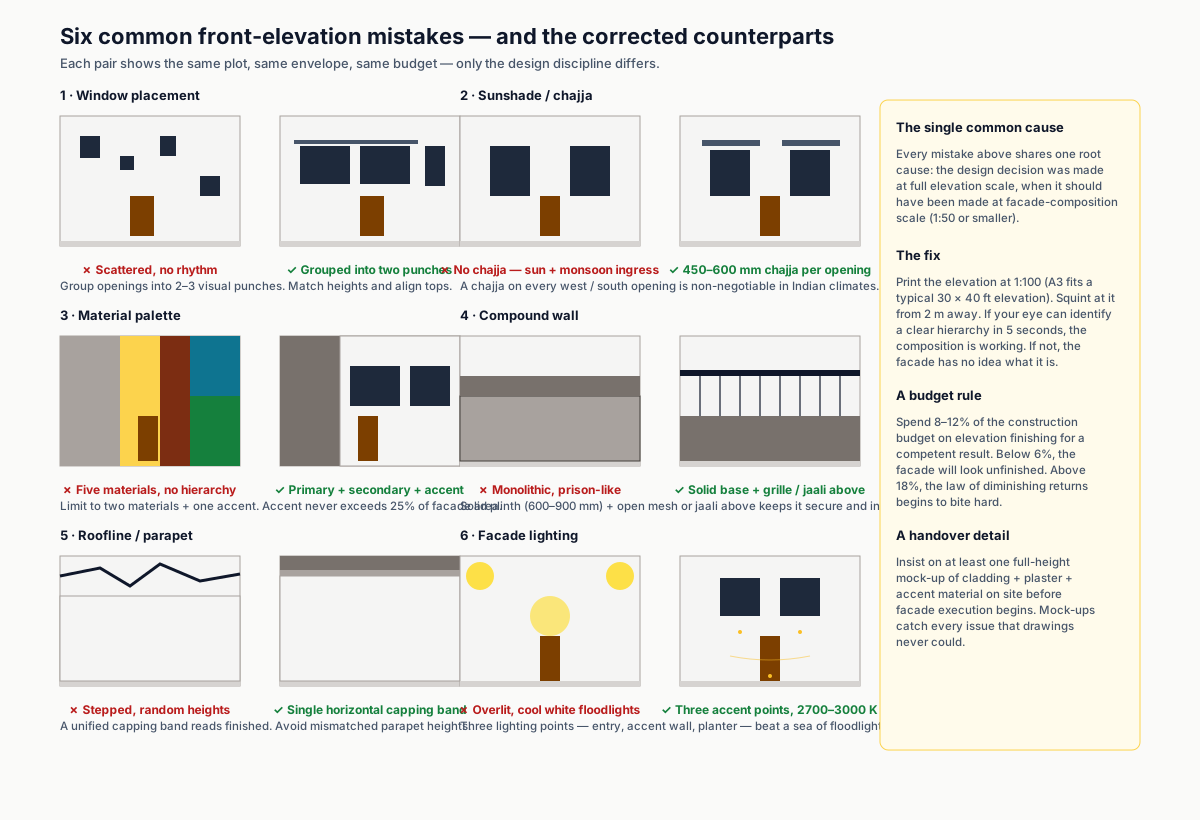
The six paired diagrams above isolate the mistakes that most often spoil an otherwise reasonable Indian front elevation. The corrections are not stylistic preferences — they are baseline composition discipline.
Mistake 1 — Window Scatter
Multiple small windows distributed without rhythm across the elevation. Fix: Group openings into two or three larger punches. Align tops. Match heights within each group.
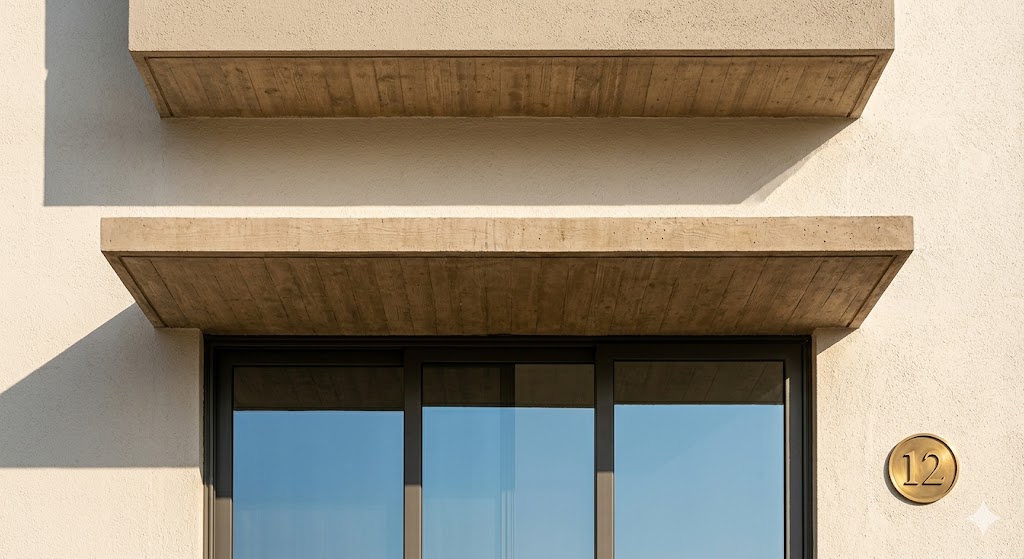
Mistake 2 — Missing or Token Chajja
Either no chajja at all (heat gain, monsoon ingress) or a token 100 mm chajja (decorative, functionally useless). Fix: 450 – 600 mm chajja on every west, south, and southwest opening. Project a longer chajja over the main door (750 – 900 mm).
Mistake 3 — Material Chaos
Five competing finishes in one elevation: stone, brick, glass, plaster, metal cladding all visible simultaneously. Fix: Two materials plus one accent. Accent never exceeds 25% of facade area. Primary material covers ≥ 50%.
Mistake 4 — Monolithic Compound Wall
Solid 1.8 m wall, flat grey cement, no transparency. Fix: 600 – 900 mm solid plinth + open grille / jaali above. Allows light, ventilation, visual connection. More secure (intruder visible) and more inviting.
Mistake 5 — Chaotic Roofline
Random parapet heights, multiple cappings, decorative trellises competing with each other. Fix: One unified horizontal capping band at parapet level. All roof-level elements (water tank cover, lift overrun, terrace pergola) tucked behind this single horizon.
Mistake 6 — Overlit Facade
Floodlights illuminating every wall, often in cool-white 5000 K LED, creating a hospital-aesthetic and ruining the evening photograph. Fix: Three accent points maximum — entry, accent wall, planter — in warm-white 2700 – 3000 K, total external lighting load ≤ 60 W for a typical 30 × 40 ft elevation.
Costing — 2026 Indicative Bands
Elevation finishing costs are quoted per square foot of elevation (not per square foot of built-up area). For a typical two-storey 30 × 40 ft house with three exposed faces (front + two sides), elevation area is approximately 1200 – 1500 sq ft.
Per-Square-Foot Elevation Bands (Tier-1 / Tier-2 Cities, 2026)
| Component | Budget | Mid | Premium |
|---|---|---|---|
| Plaster + paint | ₹50 – 90 | ₹120 – 180 | ₹220 – 350 |
| Stone cladding (Kota, granite) | ₹180 – 260 | ₹320 – 480 | ₹600 – 950 |
| Sandstone cladding | ₹220 – 320 | ₹400 – 580 | ₹700 – 1100 |
| Fluted GFRC panels | ₹450 – 650 | ₹750 – 1100 | ₹1300 – 1900 |
| Wooden cladding (treated) | ₹520 – 720 | ₹800 – 1200 | ₹1400 – 2200 |
| Aluminium composite panel | ₹280 – 380 | ₹450 – 650 | ₹800 – 1200 |
| Chajjas (RCC + waterproofing) | ₹350 – 500 / sq ft chajja | ₹550 – 750 | ₹850 – 1200 |
| Balcony railing (MS + glass) | ₹2500 – 4500 / rmt | ₹5000 – 8000 | ₹9000 – 14000 |
| Main door (teak, double leaf) | ₹35 – 65 K | ₹80 – 150 K | ₹2 – 5 L |
| Compound wall + gate | ₹1.2 – 2.5 L | ₹3 – 6 L | ₹8 – 18 L |
| Facade lighting (3 accent + cove) | ₹15 – 35 K | ₹50 – 120 K | ₹200 K – 8 L |
Total Elevation Budget — Working Estimates
| Style | Total Budget (30 × 40 ft, two-storey) | Per sq ft built-up |
|---|---|---|
| Modern RCC, budget | ₹2.8 – 4.8 L | ₹140 – 240 |
| Modern RCC, premium | ₹6.5 – 11 L | ₹325 – 550 |
| Minimalist box | ₹4 – 9 L | ₹200 – 450 |
| Tropical contemporary | ₹4.5 – 10 L | ₹225 – 500 |
| Vernacular revival | ₹6 – 14 L | ₹300 – 700 |
| Colonial bungalow | ₹8 – 18 L | ₹400 – 900 |
| Mediterranean | ₹6.5 – 14 L | ₹325 – 700 |
| Industrial loft | ₹5 – 12 L | ₹250 – 600 |
A working budget rule is to allocate 8 – 12% of total construction cost to elevation finishing. Below 6%, the facade will look unfinished. Above 18%, diminishing returns set in fast.
The Design Process — Sketch to Construction
A competent front elevation is produced through a sequence of nine stages. Skipping any stage shows up in the finished building.
| Stage | Output | Scale | Typical Duration |
|---|---|---|---|
| 1. Site analysis | Climate, orientation, neighbour heights, road width | — | 2 days |
| 2. Floor plan freeze | GF + FF plan with door / window positions | 1:100 | 1 – 2 weeks |
| 3. Concept elevation sketch | Quick hand sketches of 3 – 4 stylistic options | 1:100 | 3 – 5 days |
| 4. Client selection + refine | One direction picked, refined elevation | 1:100 | 1 week |
| 5. Detailed elevation | Material indications, all openings, dimensions | 1:50 | 1 – 2 weeks |
| 6. Bylaw check + revision | Setbacks, height, projection compliance | 1:50 | 3 – 5 days |
| 7. 3D rendering | Photoreal view for client sign-off | 1:50 | 1 week |
| 8. Working drawings | All elevations + sections + details | 1:50 / 1:20 | 2 – 3 weeks |
| 9. Site mock-up | Full-height sample of cladding + plaster + accent | 1:1 | 3 – 5 days |
The site mock-up at stage 9 is the single highest-leverage discipline a homeowner can insist on. A mock-up that costs ₹30,000 to construct can prevent ₹3,00,000 of execution mistakes on the actual elevation. Every elevation revision after the mock-up has been seen and approved is documented and signed off.
Pre-Construction Checklist for Homeowners
Before the elevation goes into execution, the following twelve items must be checked, signed off, and physically present:
- [ ] Elevation drawing at 1:50 with all dimensions, materials, lintel levels, and finishes called out
- [ ] 3D rendering signed off by the client and shared with the contractor
- [ ] Setback compliance verified against the sanctioned plan
- [ ] Height compliance with road-width formula confirmed
- [ ] Projection compliance for chajjas, balconies and cornices
- [ ] Material specifications with brand / grade for each material
- [ ] Site mock-up at full height showing cladding + plaster + accent
- [ ] Joinery shop drawings for doors, windows, railings, gates
- [ ] Facade lighting layout with fixture types, colour temperatures, IP ratings
- [ ] Compound wall and gate detail including foundation, post spacing, gate hardware
- [ ] Rainwater downpipe routing designed to be invisible on the elevation
- [ ] Air-conditioner outdoor unit positions designed and screened, not afterthought-bolted
Cross-Links — Going Deeper
The Studio Matrx guides library contains the complete supporting library for front-elevation work:
Climate and orientation
- Designing for the Indian Climate — six climate zones explained
- Passive Design across Indian Climate Zones — chajja sizing, orientation rules
- Daylighting Indian Homes and Buildings — daylight factor calculations
- Natural Light Planning for Indian Homes — window positioning
Style and proportion
- Modern vs Traditional Indian House Architecture — stylistic register
- Contemporary Indian Architecture — What Defines It? — the contemporary vocabulary
- Minimalist Architecture in the Indian Context — the minimalist register
- Vernacular Architecture — Lessons for Modern Homes — vernacular vocabulary
- Courtyard Homes in India — Climate-Responsive Design — courtyard typology
- Defining Luxury Residential Architecture in India — the luxury register
Vastu
- Vastu Shastra for Modern Homes — directional and proportional rules
Bylaws and approvals
- Building Plan Approval Process in India — city-by-city sanction process
- Building Setbacks Across India — setback rules per state
- FSI / FAR Computation for Indian Architects — area calculations
- Architect Compliance Map — Bengaluru — BBMP / RMP-2031
- Architect Compliance Map — Mumbai — MCGM / DCPR-2034
- Facade Design for Indian Climates — facade strategy by climate
Process and quality
- Working Drawings & Documentation — drawing set requirements
- Architect's Site Supervision Checklist — on-site quality control
- Building Construction Quality Assessment — standards and indices
Materials and finishing
- Construction Material Quality Standards — IS codes for materials
- Flooring & Finishes Specification for India — specification methodology
- Waterproofing Guide for Indian Homes — facade waterproofing
See it before you build it. Browse 50 front-elevation & facade designs from across India — contemporary Bangalore villas, Kerala sloped-roof homes, Chettinad and Rajasthani vernacular, compact 30×40 plots, grand luxury bungalows and apartment facades — and recolour each one instantly across five exterior palettes to picture your elevation before you build.
References
1. Bureau of Indian Standards (1987). SP 41 — Handbook on Functional Requirements of Buildings (Other than Industrial Buildings). New Delhi: BIS.
2. Bureau of Indian Standards (2016). National Building Code of India 2016, Parts 3, 4, 6, 8. New Delhi: BIS.
3. Bureau of Energy Efficiency (2018). Eco-Niwas Samhita — Energy Conservation Building Code for Residential Buildings. New Delhi: Government of India.
4. BBMP (2020). Bengaluru Revised Master Plan 2031 — Zoning Regulations. Bengaluru: Bruhat Bengaluru Mahanagara Palike.
5. MCGM (2018). Development Control and Promotion Regulations 2034. Mumbai: Municipal Corporation of Greater Mumbai.
6. DDA (2021). Master Plan for Delhi 2021. New Delhi: Delhi Development Authority.
7. CMDA (2019). Tamil Nadu Combined Development and Building Rules, 2019. Chennai: Chennai Metropolitan Development Authority.
8. Krishan, A., Baker, N., Yannas, S. & Szokolay, S.V. (2001). Climate Responsive Architecture: A Design Handbook for Energy Efficient Buildings. New Delhi: Tata McGraw-Hill.
9. Correa, C. (1985). The New Landscape: Urbanisation in the Third World. Mimar Book / Concept Media.
10. Tata Energy Research Institute (TERI) (2014). Sustainable Habitat: Inspirational Building Models for India. New Delhi: TERI Press.
11. Indian Institute of Architects. Council of Architecture Conditions of Engagement, Scale of Charges and Architectural Practice Bylaws (1989, latest amended). New Delhi: CoA.
12. Vastu Shastra Manuscripts. Mainstream consensus across Manasara, Mayamatam, and Samarangana Sutradhara on directional placement for Indian residential architecture.
Author's note: A front elevation is the only drawing in the architectural set that the homeowner will see every single day for the next forty years. They will not see the lintel levels, the column reinforcement schedules, the soil bearing capacity report, or the plumbing isometric. They will see the elevation. They will be photographed in front of it at birthdays and weddings and milestone arrivals. Their neighbours will form their first impression of the family from this single drawing's execution. Treat it with the seriousness it deserves — eleven components, three proportional rules, one climate-matched material palette, six avoided mistakes — and the work it does in their life will outlast every other decision the architect makes.
Disclaimer: Bylaw figures, FAR / FSI rates, setback distances, and projection rules cited in this guide are indicative for 2026 and vary by city, plot category, road width, and zoning classification. Always verify against the latest municipal byelaw text before finalising any elevation drawing for sanction submission. Cost bands are indicative for Tier-1 and Tier-2 Indian cities in early 2026 and exclude civil structural cost, internal finishing, MEP, and joinery. Vastu prescriptions reflect mainstream practitioner consensus across regional schools; individual practitioners may vary. Studio Matrx, its authors, and contributors accept no liability for decisions based solely on this guide; engage a licensed architect and a competent contractor for site-specific design and execution.
Export this guide
Related Guides — Deep-dive reading
Designing a Naturally Energy-Efficient Indian Home
Comfort first, gadgets last — passive design, orientation, insulation, ventilation and the climate wisdom that cuts Indian energy bills
SustainabilityClimate-Responsive Facades for India: Designing Your Home's Skin for Your Weather
A homeowner's plain-language guide to the facade strategy for every Indian climate zone — what your walls, windows, shading, and colours should actually do where you live
Building FacadesHospital Façade & Daylight Design in India
An Architect's Working Reference — Climate-Responsive Envelope · India's Five Climate Zones · WWR by Programme · Daylight Strategy & Glare Control · Shading Device Library (Overhang · Fin · Jaali · Brise-Soleil · Verandah · BIPV) · Courtyard Organisation · ECBC 2017 Compliance · BIPV Integration · Cyclone-Zone Specs · Acoustic Envelope
Healthcare ArchitectureRelated Tools — Try Free
Brise-Soleil Visualizer
Interactive horizontal-louvre cut-off angle calculator — sun altitude, louvre depth, and spacing inputs with a live shadow preview. Computes θ = arctan(spacing/depth) for façade shading, ECBC envelope compliance, hospital daylight design, and tropical sun-control detailing.
Sun Shading ToolCross-Ventilation Analyzer
Estimate airflow and air changes per hour (ACH) from room size, window areas, layout, and local wind — with NBC 2016 Part 8 compliance check.
Ventilation CalculatorProperty Tax Calculator — 10 Indian Cities
Estimate annual municipal property tax across BBMP / MCD / MCGM / GHMC / GCC / KMC / PMC / AMC / TMC / PCMC — with self-occupied, tenanted, and age-rebate adjustments.
Property Tax