

Architect Fee Structures in India
Slab, Lump-Sum, Hourly, and Hybrid — A Working Reference for Indian Practice
Of all the operational decisions an Indian architect makes in setting up practice, fee structure is the one most often gotten wrong, most rarely revisited, and most consequential for long-run profitability. A studio that bills 8% of construction cost on a delayed villa earns less per hour than a studio that bills 5% lump-sum on a fast-tracked apartment fit-out — even though the headline rate is higher. The fee model matters more than the fee number.
This guide covers the five fee structures Indian architects actually use, the cash-flow profile of each, the city-by-city benchmark ranges in 2026, the tax handling under GST and Income Tax Section 194J, and the negotiation patterns that defend the fee without forcing a discount. It is intended for practising architects building or restructuring a studio — and for clients who want to understand what the architect's quote represents.
"Price is what you pay. Value is what you get." — Warren Buffett, paraphrasing Benjamin Graham (Buffett, 2008 Berkshire Hathaway letter)
1. Why Fee Structure Determines Profitability
Architect studios fail in India for one of three reasons: scope creep, unbilled hours, and cash flow. All three are downstream consequences of fee-structure choices made at signing.
A percentage-of-cost fee that is silent on what "cost" means invites scope creep — every minor change quietly adds to the architect's workload but not their fee. A lump-sum fee that is silent on revisions invites unbilled hours — the client requests "small changes" that, at hourly billing, would have generated separate invoices. A milestone-billed fee that is silent on what triggers each milestone invites cash-flow stress — the client deliberately delays the trigger event because they pay only on its occurrence.
Reframing fee structure as an operating choice rather than a price negotiation is the single largest mindset shift a practising architect can make. The right fee structure varies by project type, client sophistication, and the studio's working capital. The wrong fee structure — applied uniformly across every engagement — is what turns a talented design practice into a chronically loss-making one.
2. The COA Percentage Slab

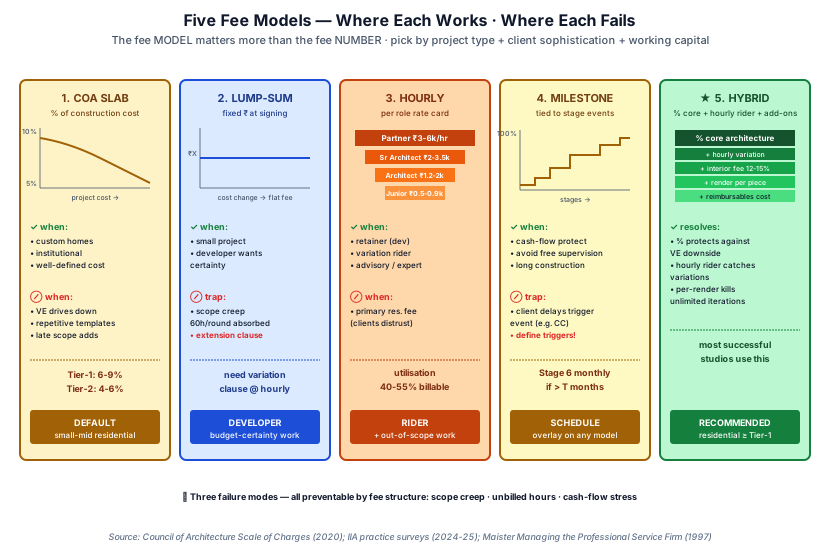
The Council of Architecture's published Scale of Charges defines the historic baseline: a sliding percentage of construction cost, anchored to the seven stages of architectural service. The full structure:
COA Scale of Charges — Indicative
| Project Cost Band | Indicative Fee % (Architecture only) |
|---|---|
| Up to ₹50 lakh | 8.0% – 10.0% |
| ₹50 lakh – ₹2 crore | 7.0% – 9.0% |
| ₹2 crore – ₹10 crore | 6.5% – 8.0% |
| ₹10 crore – ₹50 crore | 5.5% – 7.0% |
| Above ₹50 crore | 4.5% – 6.0% (negotiable on volume) |
Source: Council of Architecture, Conditions of Engagement and Scale of Charges (2020 edition); ranges reflect what Indian practices in 2026 actually charge against a published benchmark, not the floor or ceiling of the document itself.
The slab structure recognises a fundamental economic reality: design effort does not scale linearly with project cost. A ₹40 lakh apartment renovation may take more design hours per square foot than a ₹4 crore villa, because per-square-foot complexity often exceeds the larger project's. The slab compensates by raising the percentage on smaller projects.
Where the slab works: Custom residences, institutional projects with complex programmes, projects where the construction cost is well-defined upfront, and clients who want a single number that scales with what they ultimately spend.
Where the slab fails: Projects where the client repeatedly value-engineers the cost down (the architect's fee falls without the labour falling), repetitive projects (template villas in a layout, where the second through tenth villas take 10% of the design effort but invoice 100% of the fee), and projects with late-stage scope additions for which the per-percentage fee under-compensates the additional Stage 4 effort.
"The man who knows the price of everything and the value of nothing." — Oscar Wilde, on cynicism in 'Lady Windermere's Fan' (1892)
3. Lump-Sum Fees
A lump-sum fee fixes the architect's compensation in absolute rupee terms at the start of the engagement. Lump-sum is the dominant model in two contexts: small projects where the percentage scale generates a fee too small to be commercially viable, and developer projects where the client wants budget certainty.
The cash-flow profile of a well-structured lump-sum is identical to the COA slab — instalments tied to the seven stages — but the absolute number does not move with construction cost. This protects the architect from value-engineering downside (the client cannot reduce the fee by reducing the BOQ) but exposes the architect to scope-creep downside (every variation must be billed separately, or it becomes unbilled work).
The scope-creep arithmetic: Suppose a studio quotes ₹15 lakh lump-sum for a residential commission. The studio scopes the project as a 3000-sqft villa with three revision rounds, basic interior coordination, and standard MEP coordination. The client during Stage 2 asks to change the floor plan substantially after sign-off — twice. Without a variation clause invoking hourly billing or a per-revision fee, the architect absorbs both rounds. If each round consumes 60 senior-architect hours at an opportunity cost of ₹2,500/hour, the studio has just absorbed ₹3 lakh of unbilled labour — 20% of the entire engagement fee.
Defensible lump-sum structure:
| Component | What It Covers |
|---|---|
| Base fee (₹X lakh) | Stages 1–7 with up to N revision rounds at Stage 1 and Stage 2 |
| Variation clause | Any change after Stage 2 sign-off billed at hourly rate or as % of variation cost |
| Reimbursables | Travel, printing, statutory fees — pass-through at cost |
| Extra services | Interior, landscape, photo-real renders — separately quoted |
| Construction stage | If construction extends beyond T months, Stage 6 fee billed monthly thereafter |
The "extension clause" in Stage 6 is the single most important protection in a lump-sum contract. Construction delays in Indian residential projects routinely push 18-month builds to 30 months. Without an extension clause, the architect provides 12 extra months of supervision for free.
4. Hourly Billing

Pure hourly billing is uncommon in Indian residential practice but well-suited to two contexts: retainer engagements (the architect is on call for a developer's portfolio of projects), and out-of-scope variations within a fixed-fee engagement.
Hourly Rate Cards (2026 Indicative)
| Role | Tier-1 City Rate | Tier-2 City Rate |
|---|---|---|
| Principal Architect / Partner | ₹3,000 – ₹6,000 / hour | ₹2,000 – ₹3,500 / hour |
| Senior Architect (5+ yrs) | ₹2,000 – ₹3,500 / hour | ₹1,200 – ₹2,000 / hour |
| Architect (2–5 yrs) | ₹1,200 – ₹2,000 / hour | ₹800 – ₹1,200 / hour |
| Junior / Intern | ₹500 – ₹900 / hour | ₹300 – ₹600 / hour |
Source: Synthesised from IIA practice surveys (2024–2025), informal market data from active Indian studios, and adjusted for 2026 inflation.
The realism check on hourly billing is billable-hour utilisation. International benchmarks (Maister, 1997) suggest 60–70% of working hours are billable for a productive consulting practice; Indian residential studios report substantially lower utilisation — often 40–55% — because much of senior time is spent on business development, client management, and unpaid revisions. A studio quoting ₹3,000/hour to a client implicitly needs to charge enough on billable hours to cover non-billable time, or the studio runs at a loss.
Where hourly works: Retainer arrangements, client-driven scope changes within a fixed-fee project, advisory engagements with no construction component, expert-witness work in disputes.
Where hourly fails: Residential design engagements as the primary fee model — Indian clients distrust hourly bills they cannot independently verify. The standard professional response is to bill primary scope as a percentage or lump sum and bill out-of-scope work hourly.
5. Hybrid Fee Models
The fee structure that most successful Indian residential studios actually use is a hybrid: a lump-sum or percentage core, with an hourly variation rider, plus a separate interior fee, plus reimbursables at cost. The hybrid recognises that the design phase is naturally fixed-effort and the client-driven changes are naturally variable-effort.
Hybrid Structure for a Typical Residential Engagement
| Component | Structure | Indicative Quantum |
|---|---|---|
| Core architectural | % of construction cost or lump sum | 7% (Tier-1 metro) |
| Stage 1–2 revisions | Included up to N rounds | 2 concept rounds, 2 preliminary rounds |
| Variations after Stage 2 sign-off | Hourly | Studio rate card |
| Interior design | Separate % of interior fit-out cost or lump sum | 12–15% of interior cost |
| Vastu remediation rounds | Free for 1 round; hourly thereafter | Studio rate card |
| Landscape (if requested) | Separate scope, separately quoted | 5–8% of landscape cost |
| Photoreal renders | Per-render fee | ₹8,000 – ₹25,000/render |
| Reimbursables | Pass-through at cost | Travel, printing, models, statutory fees |
This structure is more complex to draft but resolves the three failure modes of the simpler structures. The percentage core protects against scope-creep on the architectural deliverable. The hourly rider protects against unbilled revisions. The separate interior and landscape fees protect against included-by-default expectations. The render-per-piece pricing protects against unlimited render iterations.
"Make things as simple as possible, but no simpler." — attributed to Albert Einstein, paraphrased from Reader's Digest (1977)
6. Milestone Billing and Cash-Flow Maths
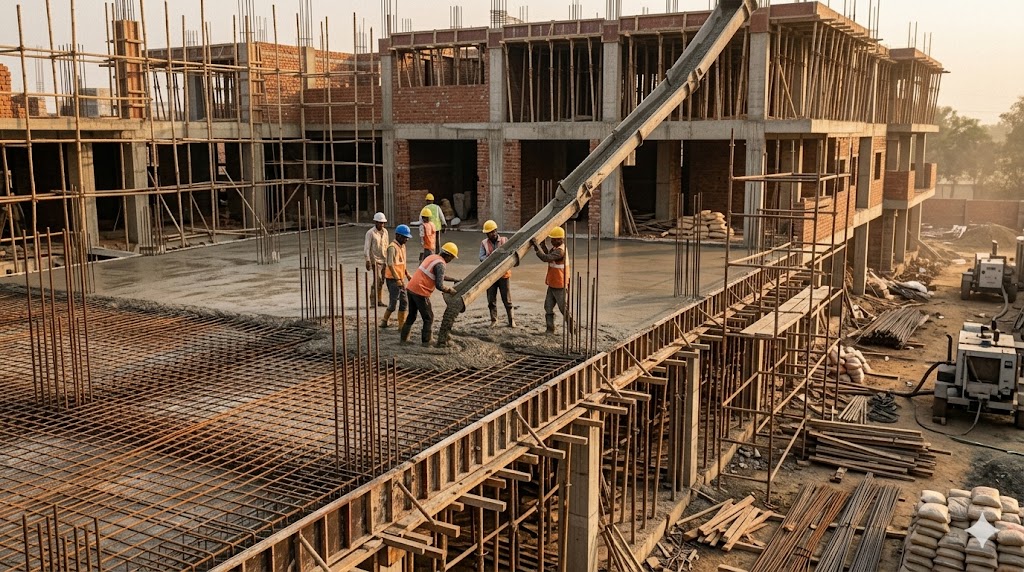
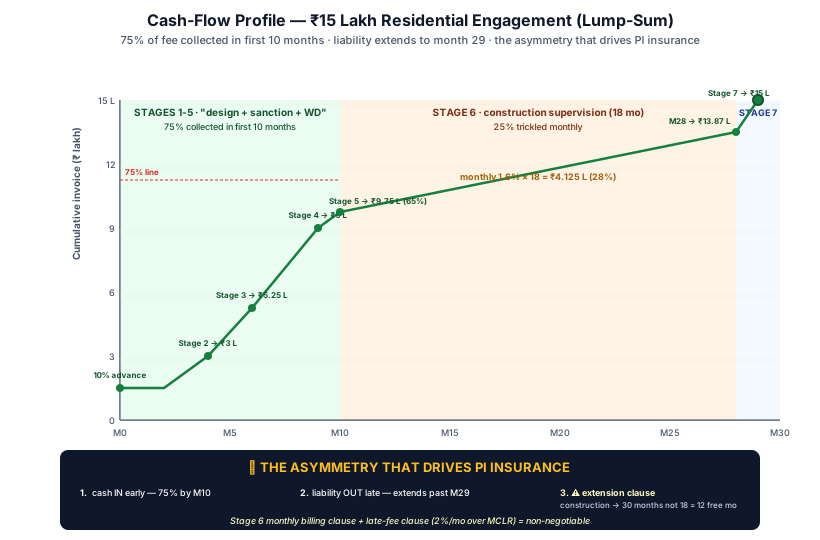
Whatever the fee structure, the billing schedule — when each instalment becomes payable — is a separate decision with cash-flow consequences. The CoA framework provides the default schedule (Stage 1 = 10%, Stage 2 = 20%, etc.), but Indian residential reality often pushes payments later than the framework anticipates.
Cash-Flow Profile of a ₹15-Lakh Residential Engagement (Lump-Sum)
| Month | Project Stage | Billing Trigger | Cumulative Invoice (₹) |
|---|---|---|---|
| 0 | Signing | 10% advance | 1,50,000 |
| 1–2 | Concept | Stage 1 sign-off | 1,50,000 |
| 3–4 | Preliminary | Stage 2 sign-off | 3,00,000 |
| 5–6 | Sanction | Stage 3 submission | 5,25,000 |
| 7–9 | Working drawings | Stage 4 issue | 9,00,000 |
| 10 | Tender | Stage 5 award | 9,75,000 |
| 11–28 | Construction | Monthly billing 1.6% × 18 months | 13,87,500 |
| 29 | Handover | Stage 7 OC support | 15,00,000 |
Indicative cash-flow profile assuming 18-month construction. In practice, Stage 6 monthly billing requires a clause specifying it; without one, the fee is collected at intervals of the contractor's running-bill cycle.
The pattern this profile reveals: 75% of the architect's lump-sum fee is collected in the first 10 months — covering Stages 1–5 — but the architect's remaining liability extends to month 29 and beyond. This asymmetry is the cash-flow basis of professional indemnity insurance: the architect is on the hook for warranty defects long after the fee has been collected and the funds redeployed.
The late-fee clause is the cash-flow companion of the milestone schedule. Every engagement letter should specify that invoices are payable within 14 or 30 days, and that delayed payment attracts interest at a stated rate (2% per month over MCLR is a defensible Indian benchmark — see Indian Contract Act 1872 §73 and Central Inland Water Transport Corp. v. Brojo Nath Ganguly (1986) for foundational law on contractual interest). Without the clause, a late-paying client provides interest-free working capital to themselves at the architect's expense.
7. GST, TDS, and the Tax Layer

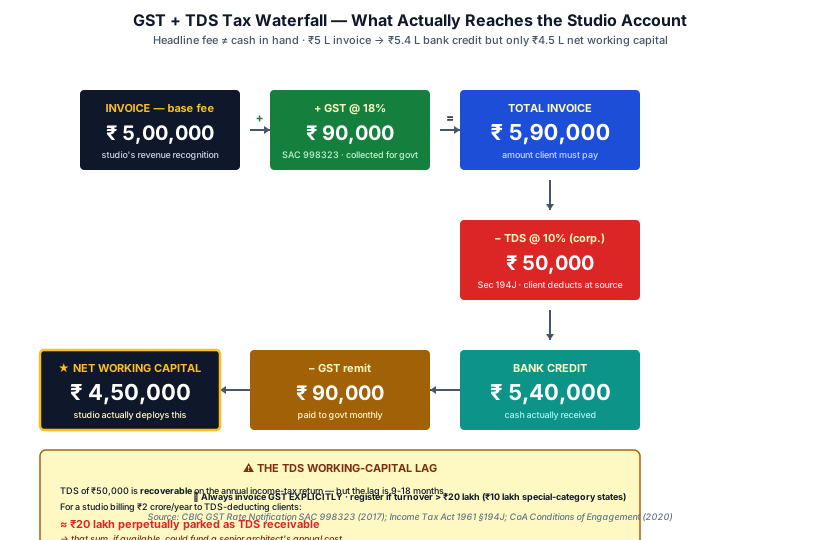
The headline fee is not the cash-in-hand. Two tax mechanisms reduce what reaches the studio account.
GST on architectural services is 18% under SAC 998323 (Architectural advisory and pre-design services and Architectural services for residential building projects). The architect must be GST-registered if turnover exceeds ₹20 lakh annually (₹10 lakh in special-category states). The 18% is collected from the client on top of the fee and remitted to the government — it is not the architect's revenue, but it must be invoiced explicitly to be recoverable.
TDS under Income Tax Section 194J applies when the client (typically a corporate or business entity, including HUFs/individuals exceeding the prescribed turnover) deducts 10% TDS at source on professional fees. The architect's invoice for ₹5 lakh thus produces ₹4.5 lakh of bank credit; the remaining ₹50,000 is deposited as TDS and credited to the architect's PAN, recoverable on annual income-tax return. Section 194J reduces working capital but not annual revenue.
Tax Handling — Worked Example
| Line Item | Amount (₹) |
|---|---|
| Architect's invoice — base fee | 5,00,000 |
| GST @ 18% | 90,000 |
| Total invoice value | 5,90,000 |
| Less: TDS @ 10% on base fee (corporate client) | (50,000) |
| Cash credited to studio account | 5,40,000 |
The studio's revenue recognition is ₹5,00,000 (the fee). The ₹90,000 GST is collected and remitted. The ₹50,000 TDS is recoverable. The cash credit of ₹5,40,000 includes the ₹90,000 GST that must be paid out, leaving the studio with ₹4,50,000 in net working capital until the TDS is recovered through the annual return cycle (often 9–18 months later).
For a small practice, the working-capital lag from TDS is non-trivial. A studio billing ₹2 crore annually to TDS-deducting clients has roughly ₹20 lakh perpetually parked as TDS receivable — a sum that, if available as working capital, could fund a senior architect's annual cost.
8. City-Wise Benchmark Ranges
Geographic price-discrimination in Indian architectural fees is real and substantial. The same residential brief commands different fees in different cities, driven by client willingness-to-pay, density of established practices, and the construction cost the percentage is anchored to.
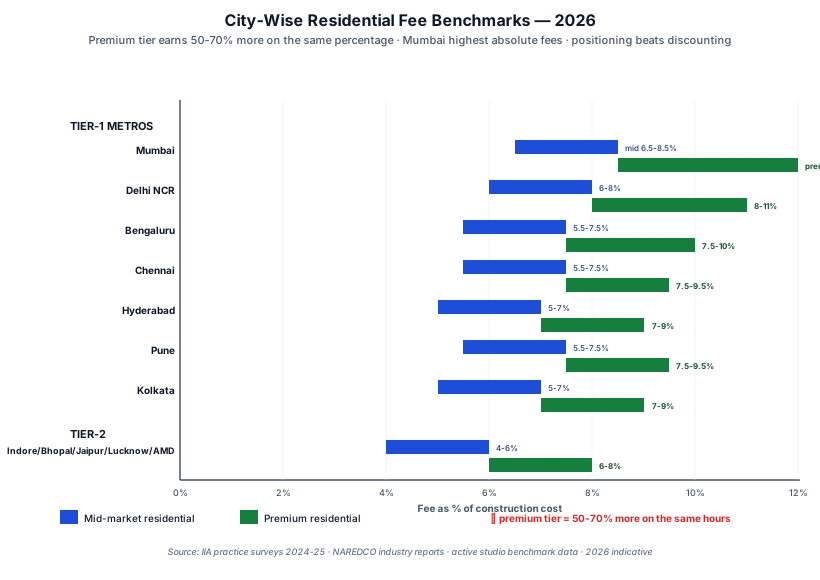
Tier-1 Cities — Residential Architecture Fee Ranges (2026)
| City | Mid-Market Residential | Premium Residential | Notes |
|---|---|---|---|
| Mumbai | 6.5% – 8.5% | 8.5% – 12% | Highest absolute fees; construction cost is also highest |
| Delhi NCR | 6.0% – 8.0% | 8.0% – 11% | Strong corporate client base; competitive at premium tier |
| Bengaluru | 5.5% – 7.5% | 7.5% – 10% | Tech-money client base; willing to pay for design quality |
| Chennai | 5.5% – 7.5% | 7.5% – 9.5% | Conservative market; lower fee tolerance |
| Hyderabad | 5.0% – 7.0% | 7.0% – 9.0% | Younger market; growing premium segment |
| Pune | 5.5% – 7.5% | 7.5% – 9.5% | Mumbai-adjacent reference pricing |
| Kolkata | 5.0% – 7.0% | 7.0% – 9.0% | Heritage market; restoration projects priced separately |
Tier-2 Cities — Residential Architecture Fee Ranges (2026)
| Tier-2 Market | Mid-Market Residential | Premium Residential |
|---|---|---|
| Indore, Bhopal, Jaipur, Lucknow, Ahmedabad | 4.0% – 6.0% | 6.0% – 8.0% |
| Tier-2 secondary (Coimbatore, Mysuru, Vizag, etc.) | 3.5% – 5.5% | 5.5% – 7.5% |
Source: Synthesised from IIA practice surveys, NAREDCO industry reports, and active studio benchmark data; ranges reflect 2026 market rates and may shift with construction-cost inflation.
The pattern in this data is consistent across markets: the premium tier in any city earns roughly 50–70% more on the same percentage than mid-market. This premium pays for senior involvement, more revision tolerance, faster response, and higher-end deliverables. A studio that can credibly position itself in the premium tier earns substantially more on the same hours of work than one that competes in the mid-market.
9. Negotiation Patterns That Defend the Fee
Indian residential clients almost always ask for a discount. The professional response is not to offer one; it is to expand the scope visible to the client so they understand the value they are receiving.
The negotiation patterns that work:
Scope-table response. When the client objects to fee, do not lower the fee — show the included scope. Most clients have not realised what the seven stages contain, what coordination involves, what revisions cost. A one-page scope table converts a fee objection into a value confirmation.
Tier-down rather than discount. If the client genuinely cannot afford the quoted fee, do not discount the same scope. Reduce the scope: fewer revision rounds, fewer 3D renders, less site supervision intensity, no detailed interior coordination. The fee falls; the value-per-rupee remains constant; the studio's hourly recovery is preserved.
Walk-away threshold. Every studio should have a published or internal minimum fee per project type. Below that threshold, the project costs the studio money. The discipline of refusing those engagements is what allows the studio to charge market rates on the engagements it accepts.
Reference benchmarks visibly. Citing the COA scale, the IIA Standard Form, or city peer benchmarks externalises the fee — the architect is not "asking" for the rate; they are quoting the published professional standard. This shifts the negotiation from "the architect is expensive" to "the architect is at market rate."
"Discount is the silent killer of design practice." — Aphorism widely attributed in Indian architectural practice circles
Cross-References Within Studio Matrx
- The Architect's Scope of Services in India — the seven stages and deliverables that the fee is buying
- How to Win Clients — fee positioning in the client-acquisition journey
- Starting an Architecture & Interior Design Firm in India — entity structure and tax registration that supports the fee model
- Working Drawings & Documentation — the deliverable that drives Stage 4's outsized fee weight
- Use the Architect Fee Calculator to model different fee structures for a specific project
- Use the Fee Proposal Tool to generate a structured fee proposal document
References
1. Council of Architecture (2020) Conditions of Engagement and Scale of Charges. New Delhi: Council of Architecture.
2. Government of India (1972) The Architects Act 1972. Act No. 20 of 1972.
3. Indian Institute of Architects (2018) IIA Standard Form of Agreement Between Client and Architect. Mumbai: IIA Publications.
4. Government of India, Central Board of Indirect Taxes and Customs (2017) GST Rate Notification — SAC 998323 Architectural Services.
5. Government of India (1961) Income Tax Act 1961, §194J (TDS on professional fees).
6. Reserve Bank of India (2024) Monetary Policy Statement — MCLR Reference. Mumbai: RBI Publications.
7. Government of India (1872) The Indian Contract Act 1872, §§73–74 (compensation, liquidated damages, contractual interest).
8. Maister, D.H. (1997) True Professionalism: The Courage to Care About Your People, Your Clients, and Your Career. New York: Free Press.
9. American Institute of Architects (2017) AIA Document B101 — Standard Form of Agreement Between Owner and Architect.
10. Royal Institute of British Architects (2020) RIBA Plan of Work 2020. London: RIBA Publishing.
11. Naredco / Knight Frank (2023) India Real Estate Outlook. Annual industry report.
12. Supreme Court of India (1986) Central Inland Water Transport Corp. v. Brojo Nath Ganguly, AIR 1986 SC 1571 — foundational on contractual fairness.
Author's Note: Fee structure is the operating system of an architectural practice. Studios that resolve the fee question once, well, and document it in their template engagement letter spend less time arguing about money and more time designing buildings. This guide is part of a Studio Matrx series on practice management; the companion guide on the COA Conditions of Engagement provides the scope-and-deliverables foundation that this fee discussion sits on top of.
Disclaimer: This article is for informational and educational purposes only. It does not constitute legal, tax, or professional advice. Fee benchmarks and tax rates cited are 2026-current but may change with statutory amendments. Architects must verify GST rates, TDS thresholds, and Income-Tax provisions with qualified counsel and current notifications before invoicing. Studio Matrx, its authors, and contributors accept no liability for decisions based on this guide.
Interactive · Architect fee estimator
₹4.80 L – ₹7.20 L for ₹80 L project
COA-recommended baseline for typical residential
All 5 stages incl. construction supervision
Drag to your project size (excludes land)
Estimated fee range
₹4.80 L – ₹7.20 L
Midpoint ₹6.00 L
Export this guide
Related Guides — Deep-dive reading
Understanding Construction Contracts & Retainage in India
A homeowner-protective guide to the contract and payment structure behind every interiors or build project — the contract types and when each fits, how to stage payments so your money trails the work, and the retention clause that quietly protects you more than any other.
Cost & MoneyThe Architect's Scope of Services in India
COA Conditions of Engagement Decoded — Stages, Deliverables, Fees, and What's Actually Included
ConstructionCost of Luxury Interiors in Indian Metro Cities
What true luxury interiors cost per sqft across Mumbai, Delhi-NCR, Bengaluru, Hyderabad, Chennai, Pune (2026)
Cost & MoneyRelated Tools — Try Free
Interior Contract Clause Checklist
16 sections and 98 checkboxes covering scope, BOQ, milestones, penalties, warranty, and disputes.
Contract ChecklistContract Studio
AI generates professional architecture service agreements with milestones and scope.
ArchitectAIInterior Contract Template — India
Legally-refined contract template with payment milestones, timeline, warranty, and jurisdiction fields.
Contract Generator