
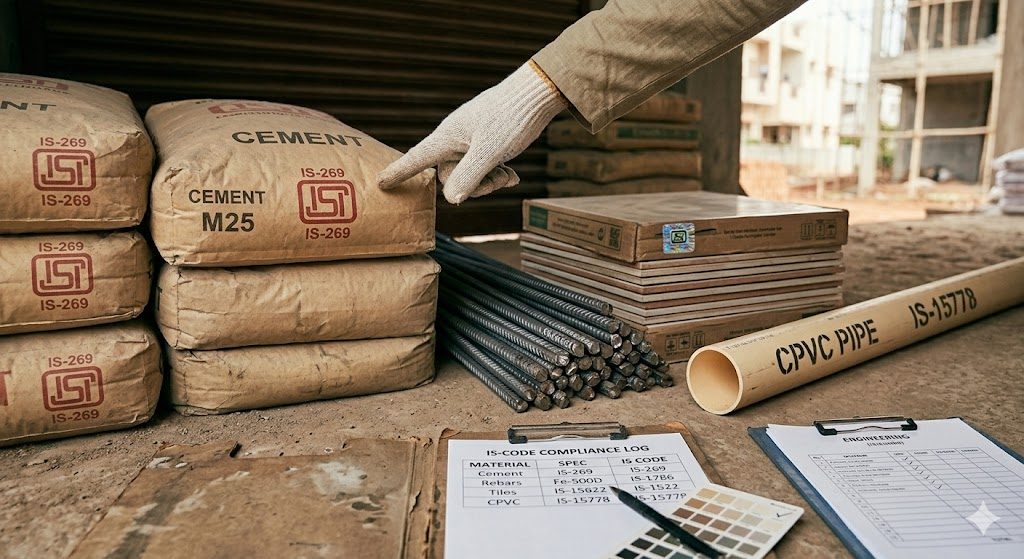
Construction Material Quality Standards
IS Codes, ISO Standards, Testing Parameters & Quality Agencies for Indian Construction
The quality of a building is only as good as the materials that go into it. A perfectly designed structure with substandard cement, uncertified steel, or contaminated sand will deteriorate faster, cost more to maintain, and — in the worst case — pose life-safety risks.
India has one of the world's most comprehensive material standards systems through the Bureau of Indian Standards (BIS), with over 200 IS codes covering construction materials alone. Yet non-compliance remains widespread — CBRI estimates that 30-40% of construction materials used in Indian residential projects do not meet the specified IS standards.
This guide provides a complete reference for architects, engineers, contractors, and homeowners — covering every major construction material, its IS/ISO codes, quality parameters, testing methods, acceptance criteria, and where to get materials tested.
The Material Quality Ecosystem in India
Standards Bodies
| Organisation | Role | Relevance |
|---|---|---|
| BIS (Bureau of Indian Standards) | Sets IS codes, certifies products with ISI mark | Primary authority for all construction materials |
| ISO (International Organization for Standardization) | International standards | Referenced when IS codes are not available |
| ASTM (American Society for Testing and Materials) | International testing standards | Used for specialised materials not covered by IS |
| NABL (National Accreditation Board for Labs) | Accredits testing laboratories | Ensures test results are reliable |
| QCI (Quality Council of India) | Overall quality infrastructure | Oversees NABL and other accreditation bodies |
The ISI Mark — What It Means
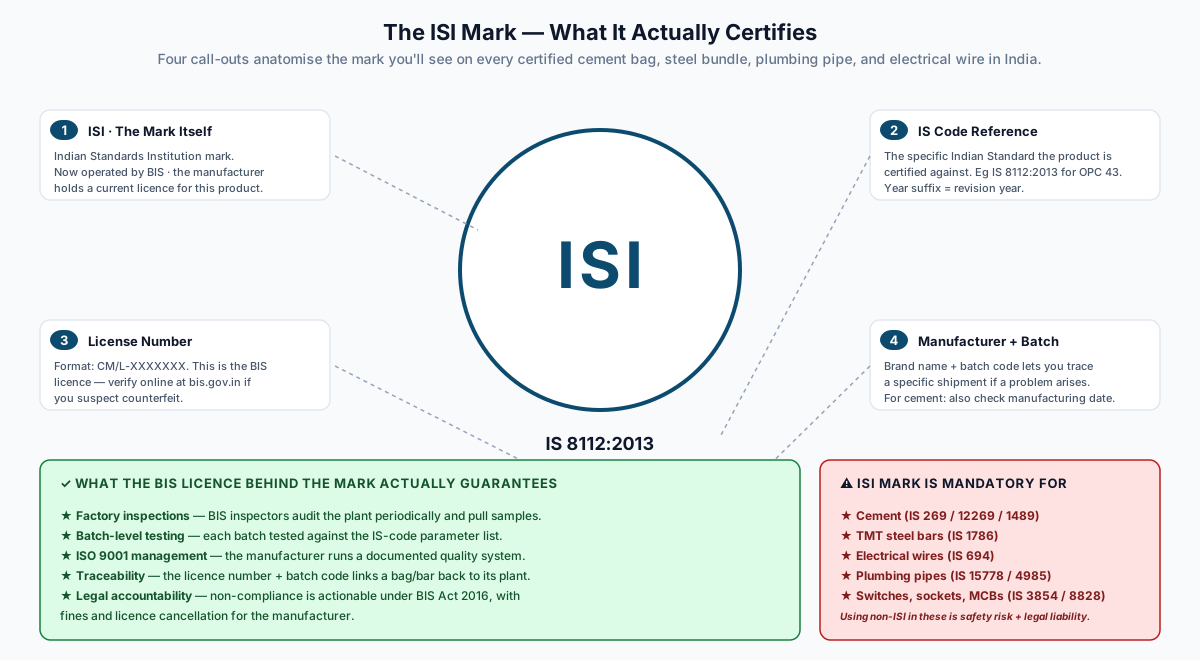
The ISI (Indian Standards Institution) mark on a product means:
- The manufacturer has a BIS license for that product
- The product is regularly tested by BIS inspectors
- It meets the IS code specification for that product category
- The manufacturer's facility follows ISO 9001 quality management
Critical: ISI mark is mandatory for cement, steel, electrical wires, and plumbing pipes used in construction. Using non-ISI materials is both a safety risk and a legal liability.
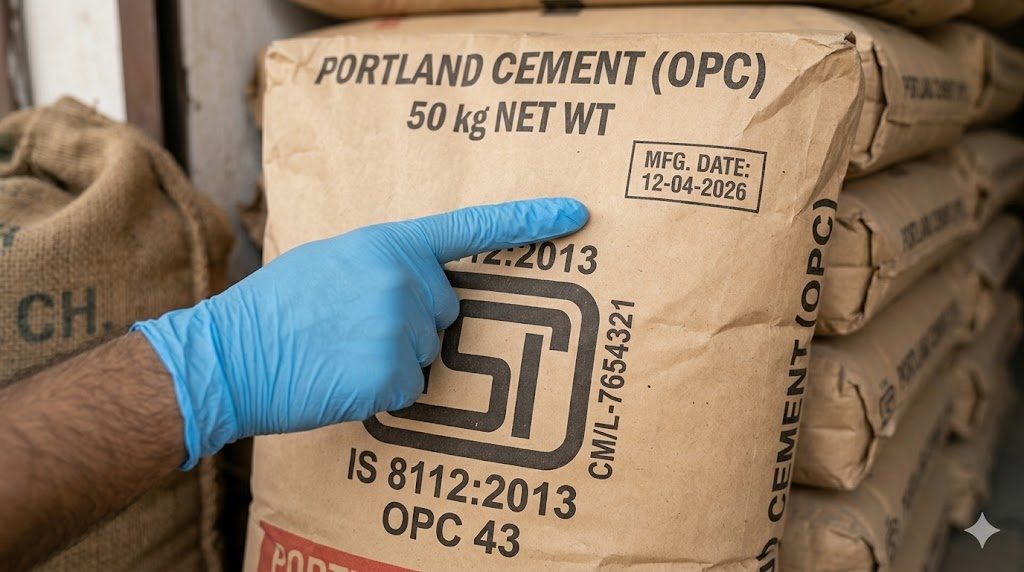
Material-Wise Quality Standards
1. Cement — The Binding Agent
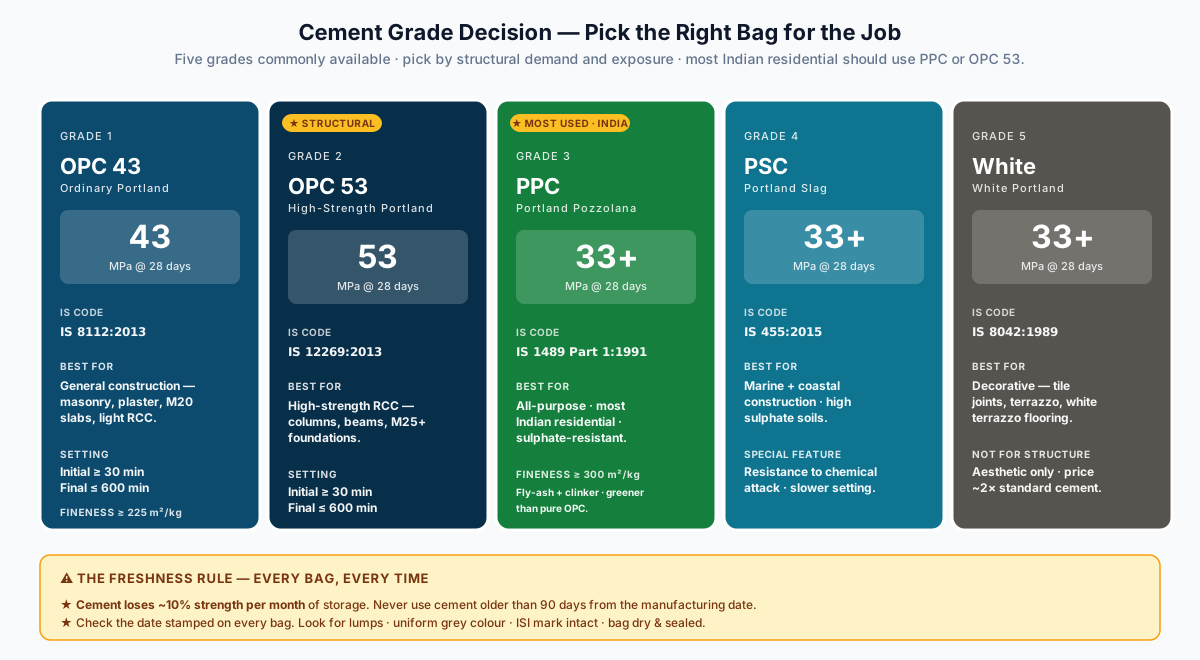
IS Codes
| Cement Type | IS Code | Strength | Best For |
|---|---|---|---|
| OPC 43 grade | IS 8112:2013 | 43 MPa at 28 days | General construction |
| OPC 53 grade | IS 12269:2013 | 53 MPa at 28 days | High-strength concrete, RCC |
| PPC | IS 1489 Part 1:1991 | 33 MPa at 28 days | All-purpose, sulphate resistant |
| PSC | IS 455:2015 | 33 MPa at 28 days | Marine/coastal, high sulphate soil |
| White cement | IS 8042:1989 | 33 MPa | Decorative, tile joints |
Quality Parameters
| Parameter | Test Method | Acceptable Value |
|---|---|---|
| Fineness | Blaine's air permeability (IS 4031-2) | ≥225 sq.m/kg (OPC), ≥300 (PPC) |
| Initial setting time | Vicat apparatus (IS 4031-5) | ≥30 minutes |
| Final setting time | Vicat apparatus | ≤600 minutes |
| Soundness | Le Chatelier expansion (IS 4031-3) | ≤10mm |
| Compressive strength (28 day) | Mortar cube test (IS 4031-6) | ≥43 MPa (OPC 43), ≥53 MPa (OPC 53) |
| Loss on ignition | Chemical analysis (IS 4032) | ≤5% (OPC), ≤5% (PPC) |
How to Check Cement Quality On-Site
1. Date of manufacture — cement loses 10% strength per month. Never use cement older than 90 days.
2. Colour — should be uniform grey (OPC) or slightly greenish (PPC). Lumps indicate moisture damage.
3. Feel test — smooth, not gritty. Gritty feel means adulteration with sand.
4. Float test — sprinkle on water. Fresh cement floats briefly then sinks. Stale cement sinks immediately.
5. ISI mark — mandatory. Check license number on every bag.
Major Brands (ISI Certified)
UltraTech, ACC, Ambuja, Shree, Dalmia, Birla, Ramco, Zuari, JK Cement, India Cements
2. Steel (TMT Bars) — The Skeleton
IS Codes
| Steel Grade | IS Code | Yield Strength | UTS | Elongation | Best For |
|---|---|---|---|---|---|
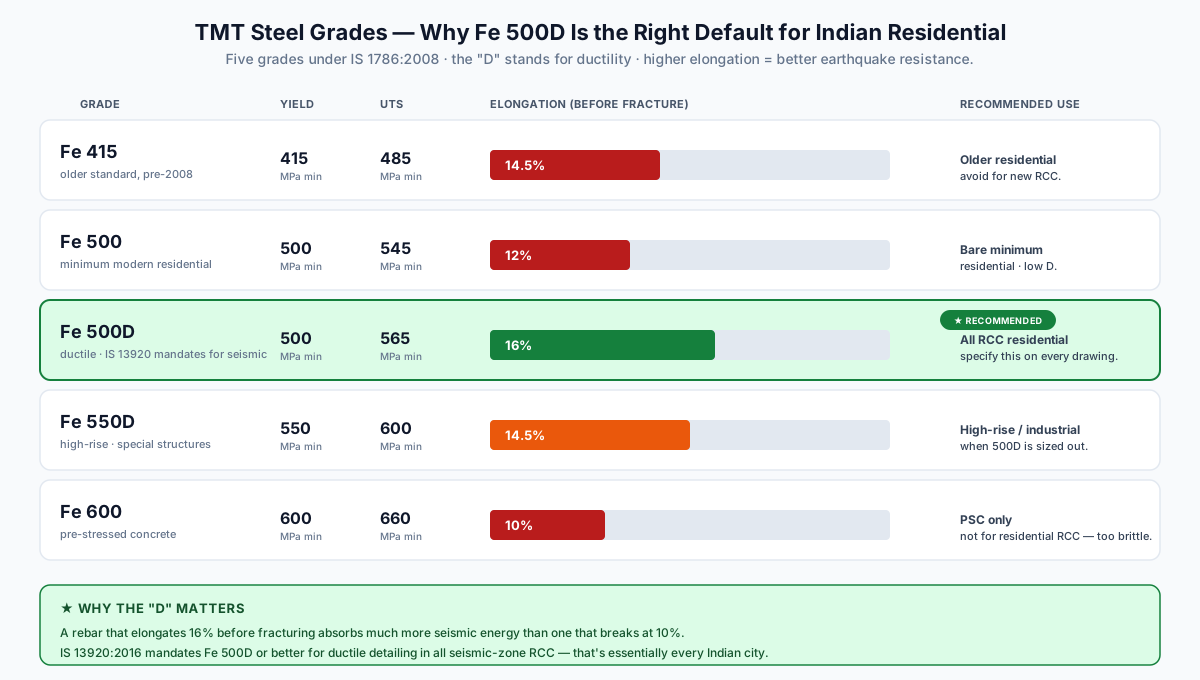
| Fe 415 | IS 1786:2008 | ≥415 MPa | ≥485 MPa | ≥14.5% | Residential (old standard) |
| Fe 500 | IS 1786:2008 | ≥500 MPa | ≥545 MPa | ≥12% | Standard residential |
| Fe 500D | IS 1786:2008 | ≥500 MPa | ≥565 MPa | ≥16% | Recommended for all RCC |
| Fe 550D | IS 1786:2008 | ≥550 MPa | ≥600 MPa | ≥14.5% | High-rise, special structures |
| Fe 600 | IS 1786:2008 | ≥600 MPa | ≥660 MPa | ≥10% | Pre-stressed concrete |
Why Fe 500D? The "D" stands for ductility — higher elongation before breaking. This is critical for earthquake resistance. IS 13920 mandates Fe 500D or better for seismic detailing. Always specify Fe 500D for residential construction.
Quality Parameters
| Parameter | Test | Acceptable (Fe 500D) |
|---|---|---|
| Yield strength | Tensile test (IS 1608) | ≥500 MPa |
| Ultimate tensile strength | Tensile test | ≥565 MPa |
| UTS/YS ratio | Calculated | ≥1.08 |
| Elongation | Gauge length test | ≥16% |
| Bend test | 180° bend around mandrel | No crack on outer radius |
| Re-bend test | Bend, age, re-bend | No crack |
| Weight per metre | Weighing | ±5% of nominal (e.g., 12mm = 0.888 kg/m) |
How to Check Steel Quality On-Site
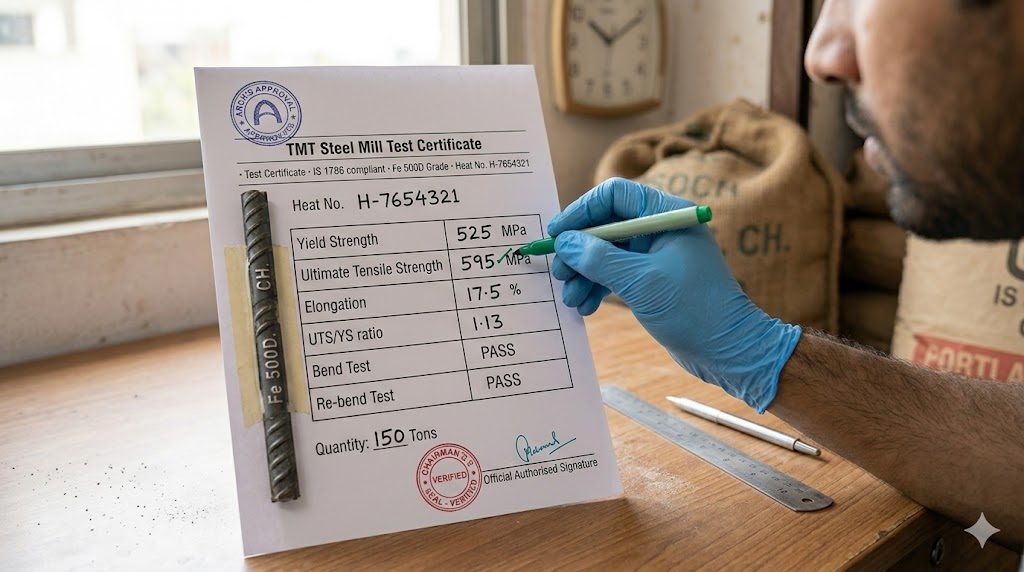
1. BIS mark — rolled/embossed on every bar. Look for "Fe 500D" + company mark.
2. Mill certificate — every lot should have a test certificate from the manufacturer.
3. Rust check — surface rust is acceptable (aids bonding). Deep pitting/flaking is not.
4. Weight check — weigh a 12mm bar per metre. Should be 0.888 kg/m ±5%. Underweight bars are substandard.
5. Bend test — bend a sample 180° around a mandrel. No crack = good quality.
6. Rib pattern — should be clear, uniform. Faded ribs indicate poor rolling quality.
Major Brands (ISI Certified)
TATA Tiscon, SAIL, JSW Neo Steel, Kamdhenu, Vizag Steel, Shyam Steel, Jindal Panther, RINL
3. Sand & Aggregates — The Filler
IS Codes
| Material | IS Code | Key Parameter |
|---|---|---|
| Fine aggregate (sand) | IS 383:2016 | Grading Zone I-IV |
| Coarse aggregate (gravel) | IS 383:2016 | Nominal size 20mm/12mm |
| Manufactured sand (M-Sand) | IS 383:2016 (revised) | Zone II grading |
| Lightweight aggregate | IS 9142 | Specific gravity <2.0 |
Sand Grading Zones
| Zone | Fineness Modulus | Best For |
|---|---|---|
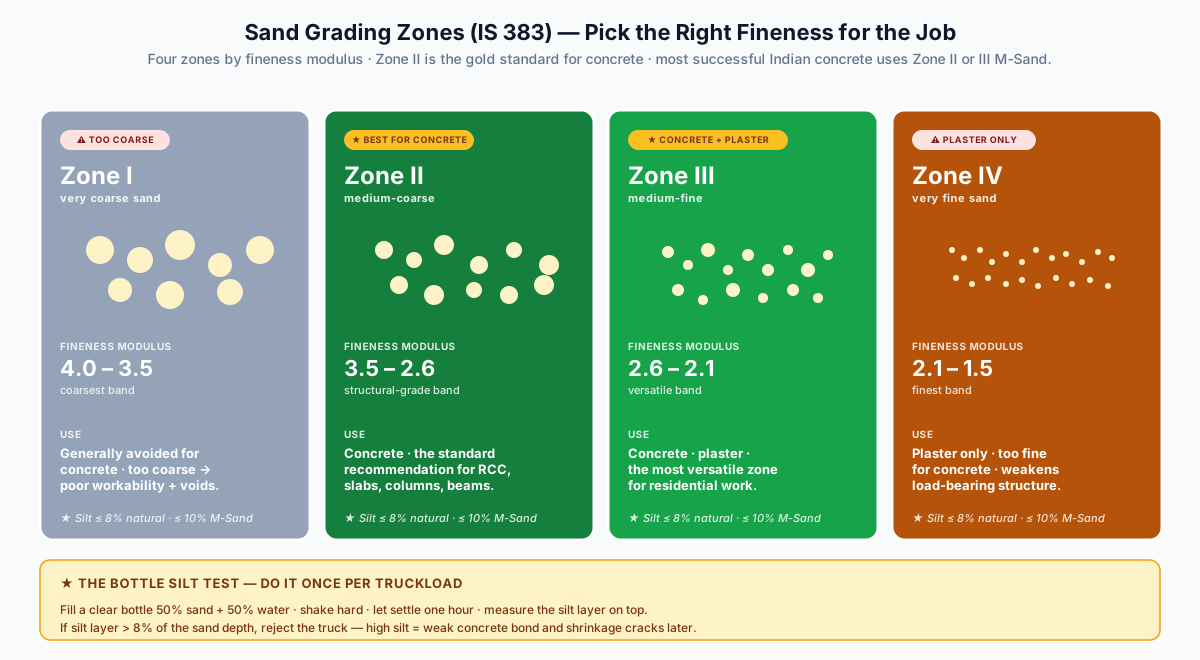
| Zone I | 4.0-3.5 | Too coarse — not ideal for concrete |
| Zone II | 3.5-2.6 | Best for concrete — most recommended |
| Zone III | 2.6-2.1 | Good for concrete and plaster |
| Zone IV | 2.1-1.5 | Fine — acceptable for plaster, not concrete |
Quality Parameters
| Parameter | Test (IS 2386) | Acceptable |
|---|---|---|
| Silt content | Sedimentation test | ≤8% (natural sand), ≤10% (crushed) |
| Organic impurities | Sodium hydroxide test | Colour lighter than standard |
| Particle shape | Visual/elongation index | Cubical preferred, flaky rejected |
| Water absorption | Soaking test | ≤2% for coarse aggregate |
| Crushing value | Aggregate crushing test | ≤30% for concrete |
| Impact value | Aggregate impact test | ≤30% for concrete |
| Specific gravity | Pycnometer test | 2.5-2.7 (normal weight) |
On-Site Sand Checks
1. Grab test — squeeze wet sand in fist. Should hold shape, break cleanly into 2-3 pieces.
2. Silt test — fill bottle 50% sand + 50% water, shake, let settle 1hr. Silt layer on top should be <8%.
3. Visual check — no clay lumps, no organic matter, uniform colour.
4. M-Sand vs river sand — M-Sand is now preferred (environmental + consistent quality). Must be IS 383 compliant.
4. Bricks & Blocks
IS Codes
| Material | IS Code | Min Strength | Water Absorption |
|---|---|---|---|
| Clay bricks (Class A) | IS 1077:1992 | ≥75 kg/sq.cm | ≤20% |
| Clay bricks (Class B) | IS 1077 | ≥50 kg/sq.cm | ≤22% |
| Fly ash bricks | IS 12894:2002 | ≥75 kg/sq.cm | ≤15% |
| AAC blocks | IS 2185 Part 3 | ≥30 kg/sq.cm (dry density 551-650) | — |
| Solid concrete blocks | IS 2185 Part 1 | ≥50 kg/sq.cm (A grade) | ≤10% |
| Hollow concrete blocks | IS 2185 Part 1 | ≥35 kg/sq.cm | ≤10% |
On-Site Brick Checks
1. Sound test — two bricks struck together should produce a clear ringing sound, not a dull thud.
2. Scratch test — fingernail should not scratch the surface. If it does, the brick is underburnt.
3. Water absorption — soak a dry brick for 24 hours. Weight gain should be <20%.
4. Efflorescence — soak and dry. White salt deposits = high efflorescence = reject.
5. Dimensions — standard 230 × 115 × 75 mm. Variation should be ≤3%.
6. Colour — uniform deep red. Pale colour = underburnt. Dark/distorted = overburnt.
5. Concrete — The Composite
IS Codes
| Aspect | IS Code | Key Provision |
|---|---|---|
| Mix design | IS 10262:2019 | Design mix proportions |
| Plain & reinforced concrete | IS 456:2000 | All concrete work specifications |
| Ready-mix concrete | IS 4926:2003 | RMC quality requirements |
| Concrete testing | IS 516:1959 | Cube test method |
| Admixtures | IS 9103:1999 | Chemical admixture standards |
Concrete Grades
| Grade | Characteristic Strength (28 days) | Common Use |
|---|---|---|
| M15 | 15 MPa | PCC, levelling |
| M20 | 20 MPa | Residential slabs, beams (minimum for RCC) |
| M25 | 25 MPa | Columns, foundations, recommended for residential |
| M30 | 30 MPa | High-rise columns, water tanks |
| M35 | 35 MPa | Pre-stressed concrete, bridges |
| M40+ | 40+ MPa | Special structures |
Concrete Quality Tests
| Test | Method | Frequency | Acceptable |
|---|---|---|---|
| Slump test | IS 1199 | Every batch / truck | 75-100mm (normal), 100-150mm (pumped) |
| Cube test (7 day) | IS 516 | Min 1 set per 5 cu.m | ≥67% of 28-day design strength |
| Cube test (28 day) | IS 516 | Min 1 set per 5 cu.m | ≥ fck + 1.65s (IS 456 acceptance criteria) |
| Water-cement ratio | Mix design record | Every batch | ≤0.50 for M20, ≤0.45 for M25 |
| Temperature | Thermometer | Every batch in summer | ≤30°C at placement |
IS 456 acceptance criteria: The mean of any group of 4 consecutive cube test results must exceed the specified characteristic strength by at least 1.65 times the standard deviation. Individual results must not fall below fck - 3 MPa.
6. Plumbing Materials
| Material | IS Code | Key Parameter |
|---|---|---|
| CPVC pipes | IS 15778:2007 | Pressure rating: SDR 11 (hot water) |
| uPVC pipes | IS 4985:2000 | Pressure rating: Class 1-6 |
| PPR pipes | IS 15801:2008 | Temperature rating: up to 95°C |
| PVC-SWR pipes | IS 13592:2013 | Soil, waste, rainwater drainage |
| GI pipes | IS 1239:2004 | Galvanised iron (older buildings) |
| CP fittings | IS 8931:2003 | Chrome plated brass fittings |
7. Electrical Materials
| Material | IS Code | Key Parameter |
|---|---|---|
| PVC insulated wire | IS 694:2010 | Copper conductor, voltage rating |
| FR (Flame Retardant) wire | IS 694 | Self-extinguishing insulation |
| FRLS wire | IS 694 | Low smoke emission |
| MCB | IS 8828:1996 / IEC 60898 | Breaking capacity, trip curve |
| RCCB | IS 12640 / IEC 61008 | Earth leakage protection |
| Switches & sockets | IS 3854:1988 | Current rating, safety |
| Conduit pipes | IS 9537:1980 | PVC/HDPE conduit for wiring |
| Earthing electrode | IS 3043:2018 | Earth resistance ≤1 ohm |
Safety critical: All electrical materials must have ISI mark. Using non-ISI wires is a fire hazard and illegal.
8. Waterproofing Materials
| Material | IS Code | Application |
|---|---|---|
| APP membrane | IS 14767:2000 | Terrace, flat roofs |
| SBS membrane | IS 14767 | Basement, below-grade |
| Integral waterproofing | IS 2645:2003 | Mixed with concrete |
| Epoxy coating | IS 9862:1981 | Water tanks, chemical resistance |
| Polyurethane coating | — (ASTM C836) | Terrace, exposed surfaces |
| Crystalline waterproofing | — (manufacturer spec) | Concrete self-healing |
ISO Codes Relevant to Indian Construction
| ISO Code | Title | Indian Equivalent |
|---|---|---|
| ISO 9001:2015 | Quality Management System | Manufacturing quality certification |
| ISO 14001:2015 | Environmental Management | Green manufacturing |
| ISO 6935 | Steel for Reinforcement | IS 1786 |
| ISO 679 | Cement Testing Methods | IS 4031 |
| ISO 13006 | Ceramic Tiles | IS 13006 |
| ISO 10545 | Ceramic Tile Testing | IS 13006 |
| ISO 8970 | Timber Structures | IS 883 |
| ISO 17025 | Laboratory Competence | NABL accreditation basis |
Material Testing Labs — Where to Get Tested
Government Labs
| Lab | Location | Speciality | Contact |
|---|---|---|---|
| CBRI (Central Building Research Institute) | Roorkee, Uttarakhand | All construction materials | cbri.res.in |
| SERC (Structural Engineering Research Centre) | Chennai | Structural materials, steel | serc.res.in |
| NIT/IIT Labs | Across India | Material testing, research | Individual college websites |
| PWD Central Labs | Every state capital | Routine material testing | State PWD websites |
| CPWD Labs | Delhi, Mumbai, Chennai, Kolkata | Comprehensive testing | cpwd.gov.in |
Private NABL-Accredited Labs
| Lab | Presence | Services |
|---|---|---|
| SGS India | Pan-India | Cement, steel, aggregate, soil |
| Intertek | Mumbai, Delhi, Bengaluru | Full material testing |
| L&T Construction Lab | Pan-India | Concrete, steel, soil |
| TUV India | Major cities | Material certification |
| Torsteel Research | Bengaluru, Mumbai | Steel specialisation |
Find NABL labs: Visit nabl-india.org → Directory → Search by "Construction Materials" + your city.
Material Quality Checklist for Homeowners
Before your contractor procures any material, verify:
- [ ] Cement: ISI mark, date <90 days old, grade as specified (OPC 53 or PPC)
- [ ] Steel: BIS mark on bars, Fe 500D grade, mill certificate copy
- [ ] Sand: Sieve analysis report (Zone II/III), silt content <8%
- [ ] Bricks/Blocks: Compression test certificate, no efflorescence
- [ ] Plywood: ISI mark, BWP (IS 710) for wet areas, BWR (IS 303) for dry
- [ ] Tiles: Water absorption certificate, ISI mark for ceramic
- [ ] Electrical wires: ISI mark, FR/FRLS grade, copper (not aluminium)
- [ ] Plumbing pipes: ISI mark, CPVC for hot water, uPVC for cold
- [ ] Waterproofing: Product data sheet, applicator certification
- [ ] Concrete: Mix design from approved lab, slump test on site
Key Takeaways
- ISI mark is non-negotiable for cement, steel, electrical wires, and plumbing — it is both a safety requirement and a legal one
- Fe 500D steel is the recommended grade for all residential RCC — the "D" ductility makes buildings earthquake-safer
- Cement expires — never use cement older than 90 days. Check the manufacturing date on every bag
- Sand quality directly affects concrete strength — insist on sieve analysis report and silt content test
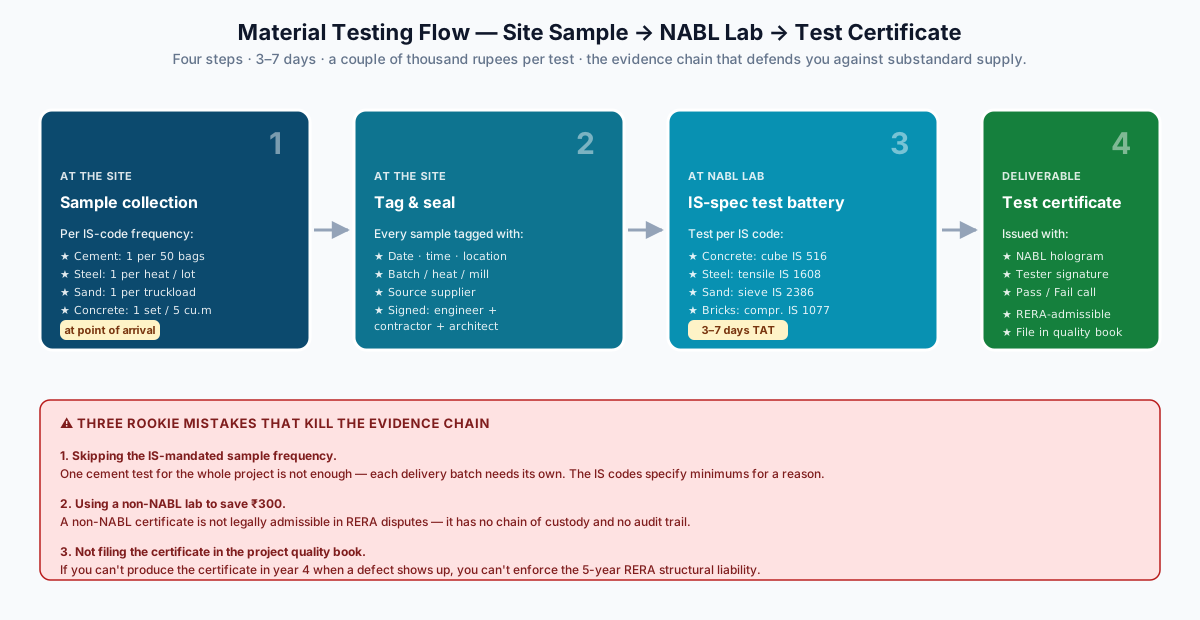
- Every material shipment should have a test certificate — maintain a project file with all certificates for RERA compliance
- NABL-accredited labs provide reliable test results — use them for any disputed material quality
References:
- Bureau of Indian Standards — Full IS code catalogue at bis.gov.in
- IS 456:2000 — Plain and Reinforced Concrete
- IS 1786:2008 — High Strength Deformed Steel Bars
- IS 383:2016 — Coarse and Fine Aggregate for Concrete
- IS 1077:1992 — Common Burnt Clay Building Bricks
- IS 12894:2002 — Pulverised Fuel Ash-Lime Bricks
- IS 10262:2019 — Concrete Mix Proportioning Guidelines
- CPWD General Specifications for Building Works 2019
- ISO 9001:2015 — Quality Management Systems
- NABL Directory of Accredited Laboratories — nabl-india.org
Export this guide
Related Guides — Deep-dive reading
IS Codes for Plumbing in India: BIS Standards, the ISI Mark and How to Buy Certified Pipes, Tanks, Valves and Fittings
A professional's plain-English guide to the Bureau of Indian Standards (BIS) system that governs plumbing materials — what the ISI mark actually certifies, how IS standards specify pipes, fittings, tanks and valves, why the marked product is the compliant one, and how to verify a standard on the BIS portal.
PlumbingBuilding Material Standards and Certifications in India: BIS, ISI, NBC and Green Labels Explained (2026)
How to know a building material is genuine and fit for purpose. A plain-language guide to the BIS / IS ecosystem and the ISI mark, the international standards you will see on datasheets, the NBC (SP 7:2026) umbrella code, and the sustainability certifications - GRIHA, IGBC, LEED, GreenPro - that tell you a product is genuinely green.
Building MaterialsConstruction Aggregates in India: Sizes, Quality & Selection (2026)
What coarse aggregate actually does in concrete, how to pick the right nominal size (10mm, 20mm, 40mm), and the field and lab checks that separate strong stone from a bad load - a specify-and-select guide for Indian homes.
Building MaterialsRelated Tools — Try Free
Electrical Safety & Load Audit
Home electrical audit — 10 categories, 65+ checkpoints across earthing, RCCB, MCB, wiring, switchboards, appliance circuits, DG/inverter backup.
Safety AuditPlumbing Pressure-Test & Leak Checklist
Pre-closure pressure and leak test — 9 categories, 60+ checkpoints across water supply, drainage, fixtures, waterproofing, hot water, tanks.
Pre-Closure TestWindow Material Comparison Tool
Compare uPVC, aluminium, wood, steel and composite windows on cost, life, upkeep and insulation.
Compare