
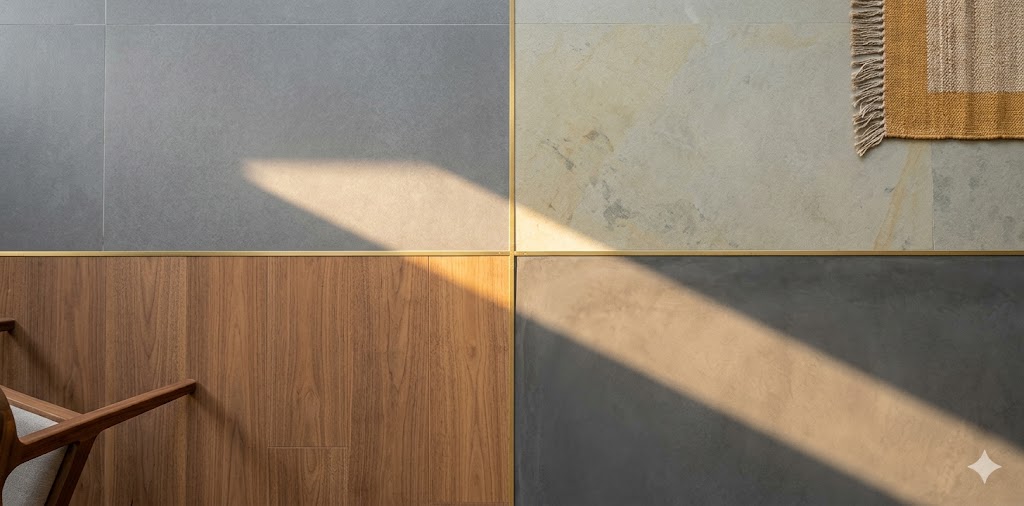
Flooring & Finishes Specification for Indian Architects
Performance Criteria, IS Codes, and Detailing for Residential Floors and Wall Finishes
Flooring is the most-touched surface of any residential building. It is walked on, dropped on, dragged across, mopped, polished, scratched, stained, and replaced. It is also the largest single material order in most residential projects — typically 8–14% of the construction cost — and the surface most likely to be regretted by clients five years after handover. Architects who specify flooring on aesthetics alone deliver projects that look correct on Day 1 and underperform from Day 365.
This guide is the architect's working reference for residential flooring and wall-finish specification. It covers the performance criteria that distinguish a defensible spec from a risky one, the Indian Standard (IS) references that the BOQ should cite, the detailing conditions at skirting, threshold, and wet-area transitions, and a lifecycle costing framework that converts headline price into total cost of ownership across the building's life.
"The truth of architecture is in its junctions." — Carlo Scarpa (1906–1978), in interview with Sergio Los, Casabella, 1972
1. Performance Criteria — What the Architect Specifies
A flooring specification is a defensible engineering decision when it cites performance, not just aesthetics. Six properties matter most for residential applications:
| Property | What It Measures | Why It Matters |
|---|---|---|
| Abrasion / wear | Surface erosion resistance under traffic | Determines how the floor looks at year 5 vs year 15 |
| Slip resistance | Friction in dry and wet conditions | Safety — particularly bathrooms, kitchens, balconies, stairs |
| Water absorption | Tile or stone's porosity (% by weight) | Affects staining, frost resistance, structural backing requirements |
| Scratch hardness | Mohs scale, or per-material test | Pet-, furniture-, child-toy resistance |
| Stain resistance | Recovery from common household spills | Kitchen, dining, entryway concerns |
| Thermal performance | Conductivity, expansion coefficient | Cool-on-foot in summer; expansion-joint requirements |
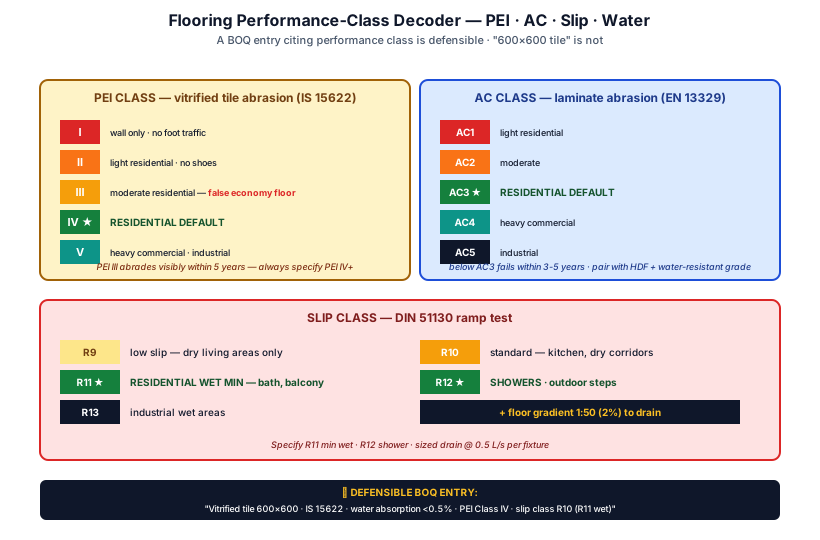
Each is measured by a published standard. For tiles: IS 15622 (vitrified) and IS 13753 (ceramic) anchor the Indian regime; DIN 51130 is the slip-class standard cited globally. The architect's BOQ entry that says "Vitrified tile, 600×600, conforming to IS 15622, water absorption <0.5%, PEI Class IV, slip class R10" is a defensible specification. "Vitrified tile, 600×600" is not.
"Specification is the point at which the architect transfers risk from imagination to industry." — Practitioner aphorism
2. Vitrified Tiles — IS 15622
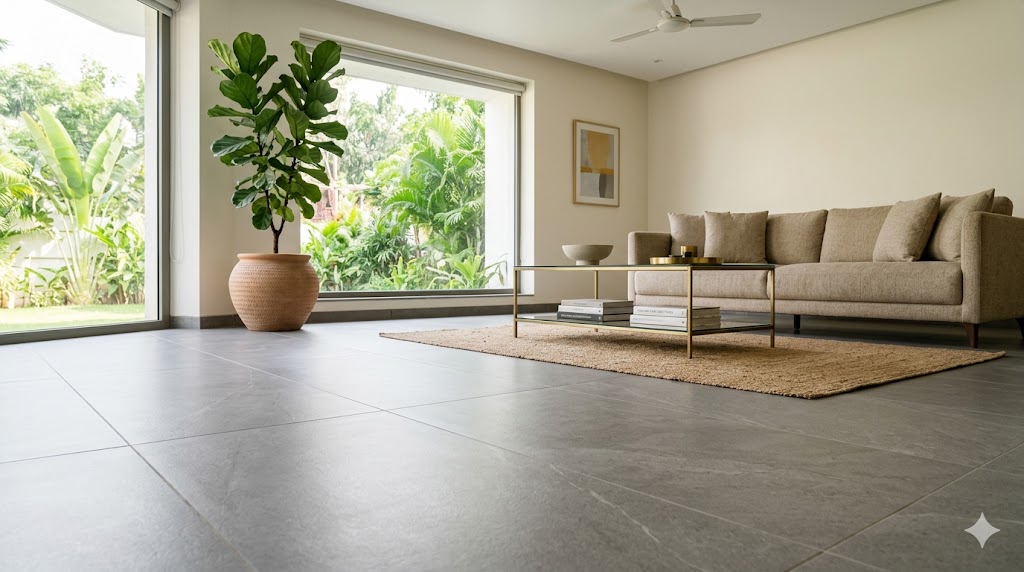
Vitrified tile is the dominant residential flooring in India today. Manufactured by pressing and firing at 1200–1400°C, it sinters to near-zero porosity and produces a hard, stain-resistant, abrasion-resistant surface.
Vitrified Tile Subtypes
| Subtype | Manufacturing | Visual Reading |
|---|---|---|
| Glazed Vitrified Tile (GVT) | Vitrified body + glazed surface print | Pattern is on glaze; visible if surface chips |
| Polished Glazed Vitrified Tile (PGVT) | GVT + polished after firing | High-gloss, photo-realistic patterns |
| Double Charge | Pattern formed by two layers of pigment, fused | Pattern penetrates 3–4mm; chips are less visible |
| Full Body / Through-Body | Pigment uniform throughout tile | No visible chip; most expensive; matches commercial spec |
| Glazed Porcelain Tile (GPT) | Porcelain body, glazed surface | Marketed similarly; thinner glaze than GVT |
Key IS 15622 Properties
| Property | IS 15622 Group BIa | What to Specify |
|---|---|---|
| Water absorption | ≤0.5% | Higher absorption = staining risk |
| Modulus of rupture | ≥35 N/mm² | Structural breaking strength |
| Surface abrasion (PEI Class) | Class IV–V for residential floor | PEI III for walls only; PEI V for high-traffic |
| Thermal shock | No damage after 10 cycles 15°C ↔ 145°C | Important for kitchen, outdoor |
| Frost resistance | If exposed | For balconies, terraces, hill-station projects |
| Crazing resistance | Pass | Glazed tiles only |
Source: Bureau of Indian Standards, IS 15622 (Pressed Ceramic Tiles), latest revision; cross-referenced with ISO 13006 / EN 14411 international tile classification.
PEI Class (Porcelain Enamel Institute, adopted in IS 15622) ranks abrasion resistance from I to V:
- PEI I — wall use only, no foot traffic
- PEI II — light residential foot traffic, no shoes
- PEI III — moderate residential traffic
- PEI IV — heavy residential, light commercial — the residential default
- PEI V — heavy commercial, industrial
For all residential floors, the architect should specify PEI IV minimum. Specifying PEI III is a false economy — the floor abrades visibly within 5 years.
3. Ceramic Wall Tiles — IS 13753
Ceramic wall tiles are softer, lower-fired, and unsuitable for floor use. Their value is in water-shedding wall surfaces in bathrooms, kitchens, and utility areas.
Key IS 13753 Properties
| Property | Ceramic Wall (IS 13753) | Vitrified Floor (IS 15622) |
|---|---|---|
| Water absorption | 10–20% | ≤0.5% |
| Body firing temperature | ~1100°C | ~1300°C |
| Surface hardness (Mohs) | 3–4 | 6–8 |
| Use | Wall only | Floor and wall |
| Cost (typical) | Lower (₹35–₹150/sqft) | Higher (₹80–₹500+/sqft) |
Source: Bureau of Indian Standards, IS 13753 (Vitreous and Semi-Vitreous Ceramic Tiles).
The architect's discipline: never specify ceramic wall tile for floor use — it cracks under foot traffic and absorbs water. And never specify vitrified floor tile for shower-wall use without considering grout-joint slip risk — the polished surface, whilst perfectly safe horizontally, is hazardous on a wet vertical wall as a handhold.
4. Natural Stone — Kota, Granite, Marble, Sandstone
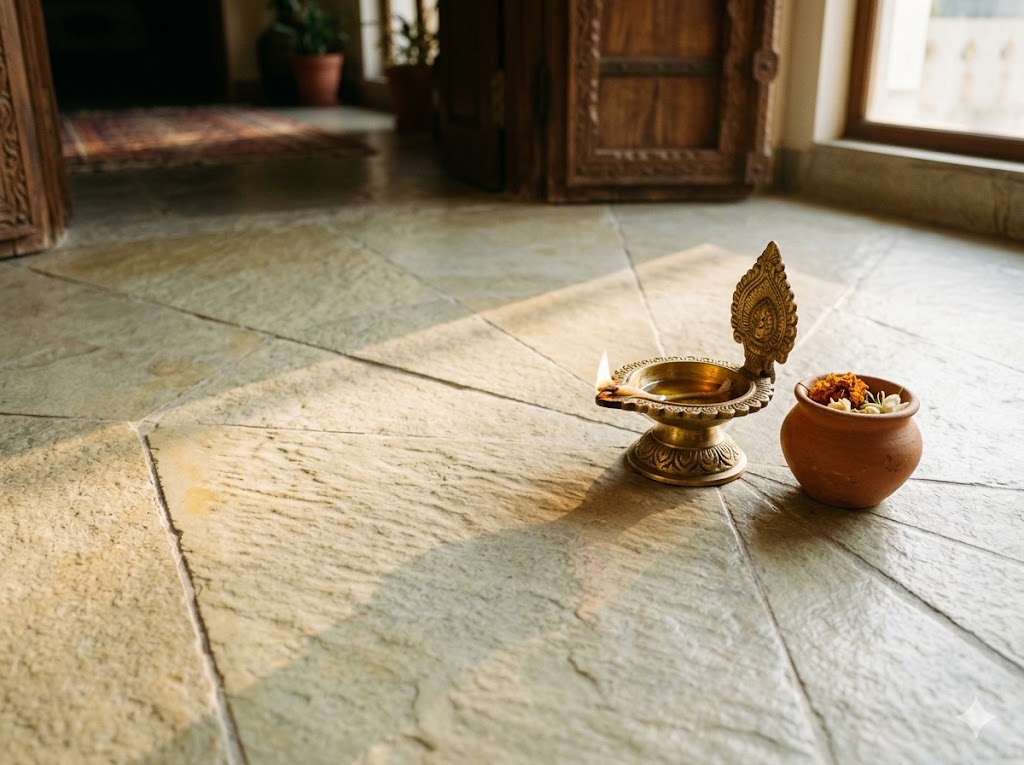
Indian residential architecture has a long tradition of natural stone flooring. Each stone has distinct performance characteristics:
Indian Residential Stone — Quick Reference
| Stone | Typical Origin | Hardness (Mohs) | Water Absorption | Slip (Honed) | Slip (Polished) | Indicative Cost (₹/sqft, supplied) |
|---|---|---|---|---|---|---|
| Kota stone | Rajasthan, Bundi/Kota | 4–5 | 1–3% | R10 | R9 | 50–120 |
| Granite | Karnataka, Tamil Nadu, AP | 6–7 | <0.5% | R10–R11 | R9 | 80–400 |
| Marble (Makrana, Indian) | Rajasthan | 3–4 | 0.4–1.5% | R10 | R9 | 90–800 |
| Marble (Italian — Statuario, Carrara) | Imported | 3–4 | 0.5–1.5% | R10 | R9 | 400–2500+ |
| Sandstone (Dholpur, Mandana) | Rajasthan, MP | 3–4 | 3–7% | R11–R12 | R10 | 60–250 |
| Slate | Andhra, Bihar, Himachal | 3–4 | 0.4–0.6% | R11 | R10 | 80–200 |
Source: Synthesised from Indian Bureau of Mines Stone Atlas (2024); cross-referenced against ASTM C97 (water absorption) and DIN 51130 (slip ratings); cost data current to 2026 wholesale-stone market.
Finish options affect performance:
- Polished — high-gloss, smooth; reduces slip resistance significantly
- Honed — matte smooth; better slip than polished, popular for residential
- Leather / brushed — textured matte; improved slip, masks scratches
- Flamed (granite only) — heat-treated rough; outdoor and wet-area-suitable
- Sandblasted — rough texture; high slip resistance
The architect's specification: honed for indoor floors, leather/brushed for high-traffic kitchen and entry, flamed/sandblasted for wet areas and outdoor. Polished is reserved for walls, accents, and dry-only premium spaces.
"Stone is the architect's truth-teller. It does not lie about its age, its cost, or its installation." — Aphorism in Indian heritage practice
5. Engineered Wood, Solid Wood, and Laminate
Wood-look flooring spans a range from solid hardwood (premium) to laminate (cost-driven). The performance differences are substantial.
Wood-Look Flooring Comparison
| Type | Construction | Hardness (Janka, lbf) | Moisture Tolerance | Lifetime | Indicative Cost (₹/sqft) |
|---|---|---|---|---|---|
| Solid Hardwood (teak, oak, walnut) | Single-piece milled wood | 1000–1820 | Low — humidity-sensitive | 50+ years (refinishable) | 350–1500 |
| Engineered Wood | 3–7 mm wear layer + plywood substrate | 1000–1500 (top layer) | Medium | 20–40 years (1–3 refinishes) | 250–800 |
| Laminate (HDF + image) | HDF substrate + photographic layer | NA — surface AC class | Low (warps if wet) | 10–20 years | 80–250 |
| Vinyl LVT / SPC / WPC (wood-look) | PVC/composite + photographic layer | NA | High | 15–25 years | 120–400 |
Source: Janka hardness from USDA Forest Products Lab data; moisture tolerance and lifetime synthesised from manufacturer datasheets and IIA practice notes.
AC Class (Abrasion Class, EN 13329) for laminate:
- AC1–AC2 — light residential
- AC3 — heavy residential / light commercial — residential default
- AC4 — heavy commercial
- AC5 — industrial
For Indian residential laminate, AC3 minimum with the appropriate substrate (HDF rather than MDF, water-resistant grade). Below AC3, the floor visibly fails within 3–5 years.
6. Vinyl Floors — LVT, SPC, WPC
Vinyl floors have moved from utility to design-forward in the last decade, driven by SPC (Stone Plastic Composite) and WPC (Wood Plastic Composite) construction that delivers near-natural-stone aesthetics with high water resistance.
| Type | Core | Thickness | Wear Layer | Water Tolerance | Best For |
|---|---|---|---|---|---|
| LVT (Luxury Vinyl Tile) | Flexible vinyl | 2–5 mm | 0.3–0.7 mm | High | Bedroom, living |
| SPC (Stone Plastic Composite) | Limestone + PVC, rigid | 4–8 mm | 0.3–0.7 mm | Very high | Whole-home, including kitchen |
| WPC (Wood Plastic Composite) | Wood flour + PVC, semi-rigid | 6–10 mm | 0.3–0.7 mm | High | Whole-home, soft underfoot |
The architect's specification: wear layer ≥0.5 mm for residential; SPC for kitchen and high-water areas; click-lock systems for floating installation (no glue needed); acoustic underlay specified separately for sound rating.
7. Microcement and Polished Concrete
Microcement (also marketed as liquid concrete, seamless cement) is a 2–3 mm cementitious topping applied over existing or new substrate, providing a continuous, joint-free finish. Polished concrete is a thicker (typically 50–75 mm) cast slab finished by mechanical polishing.
| Property | Microcement | Polished Concrete |
|---|---|---|
| Thickness | 2–3 mm | 50–75 mm |
| Substrate | Existing screed or RCC | New or existing slab |
| Joints required | Minimal — control joints only | Saw-cut at 4–6 m centres |
| Slip class | R9–R11 (depends on sealer) | R10–R12 (depends on grind) |
| Cost (₹/sqft, applied) | 350–800 | 250–600 |
| Repair | Refinish localised | Re-grind whole floor |
The architect's specification:
- Substrate must be cured (28 days minimum for fresh RCC; level for existing screed)
- Control joints every 3–6 m to allow movement
- Sealer choice (PU, epoxy, water-based) determines stain resistance and slip class
- Wet-area microcement must use a waterproofing membrane behind, not just the topping itself
8. Wet-Area Specification — Slip, Gradient, and Drain
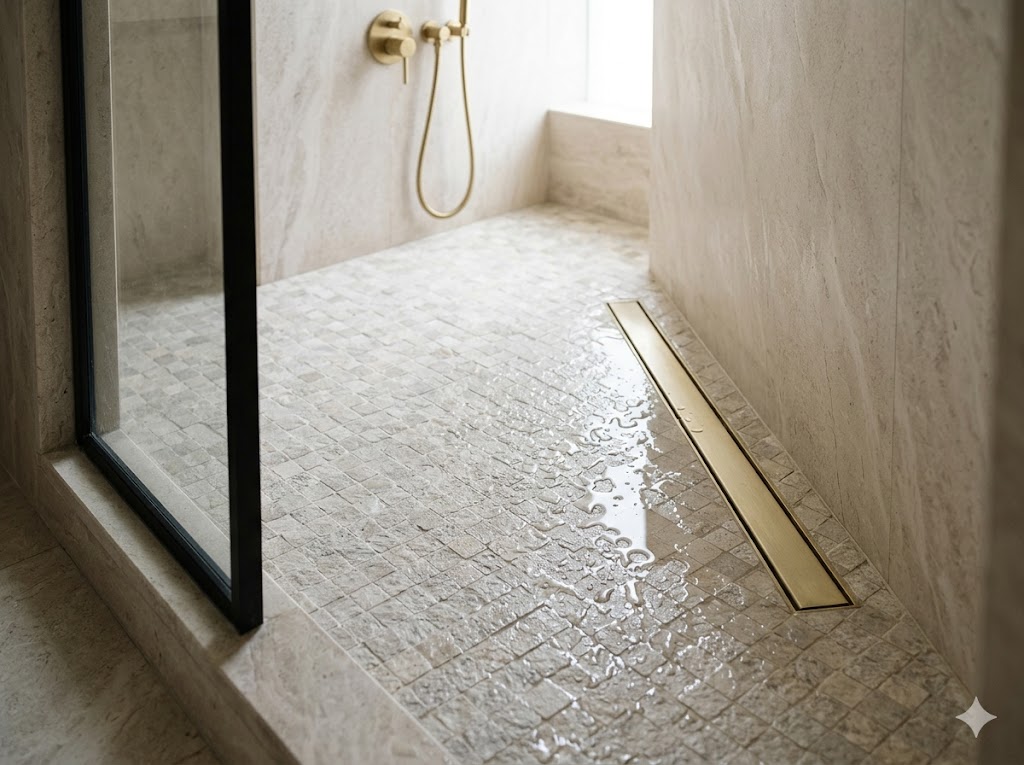
Wet areas (bathrooms, balconies, utility zones) require flooring that is safe under water, drains positively, and bonds to a waterproofing membrane below.
Slip Class for Wet Areas (DIN 51130)
| Slip Class | Description | Where to Use |
|---|---|---|
| R9 | Low slip resistance | Dry living areas only |
| R10 | Standard slip | Kitchen, dry corridors |
| R11 | Slip-resistant | Wet areas, balconies, partial-wet zones |
| R12 | Very slip-resistant | Showers, swimming-pool surrounds, outdoor steps |
| R13 | Maximum slip resistance | Industrial wet areas |
Source: DIN 51130 (German standard for slip resistance ramp test); BS 7976; equivalent provisions in IS 14264 for Indian context.
For Indian residential wet areas, R11 minimum for bathroom floors and R12 for shower areas. The floor gradient: 1:50 (2%) toward the drain, not less. The drain itself: floor trap with grating below the finish level, sized to handle 0.5 L/s flow per fixture.
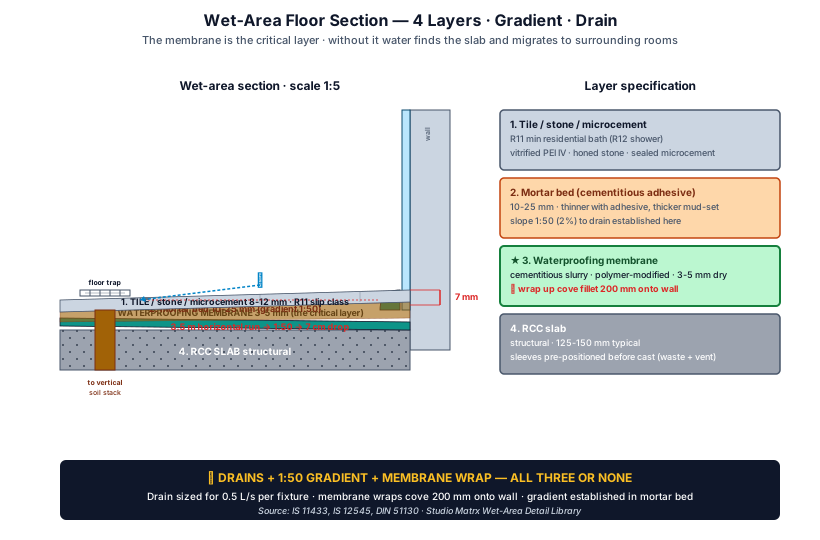
Wet-Area Section (Indicative)
The wet-area specification has four layers (top to bottom):
1. Tile / stone / microcement — finish layer, 8–12 mm typical
2. Mortar bed with cementitious adhesive — 10–25 mm; thinner with adhesive, thicker with mud-set
3. Waterproofing membrane — cementitious slurry, polymer-modified, or peel-and-stick (3–5 mm dry thickness)
4. RCC slab — structural
The membrane is the critical layer. Without it, water finds the slab and migrates to surrounding rooms. With it, the floor system is leak-tolerant for the membrane's design life (typically 15–25 years).
9. Skirting and Threshold Detailing
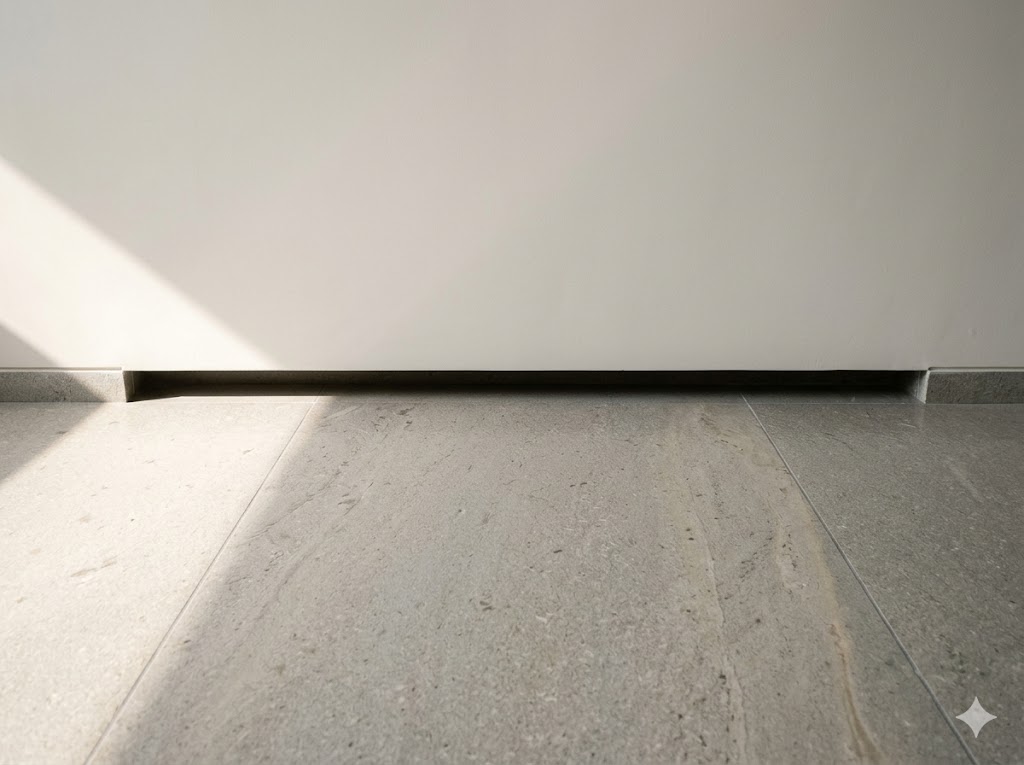
The skirting and threshold are the junctions Carlo Scarpa would have called the truth of the design. Three patterns:
Skirting Patterns
| Pattern | Detail | Where Used |
|---|---|---|
| Standard skirting | Tile or stone strip 75–100 mm tall, applied to wall above floor | Default residential, low-cost |
| Flush skirting | Skirting level with wall plaster — no projection | Premium, modernist |
| Recessed skirting | Skirting set back into wall behind plaster line — wall projects past skirting | High-design; complex detail |
| Shadow gap | Skirting omitted entirely; a 8–12 mm reveal between wall and floor | Most contemporary; strict construction tolerance required |
Threshold Patterns
| Pattern | Detail | Where Used |
|---|---|---|
| Stepped threshold | Vertical stone or tile riser at door | Wet-to-dry transition (bathroom door) |
| Flush threshold | Same level both sides | Living-to-bedroom; living-to-balcony with concealed drain |
| Reveal threshold | Continuous bronze or aluminium strip set in floor | Premium, accommodates expansion movement |
The architect's drawing — wet area section detail at 1:20 — must show every layer of the wet-area specification, the threshold transition, and the skirting condition. Without it, the contractor improvises and the result is the most common Indian residential complaint: water in the bedroom from the bathroom.
10. Lifecycle Cost Framework
The headline price of flooring is misleading. The architect's professional position to the client should be lifecycle cost: capital cost + replacement cost + maintenance cost over a defined horizon.
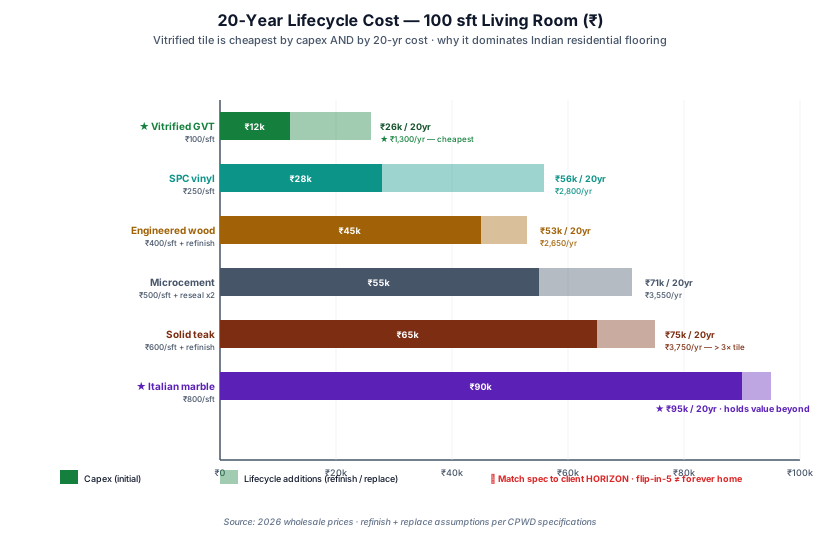
20-Year Lifecycle — 100 sqft Living Room
| Spec | Capex (₹) | Refinish / Replace Schedule | 20-Yr Total (₹) | Cost per Year (₹) |
|---|---|---|---|---|
| Vitrified GVT (₹100/sqft) | 12,000 | Replace at year 15 | 26,000 | 1,300 |
| Solid teak (₹600/sqft) | 65,000 | Refinish year 10 | 75,000 | 3,750 |
| Engineered wood (₹400/sqft) | 45,000 | Refinish year 12 | 53,000 | 2,650 |
| SPC vinyl (₹250/sqft) | 28,000 | Replace at year 18 | 56,000 | 2,800 |
| Honed Italian marble (₹800/sqft) | 90,000 | None — 20+ yr life | 95,000 | 4,750 |
| Microcement (₹500/sqft applied) | 55,000 | Reseal year 8, year 16 | 71,000 | 3,550 |
Indicative figures including fitting cost and maintenance assumptions; updated to 2026 prices.
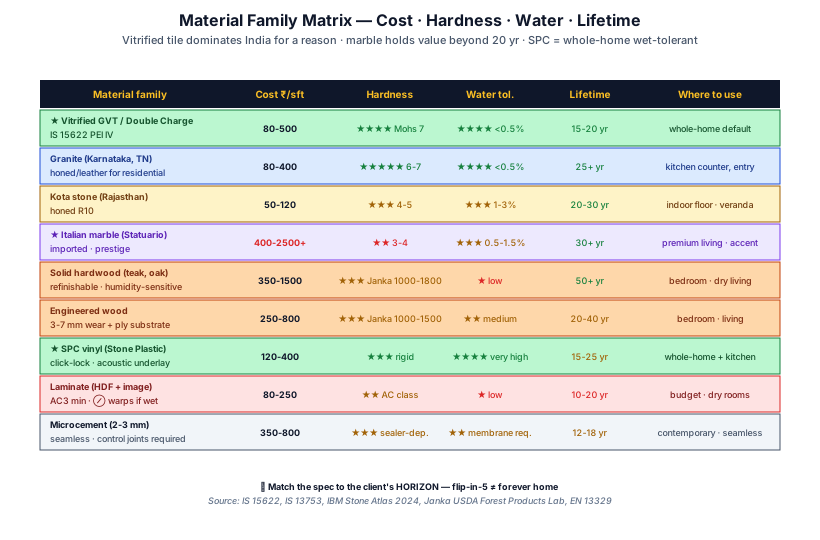
The vitrified tile is the cheapest by capex and by 20-year cost — which is why it dominates Indian residential flooring. The solid teak is more than 3× as expensive over 20 years. The marble is the most expensive but holds value beyond 20 years (and may be refurbished rather than replaced). The architect's recommendation should match the client's intended horizon — a flip-in-5-years investment property is not the same brief as a forever home.
11. The Architect's Closing Note
Flooring specification is the architect's most teachable design discipline. The codes are well-defined, the performance metrics are measurable, the cost-per-year math is straightforward, and the client conversation is one of the highest-leverage moments in the engagement. A 30-minute conversation about flooring tradeoffs at Stage 2, supported by a comparison table, prevents the year-5 regret that quietly damages architects' reputations.
The professional position: specify by performance-class first (PEI, AC, slip class, water absorption), then by aesthetic family (vitrified, stone, wood, vinyl, microcement), then by specific product. The BOQ entry should reference IS code, performance class, and finish. The detailed drawings should show skirting, threshold, and wet-area conditions at 1:20. The lifecycle cost table should be in every Stage 2 presentation.
Cross-References Within Studio Matrx
- Top Wardrobe Finish Ideas — the vertical-finish counterpart to floor specification
- Construction Material Quality Standards — broader IS-code reference for all materials
- Building Construction Quality Assessment — quality-on-site checks for finish layers
- Waterproofing Guide for Indian Homes — wet-area membrane systems that sit below flooring
- Working Drawings & Documentation — wet-area sections and threshold details
- Use the Material Comparison Tool to compare flooring options at price + performance level
- Use the Material Quality Checklist to verify on-site delivery against spec
References
1. Bureau of Indian Standards (2017) IS 15622 — Pressed Ceramic Tiles. New Delhi: BIS.
2. Bureau of Indian Standards (2009, with amendments) IS 13753 — Vitreous and Semi-Vitreous Ceramic Tiles. New Delhi: BIS.
3. Bureau of Indian Standards (2018) IS 1124 — Method of Test for Determination of Water Absorption, Apparent Specific Gravity, and Porosity of Natural Building Stones. New Delhi: BIS.
4. Bureau of Indian Standards (2014) IS 14264 — Coefficient of Friction Test Method for Floor Surfaces. New Delhi: BIS.
5. Deutsches Institut für Normung (2014) DIN 51130 — Testing of Floor Coverings — Determination of Anti-Slip Property. Berlin: DIN.
6. International Organization for Standardization (2018) ISO 13006 — Ceramic Tiles — Definitions, Classification, Characteristics, and Marking. Geneva: ISO.
7. European Committee for Standardization (2014) EN 13329 — Laminate Floor Coverings — Specifications, Requirements, and Test Methods. Brussels: CEN.
8. American Society for Testing and Materials (2018) ASTM C97 — Standard Test Methods for Absorption and Bulk Specific Gravity of Dimension Stone. West Conshohocken: ASTM.
9. Indian Bureau of Mines (2024) Stone Atlas of India — A Mineralogical and Commercial Reference. Nagpur: IBM.
10. Bureau of Indian Standards (2016) National Building Code of India 2016, Part 6 §2 (Flooring, Walls, and Roofing). New Delhi: BIS.
11. United States Department of Agriculture, Forest Products Laboratory (2010) Wood Handbook — Wood as an Engineering Material. Madison, WI: USDA FPL.
12. Bureau of Indian Standards (2017) IS 1237 — Cement Concrete Flooring Tiles. New Delhi: BIS.
Author's Note: Flooring is the architect's contract with time. The vitrified tile, the engineered wood, the microcement — each makes a different promise about how the building will look at year 1, year 10, year 20. The architect who frames the choice in those terms helps the client choose well; the architect who frames it as "modern" vs "traditional" sells decoration. This guide is intended to support the former conversation.
Disclaimer: This article is for informational and educational purposes only. It does not constitute professional materials-engineering advice. Performance values, IS-code references, and cost figures cited are indicative of 2026 Indian practice but vary by manufacturer, supplier, and region. Architects must verify against current IS standards, manufacturer datasheets, and lab test reports before final BOQ specification. Studio Matrx, its authors, and contributors accept no liability for decisions based on this guide.
Interactive · Flooring finish comparator
Vitrified tile vs Marble (Indian)
Vitrified tile
₹110/sqft₹60-180/sqft (incl. lay)
Best for
- • Living, dining, bedrooms
- • Most apartments
- • Anti-skid variants for bathroom
Watch: Pick R10+ slip rating for wet zones; matt finish for living areas.
Marble (Indian)
₹380/sqft₹200-650/sqft (incl. lay + polish)
Best for
- • Luxury living rooms
- • Foyer
- • Statement walls
Watch: Stains from turmeric, oil, lemon. Re-polish every 5-7 yrs. Avoid Italian in kitchens.
Export this guide
Related Guides — Deep-dive reading
Anti Slip Flooring for Bathroom and Wet Areas in India: R-Ratings, Finishes and Genuinely Safe Tile Choices
How to choose genuinely safe flooring for bathrooms, kitchens, balconies, pools, entrances and elderly- or child-friendly homes — the R-rating system, finishes that grip wet feet, anti-skid natural stone, slope to drains and the tiles to avoid.
Flooring & SurfacesFlooring Standards in India: The Complete Code & IS Map (2026)
Every IS, NBC, BIS and slip code that decides whether your floor is safe, durable and legal — explained for homeowners and architects.
Flooring & SurfacesBathroom Flooring Guide India: Anti-Skid Tiles, Stone, Vinyl & Epoxy Compared
Every bathroom floor material for Indian homes in one place — anti-skid ceramic and vitrified tiles, natural stone, mosaic, vinyl (SPC/LVT) and epoxy — with a full comparison table, slip ratings, ₹/sq ft costs and the safety and slope rules that keep a wet floor from becoming a hazard.
BathroomsRelated Tools — Try Free
Door Material Comparison Tool
Compare 2–4 door materials on cost, durability, maintenance, security and moisture resistance.
Comparison ToolFull-Room BOQ — Living, Bedroom, Kitchen, Bath
Room-wise BOQ across living, bedrooms, kitchen, utility, and bathrooms with line-item pricing.
Full-Room BOQApartment Furniture Size Chart
Standard furniture dimensions for Indian apartments — sofas, beds, tables, dining, storage.
Reference Chart