
Working Drawings & Documentation
From Concept to Construction Drawings — A Complete Guide for Indian Residential Architecture
Architecture begins as an idea — a spatial intuition, a response to site and climate, a vision of how people will live within walls and under roofs. But between the idea and the built reality lies a critical act of translation: the preparation of drawings and documentation that transform design intent into construction instruction. This translation is not a clerical afterthought. It is where architecture either succeeds or fails.
In India, where construction is carried out by a vast and heterogeneous workforce — from highly skilled engineers to semi-skilled masons working from experience rather than drawings — the quality of documentation is not merely a professional standard. It is the primary mechanism by which design integrity is preserved through the chaos and complexity of a construction site. A beautifully conceived home, inadequately documented, will be built wrong. An adequately conceived home, superbly documented, will be built right. The drawings are the contract between imagination and execution.
"I prefer drawing to talking. Drawing is faster, and leaves less room for lies." — Le Corbusier (1887–1965), architect and urbanist
This guide traces the complete documentation journey of an Indian residential project — from the first concept sketch to the final as-built drawing — and provides architects, engineers, and informed homeowners with a practical understanding of what each drawing type contains, why it matters, and how it connects to the IS codes, municipal approvals, and professional obligations that govern Indian architectural practice.
1. The Phases of Architectural Documentation
The Council of Architecture (CoA), constituted under the Architects Act, 1972, divides architectural services into seven phases, each with specific documentation outputs. This framework — closely aligned with international standards such as the RIBA Plan of Work (UK) and AIA phases (USA) — provides the structure for understanding what is drawn, when, and why (Council of Architecture, 2020).
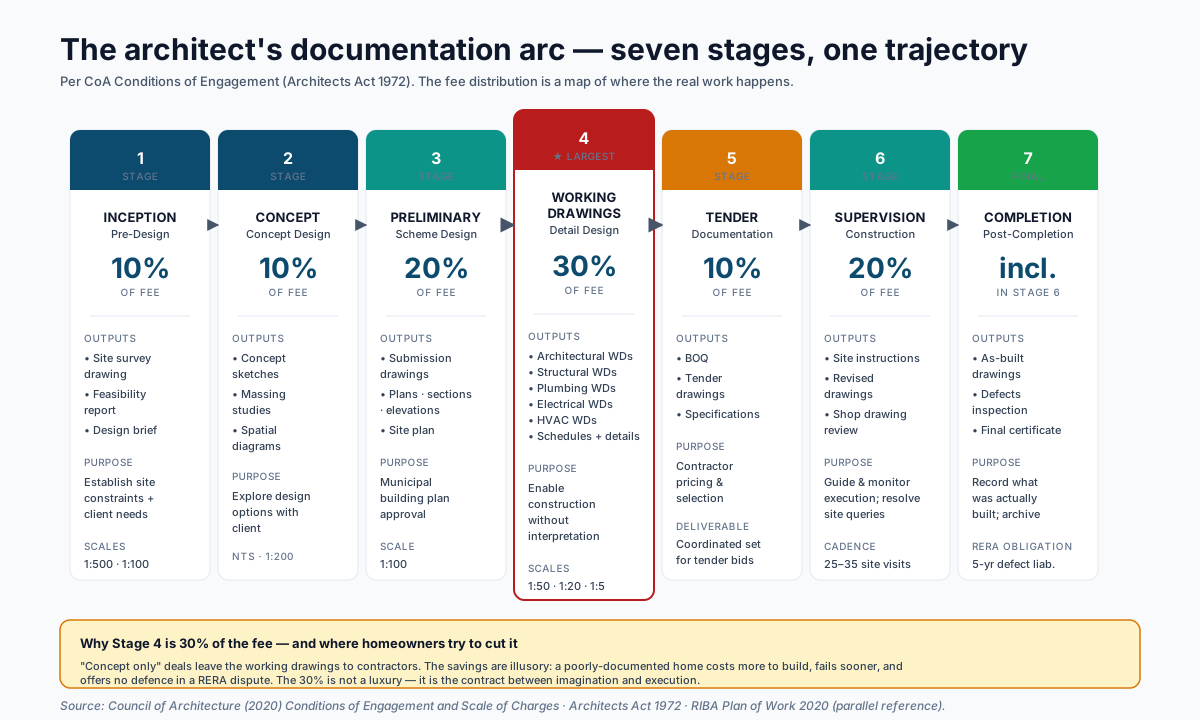
Documentation Phases and Outputs
| Phase | CoA Stage | Documentation Output | Purpose | Typical % of Architect's Fee |
|---|---|---|---|---|
| Pre-Design | Stage 1: Inception | Site survey drawing, feasibility report, design brief | Establish constraints and requirements | 10% |
| Concept Design | Stage 2: Concept | Concept sketches, massing studies, spatial diagrams | Explore and present design options to client | 10% |
| Scheme Design | Stage 3: Preliminary | Submission drawings (plans, elevations, sections, site plan) | Obtain municipal/local body approval | 20% |
| Detail Design | Stage 4: Working Drawings | Complete architectural, structural, and MEP working drawings | Enable construction | 30% |
| Tender Documentation | Stage 5: Tender | BOQ, tender drawings, specifications | Enable contractor pricing and selection | 10% |
| Construction | Stage 6: Supervision | Site instructions, revised drawings, shop drawing review | Guide and monitor execution | 20% |
| Post-Completion | Stage 7: Completion | As-built drawings, defects inspection, final certificate | Record what was actually built | Included above |
Source: Council of Architecture (2020) Conditions of Engagement and Scale of Charges. New Delhi: CoA.
CoA Recommended Fee Structure
| Construction Cost | Recommended Architectural Fee |
|---|---|
| Up to Rs. 50 lakhs | ~12% of construction cost |
| Rs. 50 lakhs to Rs. 2 crores | ~10% |
| Rs. 2 crores to Rs. 10 crores | ~8% |
| Above Rs. 10 crores | ~6–8% (negotiable) |
Source: CoA Conditions of Engagement. Structural and MEP engineering fees (typically 3–5% of construction cost) are separate from architectural fees. Interior design is charged separately at 8–15% of interior work cost.
The fee structure reflects a fundamental truth: documentation — particularly working drawings at Stage 4 — consumes the largest share of professional effort (30% of the fee). It is also, not coincidentally, the phase where most cost-cutting occurs. Homeowners who insist on 'concept only' services, leaving documentation to contractors, are making a false economy. The working drawings are not a luxury; they are the product.
2. Drawing Types in a Residential Project
A complete residential project generates between 15 and 50 sheets of drawings across multiple disciplines. Each drawing type serves a distinct purpose, is prepared at a specific scale, and enters the project at a defined phase.
Complete Drawing Set — From Survey to As-Built
| # | Drawing Type | Purpose | Typical Scale | Prepared By | Project Phase |
|---|---|---|---|---|---|
| 1 | Site Survey Drawing | Record existing site conditions — topography, boundaries, trees, services | 1:100 to 1:500 | Surveyor / Architect | Pre-Design |
| 2 | Concept Sketches | Explore massing, spatial relationships, orientation, circulation | NTS or 1:200 | Architect | Concept |
| 3 | Schematic Design Drawings | Present design intent to client; establish spatial layout | 1:100 to 1:200 | Architect | Scheme Design |
| 4 | Submission / Approval Drawings | Obtain municipal building plan sanction | 1:100 | Architect | Scheme Design |
| 5 | Design Development Drawings | Refine approved design with furniture, materials, finishes | 1:50 to 1:100 | Architect | Detail Design |
| 6 | Architectural Working Drawings | Full construction instruction — dimensions, levels, details, schedules | 1:50 (plans); 1:20 to 1:5 (details) | Architect | Working Drawings |
| 7 | Structural Drawings | Foundation, column, beam, slab reinforcement and details | 1:50 (layouts); 1:20 to 1:5 (details) | Structural Engineer | Working Drawings |
| 8 | Plumbing & Sanitary Drawings | Water supply lines, drainage, manholes, fixture locations, risers | 1:50 to 1:100 | MEP Engineer | Working Drawings |
| 9 | Electrical Drawings | Power, lighting, DB schedule, wiring, earthing, load calculations | 1:50 to 1:100 | Electrical Engineer | Working Drawings |
| 10 | HVAC Drawings | Duct layout, equipment, refrigerant piping, diffuser locations | 1:50 to 1:100 | HVAC Consultant | Working Drawings |
| 11 | Landscape Drawings | Planting plan, hardscape, irrigation, levels, grading | 1:50 to 1:200 | Landscape Architect | Working Drawings |
| 12 | Interior Design Drawings | Furniture layout, false ceiling, flooring, joinery details, wall elevations | 1:20 to 1:50 (layouts); 1:1 to 1:10 (details) | Interior Designer | Working Drawings |
| 13 | Tender Drawings | Complete coordinated set issued for contractor pricing | 1:50 to 1:100 | Architect | Tender |
| 14 | Shop Drawings | Fabrication-level details — joinery, metalwork, stone cladding | 1:1 to 1:10 | Contractor / Fabricator | Construction |
| 15 | As-Built Drawings | Record of what was actually constructed, with deviations noted | Same as working drawings | Contractor / Architect | Post-Completion |
"The architect should be equipped with knowledge of many branches of study and varied kinds of learning... He must have knowledge of drawing so that he can readily make sketches to show the appearance of the work which he proposes." — Vitruvius, De Architectura, Book I, Chapter 1 (c. 80–15 BC)
3. Standard Scales, Sheet Sizes, and Conventions
Standard Architectural Scales (per IS 962:1989 / SP 46:2003)
IS 962:1989 (Bureau of Indian Standards, 1989) — the primary Indian standard governing architectural drawing practice — specifies the scales to be used for different drawing types. The fundamental principle: the selected scale must be large enough to show clearly all the information needed for that particular drawing.
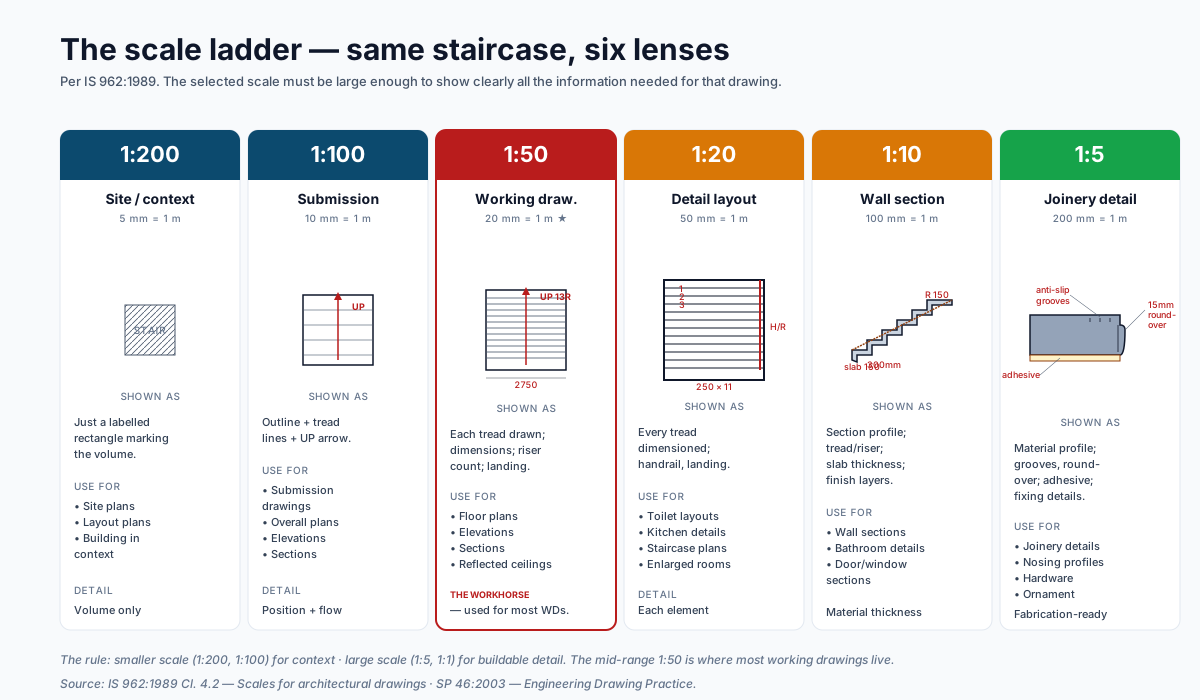
| Scale | Ratio | Use in Residential Projects |
|---|---|---|
| 1:1 | Full size | Moulding profiles, joinery edge details, hardware templates |
| 1:2 | Half size | Complex joinery details, ornamental elements |
| 1:5 | 200 mm = 1 m | Door/window sections, railing details, staircase nosing profiles |
| 1:10 | 100 mm = 1 m | Door/window elevations, wall sections, bathroom details |
| 1:20 | 50 mm = 1 m | Toilet layouts, kitchen details, staircase plans and sections, enlarged room plans |
| 1:50 | 20 mm = 1 m | Floor plans, elevations, sections, RCPs — the workhorse scale for working drawings |
| 1:100 | 10 mm = 1 m | Submission/approval drawings, overall elevations and sections |
| 1:200 | 5 mm = 1 m | Site plans, schematic building plans, building in context |
| 1:500 | 2 mm = 1 m | Site plans, layout plans, location plans |
| 1:1000 | 1 mm = 1 m | Key plans, location plans, master plans |
Source: IS 962:1989, Clause 4.2. Mixing scales on a single sheet is discouraged unless each drawing is clearly annotated with its individual scale.
Drawing Sheet Sizes (per IS 10711:2001 / SP 46:2003)
| Designation | Dimensions (mm) | Common Use in Residential Projects |
|---|---|---|
| A0 | 841 x 1189 | Large site plans, floor plans of multi-storey buildings, structural layouts |
| A1 | 594 x 841 | Most common for architectural working drawings — floor plans, elevations, sections |
| A2 | 420 x 594 | Detail drawings, smaller residential plans, enlarged details |
| A3 | 297 x 420 | Detail drawings, schedules, reduced-size prints for site reference |
| A4 | 210 x 297 | Specifications, reports, covering letters, small detail sketches |
Source: IS 10711:2001, adopting ISO 216 A-series. Title block at bottom-right corner per SP 46:2003; sheets larger than A4 folded to A4 size with title block visible (IS 11664).
Line Types and Conventions (per IS 962:1989 / SP 46:2003)
The language of architectural drawing is built from lines. Each line type carries specific meaning, and using them incorrectly is as misleading as using wrong words in a sentence.
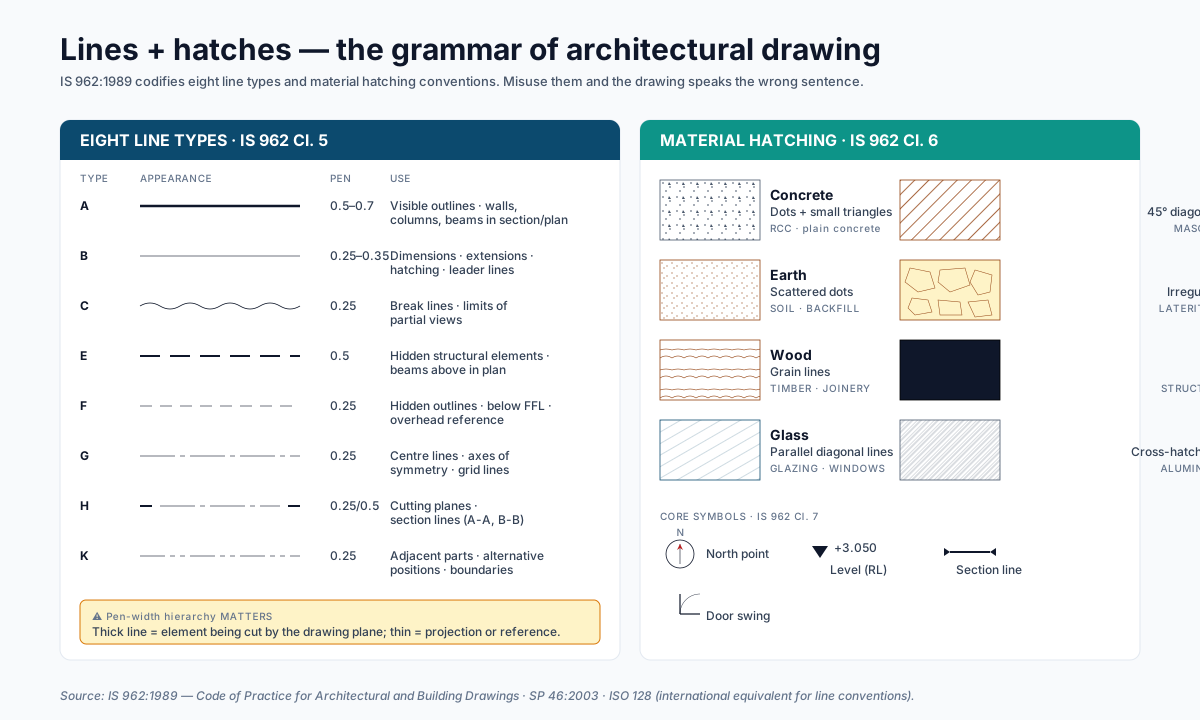
| Line Type | Appearance | Pen Width | Use in Architectural Drawings |
|---|---|---|---|
| Continuous thick (Type A) | Solid heavy line | 0.5–0.7 mm | Visible outlines of cut elements — walls, columns, beams in plan/section |
| Continuous thin (Type B) | Solid light line | 0.25–0.35 mm | Dimension lines, extension lines, hatching, leader lines, elements beyond cut plane |
| Continuous thin irregular (Type C) | Wavy line | 0.25 mm | Break lines; limits of partial views |
| Dashed thick (Type E) | Heavy dashed line | 0.5 mm | Hidden structural elements — beams above in plan |
| Dashed thin (Type F) | Light dashed line | 0.25 mm | Hidden outlines, edges below floor level, overhead elements shown for reference |
| Chain thin (Type G) | Long-short-long | 0.25 mm | Centre lines, axes of symmetry, grid lines |
| Chain thin, thick at ends (Type H) | Long-short with thick ends | 0.25/0.5 mm | Cutting planes — section lines |
| Chain thin double-dash (Type K) | Long-dot-dot-long | 0.25 mm | Adjacent parts, alternative positions, boundaries |
Source: IS 962:1989, Clause 5 and SP 46:2003, Section 3.
Essential Drawing Symbols (per IS 962:1989)
| Symbol | Convention |
|---|---|
| North Point | Arrow indicating true north — mandatory on all plans and site plans |
| Section Mark | Thick line with arrows showing direction of view; labelled A-A, B-B, etc. |
| Level / RL Mark | Triangle with level value (e.g., +0.000, +3.050); filled = finished floor level; open = structural level |
| Door Symbol | Arc showing direction of swing + line for leaf; double leaf = two arcs; sliding = parallel lines with arrow |
| Window Symbol | In plan: three parallel lines (outer wall lines + glazing line); in elevation: cross or grid for glazed area |
| Staircase | Arrow showing direction of ascent marked 'UP'; break line at cut level; treads numbered |
| Slope / Ramp | Arrow showing direction of slope with gradient (e.g., 1:12) |
| Dimension Termination | 45-degree oblique tick marks at ends of dimension lines — per IS convention (arrowheads are international practice, increasingly used in India) |
| Material Hatching | Concrete: dots/triangles; Brick: diagonal hatching; Earth: scattered dots; Stone: irregular polygons; Wood: grain lines; Steel: solid black |
Source: IS 962:1989, Clauses 6–8. Sanitary fixture symbols, electrical symbols (per IS 11353), and structural symbols have their own dedicated standards.
"Drawing is the discipline by which I constantly rediscover the world." — Francis D.K. Ching, Architectural Graphics (Ching, 2014)
4. The Anatomy of a Working Drawing Set
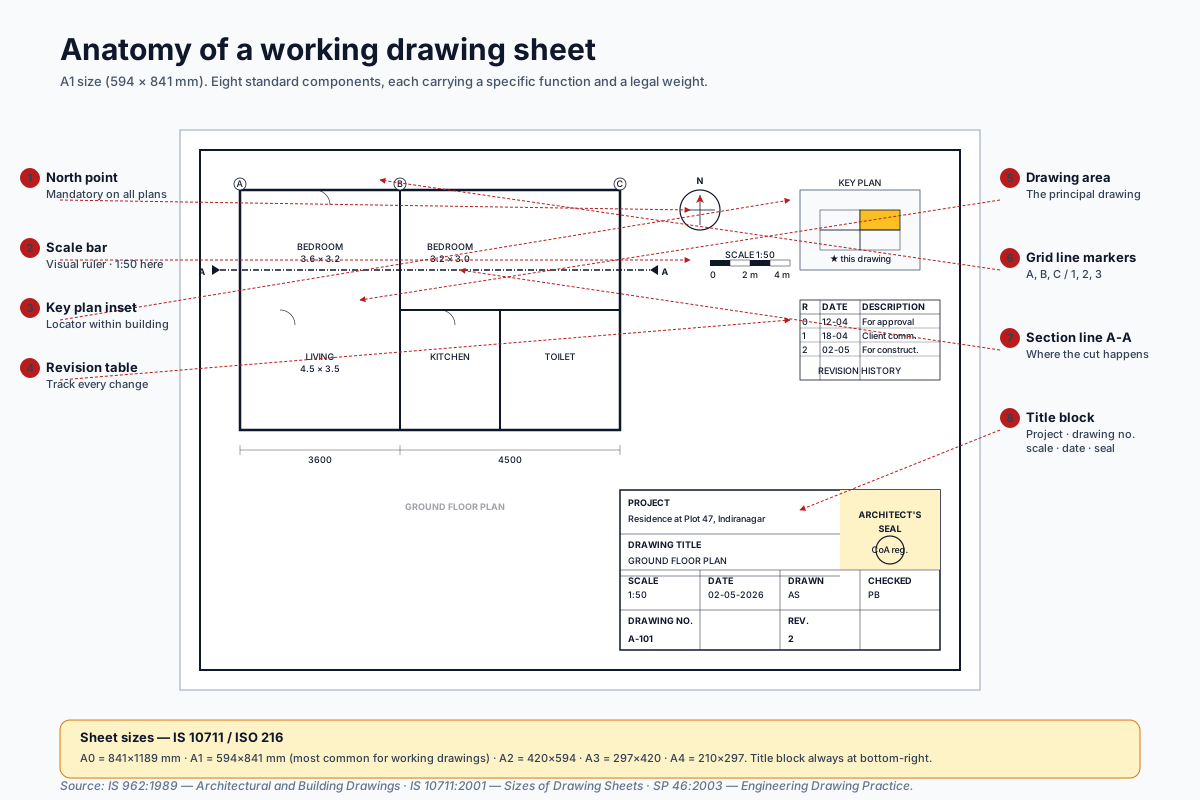
Working drawings — Stage 4 in the CoA framework — are the definitive construction documents. They must contain every piece of information a competent contractor needs to build the structure exactly as designed, without requiring further design interpretation. IS 962:1989 is explicit: drawings must not require the contractor to scale off dimensions. Every dimension necessary for construction must be stated (Bureau of Indian Standards, 1989).

4.1 Architectural Working Drawings
A complete architectural working drawing set for a typical G+2 residential home includes:
Floor Plans (1:50)
- All rooms dimensioned — overall, wall-to-wall, and opening positions
- Wall thicknesses indicated (230 mm, 115 mm)
- Door and window positions with reference tags (D1, D2, W1, W2, etc.)
- Finished floor levels (+0.000 at plinth; +3.200 at first floor, etc.)
- Staircase with numbered risers, direction arrow
- Grid lines with column reference numbers/letters
- North point on every plan sheet
Reflected Ceiling Plans (1:50)
- False ceiling layout with levels
- Light point locations
- Fan point locations
- AC vent locations
- Ceiling material and finish annotations
Elevations — All Four Sides (1:50 or 1:100)
- Plinth level, floor levels, parapet level, ridge level
- Material and finish annotations
- Window and door types visible
- Chajja (sun shade) projections
- External cladding or plaster finish zones
Sections — Minimum Two (1:50)
- One through the staircase (mandatory)
- One cross-section through the building
- Foundation depth, plinth height, floor-to-floor heights
- Slab thicknesses, beam depths, lintel heights
- Parapet height, terrace waterproofing layers
Wall Sections / Detail Sections (1:10 or 1:20)
- Full build-up from foundation to parapet
- DPC position, plinth protection
- Waterproofing layers (terrace, bathroom)
- Chajja/sunshade connection detail
- Parapet coping detail
Door and Window Schedule
- Type reference (D1, D2, W1, etc.)
- Size (width x height)
- Sill height (for windows)
- Material (teak, sal, aluminium, uPVC)
- Hardware specification (hinges, locks, handles)
- Glazing type and thickness
- Quantity and location
Toilet and Kitchen Details (1:20)
- Fixture positions with dimensions
- Plumbing connection points
- Waterproofing extent
- Tile layout if specified
- Counter/platform height and depth
Staircase Detail (1:20)
- Plan and section
- Riser height and tread width
- Handrail height and detail
- Landing dimensions
- Headroom clearance (minimum 2.1 m per NBC 2016)
4.2 Structural Working Drawings
Prepared by the structural engineer in coordination with the architect:
- Foundation plan: Footing sizes, depths, column positions, plinth beam layout
- Column schedule: Column sizes, reinforcement details for each floor
- Beam layout and schedule: Beam sizes, span, reinforcement — main bars and stirrups
- Slab reinforcement drawings: Bar diameter, spacing, direction (each slab individually)
- Staircase structural detail: Waist slab thickness, reinforcement, landing details
- Lintel and chajja details: Span, depth, reinforcement
4.3 MEP Working Drawings
- Plumbing: Water supply layout (hot and cold lines), drainage layout (soil and waste), manhole positions, pipe sizes, fixture connections, riser diagrams
- Electrical: Lighting layout, power layout (socket positions), DB schedule, wiring diagram, earthing plan, load calculation sheet
- HVAC (if applicable): Split AC / VRF piping layout, drain line routing, outdoor unit positions
"A great building must begin with the unmeasurable, must go through measurable means when it is being designed, and in the end must be unmeasurable." — Louis Kahn (1901–1974), architect (Twombly, 2003)
5. Municipal Building Plan Approval — The Documentation Checklist
In India, no construction can legally commence without sanctioned building plans from the local municipal body (Municipal Corporation, Nagar Palika, or Panchayat, depending on jurisdiction). The documentation requirements are governed by the National Building Code 2016 (Part 3) and state-specific Development Control Regulations (DCR).
Building Plan Approval — Required Documents
| # | Document / Drawing | Details Required |
|---|---|---|
| 1 | Application form | Prescribed format of local authority |
| 2 | Property ownership documents | Sale deed, property tax receipts, encumbrance certificate |
| 3 | Site / key plan | Scale 1:500 or 1:1000; showing plot in relation to nearest road and landmark; north point |
| 4 | Site plan / layout plan | Scale 1:100 or 1:200; plot boundaries with dimensions, setbacks, access road, parking, existing trees, levels |
| 5 | Building plans — all floors | Scale 1:100; ground floor, typical floors, terrace plan; with dimensions, room names, area of each room |
| 6 | Elevations — all sides | Scale 1:100; front, rear, and side elevations; showing building height, plinth level, floor levels |
| 7 | Sections — minimum two | Scale 1:100; through staircase; showing foundation depth, floor-to-floor heights, parapet |
| 8 | Area statement | Carpet area, built-up area, super built-up area; FAR calculation; ground coverage calculation |
| 9 | Specifications | Materials for foundation, superstructure, roofing, flooring, doors, windows |
| 10 | Structural design certificate | From licensed structural engineer; certifying structural adequacy |
| 11 | Structural drawings | Foundation plan, column/beam layout, slab design (for buildings above G+1 in most jurisdictions) |
| 12 | Soil investigation report | Required for buildings above height thresholds (varies by city — typically > G+2) |
| 13 | Drainage / sewage plan | Internal and external drainage layout; connection to municipal sewer or septic system |
| 14 | Water supply plan | Internal water distribution; overhead/underground tank positions |
| 15 | Rainwater harvesting plan | As per state/local mandate; showing collection, filtration, and recharge system |
| 16 | NOCs as applicable | Fire department (buildings > 15 m height), AAI (near airports), environmental clearance, heritage committee |
| 17 | Supervision undertaking | Architect/engineer undertaking to supervise construction as per sanctioned plan |
| 18 | Parking plan | Ground floor / stilt / basement plan showing parking slots as per DCR norms |
| 19 | Tree survey / permission | Tree preservation order or cutting permission from local authority |
| 20 | RERA registration | For projects above threshold as per state RERA rules |
Source: Compiled from NBC 2016, Part 3 — Development Control Rules and General Building Requirements (Bureau of Indian Standards, 2016).
The submission drawings serve as both a regulatory document and a legal instrument. Under the Real Estate (Regulation and Development) Act, 2016, promoters must upload sanctioned plans on the RERA authority website, and any deviation from sanctioned plans must be re-sanctioned and updated. Construction deviating from sanctioned plans is unauthorised and can attract penalties, demolition orders, or regularisation charges (Government of India, 2016).
6. Common Documentation Errors and How to Avoid Them
The following errors recur with depressing regularity in Indian residential documentation. Each can be avoided through systematic checking and professional rigour.
| # | Error | Consequence | Prevention |
|---|---|---|---|
| 1 | Incomplete dimensioning | Contractor scales off drawings (prohibited by IS 962); errors accumulate | Dimension every element; use cumulative (running) dimensions for long runs |
| 2 | Plan-section inconsistency | Floor levels, ceiling heights, or wall positions do not match across drawings | Cross-check every plan against its section before issue |
| 3 | Missing structural coordination | Beam positions conflict with door/window openings; columns appear in room centres | Overlay architectural and structural drawings at every stage; resolve conflicts before issue |
| 4 | Inadequate MEP integration | Plumbing risers clash with structural members; electrical conduits conflict with beams | Coordinate all disciplines on a single overlay; BIM resolves this systematically |
| 5 | Vague specifications | "Good quality marble" instead of specific type, size, thickness, finish, source | Use unambiguous specifications with material name, IS code, grade, size, and finish |
| 6 | Missing critical details | No waterproofing detail for terrace/bathroom; no expansion joint detail | Maintain a detail checklist; verify every junction, transition, and wet area has a detail |
| 7 | Non-compliance with DCR | Setbacks, FAR, or parking not matching local development control rules | Verify DCR requirements before starting; cross-check against approved plan |
| 8 | Poor revision control | Multiple versions circulating on site without clear revision marking | Number every revision; date every sheet; maintain a drawing register; supersede old prints |
| 9 | Ignoring site survey | Working drawings prepared without accounting for actual site levels and conditions | Anchor all drawings to surveyed benchmarks; verify levels on site before detailing |
| 10 | Incomplete door/window schedule | Missing hardware specs, frame details, glazing type, or sill heights | Use a standardised schedule template; review against every opening shown on plan |
"One of the great beauties of architecture is that each time, it is like life starting all over again. Drawing is an exploration, a discovery." — Renzo Piano, Italian architect, Pritzker Prize laureate
7. Digital Documentation: CAD and BIM in Indian Practice
The Current Landscape
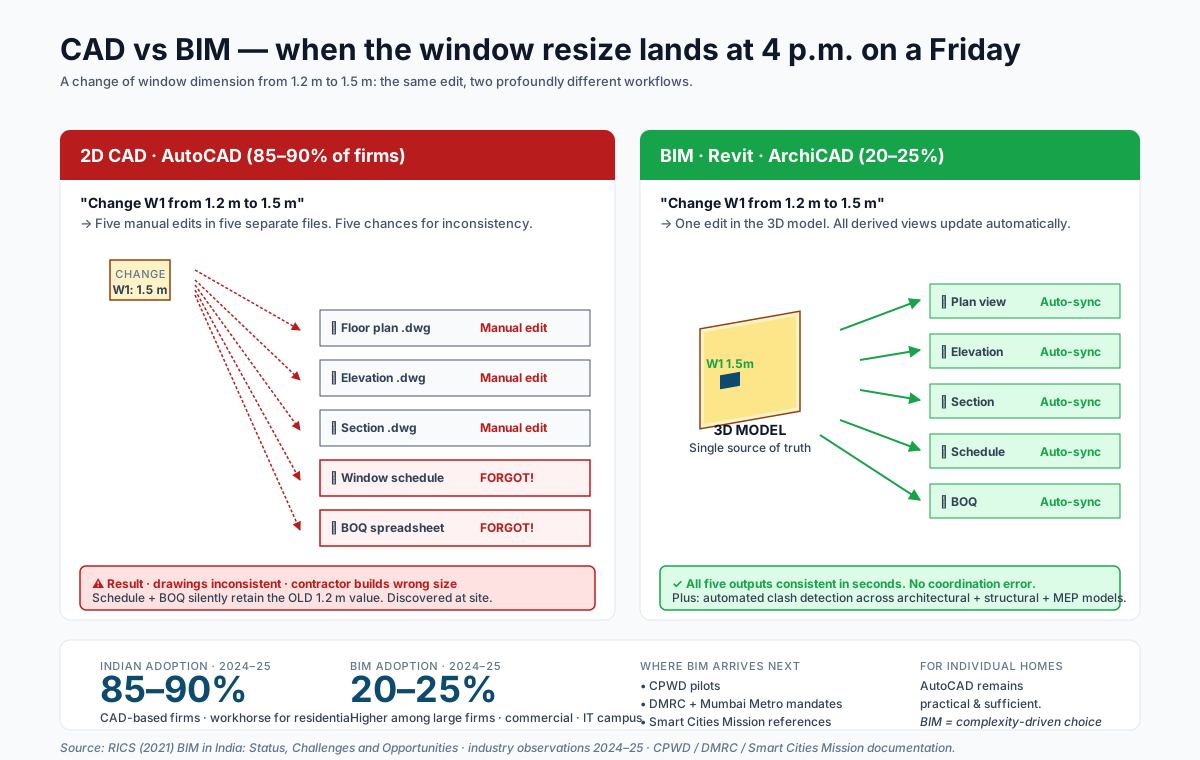
AutoCAD remains the dominant drafting tool in Indian architectural practice, used by an estimated 85–90% of firms for production drawings. Manual hand-drafting has almost entirely been replaced for construction documentation, though it remains valued in architectural education — NIT, SPA, and IIT curricula still include manual drawing — and in concept-stage design sketching.
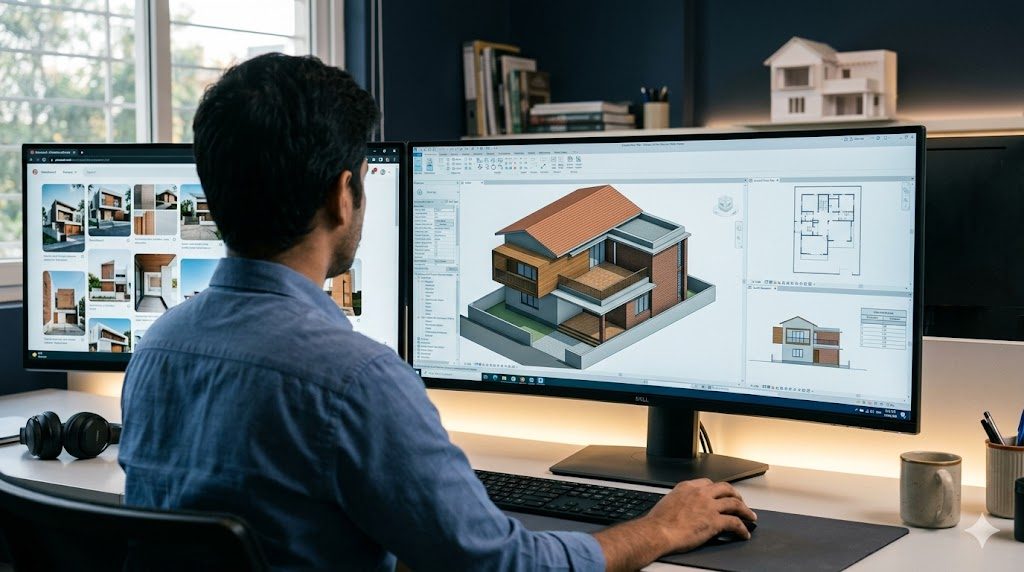
Building Information Modelling (BIM) adoption in India is growing but remains relatively low compared to the UK (where it is mandated for public projects), Singapore, or the USA. An estimated 20–25% of Indian architectural firms have adopted BIM tools (primarily Autodesk Revit and ArchiCAD) as of 2024–25, with higher adoption among large firms working on commercial, institutional, and IT campus projects (RICS, 2021).
BIM vs CAD: A Comparison for Indian Practice
| Parameter | 2D CAD (AutoCAD) | BIM (Revit / ArchiCAD) |
|---|---|---|
| Drawing output | Individual 2D sheets — plans, sections, elevations drawn independently | All views generated from a single 3D model; changes propagate automatically |
| Coordination | Manual overlay required; errors common at discipline interfaces | Automated clash detection between architectural, structural, and MEP models |
| Quantities | BOQ prepared separately from drawings; discrepancies possible | Quantities extracted directly from model; consistent with drawings |
| Revision management | Each drawing updated individually; risk of inconsistency | Model-wide revision; all sheets update simultaneously |
| Learning curve | Low; widely taught in Indian colleges | Steep; requires training and investment in software |
| Cost | Low (perpetual licenses widely used) | High (subscription model; Autodesk Revit ~Rs. 3–4 lakh/year) |
| Indian adoption | 85–90% of firms | 20–25% of firms |
| Best suited for | Small residential projects, individual homes, renovation | Multi-storey residential, mixed-use, complex geometry, large projects |
Government adoption of BIM in India is emerging. The Central Public Works Department (CPWD) has piloted BIM on select projects, Delhi Metro Rail Corporation (DMRC) and Mumbai Metro have mandated BIM on recent phases, and the Smart Cities Mission has referenced BIM in project guidelines. However, no pan-India BIM mandate exists as of 2025 (RICS, 2021).
For the typical Indian residential architect handling individual homes and small apartment projects, AutoCAD remains practical and sufficient. BIM becomes valuable — and arguably necessary — when coordination complexity increases: multi-storey residential, projects with complex MEP systems, or any project where multiple discipline consultants must work from a single coordinated model.
8. The Legal Status of Architectural Drawings
Architectural drawings in India occupy a unique position at the intersection of professional practice, intellectual property, and regulatory compliance.
Copyright: Under the Copyright Act, 1957 (amended 2012), architectural drawings are classified as 'artistic works' under Section 2(c). Copyright vests with the architect who created them, unless explicitly assigned by contract. The client receives a licence to use the drawings for the specific project for which they were commissioned, but not to reproduce the design for other projects without the architect's consent (Government of India, 1957).
Professional Liability: The architect is professionally liable for errors and omissions in drawings under both the Architects Act, 1972, and the law of torts (professional negligence). The CoA's Professional Conduct Regulations specify that failure to exercise reasonable knowledge, skill, and care constitutes 'deficient service' and professional misconduct (Council of Architecture, 1989).
Regulatory Status: Sanctioned/approved drawings are legal documents. They define the permitted construction — any deviation is unauthorised. In most Indian jurisdictions, submission drawings must bear the architect's seal, registration number, and signature. Structural drawings must bear the structural engineer's seal. These signatures carry personal professional liability.
The Practical Implication: An architect's drawing set is simultaneously a design document, a construction manual, a legal instrument, and a copyrighted creative work. This multiplicity of roles demands a level of precision and completeness that casual documentation cannot provide.
"Is it necessary? If it is not necessary, do not do it!" — Laurie Baker (1917–2007), British-Indian architect, known as the 'Gandhi of Architecture'
Baker's principle of economy applies to documentation with particular force. Every line on a drawing should serve a purpose. Every dimension should be necessary. Every annotation should instruct. Unnecessary complexity obscures essential information; disciplined economy reveals it.
9. A Documentation Checklist for Homeowners
For the homeowner commissioning an architect, the following checklist ensures that documentation is complete before construction begins:
Before Approval Stage:
- Site survey drawing with boundary dimensions and levels
- Concept options presented and one approved in writing
- Submission drawings prepared and verified against DCR/bye-laws
- Area statement with FAR and coverage calculations
Before Construction Begins:
- Complete architectural working drawings — all floors, elevations, sections, details
- Structural drawings — foundation, column, beam, slab — signed by structural engineer
- Plumbing and electrical layouts
- Door and window schedule with hardware specifications
- Material specification document
- Bill of Quantities (BOQ) for tender comparison
- All drawings coordinated across disciplines — no conflicts between architectural, structural, and MEP
During Construction:
- Revised drawings issued promptly for any approved changes
- Shop drawings reviewed and approved before fabrication
- Site instructions documented in writing
After Completion:
- As-built drawings reflecting actual construction
- All test certificates (cube test, waterproofing, electrical)
- Completion/occupancy certificate obtained
- Drawing set archived (digital and physical) for future reference
References
- Allen, E. and Iano, J. (2019) Fundamentals of Building Construction: Materials and Methods. 7th edn. Hoboken: John Wiley & Sons.
- Bhatt, N.D. and Panchal, V.M. (2014) Engineering Drawing. 53rd edn. Ahmedabad: Charotar Publishing.
- Bureau of Indian Standards (1986) IS 11669:1986 — Dimensioning of Technical Drawings — General Principles. New Delhi: BIS.
- Bureau of Indian Standards (1989) IS 962:1989 — Code of Practice for Architectural and Building Drawings. New Delhi: BIS.
- Bureau of Indian Standards (2001) IS 10711:2001 — Sizes of Drawing Sheets. New Delhi: BIS.
- Bureau of Indian Standards (2003) SP 46:2003 — Engineering Drawing Practice for Schools and Colleges. New Delhi: BIS.
- Bureau of Indian Standards (2016) SP 7:2016 — National Building Code of India 2016. New Delhi: BIS.
- Ching, F.D.K. (2014) Architectural Graphics. 6th edn. Hoboken: John Wiley & Sons.
- Ching, F.D.K. (2020) Building Construction Illustrated. 6th edn. Hoboken: John Wiley & Sons.
- Correa, C. (2012) A Place in the Shade: The New Landscape and Other Essays. New Delhi: Penguin Books India.
- Council of Architecture (1989) Architects (Professional Conduct) Regulations, 1989. New Delhi: CoA.
- Council of Architecture (2020) Conditions of Engagement and Scale of Charges. New Delhi: CoA.
- Government of India (1957) The Copyright Act, 1957 (Act No. 14 of 1957). New Delhi: Government of India.
- Government of India (1972) The Architects Act, 1972 (Act No. 20 of 1972). New Delhi: Government of India.
- Government of India (2016) The Real Estate (Regulation and Development) Act, 2016 (Act No. 16 of 2016). New Delhi: Government of India.
- RICS (2021) BIM in India: Status, Challenges and Opportunities. London: Royal Institution of Chartered Surveyors.
- Shah, M.G., Kale, C.M. and Patki, S.Y. (2012) Building Drawing with an Integrated Approach Using AutoCAD. 5th edn. New Delhi: Pearson Education India.
- Twombly, R. (ed.) (2003) Louis Kahn: Essential Texts. New York: W.W. Norton & Company.
- Vitruvius (c. 30–15 BC) De Architectura (The Ten Books on Architecture). Translated by M.H. Morgan (1914). New York: Dover Publications (reprint).
- Wakita, O.A., Bakhoum, N. and Linde, R.M. (2017) The Professional Practice of Architectural Working Drawings. 5th edn. Hoboken: John Wiley & Sons.
- Zumthor, P. (2010) Thinking Architecture. 3rd edn. Basel: Birkhauser.
Author's Note: This guide draws on published BIS codes, CoA professional practice guidelines, and established architectural documentation references. All IS code references cite the latest revisions known at the time of writing — readers should verify current editions via the BIS website (bis.gov.in). Municipal building plan approval requirements vary by state and local body — the checklist provided reflects NBC 2016 general requirements and should be supplemented with local DCR provisions. CoA fee guidelines are recommended minimums; actual market rates vary by geography and project complexity.
Disclaimer: This article is for informational and educational purposes only. It does not constitute professional architectural or legal advice. Architectural documentation must be prepared by architects registered with the Council of Architecture in accordance with applicable codes and regulations.
Export this guide
Related Guides — Deep-dive reading
Scope Boundaries — Architect, Interior Designer & Contractor
The Architects Act 1972, the IIID Code, BOCW 1996 & RERA 2016 — Stage-by-Stage Role Map, Hot Boundary Zones, Liability Matrix, and the Tri-Party Contracting Discipline for Indian Residential Practice
ConstructionBathroom Building Regulations in India: NBC 2016 & Municipal Bye-Law Requirements
What the National Building Code and your local building bye-laws actually require of a bathroom or toilet — minimum room sizes, ceiling height, mandatory ventilation and light, the WC-not-into-kitchen rule, and how plan approval works.
BathroomsBathroom Plumbing Code India: NBC 2016 Part 9, UPC-I & the IS Standards That Govern Pipework
A professional reference to the codes and standards that govern bathroom plumbing in India — the National Building Code (NBC 2016) Part 9 on Plumbing Services, the Uniform Plumbing Code India (UPC-I), the CPHEEO Manual, and the IS standards for water supply, drainage, trap seals, pipe sizing, slopes and venting — with a caveat to always verify the current code and your local authority.
BathroomsRelated Tools — Try Free
Cross-Ventilation Analyzer
Estimate airflow and air changes per hour (ACH) from room size, window areas, layout, and local wind — with NBC 2016 Part 8 compliance check.
Ventilation CalculatorRainwater Tank Sizer
How big should your rainwater tank be? Computes annual harvest, recommended tank capacity in litres, water-bill savings, and payback — for 10 Indian cities.
RWH CalculatorFalse Ceiling Cost Estimator
Live ₹/sqft across 8 ceiling types — POP, gypsum, designer, metal, PVC, wooden — with cove and spot lighting for 20 Indian cities.
Cost Calculator