
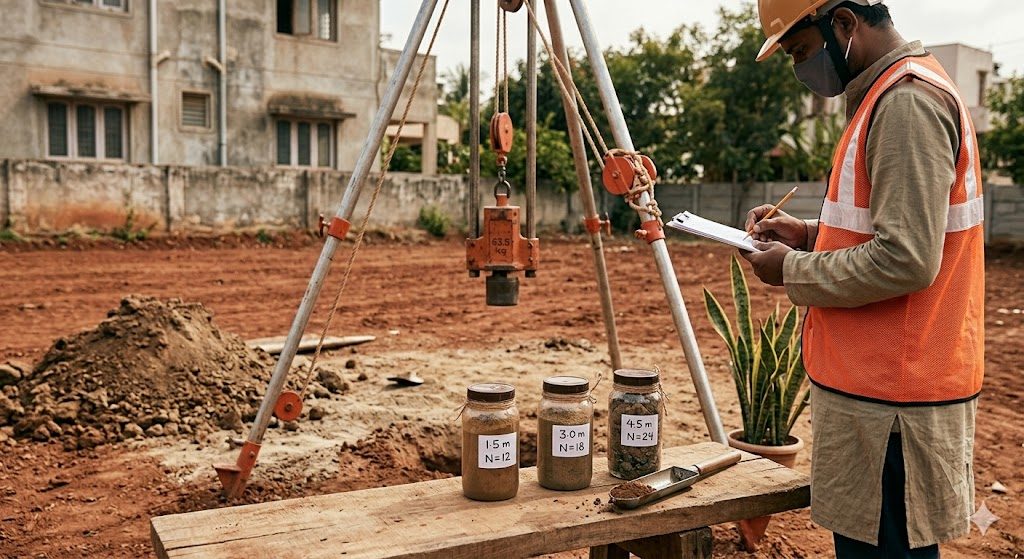
Soil Testing Before Construction
A Complete Guide to Soil Types, Testing & Foundation Solutions in India
Every building stands on soil. Yet soil testing remains one of the most neglected steps in Indian residential construction. Homeowners spend lakhs on interiors and facades but skip a ₹10,000-15,000 soil test that determines whether the building will stand safely for 50 years or develop cracks within 5.
This guide is written for architects, structural engineers, and informed homeowners. It covers why soil testing is non-negotiable, the major soil types across India, what tests are performed, how to read a soil report, and what foundation solutions work for each soil type.
Why Soil Testing Is Non-Negotiable
The Numbers That Matter
| Fact | Impact |
|---|---|
| 60% of building failures in India are foundation-related | CBRI Roorkee study |
| Soil testing costs 0.1-0.3% of total construction cost | Negligible investment for safety |
| Black cotton soil swells 20-30% when wet | Can crack foundations and walls |
| NBC 2016 mandates soil investigation for buildings above G+1 | Legal requirement |
| Foundation repair costs 10-50x more than soil testing | ₹5-20 lakhs vs ₹10-15K |
What Can Go Wrong Without Soil Testing
- Differential settlement — one side of the building sinks more than the other, causing diagonal cracks
- Foundation failure — soil cannot bear the building load, leading to structural collapse
- Water table surprises — basement flooding during monsoon
- Expansive soil damage — walls crack every monsoon as soil swells and shrinks
- Chemical attack — sulphates in soil corrode concrete and reinforcement
Real case: In 2019, a 4-storey residential building in Dharwad, Karnataka collapsed during construction, killing 19 people. The investigation revealed inadequate foundation design due to no soil investigation being conducted. The soil was weak alluvial clay that couldn't support the building load.
When Is Soil Testing Required?
| Building Type | Soil Test Required? | Regulation |
|---|---|---|
| Independent house (G+1) | Recommended | NBC advisory |
| Independent house (G+2 and above) | Mandatory | NBC 2016, IS 1904 |
| Apartment building (any height) | Mandatory | NBC 2016 |
| Buildings on slopes | Mandatory | NBC + state rules |
| Buildings near water bodies | Mandatory | NBC + CRZ |
| Any building above 15m height | Mandatory | NBC + fire regulations |
Who Conducts Soil Tests?
- NABL-accredited soil testing laboratories (preferred)
- Government geotechnical labs (PWD, state engineering departments)
- Private geotechnical consultants registered with the state
- IIT/NIT geotechnical departments (for complex projects)
Major Soil Types in India — Construction Guide
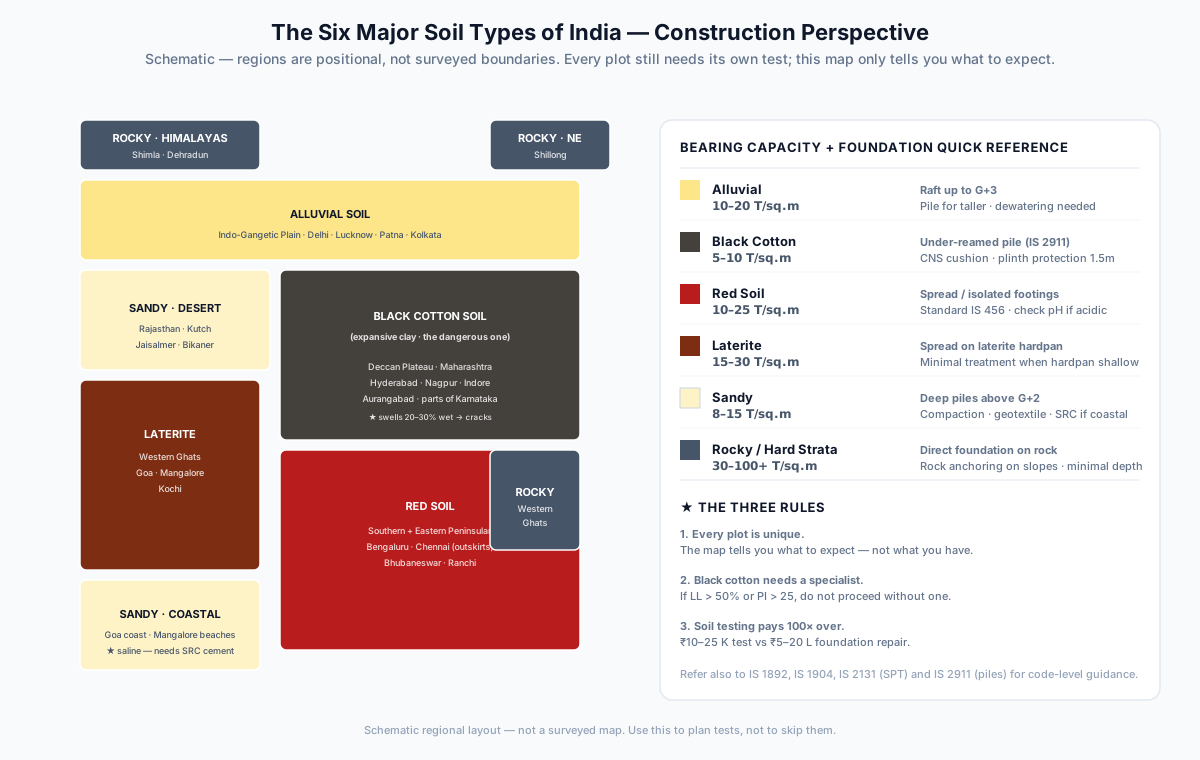
1. Alluvial Soil
Where: Indo-Gangetic Plains — Delhi, Lucknow, Patna, Kolkata, parts of Punjab and Haryana
Characteristics:
- Deposited by rivers over thousands of years
- Mix of sand, silt, and clay in varying proportions
- Moderate bearing capacity (10-20 T/sq.m)
- Water table often high (2-5m in plains)
Construction Challenges:
- Variable composition — can change drastically within the same plot
- High water table causes waterlogging in basements
- Liquefaction risk in seismic zones (Delhi is Zone IV)
Foundation Solutions:
- Raft foundation for buildings up to G+3
- Pile foundation for taller buildings
- Dewatering required during basement excavation
- Waterproofing critical for foundations
2. Black Cotton Soil (Expansive Clay)
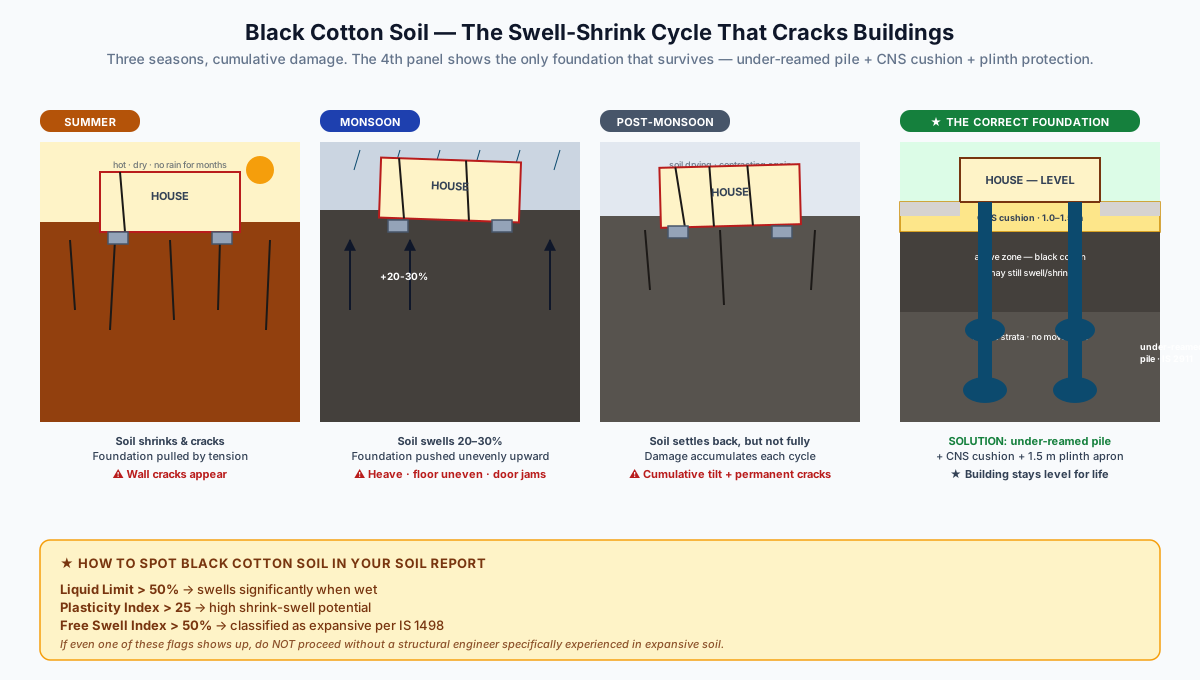
Where: Deccan Plateau — Hyderabad, Nagpur, Indore, Aurangabad, parts of Karnataka and Gujarat
Characteristics:
- Rich in montmorillonite clay minerals
- Swells 20-30% when wet, shrinks dramatically when dry
- Very low bearing capacity (5-10 T/sq.m)
- Forms deep cracks in summer
Construction Challenges:
- The most problematic soil for construction in India
- Seasonal expansion/contraction causes wall cracks, floor heaving
- Standard foundations fail — requires specialised solutions
- Plinth protection essential to prevent water reaching foundation
Foundation Solutions:
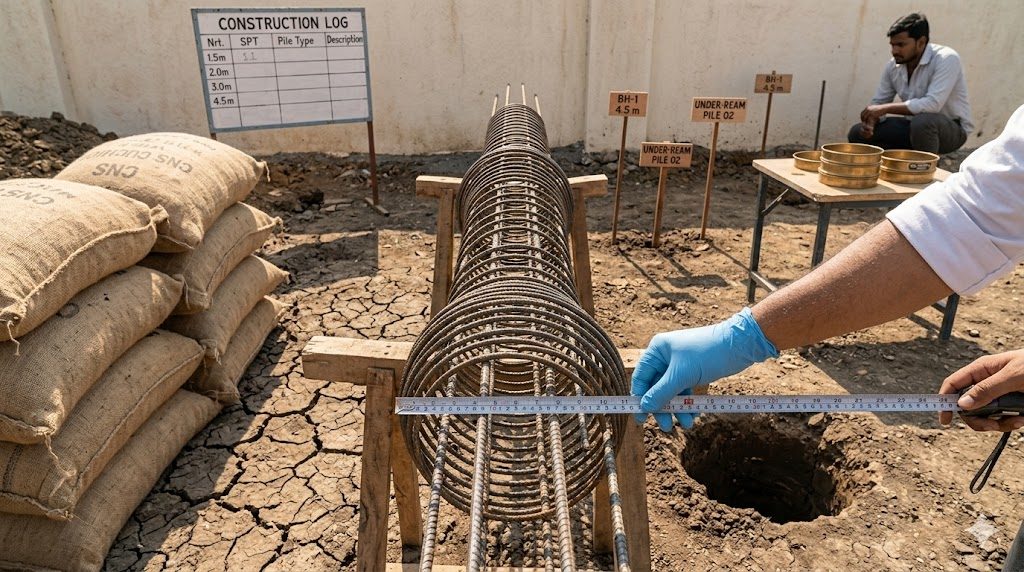
- Under-reamed pile foundation — the standard solution (IS 2911)
- Piles drilled past the active zone (typically 3-4m deep)
- CNS (Cohesive Non-Swelling) soil cushion — replace top 1-1.5m with non-expansive soil
- Plinth protection — 1.5m wide apron around building to prevent water infiltration
- Never use isolated footings on black cotton soil
Critical: If your soil report shows Liquid Limit > 50% and Plasticity Index > 25, you have expansive soil. Do NOT proceed without a structural engineer experienced in black cotton soil.
3. Red Soil
Where: Eastern and Southern India — Bengaluru, Chennai (outskirts), Jaipur, Ranchi, Bhubaneswar
Characteristics:
- Rich in iron oxide (gives red colour)
- Well-drained, low moisture retention
- Good bearing capacity (10-25 T/sq.m)
- Often found with laterite rock at depth
Construction Challenges:
- Generally good for construction
- Surface layer may be loose — needs compaction
- Can be acidic — check pH and use sulphate-resistant cement if needed
Foundation Solutions:
- Spread/isolated footings work well for most buildings
- Strip foundations for load-bearing walls
- Standard RCC foundations as per IS 456
4. Laterite Soil
Where: Western Ghats — Kochi, Mangalore, Goa, parts of Karnataka
Characteristics:
- Formed by tropical weathering of rock
- Hard when dry, slightly soft when wet
- Good to excellent bearing capacity (15-30 T/sq.m)
- Often found as hardpan at 1-3m depth
Construction Challenges:
- Laterite blocks have been used as building material for centuries (traditional Kerala homes)
- Digging through hard laterite requires mechanical excavation
- Water may percolate through porous laterite
Foundation Solutions:
- Spread footings on laterite hardpan — most economical
- Direct foundation on rock if encountered at shallow depth
- Minimal foundation treatment needed in most cases
5. Sandy Soil
Where: Rajasthan, coastal areas of Gujarat, Tamil Nadu, Andhra Pradesh, Odisha
Characteristics:
- Predominantly sand particles (>60%)
- Low cohesion — falls apart when dry
- Variable bearing capacity (8-15 T/sq.m)
- Very high permeability — water drains quickly
Construction Challenges:
- Poor load distribution — concentrated loads cause settlement
- Coastal sandy soil may contain salts that attack concrete
- Wind erosion around foundations
- Liquefaction risk in coastal seismic zones
Foundation Solutions:
- Deep foundations (piles) for buildings above G+2
- Compaction of sand layer using vibratory methods
- Geotextile reinforcement for improved bearing capacity
- Sulphate-resistant cement (SRC) for coastal areas
- Anti-corrosion measures for reinforcement in saline soil
6. Rocky / Hard Strata
Where: Peninsular India hills, Western Ghats, parts of Hyderabad, Pune, Shimla
Characteristics:
- Granite, basalt, gneiss, or sandstone at shallow depth
- Excellent bearing capacity (30-100+ T/sq.m)
- Virtually no settlement
- May require blasting or rock-cutting for excavation
Construction Challenges:
- Excavation is expensive (rock-breaking machinery needed)
- Trenching for utilities (water, sewage, electrical) is difficult
- Uneven rock surface needs levelling
Foundation Solutions:
- Direct foundation on rock — the simplest and strongest
- Rock anchoring for buildings on slopes
- Stepped foundation following rock contours
- Minimal depth required — sometimes just PCC on rock
The Soil Testing Process
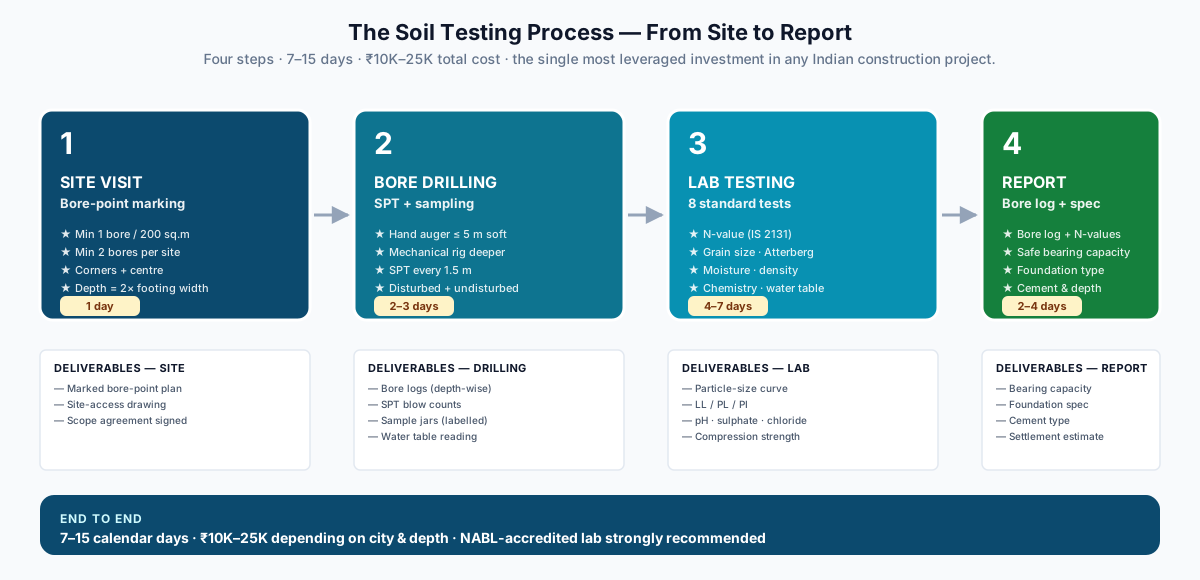
Step 1: Site Visit and Bore Point Marking
The geotechnical engineer visits the site and determines:
- Number of bore holes (minimum 1 per 200 sq.m, minimum 2 per site)
- Location of bore holes (corners + centre of proposed building)
- Depth of investigation (minimum 2x the expected foundation width, typically 6-10m)
Step 2: Bore Drilling and Sampling
A boring rig drills into the ground:
- Hand auger for soft soils up to 5m (₹3,000-5,000 per bore)
- Mechanical rotary rig for deeper or harder soils (₹5,000-10,000 per bore)
- SPT (Standard Penetration Test) conducted at every 1.5m depth
- Disturbed and undisturbed soil samples collected
Step 3: Laboratory Testing
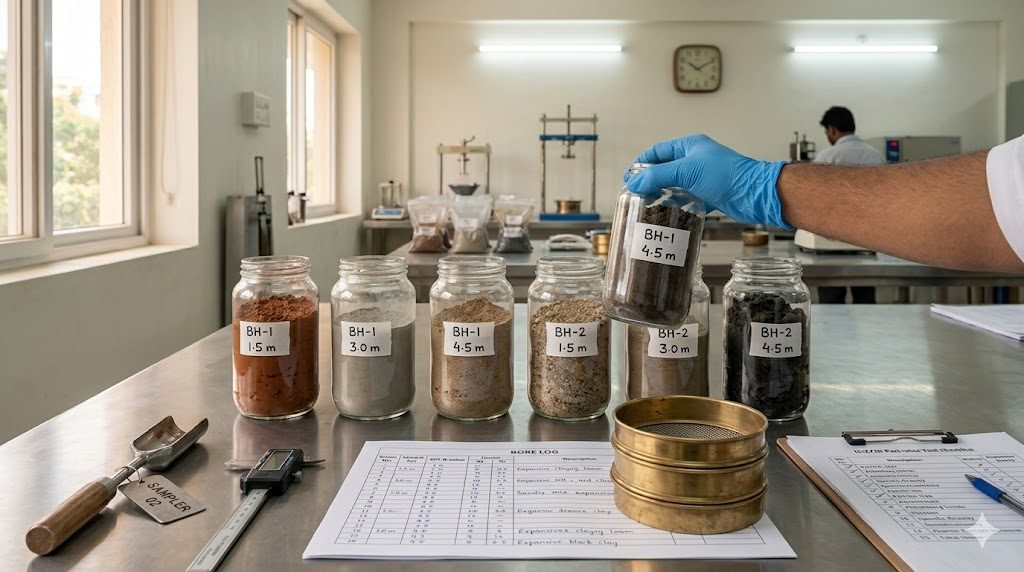
| Test | What It Measures | IS Code | Why It Matters |
|---|---|---|---|
| SPT (N-value) | Soil strength/density | IS 2131 | Determines bearing capacity directly |
| Grain size analysis | Sand/silt/clay percentage | IS 2720-Part 4 | Classifies soil type |
| Atterberg limits | Liquid limit, plastic limit | IS 2720-Part 5 | Identifies expansive soil |
| Moisture content | Natural water content | IS 2720-Part 2 | Affects bearing capacity |
| Specific gravity | Soil particle density | IS 2720-Part 3 | Used in settlement calculations |
| Unconfined compression | Cohesive soil strength | IS 2720-Part 10 | Direct strength measurement |
| Chemical analysis | pH, sulphates, chlorides | IS 2720-Part 26 | Concrete mix design |
| Water table depth | Groundwater level | During boring | Basement design, dewatering |
Step 4: Report and Recommendations
A soil investigation report includes:
1. Bore log — layer-by-layer soil description with depth
2. SPT N-values at each depth
3. Safe bearing capacity — the maximum load the soil can support (T/sq.m)
4. Foundation type recommendation — isolated, strip, raft, or pile
5. Foundation depth recommendation — minimum depth below ground
6. Water table information — seasonal variation
7. Chemical analysis results — cement type recommendation
8. Settlement calculations — expected settling under load
Understanding the Soil Report — Key Numbers
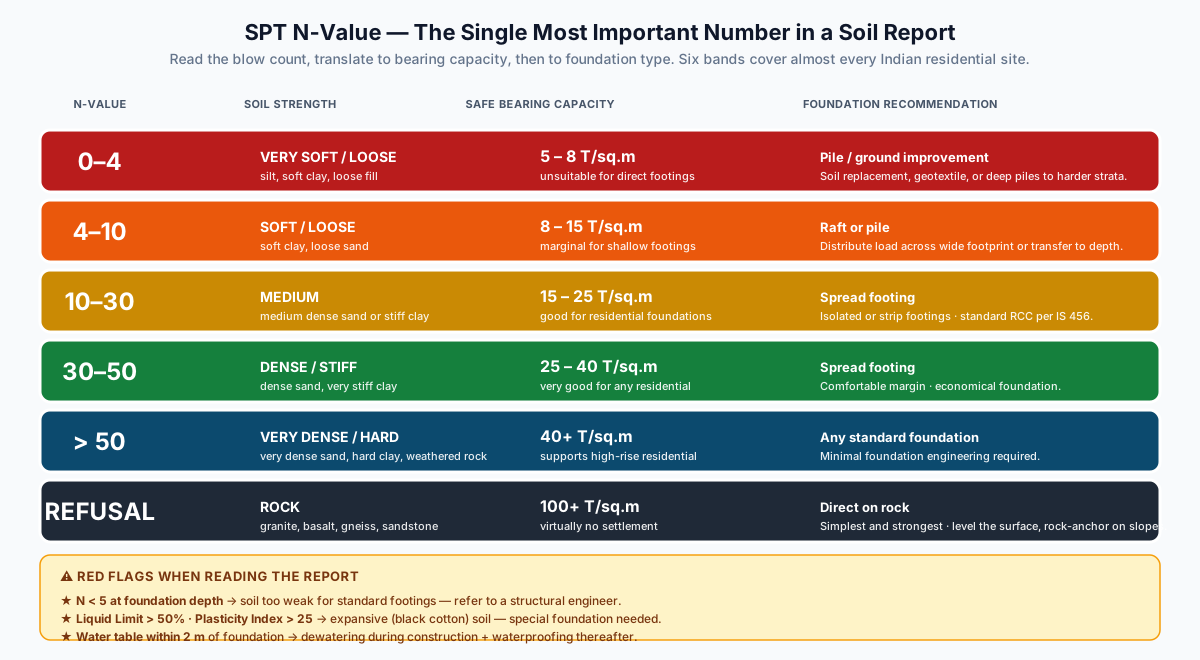
SPT N-Value Guide
| N-Value | Soil Description | Bearing Capacity | Foundation Type |
|---|---|---|---|
| 0-4 | Very soft/loose | 5-8 T/sq.m | Pile or ground improvement |
| 4-10 | Soft/loose | 8-15 T/sq.m | Raft or pile |
| 10-30 | Medium | 15-25 T/sq.m | Spread footing |
| 30-50 | Dense/stiff | 25-40 T/sq.m | Spread footing |
| >50 | Very dense/hard | 40+ T/sq.m | Any standard foundation |
| Refusal | Rock | 100+ T/sq.m | Direct on rock |
Red Flags in a Soil Report
- N-value < 5 at foundation depth — soil too weak for standard footings
- Liquid Limit > 50% — expansive soil, needs special foundation
- Sulphate content > 0.2% — use sulphate-resistant cement
- Chloride content > 0.06% — corrosion risk, increase concrete cover
- pH < 5.5 — acidic soil, needs protective measures
- Water table within 2m of foundation level — dewatering + waterproofing needed
Cost of Soil Testing Across Indian Cities
| City | Cost (2 bores, 6m depth) | Timeline | Where to Get |
|---|---|---|---|
| Bengaluru | ₹10,000-15,000 | 7-10 days | L&T, Torsteel, private labs |
| Chennai | ₹8,000-12,000 | 7-10 days | Anna University lab, private |
| Mumbai | ₹15,000-25,000 | 10-15 days | IIT Bombay, private labs |
| Delhi | ₹12,000-20,000 | 7-12 days | IIT Delhi, CRRI, private |
| Hyderabad | ₹8,000-15,000 | 7-10 days | JNTU lab, private |
| Pune | ₹10,000-15,000 | 7-10 days | CoEP lab, private |
The cost of NOT testing: Foundation repair for a cracked building ranges from ₹5-20 lakhs — 100-200x the cost of a soil test. It's the most cost-effective investment in any construction project.
Foundation Solutions Summary
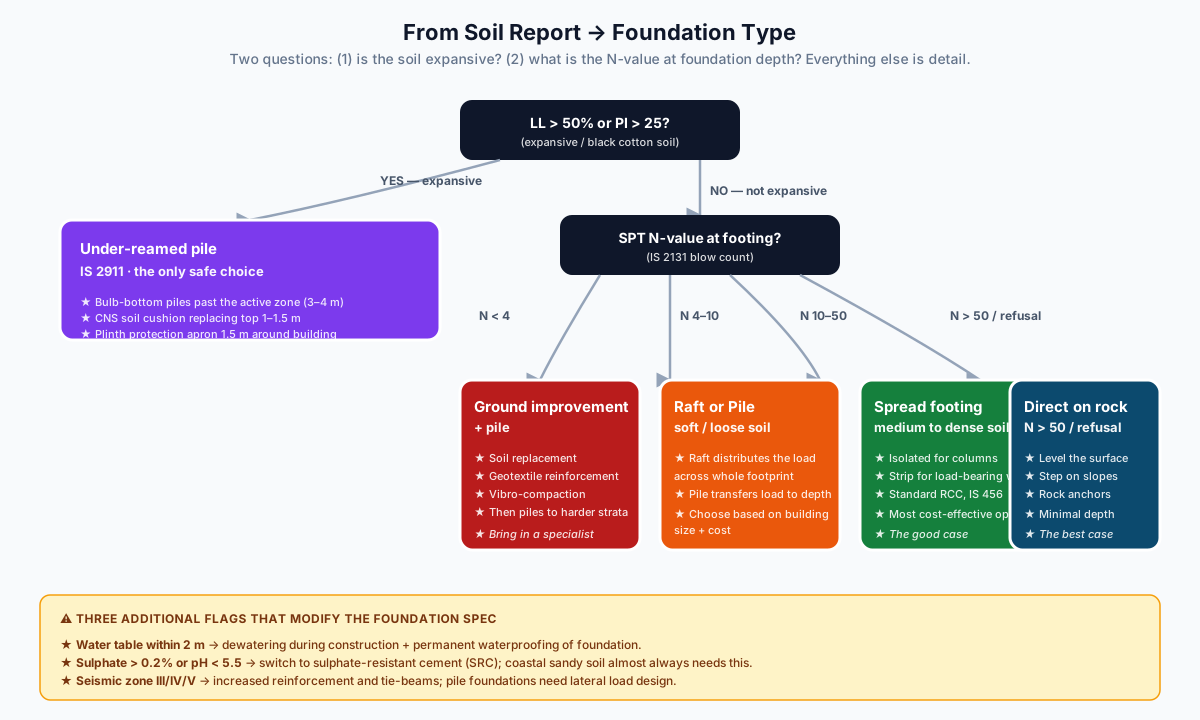
| Soil Type | Recommended Foundation | Typical Depth | Special Measures |
|---|---|---|---|
| Alluvial | Raft / Pile | 2-3m (raft), 8-15m (pile) | Dewatering, waterproofing |
| Black Cotton | Under-reamed pile | 3-5m past active zone | CNS cushion, plinth protection |
| Red Soil | Spread footing | 1.5-2.5m | Standard — check pH |
| Laterite | Spread footing on hardpan | 1-2m | Direct on hardpan if possible |
| Sandy | Deep pile / compaction | 3-8m | Geotextile, SRC cement |
| Rocky | Direct on rock | As reached | Rock levelling, anchoring |
IS Codes for Soil Investigation
| IS Code | Title | What It Covers |
|---|---|---|
| IS 1892:1979 | Subsurface Investigation | General procedure for soil exploration |
| IS 1904:1986 | Design and Construction of Foundations | Safe bearing capacity, foundation design |
| IS 2131:1981 | Standard Penetration Test | SPT procedure and interpretation |
| IS 2720 | Methods of Test for Soils | 41 parts covering all soil tests |
| IS 2911 | Design of Pile Foundations | Pile design for different soil types |
| IS 6403:1981 | Bearing Capacity of Shallow Foundations | Calculation methods |
| IS 8009 | Settlement Calculations | Predicting foundation settlement |
Common Mistakes to Avoid
1. Skipping the soil test entirely — The most dangerous and most common mistake in Indian residential construction.
2. Testing at only one point — Soil can vary dramatically within a 30x40 plot. Minimum 2 bores, ideally 3-4.
3. Insufficient depth — Testing only 3m deep when the building needs 6m deep piles. Depth should be at least 2x the expected foundation width.
4. Ignoring seasonal water table variation — Test during both dry and monsoon seasons if possible.
5. Using a non-accredited lab — Insist on NABL-accredited laboratory. Unaccredited labs often produce inaccurate results.
6. Not sharing the report with the structural engineer — The soil report is the structural engineer's most important input. Share the full report, not just the bearing capacity number.
7. Assuming neighbouring plot results apply — Soil can change completely between adjacent plots, especially in alluvial and filled areas.
Key Takeaways
- Soil testing is the cheapest insurance for any building — ₹10,000-25,000 prevents ₹5-20 lakh foundation repairs
- Black cotton soil is the most dangerous soil for construction in India — never build without specialist advice
- SPT N-value is the single most important number in a soil report — it directly determines bearing capacity and foundation type
- NBC 2016 mandates soil testing for buildings above G+1 — compliance is both a legal requirement and a safety necessity
- Always use NABL-accredited labs — accuracy of the report determines the safety of the foundation
- Share the complete soil report with your structural engineer — not just the summary
References:
- IS 1892:1979 — Code of Practice for Subsurface Investigation for Foundations (BIS)
- IS 1904:1986 — Code of Practice for Design and Construction of Foundations
- IS 2131:1981 — Method for Standard Penetration Test for Soils
- IS 2720 — Methods of Test for Soils (41 parts)
- IS 2911 — Design and Construction of Pile Foundations
- NBC 2016, Part 6 — Structural Design
- CBRI Roorkee — Building Failure Investigation Reports
- IS 456:2000 — Plain and Reinforced Concrete (cement type for soil conditions)
Export this guide
Related Guides — Deep-dive reading
Foundation Problems Every Homeowner Should Understand
What lies beneath the house — foundation types, the problem soils of India, black-cotton heave and differential settlement, the warning signs of foundation movement, and the soil test that prevents lakhs in damage.
Structural SafetyCompound Wall Foundation in India: Footings, Soil and Reinforcement (2026)
The part of a boundary wall you never see is the part that decides whether it stands straight for decades or leans, cracks and falls — a plain, India-grounded literacy guide to what sits under your compound wall: how your soil drives the footing, the common footing types, how deep to go, the plinth and DPC transition, and why footing size and reinforcement are engineer-designed to your soil and wall height, never a build-to number.
Compound WallsSoil Bearing Capacity for Indian Architects
IS 6403, Terzaghi & Meyerhof Methods, and Foundation Design for Indian Soils — A Comprehensive Guide
ConstructionRelated Tools — Try Free
Interior Red Flag Checklist — Before Signing
54 red flags across 8 categories with a live risk score and personalised PDF.
Red Flag ChecklistMonsoon-Readiness Checklist
Pre-rain home audit across 9 categories — terrace, drains, waterproofing, electrical, HVAC, pest, vehicles, documents.
Seasonal AuditProperty Tax Calculator — 10 Indian Cities
Estimate annual municipal property tax across BBMP / MCD / MCGM / GHMC / GCC / KMC / PMC / AMC / TMC / PCMC — with self-occupied, tenanted, and age-rebate adjustments.
Property Tax