
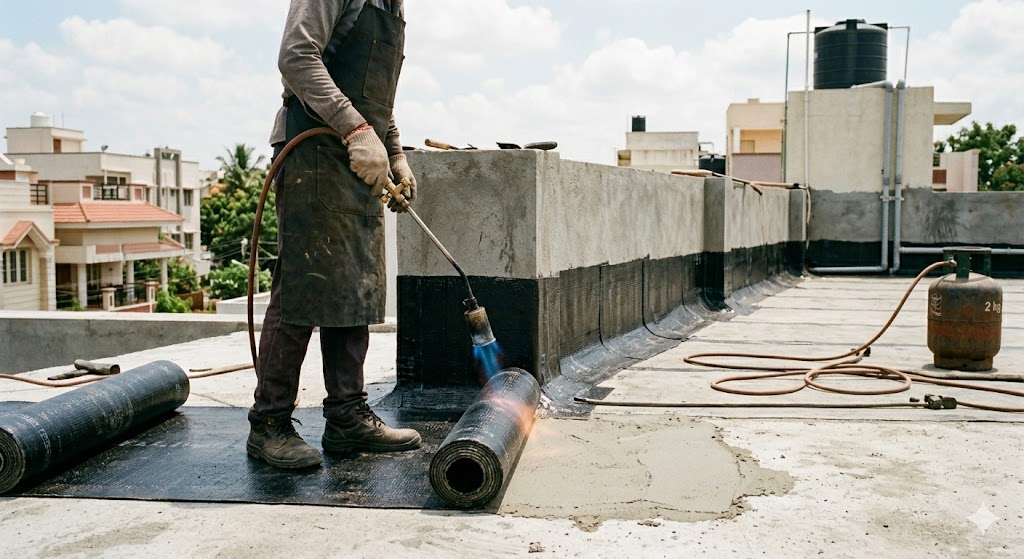
Waterproofing Guide for Indian Homes
Complete Zone-by-Zone Guide — Terrace, Bathroom, Basement, Walls & Tanks
Water leakage is the number one post-construction complaint in Indian homes. CBRI studies estimate that over 60% of Indian buildings develop some form of water-related problem within the first 10 years — terrace leaks, bathroom seepage, wall dampness, basement flooding, and water tank failures.
The tragedy is that waterproofing is one of the cheapest items in the construction budget — typically 1-2% of total construction cost. But fixing leakage after the fact costs 10-15 times more because it involves breaking tiles, removing plaster, disrupting interiors, and often relocating the family during repairs.
This guide covers waterproofing for every zone of an Indian home — terrace, bathroom, kitchen, external walls, basement, water tanks, swimming pools, and balconies — with material specifications, IS codes, application methods, cost estimates, brand recommendations, and maintenance schedules.
Why Indian Buildings Leak
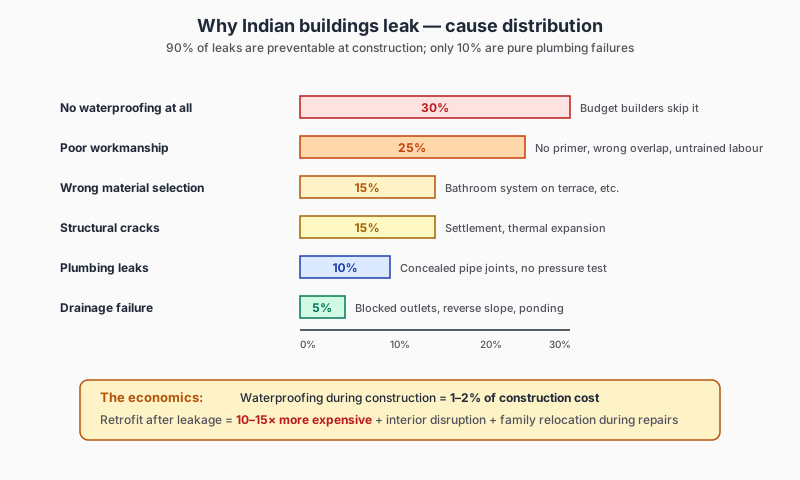
90% of leaks are preventable at construction; only 10% are pure plumbing failures. The economics are stark — waterproofing during construction is 1–2% of construction cost; retrofitting after leakage is 10–15× more expensive.
| Cause | Prevalence | Prevention |
|---|---|---|
| No waterproofing at all | 30% of cases | Many budget builders skip waterproofing entirely to save cost |
| Poor workmanship | 25% | Correct material, wrong application (no primer, insufficient coats, wrong overlap) |
| Wrong material selection | 15% | Using bathroom waterproofing on terrace, or vice versa |
| Structural cracks | 15% | Settlement cracks, thermal expansion cracks allowing water entry |
| Plumbing leaks | 10% | Concealed pipe joints failing, no pressure testing before plastering |
| Drainage failure | 5% | Blocked outlets, reverse slope, ponding water on terrace |
The golden rule: Waterproofing must be done during construction, not after. Retrofitting waterproofing is 5-10x more expensive and never as effective as getting it right the first time.
Waterproofing Materials — Complete Reference
Membrane-Based Systems
| Material | IS Code | Application | Lifespan | Cost (₹/sqft) |
|---|---|---|---|---|
| APP modified bitumen membrane | IS 14767:2000 | Terrace, flat roofs — torch-applied | 10-15 years | ₹40-70 |
| SBS modified bitumen membrane | IS 14767:2000 | Basement, below-grade — cold-applied or torch | 15-20 years | ₹50-80 |
| HDPE membrane | IS 15351 | Basement tanking, planter boxes | 20+ years | ₹60-100 |
| PVC membrane | IS 15351 | Green roofs, podium decks, tunnels | 20+ years | ₹80-120 |
| TPO membrane | — (ASTM D6878) | Large commercial flat roofs | 20+ years | ₹100-150 |
Liquid-Applied Systems
| Material | Application | Lifespan | Cost (₹/sqft) |
|---|---|---|---|
| Polymer-modified cementitious coating (flexible) | Bathrooms, wet areas, balconies | 8-12 years | ₹25-45 |
| Acrylic-based liquid membrane | Terrace (over existing surface), walls | 5-8 years | ₹20-35 |
| Polyurethane (PU) liquid membrane | Terrace, exposed surfaces, balconies | 10-15 years | ₹50-90 |
| Polyurea spray coating | Water tanks, bridges, industrial | 15-20 years | ₹100-200 |
| Epoxy coating | Water tanks, swimming pools, chemical resistance | 10-15 years | ₹60-100 |
| Silicone-based water repellent | External wall surface treatment | 5-8 years | ₹12-25 |
Cementitious Systems
| Material | Application | Lifespan | Cost (₹/sqft) |
|---|---|---|---|
| Integral waterproofing compound (IS 2645) | Mixed with concrete during casting | Life of concrete | ₹3-8 (per sqft of slab) |
| Crystalline waterproofing | Applied on concrete — penetrates and self-heals cracks | Life of concrete | ₹40-70 |
| Polymer-modified mortar | Tile bedding in wet areas, crack repair | 10-15 years | ₹30-50 |
| Coba (lime-surkhi) | Traditional Indian waterproofing for terrace | 15-25 years (with maintenance) | ₹25-40 |
Injection Systems (for Repair)
| Material | Application | Cost (₹/running ft) |
|---|---|---|
| Epoxy injection | Structural crack sealing | ₹200-400 |
| Polyurethane injection | Active water leaks, flexible cracks | ₹250-500 |
| Acrylic gel injection | Curtain grouting behind walls | ₹300-600 |
Zone 1: Terrace Waterproofing
Terrace is the most critical zone — it receives direct rainfall, UV exposure, and extreme thermal cycling (20°C to 65°C surface temperature in Indian summers).
Terrace Waterproofing — Layer by Layer
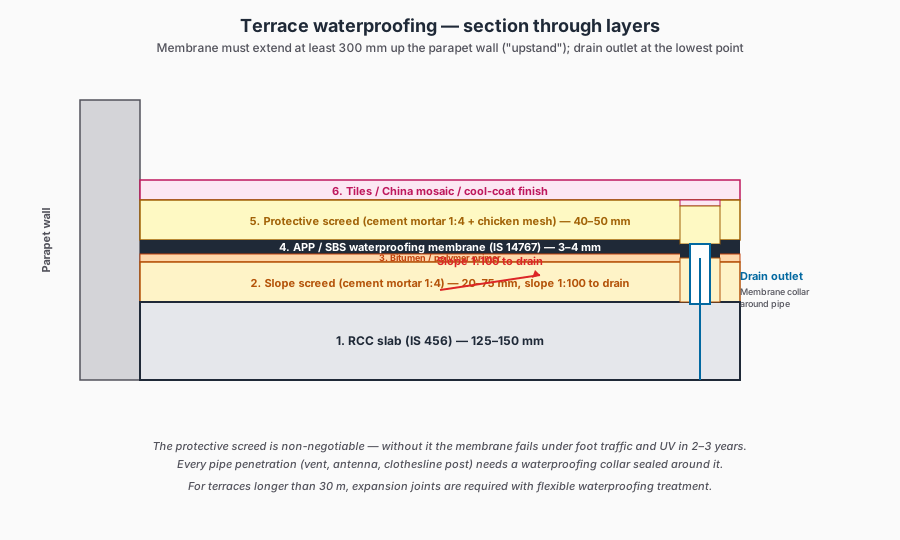
The protective screed is non-negotiable — without it, the membrane fails under foot traffic and UV in 2–3 years. Every pipe penetration needs a waterproofing collar; the membrane upstand on the parapet must be at least 300 mm above the slab.
| Layer (bottom to top) | Material | Thickness | Purpose |
|---|---|---|---|
| 1. Concrete slab | RCC slab (IS 456) | 125-150mm | Structural base |
| 2. Slope screed | Cement mortar 1:4 | 20-75mm (sloped 1:100 minimum) | Drain water toward outlets |
| 3. Primer | Bitumen primer or polymer primer | 1 coat | Adhesion of membrane to substrate |
| 4. Waterproofing membrane | APP/SBS membrane (IS 14767) | 3-4mm | Primary waterproofing barrier |
| 5. Protective screed | Cement mortar 1:4 with chicken mesh | 40-50mm | Protects membrane from foot traffic and UV |
| 6. Finish | Tiles / China mosaic / cool coat | As applicable | Aesthetics and heat reflection |
Terrace Waterproofing Methods Compared
| Method | Durability | Cost (₹/sqft) | Best For | Limitations |
|---|---|---|---|---|
| APP membrane (torch-applied) | 10-15 years | ₹45-70 | New construction, flat terraces | Requires skilled applicators, fire during application |
| SBS membrane (cold-applied) | 15-20 years | ₹55-80 | New construction, premium quality | Higher cost |
| PU liquid membrane | 10-15 years | ₹50-90 | Existing terraces (retrofit), complex shapes | Requires primer, 2-3 coats with curing between |
| Coba (traditional) | 15-25 years | ₹25-40 | Budget-friendly, traditional, eco-friendly | Labour-intensive, needs annual brick coba maintenance |
| Acrylic coating | 5-8 years | ₹20-35 | Quick fix, temporary solution | Shortest lifespan, needs recoating |
| Integral waterproofing (in concrete) | Life of slab | ₹3-8 (additive only) | During casting — no membrane needed for some applications | Cannot be added after casting, doesn't bridge cracks |
Critical Terrace Details
Parapet junction — The joint between the terrace slab and the parapet wall is the most common leak point. The membrane must extend at least 300mm up the parapet wall (called the "upstand" or "cove").
Drain outlets — Outlets must be:
- At the lowest point of the terrace slope
- Flush with the membrane level (not raised)
- Sealed with a membrane collar around the pipe
- Protected with a dome strainer to prevent clogging
Pipe penetrations — Every pipe passing through the terrace (vent pipes, TV antenna mounts, clothesline posts) must have a waterproofing collar sealed around it.
Expansion joints — For terraces longer than 30m, expansion joints are required. These need special flexible waterproofing treatment.
Zone 2: Bathroom Waterproofing
Every bathroom is a wet zone. Without proper waterproofing, water seeps through the floor and walls, causing damage to the ceiling below, corrosion of reinforcement, and fungal growth inside walls.
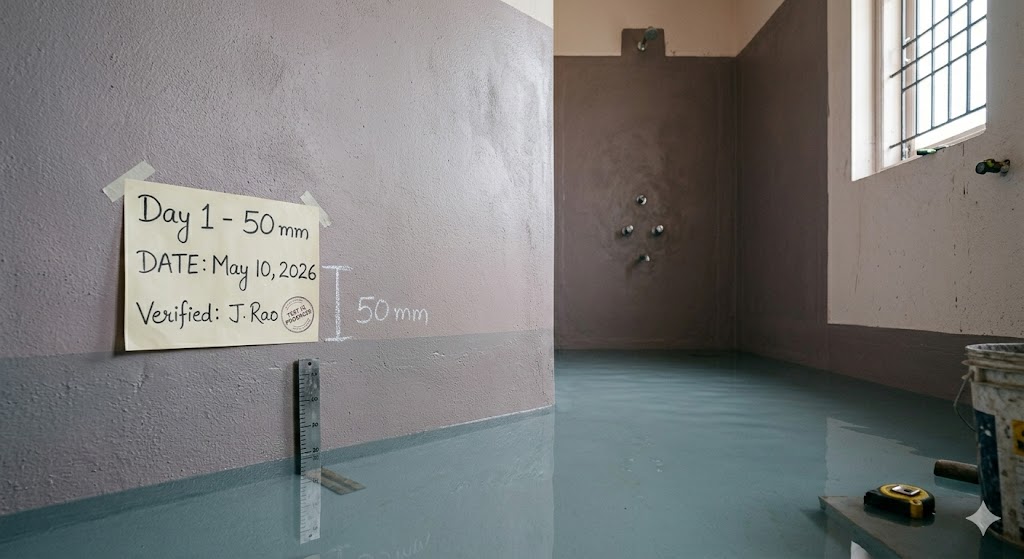
The 48-hour flood test is the only reliable verification before tiles go down. Skip this step and any defect — a missed corner, an unsealed drain — surfaces only after the bathroom is complete and far more expensive to fix.
Bathroom Waterproofing — Standard Procedure
| Step | Action | Material |
|---|---|---|
| 1 | Surface preparation | Clean concrete surface, remove loose material, fill cracks with polymer mortar |
| 2 | Primer application | Polymer primer — 1 coat |
| 3 | Corner and junction treatment | Embed waterproofing tape/fabric in corners (floor-wall, pipe penetrations) |
| 4 | First coat | Polymer-modified cementitious coating — apply horizontally |
| 5 | Second coat | Apply vertically (perpendicular to first coat) — after 4-6 hours |
| 6 | Wall application | Apply waterproofing up to 150mm above finished floor level on all walls, full height behind shower and on wet wall |
| 7 | Curing | Allow 24-48 hours curing before tile work |
| 8 | Flood test | Fill bathroom with 50mm of water for 48 hours. Check ceiling below for any dampness. |
| 9 | Tile laying | Use polymer-modified tile adhesive (not cement mortar) for wet areas |
| 10 | Grouting | Use epoxy grout or waterproof cementitious grout |
Bathroom Waterproofing Heights
| Area | Waterproofing Height |
|---|---|
| General floor | Full floor + 150mm up walls (minimum) |
| Shower area | Full height (floor to ceiling) |
| Behind WC | 300mm above WC connection |
| Basin/vanity wall | Up to 1200mm from floor |
| Wet wall (wall with concealed plumbing) | Full height |
| Door threshold | Create a 15-20mm hump to prevent water flowing out |
Common Bathroom Waterproofing Mistakes
| Mistake | Consequence | Prevention |
|---|---|---|
| Skipping waterproofing entirely | Ceiling below will show damp patches within 1-2 years | Non-negotiable — every bathroom must be waterproofed |
| Waterproofing only the floor | Water splashes on walls and seeps through | Apply on walls — 150mm minimum, full height in shower |
| Not treating corners and junctions | 80% of leaks occur at corners and pipe openings | Use waterproofing tape embedded in coating at all junctions |
| Using cement mortar for tiles instead of adhesive | Water passes through cement mortar joints | Use polymer-modified tile adhesive in all wet areas |
| Not doing flood test | Defects discovered only after tiles are laid | Always flood test for 48 hours before tiling |
| Normal grout instead of waterproof grout | Water seeps through grout lines | Use epoxy grout or waterproof cementitious grout |
Zone 3: Kitchen Waterproofing
Kitchens are semi-wet areas — not as wet as bathrooms, but water splashes, sink overflows, and pipe joints create moisture exposure.
Kitchen Waterproofing Checklist
- [ ] Below-sink area — waterproof coating on the floor and walls behind/below the sink (up to 600mm)
- [ ] Kitchen platform edge — waterproof sealant along the edge where the platform meets the wall (silicone or PU sealant)
- [ ] Backsplash zone — waterproof coating behind the backsplash tiles (up to 600mm above platform)
- [ ] Dishwasher area — waterproof tray or membrane under dishwasher
- [ ] Floor near sink — waterproof coating extending 1m around the sink area
- [ ] Utility/wash area — treat as a wet zone (same as bathroom specification)
Zone 4: External Walls
External wall dampness is the most visible waterproofing failure — it shows as paint peeling, salt deposits (efflorescence), and dark patches inside rooms.
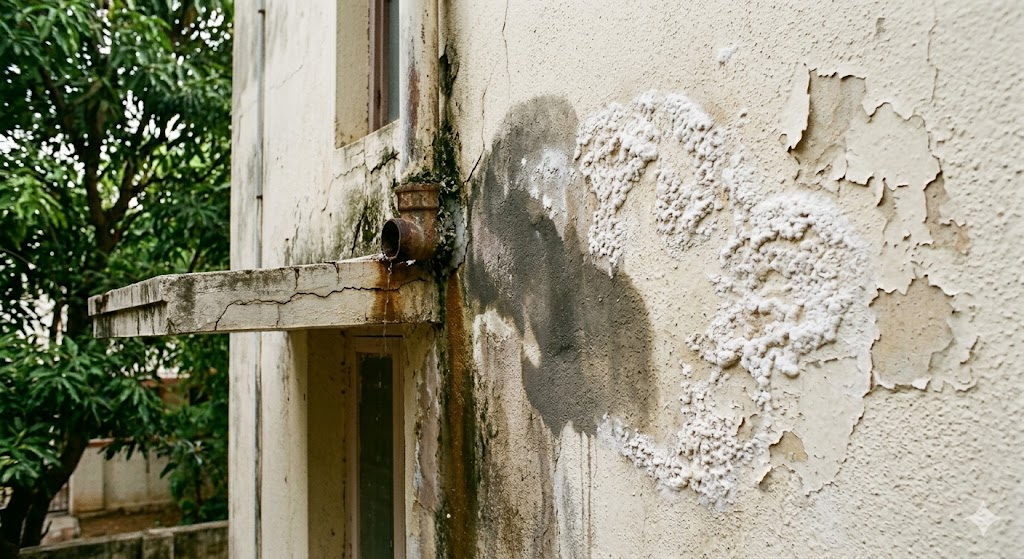
This is what skipping the silicone water repellent looks like five years on. The fix at this stage is a full re-treatment — surface preparation, silicone or elastomeric coating, sealant at every junction. Costs five to ten times what one preventive coat would have cost during construction.
Causes of External Wall Dampness
| Cause | Solution |
|---|---|
| Rain water penetration through porous plaster | External silicone-based water repellent coating |
| Window sill leaks — water enters at window frame junction | Drip mould below sill, sealant at frame-wall junction, sloped sill |
| Parapet wall cracks | Waterproof plaster + flexible sealant in cracks |
| Rising damp from ground | DPC (Damp Proof Course) at plinth level — bitumen or polymer membrane |
| Pipe penetrations through external wall | Waterproof collar around every pipe passing through wall |
| AC drain pipe leakage | Proper slope, sealed joint at wall penetration |
External Wall Treatment
| Method | Cost (₹/sqft) | Lifespan | Application |
|---|---|---|---|
| Silicone water repellent spray | ₹12-25 | 5-8 years | Transparent, doesn't change appearance. Apply on external plaster. |
| Elastomeric exterior paint | ₹25-40 | 8-12 years | Bridges hairline cracks. Premium exterior paints include this. |
| Polymer-modified plaster | ₹35-55 | 15-20 years | Waterproof plaster applied during construction |
| Cladding (stone/tile) | ₹80-200 | 20+ years | Physical barrier — best protection but expensive |
DPC (Damp Proof Course)
DPC prevents rising damp — groundwater travelling upward through the foundation and walls by capillary action.
| DPC Method | Material | Where Applied |
|---|---|---|
| Membrane DPC | Bitumen felt / HDPE sheet | At plinth level (between foundation and superstructure) |
| Chemical DPC | Silicone-based injection | Retrofit — injected into existing walls at ground level |
| Waterproof mortar DPC | Cement mortar 1:3 with waterproofing compound | At plinth level — 20mm thick layer |
Zone 5: Basement Waterproofing
Basement waterproofing is the most challenging because it must resist hydrostatic pressure — water pushing inward from the surrounding soil.
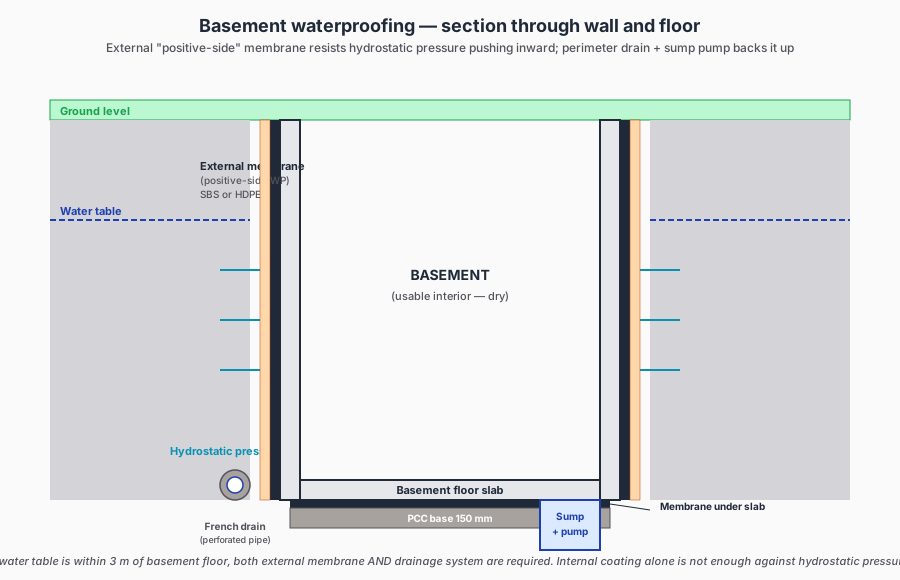
If the water table is within 3 m of the basement floor, both an external membrane and a drainage system are required — internal coating alone cannot resist hydrostatic pressure long-term.
Basement Waterproofing Methods
| Method | Application | Cost (₹/sqft) | Best For |
|---|---|---|---|
| External membrane (positive side) | Applied on the outside of basement walls before backfilling | ₹80-150 | New construction — most effective |
| Crystalline waterproofing | Applied on internal or external concrete surface | ₹40-70 | New construction + retrofit |
| Internal coating (negative side) | Applied inside the basement after construction | ₹50-90 | Retrofit when external access is impossible |
| Bentonite clay sheet | Placed outside basement walls — swells on water contact to form seal | ₹60-100 | High water table areas |
| Drainage system | French drain + sump pump around the perimeter | ₹200-500/running metre | High water table — combined with membrane |
Basement Waterproofing Sequence
1. Soil investigation — determine water table level. If water table is within 3m of basement floor, serious waterproofing is needed.
2. PCC base — lay 150mm PCC under basement floor slab.
3. Membrane on PCC — apply waterproofing membrane on PCC before casting basement floor slab.
4. Cast basement slab — with integral waterproofing compound in concrete mix.
5. Cast basement walls — with integral waterproofing compound.
6. External membrane — apply membrane on external face of basement walls (extend 300mm above ground level).
7. Protection board — place a protection board over external membrane before backfilling (to prevent damage from stones in soil).
8. Drainage — install perimeter French drain with sump pump at the lowest point.
9. Backfill — carefully backfill with clean soil, no sharp stones.
Zone 6: Water Tanks
Overhead and Underground Water Tanks
| Type | Waterproofing Method | IS Code | Cost |
|---|---|---|---|
| RCC overhead tank | Internal: Epoxy coating or crystalline waterproofing. External: Waterproof plaster. | IS 3370 (tank design), IS 2645 (waterproofing) | ₹50-80/sqft (internal) |
| RCC underground tank | Internal: Epoxy or food-grade PU. External: Membrane waterproofing. | IS 3370 | ₹60-100/sqft |
| Plastic tank (Sintex/Roto) | Pre-waterproofed, no additional treatment needed | IS 12701 | — |
Water Tank Waterproofing Tips
- Use food-grade waterproofing materials for potable water tanks
- Curing — new RCC tanks must be cured for minimum 14 days before waterproofing
- Leak test — fill tank completely and hold for 7 days. Water level should not drop more than 25mm (allowing for evaporation).
- Inlet/outlet pipes — all pipe penetrations must be sealed with puddle flanges cast into the concrete (not just sealant)
Zone 7: Balconies and Sit-Outs
Balconies are often forgotten until the ceiling below shows damp stains.
| Treatment | Detail |
|---|---|
| Floor slope | Minimum 1:100 toward outer edge or drain |
| Waterproofing | Polymer cementitious coating — same as bathroom floor |
| Railing base | Waterproof seal around railing post penetrations |
| Drip edge | Provide drip groove on the underside of the balcony slab edge to prevent water running back along the soffit |
| Planter boxes | Internal waterproofing + drainage layer before adding soil |
Brands and Products
Top Waterproofing Brands in India
| Brand | Key Products | Strengths |
|---|---|---|
| Dr. Fixit (Pidilite) | LW+, Fastflex, Roofseal, Pidicrete URP | Market leader, widest range, available everywhere |
| Fosroc | Nitoproof, Hydroproof, Renderoc | Premium quality, technical support, NABL tested |
| BASF (Master Builders) | MasterSeal, MasterProtect | International quality, strong technical team |
| Sika | SikaTop Seal, Sika Proof | Swiss quality, comprehensive range |
| Asian Paints SmartCare | Damp Proof, Crack Filler | Consumer-friendly, retail availability |
| Berger Homeshield | Damp Guard, IWL | Good retail range |
| Sunanda Global | Polyalk, STP | Strong in membrane systems |
| CICO Technologies | Raincoat, Plast | Good for cementitious systems |
Product Recommendations by Zone
| Zone | Recommended Product Type | Example Products |
|---|---|---|
| Terrace (new) | APP membrane + protective screed | Dr. Fixit Torchshield, Fosroc Nitoproof 110 |
| Terrace (retrofit) | PU liquid membrane or acrylic coating | Dr. Fixit Roofseal, Sika Sikalastic 560 |
| Bathroom | Polymer cementitious + waterproof tape | Dr. Fixit Bathseal, Fosroc Hydroproof |
| Basement | Crystalline + external membrane | Fosroc Renderoc, BASF MasterSeal 501 |
| External walls | Silicone water repellent | Dr. Fixit Dampguard, Asian Paints SmartCare Damp Proof |
| Water tank | Epoxy or food-grade PU | Fosroc Nitoproof FGP, BASF MasterSeal 588 |
Cost Summary
Waterproofing Cost for a Typical 2400 sqft (G+1) House
| Zone | Area (approx.) | Rate (₹/sqft) | Total Cost |
|---|---|---|---|
| Terrace (APP membrane + screed) | 1200 sqft | ₹55 | ₹66,000 |
| Bathrooms (4 nos, polymer cementitious) | 280 sqft | ₹35 | ₹9,800 |
| Balconies (2 nos) | 120 sqft | ₹30 | ₹3,600 |
| External walls (silicone repellent) | 2000 sqft | ₹18 | ₹36,000 |
| Kitchen wet area | 60 sqft | ₹30 | ₹1,800 |
| DPC at plinth | 150 running ft | ₹15/rft | ₹2,250 |
| Water tank (internal epoxy) | 100 sqft | ₹60 | ₹6,000 |
| Total | — | — | ₹1,25,450 |
For a house costing ₹55 lakh to construct, this is approximately 2.3% of construction cost — a small investment that prevents lakhs in future repair.
Maintenance Schedule
| Zone | Inspection | Frequency | Action If Needed |
|---|---|---|---|
| Terrace | Check for cracks, ponding water, blocked drains | Every monsoon (June-July) | Seal cracks with PU sealant, clear drains |
| Terrace coating | Check for peeling, blistering, wear | Every 2-3 years | Recoat with acrylic or PU liquid membrane |
| Bathrooms | Check grout lines, sealant at shower, drain function | Annually | Regrout with waterproof grout, reseal silicone |
| External walls | Check for paint peeling, efflorescence, damp patches | Every monsoon | Reapply silicone repellent every 5-8 years |
| Balconies | Check slope, drain, railing base | Every monsoon | Reseal cracks, clear drain |
| Water tank | Check for leaks, internal coating condition | Every 2 years | Recoat if necessary |
| Basement | Check for seepage, sump pump function | Every monsoon | Activate sump pump, check drainage |
Common Mistakes
1. Skipping waterproofing to save cost — the most expensive mistake. ₹1.25 lakh now prevents ₹10-15 lakh in repairs later.
2. Waterproofing after tiling — waterproofing must be done before tiles in bathrooms. Applying on top of tiles is a band-aid, not a solution.
3. Using one product for all zones — terrace needs membrane, bathroom needs cementitious coating. Each zone has specific requirements.
4. Not doing flood test — the only way to verify bathroom waterproofing before tiling.
5. Ignoring corner and junction treatment — 80% of leaks occur at junctions. Use fabric tape embedded in coating.
6. No slope on terrace — water must drain, not pond. Minimum 1:100 slope toward outlets.
7. Skipping external wall treatment — rain-driven moisture enters through porous plaster. A simple silicone spray prevents it.
8. No DPC at plinth — rising damp makes ground-floor walls permanently damp. DPC is cheap and essential.
9. Hiring unskilled labour — waterproofing is a specialised trade. Always use manufacturer-trained applicators.
10. Ignoring warranty — reputable waterproofing contractors offer 5-10 year warranties. Insist on a warranty certificate.
Key Takeaways
- Waterproofing costs 1-2% of construction but prevents 10-15% in future repairs — it is the highest-ROI investment in construction
- Every zone needs a different system — terrace (membrane), bathroom (cementitious), basement (membrane + drainage), walls (silicone)
- Do it during construction, not after — retrofit waterproofing is 5-10x more expensive and less effective
- Flood test every bathroom for 48 hours before tiling — the only reliable verification method
- Junction treatment prevents 80% of leaks — corners, pipe penetrations, and wall-floor joints need special attention
- Use manufacturer-trained applicators — waterproofing is only as good as its application
- Inspect every monsoon — early detection of small cracks prevents major leakage
- Insist on warranty — 5-10 years from the waterproofing contractor, separate from the building contractor
References:
- IS 14767:2000 — Specification for Elastomeric Modified Bitumen Waterproofing Membrane
- IS 2645:2003 — Integral Cement Waterproofing Compounds
- IS 3370 — Code of Practice for Concrete Structures for Storage of Liquids
- IS 456:2000 — Plain and Reinforced Concrete (durability and waterproofing provisions)
- CPWD Specifications Vol. 2 — Waterproofing chapter
- NBC 2016, Part 7 — Constructional Practices and Safety
- Dr. Fixit (Pidilite) — Technical Guidelines and Product Data Sheets
- Fosroc India — Waterproofing Solutions Manual
- BASF Master Builders Solutions — Waterproofing Handbook
- Sika India — Technical Data Sheets
- CBRI Roorkee — Building Maintenance Studies
Interactive · Waterproofing zone explorer
Terrace / Roof · Very High vulnerability
Tell-tale symptoms
- • Damp patches in top-floor ceilings
- • Salt deposits on inside walls
- • Bubbling paint
Warranty window
10-15 years (PU) · 20+ years (EPDM)
Indicative cost
₹140-340 inclusive of slope correction
Material options
PU coating + APP membrane
₹140-220/sqft
Best for: Flat slabs
Brickbat coba + IPS
₹180-280/sqft
Best for: Traditional Indian terraces
EPDM membrane
₹220-340/sqft
Best for: Heavy-rainfall regions
Design note: Most failure-prone surface in any Indian building. Always slope to outlets at 1:80; check drains every monsoon; never compromise on the chajja-to-slab joint detail.
Export this guide
Related Guides — Deep-dive reading
Bathroom Leak Prevention India: Detailing the Junctions That Stop Water Reaching the Flat Below
Bathroom leaks almost never come from a broken pipe — they come from a badly detailed junction. Here is how to get the wall-floor corner, pipe penetrations, floor trap, nahani trap and door threshold right, plus the flood test that catches a leak before you tile.
BathroomsBathroom Waterproofing Failure in India: Causes, Diagnosis & Fixes (2026)
Why bathroom waterproofing fails in Indian homes — poor surface prep, thin coats, missed junctions, no membrane turn-up, damage during tiling — how to read the symptoms, and whether a surface fix or a full redo is the right remedy.
BathroomsBathroom Waterproofing India: The Complete Guide to Membranes, Detailing, Testing & Cost
Why and where bathrooms leak, the full waterproofing system layer by layer, how the membrane types compare, the critical junction detailing, the flood test, warranties, and honest ₹ per sq ft costs for an Indian home.
BathroomsRelated Tools — Try Free
Monsoon-Readiness Checklist
Pre-rain home audit across 9 categories — terrace, drains, waterproofing, electrical, HVAC, pest, vehicles, documents.
Seasonal AuditPlumbing Pressure-Test & Leak Checklist
Pre-closure pressure and leak test — 9 categories, 60+ checkpoints across water supply, drainage, fixtures, waterproofing, hot water, tanks.
Pre-Closure TestBathroom Waterproofing Calculator
Work out waterproofing material (kg/L) and cost for a bathroom by area, wall band, system type and coats — cementitious, acrylic, PU or SBR.
Bathroom Calculator