
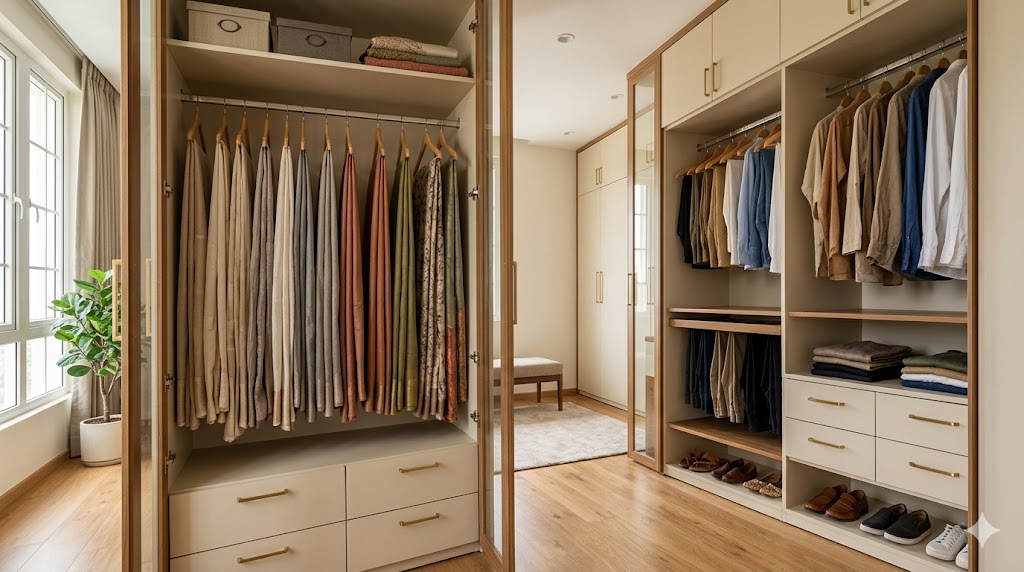
Storage Planning as a Design Discipline
Why Storage Is a Layout Problem, Not a Cabinetry Problem — Volumes, Anthropometrics, Typologies, and the Indian Family Lifecycle
Storage is the most under-designed system in the Indian residential project. Architects spend weeks resolving facade composition, plan flow, and structural grids, then reduce storage to a line item in the BOQ — "wardrobes — modular — as per client selection" — and hand the problem to a kitchen-and-wardrobe vendor whose grammar is fundamentally a finishes catalogue, not a planning discipline.
The result, repeated across thousands of completed homes, is the same: clients report after eighteen months of occupancy that they have too little storage in the rooms where they need it most, too much in rooms where it consumes valuable floor area, and storage that is dimensioned for a generic Western body when half the family wears sarees that hang to 1700 mm and stores ghee tins that need 250-mm internal clearance. The cabinetry is well-finished. The storage is wrong.
This guide reframes storage as what it actually is in residential architecture: a layout problem that must be resolved at plan stage, alongside structural grids and circulation, before a single cabinetry vendor is consulted. It is intended for practising architects and interior designers who want to design storage with the same rigour they apply to daylighting and HVAC — using inventory typologies, volume benchmarks, anthropometric reach zones, and India-specific cultural and material constraints — and to commission cabinetry vendors with a complete brief rather than a blank cheque.
The companion guide Wardrobe Finish Ideas addresses surface and material selection. This guide addresses the layer underneath: what goes inside, where, and why.
"Storage is the silent half of every floor plan. The half that is visible in photographs is the half that has not been designed." — Christopher Alexander, in conversation, paraphrased from A Pattern Language (1977), Pattern 145 — Bulk Storage
1. Why Storage Is a Layout Problem
The default Indian residential workflow treats storage as a vendor-procured commodity: the architect resolves built-up area and circulation, the kitchen-and-wardrobe vendor returns three months later with module catalogues, and the client picks a finish. This sequencing has three structural failures.
First — storage volume is set before it is measured. A 2400 mm × 600 mm wardrobe in a 12-square-metre bedroom commits ~3.5 cubic metres of internal storage volume. Whether that volume matches the family's actual clothing inventory is a question that is rarely asked, because the dimension is set by what fits the wall, not what fits the contents. The walls of a bedroom are determined by the structural grid; the storage volume should not be.
Second — the modular grammar is generic. The dominant Indian modular vendors (Sleek, Hettich-systems integrators, Häfele resellers, regional brands) sell hardware that is fundamentally Italian and German in origin — calibrated for shirts on hangers in 600-mm-deep cabinets. The Indian saree, hung at 1700 mm length on a long-hang rod, requires a fundamentally different module height than a shirt-and-trouser system. The lehenga, the sherwani, the dhoti, the sari blouse pile — none of these were anthropometric inputs to the original European modular grammar.
Third — the finish-first mindset hides the planning failure. A poorly-planned wardrobe with a beautiful PU-lacquer external finish reads as premium in the photograph and frustrating in daily use. Clients accept the dissonance because the wardrobe was not presented to them as a planning problem in the first place. They were shown finishes, not layouts.
The fix is to insert a storage-planning stage between Stage 2 (preliminary design) and Stage 4 (working drawings) of the standard architectural workflow described in the Architect's Scope of Services guide. The stage produces three outputs: a per-room storage inventory, a per-room volume budget, and a per-cabinet internal-layout specification. Cabinetry vendors are then briefed against the specification, not the wall dimension.
2. The Pre-Design Storage Audit
The audit is a structured client interview, conducted alongside the standard programme-statement interview, that produces a storage-demand schedule. The schedule lists, by room, what the family actually owns and needs to store — by quantity, frequency of use, and dimensional sensitivity. It is the storage equivalent of the structural engineer's load calculation.
What the Audit Captures
For each storage zone — wardrobe, kitchen, utility, linen, archival — the audit captures four dimensions:
| Dimension | What It Means | Why It Matters |
|---|---|---|
| Inventory count | Number of items: shirts, sarees, books, kitchen vessels, kids' toys | Sets the volume requirement in cubic feet |
| Frequency of use | Daily / weekly / seasonal / archival | Determines zone allocation — golden zone vs dead zone |
| Item dimension | Largest dimension of the worst-case item | Sets minimum shelf depth and clear height |
| Cultural constraint | Saree drape, separate offering items, in-laws' belongings | Triggers India-specific module dimensions |
A useful first-pass questionnaire takes about 45 minutes per family and is best conducted in the family's existing home, where they can point to what they own and where they currently store it. The architect's Client Discovery form can be extended with a dedicated storage-audit appendix.
Eight Family-Lifecycle Stages
The volume requirement is not a single number — it varies sharply with the family's lifecycle stage. A pre-design audit must situate the project in one of eight stages:
1. Single occupant — minimal volume; high-frequency convenience matters more than depth
2. Young couple, no children — moderate volume; future expansion planned for in plan
3. Couple with infants (0–3 years) — explosive growth in linen, toys, medical supplies
4. Family with school-going children (4–12 years) — books, uniforms, sports equipment, seasonal cycling
5. Family with adolescents (13–18 years) — privacy storage, electronics, hobby equipment
6. Empty nest with adult children visiting — archival storage, returning-children inventory peaks
7. Multi-generational — in-laws or grandparents resident; parallel storage zones
8. Senior couple alone — shrinking active inventory, growing archival; accessibility constraints
A 2400 mm × 600 mm wardrobe is adequate for stage 1, cramped for stage 4, and over-built for stage 8. The audit pins down which stage applies now and which stages must be designable-into over the next 10 years — that is, the design horizon of the cabinetry, which typically outlasts the active stage of the family by one cycle.
3. Per-Typology Volume Benchmarks
The audit converts inventory counts into a volume budget. Indicative benchmarks for Indian families, drawn from anthropometric research at the National Institute of Design (NID) and from the storage-volume tables in Time Saver Standards for Building Types (Chiara & Crosbie, McGraw-Hill, 4th ed.), adjusted for Indian wardrobe contents:
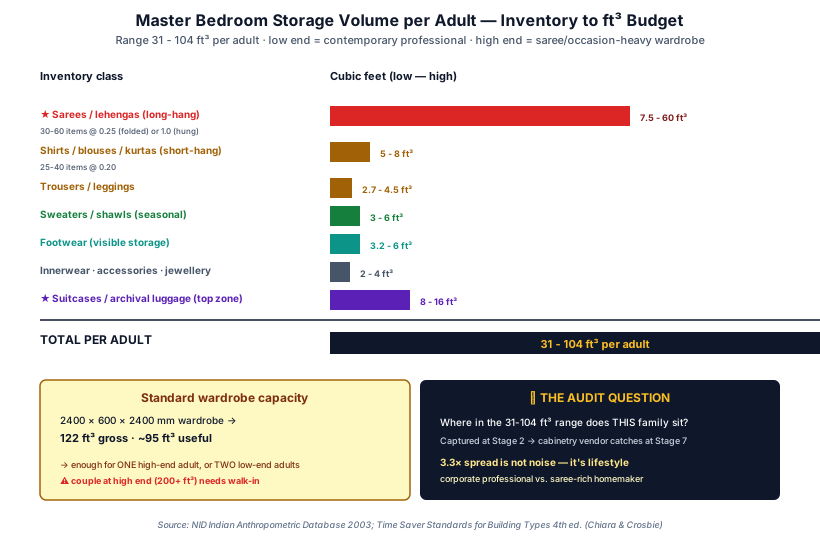
Master Bedroom — Storage Volume per Adult
| Item Class | Typical Count (per adult) | Volume per Item (cubic ft) | Total Volume (cubic ft) |
|---|---|---|---|
| Sarees / lehengas (long-hang) | 30–60 | 0.25 (folded in drawer) or 1.0 (hung) | 7.5–60 |
| Shirts / blouses / kurtas (short-hang) | 25–40 | 0.20 | 5–8 |
| Trousers / leggings (folded or hung) | 15–25 | 0.18 | 2.7–4.5 |
| Innerwear / hosiery (drawer) | continuous | drawer-bank allocation | 1.5–2.5 |
| Folded sweaters / shawls (seasonal) | 10–20 | 0.30 | 3–6 |
| Footwear (visible storage) | 8–15 pairs | 0.40 | 3.2–6 |
| Accessories, jewellery, watches | continuous | shallow tray allocation | 0.5–1.5 |
| Suitcases, archival luggage (top zone) | 2–4 | 4.0 | 8–16 |
| Total per adult | — | — | 31–104 cubic ft |
The wide range — a factor of 3.3 between the low and high end — is not statistical noise. It is the difference between a corporate professional with a contemporary wardrobe and a homemaker with an inherited and occasion-rich wardrobe. The audit pins down where the specific client sits in the range, before any volume is committed in plan.
A 2400 mm × 600 mm × 2400 mm tall wardrobe provides roughly 122 cubic feet of gross internal volume; useful storage volume after accounting for shelf and rail clearances is approximately 95 cubic feet. For a couple at the high end of the range — 200+ cubic feet of demand — a single bedroom-wall wardrobe is structurally inadequate. The plan must accommodate either a walk-in wardrobe, a second wall of cabinetry, or a dedicated dressing room. The audit catches this at Stage 2; the vendor catches it after move-in.
Kitchen — Storage Volume Drivers
Kitchen storage demand in Indian homes is driven by three categories that are largely absent from European modular catalogues:
- Bulk grain and pulse storage — atta, rice, dal: 5–15 kg containers per type, 4–8 types active = 40–120 kg dead-load volume
- Spice and condiment storage — masala dabbas, ghee tins, oil bottles: 30–80 distinct items
- Vessel and utensil storage — pressure cookers, pans, kadhais, idli stands, dosa tawas: 20–40 items, several oversized
The detailed kitchen sub-discipline is treated in §6, including the layout-relevant cabinetry modules, but for plan-stage budgeting the rule of thumb is: Indian residential kitchen storage requires 35–45% more cubic-foot volume than the standardised European modular catalogue assumes for a 4-person family.
4. Anthropometric Foundations — Reach Zones
The next layer of the storage discipline is where in the cabinetry volume each inventory class is placed. The principle is anthropometric: human reach is not uniform across a 2400-mm-tall cabinet. There are zones of high accessibility and zones of low accessibility, and matching frequency-of-use to zone is the core of internal layout design.
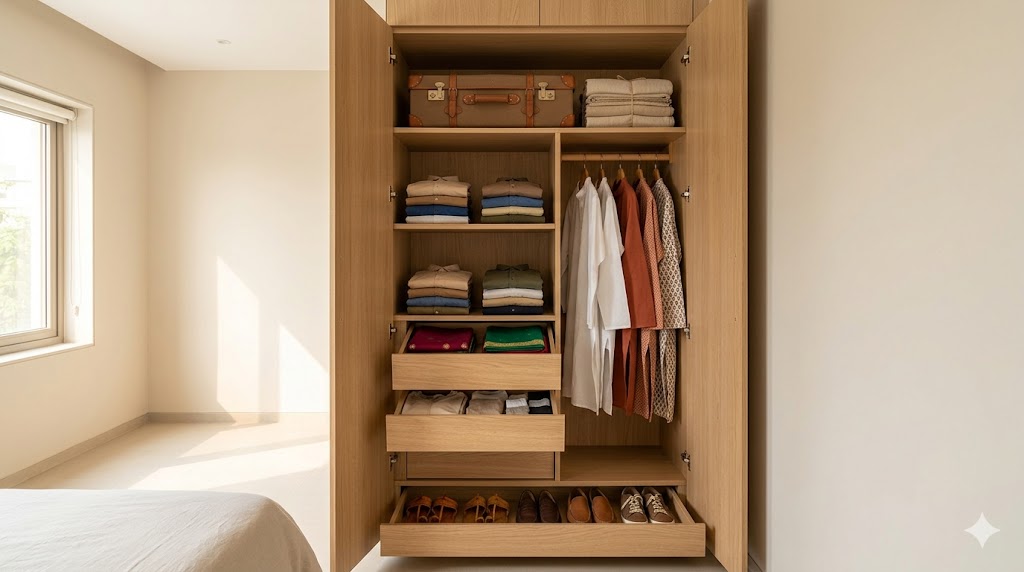
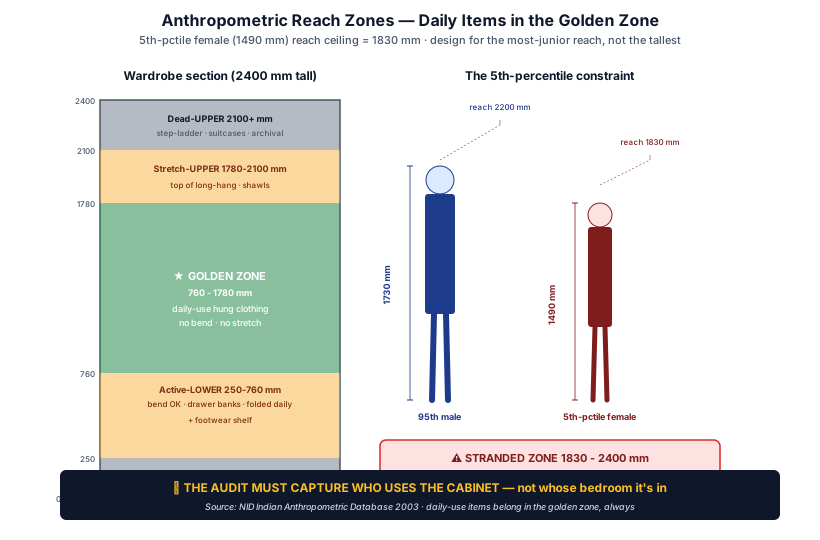
The Four Reach Zones
For a standing adult (95th percentile Indian male: 1730 mm; 5th percentile Indian female: 1490 mm; reference: NID Indian Anthropometric Database 2003), a 2400-mm-tall cabinet partitions into four zones:
| Zone | Height Range (AFL) | Reach Quality | Appropriate Contents |
|---|---|---|---|
| Dead — Lower | 0 – 250 mm | Squat-required, daily access painful | Archival, infrequent items: spare suitcases, off-season blankets |
| Active — Lower | 250 – 760 mm | Bend-required but sightline preserved | Daily folded clothing, drawer banks, footwear |
| Golden Zone | 760 – 1780 mm | No bend, no stretch; eye-level + shoulder-level | Daily-use hung clothing, shirts, blouses, kurtas, daily jewellery |
| Stretch — Upper | 1780 – 2100 mm | Stretch required; tip-toe for short occupants | Long-hang items (sarees, lehengas — top of the rod sits here) |
| Dead — Upper | 2100 – 2400+ mm | Stool or step-ladder required | Suitcases, archival linen, occasion-only items |
The principle is that daily-use items must be in the golden zone. The dressing-up sequence — shower, towel, daily underwear, daily shirt or blouse, daily trousers or saree — must be possible without bending or stretching. Anything that requires a stool to access is, by definition, not for daily use.
The 5th-Percentile Constraint
In a multi-generational Indian household, the storage must be accessible to the 5th-percentile female — typically a 1490-mm-tall grandmother or mother-in-law. Her comfortable reach ceiling is approximately 1830 mm; her step-up reach (using the lower drawer as a step, which is unsafe but widely practised) reaches 2100 mm.
If the cabinetry is dimensioned for the 95th-percentile male (whose comfortable reach reaches 2200 mm without stretch), the upper third of the cabinet becomes effectively unusable for the most senior generation. The audit must capture who in the household uses this cabinet, not just whose bedroom it is.
5. Wardrobe Internal Layout — The Modular Grammar
With the volume budget set (§3) and the zone strategy established (§4), the wardrobe internal layout becomes a constrained optimisation. The grammar has eight modular elements, each with anthropometrically-derived dimensions:
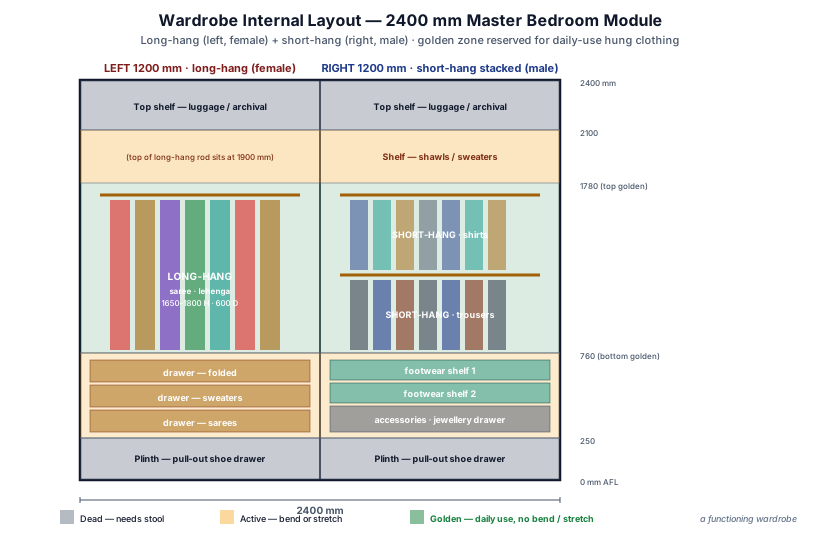
Module Dimensions for Indian Wardrobes
| Module | Internal Height (mm) | Internal Depth (mm) | Hung or Folded | India-Specific Note |
|---|---|---|---|---|
| Long hang (saree, lehenga, sherwani, gown) | 1650–1800 | 600 | Hung | Saree on padded hanger occupies 600 mm depth comfortably |
| Short hang (shirts, blouses, kurtas, trousers) | 1050–1200 | 600 | Hung | Two short-hang stacks fit one long-hang height |
| Coat / overcoat hang | 1400–1500 | 600 | Hung | Rare in Indian climate; sherwani uses long-hang |
| Folded shelf (regular) | 350 (between shelves) | 450 | Folded | Folded shirt requires 350-mm clear height |
| Folded shelf (deep) | 450 | 600 | Folded | For folded sarees on saree-ledge or shawls |
| Drawer bank (shallow) | 100–150 | 450 or 600 | Loose | Innerwear, accessories, jewellery |
| Drawer bank (deep) | 200–300 | 600 | Loose | Folded sarees, sweaters, blouses |
| Footwear shelf | 200–250 | 350–400 | Visible | Heel-up storage saves 25% depth |
The grammar combines as follows. A typical master bedroom 2400-mm-wide wardrobe with long-hang for the female partner and short-hang for the male partner:
| Zone (height AFL) | Width 0–1200 mm | Width 1200–2400 mm |
|---|---|---|
| 2100–2400 mm (Dead-Upper) | Top shelf — luggage, archival linen | Top shelf — same |
| 1780–2100 mm (Stretch) | (Top of long-hang rod sits at 1900 mm) | Stretch shelf for shawls |
| 760–1780 mm (Golden) | Long-hang rod (saree, lehenga) | Short-hang rods stacked: shirts above, trousers below |
| 250–760 mm (Active-Lower) | Drawer bank — 3 deep drawers | Footwear shelves + accessories drawer |
| 0–250 mm (Dead-Lower) | Plinth — pull-out shoe drawer | Plinth — same |
This is a functioning wardrobe — not a beautiful one, not yet. It is a wardrobe that can be photographed against, lit, finished in PU lacquer or HPL or veneer, and given any number of finish-stage details — but the underlying layout is what makes it work. The companion Wardrobe Finish Ideas guide takes the conversation into materials and finishes once this skeleton is set.
The Studio Matrx Storage Calculator utility produces this kind of zone-by-module schedule from inventory inputs and is intended as a Stage-2-to-Stage-4 worksheet for the architect.
6. Kitchen Storage Discipline
The Indian residential kitchen is the storage zone where the gap between European modular catalogues and actual demand is widest. The base, wall, and tall-unit modules are dimensionally similar; the internal fitments must be specified differently.
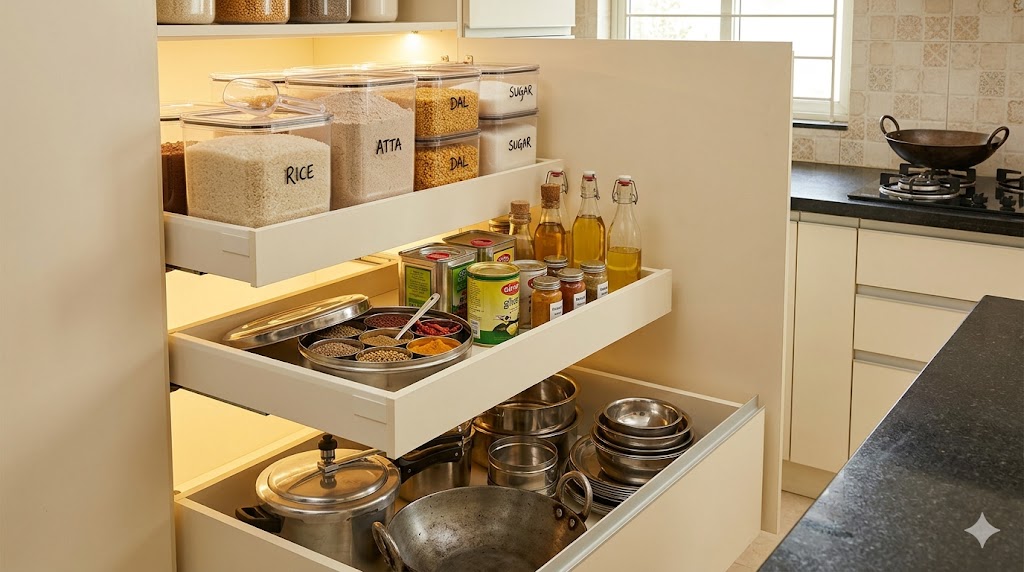
The Three-Cabinet Kitchen System
The standard kitchen has three cabinet zones:
- Base cabinets — 850 mm height + 100 mm skirting; 600 mm depth; below counter
- Wall cabinets — 700–900 mm height; 350 mm depth; bottom at 1450–1500 mm AFL
- Tall units — 2150 mm or to ceiling; 600 mm depth; floor-to-near-ceiling pantry
The tall unit is the most under-specified element. A kitchen with two 600-mm-wide tall units (one for bulk pantry, one for tall vessels and oversized appliances like the food-processor and stand-mixer) addresses 60–70% of the India-specific kitchen storage demand that base-and-wall-only kitchens leave stranded on the counter.
India-Specific Internal Fitments
The internal fitments that must be specified beyond the European default:
| Fitment | Dimension | Purpose |
|---|---|---|
| Atta drawer (deep) | 300 mm clear height; 600 mm depth | 5–10 kg atta sealed container with scoop |
| Bulk grain pull-out | 1500–1800 mm height; 200–300 mm width | 4 stacked containers for rice, dal, sugar, salt |
| Masala dabba shelf | 100–120 mm clear; 350 mm depth | Standing masala canister with 8-compartment plate |
| Ghee / oil tin shelf | 250–300 mm clear height; 350 mm depth | 5-litre ghee tin standing |
| Vessel deep drawer | 250–300 mm clear height; 600 mm depth | Pressure cooker, kadhai, large vessels |
| Idli stand vertical | 350 mm clear height; 350 mm depth | Idli plate stack vertical, separator dividers |
| Pooja item shelf | 300 mm clear height; 350 mm depth | Brass diyas, agarbatti stand, offering plates — segregated |
The pooja-item shelf is a culturally important constraint that European catalogues do not anticipate. Many Indian families maintain a separation between food-preparation and offering items that must be respected dimensionally — typically a dedicated cabinet, often near the pooja room rather than the kitchen. The architect's plan must accommodate the adjacency.
The kitchen MEP coordination — water supply to the wash zone, drainage from the sink, electrical for the chimney and cooking range, ventilation ducting — is treated in detail in the Residential MEP Coordination guide, which the storage layout must be coordinated against. Wet zones (sink and dishwasher) and bulk-storage zones (atta, dal containers) have incompatible cabinet specifications — IS 710 BWP plywood for wet, IS 303 MR plywood for dry, as specified in the Engineered Wood Lifecycle Costing guide.
7. Utility, Linen, and Housekeeping Storage
The utility zone is the second most under-designed storage discipline in Indian residential plans. It is typically reduced to "3'×6' utility balcony" in the architect's drawings, and its storage burden — washing equipment, drying rack, ironing setup, cleaning supplies, plumbing tool kit, brooms, mops, vacuum, possibly a second pantry — is left to the homeowner to resolve after move-in.
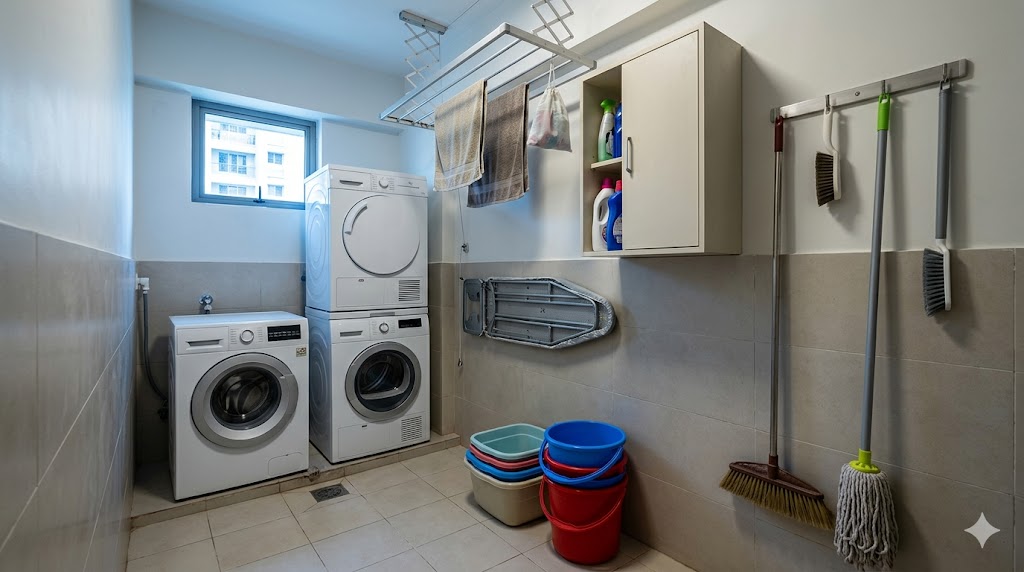
Utility Zone Inventory
A complete utility zone for a four-person Indian family must accommodate, at minimum:
| Item | Footprint (mm × mm) | Storage Type |
|---|---|---|
| Washing machine (front-load) | 600 × 600 | Floor — dedicated zone |
| Dryer (vented or condenser) | 600 × 600 | Stacked above WM, or adjacent |
| Ironing board (foldable) | 1500 × 350 (folded: 1500 × 50) | Wall-hung bracket |
| Drying rack (retractable) | 1500–2000 × 50 (extended: 1500 × 800) | Ceiling-mounted; hand-pull |
| Cleaning supply shelf | 600 × 300 | Wall cabinet, lockable for child safety |
| Broom-and-mop rail | 800 × 100 | Wall rail at 1500 mm AFL |
| Vacuum cleaner storage | 400 × 400 floor | Floor cabinet or alcove |
| Bucket-and-utility-tub stack | 600 × 400 | Floor — under-counter |
| Plumbing tool kit | 400 × 250 | Wall cabinet — adjacent to drainage stack |
The utility zone must also accommodate access to the drainage stack for periodic cleaning (a code requirement under NBC 2016 Part 9) and to the water-heater geyser if located here. Storage cabinetry must not block the access panels.
The Linen Cupboard
The linen cupboard is a separate specification — a 1200 mm × 600 mm × 2400 mm tall cabinet, ideally near the bedrooms, that stores: bed linen sets (8–12 sets), bath towels (15–25 pieces), face towels (15–25), table linen (occasional), and cleaning rags (segregated). The fitment is mostly folded shelves at 350-mm clear, plus a dedicated linen-hamper drawer at the base.
In compact apartments where a separate linen cupboard is impossible, the linen migrates to the master-bedroom wardrobe top shelf. This is a contingency solution — it works, but it consumes the dead-upper zone that would otherwise hold archival luggage. The audit must explicitly choose between a dedicated linen cupboard and this contingency, at plan stage.
8. The Children's Room Storage Lifecycle
The children's room is the storage zone with the steepest demand curve over time. A single room serves a child from infancy to early adulthood — roughly 20 years — across which the storage requirement triples and shifts in character.
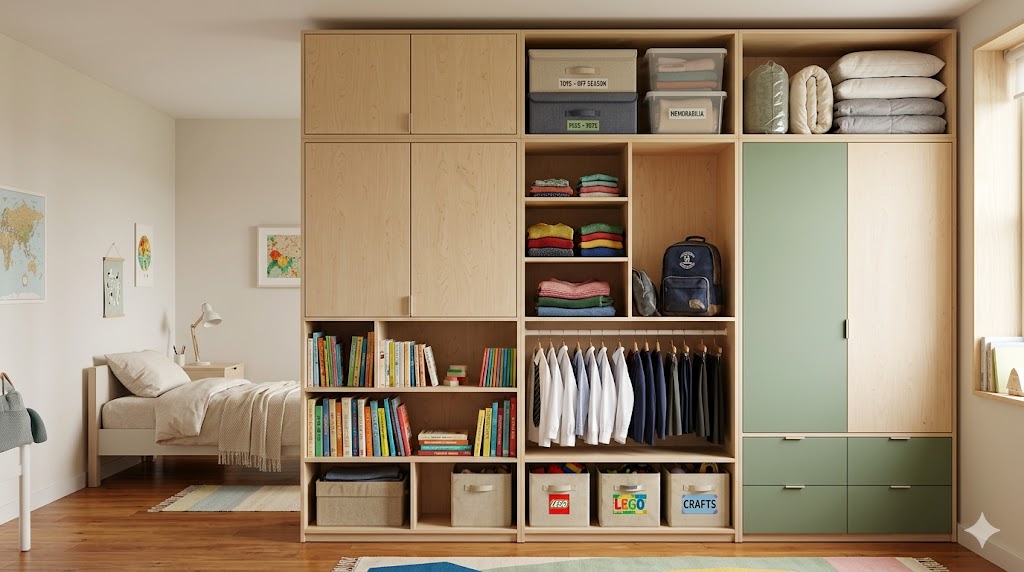
The Five-Stage Progression
| Stage | Age | Storage Character | Anthropometric Reach |
|---|---|---|---|
| Infant | 0–2 | Linen-heavy; toys low-volume; no clothing variation | Adult parent reach |
| Toddler / preschool | 3–5 | Toys explode; clothing minimal; books begin | Child reach: 800 mm |
| Primary school | 6–11 | Books dominate; uniforms; sports equipment; toys persist | Child reach: 1100 mm |
| Middle school | 12–14 | Books peak; electronics begin; sports peak | Near-adult reach: 1400 mm |
| Senior school / pre-college | 15–18 | Privacy storage; electronics; reduced toys; expanded clothing | Adult reach |
The storage cabinet that serves an infant cannot serve a senior-school student. The two solutions are:
Solution A — modular reconfigurable system. A storage unit built on a 600-mm grid with re-positionable shelves and rails. The rails and shelves move every 3–5 years as the child grows. This is the structurally correct solution — but commits the storage to a flexible-fitment hardware system that costs 25–40% more than fixed cabinetry.
Solution B — overbuilt infant-stage cabinetry that gets re-purposed. A standard adult-grade wardrobe is installed at infancy and the lower zone is treated as a temporarily inaccessible zone — the child uses the bottom drawers and shelves only. As the child grows, more zones become accessible. By age 12, the entire cabinet is in use.
Solution B is the more economical option and is widely used in Indian residential practice. Solution A is the higher-design-quality option and is appropriate when budget allows or when the client explicitly wants to design for the full 20-year horizon.
The Sibling Question
If the room is shared between siblings, the storage capacity must be doubled or the room must be designable-into a partition at the middle-school stage. The plan must accommodate the ability to install a partition wall on a structural grid that supports it; the storage must be designable so that splitting the room does not strand storage volume on the wrong side of the partition.
This is a Stage-2 plan-stage question. If raised at Stage 4, the answer is "we will figure it out later" — and the family figures it out by buying free-standing cabinetry that consumes 25% of the floor area for the next decade.
9. Material and Hardware Specification
The storage cabinetry's longevity is set primarily by the carcass material and the hinge/slide hardware. The detailed treatment is in the Engineered Wood Lifecycle Costing guide; the storage-specific summary follows.
Carcass Material — IS Code Reference
| Application | Material | IS Code | Lifespan |
|---|---|---|---|
| Bedroom wardrobe | MR plywood (moisture resistant) | IS 303 | 15–20 years |
| Kitchen base cabinets (wet) | BWP plywood (boiling-water-proof) | IS 710 | 20–25 years |
| Kitchen wall cabinets (dry) | MR plywood | IS 303 | 15–20 years |
| Utility cabinets | BWP plywood | IS 710 | 20–25 years |
| Children's room (high abuse) | MR plywood with HPL surfacing | IS 303 + IS 2046 | 12–18 years |
| Linen cupboard | MR plywood | IS 303 | 15–20 years |
The substitution of MDF or particle board for plywood is a 30–40% material-cost saving with a 50–60% reduction in lifespan. For built-in cabinetry that is integral to the architecture (full-height wall units, walk-in wardrobe carcass), this is a poor trade-off. For loose-fit cabinetry (free-standing chests, supplementary bookcases), MDF or particle board is acceptable.
Formaldehyde emission classification — E0, E1, E2, CARB Phase 2 — is a separate health-and-IAQ consideration treated in detail in the Engineered Wood Lifecycle Costing guide. For children's rooms and bedrooms, E1 or E0 rated boards are strongly preferred over E2.
Hinge and Slide Hardware — IS Code Reference
| Hardware | IS Code | Cycle Rating | Application |
|---|---|---|---|
| Standard cabinet hinge | IS 8743 (Category B) | 60,000 cycles | Bedroom wardrobe shutter |
| Heavy-duty hinge | IS 8743 (Category A) | 80,000–120,000 cycles | Kitchen tall units, daily-access shutter |
| Soft-close hinge | IS 8743 + EN 15570 | 80,000+ cycles | Premium bedroom and kitchen |
| Standard drawer slide | IS 1828 | 30,000 cycles | Bedroom drawer banks |
| Full-extension slide | EN 15338-2 (no Indian eq.) | 40,000–80,000 cycles | Kitchen pull-out, pantry, deep utility drawer |
| Tandem-box drawer system | EN 15338-2 | 80,000+ cycles | Premium kitchen, soft-close |
Hardware is the hidden lever that converts a competent cabinet into a premium one. The same plywood carcass with Category-A soft-close hinges and tandem-box drawers performs visibly differently than the same carcass with Category-B hinges and stamped-steel slides. The cost premium is 12–18% of total cabinetry cost; the performance and longevity premium is two-fold or more.
10. Cost vs Lifecycle — Built-In, Loose-Fit, and Hybrid
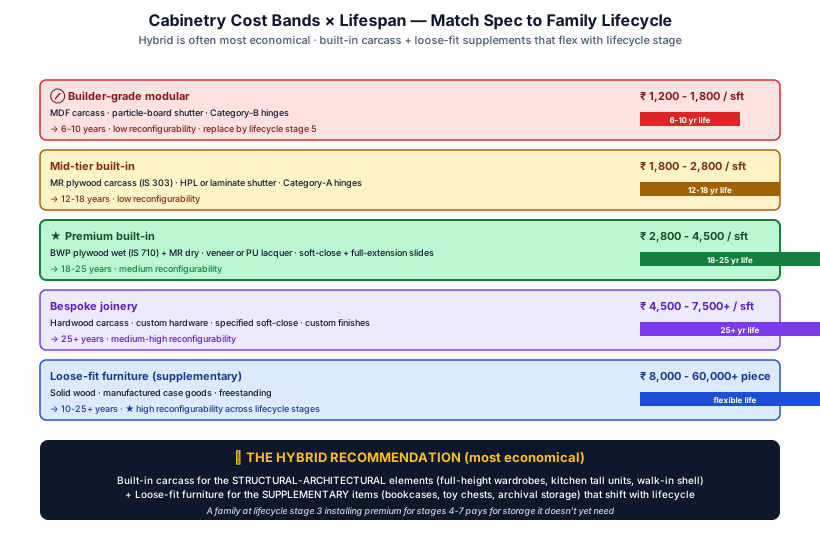
The total residential storage cost typically lands in three bands:
| Band | Cost (₹/sft of cabinetry face area) | Material + Hardware | Lifespan | Reconfigurability |
|---|---|---|---|---|
| Builder-grade modular | 1,200–1,800 | MDF carcass, particle-board shutter, Category-B hinges | 6–10 years | Low |
| Mid-tier built-in | 1,800–2,800 | MR plywood carcass, HPL or laminate shutter, Category-A hinges | 12–18 years | Low |
| Premium built-in | 2,800–4,500 | BWP plywood (wet) / MR plywood (dry), veneer or PU lacquer, soft-close, full-extension slides | 18–25 years | Medium |
| Bespoke joinery | 4,500–7,500+ | Hardwood carcass, custom hardware, specified soft-close, custom finishes | 25+ years | Medium-High |
| Loose-fit furniture | (per piece, 8,000–60,000+) | Solid wood, manufactured case goods, freestanding | 10–25+ years | High |
The plan-stage decision is not purely about budget. It is about the relationship between the family's life-cycle stage and the cabinetry's life-cycle stage. A family at lifecycle stage 3 (couple with infants) installing premium built-in cabinetry for stages 4–7 will pay for storage they do not yet need; the same family installing builder-grade modular will replace the cabinetry by stage 5.
The hybrid solution is widely the most economical: built-in carcass for the structural-architectural elements (full-height wardrobes, kitchen tall units, walk-in wardrobe shell) at the mid-tier-to-premium band, and loose-fit furniture for supplementary needs (bookcases, toy chests, archival storage) that can be replaced as life-cycle stages shift.
The Studio Matrx Material Compare utility produces lifecycle-cost comparisons for the carcass-and-hardware combinations above.
11. The Vastu and Cultural Interface
A complete storage discipline for the Indian context cannot ignore the Vastu and broader cultural constraints that influence room and cabinet placement. The architect's role is not to enforce or dispute Vastu — it is to capture the family's Vastu sensitivity in the audit and design so that the layout satisfies it without compromising functional and anthropometric correctness.
Common Vastu Constraints on Storage
| Vastu Principle | Storage Implication | Architect's Response |
|---|---|---|
| Heavy items (almirah, safe) in southwest of bedroom | Wardrobe placed on south or west wall of master bedroom | Often architecturally compatible; verify daylight isn't sacrificed |
| Bedroom door should not face wardrobe directly | Wardrobe placed on side wall, not facing door | Plan-stage constraint; coordinate with bed placement |
| Pooja items separated from kitchen storage | Dedicated pooja shelf; not mixed with food cabinets | Adjacency planning; small dedicated cabinet |
| Money and jewellery storage in southwest / north | Locker placement | Specify safe location at plan stage; coordinate with electrical for biometric/digital safes |
| Kids' clothes in northwest drawer | Drawer-bank placement in children's room | Internal-layout constraint; specify in working drawing |
The architect's posture is to treat Vastu the same way one treats a structural constraint or an IS-code constraint — as a given that the design must accommodate, not a debate to be argued. Where Vastu and anthropometrics conflict, the architect should explain the conflict, document the family's choice, and design accordingly. The companion Vastu Compliance utility is a Stage-2 audit tool for capturing the family's specific sensitivities.
Multi-Generational Storage Adjacency
In multi-generational households, Vastu and cultural constraints often manifest as adjacency requirements rather than direction requirements. The grandmother's storage must be near her sleeping zone; the in-law's belongings must not be intermixed with the daughter-in-law's belongings; ceremonial items must be stored separately from everyday items.
These are plan-stage adjacency constraints. If captured at audit and resolved at Stage 2, they are invisible. If discovered at Stage 4 or after move-in, they become contested and produce free-standing cabinetry that consumes circulation space.
12. The Storage Drawing — What to Include in the Working Set
The architect's storage discipline produces specific outputs in the working drawing set (Stage 4 of the COA Scope of Services framework):
1. Storage layout plan — overlay on the architectural plan, showing every cabinet footprint, hinge swing, and drawer extension at full reach
2. Internal-elevation cabinet drawings — every cabinet at 1:25 scale, showing module-by-module internal layout, rod heights, shelf positions, drawer positions
3. Storage schedule — table listing every cabinet by location, dimension, carcass material, shutter material, hardware specification, and finish
4. Internal lighting plan — task lighting inside walk-in wardrobes and pantry tall units; coordinate with the Architectural Lighting Design discipline
5. Coordination drawings — overlay with MEP routing where storage cabinets cross plumbing, electrical, or HVAC zones (per Residential MEP Coordination)
These five outputs are the architect's storage discipline made contractually binding. They are what the cabinetry vendor is briefed against. They are what the project handover is verified against. They are the difference between storage that was designed and storage that was ordered.
The Studio Matrx Storage Calculator and Furniture Size Chart utilities produce intermediate worksheets that feed into these working-drawing outputs. Architects who develop a house style for storage drawings will find the per-cabinet specification effort drops from 8 hours to 2 hours per project — and the rate of post-handover storage complaints drops from typical (30–40% of projects) to negligible.
13. References and Further Reading
Indian Standards
- IS 303 (1989, Reaffirmed 2018) — Plywood for General Purposes — Specification. Bureau of Indian Standards. Defines MR (moisture-resistant) plywood used in bedroom wardrobes and dry kitchen cabinets.
- IS 710 (2010, Amendment 1: 2018) — Marine Plywood — Specification. BIS. Defines BWP (boiling-water-proof) plywood used in kitchen wet zones and utility cabinets.
- IS 1734 (Parts 1–20) — Methods of Test for Plywood. BIS. Reference for accept/reject criteria.
- IS 8743 (1991, Reaffirmed 2018) — Specification for Hinges for Furniture. BIS. Categories A and B for cycle ratings.
- IS 1828 (1991, Reaffirmed 2018) — Specification for Drawer Slides. BIS. Cycle rating for residential application.
- IS 2046 (1995, Reaffirmed 2017) — Decorative Thermosetting Synthetic Resin Bonded Laminated Sheets. BIS. HPL surfacing standard.
- IS 12823 (2015) — Wood Products — Pre-laminated Particle Boards from Wood and Other Lignocellulosic Materials — Specification. BIS. Lower-tier carcass option.
- IS 4905 (1968, Reaffirmed 2017) — Methods for Random Sampling. BIS. For QA on cabinetry batches.
Anthropometric and Human-Factors Sources
- Indian Anthropometric Database (IADB). Defence R&D Organisation, Ministry of Defence, Government of India. 2003–2008 series. Reference for 5th–95th-percentile reach data for Indian population.
- National Institute of Design (NID), Ahmedabad. Anthropometric and Ergonomic Studies for Indian Furniture Design. Internal research papers, various years (1995–2015).
- Panero, J., & Zelnik, M. (1979). Human Dimensions and Interior Space. Whitney Library of Design. Foundational reference; Indian percentiles must be substituted for the US-derived data.
- Tilley, A. R., & Henry Dreyfuss Associates (2002). The Measure of Man and Woman: Human Factors in Design. Wiley.
- Neufert, E. (2019). Architects' Data, 5th Edition. Wiley-Blackwell. Storage and kitchen sections; European baseline.
- Chiara, J. D., & Crosbie, M. J. (2001). Time-Saver Standards for Building Types, 4th Edition. McGraw-Hill. Storage volume tables for residential.
Indian Building Codes and Regulations
- National Building Code of India (NBC 2016), Part 4 — Fire and Life Safety. Bureau of Indian Standards. Storage-related compartmentation in residential.
- NBC 2016, Part 9 — Plumbing Services. Drainage stack access requirements that storage cabinetry must accommodate.
- NBC 2016, Part 8 — Building Services, Section 1 — Lighting and Ventilation. Internal cabinet lighting and ventilation in walk-in wardrobes.
- Energy Conservation Building Code (ECBC 2017). BEE, Ministry of Power. Lighting power density limits — relevant for over-cabinet task lighting.
Peer-Reviewed Research
- Bhatnagar, V., Drury, C. G., & Schiro, S. G. (1985). "Posture, postural discomfort, and performance." Human Factors, 27(2), 189–199. Reach-zone fatigue research informing the golden-zone definition.
- Fadda, A., Mascia, F., & Cossu, A. (2017). "Ergonomic design of domestic kitchen storage based on user anthropometry." International Journal of Industrial Ergonomics, 58, 60–69.
- Khan, A. A., & Khan, M. R. (2012). "Anthropometric study of Indian rural women for the design of household furniture." Work, 41(Supplement 1), 4525–4532.
- Chakrabarti, D. (1997). Indian Anthropometric Dimensions for Ergonomic Design Practice. National Institute of Design, Ahmedabad. Indian-specific reference dataset.
Companion Studio Matrx Guides
- The Architect's Scope of Services in India — for embedding the storage stage into the COA workflow
- Wardrobe Finish Ideas — for material and surface specification once layout is set
- Residential MEP Coordination in India — for wet-zone cabinet coordination and drainage-stack access
- Engineered Wood Lifecycle Costing in India — for IS 710 vs IS 303 selection and carcass-cost analysis
- Architectural Lighting Design for Indian Homes — for in-cabinet and walk-in wardrobe task lighting
Companion Studio Matrx Tools
- Storage Calculator — inventory-to-volume converter and zone-allocation worksheet
- Furniture Size Chart — anthropometric reference for residential casework
- Material Compare — lifecycle cost comparison for plywood / MDF / particle board / hardwood
- Vastu Compliance — audit tool for capturing family's Vastu sensitivities at Stage 2
Author's Note: Storage is the most tested system in any residential project. Daylighting is admired in photographs; flooring is judged on showroom-day; structure is invisible. Storage is opened twice a day, every day, by every member of the family, for the life of the building. Designing it as a layout problem at Stage 2 — rather than a procurement problem at Stage 4 — is the single highest-leverage change a residential architect can make to the post-occupancy satisfaction of every project.
Disclaimer: This article is for informational and educational purposes only. It does not constitute professional architectural, ergonomic, or interior-design advice. Anthropometric data, IS code references, and storage volume benchmarks reflect 2026 Indian practice and published research, but specific projects must be designed against the actual user population, the prevailing statutory regime, and the specific brief. Architects must verify against current standards and engage qualified consultants where required. Studio Matrx, its authors, and contributors accept no liability for decisions based on this guide.
Interactive · Storage budget calculator
196 sqft · ₹2.15 L – ₹4.76 L
Indian benchmark: 12-17%. Below 10% creates chronic clutter.
Zone breakdown
Bedroom wardrobes
69 sqft
Master 8'×7' + child 6'×7'. Hanging + folded + drawer mix.
₹82,320 – ₹1.92 L
Modular kitchen
39 sqft
Base + wall + tall + pantry. Indian kitchens need 40% more than standard EU spec.
₹58,800 – ₹1.37 L
Utility / dry-balcony
20 sqft
Washing machine, dishwasher cabinet, dry storage, mop wall.
₹13,720 – ₹27,440
Foyer / shoe storage
10 sqft
Shoe rack, key wall, courier landing zone — Indian homes need 1.5× western shoe capacity.
₹8,820 – ₹17,640
Study / books
20 sqft
Open shelving + a few closed cabinets. Allow for files + electronics.
₹21,560 – ₹43,120
Linen cupboard
20 sqft
Sheets, towels, blankets — often skipped in modern plans, ends up in bedroom closets.
₹17,640 – ₹35,280
Off-season + box room
20 sqft
Suitcases, festive lights, off-season clothes. 4'×6' minimum.
₹11,760 – ₹23,520
Export this guide
Related Guides — Deep-dive reading
Designing Adaptable & Universal-Design Homes
Accessibility, Aging-in-Place, and the Multi-Stage Family — Code, Anthropometrics, and Plan-Stage Discipline for Indian Residential Architects
Room PlanningSmart Storage Interiors — A 2026 Working Reference for Indian Homes
Inventory-driven · Floor-to-ceiling · Hardware-engineered · Zone-mapped
Room PlanningHow to Plan a Home for Multi-Generational Living
Designing for grandparents, parents and children under one roof — privacy, accessibility and harmony
Home PlanningRelated Tools — Try Free
Wardrobe Storage Capacity Calculator
India-specific garment math — sarees, lehengas, kurtas, shirts, shoes. Pick a layout (2-door → walk-in), see live fill and saturation gauges.
Capacity CalculatorCross-Ventilation Analyzer
Estimate airflow and air changes per hour (ACH) from room size, window areas, layout, and local wind — with NBC 2016 Part 8 compliance check.
Ventilation CalculatorApartment Interior Planning Checklist
51-item checklist across structural, ceiling, lighting, furniture, storage, electrical, kitchen, bathroom.
Checklist