
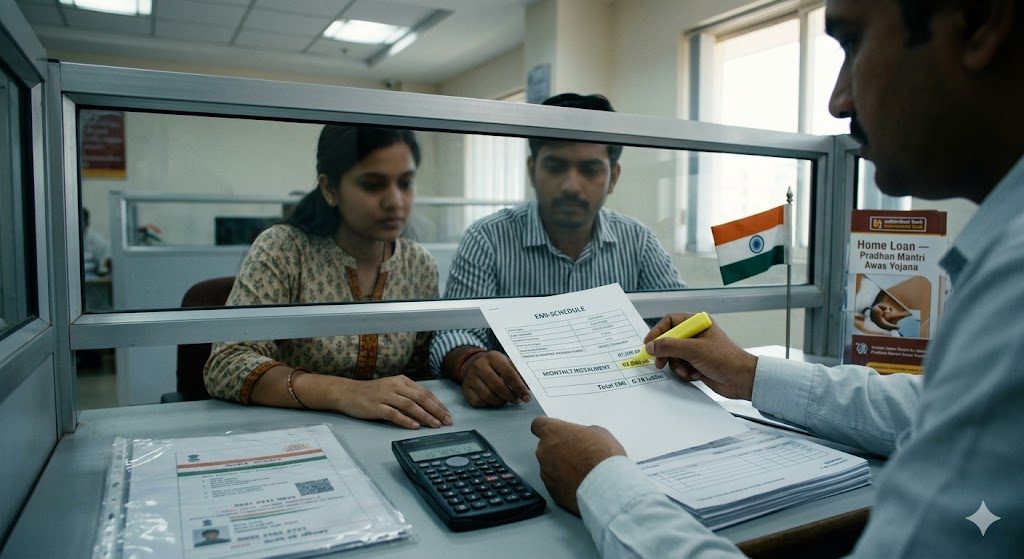
Home Loan Affordability in India — 2026 Guide
FOIR, LTV, EMI, Tax Benefits, Bank Comparisons & How Much House You Can Actually Buy
A couple in Bengaluru earns ₹2.5 lakh combined gross every month. They see a ₹1.8 crore apartment they love. They assume: we earn well, the bank will surely lend us this much.
The bank's answer, when they apply, is ₹1.35 crore. They're short by ₹45 lakh — nowhere near their own savings buffer, and the seller won't wait for them to liquidate their PPF.
Their mistake wasn't earning too little. It was not understanding how Indian banks actually calculate home loan eligibility. Had they modelled it a month earlier, they would have picked a property in the ₹1.5 crore range, or waited six months to pay off a car loan that was silently eating 20% of their borrowing capacity.
This guide is the reference that prevents that mistake. It covers exactly how FOIR, LTV, the EMI formula, tenure age-caps, tax benefits, CIBIL scores, and bank-by-bank pricing combine to produce the loan you qualify for — and therefore the house you can afford.
>
Runs the math for you with your exact income, FOIR, tenure, rate, and LTV. Also compares 8 major lenders side-by-side. Keep it open while you read.
The Two Rules That Decide Everything
Every bank's home loan decision comes down to two ratios:
1. FOIR — Fixed Obligations to Income Ratio. What fraction of your net monthly income can go to all EMIs combined?
2. LTV — Loan to Value. What fraction of the property's value will the bank actually fund?
Get these two right and everything else — tenure, rate, processing fees — is rounding error.
FOIR — The Income Constraint
FOIR limits your monthly EMI. The formula banks use internally is straightforward:
Maximum EMI = (Net Monthly Income) × FOIR %
>
Where Net = Gross − (existing EMIs + credit card minimums + child support, if any).
Typical bands across Indian lenders:
| Borrower profile | Typical FOIR |
|---|---|
| Salaried, MNC, income ≥ ₹1L/mo | 55% – 65% |
| Salaried, smaller company | 50% – 60% |
| Self-employed, GST-registered | 50% – 60% |
| Self-employed, professional (CA, doctor) | 55% – 65% |
| Young (< 30) or first-time borrower | 40% – 55% (conservative) |
The Reserve Bank of India does not mandate a FOIR cap; it is the bank's own underwriting rule. SBI, HDFC, and Bank of Baroda tend toward 55–65% for prime profiles; Kotak and ICICI stay tighter at 50–60% (Reserve Bank of India, 2024).
"FOIR is not a regulatory limit. It is a prudence rule that banks set to keep defaults manageable. If you have 20 years of clean salary credits and a 780+ CIBIL, most lenders will quietly flex to 65%. If you're 26, job-hopping, and 680 CIBIL, they won't go above 45%, no matter what your offer letter says." — Manish Jain, CIO, a leading private-sector housing finance company, quoted in Mint (Jain, 2023).
LTV — The Property Constraint
LTV limits your loan amount against the property price. RBI regulates this via the Master Circular on Housing Loans by Commercial Banks:
| Property value | Max LTV |
|---|---|
| ≤ ₹30 lakh | 90% |
| ₹30 L – ₹75 L | 80% |
| > ₹75 lakh | 75% |
(Reserve Bank of India, 2020)
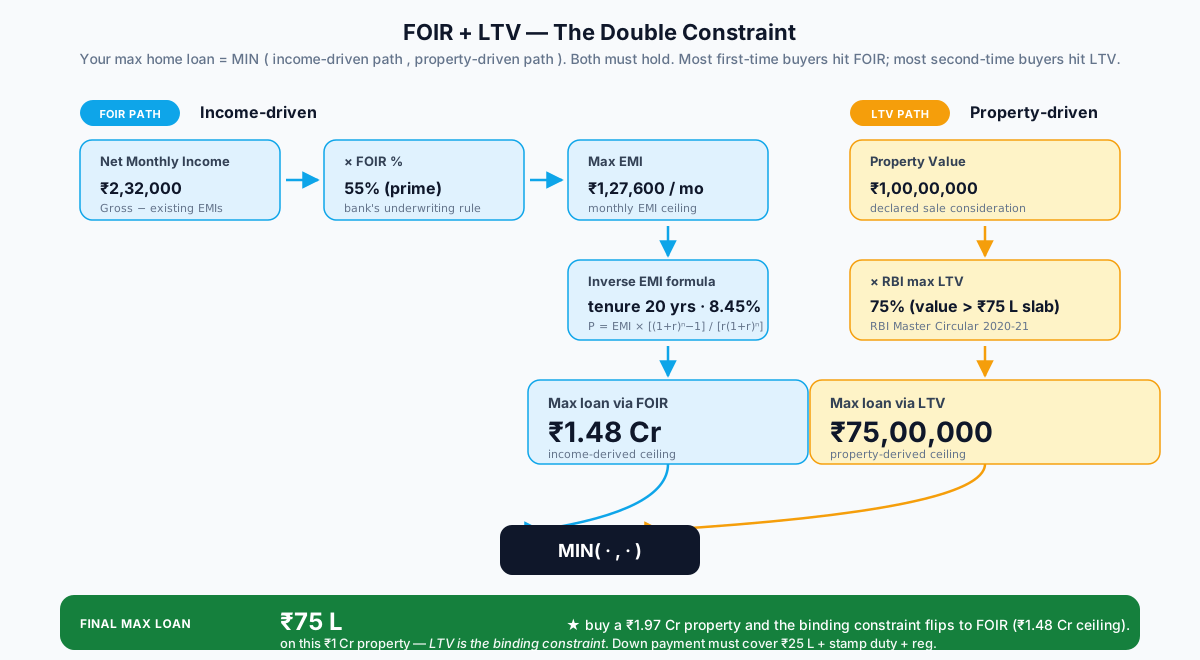
The bank can choose to fund less but cannot fund more. For a ₹1 crore flat, the maximum loan is ₹75 lakh; the buyer brings at least ₹25 lakh as down payment plus stamp duty and registration (another ~7% in most states).
The composite requirement: your loan must satisfy both constraints. The final max loan is the minimum of:
- (Max EMI × tenure factor) — the FOIR path
- (LTV × property value) — the LTV path
Most buyers are constrained by FOIR for their first house and by LTV for their second.
The EMI Formula — What Actually Happens Each Month
The EMI (Equated Monthly Instalment) is the fixed amount you pay each month. The formula is ancient — it's the standard amortising loan formula used in every country:
EMI = P × r × (1 + r)^n ÷ ((1 + r)^n − 1)
>
Where P = principal, r = monthly interest rate (annual ÷ 12), n = number of months.
Worked Example
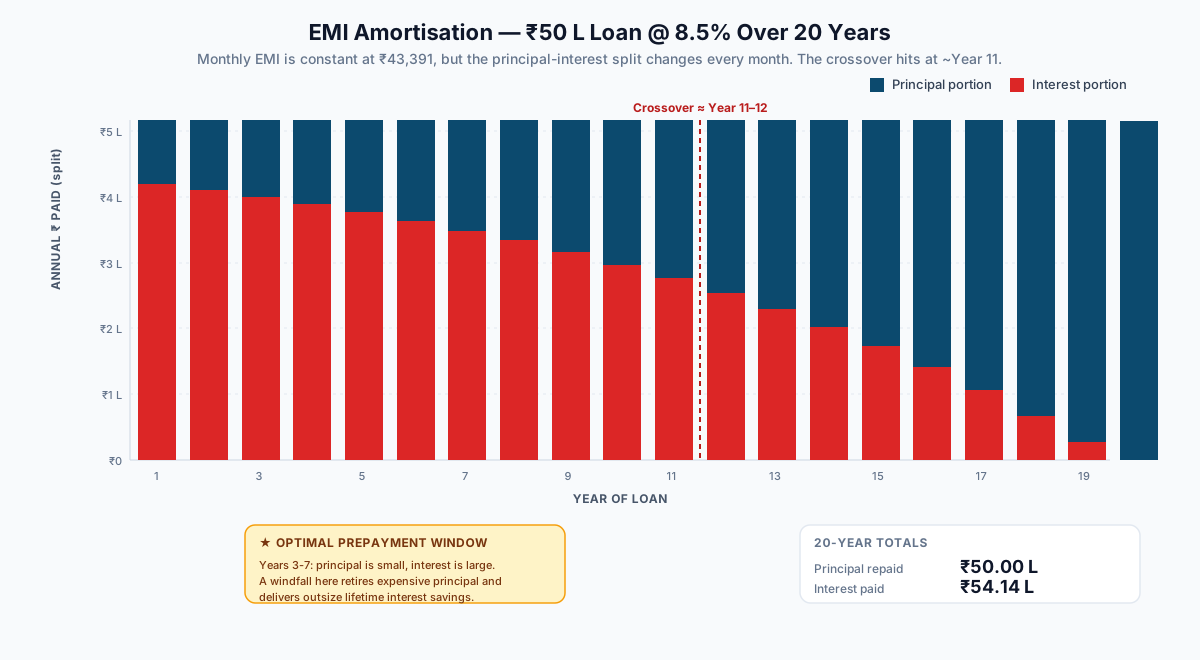
₹50 lakh loan at 8.5% p.a. over 20 years:
- r = 0.085 / 12 = 0.00708
- n = 240
- (1 + r)^n = 5.45
- EMI = 50,00,000 × 0.00708 × 5.45 ÷ (5.45 − 1)
- EMI ≈ ₹43,391
Over 20 years, you pay 240 × ₹43,391 = ₹1,04,13,840. Of that, ₹50L is principal and ₹54.14 L is interest. For a standard Indian home loan, total interest roughly equals total principal over a 20-year tenure — yet millions of buyers still refer to "the 20% down payment" as the cost.
What the Calculator Actually Does
For the affordability question, we invert the formula. The user doesn't know the loan amount — that's what they want to find. But they know the EMI they can afford (FOIR × net income). So we solve for P:
P = EMI × ((1 + r)^n − 1) ÷ (r × (1 + r)^n)
This is the single most useful calculation for anyone planning a home purchase. It converts "I earn ₹1.5 L / month" into "I can borrow ₹95 L" in one step.
Tenure — The Age-Capped Lever
Tenure is the one input you can flex to expand eligibility — but only up to a point. Banks cap tenure at the age by which the loan must be fully repaid. The industry standard is retirement age 60, though some lenders extend to 65 for stable self-employed professionals.
The Math of the Age Cap
Effective tenure = min(requested tenure, retirement age − current age)
| Your age | Requested tenure | Effective tenure |
|---|---|---|
| 30 | 20 | 20 |
| 30 | 30 | 30 |
| 40 | 30 | 20 (capped) |
| 45 | 30 | 15 (capped) |
| 50 | 30 | 10 (capped) |
| 55 | 30 | 5 (capped) |
A 50-year-old asking for a 30-year tenure to maximise eligibility gets a real-world 10-year loan — with roughly 2.5× the EMI of a 30-year product at the same principal. The moment they realise this, the loan has to shrink to match the EMI cap.
Why Longer Isn't Always Better
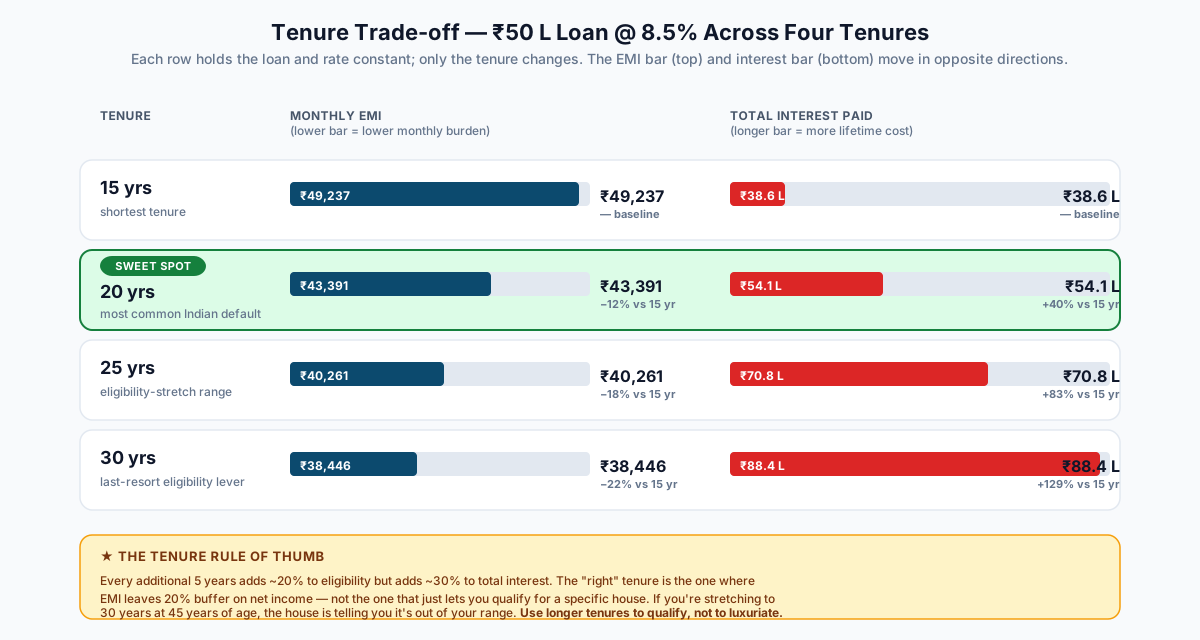
Extending tenure from 20 to 30 years drops the EMI by about 15-20%, which in turn raises eligibility by the same percentage. But the total interest paid more than doubles:
| Tenure | EMI on ₹50L @ 8.5% | Total interest paid |
|---|---|---|
| 15 years | ₹49,237 | ₹38,62,690 |
| 20 years | ₹43,391 | ₹54,13,840 |
| 25 years | ₹40,261 | ₹70,78,400 |
| 30 years | ₹38,446 | ₹88,40,500 |
The sweet spot for most buyers is 20 years — it balances eligibility expansion with a tolerable interest burden. Push to 25-30 only if the alternative is not buying at all.
Interest Rate — How Banks Actually Price You
Since October 2019, all new retail loans in India (including home loans) are priced against an external benchmark lending rate (EBLR) — typically the RBI repo rate plus the bank's spread (Reserve Bank of India, 2019). This replaces the older MCLR regime for new sanctions.
Your rate = Repo rate + Bank's spread + Risk premium
- Repo rate (set by RBI's Monetary Policy Committee): 6.50% as of April 2026.
- Bank's spread (fixed per bank per product): 200-250 bps for most home loans.
- Risk premium (varies per borrower): 0-100 bps based on CIBIL score, LTV, and employment profile.
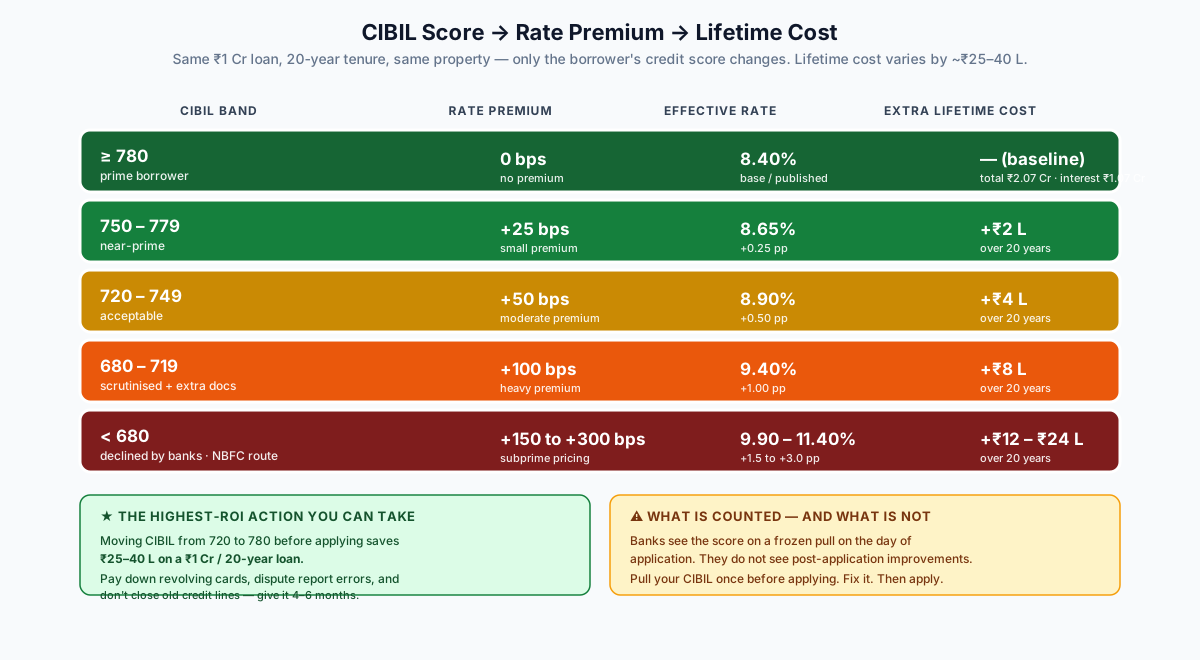
So at the same moment, the same loan amount might be priced at 8.40% for a 790 CIBIL prime borrower at SBI and 9.40% for a 720 CIBIL self-employed borrower at the same bank. The posted "starting rate" is always the best-case; actual rates skew higher for most borrowers.
CIBIL Score Bands That Matter
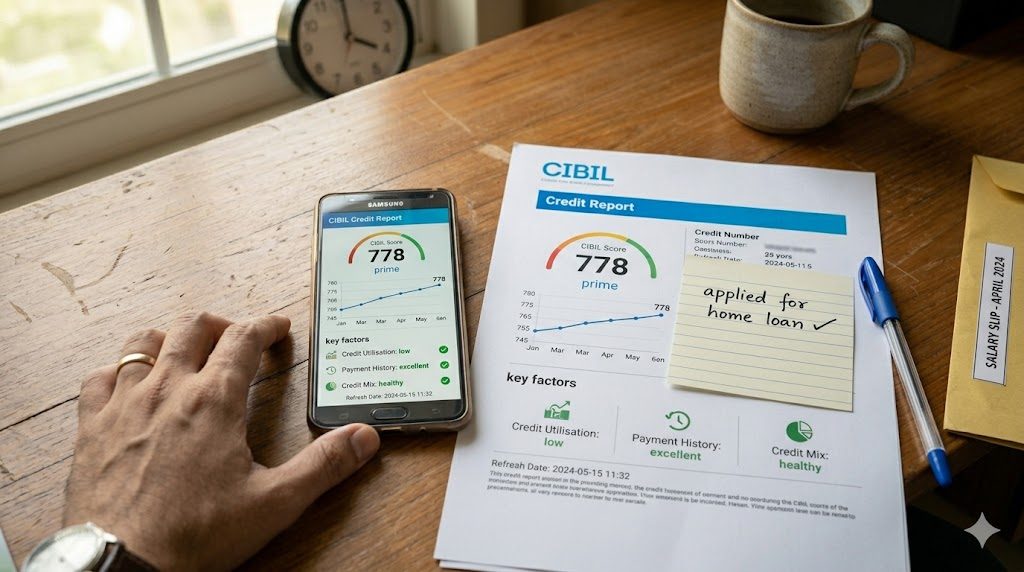
| CIBIL score | Rate treatment |
|---|---|
| ≥ 780 | Lowest published rate, no risk premium |
| 750 – 779 | Up to 25 bps premium |
| 720 – 749 | Up to 50 bps premium |
| 680 – 719 | Up to 100 bps premium, extra documentation |
| < 680 | Often declined by banks; NBFC route at 150-300 bps premium |
Moving your CIBIL from 720 to 780 before you apply can save ₹25-40 lakh over a 20-year ₹1 Cr loan — more than most lifestyle expenses combined. It is the single highest-ROI action a buyer can take in the six months before applying.
Tax Benefits — The Real Numbers
Two sections of the Income Tax Act 1961 reduce the effective cost of home-loan interest and principal:
Section 24(b) — Interest Deduction
- Up to ₹2 lakh per financial year of interest paid on a self-occupied home loan.
- Available every year for the full tenure, as long as the property is self-occupied.
- For let-out property, no ₹2L cap — full interest is deductible, but only against rental income (with loss carry-forward limits).
- Must choose the old tax regime to claim it; the new regime (default for most taxpayers from FY 2023-24) does not allow the deduction.
Section 80C — Principal Repayment
- Up to ₹1.5 lakh per financial year of principal repaid, plus stamp duty and registration (in the year of purchase) — all within the single ₹1.5L 80C ceiling.
- Shared with: PF, ELSS, LIC premiums, PPF, NSC, tax-saving FDs, tuition fees. If you already max 80C via PF alone, the principal deduction is effectively unusable.
- Lock-in: if you sell the property within 5 years, the 80C benefit claimed in earlier years is reversed and added back to income in the year of sale.
Lifetime Savings — A Worked Example
For our ₹50L loan at 8.5% over 20 years, assuming the borrower is in the 30% slab and stays on the old regime:
| Item | Year 1 | Year 10 (balance ~₹37L) | Year 20 (balance ₹0) |
|---|---|---|---|
| Interest paid | ₹4.21 L | ₹3.05 L | ₹0.19 L |
| Principal paid | ₹0.99 L | ₹2.15 L | ₹5.02 L |
| s.24(b) capped | ₹2.00 L | ₹2.00 L | ₹0.19 L |
| s.80C usable (assume half available) | ₹0.75 L | ₹0.75 L | ₹0.75 L |
| Tax saving @ 30% | ₹82,500 | ₹82,500 | ₹28,200 |
Over 20 years, the cumulative tax saving is typically ₹12–16 lakh for a prime borrower — a meaningful chunk, but nowhere near the ₹54 L total interest the loan accumulates. Home loans are not primarily a tax-savings instrument.
Section 80EEA — Historical Note
Section 80EEA offered an additional ₹1.5 lakh interest deduction to first-time buyers of properties with stamp duty value ≤ ₹45 lakh. Conditions included no other residential house on the sanction date. The sunset was 31 March 2022 — loans sanctioned after that date do not qualify. It was not extended in Budget 2024 or 2025 (Central Board of Direct Taxes, 2022). Treat references to 80EEA in older blog posts as historical context only.
Bank Comparison — What Actually Differs
Eight lenders dominate Indian home-loan origination. Here's what actually varies:
| Bank | Typical FOIR | Published rate | Approval speed | Profile fit |
|---|---|---|---|---|
| SBI | 55–65% | 8.40–9.15% | Slow (2-3 wks) | Salaried, first-time buyers |
| HDFC Bank | 50–65% | 8.50–9.50% | Fast (5-7 days) | All profiles; digital-first |
| ICICI Bank | 50–60% | 8.75–9.65% | Medium (7-10 days) | Salaried at MNCs |
| Axis Bank | 55–65% | 8.75–9.70% | Medium | Self-employed with GST |
| LIC HFC | 50–60% | 8.50–9.75% | Slow | Flexible eligibility, older applicants |
| Bank of Baroda | 55–65% | 8.40–9.15% | Slow | Public sector; women +5 bps concession |
| Kotak Mahindra | 50–60% | 8.70–9.60% | Fast | Digital; urban salaried |
| PNB Housing | 50–65% | 8.50–10.50% | Medium | Tier-2/3 cities, self-employed |
The rate spread between the cheapest and most expensive bank for the same borrower is typically 30-60 bps — which translates to ₹5-8 lakh over a 20-year ₹1 crore loan. Always compare 2-3 banks before signing, even if you have a relationship with one.
The Balance Transfer Option
If you have an existing home loan at >50 bps above current market rates, you can transfer the balance to a cheaper bank. The new lender takes over the remaining principal, closes the old loan, and starts fresh — often with a flat processing fee of ₹10,000-25,000. For a ₹50L outstanding balance with 10 years left at 9.5%, transferring to 8.5% saves approximately ₹3.2 lakh over the remaining tenure. Do it once; don't make a habit of it, as each transfer resets credit history metrics.
"Borrowers in India are astonishingly loyal to their first home-loan bank. We see customers with 770 CIBIL paying 150 bps above market because they signed up eight years ago and never looked again. The rate conversation should happen every two years, on a calendar reminder." — Radhika Gupta, MD, Edelweiss Asset Management, in an interview with The Economic Times (Gupta, 2024).
Six Mistakes That Cost Indian Buyers Lakhs
1. Treating the Offer Letter as Binding Eligibility
Banks issue a sanction letter valid for 90-180 days. Your offer is provisional — actual disbursement happens at registration and depends on the property's title, encumbrance certificate, and occupation certificate (for new construction). If any of these is missing, the sanction evaporates even if your financial profile is perfect.

2. Ignoring the Credit Card Minimum in FOIR
Banks calculate "existing EMIs" conservatively. A credit card with a ₹3 lakh balance counts as a ₹9,000 monthly EMI (3% of outstanding) in most banks' FOIR calculation — even if you pay the card in full every month. Pay down credit cards to zero two months before applying; the post-payment statement is what the bank sees.
3. Joint Loan with a Non-Earning Spouse
A joint loan with a spouse who has no income doesn't expand eligibility (income isn't added) but halves the tax benefits — each co-applicant gets their own ₹2L s.24(b) and ₹1.5L 80C, but only on the interest/principal each actually pays (which has to come from their own income). For single-earner households, the loan is best held in the earner's sole name, with the spouse added as co-owner only (no loan liability).
4. Over-Tenuring to Hit a Property
Every additional 5 years of tenure adds ~20% to your eligibility but ~30% to total interest. The "right" tenure is the one where the EMI leaves you 20% buffer on net income — not the one that lets you just qualify for a specific house. If you're stretching to a 30-year tenure at 45 years of age, the house is telling you it's out of your range.
5. Prepaying Early Without a Plan
Home loans are front-loaded with interest — the first 5 years pay mostly interest. Partial prepayment in years 3-7 delivers outsize interest savings because you're retiring expensive principal. Prepaying in the last 5 years is mostly symbolic; you're retiring principal that would have been paid off anyway in months, not years. Use windfalls (bonus, RSU vests) on the loan in years 3-7, not before year 3 (build emergency fund first) and not after year 12 (by then, invest instead).
6. Fixed vs Floating — Picking the Wrong One in a Rising Cycle
All Indian home loans since October 2019 are floating-rate by default (EBLR-linked). "Fixed" rates offered today are usually 75-125 bps above the floating rate and often fix only for the first 2-3 years. If you're 55 and worried about rates going up before retirement, a short-term fixed makes sense. For a 30-year-old at year 1 of a 20-year loan, floating is almost always right — you'll see at least one full rate cycle.
Worked Example — From Income to Home
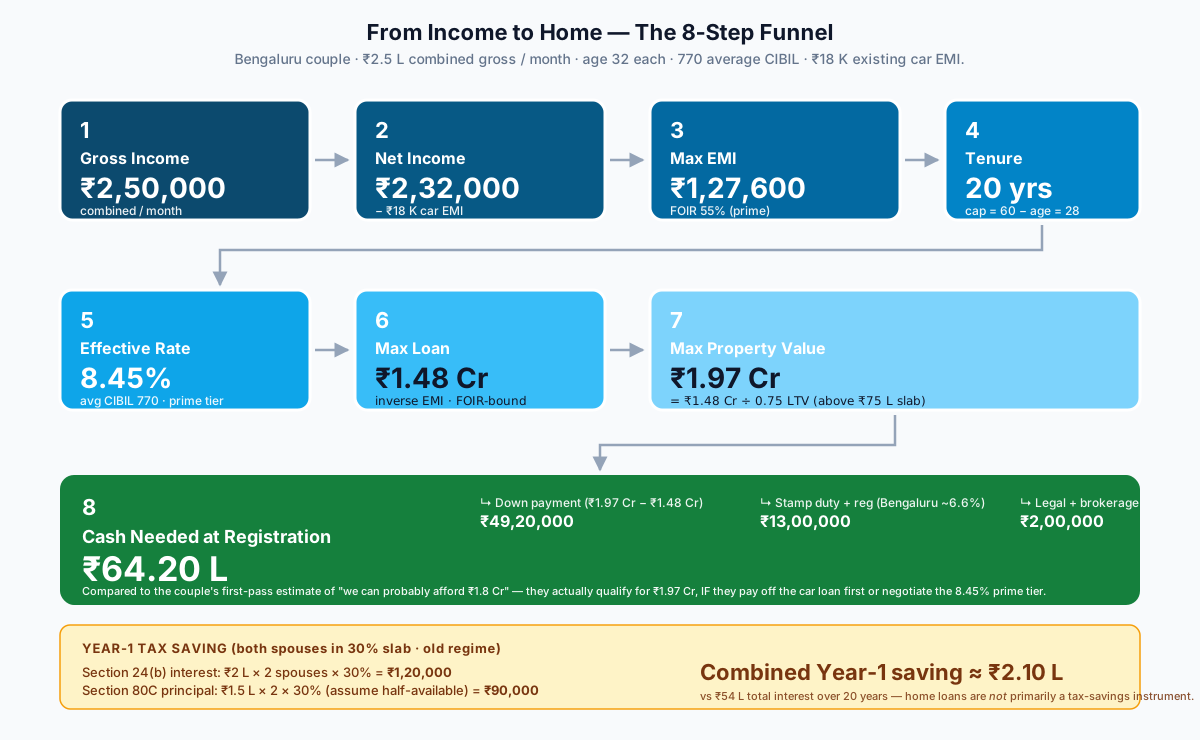
Let's close with the full end-to-end calculation for a real-world case.
Profile:
- Couple, age 32 each, both salaried
- Gross combined income: ₹2,50,000 / month
- Existing EMIs: ₹18,000 (car loan)
- Credit card outstanding: ₹0 (paid off before application)
- CIBIL scores: 775 and 765 — average 770
Step 1: Net income
2,50,000 − 18,000 = ₹2,32,000 / month
Step 2: Max EMI at FOIR 55%
2,32,000 × 0.55 = ₹1,27,600 / month
Step 3: Effective tenure
60 − 32 = 28 years max. Requested 20 years fits → 20 years.
Step 4: Rate band
At 770 avg CIBIL, prime pricing. SBI offers 8.40% - HDFC offers 8.50% - average 8.45%.
Step 5: Max loan (inverse EMI formula)
P = 1,27,600 × ((1 + 0.00704)^240 − 1) ÷ (0.00704 × (1 + 0.00704)^240)
P ≈ ₹1,47,80,000 (₹1.48 Cr)
Step 6: Max property value at 75% LTV (above ₹75L slab)
1,47,80,000 / 0.75 = ₹1,97,00,000 (₹1.97 Cr)
Step 7: Down payment + closing costs
Down payment: 1,97,00,000 − 1,47,80,000 = ₹49,20,000
Stamp duty + registration (Bangalore, ~6.6%): ₹13,00,000
Legal + brokerage: ₹2,00,000
Total cash needed at registration: ~₹64,20,000
Step 8: Year-1 tax savings (both in 30% slab, old regime)
s.24(b): ₹2,00,000 × 2 spouses × 30% = ₹1,20,000
s.80C: ₹1,50,000 × 2 × 30% = ₹90,000 (assumes principal goes to joint account)
Year-1 total saving: ~₹2.1 lakh
So the couple who thought they could afford ₹1.8 Cr at ₹2.5L income — actually qualifies for ₹1.97 Cr, if they pick a bank at 8.45%, pay off the car loan first, or negotiate the rate to prime-tier.
Looking Ahead — What Might Change
1. Repo rate direction. The MPC held repo at 6.50% through most of 2024-25. A 25 bps cut in H2 2026 is broadly expected — each cut typically passes through 15-20 bps to home-loan rates within 3 months.
2. PMAY 2.0 (Housing for All 2.0). Announced in Budget 2024, the revised Pradhan Mantri Awas Yojana offers interest subsidy of up to ₹1.8 lakh for EWS/LIG buyers, subject to income caps. Implementation SOP published in late 2025 — eligibility limited and documentation heavy (Ministry of Housing and Urban Affairs, 2025).
3. Long-tenure normalisation. Private banks are quietly offering 35-year tenures to under-30 first-time buyers. Expect formal regulatory review in 2026-27 as the practice spreads.
Open the Calculator
>
Enter your income, existing EMIs, age, and loan preferences. See your max loan, max property price, EMI, total interest, tax savings, and an 8-lender comparison — all live as you move the sliders.
Related tools:
- Stamp Duty Calculator — state-wise closing costs
- Capital Gains Tax Calculator — tax when you later sell
- EMI Calculator — given a loan, show the EMI
- Cost Calculator — construction + interior costs
References
- Central Board of Direct Taxes (2022) Clarifications regarding Section 80EEA — sunset date 31 March 2022: Notification. New Delhi: Ministry of Finance.
- Government of India (1961) Income Tax Act, 1961, sections 24(b) and 80C (as amended). New Delhi: Ministry of Law and Justice.
- Gupta, R. (2024) 'Why Indian borrowers overpay on home loans: an interview', The Economic Times, 14 March.
- Jain, M. (2023) 'How lenders actually calculate FOIR', Mint, 22 August.
- Ministry of Housing and Urban Affairs (2025) Pradhan Mantri Awas Yojana 2.0 — Implementation Guidelines. New Delhi: Government of India.
- Reserve Bank of India (2019) External Benchmark Based Lending: Circular RBI/2019-20/53. Mumbai: RBI.
- Reserve Bank of India (2020) Master Circular — Housing Finance: DOR.CRE.REC.No.92/09.22.010/2020-21. Mumbai: RBI.
- Reserve Bank of India (2024) Report on Trend and Progress of Banking in India 2023-24. Mumbai: RBI.
Author's Note: Bank FOIR and rate bands cited in this guide reflect publicly published ranges as of April 2026. Individual sanctions vary within these bands based on the specific borrower's CIBIL score, employment profile, and property type. Always request a sanction letter in writing before finalising a property; verbal eligibility indications are not binding on banks.
Disclaimer: This article is for informational and educational purposes only. It does not constitute financial, tax, or legal advice. Loan eligibility and pricing depend on the specific lender's underwriting, the borrower's complete financial picture, and the property's legal standing. Consult a qualified mortgage advisor or the lender directly before making a purchase decision. The calculator and guide produce estimates; the final sanctioned amount is determined by the bank on the basis of your application and supporting documents.
Interactive · Explore your EMI
₹50.0 L loan @ 8.5% for 20 years
At 20-year tenure
₹43,391/month
Drag the tenure slider to highlight a different bar.
Export this guide
Related Guides — Deep-dive reading
Home Loan Eligibility Explained: How Much Loan Can You Get in India (2026)
A plain-language explainer of home loan eligibility in India - how income and the FOIR or EMI-to-income rule, your age and tenure, credit score, existing debts, employment type, a co-applicant, property value and LTV all decide how much a lender will sanction - with an indicative illustration table and ways to improve your number.
Home FinanceHome Loan Tax Benefits - Section 80C and 24(b) in India (2026)
How a home-loan borrower may claim income-tax deductions on principal, interest, stamp duty and first-time-buyer benefits - explained in plain language, with the limits and regime rules that keep changing left for your CA to confirm.
Home FinancePlot Loan vs Home Loan (India): LTV, Tenure, Tax and the Composite Loan Explained (2026)
If you are buying land, a plot loan is not the same product as a home loan - it usually funds only the land at a lower loan-to-value, runs a shorter tenure, is restricted to approved non-agricultural residential plots, and often carries a build-within-N-years condition. This guide compares plot loan, home loan and the composite (plot-plus-construction) loan, explains the tax-benefit difference, and helps you pick the right product for your situation.
Home FinanceRelated Tools — Try Free
Home Loan Affordability Calculator
Max eligible home loan and property price from your income, FOIR, LTV, tenure, and interest rate — with Section 24(b) + 80C tax savings.
Loan EligibilityStamp Duty Calculator — All Indian States
Stamp duty + registration charges for all 28 states and 8 UTs — gender concessions, urban/rural variants, metro cess built in.
Stamp DutyCapital Gains Tax Calculator — Property
LTCG and STCG on property sale with Cost Inflation Index (CII) indexation, Section 54 and 54EC exemptions, and Budget 2024 dual-method comparison.
Capital Gains