
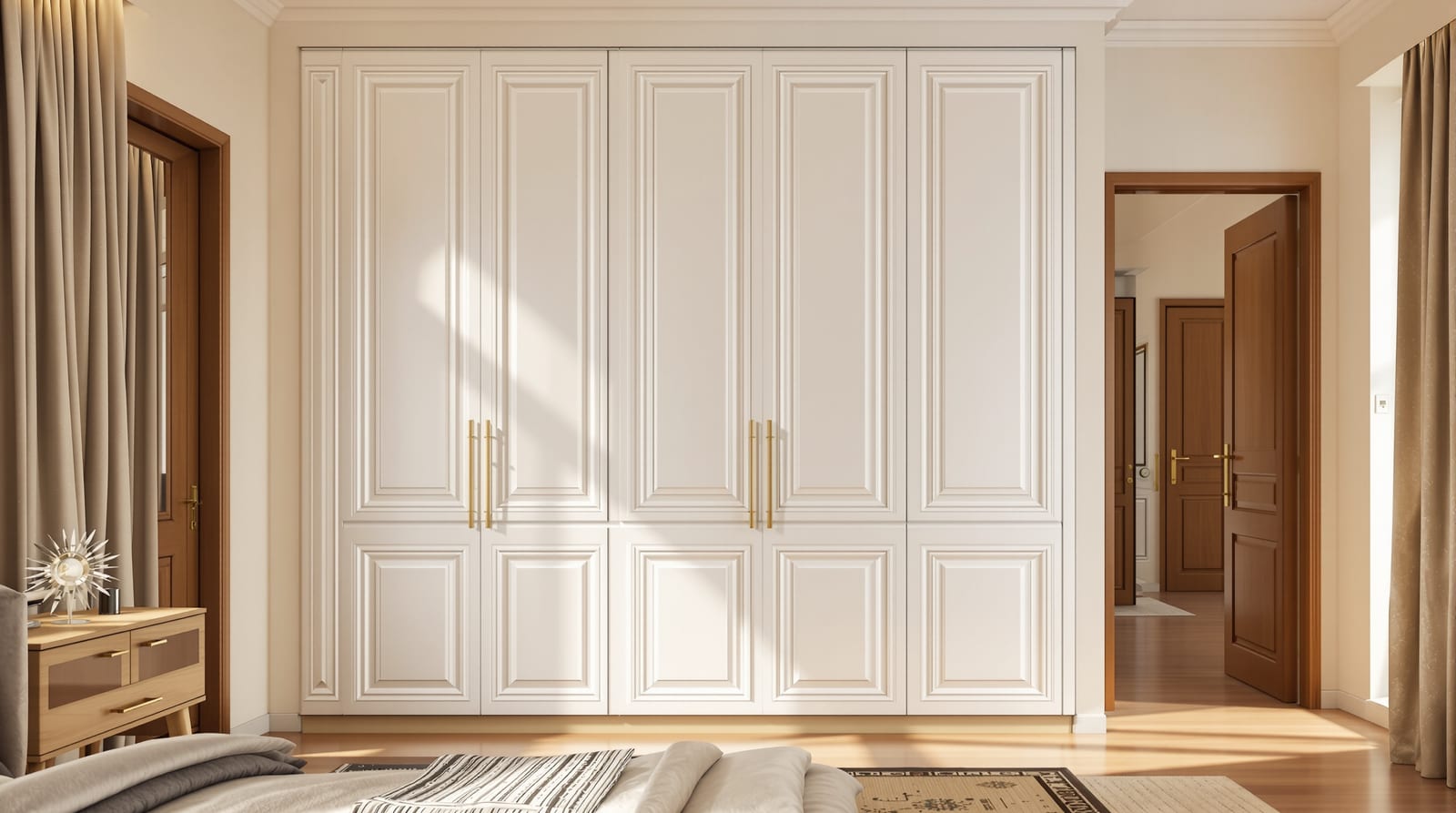
Membrane Doors in India: PVC Vacuum-Pressed Moulded Doors for Wardrobes & Bedrooms (2026)
How PVC membrane doors get their seamless one-piece moulded look, what they cost per sq ft and per shutter, why they shine in dry bedroom and wardrobe use — and exactly why they must never go near a bathroom or direct sun.
A membrane door is the reason so many Indian wardrobes and bedroom doors now look like crisply shaker-panelled, factory-finished furniture without a single visible joint or edge band. The trick is a board of MDF or HDF routed with grooves and raised-panel profiles, over which a thin sheet of PVC "membrane" foil is vacuum-pressed so tightly that it sinks into every groove and wraps the edges in one continuous, seamless skin. It looks moulded from a single piece. At roughly ₹120–300 per sq ft of finish, it delivers a designer look for far less than veneer — but only if you keep it away from water, steam and direct sun, because the very things that make it cheap and pretty also make it fragile in the wrong place.
What a membrane door actually is
"Membrane" refers to the finish, not the core. The leaf underneath is almost always plain MDF (medium-density fibreboard) or the denser HDF (high-density fibreboard), chosen because it routs cleanly and has no grain to fight. The fabrication runs like this:
- Routing / design: a CNC router cuts grooves, bevels, shaker frames or panel profiles into the MDF face. This is where the "design" lives — the panel look is carved into the board, not glued on.
- Priming / surface prep: the routed board is cleaned and sometimes primed so the adhesive and foil bond evenly into the grooves.
- Membrane foil: a thin, flexible PVC sheet (the membrane) — available in hundreds of solid colours, woodgrains, matt, gloss and textured finishes — is laid over the board with heat-activated adhesive.
- Vacuum press: the board and foil go into a heated vacuum (membrane) press. As the air is pulled out, atmospheric pressure forces the heated, softened foil down into every groove and over the rounded edges, where it fuses to the adhesive.
- Trim: the foil is trimmed at the back; the front and all visible edges are now covered by one unbroken sheet.
The defining result is a seamless, one-piece skin with no edge-banding. A laminate door has a flat face plus separately glued edge tape; a membrane door has no tape lines at all because the same foil that covers the face also wraps the edge. That seamlessness, plus the ability to mould 3D panel designs, is the whole appeal — see the layer diagram below.
The routed MDF + membrane wrap — in section
Because the foil is a single continuous skin, there is no laminate edge to lift and no dark joint line around panels — the look most people associate with "PU" or "ducco-style" painted furniture, but achieved by pressing rather than spraying.
Strengths — why membrane doors took over Indian wardrobes
- Seamless moulded designs: shaker panels, beadings, grooves and louvre-look profiles are routed and then wrapped in one go, so you get crisp 3D detailing without the visible joints of a panelled or laminated door.
- No edge-banding: none of the lifting-tape edges that plague cheap laminate work; the wrap is continuous, which also means no sharp laminate edge to chip.
- Huge choice of colours and textures: because the finish is a printed foil, hundreds of solid colours, two-tone combinations, woodgrains, matt and high-gloss options are available off the shelf — ideal for door colour ideas and matched wardrobe-plus-bedroom-door schemes.
- Decent value: at roughly ₹120–300 per sq ft of finish (board extra), a membrane shutter looks like sprayed PU furniture costing far more, which is why it dominates modular wardrobes and budget designer bedrooms.
- Easy to clean: the non-porous PVC face wipes down with a damp cloth; no polishing or re-varnishing the way veneer or solid wooden doors need.
- Factory consistency: pressed in a workshop to a repeatable finish, unlike a hand-painted door whose quality depends on the painter's day.
Weaknesses — where membrane doors fail (and why)
This is the part showrooms skip, so be clear-eyed:
- Membrane peeling in heat and steam: the foil is held on by heat-activated adhesive. Sustained heat, humidity or steam softens that glue, and over time the foil can lift, bubble or peel — usually starting at a corner or groove. This is the single biggest failure mode.
- Not for bathrooms, external doors or direct sun: a bathroom's steam, an external door's rain and a sun-facing balcony or terrace door's UV will all cook or swell a membrane door. For wet or exposed openings use WPC, PVC, FRP or uPVC instead — see best door material for India.
- MDF core swells if wet: the MDF board behind the foil drinks water. If the seamless wrap is breached — a chipped edge, a drilled hole, a leaking wall — moisture reaches the core, which swells, distorts and pushes the foil off from inside. Once the core is wet, the door is finished.
- Hard to repair: you cannot sand and re-coat a membrane door like timber or veneer. A peeled or torn foil generally means re-pressing the whole shutter or replacing it; small touch-ups rarely look right.
- Not the most premium feel: beautiful from a step away, but up close a high-gloss membrane can read as plasticky next to real veneer or laminate's harder surface, and it scratches more easily than HPL laminate.
The honest summary: membrane is a finish for dry, indoor, shaded locations — internal bedroom doors, wardrobe and kitchen shutters, study and dressing-room joinery. Put it anywhere wet, hot or sunlit and you have bought a problem.
Membrane vs laminate vs veneer
The three finishes that dominate Indian interior doors and wardrobes, compared on the points that decide a purchase:
| Factor | Membrane (PVC foil, vacuum-pressed) | Laminate (HPL sheet, glued) | Veneer (thin real-wood, polished) |
|---|---|---|---|
| Look | Seamless 3D moulded panels, no joints; matt to high-gloss | Flat face; crisp solid colours, prints, textures; visible edge bands | Natural real-wood grain; warm, premium |
| Design freedom | High — grooves and panels routed then wrapped in one piece | Low–medium — essentially flat; profiles need separate beading | Medium — flat or panelled, but grain-led |
| Edges | Seamless wrap, no edge-banding | Separate edge tape (can lift/chip) | Edge-banded or lipped, then polished |
| Moisture tolerance | Poor — peels in steam; MDF core swells if breached | Medium — surface water-resistant; edges/substrate vulnerable | Poor–medium — needs sealing; not for wet areas |
| Heat / sun tolerance | Poor — foil lifts in heat and UV | Good — HPL is heat-stable | Medium — polish can fade/yellow |
| Scratch / wear | Medium — scratches, hard to repair | High — HPL is hard and durable | Medium — scratches, but can be re-sanded/polished |
| Repairability | Poor — usually re-press or replace | Poor — replace panel | Good — sand and re-polish |
| Indicative cost (finish) | ~₹120–300 / sq ft | sheet ~₹600–2,500 (8x4) + labour | sheet ~₹1,500–6,000 + polishing |
| Best for | Dry indoor wardrobes, bedroom doors, kitchen shutters | High-traffic, durable, dry-to-damp interior surfaces | Premium living-area doors and statement joinery |
In one line: choose membrane when you want a seamless, colourful, moulded-panel look at a friendly price in a dry room; choose laminate when durability and water/heat resistance matter more than 3D detailing; choose veneer when you want genuine wood warmth and the ability to repair and re-polish. For the full material map across every door, see door materials comparison.
Cost per sq ft and per shutter in India
Membrane is priced two ways, and it pays to separate them:
- Membrane press finish (foil + pressing only): ~₹120–300 per sq ft of finished face. The wide range reflects foil quality, gloss level, single vs two-tone and the press shop. Indicative, varies by city and vendor.
- Board (MDF / HDF core): charged separately, typically ₹40–90 per sq ft depending on thickness (18 mm common for shutters) and brand. Some quotes bundle board + membrane; always ask which.
- Per shutter / per door: a standard 900 × 2100 mm (3' × 7') bedroom door leaf is roughly 19 sq ft. At ₹120–300/sq ft finish plus board, a finished membrane bedroom shutter commonly lands around ₹3,000–7,000 for the leaf, before frame, hinges, lock and fitting. A wardrobe shutter (smaller) costs proportionally less.
- Frame (chowkat): membrane is a leaf finish, not a frame — budget a separate door frame; WPC or wood frames are common for internal doors.
- Hardware + fitting: hinges, handle and lock add roughly ₹1,500–5,000 for an internal door; fitting labour is about ₹800–2,000 per door.
- GST: add 18% on materials, typical for this category.
Compared with a polished veneer or solid-wood bedroom door (often ₹8,000–20,000+), a membrane shutter is a clear saving for the same first impression — provided the room stays dry. Price your own configuration with the door cost calculator and weigh finishes side by side using the door material comparison tool; the master benchmark for every door type is the door cost guide.
Where to use a membrane door (and where never to)
Use it for: internal bedroom doors, kitchen cabinet and pantry shutters, wardrobe and dressing-room joinery, study and home-office doors, and any dry interior where you want a moulded, coloured, low-maintenance look. It pairs naturally with modern and minimalist door designs and with two-tone schemes.
Never use it for: bathrooms and WCs, the main external door, balcony, terrace or utility doors, any sun-facing opening, or anywhere a pipe or wall could leak onto the leaf. In Indian homes the most common membrane failure is a bedroom door fitted next to an attached bathroom where steam and the occasional splash reach the leaf — keep membrane on the dry side of that wall. For the room-by-room logic of which finish goes where, see interior doors by room, and for the whole-house picture start from the complete guide to home doors in India.
Frequently asked questions
What is a membrane door made of?
The core is MDF or HDF board, CNC-routed with grooves and panel profiles. A thin PVC "membrane" foil is then vacuum-pressed over the routed face with heat-activated adhesive, so the foil sinks into every groove and wraps the edges in one continuous, seamless skin. The board gives shape; the foil gives the colour, texture and finish.
Are membrane doors waterproof? Can I use one in a bathroom?
No. Membrane doors are not for bathrooms, external use or direct sun. Steam and heat soften the adhesive and the foil peels, and if water reaches the MDF core through any breach the board swells and the door is ruined. For wet areas choose WPC, PVC, FRP or uPVC instead.
What is the difference between membrane and laminate doors?
A laminate door has a flat HPL sheet glued to the face plus separate edge tape, so you see edge lines and it cannot easily be moulded. A membrane door is routed with 3D panel designs and wrapped in a single seamless foil with no edge-banding. Laminate is tougher and more heat- and water-tolerant; membrane offers seamless moulded designs and more colour choice.
How much does a membrane door cost in India?
The membrane finish runs about ₹120–300 per sq ft, with the MDF board charged separately. A standard 3' × 7' bedroom shutter commonly lands around ₹3,000–7,000 for the leaf, before frame, hardware, fitting and 18% GST. Prices are indicative and vary by foil quality, city and vendor.
Can a peeling membrane door be repaired?
Not easily. Unlike timber or veneer, a membrane door cannot be sanded and re-coated; a lifted or torn foil usually means re-pressing the whole shutter or replacing it, and small touch-ups rarely look right. Prevention — keeping the door dry, shaded and unbreached — matters far more than repair.
Export this guide
Related Guides — Deep-dive reading
Bedroom Door Design in India: Materials, Sizes, Finishes, Privacy and Cost (2026)
How to choose and design a bedroom door for Indian homes — privacy, light-noise control, finishes that match the room, the right 900x2100 internal door, locks and ₹ budget.
Home Doors & EntrancesThe Complete Home Door Guide for Indian Homes (2026): Types, Materials, Cost, Security & Vastu
Everything an Indian homeowner needs to specify the right door for every opening — from main entrance to bathroom — with real 2026 prices, IS/NBC standards and Vastu sense.
Home Doors & EntrancesAcrylic vs Cast Iron Bathtub: Which Is Better? (India, 2026)
A fair, India-first head-to-head between an acrylic bathtub and an enamelled cast-iron one — weighed on the factors that actually decide it here: slab load and handling, heat retention, durability, warmth to touch, repairability, price and installation — with a clear verdict by home type and budget.
BathroomsRelated Tools — Try Free
Door Material Comparison Tool
Compare 2–4 door materials on cost, durability, maintenance, security and moisture resistance.
Comparison ToolModular Kitchen Budget Calculator
Live breakdown by running feet, countertop area, material tier and city — with wastage, design fee, GST.
Kitchen CalculatorDoor Cost Calculator
Estimate the all-in cost of a door — leaf, frame, hardware, fitting and GST — by type, material and size.
Door Calculator