
Door Frame Cost in India 2026: Chowkat ₹/Running Foot by Material, Quantity Calc & Installed Total
A focused 2026 cost guide for the door frame (chowkat / chaukhat) — ₹ per running foot for sal, teak, hardwood, rubberwood, WPC, steel (IS 4351), RCC and granite frames, how to calculate frame quantity from the opening perimeter, readymade vs site-made, fitting labour and a worked 3'×7' example.
When most people budget a door, they price the shutter — the leaf you actually push open — and quietly forget the frame it hangs on. Yet the door frame, the chowkat or chaukhat, is the part embedded in the wall for the next thirty years, the part that takes the hinge load, the slamming and the monsoon damp. Skimp here and a beautiful teak shutter will sag, the lock will stop catching, and the whole opening will rack. This 2026 guide prices the door frame in India honestly — by material, by the running foot, by door size — and shows you the simple perimeter calculation that turns a section rate into a real number on your quote. For the full picture across shutters, hardware and fitting, pair this with the master door cost benchmark and the complete home doors guide.
All figures below are indicative and vary by city, vendor, timber quality and section size. Treat them as a sanity-check range, not a fixed price list, and always confirm the section dimensions before you compare two quotes.
What the door frame is — and why it is priced separately
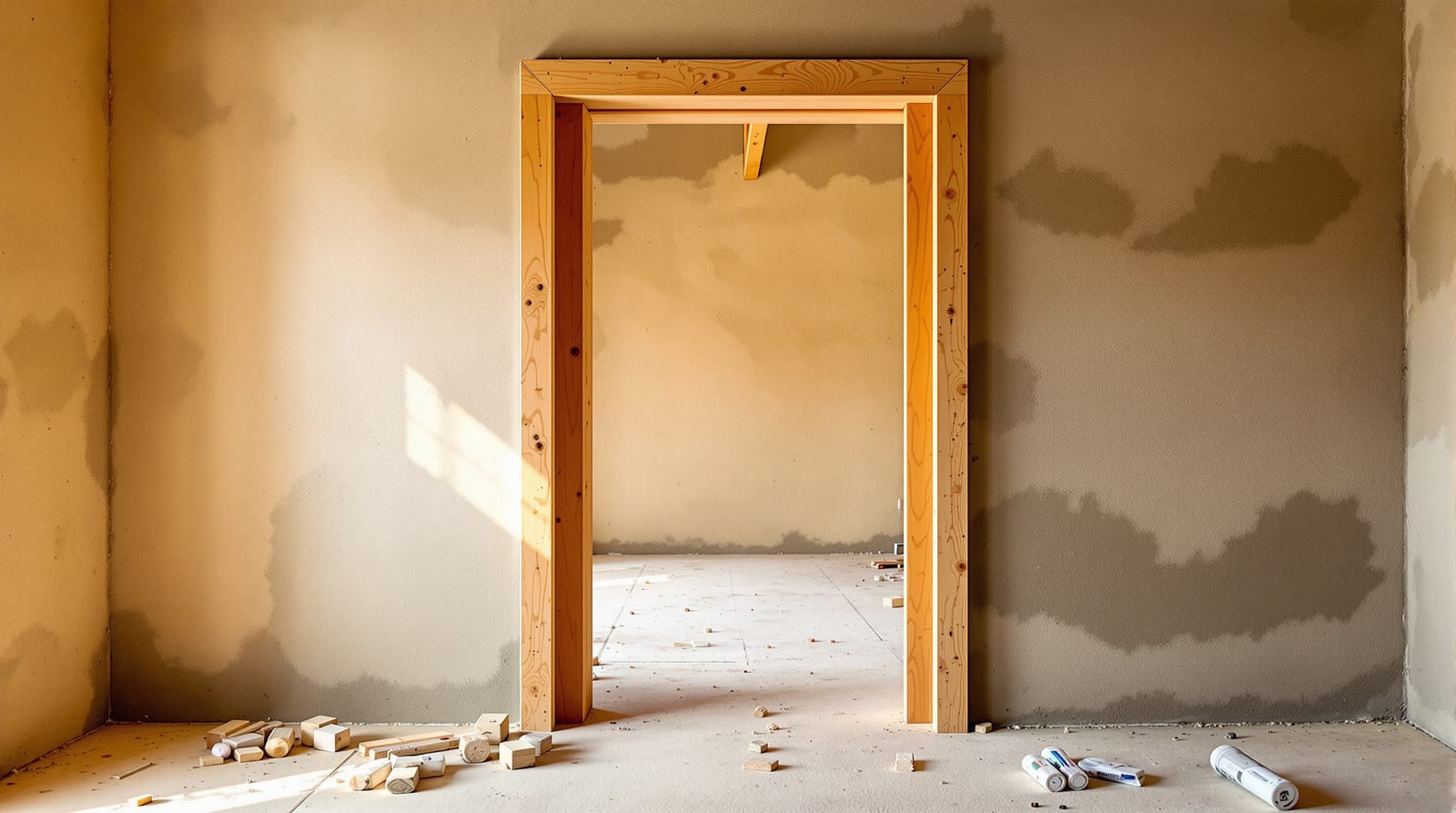
The frame is the fixed timber (or steel, WPC, RCC or stone) lining of the wall opening into which the shutter is hung. It has three working members: the head (the horizontal top piece) and two jambs (the vertical sides). A frame without a bottom member is a three-sided chowkat; many Indian doors omit the bottom sill so the floor runs through, though bathrooms and main doors sometimes add a threshold (dehleez).
Frames are quoted per running foot of the members, not per square foot, because they are a length of profiled section. The shutter is quoted separately by the square foot or per piece. This is exactly why a "door for ₹6,000" quote can balloon: that number is often the leaf alone, and the chowkat plus its fitting is a separate line. The codes that govern frames are IS 4021 (timber door, window and ventilator frames) and IS 1003 (panelled and glazed shutters and their frames); steel frames follow IS 4351.
The section size decides the rate
Before any rate makes sense you need the section size — the cross-section of the frame timber, written width × depth in inches, such as 4" × 2.5", 5" × 3" or 6" × 3". A bigger section uses more timber per running foot, so the rate climbs with it. As a rule:
- Internal doors (bedroom, bathroom): 3" × 2.5" or 4" × 2.5" sections are common.
- Main / external doors: 5" × 3" or 6" × 3" for strength and to match a thicker wall.
- The frame depth should roughly match the wall thickness so the frame sits flush; on a 9" brick wall a 4"–5" deep section plus plaster fills the reveal.
Two quotes at the "same" per-foot rate can differ by 40% simply because one is for a 4" × 2.5" section and the other for a 5" × 3" section. Always pin the section down first.
Door frame material × ₹ per running foot
This table is the frame material rate only — the section supplied (and for timber, usually planed and ready), before fitting labour, fixing hardware, finishing and GST.
| Frame material | ₹ / running foot (indicative) | Pros / where it fits |
|---|---|---|
| Sal wood (common site-made chowkat) | ₹350 – ₹650 | The default Indian door frame; hard, strong, takes hinge load well; cost-effective; needs anti-termite treatment and good seasoning |
| Teak (Burma / CP teak) | ₹600 – ₹900+ | Premium, dimensionally stable, naturally termite- and moisture-resistant; for main doors and where the frame is exposed/polished |
| Other hardwood (sheesham, marandi, local hardwoods) | ₹300 – ₹600 | Mid-tier; quality and stability vary by species and seasoning; verify it is well-dried |
| Rubberwood (finger-jointed, treated) | ₹250 – ₹450 | Engineered, kiln-dried, uniform; good value for internal frames; must be properly treated against borer |
| WPC readymade frame (wood-plastic composite) | factory rate, often ₹1,500 – ₹3,500 per readymade frame set | 100% termite-proof and water-proof, uniform, zero seasoning risk; ideal for bathrooms and humid/coastal homes; see WPC doors |
| Steel frame (pressed/galvanised, IS 4351) | ₹250 – ₹500 (often sold as a frame set) | Fire-resistant, termite-proof, dead straight, fast to fix; common in apartments, fire-exit and utility doors; see steel doors |
| RCC / cement frame (precast or cast in-situ) | ₹150 – ₹350 | Cheapest, fully termite- and water-proof, permanent; used in bathrooms, balconies and budget builds; shutter screws fix to plugs/inserts |
| Granite / stone frame (bathroom jambs) | ₹250 – ₹600 per running foot of stone | Water-proof, rot-proof at the wet floor zone; common as bathroom door jambs in South India; pairs with an FRP or WPC shutter |
Why the WPC and steel options matter for value: they deliver a single, uniform, termite-proof frame with no seasoning gamble. A site-made sal chowkat is only as good as the timber the carpenter happens to source and how well it was dried — get green or under-seasoned timber and it warps after the first summer. WPC and steel frames are factory-consistent, which is why they have taken over bathrooms and apartment construction.
How to calculate frame quantity (the perimeter method)
This is the calculation buyers miss. A frame's quantity is the running length of its members, which for a standard three-sided chowkat is:
Frame length (ft run) = door height + door height + door width = (2 × height) + width
You measure the opening, not the shutter. For a standard 3' × 7' bedroom door:
- Two jambs at 7 ft each = 14 ft
- One head at 3 ft = 3 ft
- Total = 17 running feet
Add the bottom member only if your frame has a sill (then add another width). At a sal rate of, say, ₹500/ft run, the frame timber for that door is 17 × ₹500 = ₹8,500 before fitting. That single number is what gets left off most door budgets.
A quick reference for common Indian door sizes (three-sided frame, no sill):
| Door size (W × H) | Running feet of frame | Frame cost @ ₹400/ft | Frame cost @ ₹700/ft |
|---|---|---|---|
| Bathroom 2.5' × 7' | 16.5 ft | ₹6,600 | ₹11,550 |
| Bedroom / internal 3' × 7' | 17 ft | ₹6,800 | ₹11,900 |
| Kitchen / utility 3' × 7' (heavier section) | 17 ft | ₹6,800 | ₹11,900 |
| Main / external 3.5' × 7' | 17.5 ft | ₹7,000 | ₹12,250 |
| Double main door 5' × 7' | 19 ft | ₹7,600 | ₹13,300 |
Use the lower column for value sal/rubberwood and the higher for teak; both before fitting, finishing and GST. To run your own numbers and add the shutter, hardware and labour, use the door cost calculator.
Readymade vs site-made frames
The split is no longer just timber. You now choose between a frame made on site and a readymade factory frame.
- Site-made (carpenter): the carpenter buys timber section, cuts, joins and fixes the chowkat in place. Cheapest in material, but quality rides on the carpenter's timber sourcing, seasoning and joinery. Best where you want a specific timber, section or finish.
- Readymade (factory): a precision-cut, pre-treated frame — common in WPC, steel and engineered timber — delivered as a set and fixed fast. Higher unit cost but uniform, termite-proof and no seasoning gamble. Increasingly the apartment standard.
For coastal salt, monsoon humidity and termite-prone homes, a readymade WPC or steel frame usually wins on lifecycle value even at a higher upfront price; for a polished, traditional main door, well-seasoned teak or sal still leads. See best door material for India and the door materials comparison to match the frame to your climate.
Fixing and installation labour
A frame is only as good as how it is fixed. Budget the fitting labour as a real line:
| Frame work | ₹ (indicative) | What it covers |
|---|---|---|
| Frame fixing labour (per door, site-made) | ₹400 – ₹1,200 | Setting plumb, holdfasts/clamps in the masonry, packing and aligning |
| Readymade frame fitting (WPC / steel) | ₹500 – ₹1,500 | Anchoring the factory set, levelling, sealing the gap |
| Holdfasts / fixing lugs, screws, anchors | ₹150 – ₹600 | Hardware that ties the frame to the wall |
| Anti-termite treatment of timber frame | ₹100 – ₹400 | Coat/treatment before fixing — essential for sal/hardwood |
The frame is normally fixed before plastering so the wall closes neatly around it. A frame set out of plumb is the most common reason a new door does not latch — pay attention here, not just to the timber. Once the frame is in, the installation cost guide covers hanging the shutter, hinges and the lock.
Worked example: frame for a standard 3' × 7' bedroom door
Putting it together for a site-made sal frame, 4" × 2.5" section:
| Line item | Quantity | Rate | Amount |
|---|---|---|---|
| Sal frame timber | 17 ft run | ₹500 / ft | ₹8,500 |
| Anti-termite treatment | 1 door | ₹250 | ₹250 |
| Holdfasts + fixing hardware | 1 set | ₹350 | ₹350 |
| Fixing labour | 1 door | ₹800 | ₹800 |
| Subtotal (frame only) | ₹9,900 | ||
| GST @ 18% (where billed) | ₹1,782 | ||
| Frame installed total | ≈ ₹11,700 |
That is just the chowkat — the shutter, hinges, handle and lock are all extra. Swap to a budget readymade option and a WPC frame set might land around ₹2,000–₹3,500 plus ₹500–₹1,500 fitting; a teak frame for the same opening would push the timber alone past ₹10,000. The lesson holds: the frame is routinely 10–20% of the true installed cost of a door, and leaving it out is the single biggest reason door budgets blow up.
Frequently asked questions
Is the door frame cost included in the door price quote?
Often not. Many quotes price only the shutter (the leaf). The chowkat, its fitting labour and fixing hardware are frequently separate lines. Always ask the vendor to confirm whether the frame is included and at what section size before comparing two quotes.
How do I calculate how much frame material I need?
For a standard three-sided frame, add (2 × door height) + door width. A 3' × 7' door needs (2 × 7) + 3 = 17 running feet. Multiply that by the per-running-foot rate for your chosen material. Add another width only if your frame has a bottom sill.
Which door frame is best for a bathroom in India?
A water-proof, rot-proof frame: WPC, granite/stone jambs, or RCC. Timber frames swell and rot at the wet floor zone over time. WPC and stone are the popular durable choices and are fully termite-proof; pair them with a WPC or FRP shutter.
Are WPC and steel frames really worth the higher price?
For humid, coastal or termite-prone homes, usually yes. They are factory-uniform, termite- and water-proof, and skip the seasoning gamble of site timber, so they last longer with less trouble. Well-seasoned sal or teak still leads where a traditional, polished main-door look matters.
Do door frame prices include GST?
Usually not in the headline rate. Factory and branded frames typically attract about 18% GST; small local carpenters may quote without a formal GST bill. Confirm whether GST is included so your comparison is like-for-like, and keep the invoice for any warranty.
Export this guide
Related Guides — Deep-dive reading
Wooden Door Frames in India: Species, Cost & Care (India 2026)
How to choose, season and treat a timber chowkhat that survives India's termites, monsoon and heat — and what it costs per running foot.
Home Doors & EntrancesConcrete Door Frames in India: RCC Chowkhat Guide (India 2026)
Why precast cement-concrete door frames win on cost and durability in budget housing and wet areas, and where they fall short.
Home Doors & EntrancesDoor Frame Fixing Methods: Holdfasts & Anchors (India 2026)
How to fix a chowkhat to masonry with M.S. holdfasts, lugs, screws and frame anchors — numbers, spacing and packing that keep the frame true.
Home Doors & EntrancesRelated Tools — Try Free
Door Frame Cost Calculator
Estimate door frame (chowkat) cost from the opening size and frame material — sal, teak, WPC, steel, RCC or granite.
Door CalculatorDoor Cost Calculator
Estimate the all-in cost of a door — leaf, frame, hardware, fitting and GST — by type, material and size.
Door CalculatorDoor Material Comparison Tool
Compare 2–4 door materials on cost, durability, maintenance, security and moisture resistance.
Comparison Tool