
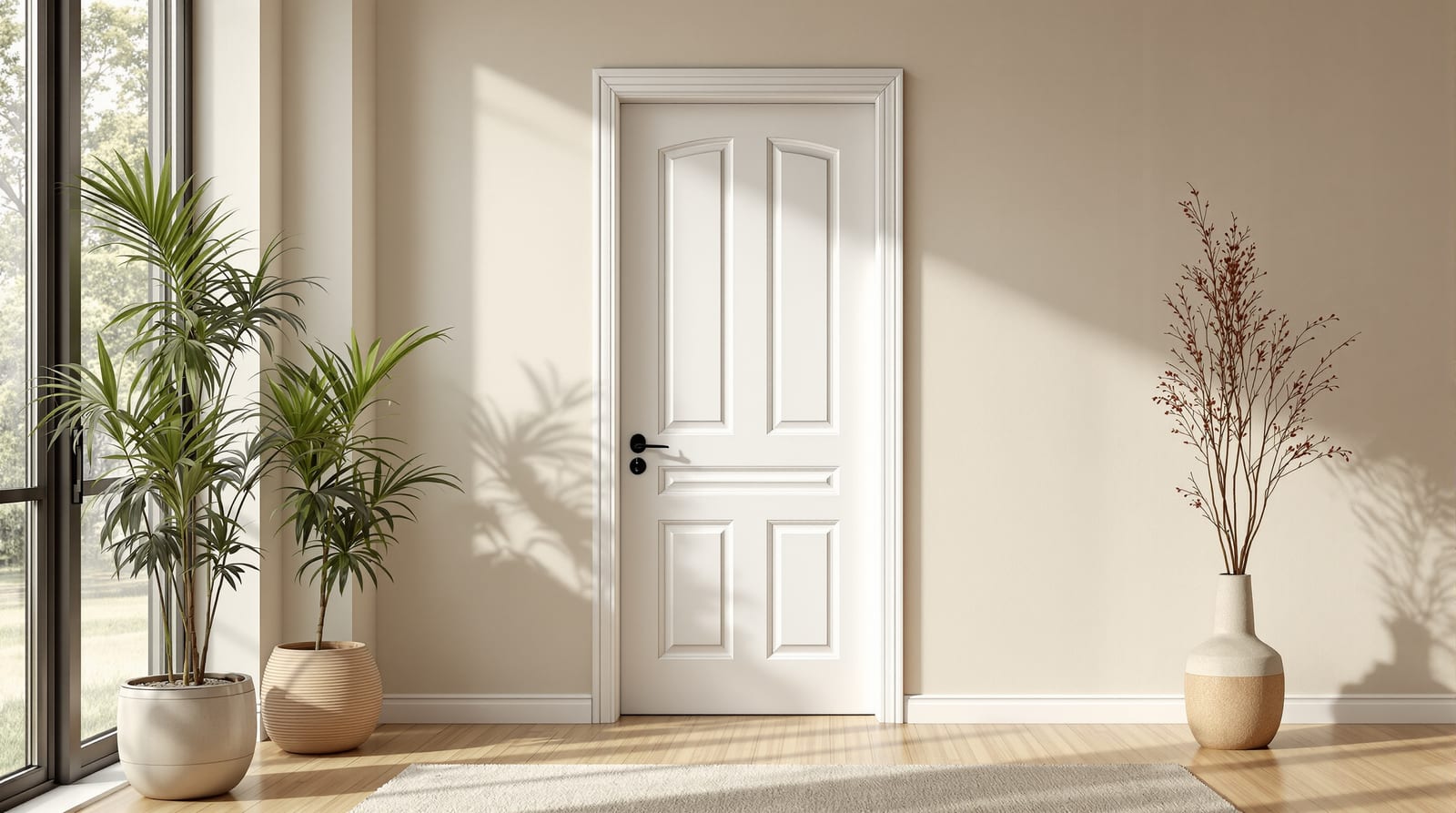
MDF Doors in India (2026): Moulded Panel & Pre-Primed Paint-Grade Doors, Cost & the Moisture Caveat
Why engineered fibreboard gives the smoothest paint-grade internal door in Indian homes — and the one place you must never put it.
If you have ever admired a perfectly smooth, factory-painted panel door in a designer flat or a hotel-style bedroom and wondered how the paint sits so flawlessly with no visible grain, the answer is almost always MDF. Engineered fibreboard takes paint better than any natural timber, which is why moulded MDF and HDF panel doors have quietly become the default "painted designer door" in urban Indian homes. But the same material that paints so beautifully also has a hard rule attached: keep it dry. This guide explains what MDF and HDF actually are, the three ways they show up in Indian doors, where they are exactly right, and the one mistake that wrecks them.
For the wider picture of which material suits which opening, read this alongside our door materials comparison and the complete doors guide for India.
What MDF and HDF actually are
MDF stands for Medium-Density Fibreboard. It is made by breaking timber and wood waste down into fine fibres, mixing them with a resin binder (usually urea-formaldehyde), then pressing the mixture under heat and pressure into a dense, uniform board. There is no grain, no knots and no layers — just a homogenous mass of fibre. That uniformity is the whole point: cut an MDF edge and it is smooth and tight enough to paint directly, unlike plywood whose layered edge needs lipping.
HDF (High-Density Fibreboard) is the same idea pressed harder, to a higher density (typically above 800 kg/m3 versus roughly 600-800 for MDF). HDF is denser, stronger and thinner for the same stiffness, which is exactly why it is used for the thin moulded skins of panel doors and for laminate flooring.
The key things to hold in your head:
- No grain, dead flat — the best paint surface of any door material.
- Engineered and uniform — it routs, moulds and machines into crisp panel profiles cleanly.
- Hygroscopic — fibreboard drinks water. Soak an unsealed edge and it swells, softens and never fully recovers. This single fact governs where MDF doors belong.
The three ways MDF shows up in an Indian door
People say "MDF door" loosely. In practice it means one of three different products, and the difference matters for both price and durability.
1. Moulded panel (HDF skin) doors
This is the big one. A moulded panel door is built like a flush door but with character: a softwood or engineered timber frame (stiles and rails) around the perimeter, often a cardboard honeycomb or hollow core inside, faced front and back with pre-moulded HDF skins. The skin is a thin sheet of HDF pressed in a mould so it carries the raised-and-recessed look of a traditional 2-panel, 4-panel or 6-panel door — but it is one continuous moulded sheet, not real joinery.
The result is a light, affordable door that looks like a classic panelled door and paints like a dream. Brands sell these as "moulded doors," "skin doors" or "designer panel doors." Because the core is usually hollow, they are light and best suited to internal openings — see how this compares in our note on solid versus hollow-core doors and the panel doors guide.
2. Pre-primed, ready-to-paint doors
Many moulded HDF and MDF doors come pre-primed at the factory — a base coat of primer already sprayed on, so the carpenter or painter only adds the finish colour on site. This saves a coat, gives a more even base than site-priming a raw board, and is why pre-primed doors are popular with builders doing many flats at once. You buy them white, you paint them whatever you like.
3. MDF as the core under membrane or laminate
The third use is invisible: MDF is a superb substrate. Because it is so flat and routs into 3D profiles, MDF is the standard core under PVC membrane doors — the membrane is vacuum-pressed onto a CNC-routed MDF panel to give those seamless white shaker-style wardrobe and door fronts. MDF also sits under some laminate doors and painted lacquer fronts. Here the MDF never shows; it is chosen purely for flatness and machinability.
A moulded HDF skin door in section
The anatomy explains both the strengths and the limits. Here is a horizontal section through a moulded panel door leaf:
The two moulded HDF skins carry the look and the paintable surface; the timber perimeter frame gives the leaf its edge strength and somewhere to fix hinges and the lock; the hollow honeycomb core keeps it light and cheap. The exposed bottom edge and any cut-out (for a lock or a glass insert) are the door's weak points for moisture — which brings us to the caveat.
The big caveat: MDF and water do not mix
This is the single most important thing to understand before buying. MDF and standard HDF swell, soften and sag when they take on moisture, and the damage is permanent. A wet-mopped floor that splashes the bottom edge, a leaking overhead tank, a bathroom's daily steam, or monsoon damp against an external wall will all eventually destroy an MDF door. The fibres absorb water, the board bloats at the edges, paint blisters and the panel deforms.
Practical rules for an Indian home:
- Never use plain MDF/HDF doors for bathrooms, WCs, balconies, terraces, external entrances or utility/wash areas. For wet zones use WPC doors, uPVC, FRP or aluminium instead — see best door material for India and the bathroom door guide.
- Seal every edge. The bottom edge especially must be sealed with primer/paint before fitting, and a small threshold gap kept above a wet-mopped floor. Cut edges around locks must be re-sealed.
- Mind the mop. In Indian homes floors are washed daily; an MDF door touching a wet floor wicks water up. Keep a clearance and a dry threshold.
- Boil-proof / moisture-resistant MR-grade MDF exists (often green-tinted) and tolerates humidity better, but it is still not a wet-area material — treat any moisture rating as "more forgiving," not "waterproof."
Used correctly — dry internal rooms only — an MDF door lasts well for years. Used in the wrong place, it can fail in a single monsoon.
Strength: MDF versus plywood
Beyond moisture, the honest mechanical truth is that plywood is stronger and holds screws better than MDF. Plywood's cross-banded veneers give it tensile strength and a grip on screws and hinges that homogenous fibreboard lacks; an MDF edge can split if you over-drive a screw, and a hollow moulded door's frame (not the skin) is what really carries the hinges. For a busy, slam-prone door — a child's room, a much-used study — a plywood or solid-core door is more robust. MDF's advantages are surface finish, dimensional stability against grain movement, and cost, not raw strength. Pair this with the door materials comparison.
MDF vs plywood vs solid wood at a glance
| Factor | MDF / HDF moulded | Plywood (flush) | Solid wood (teak/sal) |
|---|---|---|---|
| Cost (per shutter, indicative) | ~₹2,000-6,000 | ~₹1,200-9,000 (designer veneered higher) | ₹10,000-25,000+ (teak far more) |
| Paint finish | Best — dead-flat, no grain | Good but edges need lipping; grain can show | Grain shows; suits polish not flat paint |
| Moisture resistance | Poor — swells, must stay dry | Better (BWR/BWP grades resist water) | Good if seasoned & sealed; can still warp |
| Strength / screw-hold | Lower; edges can split | Higher; good screw grip | Highest; very strong |
| Weight | Light (hollow moulded) | Medium | Heavy |
| Best use | Dry internal painted designer doors | Most internal doors, semi-wet with BWR | Main doors, premium feel, carving |
| Carving / 3D profile | Routs/moulds crisply | Limited | Hand-carve-able |
For grades and water resistance in plywood, our plywood doors guide covers MR vs BWR vs BWP; for the warm natural-wood end, see wooden doors and teak doors.
Cost: what MDF doors run in 2026
MDF and moulded HDF doors are usually priced per shutter for standard internal sizes. These are indicative ranges and vary by city, brand, size and finish — confirm a live quote.
| Door type | Indicative cost (per standard shutter) | Notes |
|---|---|---|
| Plain pre-primed moulded HDF panel door | ₹2,000-3,500 | Light hollow-core, ready to paint; builder default |
| Better-brand moulded panel (2/4/6-panel) | ₹3,500-6,000 | Crisper mould, solid-feel options, primed |
| MDF core + PVC membrane finish | ₹120-300 per sq ft of finish + core | Membrane press over routed MDF; designer fronts |
| MR-grade (moisture-resistant) MDF leaf | + roughly 15-30% over plain MDF | More forgiving humidity, still not wet-area |
To that add +18% GST, a door frame / chowkat (sal/teak ₹350-900 per running foot, or a uniform WPC/steel frame), fitting labour ~₹800-3,000 per door, and hardware (hinges, lock, handle) ₹1,500-8,000. A finished, fitted painted MDF internal door commonly lands around ₹4,000-9,000 all-in for a standard bedroom opening. For the full benchmark see the master door cost guide and the door installation cost guide; to model your own configuration, use the door cost calculator.
Where MDF doors are exactly right
Choose an MDF / moulded HDF door when:
- It is a dry internal room — bedroom, study, home office, dressing room, store, walk-in. No wet mopping splashing the leaf, no steam.
- You want a painted, designer look — clean shaker panels, a bold colour, two-tone, or a flush painted slab. MDF gives the smoothest paint of any door. See door colour ideas.
- Budget matters and you want the panelled look without solid-wood cost.
- You want consistency across many doors — pre-primed moulded doors are uniform flat to flat, which is why builders specify them.
- You want crisp 3D detail under membrane — for seamless white panelled fronts.
Avoid it for the main entrance (use a solid or engineered-wood door for mass, security and the first impression — see main door design), and for every wet or external opening.
A quick buying checklist
When ordering a moulded MDF/HDF door, confirm: core (hollow honeycomb vs solid/tubular for a heavier feel), skin thickness and mould pattern, whether it is pre-primed, edge sealing on the bottom rail, the frame material it pairs with, MR-grade or standard, leaf size against door size standards, and whether GST and fitting are included. Plan the swing and clearance — our note on measuring a small room helps you avoid a door that fouls furniture.
Frequently asked questions
Are MDF doors good for Indian homes?
For dry internal rooms — bedrooms, studies, store rooms — yes, they are excellent: light, affordable and the best paint-grade finish you can get. The catch is moisture. Never use a plain MDF door for a bathroom, balcony, terrace, utility area or external entrance, where India's monsoon humidity and daily wet-mopping will swell and ruin it.
What is the difference between MDF and HDF doors?
Both are engineered fibreboard. HDF is pressed to a higher density, so it is stronger, harder and thinner for the same stiffness. In doors, thin HDF is moulded into the panel skins, while MDF (medium density) is used for thicker cores and as the routed substrate under membrane finishes.
Is an MDF door stronger than a plywood door?
No. Plywood is stronger and holds screws and hinges better thanks to its cross-banded veneers, and BWR/BWP plywood resists moisture far better. MDF wins on surface smoothness for painting, dimensional uniformity and cost — not on raw strength. For a high-traffic, slam-prone door, plywood or a solid-core leaf is more robust.
Can MDF doors be used in bathrooms?
No — plain MDF/HDF should never go in a bathroom or WC. The steam, splashes and humidity will swell the fibreboard and blister the paint permanently. Use WPC, FRP, uPVC or aluminium for wet areas instead; see best door material for India.
How much does an MDF door cost in India?
A plain pre-primed moulded HDF panel shutter is roughly ₹2,000-3,500, and a better-brand moulded panel door ₹3,500-6,000, before frame, hardware, +18% GST and fitting. Finished and fitted, a standard painted MDF internal door commonly lands around ₹4,000-9,000 all-in. See the master door cost guide.
Export this guide
Related Guides — Deep-dive reading
The Complete Home Door Guide for Indian Homes (2026): Types, Materials, Cost, Security & Vastu
Everything an Indian homeowner needs to specify the right door for every opening — from main entrance to bathroom — with real 2026 prices, IS/NBC standards and Vastu sense.
Home Doors & EntrancesWPC Doors for Indian Homes: 100% Waterproof, Termite-Proof, and Where They Belong
Wood-plastic composite doors and frames promise zero swelling, zero termites and a low price - here is what that really means, where the screw-holding catch bites, and how WPC compares with wood and flush doors in 2026.
Home Doors & EntrancesBedroom Door Design in India: Materials, Sizes, Finishes, Privacy and Cost (2026)
How to choose and design a bedroom door for Indian homes — privacy, light-noise control, finishes that match the room, the right 900x2100 internal door, locks and ₹ budget.
Home Doors & EntrancesRelated Tools — Try Free
Door Cost Calculator
Estimate the all-in cost of a door — leaf, frame, hardware, fitting and GST — by type, material and size.
Door CalculatorDoor Material Comparison Tool
Compare 2–4 door materials on cost, durability, maintenance, security and moisture resistance.
Comparison ToolMaterial Comparison Sheet
India's interior material cheatsheet — plywood, finishes, hardware, countertops, paints, waterproofing.
Reference Guide