
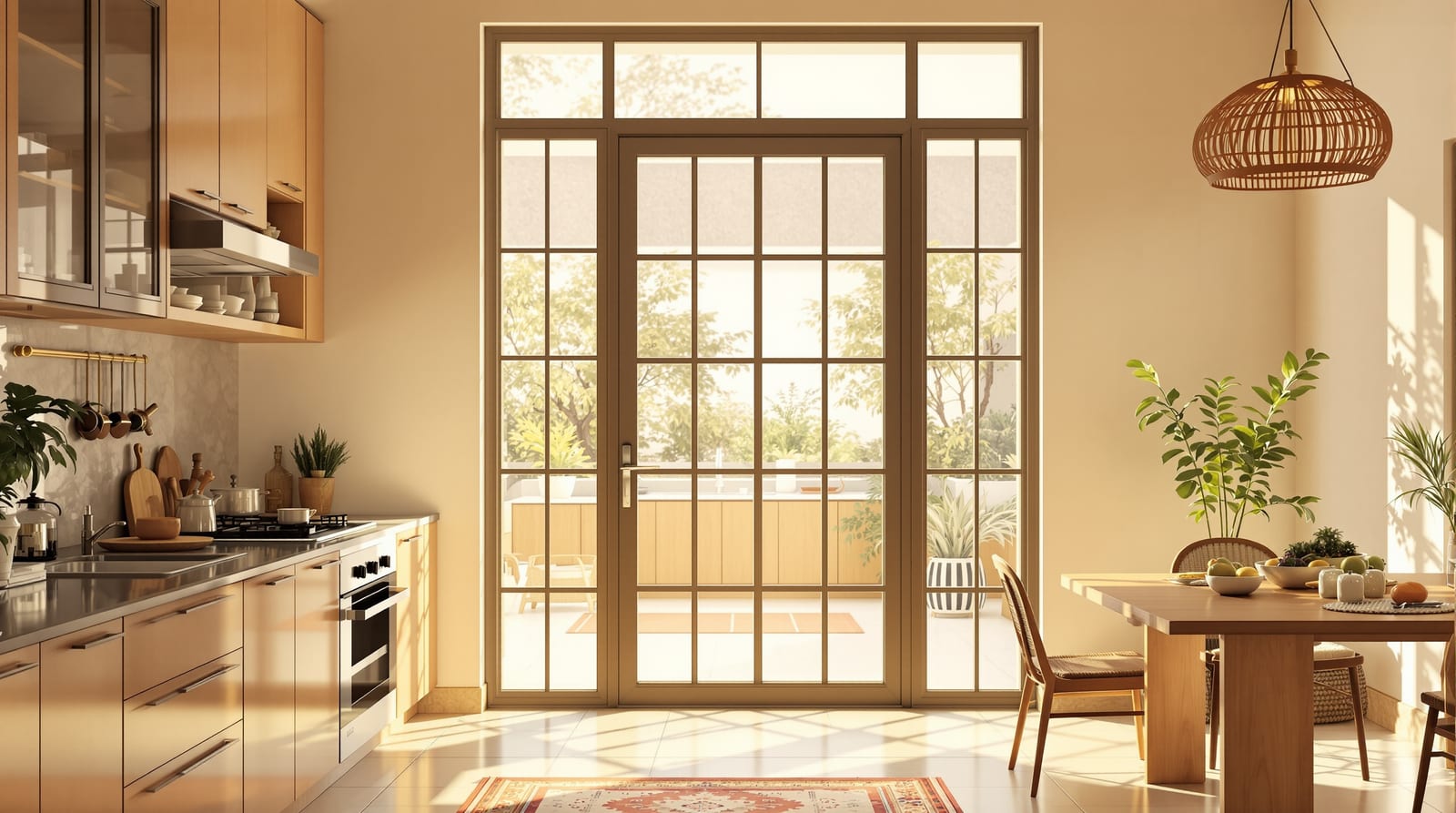
Kitchen Door Design for Indian Homes (2026): Options, Materials & Layout
How to choose a kitchen door that survives grease, smoke and hands-full traffic — swing, sliding, glass-panel, Dutch and folding options for open and closed Indian kitchens.
The kitchen door is the hardest-working door in an Indian home, and the one most people choose last and worst. It has to take grease film and turmeric splatter, shrug off radiant heat from a four-burner hob, open when both your hands are full of a hot kadai, and somehow let light through while keeping the smell of fried fish or a tadka of asafoetida out of the living room. A bedroom door only opens a few times a day; a busy Indian kitchen door swings dozens of times during a single dinner prep. Choose the wrong leaf or material and you will be repainting, rehanging or wiping it forever.
This guide is a spoke off our room-by-room interior door hub. It goes deep on the kitchen specifically — the open-versus-closed debate, the door styles that actually suit cooking traffic, the wipeable materials that survive heat and oil, the often-forgotten utility-balcony door, and ventilation. For overall door buying strategy, start with the complete guide to home doors in India.
First decide: open kitchen, closed kitchen, or a door you can close on demand
In India this is not a small decision, and the right door follows from it. The Western open-plan island kitchen looks beautiful on Instagram, but Indian cooking is high-smoke and high-aroma: deep-frying, tempering whole spices in hot oil, roasting masalas, pressure-cooking dal. In an open layout that smell travels straight into your sofa fabric, curtains and, in apartments, sometimes the neighbour's lobby. Joint families running two simultaneous meals make it worse.
The pragmatic middle path most Indian designers now recommend is a semi-open kitchen with a closeable door or partition — open and social most of the time, sealed off when something heavy is frying. This is why door style matters so much in the kitchen: you want the option to close, not a permanent wall.
| Kitchen layout | Best door approach | Why it suits Indian cooking |
|---|---|---|
| Fully closed (separate room) | Single swing or double-action swing door, or a sliding door | Contains smoke/smell fully; easy hands-full entry |
| Semi-open / breakfast-counter pass | Glass-panel swing or sliding door; Dutch door over the counter | Light and connection, but seal smell on demand |
| Open-plan island | Folding glass partition you can stack away | Open daily, closeable when deep-frying |
| Kitchen + utility balcony behind | Aluminium/uPVC glazed door to the utility | Wet zone, daylight, ventilation, sound of washing machine |
Door options that actually suit a kitchen
The kitchen rewards a specific shortlist. Looks come second to "can I open this with my elbow while carrying a hot pan."
Double-action (saloon-style) swing door — the hands-full hero
A double-action door swings both ways and self-closes on a spring or floor pivot, so you push through with a hip, elbow or the pan itself and it shuts behind you. For a busy closed kitchen with constant in-out traffic during dinner, nothing beats it. It can be a full leaf or a half-height saloon door for airflow. Pair it with a kick-plate at the base where shoes and trolleys hit. Read more on how these behave in our guide to swing doors in India.
Standard single swing door
The default. Cheapest, simplest, fully closeable for smell control. The catch in small Indian kitchens is the swing arc eating floor or counter space — see the SVG below. Hang it to open outward into the passage if the kitchen is tight, so the leaf does not collide with the slab or a person standing at the hob.
Sliding door — when floor space is the constraint
A sliding kitchen door (surface-mounted or pocket) removes the swing arc entirely, which is gold in a compact flat where the kitchen door is wedged between a counter and a fridge. Glass sliders keep light flowing. The trade-off: hands-full operation is harder (you can't bump it open the way you bump a swing door), the bottom track collects atta and oil and needs cleaning, and a single slider rarely seals smell as tightly as a swung leaf. See sliding doors in India for track and material detail.
Glass-panel door — light in, smell trapped
A framed door with a large toughened-glass panel is arguably the best all-rounder for the modern Indian kitchen: it keeps the cooking smell and smoke physically sealed inside while letting daylight and a line of sight through, so the kitchen does not feel like a dark box and someone outside can see the cook. Use frosted or fluted glass if you want privacy over the mess. Frame it in aluminium or laminate-faced material, not raw timber. Our glass-panel door designs guide covers grilles, fluting and frame options.
Dutch door — serve and talk without opening fully
A Dutch (stable) door is split horizontally so the top half opens while the bottom stays shut. In a kitchen this is genuinely useful: open the top to pass a plate across, chat with kids doing homework, or vent steam, while the closed bottom keeps a toddler or the dog out of a hot cooking zone. It's a lovely fit for a kitchen that opens onto a dining counter. More in Dutch doors in India.
Folding partition — open-plan flexibility
Bi-fold or folding glass/aluminium partitions let you have it both ways: stack the panels fully open so the kitchen breathes into the living room daily, then fold them shut and seal the smell when you start a heavy fry. This is the premium solution for an island kitchen that wants to stay open most of the time. See bi-fold doors in India.
Wipeable materials: what survives grease and heat — and what doesn't
The single biggest kitchen-door mistake in India is using a raw-wood, veneer or PVC-membrane door right next to the hob. Heat from cooking and the constant film of airborne oil are brutal on porous and heat-sensitive finishes.
- Avoid near heat: raw/natural-finish solid wood and veneer (oil soaks into the grain and goes patchy; needs re-polishing), and PVC membrane-pressed MDF (the membrane can lift, bubble or discolour with sustained radiant heat and steam). Keep these well away from the hob if used at all.
- Best for kitchens: laminate-faced flush or panel doors (a wipe of mild soapy water removes oil film; choose a matte or textured laminate so fingerprints and splatter don't glare), glass (toughened, wipes clean, takes heat and steam), and aluminium-framed glazed doors (non-porous, dimensionally stable, ideal for the kitchen-to-utility opening).
- WPC is a smart frame and shutter choice for the wet utility-balcony side — waterproof and termite-proof. See WPC doors in India.
| Kitchen door option | Key benefit | Recommended material | Indicative cost (door, ex-fitting/GST) |
|---|---|---|---|
| Single swing (closed kitchen) | Cheapest, full smell seal | Laminate flush (IS 2202) | ₹1,200–4,000 / shutter |
| Double-action swing | Hands-full, self-closing | Laminate flush + spring hinge | ₹2,500–6,000 + ₹1,500–4,000 hardware |
| Sliding (space-saving) | No swing arc | Aluminium-framed glass | ₹450–1,200 / sq ft of opening |
| Glass-panel swing | Light in, smell trapped | Aluminium/laminate frame + toughened glass (IS 2553) | ₹3,000–9,000 / shutter |
| Dutch (serve & vent) | Half-open service hatch | Laminate panel, split leaf | ₹4,000–10,000 / shutter |
| Folding partition | Open ↔ closed on demand | Aluminium + glass bi-fold | ₹700–1,500 / sq ft of opening |
| Utility-balcony door | Wet zone, ventilation | uPVC / aluminium glazed, or WPC | ₹400–900 / sq ft of opening |
Costs are indicative for 2026 and vary by city, vendor, profile grade and finish; add ~18% GST, frame (chowkat) and fitting labour of roughly ₹800–3,000 per door. Cross-check against our door cost benchmark for India, or estimate yours with the door cost calculator.
Size, swing and the utility-balcony door
A kitchen door is typically 800–900 mm wide × 2100 mm (7 ft) high under NBC 2016 common practice — wider than a bathroom door because trolleys, gas cylinders and large vessels pass through. Don't drop below 800 mm or a gas cylinder and a person can't pass comfortably. Confirm against door size standards in India.
The utility-balcony door off the kitchen is the one homeowners forget. Most Indian kitchens back onto a utility/wash balcony holding the sink, washing machine, brooms and (often) the gas cylinder. That door is in a wet, ventilated zone and should be uPVC or aluminium glazed (or WPC) — never natural wood, which warps and rots there. A glazed leaf pulls daylight deep into the kitchen and lets you keep an eye on laundry. Add a mosquito mesh layer there if it opens often; see our utility-balcony depth in utility door guide.
Ventilation matters as much as the door. A door alone won't clear smoke — pair your kitchen-door choice with a chimney/exhaust and a ventilator or openable window, because Indian high-smoke cooking overwhelms a closed room fast. A Dutch door's openable top or a glazed utility door doubles as a cross-ventilation path.
Plan your real swing clearances before buying — the door swing planner and our note on measuring a small room help you avoid a leaf that fouls the counter.
A quick decision shortlist
- Tight closed kitchen, lots of traffic → double-action swing in laminate flush.
- Want light but must trap smell → glass-panel swing door.
- No floor for a swing arc → sliding glass door.
- Open-plan you want closeable when frying → folding glass partition.
- Serve/vent without opening fully → Dutch door onto the counter.
- The door behind the kitchen → uPVC/aluminium glazed utility door with mesh.
Frequently asked questions
Is an open or closed kitchen better for an Indian home?
For high-smoke Indian cooking, a fully open kitchen lets frying smells into your living spaces and fabrics. The practical winner is a semi-open kitchen with a glass-panel swing, sliding or folding door you can close on demand — open and social most of the time, sealed when something heavy is on the hob.
What is the best material for a kitchen door in India?
Wipeable, heat-stable, non-porous materials: laminate-faced flush or panel doors, toughened glass, and aluminium-framed glazed leaves. Avoid raw/natural wood and veneer (oil soaks the grain) and PVC-membrane MDF near the hob, where heat and steam can bubble or lift the finish.
What size should a kitchen door be?
Typically 800–900 mm wide and 2100 mm (7 ft) high under NBC 2016 common practice — wider than a bathroom door so trolleys, large vessels and gas cylinders pass. Don't go below 800 mm. The utility-balcony door behind the kitchen follows the same width.
Why is a double-action swing door good for a kitchen?
It swings both ways and self-closes, so you push through with an elbow, hip or the pan you're carrying — ideal when both hands are full during meal prep. Add a kick-plate at the base for trolley and shoe knocks, and it keeps the kitchen sealed between trips.
Should the kitchen-to-utility-balcony door be different from the main kitchen door?
Yes. The utility balcony is a wet, ventilated zone with the sink, washing machine and often the gas cylinder, so use uPVC, aluminium glazed or WPC there — never natural wood, which warps and rots. A glazed leaf also brings daylight in and lets you watch the laundry; add a mosquito mesh if it opens often.
Export this guide
Related Guides — Deep-dive reading
Dining Room Door in India: Best Partition & Opening Choices (2026)
How to choose the right door for the dining area of an Indian home - kitchen-dining partitions that trap cooking smells and smoke while keeping flow, plus open dining-to-living and dining-to-garden options - ranked picks, drivers and indicative costs.
Home Doors & EntrancesThe Complete Home Door Guide for Indian Homes (2026): Types, Materials, Cost, Security & Vastu
Everything an Indian homeowner needs to specify the right door for every opening — from main entrance to bathroom — with real 2026 prices, IS/NBC standards and Vastu sense.
Home Doors & EntrancesSwing Doors in India: Double-Action Café Doors, Self-Closing & How to Read Door Handing
Two-way swinging pass-through doors, self-closing AC-room doors, and a plain-English guide to door handing — left/right hand, inswing/outswing — so you order the right swing the first time.
Home Doors & EntrancesRelated Tools — Try Free
Cross-Ventilation Analyzer
Estimate airflow and air changes per hour (ACH) from room size, window areas, layout, and local wind — with NBC 2016 Part 8 compliance check.
Ventilation CalculatorWindow Size Calculator
Get the right window size, glazing area and openable area for any room using NBC daylight rules.
Window ToolAcoustic Privacy (STC) Visualizer
Indian healthcare acoustic visualizer — compare wall assemblies and noise sources, see received SPL after STC attenuation, and check FGI 2018 / IS 1950 / NABH speech-privacy compliance with live dual-canvas waveform.
Acoustic Tool