
Laminate Doors in India (2026): HPL-Finished Flush Doors, Designs, Brands & Cost
The default mid-range Indian internal door finish — what HPL laminate is, finish ranges, thickness, edge-banding, durability and how it compares to veneer, membrane and paint.
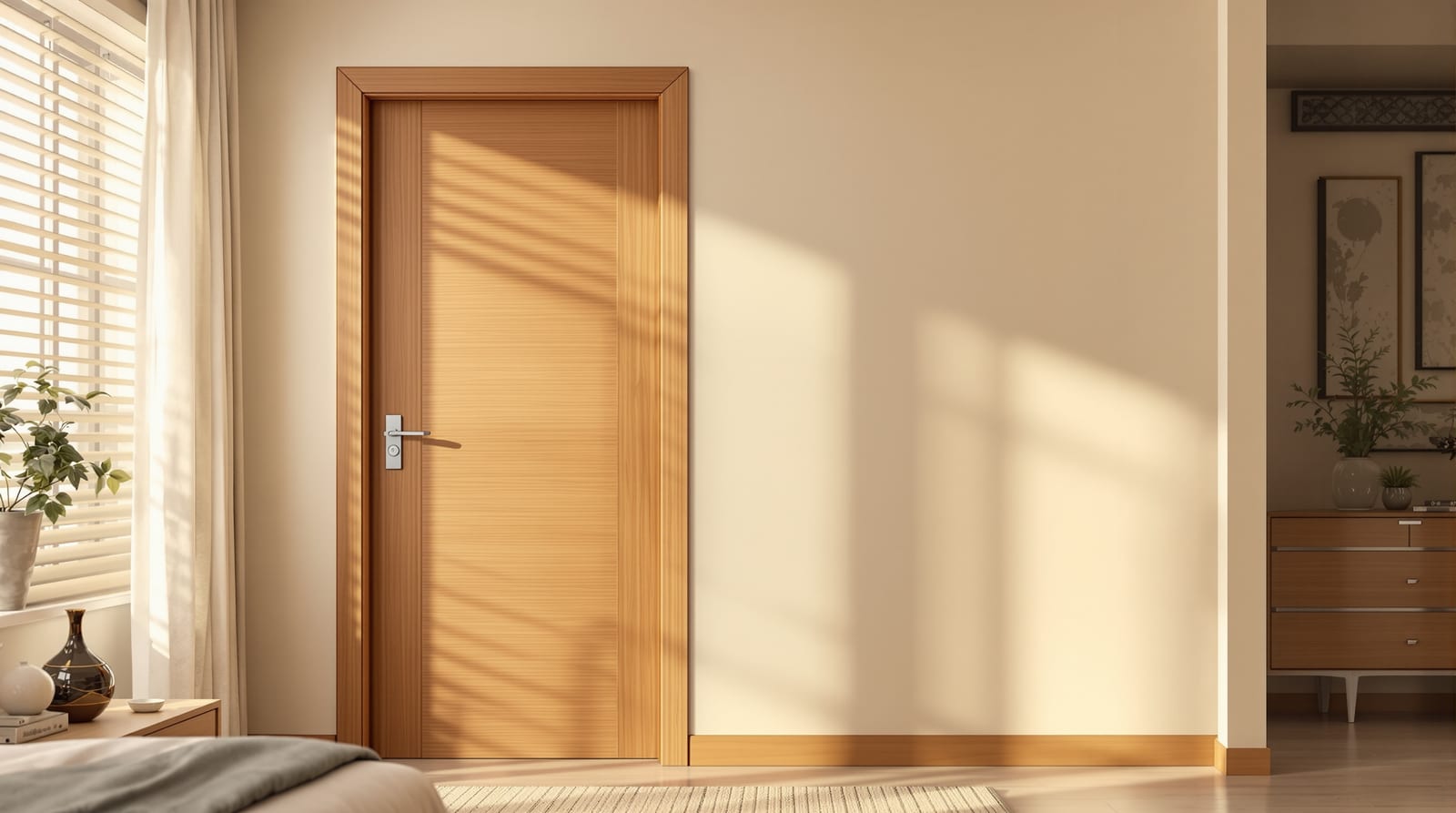
If you have ever pointed at a smooth, woodgrain bedroom door in an Indian flat and asked "is that real wood?", the answer is almost always no — it is a laminate door. A flush plywood or WPC shutter faced with a thin, factory-pressed decorative sheet is the workhorse of Indian internal doors: tough, washable, endlessly patterned and a fraction of the cost of real timber. Get the finish, thickness and edge-banding right and a laminate door looks crisp for fifteen years; get them wrong and it peels at the edges in two monsoons.
This guide explains exactly what a laminate door is, how to read the finish and thickness specs, what it costs per shutter in 2026, and when you should spend more on veneer instead. For the door substrate itself, pair this with our flush doors guide; for the full picture see the complete guide to home doors and the door materials comparison hub.
What "laminate door" actually means
A laminate door is not a separate type of door — it is a flush door plus a surface finish. Two things are stacked:
1. The substrate (the shutter): a solid-core or hollow-core flush door, usually block-board, plywood, MDF or WPC, made to IS 2202. This gives the door its strength, weight and screw-holding.
2. The laminate (the face): a decorative High-Pressure Laminate (HPL) sheet glued onto both faces of that shutter under heat and pressure.
HPL is built from layers of kraft paper soaked in phenolic resin, topped with a printed decorative paper and a clear melamine wear layer, then cured under roughly 1,400 psi at about 140-150 degrees C. The result is a hard, non-porous skin a millimetre thick. The printed layer is what carries the woodgrain, marble, solid colour or fabric look — which is why laminate can mimic teak, walnut or concrete at a tenth of the price.
So "laminate door" = a factory or carpenter-made flush shutter with an HPL sheet pressed on. The door's behaviour in heat and damp comes mostly from the substrate (a WPC core laughs at water; an MDF core does not), while its looks and scratch-resistance come from the laminate.
Laminate finishes: the range you can choose from
The single biggest reason laminate dominates Indian interiors is choice. A typical laminate catalogue (Greenlam, Merino, Century, Sundek, Royale Touche, Stylam, Advance) runs to thousands of designs across these families:
| Finish family | Look & feel | Best for | Care notes |
|---|---|---|---|
| Solid colours | Flat matte or satin block colour | Modern, minimalist, two-tone doors | Fingerprints show on dark glossy versions |
| Woodgrain | Printed teak, walnut, oak, wenge | The default "wooden door" look on a budget | Choose synchronised texture for realism |
| Textured / suede | Matte with a tactile grain you can feel | Premium-feel bedroom and wardrobe doors | Hides scratches and dust best |
| High-gloss | Mirror-like, reflective | Statement modern doors, glossy wardrobes | Shows every smudge and swirl mark |
| Matte / super-matte | Low-sheen, anti-fingerprint | 2026's most popular look for flats | Excellent everyday finish |
| Metallic / fabric / stone | Brushed metal, linen, marble prints | Accent and feature doors | Pattern-match adjacent panels carefully |
Textured and matte finishes are the smart default for a busy Indian household — they hide the daily scuffs from slippers, school bags and joint-family traffic far better than high-gloss. See door laminate designs for design pairings and door colour ideas for palettes.
Thickness: the number that quietly decides quality
Laminate is sold and specified by thickness, and this is where corners get cut:
- 0.6-0.8 mm: "liner" or backer-grade laminate. Fine for the hidden back of a wardrobe, not for a door face. Avoid on doors.
- 0.8-1.0 mm: the most common door-face grade. Acceptable on internal doors with a good core, but thinner sheets telegraph any roughness in the substrate.
- 1.0 mm (and 1.0 mm-plus): the right specification for a door you touch daily. A genuine 1 mm HPL has a thicker wear layer, resists scratches and post-forming better, and lasts the door's life.
When a quote says "laminate door" without a thickness, assume the cheapest sheet. Always write "1 mm HPL on both faces" into your order. A door faced on one side only will bow over time as the two faces absorb humidity unequally — which brings us to the most important detail.
Always laminate both sides (double-side)
A flush door must be balanced: the same sheet on the front and back. If a carpenter laminates only the corridor-facing side and leaves the back as bare ply (or a cheap backer), the two faces expand and contract differently in Mumbai or Chennai humidity and the door warps. Insist on double-side lamination of the same thickness — it is non-negotiable for a door that stays straight.
Edge-banding: where laminate doors live or die
The face sheets cover the front and back, but the four edges of the shutter are exposed plywood unless they are sealed. Edge-banding closes them, and it is the single biggest predictor of whether a laminate door survives Indian conditions.
- PVC or laminate lipping is glued to all four edges so no raw ply is visible.
- The vertical edges (where the lock and hinges sit) and especially the top and bottom edges must be sealed. Bare bottom edges wick up mopping water and floor-washing moisture, the glue line fails, and the laminate lifts.
- A well-banded laminate door has no visible dark plywood line and no gap you can catch with a fingernail.
Cheap doors skip the top and bottom bands because nobody looks there — then peel within two monsoons. When you inspect a finished door, run your finger along every edge. This is the difference between a ten-rupee saving and a ten-year door.
Here is the layer section of a properly built laminate door:
Durability: what laminate handles, and what it does not
A 1 mm HPL face is genuinely tough for daily life:
- Scratch and abrasion: excellent. The melamine wear layer shrugs off bag zips, keys and slippers far better than paint or polish.
- Stains and cleaning: excellent. Non-porous, so it wipes clean — ideal for kitchen-side and kids' room doors. Use a damp cloth, never abrasive scrubbers on high-gloss.
- Heat: good on the face, but edges are the weak point — a hot vessel or a stray iron left against an edge can lift the band. Keep heat off edges.
- Water: the face is water-resistant; the risk is always the edges and the substrate. Sealed edges plus a water-friendly core (WPC) make a laminate door fit for a bathroom-adjacent corridor. A bare-edged MDF-core laminate door near a wet area will swell and delaminate. For genuinely wet rooms, read WPC doors and the best door material guide.
- Termites: laminate itself is inedible, but termites attack the core and frame. Use a treated or WPC core in termite-prone zones.
The headline: laminate's durability is mostly about the edge-banding and the substrate, not the sheet. A good sheet on a bad core is a bad door.
Top laminate brands in India
For the decorative sheet, the established names are Greenlam, Merino, Century (CenturyLaminates), Royale Touche, Sundek, Stylam, Advance, Virgo and Sunmica (Sunmica is so dominant it became the generic word for laminate). For the finished door, factory brands like Greenply, CenturyPly, Kitply, Duroply and Action Tesa supply pre-laminated flush shutters to IS 2202. Choose a 1 mm sheet from a reputable brand with an ISI mark and ask for the decor (design) code so you can match future doors and wardrobes.
Cost: what a laminate door runs in 2026
Two things drive the price — the flush door (substrate) and the laminate sheet, plus the carpenter's pressing labour or the factory premium. Costs are indicative and vary by city, brand and vendor; add about 18% GST and separate frame, hardware and fitting charges.
| Component | Indicative 2026 cost | Notes |
|---|---|---|
| Plain flush door shutter (IS 2202) | ₹1,200-4,000 / shutter | Block-board/ply core; WPC flush ₹2,000-4,500 |
| HPL laminate sheet (8x4 ft) | ₹600-2,500 / sheet | 1 mm branded sheets toward the upper end |
| Applied per shutter (door + both-side laminate + edges + labour) | ~₹3,000-6,500 / shutter | Mid-range standard internal door, fitted finish-ready |
| Factory pre-laminated flush door | ~₹2,500-5,500 / shutter | Cleaner edges, consistent pressing |
| Frame (chowkat) | ₹350-900 / ft run (timber) | WPC/steel frames cheaper and more uniform |
| Fitting labour + hardware | ₹800-3,000 + ₹1,500-8,000 | Hinges, lock, handle, stopper |
So a complete, fitted laminate bedroom door typically lands around ₹5,000-10,000 all-in, against ₹10,000-25,000-plus for a solid wood door. Use the door cost calculator to price your set, and see the master door cost benchmark and flush door price guide.
Laminate vs veneer vs membrane vs paint
This is the decision most homeowners actually face: how to finish a flush door. Each has a personality.
| Finish | What it is | Look | Durability | Cost | Best for |
|---|---|---|---|---|---|
| Laminate (HPL) | Printed resin sheet pressed on | Realistic prints, huge range, uniform | Very high scratch/stain; edge is the weak point | Lowest (mid-range) | Default internal doors, kids/kitchen, rentals |
| Veneer | A thin slice of real wood | Natural, premium, each piece unique | High, but needs polish/PU and re-coating | Higher | Statement, living and main-side doors |
| PVC membrane | Thermo-pressed foil on routed MDF | Seamless wrapped profiles, no edge joints | Moderate; can peel with heat/steam over years | Mid | Profiled, moulded and shaker-style shutters |
| Paint / Duco / PU | Sprayed lacquer on primed MDF/wood | Solid colour, smooth, any RAL shade | Good but chips; touch-up needed | Mid-high | Coloured, modern flat doors |
The simplest way to think about laminate versus veneer: laminate is printed, durable and cheaper; veneer is real wood, premium and pricier. Laminate gives you a flawless, repeatable woodgrain that never needs polishing; veneer gives you genuine timber character that ages and can be refinished. For doors you touch a hundred times a day in a busy home, laminate usually wins on value; for one or two showpiece doors, veneer earns its premium. Compare in depth with veneer doors, membrane doors, and the wider door materials comparison, or run the door material comparison tool.
How to specify a laminate door (a buyer's checklist)
- Substrate: IS 2202 flush door; WPC or treated core for any wet/termite-prone location.
- Laminate: branded 1 mm HPL, ISI-marked, with the decor code recorded.
- Both sides: same sheet, both faces — insist on it to prevent warping.
- Edges: all four edge-banded, including top and bottom; no raw ply visible.
- Texture: matte or suede for a busy home; high-gloss only where smudges will be tolerated.
- Frame: match a timber/WPC/steel frame to the location; see the flush doors guide.
- Sizes: standard bedroom 900 x 2100 mm, bathroom 700-750 x 2000-2100 mm — see door size standards.
Frequently asked questions
Is a laminate door real wood?
No. A laminate door is a flush plywood/MDF/WPC shutter faced with a printed HPL sheet that looks like wood (or marble, fabric or solid colour). It is not solid timber, and not a real wood veneer either — veneer is an actual thin slice of wood. See veneer doors for the real-wood option.
Laminate or veneer — which should I choose?
Choose laminate for everyday internal doors where you want durability, a flawless repeatable finish and lower cost. Choose veneer for one or two premium statement doors where genuine wood character justifies the price and the periodic re-polishing. Most Indian homes use laminate throughout and reserve veneer for the living-room-facing or main door.
Why do laminate doors peel at the edges?
Because the top and bottom edges were left unsealed. Mopping water, monsoon humidity and floor-washing wick into bare plywood, the glue line fails, and the laminate lifts. Full four-side edge-banding and a water-tolerant core (WPC) prevent it. Always check every edge before accepting the door.
What thickness of laminate is best for doors?
A genuine 1 mm HPL on both faces. Thinner 0.6-0.8 mm sheets are backer-grade and telegraph substrate flaws; they belong on hidden wardrobe backs, not doors you touch daily.
Can laminate doors be used in bathrooms?
On the dry side of a bathroom, yes — with a WPC core and fully sealed edges. For the wet interior face or a constantly damp room, a fully waterproof FRP, WPC or PVC door is safer. See the best door material guide and WPC doors.
For the bigger picture, return to the complete guide to home doors in India, compare every option in the types of doors hub, and pick your design in door laminate designs. Studio Matrx keeps these guides current — see the verified date below.
Export this guide
Related Guides — Deep-dive reading
Bedroom Door Design in India: Materials, Sizes, Finishes, Privacy and Cost (2026)
How to choose and design a bedroom door for Indian homes — privacy, light-noise control, finishes that match the room, the right 900x2100 internal door, locks and ₹ budget.
Home Doors & EntrancesThe Complete Home Door Guide for Indian Homes (2026): Types, Materials, Cost, Security & Vastu
Everything an Indian homeowner needs to specify the right door for every opening — from main entrance to bathroom — with real 2026 prices, IS/NBC standards and Vastu sense.
Home Doors & EntrancesVeneer Doors in India (2026): Natural Wood Looks, Finishing, Cost & Care
Why a thin slice of real wood over a flush door gives the warmest premium internal-door look in Indian homes — and what it takes to keep it that way.
Home Doors & EntrancesRelated Tools — Try Free
Door Cost Calculator
Estimate the all-in cost of a door — leaf, frame, hardware, fitting and GST — by type, material and size.
Door CalculatorDoor Material Comparison Tool
Compare 2–4 door materials on cost, durability, maintenance, security and moisture resistance.
Comparison ToolMaterial Comparison Sheet
India's interior material cheatsheet — plywood, finishes, hardware, countertops, paints, waterproofing.
Reference Guide