
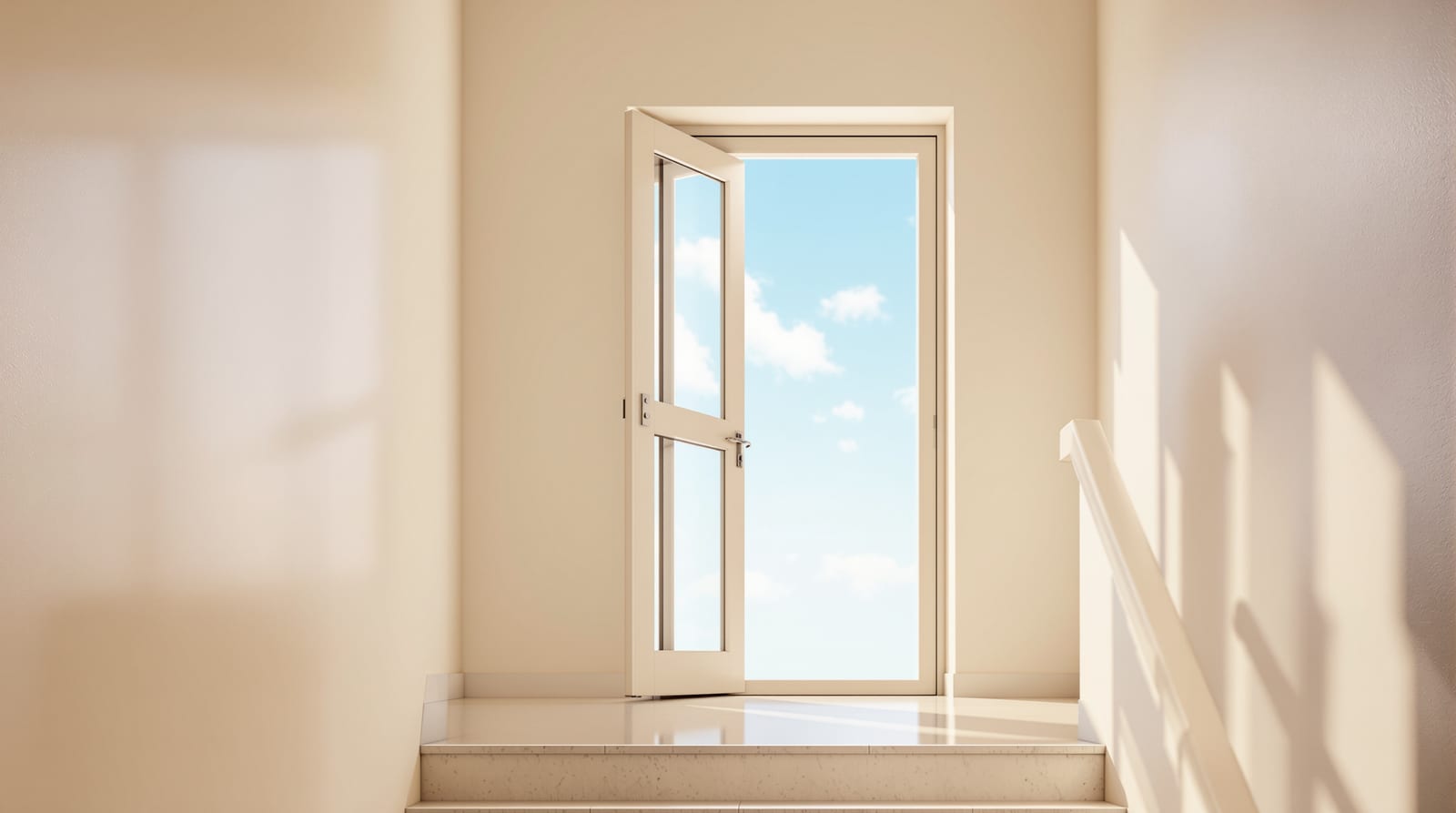
Terrace Door for Indian Homes: Weatherproof Material, Lock & Threshold Guide
How to pick a roof-access terrace door that survives full sun and monsoon, keeps rain out of the stairwell, and stops intruders.
The terrace door is the most punished door in an Indian home, and the one most people buy last and cheapest. It stands at the top of the stairwell with one face fully exposed to the sky: blazing summer sun from March to June, then driving monsoon rain from June to September, usually with no chajja or overhang to shield it. A flush door or a polished teak leaf that looks perfect on a bedroom will swell, delaminate and bleach grey within two monsoons up there. Worse, the terrace is a favourite break-in route because intruders can reach it from an adjacent parapet, water tank platform or neighbouring roof. So this door has to do two hard jobs at once: survive open weather and resist forced entry. This guide covers the material picks that actually last, the threshold and waterproofing detail that keeps rain out of your staircase, sun-fade, security, and sizing.
For the wider picture of room-by-room door choices, see our interior doors by room guide, and for the whole cluster start at the complete guide to home doors.
Why the terrace is the toughest door location in the house
Three exposures combine on a roof door that exist nowhere else indoors:
- Full UV. Six to eight hours of direct sun daily for months. UV breaks down polymers and pigments, fading laminates, cracking cheap PVC, and chalking unprotected paint.
- Driving rain with no overhang. Monsoon rain hits the leaf horizontally and pools at the sill. Water finds every unsealed joint, every screw hole, every gap under the leaf, and runs straight down your internal staircase.
- Thermal cycling. The leaf can swing from a 50 degree Celsius surface at noon to a cold downpour within minutes. Materials that expand and contract differently from their core (veneer over MDF, laminate over plywood) shear apart at the bond line.
Add coastal salt air in cities like Chennai, Mumbai, Kochi and Visakhapatnam, and termite pressure from a damp parapet, and you have the harshest microclimate in the building. The right answer is almost always a non-timber, fully weatherproof leaf.
Materials that survive a terrace, and the ones that fail
The short version: pick FRP, aluminium, steel or WPC. Avoid solid wood (unless premium teak, well-finished and accepted as high-maintenance), and never use a flush, MDF, plywood, veneer or membrane door on an exposed terrace.
What works
- FRP (Fibre-Reinforced Plastic / fibreglass): Moulded, fully waterproof, rot-proof, termite-proof and rust-proof. UV-stabilised grades hold colour reasonably well. Light, low-maintenance and the best value weatherproof leaf. Conforms to IS 14856 for FRP shutters and frames. See FRP doors in India and fibreglass doors.
- Aluminium (framed, often with louvre or glass infill): Will never rot, swell or get eaten by termites. Powder-coated or anodised sections resist weather; sections typically to IS 733 / IS 1285. Good for a ventilated terrace door with a louvre or grill panel. More detail in aluminium doors.
- Steel (pressed / galvanised security door): The toughest option for security. Galvanised and powder-coated steel resists weather; insist on hot-dip galvanising or a quality powder coat or it will rust at the cut edges and welds. Frames often to IS 4351. See steel doors.
- WPC (Wood-Plastic Composite): Waterproof, termite-proof, paintable and looks like timber. Good mid-range choice for a terrace, though large flat WPC leaves can bow under direct sun if thin or unsupported, so choose a quality profiled or framed leaf and a light colour. See WPC doors.
- uPVC: Weatherproof and used for terrace and balcony openings, especially glazed; quality of the profile and steel reinforcement inside matters. See uPVC doors.
What fails on a terrace
- Flush doors (plywood/MDF core): Even "waterproof" or marine-ply flush doors are designed for sheltered internal use. Water tracks in at the unlamininated bottom edge and through the lock cutout, the core swells, and the faces bubble. A flush door on a terrace is a two-monsoon door.
- MDF, membrane and laminate-on-MDF doors: MDF is compressed wood fibre and behaves like a sponge at any exposed edge; it crumbles. Membrane (PVC pressed over MDF) lifts and peels in UV and heat. See why in MDF doors and membrane doors — both are strictly indoor finishes.
- Veneer doors: A thin natural-wood skin over plywood or MDF. UV bleaches the veneer grey and the bond line delaminates with thermal cycling. Keep veneer doors for the living room.
- Ordinary solid wood / non-teak timber: Swells and jams every monsoon, then shrinks and develops gaps in summer; needs re-coating every year or two. Premium teak survives but is expensive and still high-maintenance outdoors — see wooden doors.
Terrace door material comparison
| Material | Weather resistance | Security | Maintenance | Indicative cost (leaf, ex-fitting) | Best for |
|---|---|---|---|---|---|
| FRP / fibreglass | Excellent (waterproof, UV-stabilised) | Moderate (use good lock) | Very low | ₹6,000-20,000 per set | Best all-round value |
| Aluminium (louvre/glazed) | Excellent | Moderate | Low | ₹450-900 / sq ft of opening | Ventilation + light |
| Steel (galvanised) | Good (needs galvanising/coat) | Excellent | Low-medium (touch up coat) | ₹8,000-25,000 per set | Maximum security |
| WPC | Very good (light colour) | Moderate | Low | ₹75-150 / sq ft (≈ ₹2,000-4,500/shutter) | Timber look, budget |
| uPVC (glazed) | Very good | Moderate | Low | ₹400-700 / sq ft of opening | Glazed/light access |
| Flush / MDF / veneer | Poor — fails | Low | High (replace) | (do not use) | Indoor only |
| Solid teak | Good if coated | Good | High (annual coat) | ₹800-1,500+ / sq ft | Heritage look, big budget |
Costs are indicative and vary by city, vendor, profile grade and finish; add about 18% GST, plus frame, hardware and fitting labour (roughly ₹800-3,000 per door). Compare across types in the door materials comparison hub and the climate-led best door material guide, or run numbers in the door cost calculator.
Waterproofing: stop rain reaching your staircase
A terrace door is also a waterproofing detail. Get this wrong and every monsoon sends a sheet of water down your internal stairs, ruining the steps, the paint and sometimes the floor below. The principle is simple: lift the inside floor above the outside, and break the path water can take under the leaf.
Practical detail points your mason and door fitter should follow:
- Slope the terrace away from the door. The finished terrace level just outside should fall toward the rainwater outlet, never pond against the sill.
- Raise the internal landing. Keep the inside floor 50-100 mm higher than the terrace, so even if water reaches the sill it cannot run in. Build a step down to the terrace if needed.
- Use a raised threshold or water-bar. A 12-25 mm threshold across the opening blocks the under-leaf path. Keep it low (about 12 mm or chamfered) if anyone elderly uses the terrace, to stay close to the accessibility limit — see accessible doors.
- Seal the leaf bottom. Fit a door bottom sweep or weather strip and a drip on the outer face so rain sheets off instead of wicking under.
- Waterproof the surrounding slab and parapet junction. The door detail only works if the terrace itself is waterproofed and the chowkat is sealed to the wall with a quality sealant, not just cement.
- Add a small chajja or hood above the door if at all possible; even a 300-450 mm projection dramatically reduces the water hitting the leaf and lock.
Sun-fade: colours and finishes that hold up
UV is brutal on the terrace. Two leaves of the same FRP door, one indoors and one on the roof, will look like different products after three summers if the finish is not UV-rated.
- Choose UV-stabilised finishes. Specify UV-stabilised FRP, powder-coated aluminium/steel, or a quality exterior PU coat on WPC. Avoid plain interior laminates and membrane finishes, which chalk and peel.
- Prefer lighter, neutral colours. Whites, greys, beiges and pale woodgrains fade far less visibly than deep reds, blacks and dark blues, and they run cooler, reducing thermal stress and WPC bowing.
- Powder coat over paint. A factory powder coat on metal lasts years; site-applied enamel chalks in one or two summers and needs re-coating.
- Plan to re-coat timber. If you insist on teak or solid wood, budget for a fresh exterior coat every one to two years. For colour direction across the house, see door colour ideas.
Security: the terrace is a real intrusion route
Burglars routinely enter through the terrace because it is unsupervised and reachable from adjacent roofs, parapets, water-tank platforms or a drainpipe. Treat the terrace door as an external security door, not an afterthought.
- Strong leaf and frame. A galvanised steel door or a stout FRP/WPC leaf in a steel or WPC frame resists kicking far better than a hollow flush door.
- Good lock, fitted properly. Use a quality mortise lock or a multi-point lock with a deep, hardened bolt and long strike screws into a solid frame. A flimsy aldrop and a brass tower bolt are not enough. For lock selection see the door hardware guide and door security in India; rate options with the door security rating tool.
- Lock from inside, ideally keyless from outside. Many homeowners want the terrace bolted from inside so it cannot be opened from the roof at all. If you need outside access, fit a deadbolt rather than a simple latch.
- Ventilation grill option. A door with a fixed grill or louvre panel (steel grill, aluminium louvre, or an FRP leaf with a top vent) lets the stairwell breathe and dries the damp landing, while the grill bars also deter entry. This is a popular and sensible terrace door style in Indian homes.
- Light the terrace head. A motion-sensor light at the terrace door removes the cover intruders rely on. Pair with energy-efficient door sealing so the lit, sealed door also stops draughts and dust.
Self-closing: stop the banging in the wind
Terraces are windy, and an unrestrained terrace door slams hard enough to crack the leaf, shatter glass infill, or fly open and let rain in. Two cheap fixes:
- Door closer / self-closing hinge. A surface or hydraulic closer brings the leaf back to a soft, sealed close every time, protecting the weather seal and stopping the bang. A spring hinge is a budget alternative.
- Hold-open catch. Add a floor or wall catch so you can hold the door open when you are on the terrace without it slamming, then release it to self-close on the way down.
A self-closing terrace door also stays sealed against rain and dust when you forget to latch it, which on a roof door you will.
Size and direction
Stick to standard external practice. A terrace door is usually a single leaf at 900-1000 mm wide × 2100 mm high (3'-3.5' × 7'); a tight stairwell may take 800 mm. Keep the height 2100 mm (7') so the frame fits standard 7' openings, and remember the chowkat adds roughly 50-75 mm. Keep the threshold low (about 12 mm or chamfered) for safe stepping, especially for older family members carrying washing or pickle jars to the roof. NBC 2016 Part 3 governs widths; for the full table see door size standards and residential door standards, or use the door size calculator. Like most doors, plan it to open inward so a monsoon gust cannot rip it off its hinges, and check the swing against the top stair with the door swing planner.
Quick buying checklist
- Material: FRP, aluminium, steel or WPC — never flush/MDF/veneer/membrane on an exposed terrace.
- UV-stabilised, light-coloured, powder-coated or PU finish.
- Raised threshold/water-bar, sloped terrace, raised inside landing, bottom seal and drip.
- Quality mortise or multi-point lock with long strike screws into a solid frame.
- Grill or louvre vent panel for airflow and added deterrence.
- Self-closing hinge or closer plus a hold-open catch.
- Standard 900-1000 × 2100 mm, low threshold, opens inward.
Frequently asked questions
Can I use a normal flush door for my terrace if it is laminated?
No. Lamination only covers the two faces; water enters at the bottom edge and the lock cutout, swells the core, and bubbles the faces within a monsoon or two. Use FRP, aluminium, steel or WPC instead.
Is FRP or steel better for a terrace door?
FRP is the better all-round value: fully waterproof, rust-proof, termite-proof and low-maintenance. Choose steel when security is the priority, but insist on hot-dip galvanising or a quality powder coat, or the cut edges and welds will rust.
How do I stop terrace rain from running down my staircase?
Slope the terrace away from the door, raise the inside landing 50-100 mm above the terrace, fit a raised threshold or water-bar, seal the leaf bottom with a sweep and drip, waterproof the slab and frame junction, and add even a small chajja above the door.
What size should a terrace door be?
A single leaf of about 900-1000 mm wide and 2100 mm (7') high suits most stairwells; 800 mm for a tight landing. Keep the threshold low (around 12 mm) for safe stepping.
Why does my terrace door slam and how do I fix it?
Terraces are windy. Fit a hydraulic door closer or a self-closing spring hinge so the leaf closes softly and stays sealed, and add a hold-open catch for when you are working on the roof.
Export this guide
Related Guides — Deep-dive reading
Aluminium Doors in India: Profiles, Glazing, Cost & uPVC vs Steel (2026)
Framed glazed aluminium doors — sliding, openable and French-style — for balconies, utility and modern facades: powder-coat vs anodised vs wood-finish profiles, IS 733/1285 sections, thermal-break options and ₹/sq ft costs.
Home Doors & EntrancesGuest Room Door in India: Privacy, Quiet and Smart Picks Without Overspending (2026)
How to choose a guest bedroom door for an Indian home - privacy and acoustics so visitors feel comfortable, but budget-sensible for a room used only now and then: solid-core flush for quiet, panel or laminate for looks, the right privacy lock, simple soundproofing, and a finish that matches the rest of your doors - with picks ranked and indicative rupee costs.
Home Doors & EntrancesThe Complete Home Door Guide for Indian Homes (2026): Types, Materials, Cost, Security & Vastu
Everything an Indian homeowner needs to specify the right door for every opening — from main entrance to bathroom — with real 2026 prices, IS/NBC standards and Vastu sense.
Home Doors & EntrancesRelated Tools — Try Free
Cross-Ventilation Analyzer
Estimate airflow and air changes per hour (ACH) from room size, window areas, layout, and local wind — with NBC 2016 Part 8 compliance check.
Ventilation CalculatorDoor Material Comparison Tool
Compare 2–4 door materials on cost, durability, maintenance, security and moisture resistance.
Comparison ToolDoor Cost Calculator
Estimate the all-in cost of a door — leaf, frame, hardware, fitting and GST — by type, material and size.
Door Calculator