
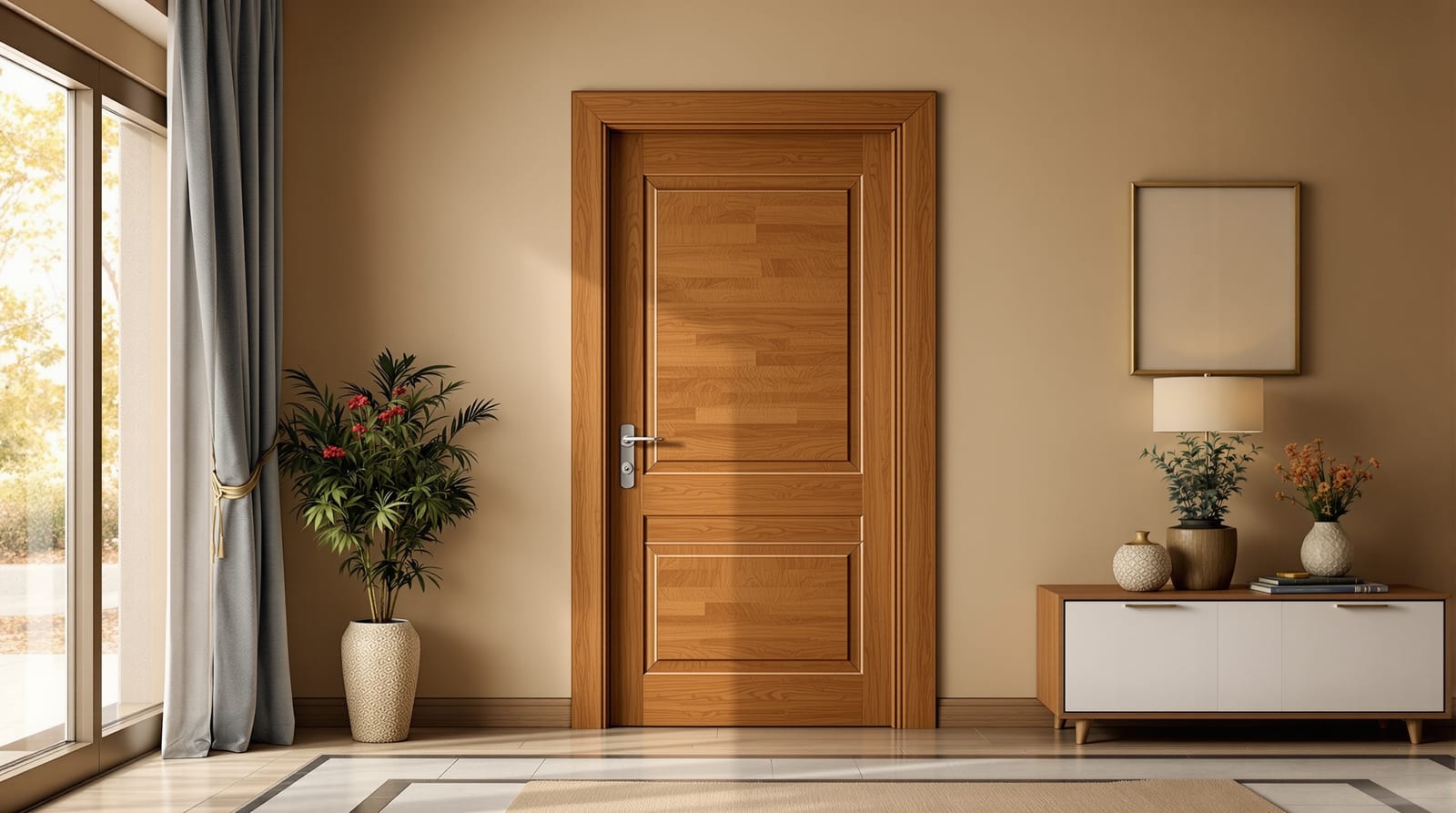
Veneer Doors in India (2026): Natural Wood Looks, Finishing, Cost & Care
Why a thin slice of real wood over a flush door gives the warmest premium internal-door look in Indian homes — and what it takes to keep it that way.
A veneer door is the quiet luxury of Indian interiors: a flush or engineered door wearing a wafer-thin slice of real teak, walnut or oak on its face. From a metre away it reads as solid timber — the same grain flow, the same warmth — at a fraction of the cost and weight. But unlike a laminate door, a veneer is genuine wood, so it must be polished, and it lives or dies by how well that finish is done. This guide explains exactly what veneer is, how the looks are matched, why it costs more, how to care for it, and when a laminate door is the smarter buy instead.
What a veneer actually is
Veneer is a thin sheet of real wood, sliced from a log, that gets glued onto a stable substrate — most commonly a flush door (plywood-skinned hollow or solid core) or an engineered/MDF door. The visible "wood" on the door is this veneer; the body underneath is not the same species.
- Natural veneer is shaved directly from a hardwood log, usually 0.5 mm to 4 mm thick (most commercial decorative veneer is around 0.5-1 mm). Because it is real wood, every sheet is unique — knots, grain swirl and colour vary.
- Reconstituted / engineered veneer (often called "recon" or "engineered") takes fast-growing wood, dyes and re-presses it into blocks, then slices it. The result has uniform, repeatable grain and colour — useful when you need four matching doors that look identical. It is real wood, but engineered for consistency rather than character.
- Veneer sheets are typically sold in 8 ft x 4 ft sizes (₹1,500-6,000 per sheet, indicative, varies by species and city), pressed onto ply or MDF in a factory or a good carpentry workshop.
The key mental model: a veneer door is real wood on the surface, engineered material in the body. That is what gives you the look of teak without the price, weight or warping of a solid teak slab. For how the body itself is built, see our guides on flush doors and engineered wood doors.
Veneer layer build-up
Note the order from the inside out: core, face board, adhesive, veneer, polish. The polish at the very top is not optional — it is what protects the raw wood and brings out the grain. A veneer left unpolished will absorb stains, dull and lift within a season of Indian humidity.
Species and looks — what you can get
Because the surface is real wood, the species defines the look. Common decorative veneers in the Indian market:
| Veneer species | Look | Typical use |
|---|---|---|
| Teak (Burma / CP / plantation) | Golden-brown, even straight grain; ages beautifully | The default "premium Indian" door look; main and bedroom doors |
| Walnut | Deep chocolate, dramatic grain swirl | Statement doors, studies, wardrobes |
| Oak | Pale, open straight grain; Scandinavian/modern feel | Light, contemporary interiors |
| Sapele / mahogany | Reddish-brown, ribbon stripe | Warm, classic panel-door looks |
| Smoked / fumed | Dark, moody tones | Modern minimalist and two-tone schemes |
| Recon / engineered | Uniform, repeatable grain, any colour | When all doors in a flat must match exactly |
For the contrast between veneered teak and a genuine solid teak slab, see teak wood doors and the broader wooden doors overview.
Matching: book-match, slip-match, crown
The "designer" feel of a veneer door comes from how individual veneer leaves are arranged across the face. This is what separates a tasteful door from a busy, mismatched one.
- Book-match: alternate leaves are flipped like pages of a book, so the grain mirrors symmetrically down a centre line. The most popular look for Indian doors — calm and balanced.
- Slip-match: leaves are laid side by side in the same direction, so the grain repeats and "marches" across. Good for a continuous, uniform run of wardrobes or a wall of doors.
- Crown / cathedral-cut: a flat-sliced veneer shows a centred, arch-like figure (the "crown") on each leaf — bold and grainy.
A skilled workshop will also balance the door — applying veneer on both faces — so the door does not bow over time as one side pulls against the other. Always insist on a balanced door; a single-sided veneer on a flush leaf is a future warp.
The finishing step — the part that defines veneer
This is the single biggest practical difference between veneer and laminate. A laminate is a printed, pre-finished plastic sheet — fit it and you are done. A veneer is raw wood and must be finished on site or in the workshop:
- Melamine: the workhorse polish. Affordable, decent durability, matte-to-satin sheen, lets the grain show. Most veneer doors in Indian homes are melamine-finished.
- PU (polyurethane): tougher, more scratch- and water-resistant, richer depth; available in matte, satin or high-gloss. Costs more and takes more coats. The choice for high-traffic or premium doors.
- Duco / lacquer (NC or PU lacquer, spray-applied): a fine, even sprayed finish — usually used for solid colours, but a clear lacquer can sit over veneer for a flawless, factory-grade surface.
Whichever you pick, the finish is sanded, sealed, coated in layers and buffed. Good polishing is skilled labour — a rushed job leaves visible sanding marks, patchy sheen or trapped dust. Budget for this: the polish can add ₹1,500-4,000 per door in labour and material over the bare veneered shutter.
Durability and care
A well-finished veneer door is durable for everyday internal use, but it is still wood under a coat of polish, so respect a few realities of the Indian climate:
- Humidity and monsoon: the engineered core resists swelling far better than solid wood, but standing water or a leaking wall behind a door will eventually lift the veneer. Keep veneer doors for dry internal locations — bedrooms, studies, living rooms — not exposed external faces or wet bathrooms. For wet zones use WPC or FRP instead.
- Sunlight: direct sun fades and yellows some veneers (and some polishes). A balcony-facing door may need a UV-resistant PU.
- Cleaning: wipe with a dry or barely-damp soft cloth. Avoid harsh chemical cleaners and scrubbing pads, which dull the polish.
- Repair: small scratches in the polish can often be re-buffed or re-coated locally — an advantage over laminate, which cannot be re-finished. Deep gouges that reach through the thin veneer are harder; a 0.5 mm veneer leaves little to sand back.
- Termites: the engineered core should be from a treated, IS-grade flush door (IS 2202); cheap untreated cores are vulnerable. Insist on a branded BWP/BWR-grade flush base.
With sensible care, a PU-finished veneer door comfortably lasts 12-15 years looking good, and can be re-polished to refresh it.
Why veneer costs more
Veneer is dearer than laminate for honest reasons: it is real wood (a natural, variable raw material), it requires skilled book-matching, it must be finished by hand on site, and it can be re-polished and repaired rather than replaced. You are paying for genuine wood character and a finish that is renewable. A laminate, by contrast, is a printed sheet — cheaper, faster, maintenance-free, but a fixed look you cannot refinish.
Veneer vs laminate — the honest comparison
| Factor | Veneer door | Laminate door |
|---|---|---|
| What it is | Real wood slice (0.5-4 mm) on a flush/engineered core | Printed decorative plastic sheet on flush core |
| Look | Genuine grain, depth, natural variation; warm, premium | Huge design range incl. wood-prints, solids, textures; uniform |
| Finishing | Must be polished on site (melamine / PU / Duco) | Pre-finished — fit and forget |
| Cost (door) | Higher: ~₹4,000-9,000+ per veneered + polished shutter | Lower: ~₹1,200-4,000 per shutter (indicative) |
| Durability | Good internally; finish-dependent; sun/water sensitive | Very scratch- and stain-resistant; water-tolerant surface |
| Repair | Scratches can be re-buffed / re-polished; deep gouges hard | Cannot be refinished; damaged sheet usually replaced |
| Best for | Premium bedrooms, studies, statement internal doors | High-traffic, budget, kids' rooms, rental, wet-adjacent |
Costs are indicative and vary by city, species, finish and vendor; add ~18% GST plus frame, hardware and fitting labour (₹800-3,000 per door). For the full picture of every material side by side, use our door materials comparison and the interactive door material comparison tool.
What it costs in India (2026)
Indicative 2026 benchmarks, varying by city and vendor:
- Veneer sheet (8x4): ₹1,500-6,000 each, by species and figure (recon at the lower end, premium walnut/teak at the top).
- Veneered flush door (designer, factory or workshop): ~₹4,000-9,000 per shutter for the veneered leaf.
- Polishing (melamine/PU): ₹1,500-4,000 per door in labour + material; PU and high-gloss cost more.
- Frame (chowkat): sal/teak ₹350-900 per running foot; or a uniform WPC frame ₹1,500-3,500 readymade.
- Hardware + fitting: hinges, handle, lock ₹1,500-8,000; fitting labour ₹800-3,000.
- GST: typically +18% on materials.
Estimate a complete, fitted, PU-finished veneer bedroom door in the rough region of ₹9,000-18,000+ all-in, depending on species, finish and city. Price a precise spec with the door cost calculator, and see designer door pricing for the higher end.
Where veneer fits in your home
Reserve veneer for the doors you see and touch every day and want to feel premium: master bedroom, study, formal living. Pair it with a laminate door for utility, kids' and store rooms, and WPC or FRP for bathrooms and external-facing wet zones. For the full decision framework across types and materials, start with our complete home doors guide and the door materials comparison.
Frequently asked questions
Is a veneer door real wood?
The surface is — a 0.5-4 mm slice of genuine hardwood like teak, walnut or oak. The body underneath is usually a flush door or engineered/MDF core, not the same solid species. So you get real wood grain on the face without the cost, weight or warping of a solid timber slab.
Why does a veneer door need polishing when a laminate doesn't?
Because veneer is raw, unfinished wood. It must be sealed and coated (melamine, PU or lacquer) to protect it and bring out the grain. A laminate is a pre-finished printed plastic sheet, so it arrives ready to fit. That on-site finishing step is the main reason veneer costs more.
Can veneer doors be used in bathrooms?
Not recommended. Veneer is wood and dislikes standing water and constant humidity; the finish and the thin veneer can lift over time. Keep veneer for dry internal rooms and use WPC or FRP doors for bathrooms and wet zones.
Veneer or laminate — which should I choose?
Choose veneer for premium, statement internal doors where genuine wood warmth matters and you don't mind the polishing and care. Choose laminate for budget, high-traffic, kids' or rental doors where a tough, maintenance-free, lower-cost surface wins. Many Indian homes mix both.
Can a scratched veneer door be repaired?
Often yes — light scratches in the polish can be re-buffed or re-coated locally, and the whole door can be re-polished to look new, which laminate cannot. Deep gouges that cut through the thin veneer are harder to hide, since there is little wood to sand back.
Export this guide
Related Guides — Deep-dive reading
Door Polishing & Refinishing in India: Melamine, PU, Duco & Oil Finishes Compared
What melamine, PU, Duco and traditional oil-wax finishes look like, how long they last, and how to strip, sand and re-polish a tired wooden or veneer door — plus indicative ₹ per door.
Home Doors & EntrancesGuest Room Door in India: Privacy, Quiet and Smart Picks Without Overspending (2026)
How to choose a guest bedroom door for an Indian home - privacy and acoustics so visitors feel comfortable, but budget-sensible for a room used only now and then: solid-core flush for quiet, panel or laminate for looks, the right privacy lock, simple soundproofing, and a finish that matches the rest of your doors - with picks ranked and indicative rupee costs.
Home Doors & EntrancesModern Door Design for Indian Homes: 9 Contemporary Looks That Still Work in the Monsoon
Minimalist flush-and-groove leaves, vertical and horizontal slats, flush-with-frame reveals, handle-less pulls, glass accents and statement pivots - the contemporary door styles that look right in a 2026 Indian home, and what each one costs and demands.
Home Doors & EntrancesRelated Tools — Try Free
Door Material Comparison Tool
Compare 2–4 door materials on cost, durability, maintenance, security and moisture resistance.
Comparison ToolDoor Cost Calculator
Estimate the all-in cost of a door — leaf, frame, hardware, fitting and GST — by type, material and size.
Door CalculatorMaterial Comparison Sheet
India's interior material cheatsheet — plywood, finishes, hardware, countertops, paints, waterproofing.
Reference Guide