
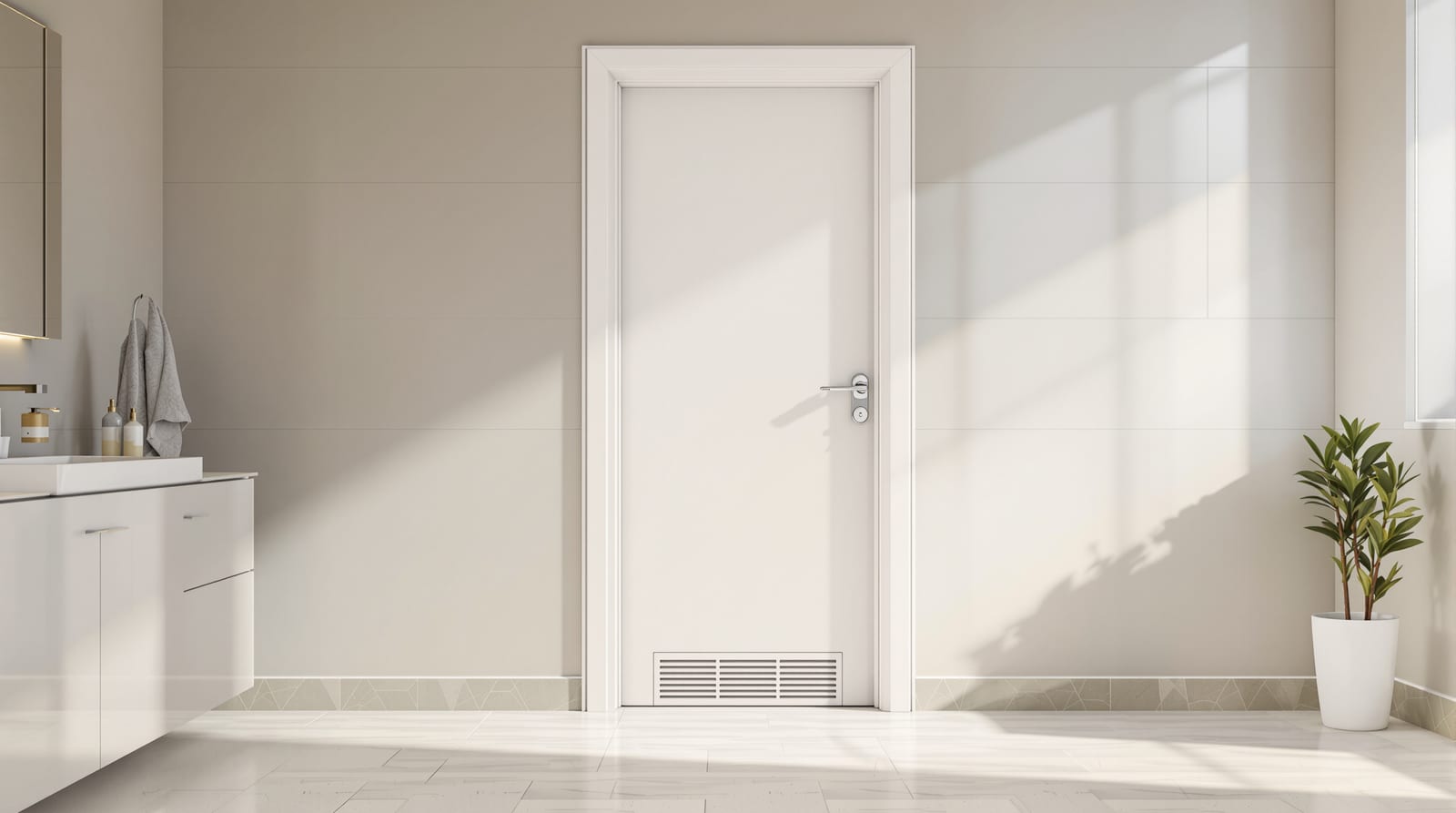
Bathroom Door for Indian Homes (2026): Waterproof Materials, Sizes, Ventilation & Locks
How to pick a toilet door that survives years of splash, steam and monsoon humidity — material ranking, the wet-area threshold detail, ventilation, narrow sizing, privacy locks and anti-rust fittings.
Walk into almost any five-year-old Indian flat and the door that has aged worst is the bathroom door. The bottom rail is swollen, the laminate is peeling, the hinges have wept rust streaks down the frame, and there is a faint warp you can feel when the latch no longer lines up. None of that is bad luck. It is the predictable result of fitting a wood-based door — a flush, MDF or membrane shutter built for a dry bedroom — into the single wettest, most humid opening in the house. The bathroom door is the one door where material choice is not about looks; it is about survival.
This guide is the wet-area spoke of our room-by-room interior door guide. It covers how to rank waterproof materials, the threshold and ventilation details that actually keep a door alive, the narrow sizing bathrooms use, swing and privacy-lock decisions, anti-rust fittings, frame material, and realistic ₹ budgets for an Indian home in 2026.
Why ordinary doors rot in a bathroom
A bathroom subjects a door to three relentless attacks: liquid splash on the lower 300-400 mm, near-constant high humidity and steam from hot showers, and — in older Indian homes — water that pools and travels under the door during bucket baths and floor washing. Wood and wood-composite cores hate all three.
- Flush doors (IS 2202) have a hollow or solid timber-batten core wrapped in plywood or MDF skins. Moisture wicks in at the unsealed bottom edge, the core swells, and the skin delaminates. Even "waterproof" BWR-grade plywood resists better but is not immune at the cut edges.
- MDF and HDF doors are the worst offenders. MDF is wood fibre and glue compressed into board; the moment water reaches it, it puffs up like a sponge and never recovers.
- Membrane / PVC-pressed doors look great in a catalogue, but the skin is a thin PVC film vacuum-pressed onto an MDF core. Once water gets behind the film at an edge or pinhole, the MDF underneath swells and the film bubbles.
The lesson is simple: in a bathroom, choose a door whose core itself is waterproof, not a wood door with a waterproof skin.
Waterproof bathroom door materials, ranked
Here is how the realistic Indian options stack up. Costs are for the shutter (material + make); frame, fittings and fitting labour are extra, and prices are indicative and vary by city and vendor.
| Door material | Waterproofing | Typical cost (shutter) | Lifespan in a wet bathroom | Notes |
|---|---|---|---|---|
| WPC (wood-plastic composite) | Excellent — 100% waterproof core | ₹2,000-4,500 (₹75-150/sq ft) | 15-20+ yrs | Termite-proof, takes laminate/paint, screws hold well, looks like a normal door. Best all-round pick. |
| FRP (fibre-reinforced plastic, IS 14856) | Excellent — fully waterproof, rust-free | ₹1,500-4,000 per door | 15-20+ yrs | Light, very common in PG/hostels and budget builds; moulded look, limited finishes. |
| PVC (hollow/solid profile) | Very good — waterproof, but light | ₹1,200-3,000 | 8-12 yrs | Cheapest waterproof option; can flex/dent and look plasticky; fine for utility WCs. |
| uPVC (framed, glazed/panel) | Excellent — waterproof, rigid | ₹400-700/sq ft of opening | 15-20+ yrs | Rigid, often with frosted glass; premium look, costlier. |
| Marine ply BWP (IS 710) + laminate | Good — water-boiling-proof grade | ₹3,000-7,000 | 10-15 yrs (if edges sealed) | Real wood feel; only works if ALL edges are sealed/lipped and bottom is protected. |
| Aluminium (framed, panel/louvre) | Excellent — waterproof, rust-free | ₹450-900/sq ft of opening | 20+ yrs | Light, ventilated profiles available; industrial look. |
| Flush / MDF / membrane (wood-based) | Poor — swells and rots | ₹1,200-4,000 | 2-5 yrs in a wet bath | Avoid for bathrooms unless the bath is genuinely dry (separate shower cubicle, no floor washing). |
For most Indian homeowners the decision narrows to WPC for a door that looks like a regular interior door, FRP for the cheapest reliable waterproof shutter, and uPVC or aluminium when you want a frosted-glass, premium or highly ventilated look. Read the deeper material guides for each: WPC doors, FRP doors, PVC doors, and the climate-led best door material guide.
The threshold and the wet-area sill
Material is only half the battle. The other half is stopping water from reaching the door in the first place. Two details matter.
The threshold (door sill). A small raised sill at the bathroom doorway — typically 12-25 mm of granite or marble — checks shower water and floor-wash water from flowing out into the bedroom, and keeps the door's lower edge clear of standing water. For accessibility a high sill is a trip hazard; the Harmonised Guidelines 2021 recommend thresholds of 12 mm or less in barrier-free homes, so in an accessible bathroom you bevel the sill or use a flush drain and a shower curtain instead. For a normal bathroom, a low granite threshold plus a good floor slope toward the trap is the standard, durable answer.
Floor slope. The bathroom floor should fall about 1:80 to 1:100 toward the floor trap so water never sits against the door. A door fitted over a flat or back-sloping floor will rot at the bottom no matter what it is made of.
Ventilation: louvre top, gap at bottom
A bathroom door is also a ventilation device. Steam and humidity must escape, or even a waterproof door faces years of condensation and the bathroom stays damp and mould-prone.
- Louvre vents — angled slats in the top third of the door — let warm, humid air bleed out while preserving privacy (you cannot see through angled louvres). A louvre-vented WPC or FRP door is the classic Indian bathroom solution. See louvered doors for how the slats are cut.
- Bottom gap / undercut — a 10-15 mm gap under the door lets replacement air flow in and helps the floor dry. This is also how an exhaust fan actually pulls air.
- Exhaust fan still does most of the work; the door vent and gap simply let it breathe.
A bathroom door at a glance
Size: bathrooms are narrow
Bathroom and WC doors are the smallest in the house. The NBC 2016 and common Indian practice put them at 700-750 mm wide × 2000-2100 mm high (roughly 2'3"-2'6" × 6'8"-7'). The narrow leaf saves wall space, swings clear of fittings and is easier to seal. Going below 700 mm makes the bathroom feel cramped and fails wheelchair access; if the home needs to be accessible, you step up to a 900 mm leaf (giving about 810-850 mm clear width per the Harmonised Guidelines 2021) or, better, a sliding/pocket door so the swing does not eat floor space. See door size standards for the full chart.
Swing, privacy lock and emergency release
Inward vs outward swing. Bathroom doors almost always open inward in Indian homes, so the door does not block a tight passage or hit someone walking past. The trade-off: if someone collapses inside and falls against the door, an inward door can be hard to push open. The mitigations are an emergency-release privacy lock (a coin-slot or screwdriver-slot on the outside that unlocks the door from the corridor) and, where the bathroom is large enough, an outward or sliding door. For elderly or accessible bathrooms, an outward-opening or sliding door is the safer default.
The lock. Use a dedicated bathroom privacy lock — a thumb-turn or snib on the inside, no keyhole, plus the emergency release outside. Avoid a full keyed lockset (you do not want to hunt for a bathroom key). Match the door hardware guide recommendations for finish.
Anti-rust fittings and the right frame
In a humid bathroom, ordinary mild-steel or brass-plated fittings corrode within a couple of years — that is where the rust streaks come from. Specify:
- Hinges, screws, latch and tower bolts in stainless steel (SS 304), not painted MS or brass-coated. SS 304 is the standard anti-rust grade; SS 316 is even better in coastal/salt-air homes.
- Concealed/butt hinges in SS, with SS screws (a single MS screw will bleed rust onto an otherwise stainless set).
- A waterproof frame. A timber chowkat absorbs water at the floor and rots just like the door. Far better: a granite/marble frame (a stone patti let into the masonry — extremely durable and the Indian classic for bathrooms), a WPC frame, or a steel/aluminium frame. Any of these beats sal or teak wood at the wet doorway. Readymade WPC frames run about ₹1,500-3,500; a granite patti is often cheaper still and lasts the life of the building.
A realistic bathroom door budget (2026)
| Item | Indicative cost | Notes |
|---|---|---|
| WPC or FRP shutter (700-750 mm) | ₹1,800-4,000 | Waterproof core; FRP at the lower end |
| Granite threshold + stone frame patti | ₹1,500-4,000 | Or WPC frame ₹1,500-3,500 |
| SS 304 hinges + bathroom privacy lock + bolts | ₹600-2,000 | SS 316 for coastal homes |
| Fitting labour | ₹800-1,500 | Per door |
| Typical all-in per bathroom door | ₹4,500-11,000 | +18% GST; varies by city/vendor |
A wood flush door looks cheaper on day one but is a false economy: replacing a rotted bathroom door (shutter, frame, fittings and the wall repair around it) costs far more than buying the right waterproof door once.
How to specify your bathroom door in one line
For most Indian homes: a louvre-vented WPC shutter, 750 × 2100 mm, inward swing, in a granite or WPC frame over a low granite threshold, with a 10-15 mm bottom gap, SS 304 hinges and bolts, and a bathroom privacy lock with external emergency release. Coastal home? Step the fittings up to SS 316 and consider FRP or uPVC. Accessible bathroom? Switch to a sliding or outward door and a flush, 12 mm-or-less threshold.
For the full room-by-room picture see the interior doors by room guide, and compare materials across the house in the best door material guide.
Frequently asked questions
Which is the best material for a bathroom door in India?
WPC (wood-plastic composite) is the best all-round choice: 100% waterproof, termite-proof, looks like a normal door and lasts 15-20+ years. FRP is the cheapest reliable waterproof option, and uPVC or aluminium suit a frosted-glass or highly ventilated look. Avoid ordinary flush, MDF and membrane doors — they rot.
What size should a bathroom door be?
Indian bathroom and WC doors are 700-750 mm wide × 2000-2100 mm high (about 2'3"-2'6" × 7'). The narrow leaf saves space and is easier to keep clear of standing water. For wheelchair access use a 900 mm leaf or a sliding door.
Should the bathroom door open inward or outward?
Inward is the Indian default so it does not block the passage. Always pair it with an emergency-release privacy lock that can be opened from outside. For elderly or accessible bathrooms, an outward-opening or sliding door is safer because a person who collapses inside will not block it.
How do I stop my bathroom door hinges from rusting?
Use stainless steel SS 304 hinges, screws and bolts — not painted mild steel or brass-coated fittings. In coastal or salt-air homes, step up to SS 316. A single mild-steel screw in a stainless set will still bleed rust, so insist on SS screws throughout.
Why does my flush door bottom keep swelling?
Flush, MDF and membrane doors have a wood-based core that wicks up splash and floor-wash water at the unsealed bottom edge and swells. The fix is a waterproof-core door (WPC, FRP, PVC or marine ply BWP with sealed edges), a low threshold to check water, a proper floor slope to the drain, and a bottom gap so the area dries.
Export this guide
Related Guides — Deep-dive reading
Accessible Doors in India: Wheelchair & Senior-Friendly Door Design Guide
Clear width, lever handles, flush thresholds, swing vs sliding, lock reach and sensor doors - how to specify wheelchair- and senior-friendly doors to the RPwD Harmonised Guidelines 2021 and NBC 2016.
Home Doors & EntrancesBest Door Material in India (2026): The Right Choice for Every Room & Climate
A situation-by-situation verdict on the best door material for Indian homes - teak or steel for the main entrance, WPC or uPVC for bathrooms and coasts, engineered flush for bedrooms - with a by-location decision table and budget-vs-premium picks.
Home Doors & EntrancesCoastal Region Door Buying in India 2026: Salt-Air Guide
Why cheap flush and MDF doors fail near the sea, and which water-resistant materials and corrosion-proof hardware actually last.
Home Doors & EntrancesRelated Tools — Try Free
Door Material Comparison Tool
Compare 2–4 door materials on cost, durability, maintenance, security and moisture resistance.
Comparison ToolBathroom Door Material Selector
Get the best wet-area door material — WPC, FRP, PVC, marine ply or aluminium — ranked for your bathroom or utility.
Material SelectorCross-Ventilation Analyzer
Estimate airflow and air changes per hour (ACH) from room size, window areas, layout, and local wind — with NBC 2016 Part 8 compliance check.
Ventilation Calculator