
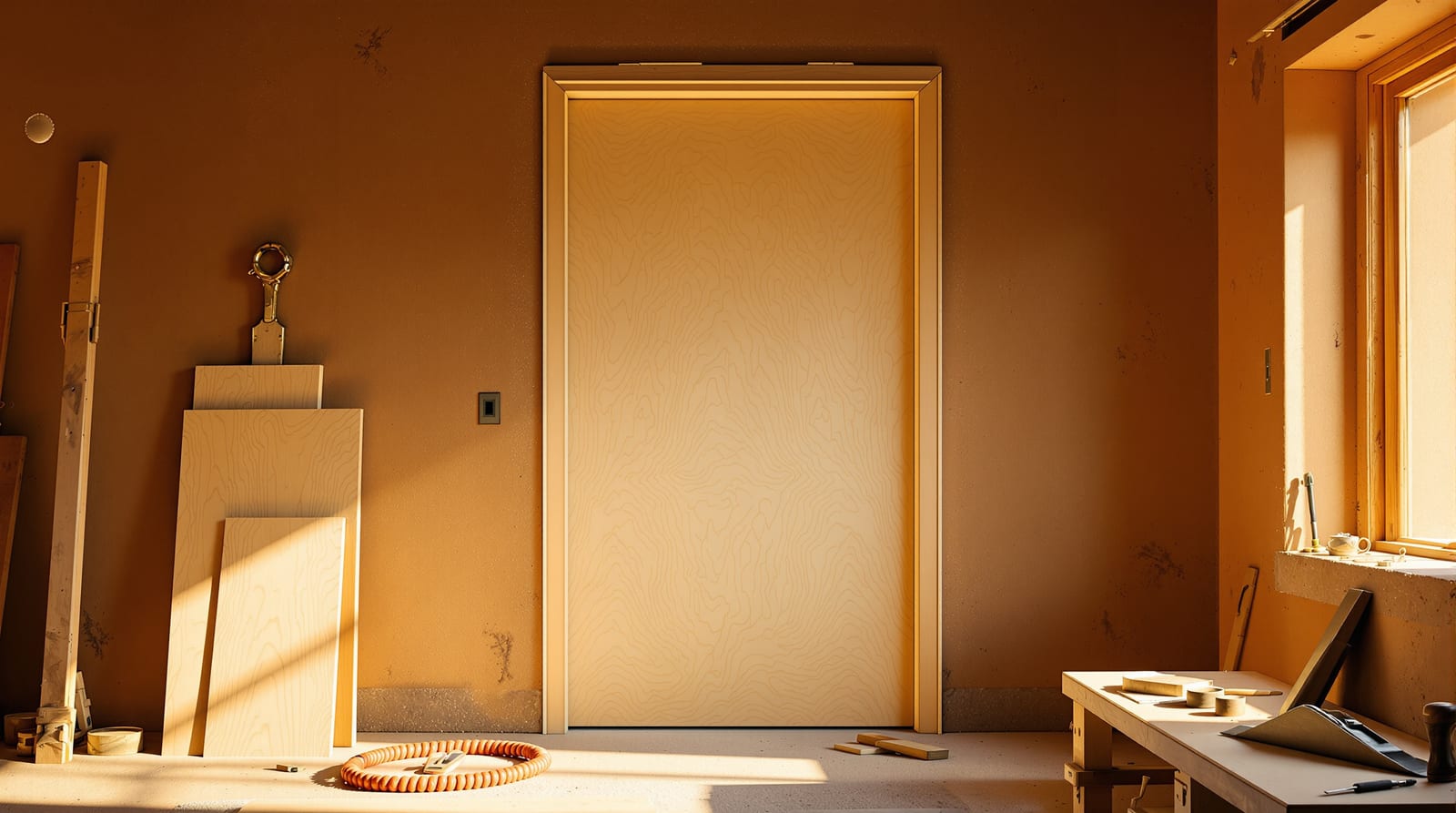
Plywood Doors in India (2026): Flush Door Grades (MR/BWR/BWP IS 710), Core Types, Brands & Cost
The workhorse internal door of Indian homes — how plywood flush doors are built, why the IS 710 / IS 303 grade decides bathroom and external suitability, core types, termite treatment and ₹ per shutter.
Open almost any flat in India and the bedroom, kitchen and store-room shutters are very likely plywood flush doors. They are light, cheap, take any finish, and a local carpenter can hang one in an afternoon. But "plywood door" hides one decision that quietly determines whether your shutter lasts twenty years or warps in two monsoons: the GRADE of the plywood used in its faces and core. A commercial-grade (MR) flush door and a marine-grade (BWP, IS 710) flush door look identical on the showroom wall and can differ in price by two to three times — and only one of them belongs near a bathroom. This guide unpacks how plywood doors are built, what the IS grades actually mean, and how to buy one without getting a fake ISI sticker.
For where plywood doors sit against teak, WPC, uPVC and solid wood, see the door materials comparison; for the broader flush-door family this is part of flush doors in India; and for the whole-house view, the complete guide to home doors.
What a "plywood door" actually is
Strictly speaking, almost no internal door is solid plywood the way a sheet of ply is. What people call a plywood door is a flush door (IS 2202) whose flat faces are plywood, built around a core. The anatomy is:
- Frame (stiles and rails): seasoned timber battens — usually hardwood or rubberwood — running around the perimeter, plus a wider lock rail where the handle and latch go.
- Core (the filling): the material between the two faces. This is what separates a heavy, solid-feeling door from a light, drummy one.
- Cross-bands and face plywood: thin veneer cross-bands glued at right angles, then the visible plywood face on both sides.
- Finish skin (optional): laminate, veneer, PVC membrane or paint pressed/applied on top.
So a plywood door is really a sandwich, and its quality is set by three things independently: the grade of the face/core plywood, the type of core, and the finish. You can have a top-grade BWP face over a hollow core, or an MR face over a solid block board — vendors mix and match, which is exactly why you must ask specifics rather than trust the word "plywood."
The grade distinction that decides everything
This is the single most important section. Indian plywood is graded by how its glue bond survives moisture, under two standards:
- IS 303 governs general plywood (MR and BWR grades).
- IS 710 governs marine / Boiling Water Proof (BWP) plywood — the highest moisture grade.
Both rely on the GLUE used to bond the veneers. Cheaper plywood uses urea-formaldehyde resin (water-soluble, fails when wet); marine grades use phenol-formaldehyde resin (waterproof, survives boiling). The grade ladder:
| Grade | Standard | Glue / bond | Moisture resistance | Where it belongs | Indicative cost per standard shutter (32 mm) |
|---|---|---|---|---|---|
| Commercial / MR (Moisture Resistant) | IS 303 | Urea-formaldehyde | Resists humidity, NOT standing water | Dry bedrooms, store, dressing — never a wet wall | ₹1,200 – 2,200 |
| BWR (Boiling Water Resistant) | IS 303 | Phenol-bonded (BWR) | Withstands occasional damp / splashes | Kitchen, utility, semi-wet zones | ₹2,000 – 3,500 |
| BWP / Marine | IS 710 | Phenol-formaldehyde, fully waterproof | Survives prolonged water & boiling-water test | Bathroom, balcony, external face, coastal homes | ₹3,000 – 5,500 |
Two practical translations of this table:
1. Grade decides bathroom and external suitability, not looks. An MR flush door on a bathroom wall will swell, delaminate at the bottom and the laminate will lift within a couple of monsoons. For bathrooms and balconies, insist on IS 710 BWP — or sidestep the problem entirely with a WPC door or uPVC door, which are unaffected by water by design. Many Indian homes now use WPC for wet rooms and plywood flush doors only for dry internal openings — a sensible split.
2. "Marine" on a sticker is not proof. IS 710 is the only marine designation that means anything; "MR Plus", "Gold", "Club", "710-grade-equivalent" are marketing. Ask for the actual IS number and the ISI mark.
For a deeper material-by-material wet-zone decision, see the best door material for Indian conditions.
Core types: why two "plywood doors" feel completely different
Lift two plywood doors and one feels reassuringly solid while the other sounds hollow when you knock. That is the core:
- Solid core / block-board core: the cavity is packed solid — block board (timber battens edge-glued and faced), particle board, or a timber-batten frame filled tightly. Heavier, better sound insulation, holds screws and hinges firmly, more dimensionally stable. This is what you want for main internal doors and anything that will take a heavy lock.
- Hollow / cellular core: a honeycomb or grid of timber or hardboard strips with air gaps between. Lighter, cheaper, easier to swell, weaker on sound, and screws can pull out of the empty zones. Fine for a store-room or a budget-build, poor for a master bedroom.
Vendors rarely volunteer this. A door sold as a "₹1,400 plywood flush door" is almost always hollow/cellular; the "₹2,800 solid core" is block-board filled. For the full trade-off — including how it affects soundproofing and security — see solid vs hollow core doors.
Anatomy diagram
How a plywood door takes finishes
One reason plywood flush doors dominate Indian homes is that they accept almost any surface, so you choose look and budget independently of the door itself:
- Laminate (HPL): a 0.8–1 mm sheet pressed on. Cheapest durable finish, huge design range, scratch-resistant. See laminate doors.
- Veneer: a thin slice of real wood, polished — the premium "wooden door" look at flush-door weight. See veneer doors.
- PVC membrane / paint: membrane gives moulded/2-tone looks on MDF-faced shutters; paint (enamel/PU) is the cheapest but needs a smooth primed face.
Because the FACE is what you see, an unscrupulous vendor can put a good laminate over a cheap MR hollow core. Specify the core and grade in the quotation, not just the finish. For the wood-look alternatives, also see wooden doors.
Termite, borer and the monsoon problem
Plywood is timber, so it is vulnerable to:
- Termites and powder-post borers — endemic across most of India. Buy plywood that is chemically treated / preservative-treated (look for a "termite & borer proof" or boron-treated claim backed by the ISI mark) and treat the door frame (chowkat) timber too.
- Bottom-edge swelling — the unsealed bottom edge wicks up mopping water. Insist the carpenter seals all four edges (especially top and bottom) with primer/sealant before fitting, and keep a small floor gap.
- Coastal salt air — near the sea, only BWP/IS 710 (or non-timber WPC/uPVC) survives long term.
A good frame matters as much as the shutter: sal or teak chowkat runs roughly ₹350–900 per running foot; readymade WPC/steel frames are more uniform and immune to swelling. Budget separately for the frame and for fitting labour (₹800–3,000 per door) and a hardware set (₹1,500–8,000), plus ~18% GST — these are not in the shutter price.
Buying tips: avoiding fake ISI and false grades
The plywood market is notorious for counterfeit ISI marks. Protect yourself:
1. Demand the genuine ISI / IS number — IS 303 for MR/BWR, IS 710 for BWP. The ISI mark must carry a CM/L licence number you can verify on the BIS Care app. A sticker with just "ISI" and no licence number is a red flag.
2. Match grade to room — MR for dry rooms only; BWR for kitchen/utility; BWP (IS 710) for bathroom, balcony, external and coastal. Do not let a vendor "upsell down" an MR door for a wet zone.
3. Knock-test for the core — a solid, dull thud means solid/block-board core; a hollow ring means cellular core. Confirm in writing.
4. Check weight and thickness — a standard flush shutter is ~32 mm; a suspiciously light door of that thickness is hollow.
5. Buy factory-made (IS 2202) over loose-carpenter assembly where you can — factory presses bond more reliably than site glue, and you get a brand warranty (Greenply, Century, Kitply, Mayur, Duro, Action Tesa and Sarvesh among the better-known names; many regional brands are fine if genuinely ISI-marked).
6. Get the grade printed on the bill — "BWP IS 710, solid core, both-side laminate" — so any swelling within warranty is the vendor's problem, not yours.
For a budget plan across the whole house, the door cost guide for India breaks down shutter + frame + hardware + labour, and the door cost calculator lets you compare grades quickly.
Plywood door vs the alternatives, in one line each
- vs WPC: WPC is fully waterproof and termite-proof but heavier-feeling-plastic and pricier; better for bathrooms, plywood better for dry rooms on budget. See WPC doors.
- vs solid wood / teak: real wood is far costlier and heavier; plywood flush gives 90% of the look (with veneer) at a fraction of the price. See teak wood doors.
- vs engineered wood: overlapping categories — engineered/HDF doors trade on dimensional stability; see engineered wood doors.
Frequently asked questions
Which plywood grade is best for a bathroom door in India?
Only IS 710 BWP (marine / boiling-waterproof) plywood is genuinely safe for a bathroom. MR and even BWR will eventually swell and delaminate at the wet bottom edge. Honestly, for bathrooms many Indian homes now skip plywood and use a WPC or uPVC door, which cannot absorb water at all.
Is a plywood flush door termite-proof?
Not inherently — plywood is timber. Buy preservative/boron-treated plywood with a genuine ISI mark, treat the frame timber, and seal all four edges. A "termite & borer proof" claim only holds if it is from a reputable brand with a verifiable BIS licence; otherwise treat it as marketing.
How much does a plywood door cost per shutter in 2026?
Indicative, varies by city and vendor: commercial/MR flush ₹1,200–2,200, BWR ₹2,000–3,500, and BWP/marine (IS 710) ₹3,000–5,500 per standard shutter. Veneered/designer faces add ₹4,000–9,000. Frame, hardware, fitting labour and ~18% GST are extra.
How do I tell a solid-core door from a hollow one?
Knock it: a dull, heavy thud means a solid or block-board core; a hollow ring means a cellular/honeycomb core. Lift it too — a solid 32 mm shutter is noticeably heavier. Get "solid core" written on the bill. More detail in solid vs hollow core doors.
How do I avoid a fake ISI plywood door?
Insist on the IS number (303 or 710) plus an ISI mark with a CM/L licence number, and verify that number on the BIS Care app. A bare "ISI" sticker with no licence number, or a vague "marine equivalent" claim, is the classic counterfeit. Get the exact grade printed on your invoice.
Export this guide
Related Guides — Deep-dive reading
Solid Core vs Hollow Core Doors in India: Weight, Sound, Security & Cost Compared
The single biggest difference between a cheap flush door and a good one is the core you cannot see - here is how solid-core and hollow/cellular-core doors really compare, and how to tell them apart before you pay.
Home Doors & EntrancesThe Complete Home Door Guide for Indian Homes (2026): Types, Materials, Cost, Security & Vastu
Everything an Indian homeowner needs to specify the right door for every opening — from main entrance to bathroom — with real 2026 prices, IS/NBC standards and Vastu sense.
Home Doors & EntrancesWPC Doors for Indian Homes: 100% Waterproof, Termite-Proof, and Where They Belong
Wood-plastic composite doors and frames promise zero swelling, zero termites and a low price - here is what that really means, where the screw-holding catch bites, and how WPC compares with wood and flush doors in 2026.
Home Doors & EntrancesRelated Tools — Try Free
Door Material Comparison Tool
Compare 2–4 door materials on cost, durability, maintenance, security and moisture resistance.
Comparison ToolDoor Cost Calculator
Estimate the all-in cost of a door — leaf, frame, hardware, fitting and GST — by type, material and size.
Door CalculatorMaterial Comparison Sheet
India's interior material cheatsheet — plywood, finishes, hardware, countertops, paints, waterproofing.
Reference Guide