
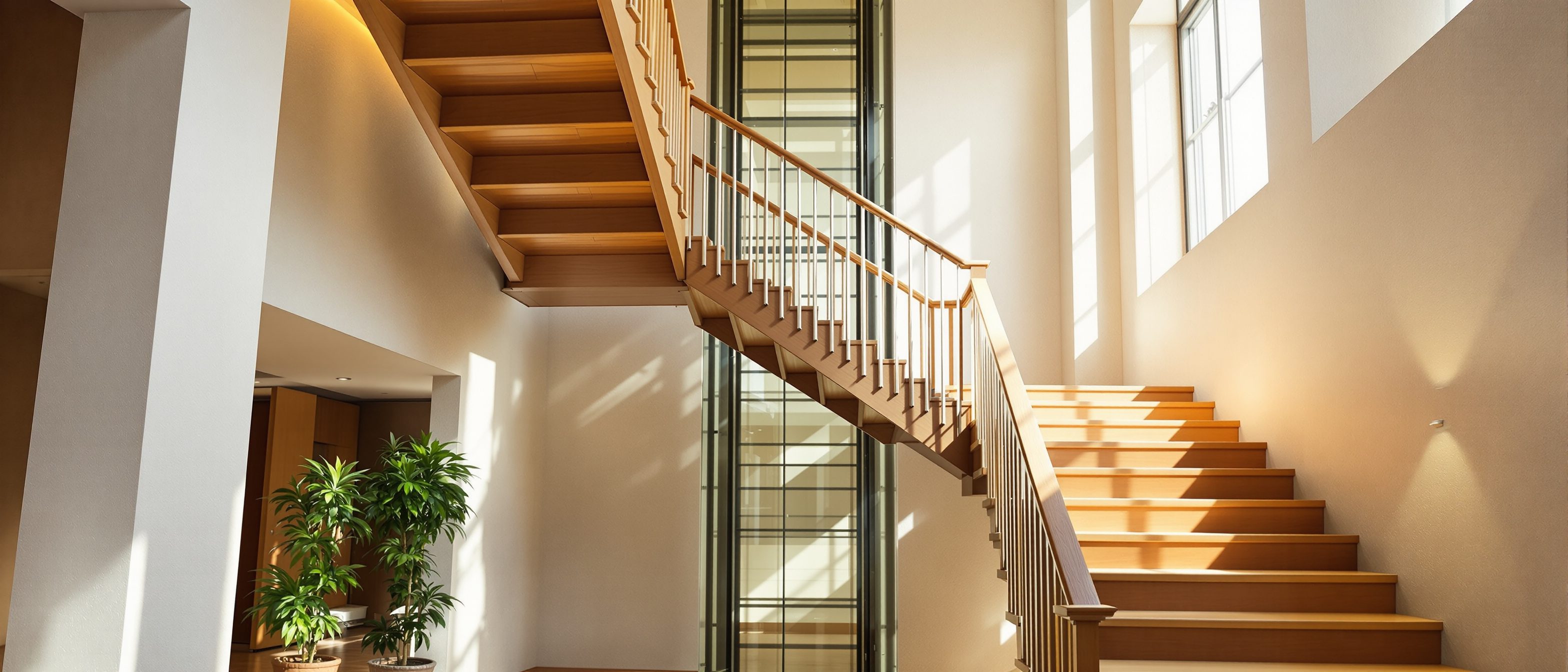
Lift and Fire Safety Planning (India): What Home Lifts Must Do When There's a Fire
Why your home lift is never the escape route, how fire recall works, when a fireman's lift is required, and the local fire NOC and bye-law checks every Indian homeowner should make.
When the alarm sounds, the lift is not your way out
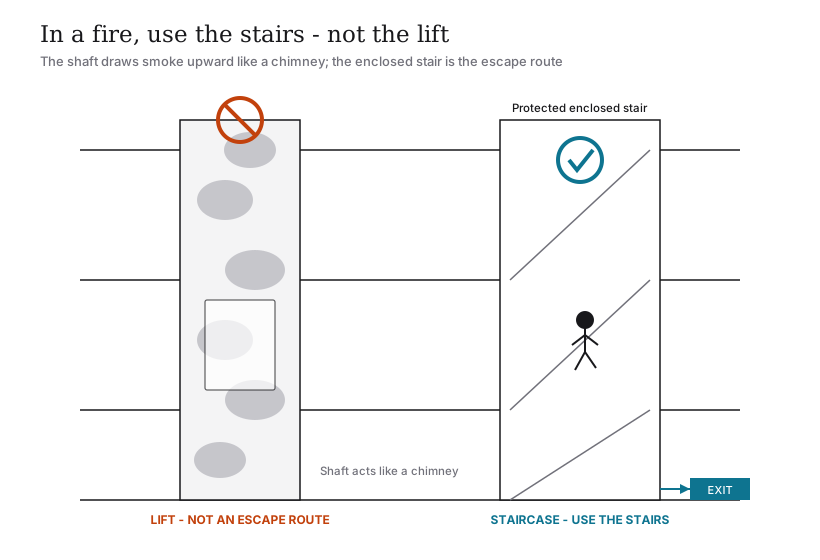
There is a deeply held instinct, especially in a multi-storey home with an elderly parent or a small child upstairs, to reach for the lift the moment something goes wrong. In a fire, that instinct is dangerous. A normal home or passenger lift is not an escape route. The right answer, drilled into every fire-safety code in the world, is the same in a bungalow in Pune as in a high-rise in Mumbai: use the stairs.
This guide is the fire-safety spoke of our Residential Elevator Handbook. It goes deeper than the handbook on one narrow but vital question: what should your home lift actually do when there is a fire, and what must you plan and verify so that it does it. It assumes you have already chosen a lift type and sized the shaft — for that, see the Buyer's Guide and the Lift Shaft Design Guide.
A lift is a convenience, not an exit. In a fire it should take itself out of the way — return to a safe floor, open its doors, and stay put — so that everyone uses the protected staircase.
All thresholds below (heights, car sizes) are indicative. Fire rules in India are set by NBC 2016 Part 8 and then adopted, modified and enforced through state and municipal bye-laws and the local fire service. Always confirm the exact figures and any fire NOC requirement with your local fire department before you build.
Why a normal lift is not an escape route
Three physical facts make an ordinary lift the wrong choice during a fire:
- The shaft acts like a chimney. A vertical hoistway connects every floor. Smoke and hot gases rise through it fast, and the very car you would step into can fill with smoke.
- Power is unreliable. A fire — or the fire service cutting supply — can stop the lift between floors and trap occupants. The stairs never lose power.
- Doors can open onto the fire floor. A lift called normally may deposit you exactly where the fire is, doors opening into smoke and heat.
This is why the staircase, not the lift, is the protected means of escape. A well-detailed stair core is enclosed, often pressurised in larger buildings, and stays usable when the lift cannot. If you are still planning your vertical circulation, read Designing a Staircase (India) and our note on integrating the lift with the staircase so the stair remains the clear, obvious exit.
Fire-recall: what the lift should do on a fire alarm
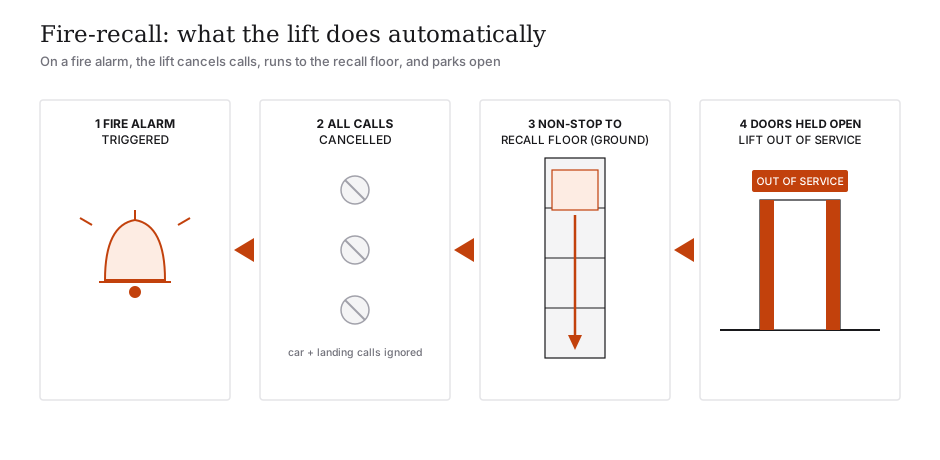
A properly specified residential lift connects to the building's fire alarm (or at minimum has a fireman's switch). When fire is detected, the lift should perform fire recall, sometimes called Phase 1 recall:
1. It cancels all existing car and landing calls.
2. It travels non-stop to a designated recall floor — usually the ground or main exit level, or an alternate floor if the fire is at the main level.
3. It parks with its doors open and stays there, removed from normal service, so it cannot be summoned to a fire floor and no one can be carried into danger.
For most independent homes the recall floor is simply the ground floor at the main entrance. The point is that the lift makes itself safe and gets out of the way — it is no longer part of how people move during the emergency.
When you specify your lift (see the Lift Specification Checklist), ask the vendor in writing for: a fireman's switch, fire-alarm interface / fire-recall capability, and the designated recall floor. These are inexpensive at the order stage and very awkward to add later.
Fire-rated landing doors and the shaft's role in compartmentation
A building resists fire spread by being divided into compartments — areas bounded by walls, floors and doors that hold back fire and smoke for a rated time (commonly expressed in hours or minutes). A lift shaft punches a vertical hole through every one of those floor compartments, so the shaft and its openings have to be detailed carefully:
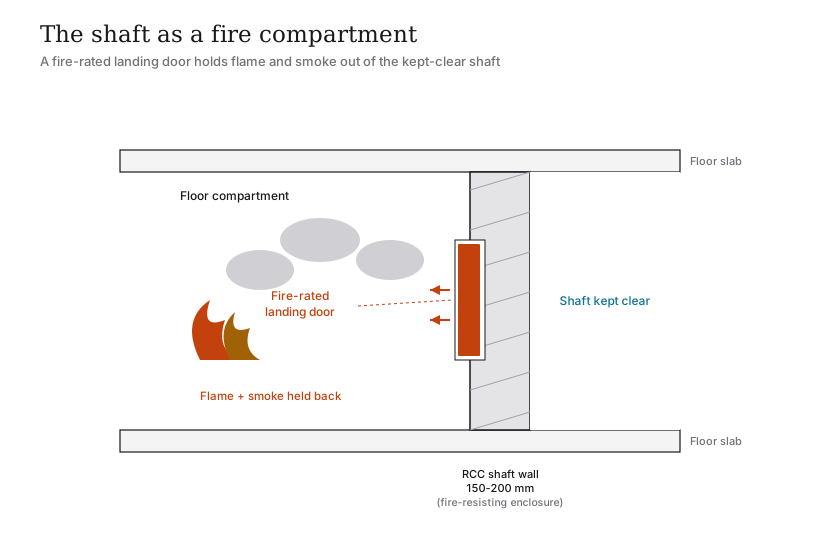
- The shaft enclosure — typically a 150–200 mm RCC lift well (see the Shaft Design Guide) — is a fire-resisting wall in its own right. Concrete naturally gives good fire resistance, which is one reason a properly built RCC hoistway is the norm.
- The landing doors — the doors you see on each floor — are the weak point, because they are openings in that wall. Fire-rated landing doors are designed to resist the passage of flame and smoke for a stated period, keeping the shaft from becoming a smoke chimney that feeds every floor.
For a tall or fireman's-lift installation this matters most; for a low independent home it is still good practice to ask whether the landing doors carry a fire rating, and to make sure the shaft openings are properly sealed where services pass through.
When a fireman's lift is actually required
A fireman's lift is a special lift the fire service can take control of and use to fight a fire and move firefighters, equipment and trapped occupants (on a stretcher) during an incident. It is not the same as your ordinary home lift, and most independent homes do not need one.
Under NBC 2016 Part 8 Section 5 — as adopted and varied by state and municipal bye-laws — a fireman's lift is generally triggered by building height:
| Item | Indicative figure | Notes |
|---|---|---|
| Height trigger | generally above 15 m (some residential rules set 30 m) | The single most important thing to verify locally; thresholds differ by state and occupancy. |
| Minimum capacity | ~8 persons / 544 kg | So it can carry a stretcher plus attendants. |
| Minimum car size | ~1100 x 1400 mm | Sized to take a stretcher. |
| Travel | full building height | Must serve every floor. |
| Power | backup power supply | Must keep running when normal supply is cut. |
To put the height trigger in perspective: a typical residential floor is about 3 m. A G plus 4 building is roughly 15 m and a G plus 9 roughly 30 m. Almost every independent house, duplex and villa sits well below these heights, so the fireman's-lift rule usually does not apply. (For those building taller homes, see duplex lift planning and villa lift planning, and confirm the height where the fireman's-lift rule bites in your bye-laws.)
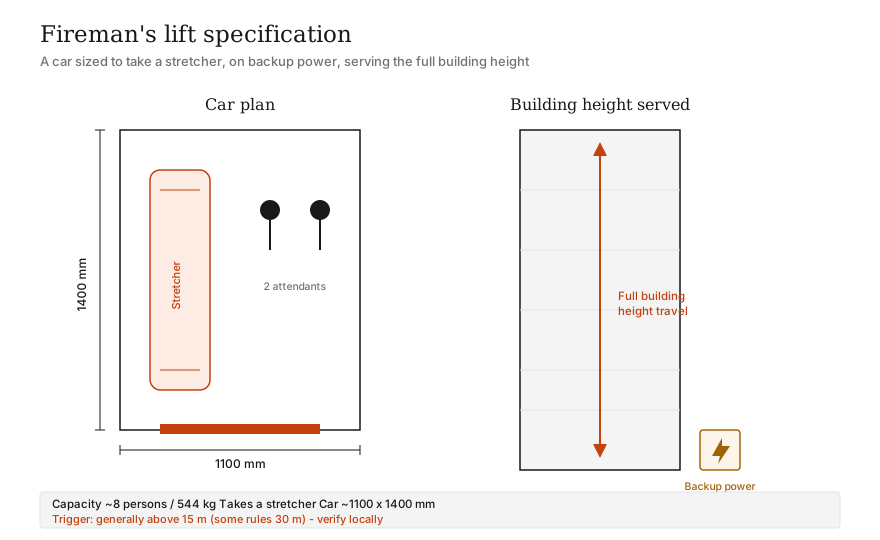
The honest takeaway for most homeowners: you are below the fireman's-lift threshold, so do not over-specify. Spend the attention instead on fire recall, fire-rated landing doors and a working ARD — and on keeping your staircase as the clear escape route.
Backup power and ARD: getting people to a floor in an outage
In India, a power cut during any incident is a real possibility. An Automatic Rescue Device (ARD) is a battery unit that, on loss of mains power, drives the car gently to the nearest landing and opens the doors, so no one is left stranded between floors. We treat ARD as non-negotiable across this whole cluster — do not buy a home lift without it.
ARD and fire recall are complementary, not the same thing:
| Feature | Triggered by | What it does | Why it matters in a fire |
|---|---|---|---|
| ARD (battery backup) | Power failure | Brings car to nearest floor, opens doors | Stops anyone being trapped if supply drops during the incident |
| Fire recall | Fire alarm / fireman's switch | Sends car to designated floor, parks doors open, removes from service | Keeps the lift from carrying people to a fire floor; clears it for the fire service |
| Fireman's switch | Manual (fire service) | Lets responders take direct control of the car | Only meaningful on lifts meant to serve responders, typically the fireman's lift |
The practical sequence to remember: ARD gets you to a floor; then you take the stairs. The lift's job in a fire is to deliver you safely to a landing and then bow out — never to be your route down through a burning building.
The fire NOC and bye-law check
Before you commission a lift, two local checks sit alongside the state Lift Act licensing covered in the pillar:
- Fire NOC / fire-department clearance. Many states require a fire No Objection Certificate for buildings above a certain height or occupancy. For most single-family homes this may not apply, but for taller homes, mixed-use plots, or anything near the fireman's-lift threshold, ask your local fire service early.
- Municipal bye-laws. These adopt NBC 2016 but vary the numbers — the height at which a lift, a fireman's lift, or a fire NOC becomes mandatory differs by city and state. Your architect or licensed lift contractor will know the local position; confirm it in writing.
Lifts are also state-regulated for safety more broadly (installation licence, operation licence, periodic inspection by the government lift inspectorate) — that licensing track is detailed in the pillar handbook.
Home fire-safety-for-lifts checklist
Use this when specifying, ordering and commissioning your lift. Mark each item and keep the vendor's written confirmations.
| # | Check | Why it matters | Confirm with |
|---|---|---|---|
| 1 | Fire-recall capability specified | Lift parks safely on a fire alarm | Lift vendor (in writing) |
| 2 | Fireman's switch fitted | Lets the car be taken out of normal service | Lift vendor |
| 3 | Designated recall floor agreed | Usually ground / main exit level | Architect + vendor |
| 4 | Fire-rated landing doors | Stop the shaft becoming a smoke chimney | Lift vendor + bye-law |
| 5 | RCC shaft enclosure intact and sealed | Maintains fire compartmentation | Structural engineer |
| 6 | ARD (battery backup) fitted | Reaches a floor in a power cut | Lift vendor — do not skip |
| 7 | Emergency alarm + intercom working | Calls for help if anyone is inside | Lift vendor |
| 8 | Staircase kept as the clear escape route | Lift is never the exit in a fire | Architect |
| 9 | Fireman's-lift requirement checked against height | Generally above 15 m (some rules 30 m) | Local fire service |
| 10 | Fire NOC / bye-law position confirmed | Avoids occupancy / commissioning hold-ups | Local fire department |
The bottom line
For the overwhelming majority of Indian homes, fire safety and the lift comes down to four things: the lift should recall and park out of the way on a fire alarm; the landing doors and shaft should keep fire from spreading floor to floor; an ARD should get anyone inside to a floor in a power cut; and everyone evacuates by the staircase. The fireman's lift, with its 8-person stretcher car on backup power, only enters the picture once your building climbs past the local height trigger — and most homes never do. Plan the simple things well, verify the thresholds with your local fire service, and the lift becomes one less thing to worry about when it matters most.
To keep building on this, return to the Residential Elevator Handbook, revisit the Lift Shaft Design Guide for the compartmentation detailing, and use the Buyer's Guide and Specification Checklist to lock in fire recall and ARD on your order. For ageing-in-place homes where the lift carries the most weight, see senior-friendly lift planning.
References
- IS 14665 (Electric Traction Lifts), BIS — Part 1 outline dimensions (car, well, pit, headroom, doors): https://law.resource.org/pub/in/bis/S05/is.14665.1.2000.pdf ; Part 2 installation, operation and maintenance: https://law.resource.org/pub/in/bis/S05/is.14665.2.1-2.2000.pdf
- National Building Code of India 2016 (NBC 2016), Part 8 Building Services, Section 5 — Installation of Lifts, Escalators and Moving Walks; and Part 4 Fire and Life Safety (BIS): https://www.bis.gov.in/standards/technical-department/national-building-code/ ; Guide for Using NBC 2016: https://www.bis.gov.in/wp-content/uploads/2022/08/Booklet-Guide-for-Using-NBC-2016.pdf
- RPwD Act 2016 (Rights of Persons with Disabilities Act) — accessibility obligations: https://ssepd.odisha.gov.in/sites/default/files/2024-01/RPWD%20ACT.pdf
- CPWD / MoHUA Harmonised Guidelines and Space Standards for a Barrier-Free Built Environment: https://www.cpwd.gov.in/Publication/Harmonisedguidelinesdreleasedon23rdMarch2016.pdf
- State Lift Acts (Maharashtra Lifts, Escalators and Moving Walks Act 2017; Karnataka Lifts, Escalators and Passenger Conveyors Act 2015; Delhi Lifts and Escalators Act 2007; Tamil Nadu Lifts Act 1997) and general lift regulation overview: https://www.99acres.com/articles/know-all-about-the-lift-regulations-in-india.html ; Maharashtra licence to operate a lift: https://services.india.gov.in/service/detail/maharashtra-license-to-operate-lift
Export this guide
Related Guides — Deep-dive reading
Building Codes for Residential Elevators (India): NBC 2016 and Local Bye-Laws
How NBC 2016 Part 8 Section 5 and your municipal building bye-laws decide when a home lift is required, where its shaft goes, and how it must be built and fire-protected.
Home Lifts & AccessibilityStaircase Fire Safety in India (2026): The Protected Stair That Gets Everyone Down
The staircase is the primary vertical escape route in almost every Indian building, so a protected, smoke-free stair is the spine of egress: enclosed, fire-doored, non-combustible, and above all kept clear.
SecurityLift Planning for Senior-Friendly Homes (India): Ageing in Place, with the Lift at the Centre
When stairs become a barrier with age, the home lift is the heart of an ageing-in-place plan. How to choose it over a stairlift, specify it for an older user, place it for daily use, and plan for a parent moving in.
Home Lifts & AccessibilityRelated Tools — Try Free
Lift Shaft Size Calculator
Required hoistway, pit and headroom dimensions for a home lift by capacity and drive type.
Lift CalculatorAccess-Control Battery-Backup Calculator
Size the standby battery so an access system keeps running through a power cut, with an egress life-safety note.
Battery BackupElevator Capacity Calculator
Pick the right home-lift capacity — 2 to 8 person — with car size and wheelchair fit.
Lift Calculator