
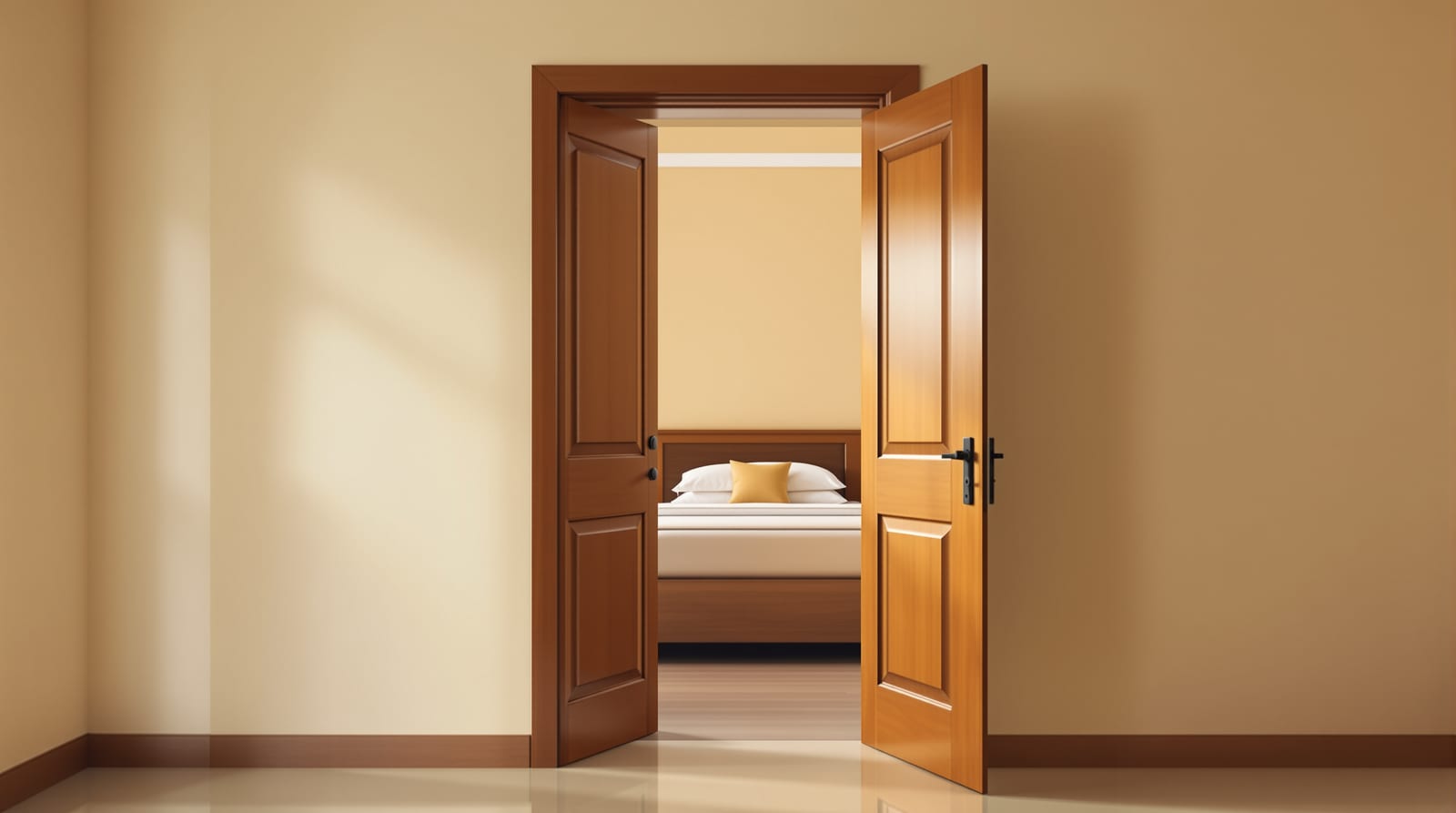
Guest Room Door in India: Privacy, Quiet and Smart Picks Without Overspending (2026)
How to choose a guest bedroom door for an Indian home - privacy and acoustics so visitors feel comfortable, but budget-sensible for a room used only now and then: solid-core flush for quiet, panel or laminate for looks, the right privacy lock, simple soundproofing, and a finish that matches the rest of your doors - with picks ranked and indicative rupee costs.
The guest room is the one door in your home that has to perform for strangers. A relative staying over, a friend down for a wedding, your parents visiting for a month - they should be able to close the door, hear a little less of the kitchen and the TV, and not worry that anyone can wander in while they change. Yet it is also the room nobody uses for weeks at a time, which means it is the worst place in the house to overspend. The trick with a guest room door in India is to buy genuine privacy and a noticeable drop in noise, then stop - no carved teak, no smart lock, no acoustic studio build. This guide ranks the doors that hit that balance, tells you the one lock to fit, and gives honest rupee figures so you spend on the bedroom and bathroom doors that get used daily instead.
If you want the whole-home picture first, see interior doors by room in India and the master doors by space guide for India. For the master-bedroom logic that a guest room borrows from, read bedroom door design in India.
What a guest room door actually needs
A guest room door answers to two real drivers and one budget brake. Name them before you shop.
- Privacy. A guest must be able to lock the door from inside and trust it. This is the non-negotiable. It is also cheap to satisfy - a privacy latch costs a few hundred rupees.
- Acoustics. Guests sleep on a different clock from the household. A door that muffles the morning kitchen, the doorbell and late-night TV makes the difference between a guest who sleeps and one who does not. Real acoustic performance comes from one thing above all: a door with a solid core rather than a hollow one.
- Don't overspend (the brake). The room is used occasionally, so every rupee beyond privacy and quiet should be questioned. You do not need a smart lock, a fire rating, or premium teak here. Match the finish to your other doors and move on.
Two more demands are minor but worth a line. The leaf should follow the door width standards for India - a habitable room door is at least 900 mm wide, which a guest with a suitcase will thank you for. And the finish should fit the home, because a guest room door is usually seen from a corridor where it sits next to the bedroom and bathroom doors.
Why solid-core flush is the smart default
The single biggest acoustic upgrade for a guest room is moving from a hollow-core flush door to a solid-core one. A hollow flush leaf is two plywood faces over a honeycomb cardboard lattice - light, cheap and acoustically useless; you can hear a normal conversation straight through it. A solid-core flush door fills that cavity with a dense particle or block-board core, adding mass, and mass is what stops sound. The difference is dramatic for very little money: a solid-core flush leaf might cost 1,500 to 3,000 rupees more than the hollow version and cut perceived noise far more than any seal or curtain.
This is why a flush door - specified solid-core, not hollow - is the value champion for a guest room. The drawing below shows what you are paying for inside the leaf.
The drawing also flags the cheapest acoustic win after the core: the gap under the door. Sound and smell leak through that strip more than through the leaf itself. A drop seal or a brush strip costs a few hundred rupees and is the best-value soundproofing you can buy for a guest room.
Picks ranked: option, privacy, acoustics and rupee cost
The table ranks the realistic guest room choices in India against the three things that matter, with indicative costs for a standard 3x7 ft leaf including frame and basic fitting (add 18% GST; figures vary by size, finish and city).
| Door option | Privacy | Acoustics | Indicative ₹ | Best when |
|---|---|---|---|---|
| Solid-core flush + privacy latch | Good with latch | Good - mass blocks noise | 4,500-9,000 | The smart default - quiet and cheap |
| Laminate-faced flush (laminate door) | Good with latch | Good if solid-core | 5,000-10,000 | Want a wipe-clean, durable face that matches other doors |
| Solid-core panel door | Good with latch | Good - solid leaf | 6,000-14,000 | The home leans traditional and looks matter at the corridor |
| Veneer flush (factory-finished) | Good with latch | Good if solid-core | 7,000-15,000 | You want warmth and a premium feel without teak prices |
| Hollow-core flush | Good with latch | Poor - sound passes through | 3,000-5,000 | Tight budget and the room is rarely used; skip if you can |
| Solid teak / engineered hardwood | Good with latch | Very good | 18,000-60,000+ | Overspend for an occasional room - save it for the main door |
The verdict for most Indian homes: a solid-core flush door, laminate-faced to match your other interior doors, with a privacy latch and a floor seal. It gives a guest real privacy and a real drop in noise for roughly 5,000 to 10,000 rupees - and leaves your budget for the doors that earn their keep daily. Reserve panel or veneer if the guest room opens off a corridor where it must visually match traditional doors, and reserve teak entirely for the entrance. If you are weighing leaf types more broadly, the panel doors guide and the deeper soundproof doors in India cover the trade-offs.
The one lock to fit: a privacy latch
A guest room does not need a key. It needs a privacy lock-set - the kind with a thumb-turn or push-button on the inside that the guest engages, and a small emergency-release hole on the corridor side so a parent or host can open it with a coin or pin if a child locks themselves in or a guest is unwell. This is the same logic used in bedroom door design in India: privacy for the occupant, a safe override for the household.
That is genuinely all the lock you need here. Resist the upsell. You do not want a mortise lock with a key (guests lose keys; you do not want a locked-out room), and you certainly do not need a smart lock - those belong on the main door and secure rooms, not on an occasional bedroom. A decent privacy latch costs roughly 400 to 1,500 rupees fitted. For the full menu of what exists and why a privacy latch is the right tier here, see door locks types in India.
Simple soundproofing that earns its rupees
You do not build a recording booth for a guest. You apply two or three small fixes that, together, get most of the benefit of an expensive acoustic door:
- Choose a solid core, not hollow. Already the biggest single win - it is built into the leaf you pick above.
- Seal the floor gap. A drop seal or brush strip on the bottom edge stops the largest leak. A few hundred rupees.
- Add perimeter seals. Self-adhesive rubber or foam tape around the frame rebate closes the gaps along the sides and top. Cheap and quick.
- Hang it tight, not loose. A well-fitted frame with minimal gaps beats a fancy leaf hung badly.
Together these typically cost under 2,000 rupees on top of the door and deliver a clear, audible improvement. Only if your guest room sits next to a noisy lift lobby, a road or a shared wall would you step up to a purpose-built soundproof door with an STC rating - and even then, that is the exception, not the guest-room norm.
Match the home, then stop
Because the guest room is seen from a corridor alongside other doors, the finish should match - same laminate shade or veneer family, same handle line, same architrave - so the home reads as one piece. Buy the guest room leaf in the same batch as your bedroom and bathroom doors so the laminate matches exactly; ordering it separately later risks a visible colour mismatch. Beyond matching, there is nothing to chase. No carving, no contrast statement, no smart hardware. Spend the saved budget where it shows every day. For where each room's spend should go, the interior doors by room guide and the doors by space guide map the whole home.
Do and don't
- Do specify solid-core, not hollow-core, if you care at all about a quiet guest - it is the cheapest big upgrade.
- Do fit a privacy latch with an emergency release, and confirm the corridor side has the release hole.
- Do seal the floor gap and frame perimeter - small money, real quiet.
- Do order the guest room leaf in the same batch and finish as your other interior doors so it matches.
- Don't fit a smart lock, a keyed mortise or a fire-rated door on an occasional guest bedroom - it is wasted money.
- Don't put teak or premium veneer here; save the budget for the main door and daily-use rooms.
- Don't assume a hollow flush door gives any privacy of sound - it gives almost none.
Frequently asked questions
What is the best door for a guest room in an Indian home?
A solid-core flush door, laminate-faced to match your other interior doors, fitted with a privacy latch and a floor seal. It delivers real privacy and a clear drop in noise for roughly 5,000 to 10,000 rupees, which is the right spend for a room used only occasionally. Step up to a panel door only if your corridor leans traditional.
How much should a guest room door cost in India?
Plan for about 4,500 to 10,000 rupees for a solid-core flush or laminate leaf including frame and basic fitting, plus 400 to 1,500 for a privacy latch and under 2,000 for seals (add 18% GST). A hollow-core door is cheaper at 3,000 to 5,000 but gives no acoustic privacy. Teak at 18,000 plus is overspending for this room.
Do I need a soundproof door for the guest room?
Usually no. A solid-core leaf plus a floor seal and perimeter tape gets you most of the benefit for a fraction of the cost. Reserve a purpose-built soundproof door for guest rooms beside a lift lobby, a busy road or a shared wall where noise is genuinely a problem.
What lock should a guest room door have?
A privacy lock-set - a thumb-turn or push-button latch on the inside with an emergency-release hole on the corridor side. No key, no smart lock. It gives the guest privacy and lets the household open the door safely in an emergency. The door locks types guide explains where each lock tier belongs.
Should the guest room door match the other doors in the house?
Yes. Because it is seen from a corridor next to the bedroom and bathroom doors, matching the laminate shade, handle and architrave makes the home read as one piece. Order it in the same batch to avoid a finish mismatch, and follow the room-by-room logic in interior doors by room in India.
Export this guide
Related Guides — Deep-dive reading
Soundproof Doors in India: How Doors Leak Sound, STC Ratings, Seals & Real Costs
A door is the weakest acoustic link in any wall - and it usually leaks through the gaps, not the panel - so here is how to actually quieten a bedroom, home theatre or street-facing room, from a 1,500-rupee seal kit to a proper acoustic door.
Home Doors & EntrancesBedroom Door Design in India: Materials, Sizes, Finishes, Privacy and Cost (2026)
How to choose and design a bedroom door for Indian homes — privacy, light-noise control, finishes that match the room, the right 900x2100 internal door, locks and ₹ budget.
Home Doors & EntrancesDoor Acoustic Performance: STC & Sound Control (India 2026)
How sound travels through and around a door, what STC ratings really mean, and what makes a door genuinely quiet in an Indian home.
Home Doors & EntrancesRelated Tools — Try Free
Acoustic Privacy (STC) Visualizer
Indian healthcare acoustic visualizer — compare wall assemblies and noise sources, see received SPL after STC attenuation, and check FGI 2018 / IS 1950 / NABH speech-privacy compliance with live dual-canvas waveform.
Acoustic ToolDoor Cost Calculator
Estimate the all-in cost of a door — leaf, frame, hardware, fitting and GST — by type, material and size.
Door CalculatorDoor Laminate Finish Selector
Answer a few questions and get a recommended door laminate finish family — woodgrain, solid, textured, gloss or matte.
Design Selector