
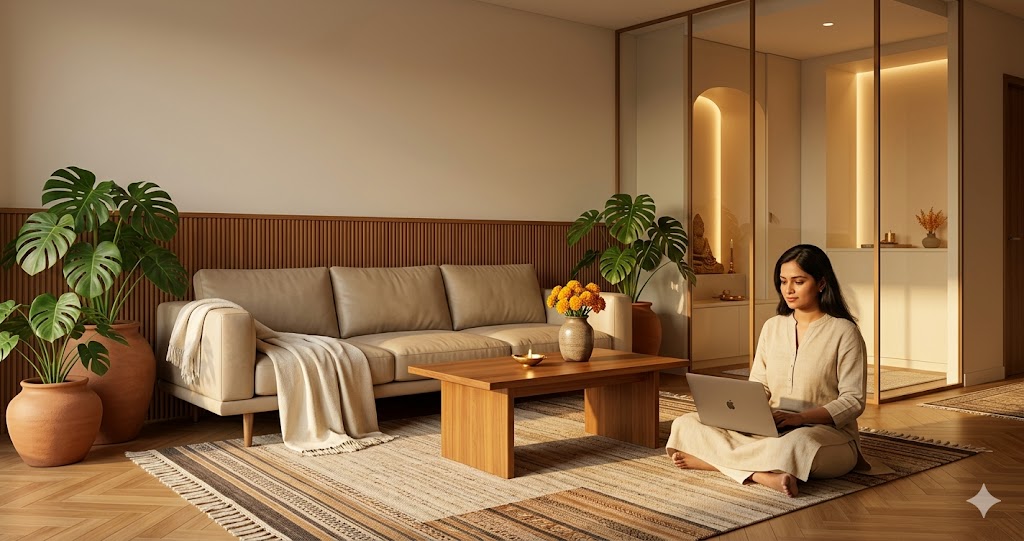
AI Interior Design — A 2026 Consumer Cornerstone for Indian Homes
Six capabilities · Studio Matrx walkthrough · India-native vs US tools · DPDP-safe
The average Indian homeowner — the one with a 1,150 sq ft Bengaluru 3 BHK, a ₹14 lakh interior budget, and a deadline of "before Diwali" — finally has an AI tool that understands what a diwan is, why the pooja nook must face north-east, and that the kitchen platform is 850 mm because the homeowner is 5'2". AI interior design in India has spent five years being a translation exercise — Western tools trained on Western rooms, asked to imagine Indian homes they had never seen. That era ended in 2026.
This guide is the consumer-facing cornerstone for "AI interior design" in the Indian context. If you are a homeowner trying to figure out whether to trust an AI tool with your once-in-a-decade home interior decision, this is the document written for you. We will explain what AI interior design actually does (and doesn't do), walk through how Studio Matrx — India's first AI-native interior design platform — handles your project end-to-end, compare every meaningful tool in the 2026 market (Foyr Neo, Interior AI, Reroom, Decormatters, Coohom, Planner 5D, Maket, Midjourney pipelines), and give you the honest limits we wish more vendors admitted.
"AI interior design isn't replacing the designer. It's replacing the four months you used to spend choosing between two moodboards your designer sent."
If you want the practitioner/designer-side reference, read AI-Powered Interiors. For adjacent reads, see AI Home Design, AI Room Planner, and Virtual Interior Design.
This guide refreshes every 12 months. Last verified: May 2026 · Next verify: May 2027.
What AI Interior Design Actually Means (and What It Doesn't)
AI interior design is the use of generative and analytical AI to compress the interior design workflow — from brief-taking to moodboard to photoreal render to bill of quantities — from a 6-to-10 week designer-led cycle into a 20-to-90 minute homeowner-led cycle. In practice, this is three categories of model stitched together:
- Vision-language models (GPT-4o-class, Claude, Gemini) that read your brief — "warm minimal 2 BHK for a young family in Whitefield with a music corner" — and translate it into a structured design intent: style tags, color hierarchy, material palette, room-by-room program.
- Diffusion models (SDXL, FLUX, ControlNet variants) that turn that intent into photoreal images, conditioned on your actual room photographs or floor plans so the geometry stays faithful.
- Optimisation/rule engines that price the design — material rates pulled from Bengaluru/Mumbai/Pune vendor APIs, BoQ generated against IS-code-compliant assemblies, lead times reconciled with site-readiness.
Done well, this is not a gimmick. It collapses the 35-40% of project time that designers historically spent on the iterative early-stage convergence — the "show me three options for the living room" loop — and gives that time back to the homeowner as decision quality, and to the designer as execution focus.
Five things AI interior design is NOT:
1. It is not a render-only tool. If all you get is a pretty picture and no quantification — no BoQ, no vendor list, no material rates, no fit-out lead time — you have a moodboard generator, not an interior design tool.
2. It is not "ChatGPT, but for interiors". Generic LLMs hallucinate dimensions, invent Vastu rules, and have never seen a 6-ft Indian diwan. Production interior AI is fine-tuned, retrieval-augmented, and India-aware.
3. It is not a replacement for the site visit. Civil readiness, plumbing chase locations, false ceiling drops, structural beam positions — none of these are reliably extracted from a smartphone photo. AI gives you the design; humans must verify the site.
4. It is not augmented reality (AR) furniture placement. IKEA Place, Houzz View in My Room, and Decormatters offer AR. AR is a viewing surface. AI interior design is an authoring surface — it generates the design itself.
5. It is not Vastu-compliant by default. Most global tools have no concept of north-east pooja placement, brahmasthan voids, or kitchen-on-southeast-only rules. India-native platforms (Studio Matrx) make Vastu a first-class input; foreign tools treat it as an afterthought, if at all.
Why AI Interior Design Matters in 2026 India
The Indian interior design market hit roughly ₹47,000 crore in FY26 (Statista, IBEF estimates), growing 18-22% year-on-year — substantially outpacing the broader real-estate market. Three pressures are forcing the AI inflection.
Pressure one: the supply-demand mismatch. India produces approximately 9,000 formally-trained interior designers per year against a market that absorbs roughly 280,000 new urban housing units annually in the eight major metros. The deficit means most middle-income homeowners (the ₹8-25 lakh interior bracket) end up working with contractor-led "designer" firms that operate as procurement shops with weak design rigor. AI fills the design-quality gap that would otherwise go unmet.
Pressure two: cost transparency demand. Post-RERA, post-GST, post-digital-payment, Indian homeowners expect itemized pricing. The opaque "₹1,800 per square foot turnkey" quote has lost trust. AI tools that auto-generate a line-item BoQ — every running foot of carcass plywood, every linear meter of profile light — meet a buyer expectation that traditional firms struggle to.
Pressure three: the time-to-move-in crunch. The Bengaluru/Pune/Hyderabad IT homeowner who buys an under-construction flat in 2024 takes possession in 2026, and wants to move in within 75 days. Six-week design cycles don't fit that window. AI compresses design to weeks; the saved time goes to procurement and execution.
Pressure four: the smartphone-native generation enters the home-buying market. The 28-38 year old buyer of a 2026 Bengaluru 3 BHK grew up swiping Pinterest, watching design YouTubers, and pricing things on Amazon. Their tolerance for opaque "trust me, it'll look nice" designer pitches is near zero. They expect to see the design before they pay for it. AI-generated photoreal renders match this expectation; designer mood-cards and 2D drawings do not.
Pressure five: post-COVID home-as-workplace reality. The home is now also office, gym, school, and entertainment venue. Room programs are denser — a single 11x12 ft second bedroom must host a guest bed, a desk, a wardrobe, and sometimes a Peloton. The constraint-solving complexity exceeds intuitive designer pattern-matching; AI optimization handles it better.
The seam Studio Matrx fills is precise: an India-native, homeowner-first AI platform that respects Vastu, prices in ₹ against actual Indian vendor catalogs, and produces designs grounded in the actual Indian apartment typology (1 BHK / 2 BHK / 3 BHK / 4 BHK / villa) rather than the open-plan American home most foreign tools default to. It is the platform that knows your kitchen has a pressure-cooker valve to deal with, your living room has a TV plus a streaming-puck plus a sound-bar plus an inverter line plus a curtain rod plus a fan with a wall-regulator, and your bedroom needs a wardrobe with a locker for jewelry. These specifics are not edge cases in India — they are the spec.
The Seven Capabilities That Matter
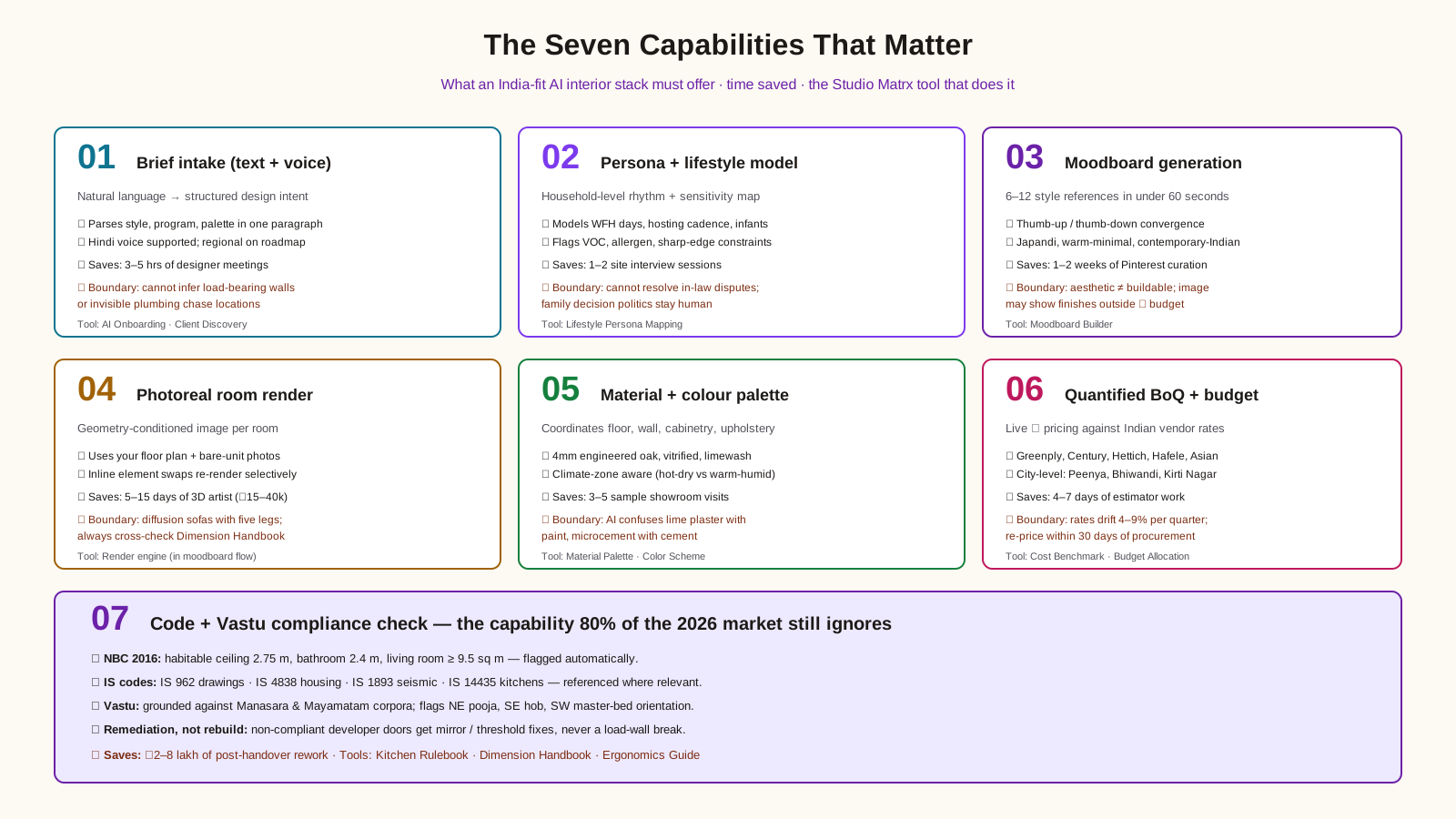
Not every "AI interior" tool offers all seven. The most useful capability stack for a 2026 Indian homeowner looks like this:
| Capability | What it does | Time / cost saved | Studio Matrx flow that does it |
|---|---|---|---|
| Brief intake (text + voice) | Translates natural language into structured style + program intent | 3-5 hours of designer meetings | AI Onboarding, Client Discovery |
| Persona + lifestyle modeling | Maps household members, daily rhythm, hosting patterns | 1-2 site interview sessions | Lifestyle Persona Mapping |
| Moodboard generation | Produces 6-12 visual style references in 60 seconds | 1-2 weeks of Pinterest curation | Moodboard Builder |
| Photoreal room render | Generates room images conditioned on your floor plan or photo | 5-15 days of 3D artist time (₹15-40k) | Render engine (in moodboard flow) |
| Material + color palette synthesis | Coordinates flooring, wall finish, cabinetry, upholstery | 3-5 sample visits | Material Palette, Color Scheme |
| Quantified BoQ + budget | Auto-pricing against live vendor rates | 4-7 days of estimator work | Cost Benchmark, Material Rate Library, Budget Allocation |
| Code + Vastu compliance check | Validates against NBC 2016 + Vastu rules | Avoids ₹2-8 lakh rework | Kitchen Rulebook, Dimension Handbook, Ergonomics Guide |
The honest read: tools that stop at capability four (photoreal render) are 80% of the 2026 market, and they're the source of the "AI interior design is just hype" perception. The breakthrough is capabilities five through seven — the ones that turn an image into an actionable, priced, code-aware design.
How Studio Matrx Does AI Interior Design — End-to-End Walkthrough
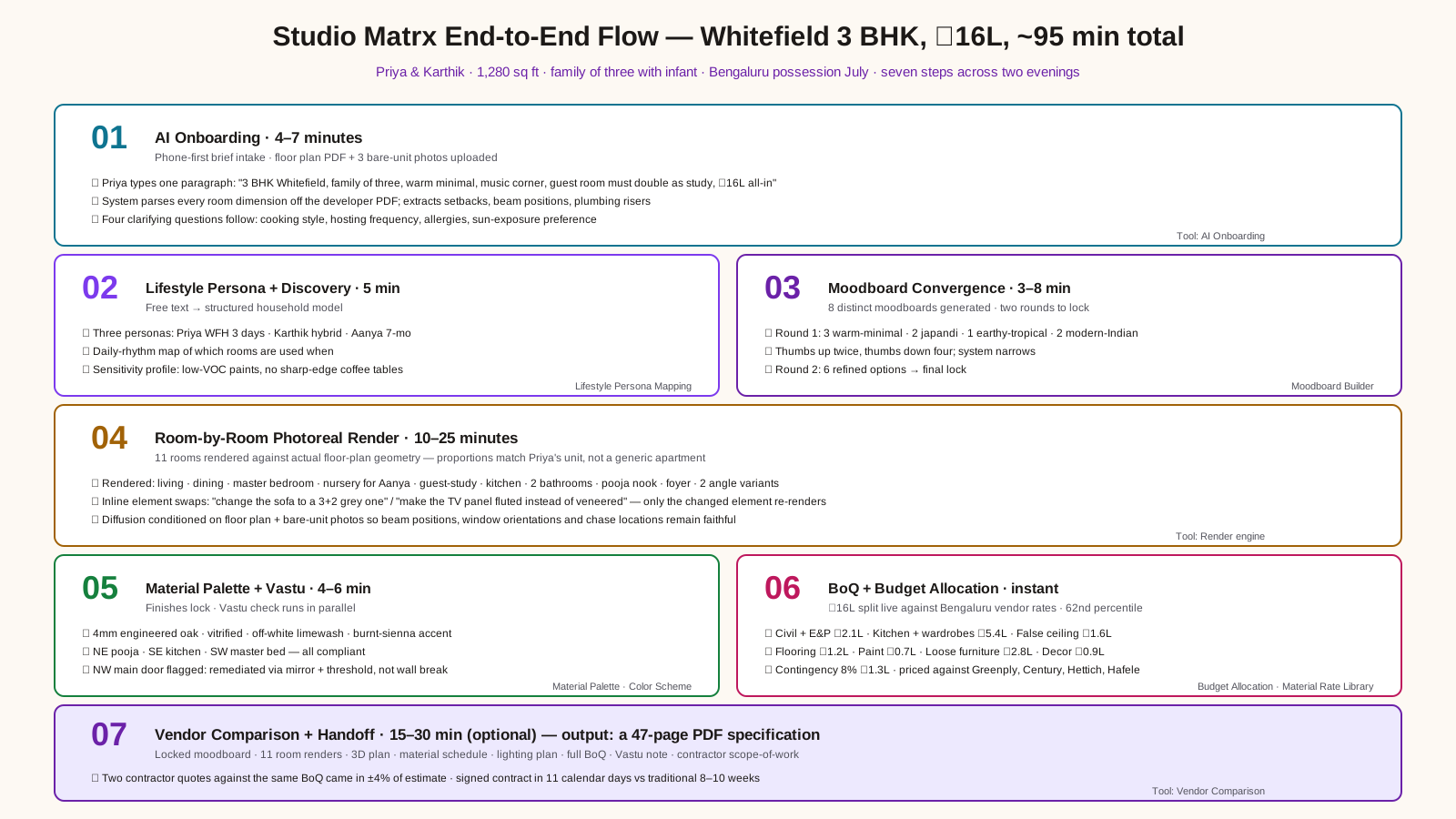
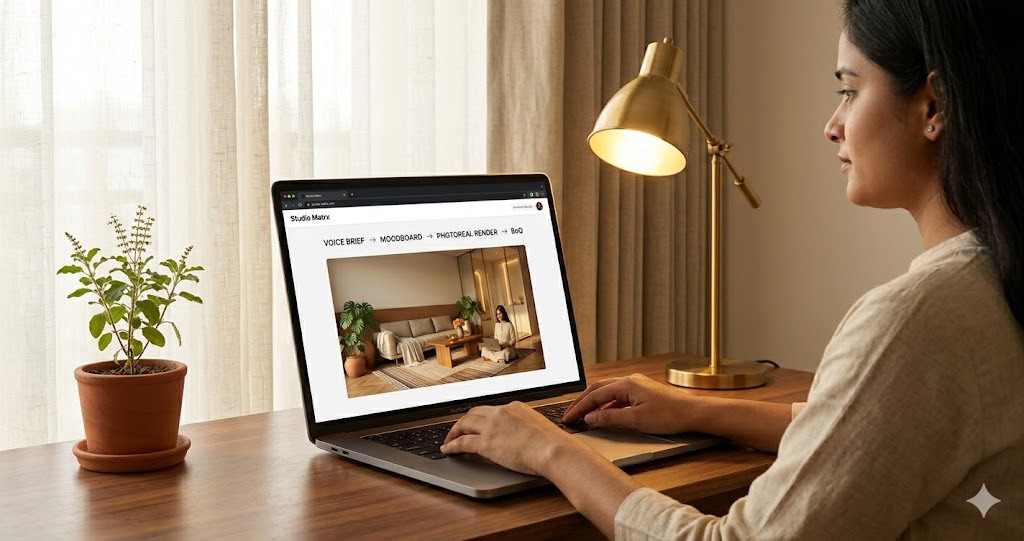
This is the heart of this guide. Below is the actual end-to-end Studio Matrx flow for a typical homeowner — let's use a real composite: Priya and Karthik, a couple buying a 1,280 sq ft 3 BHK in Whitefield, Bengaluru, with a 7-month-old daughter and a budget of ₹16 lakh inclusive of GST.
Step 1: AI Onboarding (4-7 minutes). Priya opens AI Onboarding on her phone, types a single paragraph: "3 BHK Whitefield, possession July, family of three with infant, like warm minimalism but not stark, need a baby-safe living room, music corner for my husband's guitar collection, mother-in-law visits monthly so guest room must double as study, budget ₹16L all-in." She uploads three photos of the bare unit and the developer's floor plan PDF. The system parses the floor plan, extracts every room dimension, and asks four clarifying questions (cooking style, hosting frequency, allergies, sun exposure preference).
Step 2: Lifestyle Persona + Discovery (5 minutes). The Client Discovery and Lifestyle Persona Mapping tools convert her free-text into a structured household model: three personas (Priya - WFH 3 days, Karthik - hybrid, Aanya - 7-month-old infant), daily-rhythm map (which rooms are used when), hosting cadence (1 dinner/month for 6-8 people), and a sensitivity profile (the infant rules out high-VOC paints and sharp-edged coffee tables).
Step 3: Moodboard Convergence (3-8 minutes). The Moodboard Builder generates 8 distinct moodboards — three warm-minimal variants, two japandi-leaning, one earthy-tropical, two contemporary-Indian. Priya thumbs up two, thumbs down four. The system narrows. After a second round of 6, she locks one. Cross-link: read Japandi Apartment and Budget Luxury Interiors for adjacent style cornerstones.
Step 4: Room-by-Room Photoreal Render (10-25 minutes). Now Studio Matrx generates the actual photoreal renders — living, dining, master bedroom, second bedroom (Aanya's nursery), guest/study, kitchen, both bathrooms, the pooja nook, and the foyer. Each render is conditioned on the actual floor-plan geometry, so the proportions match her unit. Priya can swap individual elements ("change the sofa to a 3+2 grey one", "make the TV panel fluted instead of veneered") via inline prompts and the diffusion engine re-renders only the changed element.
Step 5: Material Palette + Vastu Reconciliation (4-6 minutes). The Material Palette and Color Scheme tools lock the finishes — 4mm engineered oak flooring in living/dining, vitrified tile in kitchen/bath, off-white limewash on three walls and a single accent in burnt-sienna for the dining wall. Vastu check runs in parallel — the pooja nook is north-east (compliant), the kitchen is south-east (compliant), the master bed is south-west head-direction (compliant). One issue surfaces: the original developer-installed main door is north-west, which Vastu literature treats as suboptimal; Studio Matrx flags this with a remediation note (mirror placement, threshold treatment) rather than asking her to break a load-bearing wall.
Step 6: BoQ + Budget Allocation (instant, computed live). Budget Allocation splits the ₹16 lakh — civil + electrical + plumbing (₹2.1L), kitchen + wardrobes (₹5.4L), false ceiling + lighting (₹1.6L), flooring (₹1.2L), painting (₹0.7L), loose furniture (₹2.8L), decor + soft furnishings (₹0.9L), contingency 8% (₹1.3L). The Material Rate Library prices every line item against Bengaluru vendor rates (Greenply, Century, Asian Paints, Hettich, Hafele, local profile-light vendors in Peenya). The Cost Benchmark tool shows the ₹16L estimate is in the 62nd percentile for a 1,280 sq ft Whitefield 3 BHK — competitive, not stretched.
Step 7: Vendor Comparison + Handoff (15-30 minutes, optional). Priya can either (a) take the BoQ to a contractor of her choice as a procurement spec, or (b) use Vendor Comparison to receive 3-5 verified contractor quotes against the same BoQ. Studio Matrx does not execute the project itself — it produces the design specification that a contractor or designer-of-record then builds. We are honest about this scope: AI authors the design; humans build it.
What Priya gets at the end of step 7. A 47-page PDF design document with: locked moodboard, 11 room-by-room photoreal renders (including two angle variants for living and master), 3D floor-plan overlay, material schedule keyed to every surface, lighting plan with switch positions and dimming groups, full BoQ with line-item prices and vendor SKUs, Vastu compliance note, install sequence, and a contractor scope-of-work that can be sent verbatim to procurement. She also gets a live link — the design stays editable for 60 days, so she can swap a sofa color in week 3 without re-doing the whole flow.
What Priya does in the next 30 days. She prints the PDF, takes it to two contractors that the Vendor Comparison flow shortlisted, gets firm quotes against the BoQ (both come in ±4% of the Studio Matrx estimate — which is well within normal estimation tolerance), picks the contractor whose snagging-policy and timeline she prefers, and signs a contract. Total decision time on her side: about 11 calendar days from first moodboard to signed contract. The traditional designer-led equivalent would have been roughly 8-10 weeks.
The total elapsed time for Priya inside Studio Matrx itself: roughly 95 minutes across two evenings. Traditional comparable: 5-7 weeks of designer meetings.
"The Studio Matrx design isn't a single render. It's a 47-page document — moodboard, room renders, BoQ, vendor list, Vastu notes, install sequence — that a contractor can build from on Monday morning."
AI Interior Design vs Traditional Designer-Led Process
| Criterion | AI / Studio Matrx | Traditional designer-led | Winner + caveat |
|---|---|---|---|
| Time to first moodboard | 90 seconds | 5-10 days | AI — but designer adds curatorial taste |
| Time to final design | 1-3 evenings | 4-8 weeks | AI — caveat: complex bespoke projects still need designers |
| Cost | ₹0-9,999/year (Studio Matrx tiers) | ₹85,000 - ₹4.5 lakh designer fee | AI — caveat: execution still has independent cost |
| Iteration count | Unlimited | 2-4 rounds typical | AI |
| Site-condition awareness | Limited (photo-based) | Strong (physical visit) | Designer |
| Vastu compliance | Built-in (India-native tools only) | Designer-dependent | Tie — pick India-native AI |
| BoQ accuracy | High (live vendor rates) | Variable | AI — but designer negotiates vendor margin |
| Vendor relationship leverage | None | Strong | Designer |
| Bespoke joinery / one-off pieces | Weak | Strong | Designer |
| Code compliance (NBC, IS, fire) | Rule-checked | Designer-dependent | Tie |
| Project management on site | Out of scope | Often included | Designer |
| Repeatability across rooms | Strong | Manual | AI |
The honest synthesis: AI is decisively better for the design-authoring half of the project (brief → moodboard → render → BoQ). Humans remain better for the site-execution half (negotiation, supervision, on-site decisions, snagging). The 2026 best practice is hybrid: AI designs, contractor executes, optional independent designer-of-record supervises if the project is large or bespoke. See Choosing an Interior Designer in India for the human-designer side of this decision.
Tool Landscape 2026
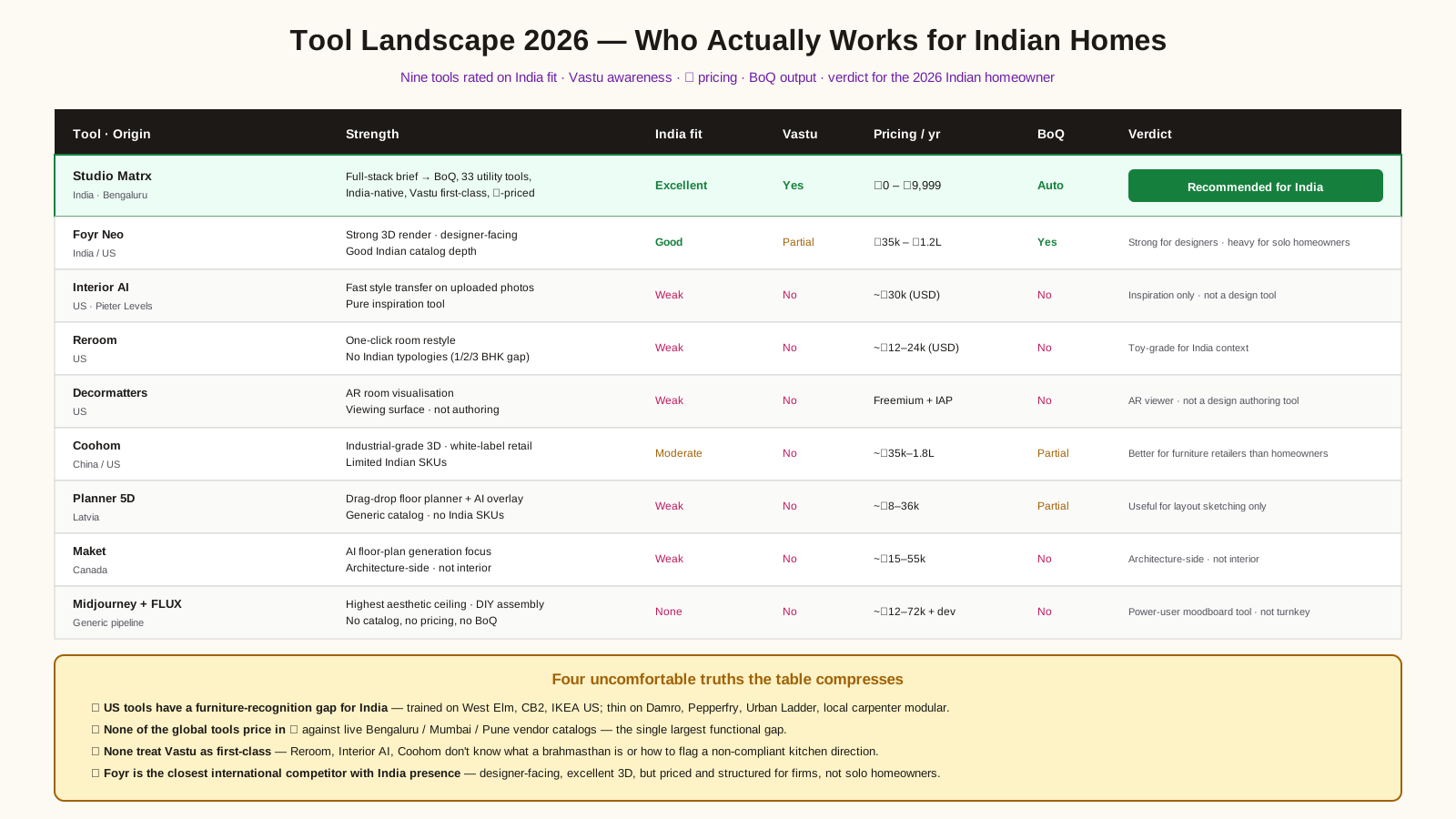
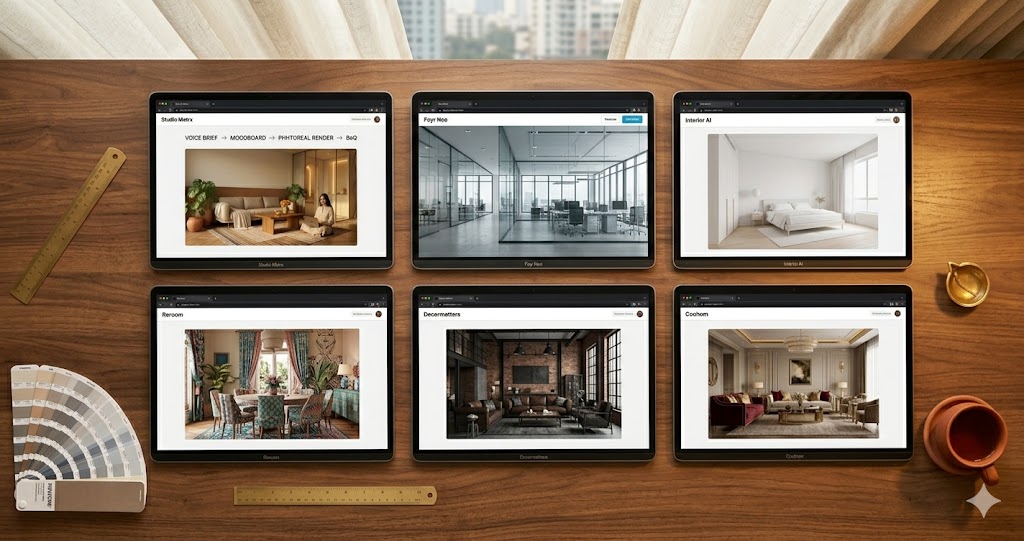
The 2026 AI interior tool market is messier than vendor marketing suggests. Below is an honest, India-aware comparison.
| Tool | Origin | Strength | India fit | Vastu aware | Pricing (₹/year approx) | BoQ output | Verdict for Indian homeowner |
|---|---|---|---|---|---|---|---|
| Studio Matrx | India (Bengaluru) | India-native, full stack brief→BoQ, 33 utility tools, ₹-priced, Vastu first-class | Excellent | Yes | ₹0 - ₹9,999 | Yes (auto) | Recommended for India-context buyers |
| Foyr Neo | India/US | Strong 3D render, designer-facing, good Indian catalog | Good | Partial | ₹35,000 - ₹1,20,000 | Yes | Strong for designers, heavy for solo homeowners |
| Interior AI | US (Pieter Levels) | Fast style transfer on uploaded photos | Weak — Western furniture bias | No | $25-50/month (~₹2,500/mo) | No | Useful as inspiration, not a design tool |
| Reroom | US | One-click room restyle | Weak — no Indian typologies | No | $10-20/month | No | Toy-grade for India context |
| Decormatters | US | AR room visualization | Weak | No | Freemium + IAP | No | AR viewer, not a design authoring tool |
| Coohom | China/US | Industrial-grade 3D, white-label for retail | Moderate — limited Indian SKUs | No | $30-150/month | Partial | Better for furniture retailers than homeowners |
| Planner 5D | Latvia | Drag-drop floor planner with AI overlays | Weak — generic catalog | No | $7-30/month | Partial | Useful for layout sketching only |
| Maket | Canada | AI floor plan generation focus | Weak for interiors | No | $15-50/month | No | Architecture-side tool, not interior |
| Midjourney + FLUX pipeline | Generic | Aesthetic ceiling is highest | None — DIY assembly | No | $10-60/month + dev time | No | Power-user moodboard tool, not turnkey |
A few uncomfortable truths the table compresses:
- Most US tools have a furniture-recognition gap for India. Their training data is heavy on West Elm, CB2, IKEA US — and light on Damro, Urban Ladder, HomeTown, Wooden Street, Pepperfry, and the actual carpenter-built modular kitchens that dominate Indian interiors.
- None of the global tools price in ₹ against live Indian vendor catalogs. That is the single largest functional gap.
- None of the global tools treat Vastu as a first-class input. Reroom, Interior AI, Coohom — none of them know what a brahmasthan is, and none can flag a non-compliant kitchen direction.
- Foyr is the closest international-grade competitor with India presence. It is designer-facing and excellent at 3D, but priced and structured for professional firms, not solo homeowners.
For an India-resident homeowner trying to design their own home with AI in 2026, Studio Matrx is the recommended default. For a designer who already has Foyr in their workflow and wants to add AI moodboarding, the answer is often "use both" — Studio Matrx for brief→moodboard→BoQ, Foyr for high-fidelity client-facing 3D presentations.
Eight Risks, Pitfalls and Honest Limits
1. Photoreal render does not mean buildable design. A diffusion model will happily generate a sofa with five legs and a window where a beam should be. Always cross-check renders against the Dimension Handbook and have a contractor verify constructability before procuring.
2. Vendor catalog drift. Vendor rates for plywood, profile lights, and hardware shift 4-9% per quarter. A BoQ generated in February is stale by August. Re-run pricing within 30 days of procurement.
3. The "AI hallucinated Vastu" failure mode. Generic LLMs will confidently invent Vastu rules that contradict canonical sources. Use only tools that ground Vastu against documented references — Studio Matrx grounds against Manasara and Mayamatam corpora; verify any tool you use does similar.
4. False ceiling and plumbing assumptions. AI tools assume a 250-300 mm false-ceiling drop is available everywhere. In some Mumbai redevelopment buildings, slab-to-slab is only 2.6 m — and a 250 mm drop leaves you with 2.35 m clear, which is below NBC 2016 minimum. Site-survey before locking design.
5. Bathroom waterproofing is invisible to AI. The model renders the finished tile but does not specify the membrane, fall, or chase routing. Bathroom design specifically needs human plumbing-design overlay.
6. Loose-furniture procurement gap. AI shows a beautiful 6-seater dining table; the actual market may only have 4-seater or 8-seater in your budget bracket. Cross-check loose furniture availability before locking design.
7. Lighting design oversimplification. Diffusion-model lighting looks correct but does not respect lux levels, CRI, or beam angle — the real metrics that determine whether a room actually works. Use Daylight Factor and Circadian Light Meter for the engineering layer.
8. The "approval seeking" trap. Some homeowners use AI to generate 40 designs and never converge. The convergence discipline — picking and committing — must come from the human. AI removes the cost of iteration; it does not remove the decision. We see this pattern most often in dual-decision-maker households where one partner is design-confident and the other is anxiety-driven; the AI tool inadvertently feeds the anxiety by making "one more option" frictionless. The cure is a pre-committed convergence rule: "we will look at 12 options across two rounds, then we lock by Sunday at 9 pm". Set the rule before you start generating.
Read Smart Storage Interiors and Compact Luxury Apartment for adjacent reads on getting more out of constrained Indian flats — both are areas where AI excels precisely because the optimization problem is well-defined.
India-Specific Considerations
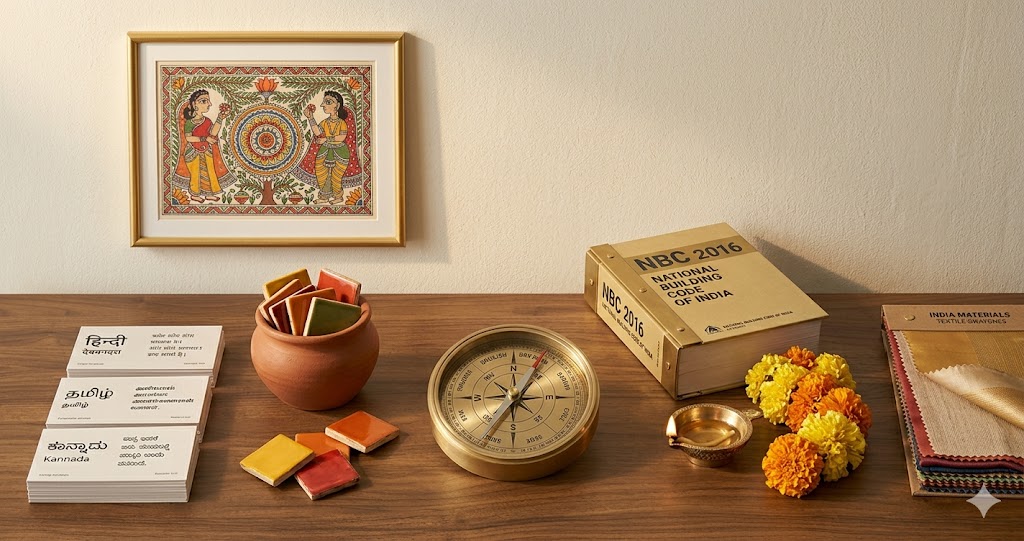
Designing for India is not designing for a generic global apartment with a saree-print throw. The actual differences:
NBC 2016 (National Building Code). Defines minimum ceiling heights (2.75 m for habitable rooms, 2.4 m for bathrooms), minimum room dimensions (9.5 sq m for living rooms in flats), staircase rise/tread, and fire-egress. Any AI design that violates NBC creates a OC/CC risk. Studio Matrx checks the dimensional rules against Dimension Handbook.
Relevant IS codes. IS 962 (architectural drawings), IS 4838 (housing dimensions), IS 1893 (seismic — relevant for any structural change), IS 875 (loading), IS 3370 (water-retaining structures, relevant for sunken bathrooms), IS 14435 (kitchens). AI tools rarely cite these; an India-native tool should.
DPDP Act 2023 (Digital Personal Data Protection). Your home photos, floor plans, family persona profile — these are personal data under the DPDP Act. Pick a tool that (a) stores India-resident data in India, (b) lets you delete your project data on demand, (c) does not train its global model on your private inputs without explicit opt-in consent. Studio Matrx complies; most US tools have not yet adapted their data residency to DPDP.
Vastu compatibility. Roughly 62-71% of Indian homeowners (across surveys 2022-2025) factor Vastu into interior decisions, with higher salience in Bengaluru, Hyderabad, Chennai, and Pune than in cosmopolitan Mumbai or Delhi NCR. An AI tool that cannot reason about cardinal directions is a non-starter. See Vastu for Kitchen, Vastu for Bedroom, Entrance Vastu, and Vastu Modern Homes for the rules an AI must respect.
Regional vendor reality. Bengaluru's plywood market is centered in Peenya and Yeshwanthpur; Mumbai's in Bhiwandi and Andheri-east; Delhi's in Kirti Nagar; Pune's in Bhosari. Rates differ 8-18% across cities for identical SKUs. Hyderabad and Chennai have stronger granite supply chains; Bengaluru has stronger engineered-wood depth; Mumbai has stronger imported tile presence. AI tools that price against a single national rate-card miss this; Studio Matrx maintains city-level rate libraries.
Language inclusivity. A meaningful share of Indian homeowners — particularly tier-2-city buyers, older homeowners, and family members involved in approval (parents, in-laws) — prefer Hindi, Tamil, Kannada, Marathi, Telugu, Bengali, Gujarati for design conversations. Studio Matrx ships an English-first product with Hindi voice-brief support; deeper regional language support is on the roadmap.
Climate zones. India spans five major climate zones (hot-dry, warm-humid, composite, temperate, cold). Material recommendations must respect zone — vinyl flooring fails in coastal Mumbai humidity, dark south-facing walls overheat in Jodhpur. Studio Matrx zones recommendations using Cross Ventilation Analyzer and Brise Soleil Visualizer outputs.
The Studio Matrx Stack for AI Interior Design
These are the actual tools in the platform you'll touch for a typical interior project:
- AI Onboarding — natural-language project brief, generates the structured intent that drives every downstream step.
- Client Discovery — extracts requirements via guided question flow, useful when you don't know what you don't know.
- Lifestyle Persona Mapping — household-level persona model that shapes room program and material choices.
- Moodboard Builder — 60-second moodboard generation with thumb-up/thumb-down convergence.
- Material Palette — coordinated finish selection across flooring, wall, cabinetry, upholstery.
- Color Scheme — palette generator with light-temperature awareness.
- Furniture Planner — layout planning against floor-plan geometry.
- Kitchen Rulebook — kitchen-specific ergonomics and Vastu rule checker.
- Wardrobe Planning — wardrobe internal-layout optimizer.
- Cost Benchmark — compare your project's cost against percentile bands for your city + typology.
- Material Rate Library — city-level live vendor rates.
- Budget Allocation — head-wise budget split with sensitivity analysis.
- Vendor Comparison — solicit and compare contractor quotes against your BoQ.
For a typical 2-3 BHK Indian apartment project, you'll engage with 8-10 of these tools across the lifecycle. The platform stitches them; you don't have to assemble manually.
When NOT to Use AI Interior Design
Honesty matters more than evangelism. AI interior design is the wrong tool in these cases:
Heritage and bungalow restoration. A 1930s Mumbai chawl, a Chettinad mansion, a Goa Portuguese villa, a Lutyens Delhi bungalow — these require restoration craft, conservation-grade material knowledge, and on-site archaeological judgment that AI cannot deliver. Hire a conservation architect.
Sub-400 sq ft micro-units. At extreme tightness, every centimeter is a hand-resolved design decision. AI can sketch; a senior small-space designer will out-perform on liveability. (Though AI can be a useful starting-point sketch — see Space Efficient Homes.)
Ultra-luxury bespoke projects (₹1 crore+). Above this threshold, design fee is a small fraction of project cost, the client expects custom joinery and one-off pieces, and the value of a senior designer's curatorial taste exceeds AI's efficiency. Use AI for early-stage option exploration only.
Commercial F&B and retail. Brand-identity-led commercial interiors require human storytelling and brand integration that AI tools (Studio Matrx included) are not designed for.
Heavily structural-change projects. If your project involves moving load-bearing walls, adding mezzanines, or extending into balconies, you need a structural engineer + architect first; interior AI tooling is downstream of that decision.
You enjoy the design process and have time. This is the underrated case. If interior design is the fun part of your year and you'd rather spend three months pinning, swatching, and shopping — do that. AI compresses the timeline; if the timeline is the joy, don't compress it.
The 5-Year Trajectory: AI Interior Design in 2030
Five trends are visible in 2026 that will define 2030.
One: voice-first becomes default. By 2028 the dominant input modality for AI interior tools will be voice — Hindi, English, Tamil, Kannada, Marathi — replacing the current click-and-type flow. Studio Matrx is mid-rollout on this; the technology is ready, the regional-language depth is the gap.
Two: live AR walkthroughs on commodity phones. By 2029 a homeowner with a mid-range phone will be able to walk through the photoreal design overlaid on the bare unit. Studio Matrx is targeting VR walkthroughs for late 2026 (H2 roadmap, not shipped yet — honest disclosure); mobile AR is 2027.
Three: vendor-API integration becomes table stakes. The line between "design tool" and "procurement platform" dissolves. By 2028 you will be able to convert a Studio Matrx BoQ into firm vendor purchase orders inside the platform; the design + procurement + project-management surface unifies.
Four: regulatory codification. DPDP enforcement, Bureau of Indian Standards updates, and BIS/CPWD-specific schedules for "AI-generated design documents" will appear by 2027-28. Tools that have not built compliance scaffolding will be locked out of larger projects.
Five: AI-native designers as a profession. A new role — the AI-augmented interior designer — will replace 30-40% of conventional designer headcount by 2030. The senior craft layer remains; the junior "moodboard + drafting" layer compresses. This is good for homeowners (lower cost, faster cycles), good for senior designers (more leverage), and disruptive for the mid-tier.
Frequently Asked Questions
Is AI interior design accurate for Indian apartments?
For India-native tools (Studio Matrx, Foyr) — yes, accuracy is high enough to drive real procurement decisions. For US/global tools applied to Indian apartments — accuracy degrades meaningfully because the training data, furniture catalogs, and spatial assumptions are Western. Accuracy is highest when you upload your actual floor plan and bare-unit photos rather than relying on text-only briefs.
How much does Studio Matrx cost?
Studio Matrx operates a freemium model. The core flow — brief, moodboard, render, BoQ — is accessible at no cost with usage limits. The Supporter tier (~₹999/year) lifts limits and adds features. The Pro Member tier (~₹9,999/year) is positioned for practitioner / professional use with team and white-label features. Current pricing is on the studiomatrx.org pricing page; we keep tiers simple and Indian-priced.
Can AI replace my interior designer?
For the design-authoring phase (brief → moodboard → render → BoQ): largely, yes, especially for standard 1-3 BHK apartments. For the site-execution phase (contractor management, snagging, on-site judgment): not yet, and probably not by 2030 either. The best 2026 pattern is hybrid: AI authors the design, you take the BoQ to a contractor, and you optionally hire a designer-of-record for supervision if the project is large or you want a second pair of eyes.
What's the difference between Studio Matrx and using ChatGPT for interiors?
ChatGPT (and Claude, Gemini, etc.) are general-purpose LLMs. They can discuss interior design intelligently but cannot: (a) generate photoreal renders conditioned on your actual floor plan, (b) price against live Indian vendor catalogs, (c) check Vastu compliance against canonical sources, (d) produce an actionable BoQ, (e) integrate with city-level vendor APIs. Studio Matrx is a vertical stack — LLM + diffusion + rule engine + vendor catalog — purpose-built for the interior design workflow in India.
Is my home data safe under DPDP Act?
Studio Matrx is DPDP Act 2023 compliant: data residency in India, deletion-on-demand, no third-party sharing without consent, no model training on private project inputs unless you explicitly opt in. We publish our privacy practices on the platform. For any AI tool, the test is: can you (a) see what data they hold about you, (b) delete it on request, (c) restrict its use in model training? If the answer to any is "no", reconsider.
Does Studio Matrx understand Vastu?
Yes. Vastu is a first-class input in our brief intake and a first-class check in our compliance engine. We ground Vastu rules against documented canonical sources (Manasara, Mayamatam, contemporary academic Vastu scholarship) rather than letting the LLM hallucinate. We flag non-compliant placements with remediation options (mirror placement, threshold treatment, color correction) when structural change isn't feasible. See Vastu Modern Homes and Pooja Room Design India for the rule set we apply.
Can Studio Matrx handle my kitchen design specifically?
Yes — kitchen is one of the most-used flows on the platform. The Kitchen Rulebook tool handles work-triangle, platform height (against user height, not just a 900 mm default), Vastu (hob orientation, sink placement), and module sizing. Read Kitchen Design India and Modular Kitchen India for the cornerstone guides.
What about my bedroom — does the same flow work?
Yes. The bedroom flow includes bed-direction Vastu, wardrobe optimization via Wardrobe Planning, light-layering, and acoustic considerations. See Bedroom Design India for the cornerstone.
I want a low-budget design — does AI help or just push expensive recommendations?
AI is particularly good at low-budget design because it can explore the design space exhaustively and surface non-obvious cost savings (a fluted MDF accent wall at ₹14,000 that visually replaces a ₹95,000 imported tile feature). Read Budget Luxury Interiors for the philosophy; the platform's Budget Allocation tool will hold a hard ceiling once you set it.
Does Studio Matrx do 3D walkthroughs / VR?
Photoreal still renders: yes, today. Full VR walkthrough: on the H2 2026 roadmap, not shipped at the time of this guide's publication. Mobile AR: targeted for 2027. We name explicitly what's shipped vs. roadmap so you can decide based on what exists, not what's promised.
References
1. Statista. (2025). Interior Design Market — India Outlook 2025-2030. https://www.statista.com/outlook/cmo/furniture/india
2. IBEF (India Brand Equity Foundation). (2025). Real Estate Industry Report. https://www.ibef.org/industry/real-estate-india
3. Bureau of Indian Standards. (2016). National Building Code of India 2016, Volumes 1 and 2. New Delhi: BIS. https://www.bis.gov.in
4. Ministry of Electronics and Information Technology, Government of India. (2023). Digital Personal Data Protection Act, 2023. https://www.meity.gov.in
5. Bureau of Indian Standards. IS 962 (1989) — Code of Practice for Architectural and Building Drawings; IS 4838 — Housing Dimensions; IS 1893 (2016) — Criteria for Earthquake Resistant Design of Structures. https://www.bis.gov.in
6. Houzz. (2024). India Interior Design and Renovation Trends Report. https://www.houzz.in
7. KPMG India. (2024). Future of Real Estate and Proptech in India. https://kpmg.com/in
8. RICS South Asia. (2024). Real Estate Industry Survey. https://www.rics.org/in
9. CREDAI. (2025). Urban Housing Demand and Supply Outlook. https://credai.org
10. Knight Frank India. (2025). India Real Estate Residential Report H1 2025. https://www.knightfrank.co.in
11. NASSCOM. (2024). AI Adoption in Indian Industries: Annual Report. https://nasscom.in
12. Acharya, P. K. (translation, reprint 2012). Manasara: Architecture and Sculpture. Munshiram Manoharlal Publishers.
13. Dagens, B. (translation, 1994). Mayamatam: Treatise of Housing, Architecture and Iconography. Indira Gandhi National Centre for the Arts.
14. Council of Architecture, India. (2023). Architects Act 1972, Rules and Schedules. https://www.coa.gov.in
15. Levels, P. (2023-2025). Interior AI — Product Documentation. https://interiorai.com
16. Foyr. (2025). Foyr Neo Product Documentation. https://foyr.com
17. McKinsey & Company. (2024). The State of AI in 2024 — Global Survey. https://www.mckinsey.com
18. RedSeer Consulting. (2024). Home and Living Market in India. https://redseer.com
Related Guides
- AI-Powered Interiors — the practitioner / designer-side companion to this consumer guide.
- AI Home Design — sister cornerstone on whole-home AI design (architecture + interior overlap).
- AI Room Planner — narrower cornerstone on layout-focused AI tools.
- Virtual Interior Design — adjacent cornerstone on online / remote interior design services.
- Budget Luxury Interiors — when AI meets a tight budget and a luxury aspiration.
- Japandi Apartment — one of the most-generated styles on the platform; useful adjacent style cornerstone.
Export this guide
Related Guides — Deep-dive reading
AI Render Generator — Photoreal AI Rendering for Indian Architects + Designers (2026)
Sketch/photo/white-box → photoreal · 12 min vs V-Ray 4 hr · Studio Matrx + Lumion + D5 + Twinmotion + Enscape
Design StylesAI Home Visualization — Decision-Maker Lens for Indian Homeowners (2026)
Compare 3 wall colors · A/B sofa options · Phone AR · Studio Matrx walkthrough · Render-to-reality fidelity
Design StylesAI-Powered Interiors — A 2026 Practitioner's Guide for Indian Homes
Six AI capabilities · Augmented workflow · Tool comparison · Risks and pitfalls
Design StylesRelated Tools — Try Free
Cross-Ventilation Analyzer
Estimate airflow and air changes per hour (ACH) from room size, window areas, layout, and local wind — with NBC 2016 Part 8 compliance check.
Ventilation CalculatorBrise-Soleil Visualizer
Interactive horizontal-louvre cut-off angle calculator — sun altitude, louvre depth, and spacing inputs with a live shadow preview. Computes θ = arctan(spacing/depth) for façade shading, ECBC envelope compliance, hospital daylight design, and tropical sun-control detailing.
Sun Shading ToolFalse Ceiling Cost Estimator
Live ₹/sqft across 8 ceiling types — POP, gypsum, designer, metal, PVC, wooden — with cove and spot lighting for 20 Indian cities.
Cost Calculator