
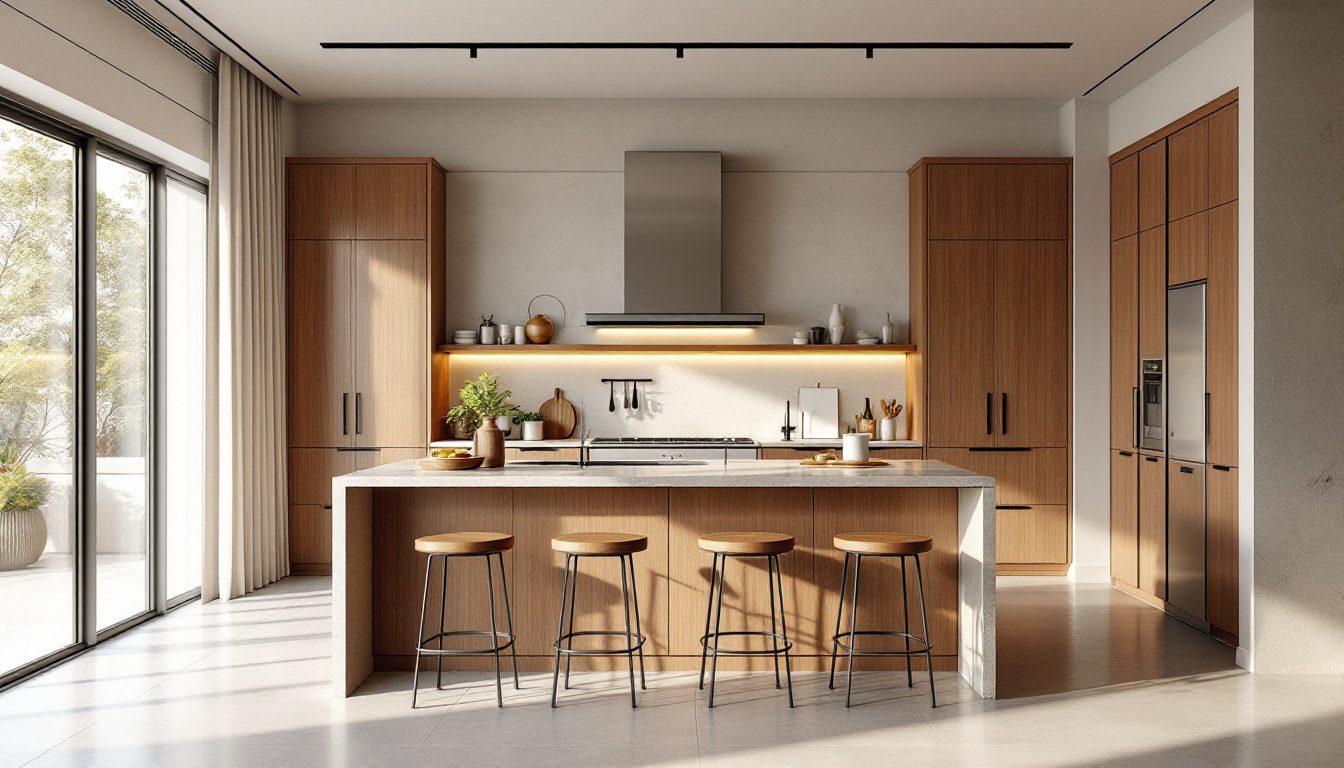
Kitchen Design in India: Designing the Heart of the Home
From back-room to social keeping room — the work triangle, galley vs island layouts, Indian storage reality, and the open-plus-utility kitchen that actually works
Every house has a heart — the one room that, more than any other, gives you the feeling of being home. For most of human history that heart was the hearth, the fire you cooked over and gathered around. Walk through almost any Indian home today and you will find that the hearth has simply moved indoors and grown up. The heart of the home is the kitchen.
It is where the day begins, with chai brewing before anyone has properly said good morning. It is where a child spreads homework across the counter while dinner simmers, where the cousin who came to "help" ends up leaning against the slab and talking for an hour, where every guest at a party drifts no matter how carefully you arranged the drawing room. The kitchen pulls people toward it. And that is precisely why it deserves to be designed for far more than efficiency. It deserves to be designed for living.
It is also, plainly, the hardest room in the house to get right. No other space has to hold cabinetry, appliances, plumbing, gas, exhaust, water, electrical points, deep storage and washable finishes — and at the same time serve cooking, cleaning, storing, eating and entertaining, often within the same hour. There is no single perfect kitchen waiting in a catalogue. The right kitchen is the one that fits how you cook, how your family gathers, and what your week actually looks like.
Design the kitchen for the cook you are, not the cook you imagine you might become. The everyday Tuesday dinner matters more than the once-a-year Diwali feast.
This guide walks you through the thinking — from the big decision about open versus enclosed, to the questions to answer before a single cabinet is drawn, to the work triangle, the layouts that suit Indian flats, the storage your kitchen really needs, and a realistic 2026 budget. By the end you should be able to brief a designer, or Studio Matrx's AI, with confidence.
From a back room to a keeping room
A century ago, the kitchen was hidden. It sat at the back of the house, out of sight of guests, often staffed and deliberately separated from the dining room and the formal rooms where the family entertained. Cooking was work, and work was kept away from company.
The modern open kitchen turned that idea inside out. Designers sometimes borrow an old word for it — the keeping room, from "keep," the strong inner stronghold of a castle. The keeping room rolls food preparation, casual eating, family time and simply being together into one warm, continuous space. Instead of hiding the cooking, it celebrates it. The kitchen becomes the focal point of family life rather than its service entrance.
For many Indian families this is a genuinely appealing shift. We are social cooks — festivals, fasts, guests dropping in unannounced, three generations under one roof. The open kitchen suits the way a lot of us live, letting the cook stay part of the conversation instead of exiled behind a wall.
But — and it is an important but — Indian cooking is not gentle on the air. Daily tadka, deep frying, roasting masalas, slow dum over a low flame: these throw out smell, smoke and a fine film of grease that settles on everything within reach. A fully open kitchen connected to your sofa fabric and curtains will carry the memory of last week's fish curry for a long time. So most Indian homes that think it through arrive at a sensible middle path.
The middle path is a beautiful open kitchen for show, for breakfast, for chai with friends and for light cooking — paired with a small enclosed utility or "dirty" kitchen tucked behind or beside it, where the heavy frying and the smelliest tadka happen behind a door. The dirty kitchen takes the wear, the grease and the strong odours; the show kitchen stays clean and social. If you have the space for it, this arrangement gives you the best of both worlds.
Decide which way you lean — fully open, fully enclosed, or the open-plus-utility middle path — before the layout is locked. It is the one choice that shapes every other.
The table below frames the trade-off honestly.
| Approach | Strengths | Watch-outs | Best for |
|---|---|---|---|
| Fully open kitchen | Sociable, brings in light, feels larger, cook stays included | Smell and grease travel; needs powerful ventilation; mess is on show | Light cooks, couples, smaller families, weekend-heavy cooking |
| Enclosed kitchen | Contains smoke and odour, hides clutter, easier to keep the home clean | Cook is cut off, can feel boxed-in, needs its own light and ventilation | Heavy daily cooking, joint families, those who cook with domestic help |
| Open + utility (middle path) | Social front, working back; clean home, contained mess | Needs more floor area and a second small zone with services | Most Indian families who can spare the square footage |
A quick word on orientation, since many readers will ask: traditional Vastu places the kitchen in the south-east (the Agni corner) with the cook facing east. You do not have to follow it, but if it matters to you or your family, settle the direction early — it constrains where the hob and window can go. Our Vastu compass tool helps you check the actual orientation of your plan against these guidelines before the slab is poured.
Twenty questions before you draw a thing
The best kitchens are never designed cabinet-first. They are designed by first understanding the cook and the family. Before any layout is sketched, sit down — ideally with everyone who will use the room — and work through the questions below. They are deliberately about behaviour, not hardware, because the hardware should answer the behaviour and not the other way around.
Treat this as a written brief. Note every answer, and every stray wish, even ones that feel like they will not matter for months — the air-fryer point you do not need yet, the dream of a coffee corner, the fact that your mother visits and cooks differently. Write it down now, because if you do not, it slips away until it is far too late and expensive to add.
| # | Question | Why it shapes the design |
|---|---|---|
| 1 | Is the kitchen a centre of family life, or strictly a workspace? | Decides open vs enclosed, and whether it needs to look good |
| 2 | Who cooks — one person, two together, the whole family, plus help? | Sets aisle widths and whether you need two work zones |
| 3 | When guests come, do you want them in the kitchen, nearby, or away? | Decides the island, seating and the opening to the living area |
| 4 | Do you want morning light in here? | Fixes window placement before cabinets compete for the wall |
| 5 | How many full meals a week, and how elaborate? | Heavy cooking pushes you toward an enclosed or utility kitchen |
| 6 | Do you cook for large groups at festivals and functions? | Drives extra burners, prep counter and bulk storage |
| 7 | Should there be counter seating, a table, or a chat spot for the cook? | Adds an island or breakfast counter to the plan |
| 8 | Is the dining area beside the kitchen? Is there a separate formal one? | Decides how the kitchen connects to its neighbours |
| 9 | Veg, non-veg, or both — and do you keep them separate? | May call for two sinks, two prep zones or separate storage |
| 10 | Gas, induction, or both? | Affects ventilation, electrical load and counter layout |
| 11 | Do you need a dedicated utility or dirty kitchen? | The single biggest space decision after open vs enclosed |
| 12 | Where do the water purifier, dishwasher and washing machine live? | These need plumbing points fixed early, not retrofitted |
| 13 | How much dry-ration storage do you buy in bulk? | Sizes the tall pull-out and pantry units |
| 14 | How many large vessels — patilas, cookers, kadhais — do you own? | Sizes the deep drawers under the hob |
| 15 | Any small appliances on the counter daily — mixer, grinder, kettle? | Calls for an appliance garage to keep the slab clear |
| 16 | Do you bake, or want to? | Adds an oven niche, a cool slab and counter clearance |
| 17 | Is there a maid or cook, and do they need their own clear zone? | Shapes circulation and the cleanup station |
| 18 | How tall is the main cook? | Sets counter height — this is personal, not standard |
| 19 | What does your daily clutter look like honestly? | Decides how much closed storage you truly need |
| 20 | What do you dislike about your kitchen today? | Often the most useful answer of the whole list |
If working through this on paper feels daunting, our room programming worksheet walks you through it question by question and produces a tidy brief you can hand to a designer.
The work triangle, and why it still matters
You will hear, from every modular-kitchen salesperson, about the famous "work triangle" — the imaginary triangle drawn between the three things you move between most while cooking: the sink, the hob (cooktop) and the refrigerator. The concept is often over-sold, but the idea underneath it is sound and worth keeping. These three points are where the work happens. Keep them sensibly close together and cooking flows; scatter them across a vast kitchen and you will walk a small marathon to make one dinner.

The rule of thumb, drawn from decades of kitchen ergonomics, goes like this: each leg of the triangle should be somewhere between about 4 and 9 feet, and the three legs together should total no more than roughly 26 feet. Keep the sink roughly central, since it is the busiest point of all three. Do not let an island or a dining chair break the path between the hob and the sink — that walk, with a hot, dripping vessel, happens dozens of times a day.
Maximise counter space, not floor space. A bigger room is not a better kitchen; the goal is to remove footsteps, not add them.
In a larger kitchen — or one shared by two cooks — a single triangle stops being enough. Here you think in work stations instead. Split the room into zones, each with its own mini-triangle: a cooking station around the hob, with its landing counter and spice pull-out; and a cleanup station around the main sink, with the dishwasher, the drying rack and the bins. Add a prep sink near the cooking zone and the two cooks stop colliding. This zoning idea, more than any rigid triangle, is what makes a busy Indian kitchen calm.
If you want to test whether your three points sit at comfortable distances, our scale and proportion calculator lets you plug in your runs and clearances and see them against the standards.
Galley, L-shape, island — what suits Indian flats
Three layouts do most of the work in Indian homes. Each has a personality.
The galley — two parallel counter runs facing each other — is the single most efficient layout ever devised. Everything is within a step or a half-turn, which is exactly why professional kitchens use it and exactly why it suits the long, narrow kitchens so common in apartments. Put the sink and hob on one run and the fridge and tall storage on the other, and the triangle almost designs itself.
The L-shape wraps counters along two adjacent walls and frees up the opposite corner. That freed corner is precious: it becomes a breakfast counter, a small dining table, or simply the room to open the kitchen toward the living area. The L-shape is the natural friend of the open, social kitchen.
The island kitchen, where you genuinely have the floor area, is really a galley wearing better clothes. The island plus the run opposite it form the working core — the same efficient two-line arrangement — while the far side of the island gives you bonus prep surface, casual seating and a gathering point. Just remember the island is not free: it needs about 1 metre of clear aisle on every side that people use.
| Layout | Footprint it suits | Pros | Cons | Verdict for Indian flats |
|---|---|---|---|---|
| Galley | Narrow, 2.4–3 m wide | Most efficient; tight triangle; cheap to build | Only one cook comfortably; can feel like a corridor | Excellent for 1–2 BHK apartment kitchens |
| L-shape | Square-ish, medium | Opens a corner; sociable; flexible | Corner cabinet can waste space without a carousel | The everyday workhorse for 2–3 BHK homes |
| U-shape | Larger, 3 m+ each way | Most storage and counter; two work zones | Needs real space; two dead corners | Great if the room can take it |
| Island | Open-plan, 3.6 m+ wide | Social hub; extra prep and seating | Eats floor area; needs services run to the island | Aspirational; brilliant when the space exists |
Whatever final shape you choose, the work triangle has to survive inside it in some recognisable form. Lose it and the kitchen becomes disjointed and awkward to use, no matter how large or how expensive the finishes. To sketch these options against your real room before committing, the bubble diagram planner lets you push zones around on screen and feel the flow.
Mind the big boxes
Here is a detail that quietly ruins more layouts than any other. The refrigerator, the tall wall-oven column, a built-in tall pantry, a freezer — these are the big boxes. Because of their sheer bulk, floor to ceiling, they break both the look and the working flow of a kitchen if you put them in the wrong place.
Drop a fridge in the middle of a counter run and you do two bad things at once. You strand the counter on the far side of it — that orphaned stretch feels cut off from the work zone and quietly goes unused, a place where the toaster and a fruit bowl go to be forgotten. And you break the long, continuous work surface that makes a kitchen feel generous to cook on.
The fix is simple and almost always possible: place the big boxes at the ends of the counter runs, never in the middle. Keep them off the main sight line into the rest of the room too, so the first thing a guest sees is not the side of your refrigerator. Anchor the runs with the big boxes at the bookends and let an unbroken counter flow between them. Your kitchen will instantly feel larger and work better.
The storage an Indian kitchen actually needs
Imported kitchen designs assume Western cooking: a few pans, packaged food, a dishwasher doing the heavy lifting. An Indian kitchen runs on a completely different inventory, and storage planned for the wrong one is the most common reason a brand-new modular kitchen feels cramped within a year.
Plan storage around how an Indian kitchen genuinely works. Deep drawers under and beside the hob for the heavy metal — patilas, pressure cookers, kadhais, the tava. Drawers, not shelves: you pull one out and see everything, instead of kneeling to excavate a deep cabinet. A dedicated appliance garage — a counter-level cabinet with a roller or flap shutter — for the mixer-grinder, wet grinder, kettle and toaster, so the slab stays clear and these heavy machines are not lifted in and out every day. Tall pull-out units for dals, atta, rice, masalas and provisions, where narrow vertical baskets glide out and let you read every label at a glance. And a planned spot, with its own point and plumbing, for the water purifier — far too often an afterthought stuck on randomly once everything else is built.
Easy to forget but vital: landing counter beside both the hob and the fridge. Somewhere to set down a hot kadhai the moment it leaves the flame, and somewhere to rest the tray of vegetables or the bag of groceries the moment you open the fridge. A few centimetres of clear counter at exactly those two points saves a hundred small daily fumbles.
| Zone | What it stores | Best fitting |
|---|---|---|
| Under-hob | Patilas, cookers, kadhais, tava | Deep drawers (200–300 mm) on full-extension channels |
| Beside hob | Daily oils, salt, common masalas | Pull-out spice unit or shallow drawer within arm's reach |
| Tall pantry | Atta, rice, dals, bulk provisions | Tall larder pull-out, vertical wire baskets |
| Counter | Mixer, grinder, kettle, toaster | Appliance garage with roller/flap shutter |
| Cleanup | Detergents, scrubbers, bins | Under-sink pull-out with segregated dustbins |
| Overhead | Crockery, occasional vessels, dry snacks | Wall units to 600 mm above counter; lift-up shutters |
| Corner | Awkward dead space | Magic corner or carousel — never leave it as a void |
A genuinely useful exercise before you finalise anything: measure your current kitchen in running feet. Count the running feet of lower cabinets, upper cabinets and open counter you have right now, and note what overflows and what stays empty. Those numbers become your yardstick. When a designer proposes a new plan, you can hold it against a real figure — "I have 14 running feet of lowers today and it is not enough" — instead of guessing at the word "enough."
Connections first, cabinets last
There is a sequence the best designers follow, and it is almost the reverse of what most homeowners do. Most people start by choosing a shutter colour. The professionals start by deciding how the kitchen should connect to everything around it — the dining area, the utility, the living room, a balcony or the outdoors — and only work inward from there.
So the order is: first, fix the connections, the openings and doorways that tie the kitchen to its neighbours and decide how social it will be. Second, fix the windows, because that morning light, once you have committed the wall to upper cabinets, is gone for good. Only then, in the space that remains, lay out the cabinets, the counters and the appliances.
This feels backwards, and it works. It also means you should expect to revise — to move a door, widen an opening, shift a window and rethink the whole arrangement several times over. That circling back is not the process failing; it is the process working. A good kitchen design stays flexible until quite late, and the time to discover a problem is on paper, not in poured concrete.
Plan the openings and the light first; the cabinets will happily fill whatever is left. Plan the cabinets first and you will spend the next ten years cooking with your back to a wall where a window should have been.
While the connections are still on paper, settle the technical numbers too, because they constrain the cabinets. Counter height should suit the main cook — the standard sits around 850 to 900 mm, but a tall cook is happier at 920 mm and a shorter one at 820 mm, so measure rather than default. Keep the working aisle between two facing runs at about 1,050 to 1,200 mm if two people cook together, and never below 900 mm even in the tightest galley. The dado or backsplash — the washable, oil-proof surface behind the hob and sink — should rise to meet the underside of the wall units, in tile, glass or a solid surface that wipes clean.
| Dimension | Recommended range | Note |
|---|---|---|
| Counter height | 850–900 mm | Tune to the main cook; 920 mm if tall |
| Counter depth | 600 mm | Standard; 650 mm gives easier landing space |
| Working aisle (one cook) | 900–1,050 mm | Below 900 mm feels cramped |
| Working aisle (two cooks / island) | 1,050–1,200 mm | Lets two people pass with vessels |
| Wall-unit clearance above counter | 600 mm | Room for appliances and a clear sight line |
| Wall-unit / dado height | 700–750 mm of dado | Backsplash meets the underside of wall units |
| Plinth (toe-kick) height | 100–150 mm | Standard skirting under base units |
Gas, induction and getting the air right
The fuel choice ripples through the whole plan. Gas (LPG or piped) gives the high, instant, visible flame Indian cooking leans on, independent of the power supply, but it demands a safe cylinder location, good ventilation and a clear path for the line. Induction is precise, cool, easy to wipe down and excellent for the open show kitchen, but it needs flat-bottomed vessels and a heavy electrical point, and it cannot char a roti or a baingan the way a flame can. Many Indian homes settle on a hybrid: a gas hob for the serious cooking plus an induction plate for quick jobs and as a power-cut backup.
Whatever the fuel, ventilation is not optional for Indian cooking — it is the single feature that decides whether your beautiful open kitchen stays beautiful. Size the chimney to the hob: a chimney should be at least as wide as the cooktop, usually 60 or 90 cm to match a 3- or 4-burner hob, and mounted 650 to 750 mm above the cooktop for an efficient draw without scorching. For the heavy frying and tadka common in Indian homes, look for a strong suction rating — around 1,200 cubic metres per hour or more for a busy kitchen — and a ducted chimney that throws the air outside rather than a recirculating one that merely filters it. Pair it with an openable window or exhaust fan so make-up air can flow. A BEE-rated chimney and energy-efficient appliances will also keep the running cost sensible over the years.
What it costs in 2026
A modular kitchen in India is usually priced per running foot, which is why measuring your runs matters so much. The number rolls up the carcass (the cabinet boxes), the shutters, the hardware (channels, hinges, baskets) and basic accessories — but typically not the countertop, the appliances, the chimney, the sink or the electrical and plumbing work, which are quoted separately. Always ask exactly what a per-foot price includes before you compare two quotes, because the gaps are where surprises live.
| Tier | Indicative ₹ per running foot (2026) | What you typically get |
|---|---|---|
| Budget | ₹1,400–2,200 | BWR ply or MDF carcass, laminate shutters, basic hinges, limited pull-outs |
| Mid-range | ₹2,500–4,000 | BWP marine ply carcass, laminate or membrane shutters, soft-close hardware, several pull-outs |
| Premium | ₹4,500–7,000 | BWP ply or boiling-water-proof carcass, acrylic shutters, full soft-close, tall units, branded fittings |
| Luxury | ₹8,000–15,000+ | Imported boards and hardware, lacquered or acrylic finishes, integrated appliances, custom everything |
On top of the cabinetry, budget separately and realistically: a granite or quartz countertop at roughly ₹250–900 per square foot depending on stone; a chimney at ₹12,000–45,000; a hob at ₹8,000–30,000; a good sink at ₹6,000–25,000; and electrical, plumbing and a backsplash that together often add 10–20% to the cabinetry figure. A typical 10–12 running-foot mid-range apartment kitchen, fully finished with appliances, commonly lands somewhere around ₹1.5–3.5 lakh in 2026; premium open kitchens with an island climb well past that. To pressure-test your own numbers room by room, our cost calculator lets you build the estimate line by line.
A quick word on shutter materials
The shutter — the visible cabinet door — is where most of your money and almost all of your kitchen's character live. Three families dominate the Indian market, and the honest comparison looks like this.
| Shutter | Look and feel | Durability | Cost | Best for |
|---|---|---|---|---|
| Laminate | Matte or gloss, huge range of designs | Good; scratch-resistant, hides marks | Most affordable | Budget and mid-range; high-use family kitchens |
| Membrane (PVC-wrapped MDF) | Seamless, moulded, soft-touch; routed designs possible | Good if kept dry; edges can peel with heat/water over time | Mid | Mid-range; classic and shaker styles |
| Acrylic | High-gloss, mirror-like, rich depth of colour | Very good; UV-stable, but shows fingerprints and fine scratches | Premium | Premium open and show kitchens |
There is no single right answer. A heavy-cooking family kitchen is often happiest in tough, forgiving laminate; an open show kitchen on display to guests may justify the glamour of acrylic; membrane sits comfortably in between and gives you moulded, traditional-looking shutters at a sensible price. Match the shutter to how the kitchen will actually be used, not to the showroom that dazzled you on a Sunday afternoon.
Bring it to life with Studio Matrx
You now have the framework: decide open versus enclosed, answer the twenty questions, protect the work triangle, place the big boxes at the ends, plan storage for patilas and pull-outs rather than for a catalogue, fix the connections and light before the cabinets, and hold every plan against your kitchen measured in running feet. The next step is to see it. Studio Matrx's DesignAI turns your answers — how you cook, how your family gathers, your space and your budget — into real kitchen concepts laid out for your home, complete with layouts, storage and finishes you can refine. Tell it about your kitchen, and watch the heart of your home take shape.
References
- Bureau of Indian Standards. National Building Code of India 2016 (NBC 2016), Part 8 — Building Services and Part 4 — Fire and Life Safety. New Delhi: BIS.
- Bureau of Indian Standards. IS 13990 / IS 4963 and related standards on modular furniture and built-in storage units. New Delhi: BIS.
- Bureau of Indian Standards. IS 15958 / IS 4246 — Domestic LPG installations and gas appliances safety guidelines. New Delhi: BIS.
- Bureau of Energy Efficiency (BEE). Standards & Labelling Programme — Star ratings for kitchen chimneys, refrigerators and domestic appliances. Ministry of Power, Government of India.
- Bureau of Energy Efficiency (BEE). Eco Niwas Samhita (Energy Conservation Building Code for Residential Buildings) and ECBC guidance on residential ventilation and daylight. Government of India.
- Panero, Julius, and Martin Zelnik. Human Dimension and Interior Space: A Source Book of Design Reference Standards. New York: Whitney Library of Design.
- Indian Green Building Council (IGBC). Green Homes Rating System — guidance on residential ventilation, indoor air quality and daylighting. Hyderabad: CII–IGBC.
- Hirsch, William J. Jr. Designing Your Perfect House: Lessons from an Architect. Dalsimer Press. (A general inspiration for this series' approach to designing the kitchen as the heart of the home.)
Export this guide
Related Guides — Deep-dive reading
Storage Planning Before Interior Design
Why storage must be planned first — audited, budgeted and given its floor area — before a single layout, colour or sofa is chosen. The homeowner's plan-it-first master guide for Indian homes.
StorageNorth-Facing Window Design (India): The Best Light With the Least Heat
Why the north wall gives soft, even, glare-free daylight with almost no heat, and how to design large, high-VLT windows that make the most of it.
Windows & GlazingDesigning Utility Rooms
How to plan a proper back-of-house utility room in an Indian home — the hardworking space where washing, drying, cleaning kit and the inverter all live together, designed instead of leftover.
StorageRelated Tools — Try Free
Cross-Ventilation Analyzer
Estimate airflow and air changes per hour (ACH) from room size, window areas, layout, and local wind — with NBC 2016 Part 8 compliance check.
Ventilation CalculatorVastu Window Planner
Vastu guidance for window placement and size by wall direction and room — rating and remedies.
VastuWindow Orientation Planner
Pick the best window type, glass and shading by wall direction — north, east, south and west.
Window Tool