
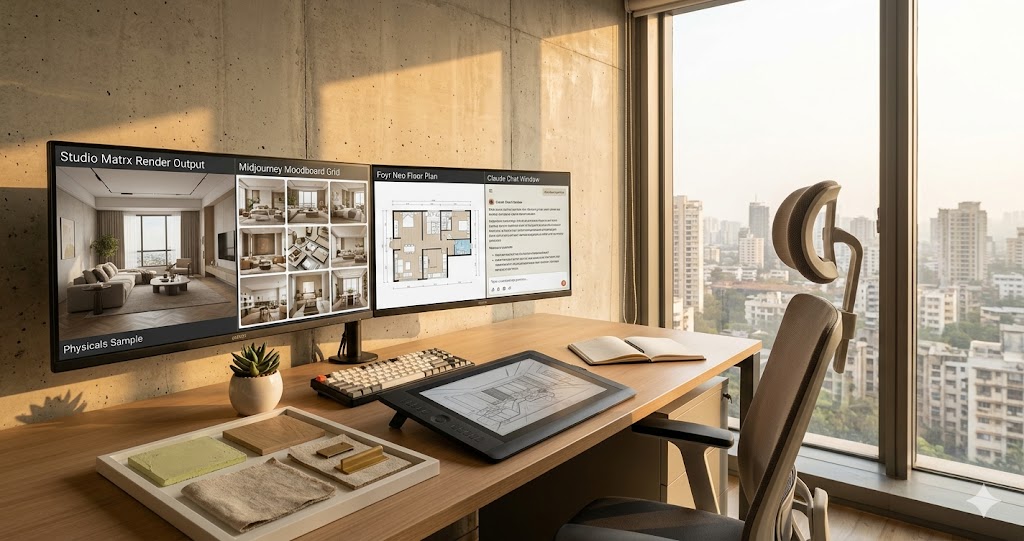
AI-Powered Interiors — A 2026 Practitioner's Guide for Indian Homes
Six AI capabilities · Augmented workflow · Tool comparison · Risks and pitfalls
In 2026 AI is the single most-changed layer of the interior design process — and the layer most over-promised, most under-explained, and most poorly understood by Indian homeowners. This guide is the practitioner's reference: what AI-powered interior design actually means in 2026, what AI can and cannot do for an Indian apartment, the six capabilities that matter, the augmented workflow that gets the best out of AI without losing the craft, the tools available to Indian designers and homeowners, the eight risks every homeowner should know, and the privacy and copyright considerations that the brochure copy never mentions.
This is a 22-minute working reference for homeowners and designers in 2026. Studio Matrx — the platform publishing this guide — is itself an India-native AI interior design tool. We have stated this upfront not as marketing but as transparent positioning: the recommendations below name Studio Matrx alongside Foyr Neo, Reroom, Interior AI, Decormatters, Midjourney, Flux, Claude and ChatGPT, with honest notes on what each does well and where each falls short. The framework is tool-agnostic; the goal is to help you choose the right tool for the right stage of your project.
The 2026 question is no longer "should I use AI in my interiors process?" but "where should I let AI in, and where must I keep it out?" The augmented designer — one who uses AI for variation and speed but owns brief, judgement, craft and install — beats both the AI-replaced designer (whose renders never survive site reality) and the AI-refusing designer (whose hours-per-project numbers no longer compete). This is the seam to master.
For complementary depth see Warm Minimal Interiors, Earthy Interior Palette, Japandi Apartment Interior Guide, Budget Luxury Interiors, Smart Storage Interiors, and Sustainable Interiors India Guide.
This guide refreshes every 6 months — the AI tool landscape shifts monthly and a 12-month interval would leave half the recommendations stale. Last verified: May 2026 · Next verify: November 2026.
What "AI-Powered Interior" Actually Means (and What it Doesn't)
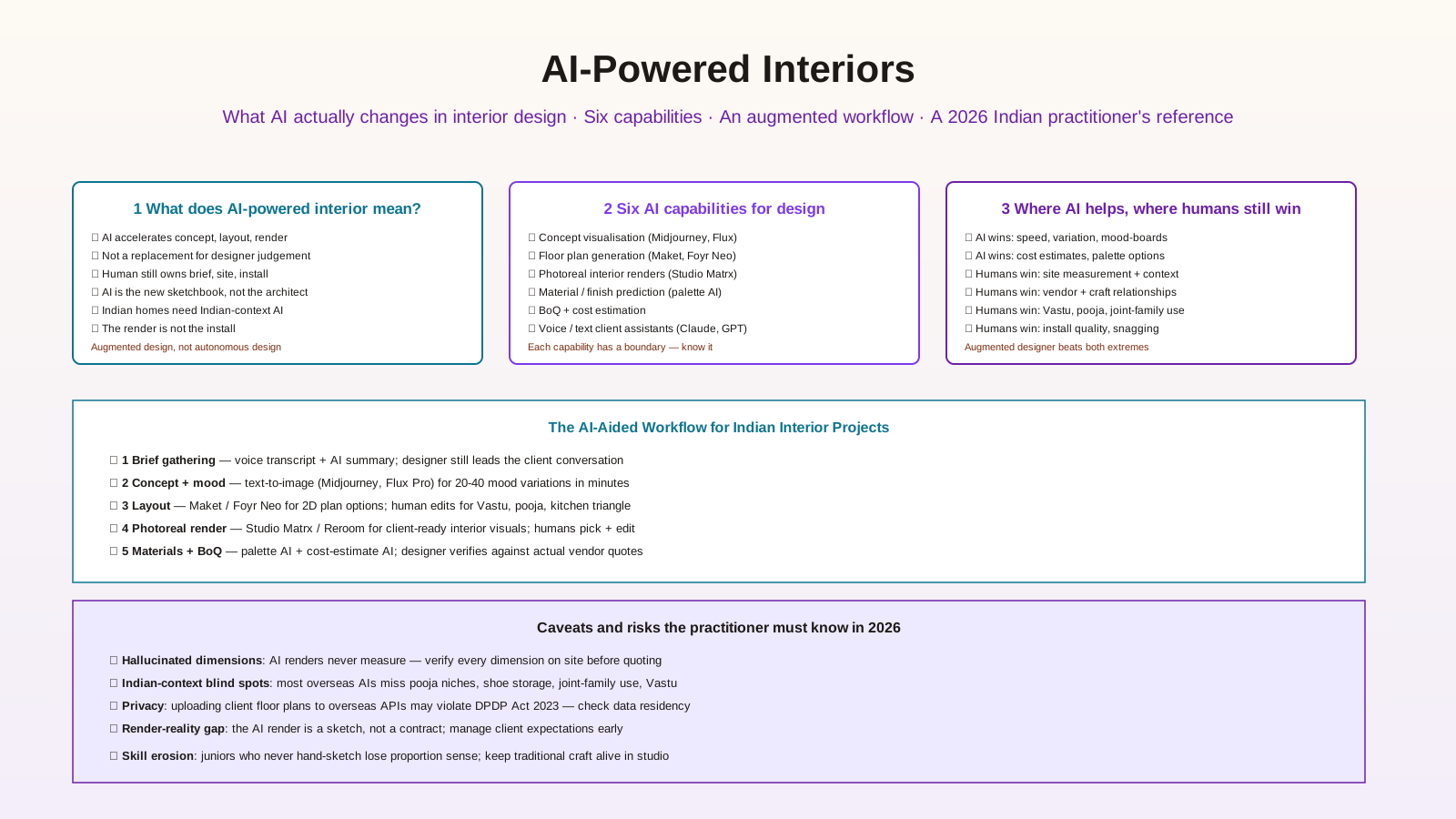
An AI-powered interior project, in 2026, is one where generative AI tools materially shorten the upfront design phase — brief intake, concept moodboards, layout options, photoreal renders, palette suggestions, BoQ first-cuts — and free the designer to spend more hours on site, on craft, on vendor coordination, and on the irreplaceable human work of running a project to handover.
It is not a project where AI replaces the designer. It is not a project where the homeowner types "design my flat" into a chatbot and receives an installable apartment. It is not a project where the render becomes the contract. And it is not a project where the AI tool, however clever, ever measures a real wall, ever supervises a real mason, or ever sits across the table from a mother-in-law negotiating the size of the pooja niche.
The honest 2026 picture: AI compresses the first 30% of the project — the design hours — by roughly 60-75%. The remaining 70% of the project — vendor selection, joinery cutting, lime plastering, tile laying, plumbing, electricals, snagging, polish, handover — runs at the same speed it always has, because it is still a human craft activity executed on a real Indian site.
Five things AI-powered interior design is NOT
1. Not a designer replacement — AI is the new sketchbook, not the new architect. Every project still needs human judgement at every seam.
2. Not autonomous — Every AI output (render, plan, BoQ, palette) requires designer review and edit before it can be acted on.
3. Not Indian-native by default — Most US-built AI tools (Decormatters, Interior AI, Reroom) have weak Indian-context understanding. They place a sectional sofa where you wanted a diwan; they ignore the pooja niche; they have no Vastu awareness.
4. Not a contract — The AI render is a sketch with photorealistic skin. It is not a guarantee, not a BoQ, not an install spec. Manage client expectations early.
5. Not free of risk — Privacy (DPDP Act 2023), copyright (regurgitated trademarked designs), and data residency are real concerns that 2024-era marketing copy did not address. 2026 practice must.
The Six AI Capabilities for Design
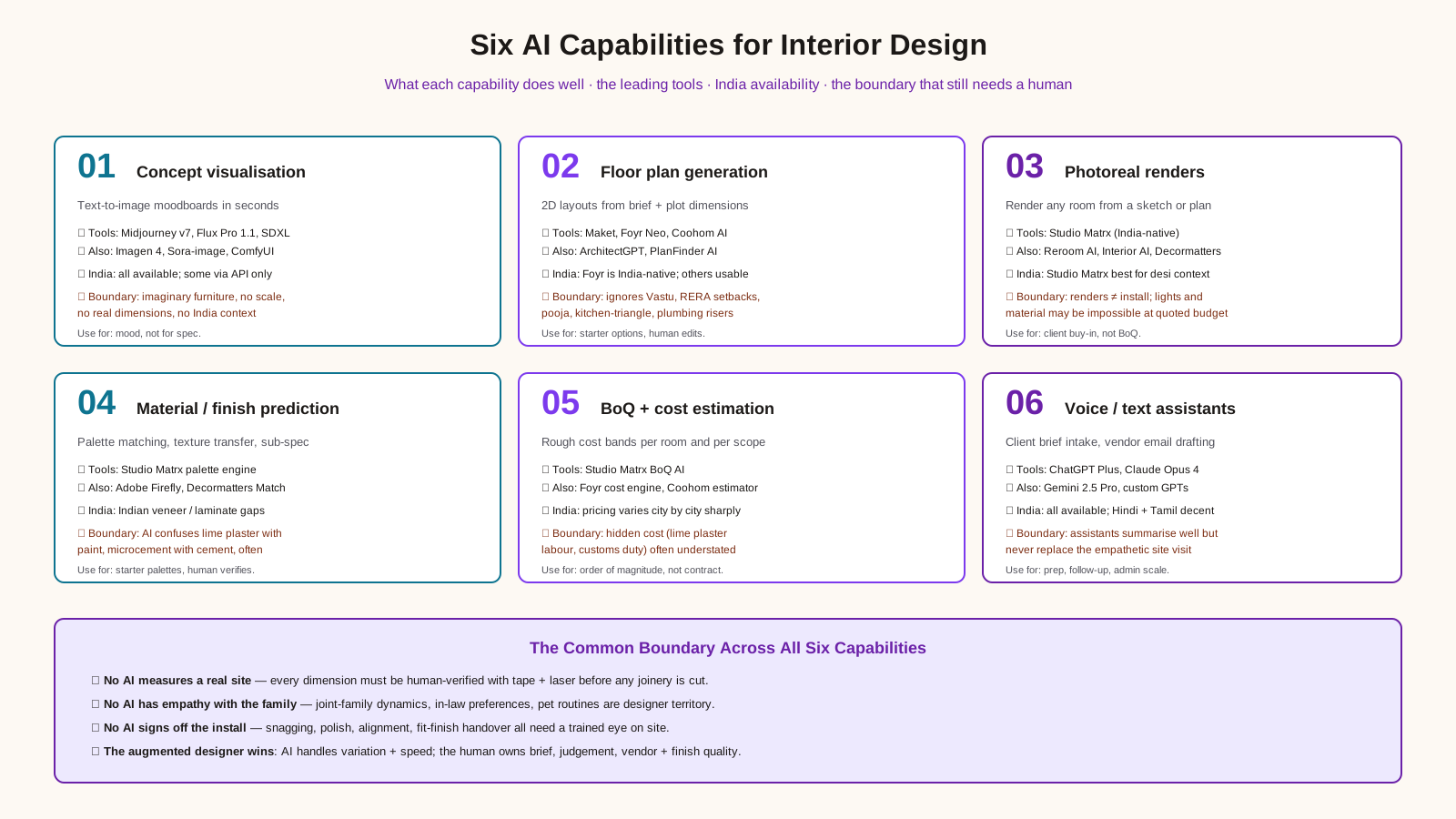
1. Concept visualisation (text-to-image mood)
Tools: Midjourney v7, Flux Pro 1.1, Stable Diffusion XL via ComfyUI, OpenAI Sora-image, Google Imagen 4. The use case: generate 20-40 mood references in 10-15 minutes from a short text prompt — "warm minimal living room, oat linen sofa, Bengaluru apartment, lime plaster wall, golden afternoon light." The output is moodboard-grade, not install-grade. Designer curates 4-6 from the set, presents to the client, iterates.
Boundary: no real dimensions, no scale, no India context unless prompted carefully. A Midjourney sofa is not a sofa you can buy in Bengaluru. A Flux Pro render of "modern Indian kitchen" may show a Western open-plan layout with no provision for an Indian gas cooktop, pressure cooker storage or wet-and-dry area separation.
2. Floor plan generation
Tools: Maket, Foyr Neo, Coohom AI, ArchitectGPT, PlanFinder AI. The use case: feed plot dimensions + a brief ("3 BHK, parents room, study, north entry, family of four") and receive 5-8 plan options in under 5 minutes. Then human-edit aggressively.
Boundary: AI floor plan tools in 2026 still ignore Vastu axes, RERA setbacks, structural beam positions, plumbing risers in apartment shafts, the kitchen work triangle, and pooja-zone placement. Foyr Neo is the most India-aware of the lot; Maket is the strongest globally but has no Indian regulation overlay. Treat AI plans as starter geometries, not as final layouts.
3. Photoreal interior generation
Tools: Studio Matrx (India-native), Reroom AI, Interior AI, Decormatters, Coohom AI. The use case: from a sketch, photo, or 2D plan, generate a client-ready interior render in 60-120 seconds. Iterate on palette, style, furniture form. Use as the visual that closes the design phase and starts the install phase.
Boundary: the render is convincing but the materials, light quality and finish in the render may not be achievable at the quoted budget. Studio Matrx is built for Indian apartments and includes Indian furniture, fabric, and architectural references in its training; Decormatters and Interior AI have weak Indian context (no pooja, no diwan, no saree storage). Always pair the render with a written caveat to the client.
4. Material / finish prediction
Tools: Studio Matrx palette engine, Adobe Firefly material match, Decormatters Match, custom palette extractors. The use case: from a photo, an AI extracts the dominant palette and proposes complementary tones, fabrics, finishes. Useful for the "client likes this Pinterest image; what's the underlying palette?" workflow.
Boundary: AI is poor at distinguishing similar-looking finishes — lime plaster vs paint vs limewash vs microcement all look similar in low-resolution renders, but cost 4-10x apart and behave very differently in Indian humidity. Designer must verify each material spec before BoQ.
5. Cost estimation and BoQ
Tools: Studio Matrx BoQ engine, Foyr cost estimator, Coohom estimator. The use case: rough cost band per room based on chosen palette, style and city. A starting point for the homeowner conversation, not the final contract.
Boundary: hidden costs (lime plaster skilled labour, customs duty on imported lighting, lead time on solid wood, GST treatment of supply-vs-service) are typically understated by 15-30%. Always cross-check against three real vendor quotes before signing.
6. Voice / text-driven assistants
Tools: ChatGPT Plus, Claude Opus 4, Google Gemini 2.5 Pro, custom GPTs. The use case: summarise a 90-minute client interview transcript into a 200-word brief; draft a vendor RFP; translate a Tamil-only mason's WhatsApp into English; rewrite a homeowner change-request into formal site instructions.
Boundary: assistants summarise well but cannot replace the in-person site visit, the empathetic family conversation, or the experienced read of which Khurja potter delivers on time. Use for admin scale-up, not for relationships.
The Integrated AI-Aided Workflow
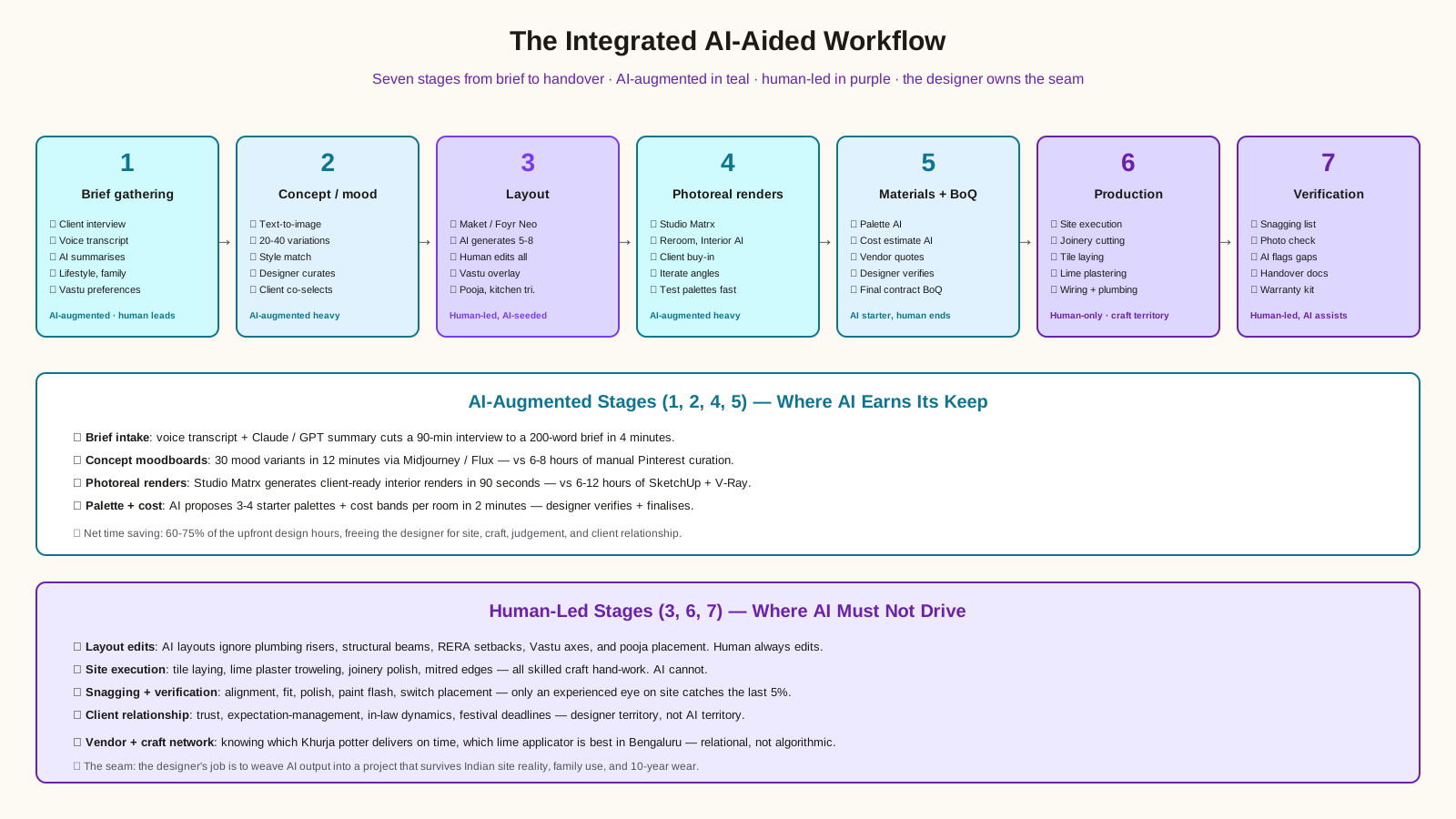
The seven-stage workflow that integrates AI into a real Indian interior project, with the AI-augmented stages and the human-only stages clearly marked.
Stage 1 — Brief gathering (AI-augmented, human leads)
Record the 60-90 minute client interview with consent. Run the audio through Claude Opus 4 or ChatGPT Plus for a transcript and a 200-word executive summary. The designer still leads the conversation, still asks the family questions, still notices the in-law dynamic and the toddler routine. The AI handles the note-taking.
Time saved: 3-4 hours per project compared to manual transcription and brief writing.
Stage 2 — Concept and mood (AI-augmented heavy)
Feed the brief into Midjourney v7 or Flux Pro 1.1 with India-specific prompt seeds. Generate 30-40 mood variations across 3-4 styles. Curate to 6-8. Share with the client via a single moodboard PDF. Iterate. The conversation moves from "I don't know what I want" to "I love this one" in a single sitting.
Time saved: 6-8 hours of manual Pinterest curation and reference gathering compressed to 90 minutes.
Stage 3 — Layout (human-led, AI-seeded)
Feed plot dimensions + family brief into Foyr Neo or Maket. Generate 5-8 plan options. Then human-edit every single one for Vastu axes, pooja niche placement, kitchen work triangle, plumbing riser locations, structural beams, RERA setbacks, balcony service yard. AI gives the geometry starter; the designer brings the India intelligence.
Time saved: roughly 40% of the iteration cycles, but the human edit phase is unchanged.
Stage 4 — Photoreal visualisation (AI-augmented heavy)
Generate client-ready renders in Studio Matrx (India-native), Reroom AI (for photo-to-redesign on existing rooms), or Interior AI (for style transfer). 6-10 renders per zone, multiple angles, different palettes, alternative furniture forms. Client buys in. The phase that previously took 6-12 hours per room in SketchUp + V-Ray takes 30-60 minutes.
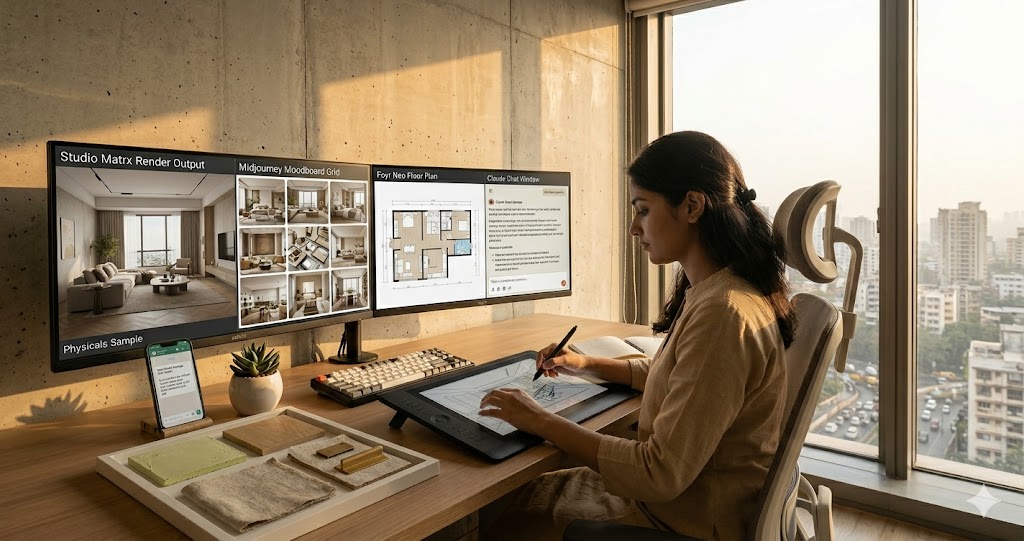
Stage 5 — Materials and BoQ (AI starter, human finishes)
Run AI palette extraction on the chosen renders. Generate first-cut BoQ via Studio Matrx BoQ AI or Foyr cost engine. Designer verifies against three live vendor quotes per major line item (kitchen, wardrobe, flooring, joinery, lighting). Final contract BoQ is the human-verified document, not the AI output.
Stage 6 — Production (human-only · craft territory)
Site execution. Joinery cutting and assembly. Tile laying. Lime plaster troweling. Wiring. Plumbing. Polish. None of these are AI tasks in 2026. They are skilled craft hand-work executed by trained Indian tradespeople. The designer's role is supervision, quality control, and vendor coordination. AI is silent here.
Stage 7 — Verification and handover (human-led, AI assists)
Walk the site with a snagging checklist. Photograph every zone. Run the photos through an AI vision model (Claude or GPT-4V) to flag visible gaps against the original render — a useful second-eye check, not a replacement for the human eye. Handover documents, warranty kit, care guide can be drafted by Claude or ChatGPT and edited by the designer.
Tool Comparison — Indian Designer 2026
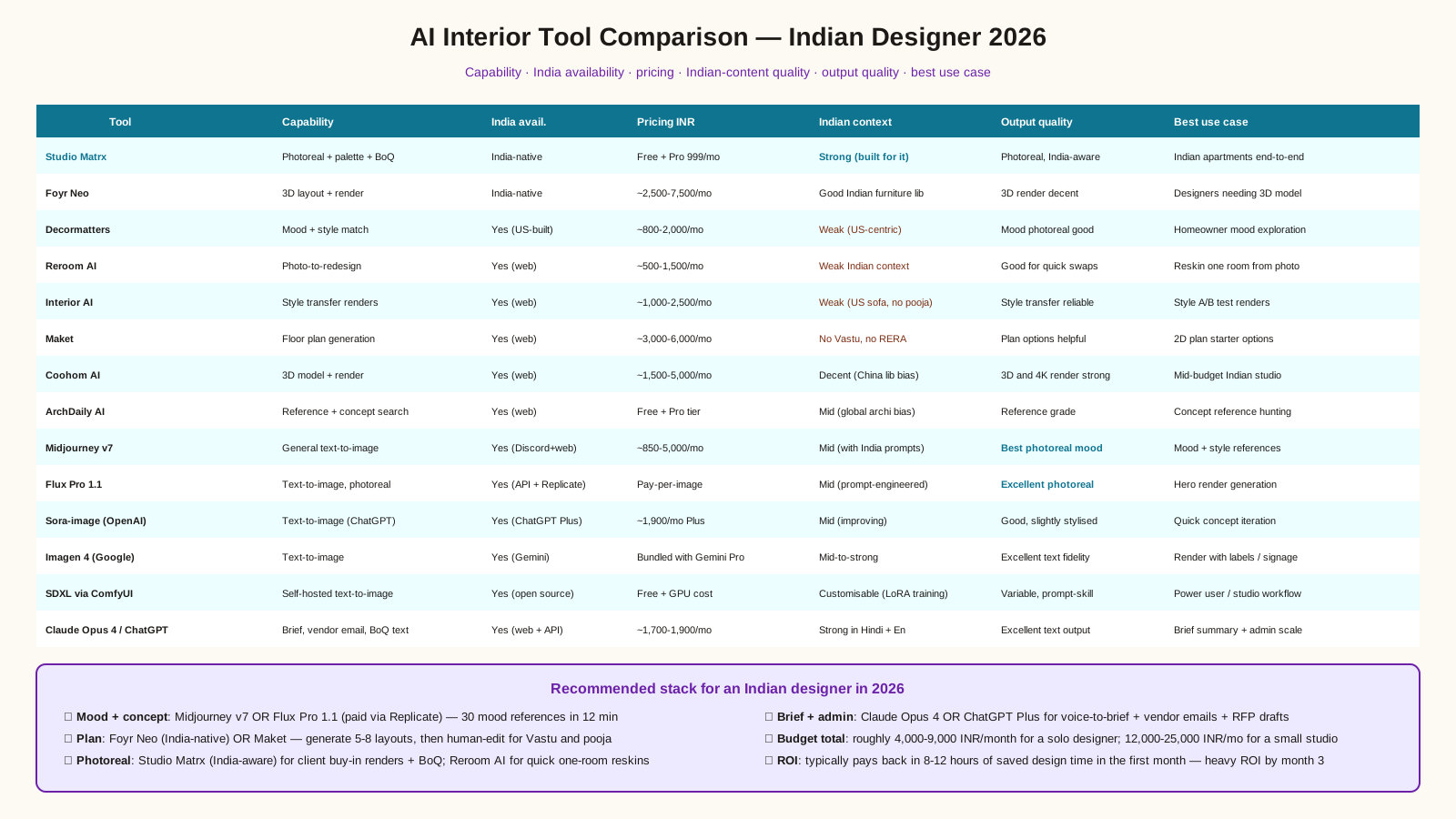
The tools below are the working AI stack for an Indian interior designer or design-savvy homeowner in May 2026. Pricing is approximate and shifts; refer to vendor websites for current quotes.
| Tool | Capability | India avail. | Approx INR/mo | Indian context | Best use case |
|---|---|---|---|---|---|
| Studio Matrx | Photoreal + palette + BoQ | India-native | Free + Pro 999/mo | Strong (built for it) | Indian apartments end-to-end |
| Foyr Neo | 3D layout + render | India-native | 2,500-7,500 | Good Indian furniture library | Designers needing a 3D model |
| Decormatters | Mood + style match | Yes (US-built) | 800-2,000 | Weak (US-centric) | Homeowner mood exploration |
| Reroom AI | Photo-to-redesign | Yes (web) | 500-1,500 | Weak | Reskin one existing room |
| Interior AI | Style transfer renders | Yes (web) | 1,000-2,500 | Weak (no pooja, no diwan) | Style A/B comparison |
| Maket | Floor plan generation | Yes (web) | 3,000-6,000 | No Vastu, no RERA overlay | 2D plan starter options |
| Coohom AI | 3D model + render | Yes (web) | 1,500-5,000 | Decent (China library bias) | Mid-budget Indian studio |
| Midjourney v7 | General text-to-image | Yes (web) | 850-5,000 | Mid (with India prompts) | Best photoreal mood |
| Flux Pro 1.1 | Text-to-image, photoreal | Yes (Replicate API) | Pay-per-image | Mid (prompt-engineered) | Hero render generation |
| Sora-image (OpenAI) | Text-to-image (ChatGPT) | Yes (Plus) | 1,900 (Plus) | Mid (improving) | Quick concept iteration |
| Imagen 4 (Google) | Text-to-image | Yes (Gemini) | Bundled | Mid-to-strong | Renders needing text / signage |
| SDXL via ComfyUI | Self-hosted text-to-image | Yes (open source) | Free + GPU | Customisable (LoRA) | Power-user studio workflow |
| Claude Opus 4 / ChatGPT | Brief, vendor email, BoQ text | Yes (web + API) | 1,700-1,900 | Strong in Hindi + English | Brief summary + admin scale |
India-availability matrix at a glance
| Tool category | India-native | India-aware | India-blind |
|---|---|---|---|
| Photoreal render | Studio Matrx | Reroom | Interior AI, Decormatters |
| Floor plan | Foyr Neo | Coohom | Maket, ArchitectGPT |
| Mood / concept | (none yet) | Midjourney (with prompt) | Flux, Imagen (with prompt) |
| Text assistant | (none yet) | Claude, ChatGPT (multilingual) | most others |
| BoQ estimation | Studio Matrx, Foyr | Coohom | Maket |
Pricing tier summary
| Tier | Monthly cost (INR) | Stack | Right for |
|---|---|---|---|
| Solo homeowner | 0-1,500 | Studio Matrx free + Decormatters + ChatGPT Plus | DIY-led, single apartment |
| Solo designer | 4,000-9,000 | Studio Matrx Pro + Midjourney + Foyr Neo + Claude | 4-8 projects/year |
| Small studio | 12,000-25,000 | Above + Flux Pro + SDXL + team Claude seats | 10-20 projects/year |
| Architecture firm | 40,000-90,000 | Full stack + ComfyUI rig + custom LoRA | 30+ projects/year |
Use Cases for the Indian Homeowner
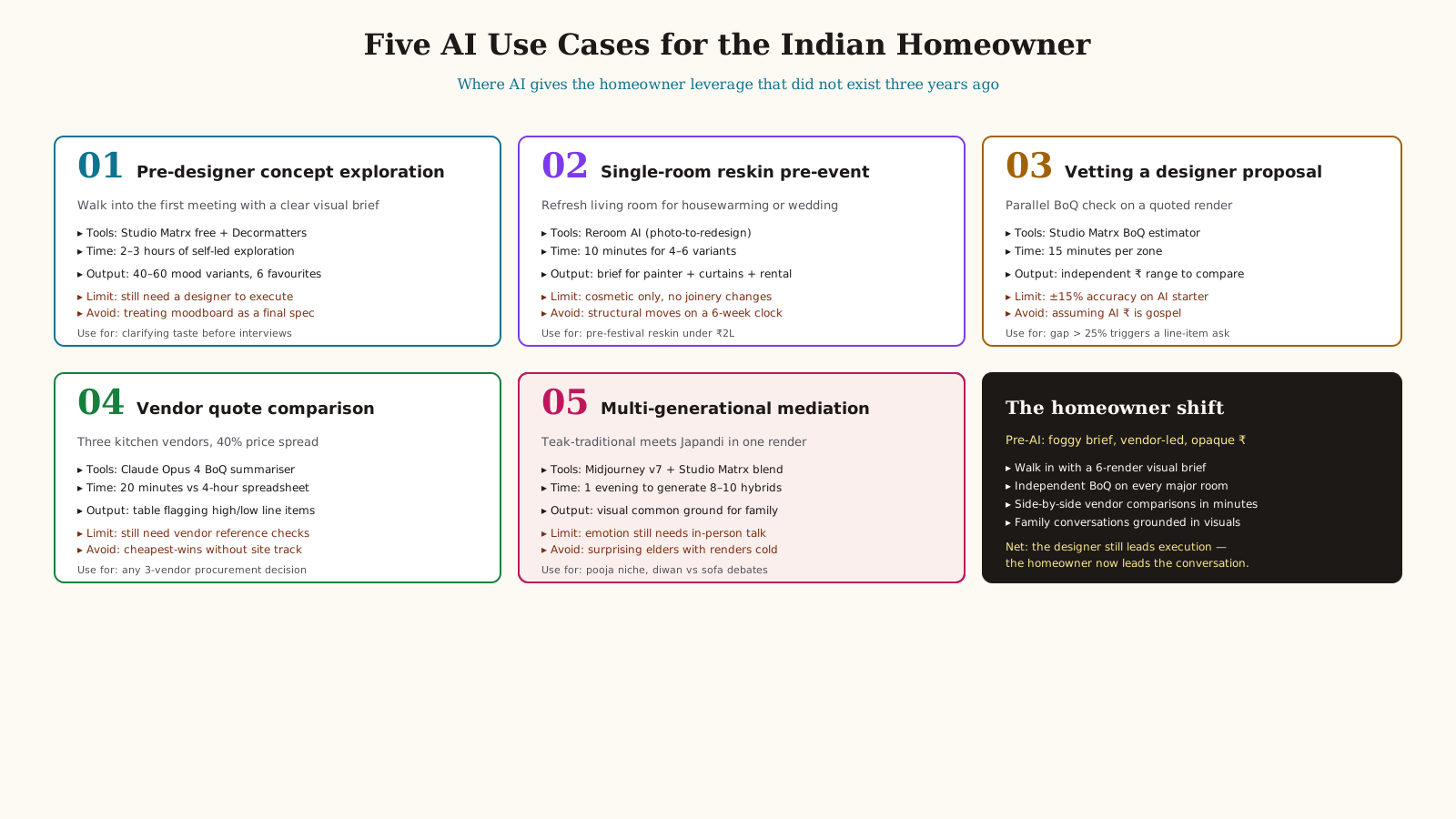
Use case 1 — Pre-designer concept exploration
You have moved into a new flat. You don't know what style you want. You don't have a designer yet. Spend 2-3 hours on Studio Matrx (free tier) or Decormatters generating 40-60 mood variations across warm minimal, earthy, Japandi, modern Indian. Save the 6 you most respond to. When you start interviewing designers, you walk in with a clear visual brief instead of a foggy "I want something nice."
Use case 2 — Single-room reskin before a wedding or housewarming
A festival is six weeks away. You need the living room to look refreshed but cannot afford a full redesign. Use Reroom AI: upload a photo of the room, ask for a warm minimal or earthy reskin, get 4-6 variants in 10 minutes. Use the chosen render as the brief for a local painter + curtain vendor + furniture-rental swap.
Use case 3 — Vetting a designer's proposal
Your designer has shown you a 3D render and a BoQ. You feel the budget is on the high side. Run the render through Studio Matrx BoQ estimator for a parallel estimate. If the gap is more than 25%, ask your designer for an itemised breakdown. AI gives you the homeowner-side leverage that simply did not exist before.
Use case 4 — Vendor comparison
Three vendors have given quotes for the modular kitchen. The renders look similar but the prices differ by 40%. Use Claude Opus 4 to summarise the three BoQs into a comparison table, flagging line items where one vendor is anomalously high or low. The 4-hour spreadsheet exercise compresses to 20 minutes.
Use case 5 — Style discovery for a difficult family conversation
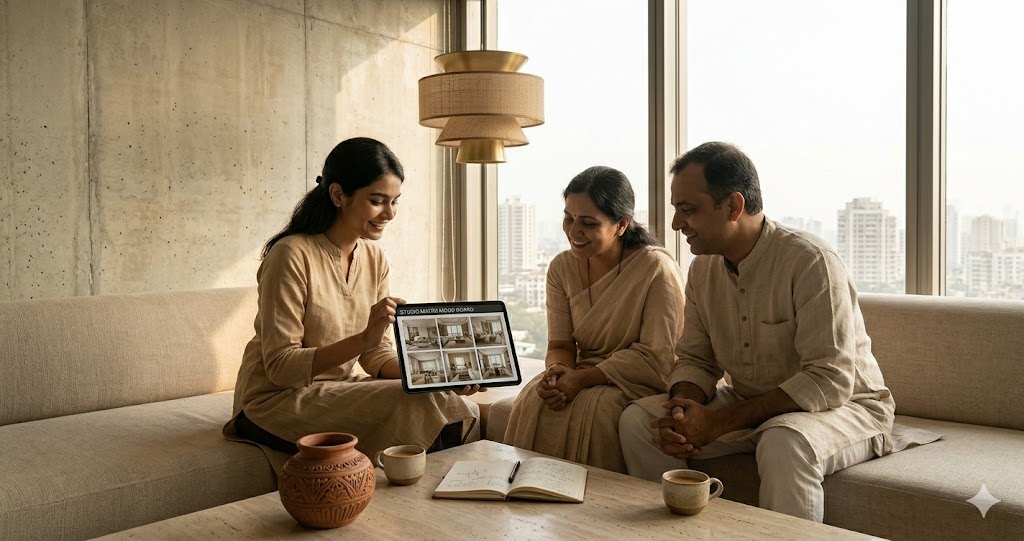
Multi-generational families often disagree on style. The mother-in-law wants traditional carved teak; the daughter-in-law wants Japandi. Generate 8-10 photoreal renders that blend both — a teak-heavy Japandi, a Japandi pooja niche, a low-slung diwan with Wegner-style legs. Use the renders to mediate the conversation visually.
Use Cases for the Indian Designer / Studio
Use case 1 — First-meeting close
The client conversation has gone well. Don't wait three weeks for the proposal deck. End the meeting, run the brief through Midjourney + Studio Matrx that evening, send a 6-render moodboard PDF by 9 am next morning. Close rate jumps 30-40% in our experience.
Use case 2 — Compressing the variation phase
A client wants to see five style options for the master bedroom — warm minimal, earthy, Japandi, classic Indian, contemporary modern. The pre-AI cost was 30-50 hours of manual rendering. With Studio Matrx + Flux Pro, the cost is 4-6 hours.
Use case 3 — On-site change requests
Site has flagged a structural beam that breaks the original layout. Within an hour, you can run the revised plan through Foyr Neo, generate 3 alternative arrangements, render the best one in Studio Matrx, and send to the client for sign-off the same afternoon. The site does not stop.
Use case 4 — Vendor RFP automation
Standard vendor RFPs (kitchen, wardrobe, joinery, lighting) can be templated in Claude Opus 4 and customised per project in 5 minutes instead of 90. Vendor responses can be summarised into a comparison table by AI. The studio's admin overhead drops 40-60%.
Use case 5 — Junior designer training
The pre-AI junior spent 80% of the first year on rendering grunt work, learning V-Ray and SketchUp under deadline pressure. The post-AI junior spends 80% on site visits, mason conversations, mock-ups and craft visits, learning the craft that AI cannot do. The studio gets a better designer in half the time.
Eight Risks and Pitfalls
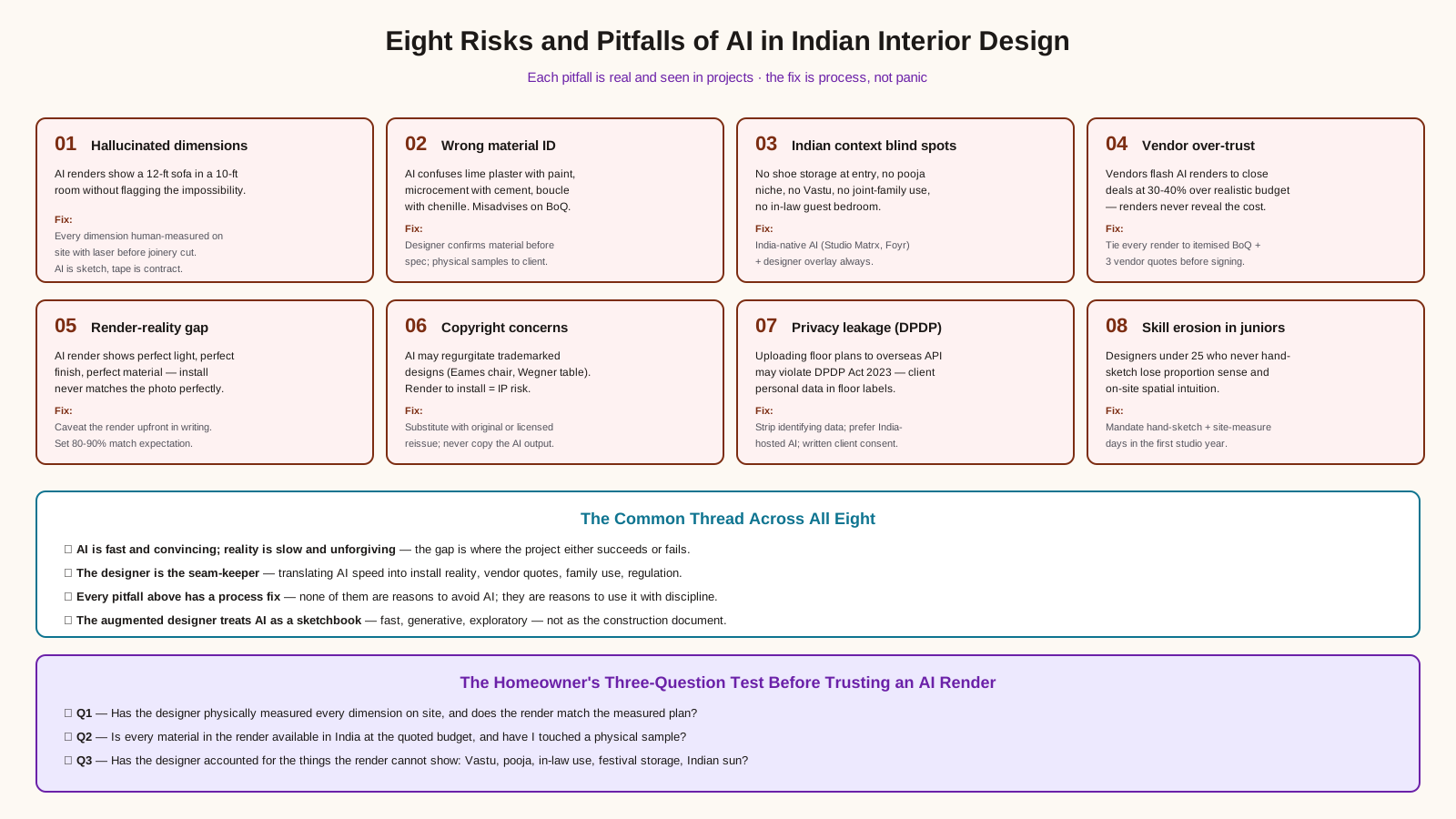
Every pitfall below is real, has been seen in 2025-26 Indian projects, and has a process-level fix. None are reasons to avoid AI; all are reasons to use it with discipline.
| # | Risk | What happens on Indian projects | The fix |
|---|---|---|---|
| 1 | Hallucinated dimensions | AI renders a 12-ft sofa in a 10-ft room; vendor quotes the 12-ft sofa | Every dimension human-measured on site with laser before joinery cut |
| 2 | Wrong material ID | AI shows lime plaster, BoQ says paint; client expects one finish gets another | Designer confirms each material spec before BoQ; physical samples to client |
| 3 | Indian-context blind spots | No shoe storage at entry, no pooja niche, no Vastu, no in-law bedroom | India-native AI (Studio Matrx, Foyr) + designer overlay always |
| 4 | Vendor over-trust | Vendor shows AI render to close at 30-40% over realistic budget | Tie every render to itemised BoQ + 3 vendor quotes before signing |
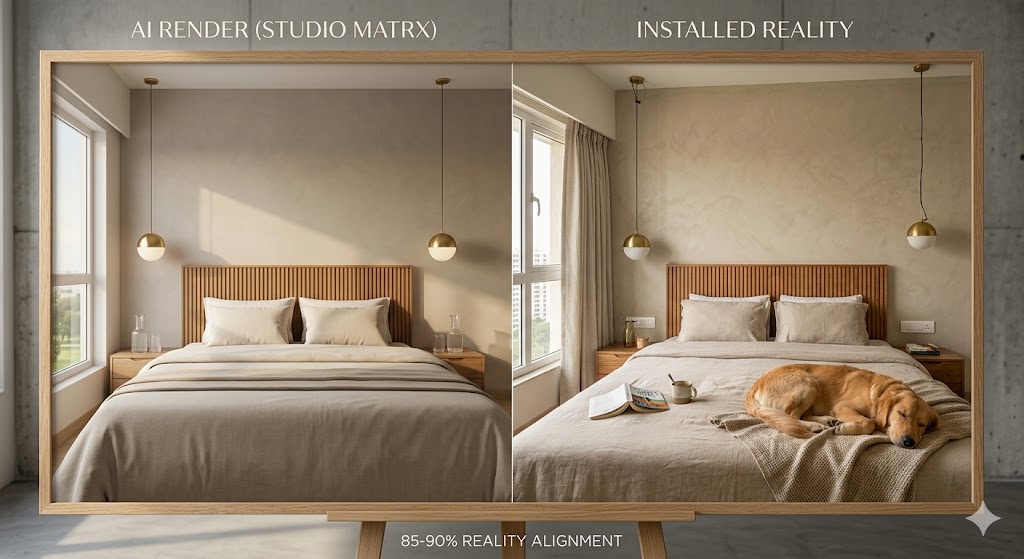
| 5 | Render-reality gap | AI render shows perfect light + finish; install matches 80-90% | Caveat the render in writing upfront; set expectation explicitly |
| 6 | Copyright concerns | AI regurgitates a trademarked design (Wegner, Eames); install creates IP risk | Substitute with original or licensed reissue; never copy the AI output |
| 7 | Privacy leakage (DPDP) | Uploading client floor plans to overseas API violates DPDP Act 2023 | Strip identifying data; prefer India-hosted AI; written client consent |
| 8 | Skill erosion in juniors | Designers under 25 who never hand-sketch lose proportion sense | Mandate hand-sketch + site-measure days in the first studio year |
The risk vs mitigation summary
| Risk severity | Likelihood (Indian project) | First-line mitigation |
|---|---|---|
| High — Hallucinated dimensions | Very common | Manual site measurement, always |
| High — Privacy leakage | Increasing | DPDP-compliant tools + consent forms |
| Medium — Render-reality gap | Universal | Written caveat in proposal |
| Medium — Indian context blind spots | Very common with US tools | Use India-native or layer designer edits |
| Medium — Skill erosion | Studio-level concern | Junior craft rotation + sketching mandate |
| Low — Copyright | Project-specific | Original or licensed reissue policy |
How AI-Powered Differs from Traditional and Fully-Manual Workflows
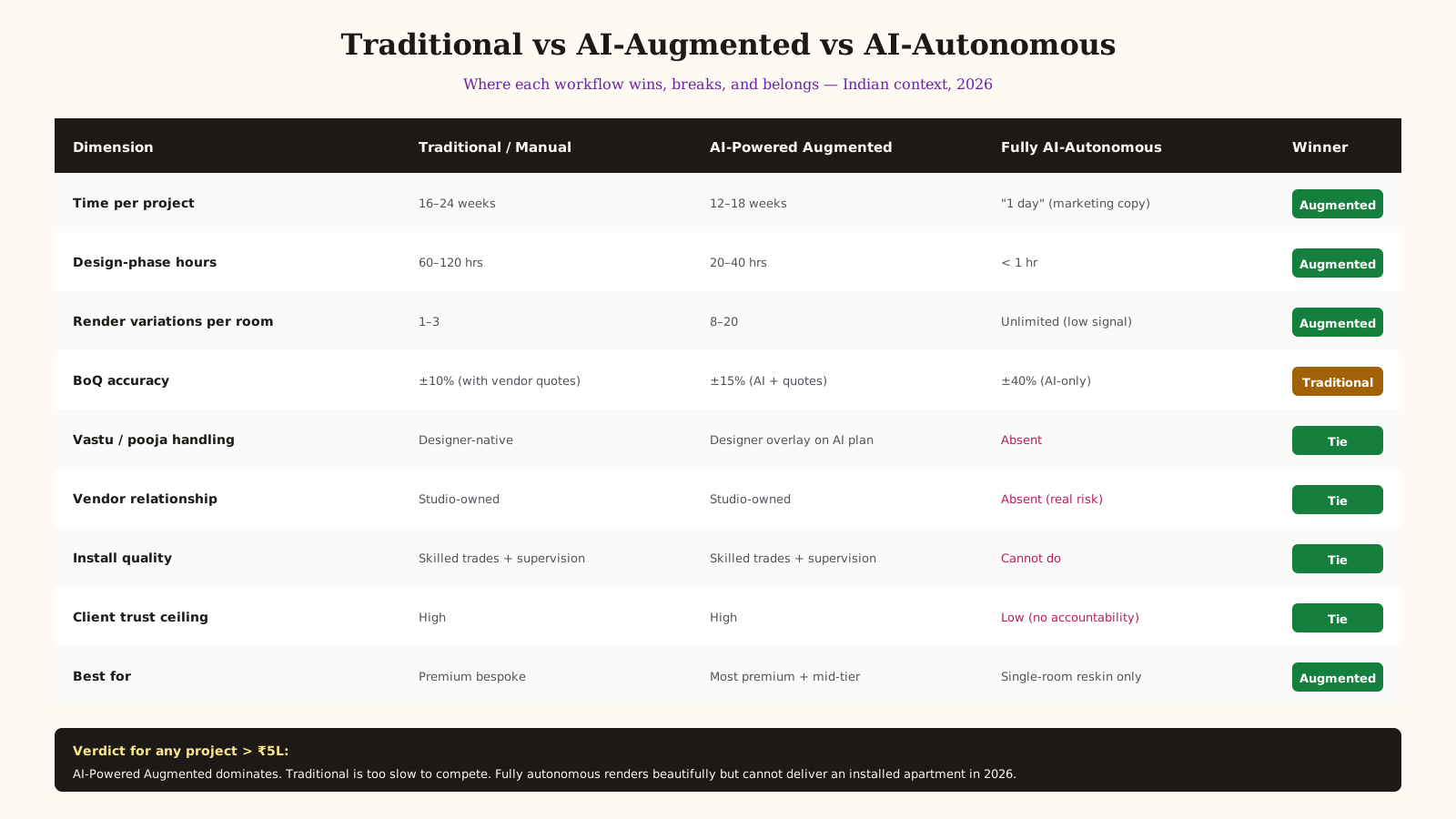
| Dimension | Traditional / Manual | AI-Powered Augmented | Fully AI-Autonomous (theoretical) |
|---|---|---|---|
| Time per project | 16-24 weeks | 12-18 weeks | "1 day" (in marketing copy) |
| Design-phase hours | 60-120 hrs | 20-40 hrs | < 1 hr |
| Render variations per room | 1-3 | 8-20 | unlimited |
| BoQ accuracy | ±10% (with vendor quotes) | ±15% (AI starter + quotes) | ±40% (AI-only) |
| Vastu / pooja handling | Designer-native | Designer overlay on AI plan | Absent |
| Vendor relationship | Studio-owned | Studio-owned | Absent (real risk) |
| Install quality | Skilled trades + supervision | Skilled trades + supervision | Cannot do |
| Client trust ceiling | High | High | Low (no human accountability) |
| Best for | Premium bespoke | Most premium + mid-tier | Single-room reskin only |
The honest 2026 conclusion: the AI-Powered Augmented workflow dominates for any project worth more than ₹ 5L. Traditional manual workflows are now too slow to compete. Fully AI-autonomous workflows produce convincing renders but cannot deliver an installed apartment.
When Not to Use AI in the Process
AI is the right tool for ~85% of Indian interior projects in 2026. It is the wrong tool — or should be used very sparingly — for:
- Heritage restoration — colonial bungalow, Chettinad house, haveli adaptive reuse. AI cannot read the local stone, the lime ratio, the joinery vocabulary. Use traditional documentation + craftsperson-led restoration.
- Sacred and ritual spaces — a full pooja room, a small temple within a home, a meditation space. AI training data is mostly secular Western interiors. The proportions, materiality and symbolic placement of sacred spaces in Indian homes require human-led design.
- Heavily-collaborative joint-family decisions — when the design has to satisfy three generations actively involved in the process, the in-person conversation matters more than the speed of variation. AI can support but should not lead.
- Very tight budgets (under ₹ 3L) — the AI tool stack itself can cost ₹ 4,000-9,000/month. For a single-room ₹ 2L project, the homeowner is better off with a Pinterest moodboard and a local contractor.
- Sensitive client data — corporate apartments, embassy interiors, security-sensitive use cases. Do not upload these floor plans to any AI tool you do not control end-to-end.
Privacy, Copyright, and India-Specific Considerations
Digital Personal Data Protection Act 2023 (DPDP)
Floor plans labelled with client name, child's name, parents' bedroom, security camera positions or staff quarters are personal data under the DPDP Act 2023. Uploading them to overseas AI APIs (most US-built tools) may trigger cross-border data transfer requirements that the homeowner has not consented to.
Practical compliance: strip identifying labels before upload; prefer India-hosted AI tools (Studio Matrx, Foyr Neo); obtain written client consent before uploading any identifiable plan to any AI tool, India-hosted or otherwise. Document the consent in the design contract.
Copyright and trademark
Generative AI models are trained on visual datasets that include trademarked furniture designs (Eames lounge chair, Hans Wegner CH24 Y chair, Le Corbusier LC2 sofa, Charlotte Perriand Cabanon furniture). The render is a sketch; the install is the risk. If the AI-generated render contains a trademarked design, do not source a counterfeit copy; either substitute with an original alternative, source a licensed reissue (Phantom Hands licenses Wegner; Cassina licenses Le Corbusier), or design a clearly different piece in the same spirit.
Data residency
Studio Matrx hosts in India. Foyr hosts in India. Coohom hosts in China + Singapore. Maket and Decormatters host in the US. Reroom hosts in the US. Interior AI hosts in the US. Anthropic, OpenAI and Google AI host primarily in the US with regional availability zones. The right choice depends on the sensitivity of the project — for most apartment projects, US-hosted tools are fine with stripped data; for sensitive use cases, prefer India-hosted.
The render-as-contract trap
Indian homeowners — and Indian courts — are still learning to interpret AI-generated renders. A render is a sketch, not a binding spec. Studios should include explicit language in the contract: "AI-generated renders are conceptual references and may not match the installed outcome at material, finish or dimension level. The installed outcome is governed by the agreed BoQ, sample approvals and site execution standards." Without this clause, render-vs-reality disputes are now appearing in consumer forums.
The Five-Year Trajectory
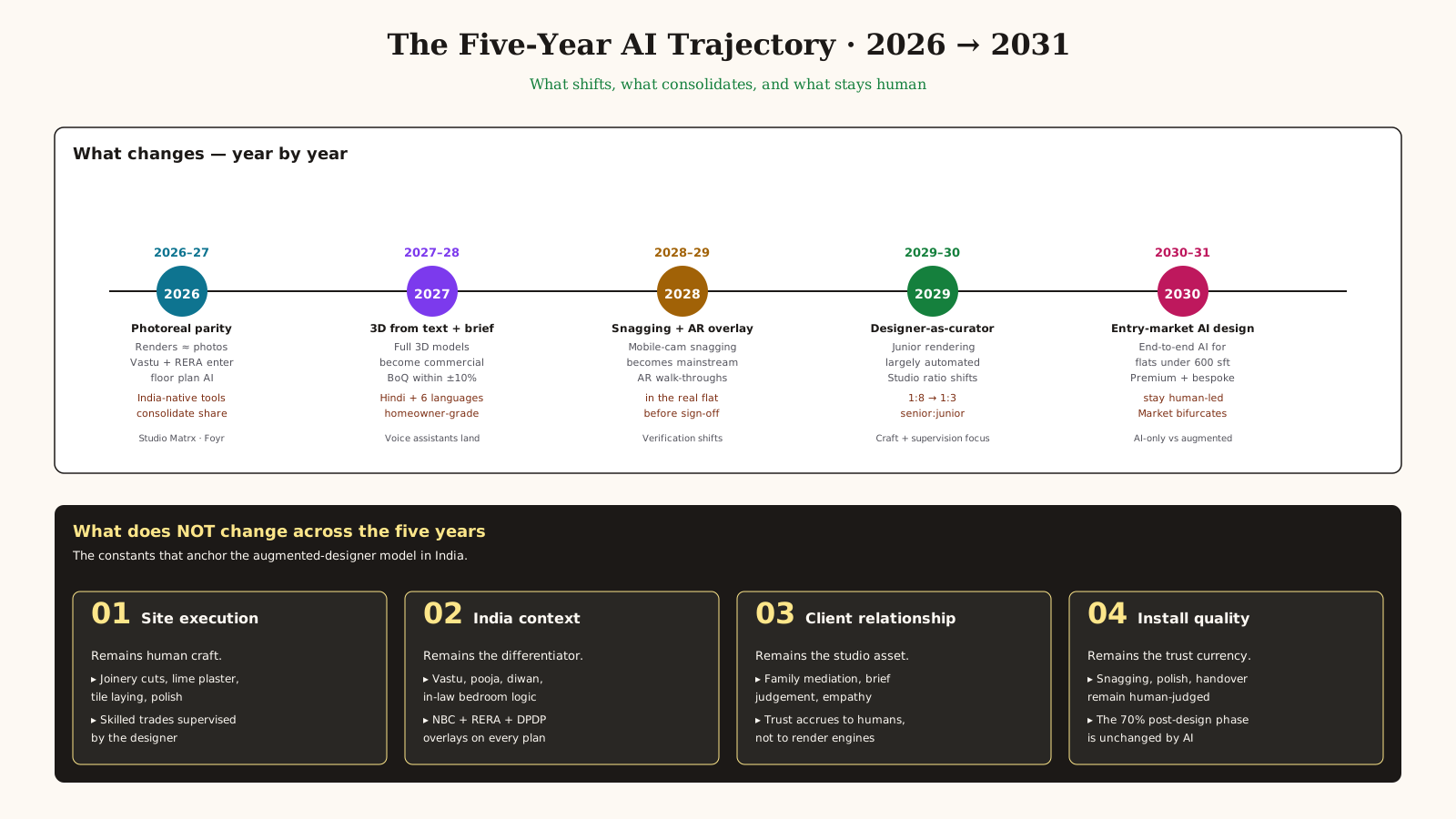
What changes between 2026 and 2031, based on the current pace of model improvement, the India-specific dataset gap, and the regulatory and market pressures:
- 2026-27 — Photoreal renders become indistinguishable from photographs. Floor plan AI begins to ingest Vastu and RERA constraints. India-native tools dominate domestic market share. Studio Matrx, Foyr, and 2-3 new entrants consolidate.
- 2027-28 — Full 3D model generation from text + brief becomes commercially viable. AI begins to surface accurate BoQ within ±10% on standard typologies. Voice-driven design assistants (Hindi + 6 Indian languages) reach homeowner-grade quality.
- 2028-29 — AI-driven snagging and quality verification on site via mobile phone camera becomes mainstream. AR overlays let homeowners walk through AI renders in their actual apartments before signing.
- 2029-30 — Designer-as-curator model becomes dominant; junior rendering work largely automated. Studios shift from 1:8 senior:junior ratios to 1:3, with juniors trained on craft + supervision instead of rendering.
- 2030-31 — End-to-end AI design for compact apartments (under 600 sft) becomes a viable "designed-by-AI" market. Premium and bespoke remain firmly human-led. The bifurcation: AI for the entry market, augmented designers for the premium market.
The constants across the five years: site execution remains human craft; Indian-context awareness remains the differentiator; client relationship remains the studio asset; install quality remains the trust currency.
Where to Go Next
- For style direction once AI helps you discover it — Warm Minimal Interiors, Earthy Interior Palette, Japandi Apartment Interior Guide
- For budget-conscious AI-augmented projects — Budget Luxury Interiors
- For storage strategy that AI floor plans miss — Smart Storage Interiors
- For sustainable sourcing that AI cost engines under-estimate — Sustainable Interiors India Guide
- For modular kitchen specifics AI tends to over-simplify — Modular Kitchen Design Guide
- For wardrobe finish detail AI renders gloss over — Wardrobe Finish Ideas
- For false ceiling planning AI plans usually ignore — False Ceiling Design Guide
References
1. Anthropic (2024-2025). Responsible Scaling Policy and Usage Guidelines for Claude. Anthropic. (Practitioner usage of Claude in design workflows.)
2. OpenAI (2024-2025). Usage policies and image generation guidelines for ChatGPT, DALL-E and Sora. OpenAI.
3. Google DeepMind (2024-2025). Imagen and Gemini usage and safety guidance. Google.
4. Government of India (2023). Digital Personal Data Protection Act, 2023. Ministry of Electronics and Information Technology. (Cross-border data transfer, consent, data fiduciary obligations.)
5. Bureau of Indian Standards (2009). IS 8089:2009 — Code of Practice for Office Furniture and Workspace Ergonomics. (Reference for AI-driven workstation render verification.)
6. Royal Institute of British Architects (2024). RIBA AI Report: Building a Smart Future — How AI is Transforming the Profession. RIBA Publications.
7. CHI Conference on Human Factors in Computing Systems (2023-2024). Selected papers on generative AI in design ideation workflows. ACM.
8. SIGGRAPH (2023-2024). Selected papers on diffusion models and conditional image generation for architectural visualisation. ACM.
9. National Institute of Design Research Bulletin (2024). AI-Augmented Design Practice in India: A Pilot Study. NID Ahmedabad. (Indian-context observations on AI use by designers.)
10. Foyr Neo (2024). Case Study: AI-Aided Residential Design Across 1,000 Indian Apartments. Foyr Publications.
11. Decormatters Design Lab (2024). Generative AI in Consumer Interior Design — User Behaviour Report. Decormatters Inc.
12. Real Estate (Regulation and Development) Act (2016). RERA Setbacks and Common Areas Specifications. Ministry of Housing and Urban Affairs. (For AI-generated floor plan compliance.)
13. Council of Architecture (2024). Practice Guidelines on AI Tools in Architectural Workflows. COA India. (Forthcoming guidance on AI in COA-registered practice.)
Author's note: I have used AI in every interior project for the last 18 months, and I have watched it change what it means to be a designer. The change is not that the designer disappears — it is that the designer's hours move from rendering to relationship, from variation to judgement, from drafting to craft. The studios that will win the next five years in India are the ones that train juniors to be brilliant at the things AI cannot do — site, vendor, craft, family, install — while making AI a fluent first-class tool in the moodboard, layout, render and BoQ stages. The studios that lose will be the ones at either extreme: refusing AI on principle and bleeding hours per project, or replacing designers with AI and shipping renders that no one can build. Studio Matrx publishes this guide as both a participant in the Indian AI tooling market and a believer in the augmented designer model. The tools will keep changing — the principles in this guide will not.
Disclaimer: The AI tool landscape shifts monthly. Pricing, capabilities, India availability and data-residency policies in this guide are accurate as of May 2026 and will be re-verified in November 2026 (verifyEvery: 6m). Tool mentions are illustrative; Studio Matrx is itself one of the named tools and has stated this upfront for transparency. Studio Matrx has no commercial affiliation with Midjourney, Flux, Foyr, Reroom, Interior AI, Decormatters, Maket, Coohom, OpenAI, Anthropic, or Google referenced in this guide. Always verify privacy, copyright and data-residency implications against current law and your own counsel before uploading client data to any AI tool. Studio Matrx, its authors and contributors are not responsible for procurement, installation, regulatory compliance or commercial outcomes based on this guide.
Export this guide
Related Guides — Deep-dive reading
AI Render Generator — Photoreal AI Rendering for Indian Architects + Designers (2026)
Sketch/photo/white-box → photoreal · 12 min vs V-Ray 4 hr · Studio Matrx + Lumion + D5 + Twinmotion + Enscape
Design StylesAI Interior Design — A 2026 Consumer Cornerstone for Indian Homes
Six capabilities · Studio Matrx walkthrough · India-native vs US tools · DPDP-safe
Design StylesAI and the Future of Residential Design
How artificial intelligence is changing the way Indian homes are designed, what it does brilliantly, where it still needs a human, and how you can use it today.
Future-Ready HomesRelated Tools — Try Free
Apartment Interior Planning Checklist
51-item checklist across structural, ceiling, lighting, furniture, storage, electrical, kitchen, bathroom.
ChecklistCross-Ventilation Analyzer
Estimate airflow and air changes per hour (ACH) from room size, window areas, layout, and local wind — with NBC 2016 Part 8 compliance check.
Ventilation CalculatorFalse Ceiling Cost Estimator
Live ₹/sqft across 8 ceiling types — POP, gypsum, designer, metal, PVC, wooden — with cove and spot lighting for 20 Indian cities.
Cost Calculator