
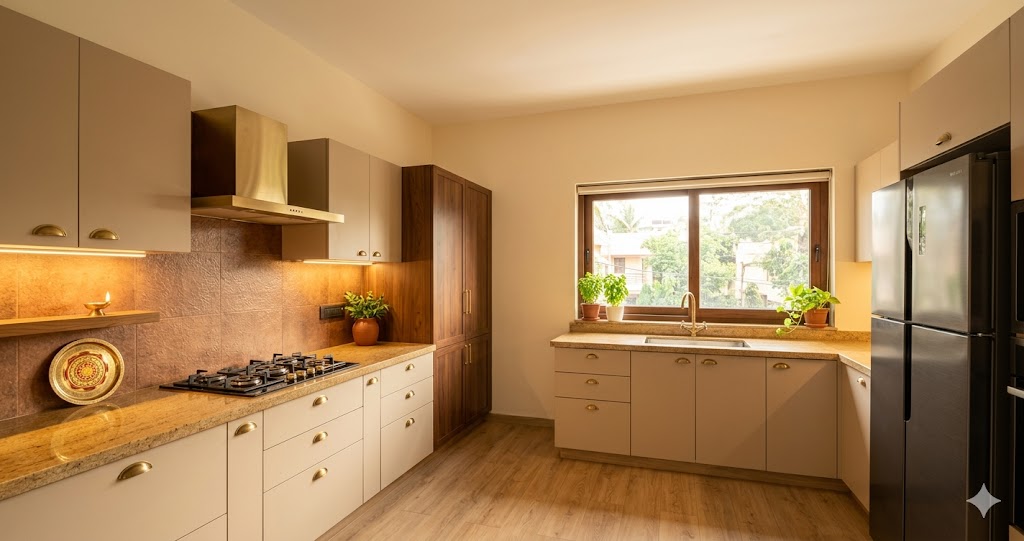
Vastu for Kitchen — A 2026 Working Reference for Indian Homes
Agni placement · Eight directions · Apartment adaptation
Vastu for the kitchen is the single most-asked vastu question in India in 2026 — and the one with the most apartment-specific compromise needed. The kitchen is where fire (Agni) is invoked daily, where the family's food is prepared, and where — according to every classical Indian vastu text from the Brihat Samhita to the Mayamatam — the home's prana is produced. Get the kitchen wrong and the rest of the house struggles to compensate. Get it right and the apartment settles around it.
This is a 22-minute working reference for homeowners building, renovating, or vastu-correcting a kitchen in an Indian apartment. It covers what kitchen vastu actually is, the eight directions and what each must hold, cooktop and sink placement rules, refrigerator and storage placement, the eight must-fix violations, apartment-specific adaptations when the builder has fixed your layout, colours and materials per direction, three remedy tiers from DIY to full rebuild, how vastu differs from modern ergonomic kitchen design, and when strict vastu adherence does not make practical sense.
The kitchen is the fire zone — Agni. Placement of cooking, sink, and storage in correct directions is more important than every other vastu rule in the home, because the kitchen produces the day's prana, the day's nourishment, and the day's energy. Bedroom vastu can be tuned later. Entrance vastu can be eased with thresholds and lighting. Kitchen vastu touches the body three times a day, every day, for the life of the home.
For complementary depth see Vastu for Modern Homes, Vastu House Plan India, Pooja Room Design India, Modular Kitchen Design Guide, Warm Minimal Interiors, and Earthy Interior Palette. For working tools to test your own kitchen, see the Vastu Compliance Checker and the Vastu Compass.
This guide refreshes every 24 months — vastu interpretation evolves slowly but Indian apartment typologies evolve fast. Last verified: May 2026 · Next verify: May 2028.
What Kitchen Vastu Is
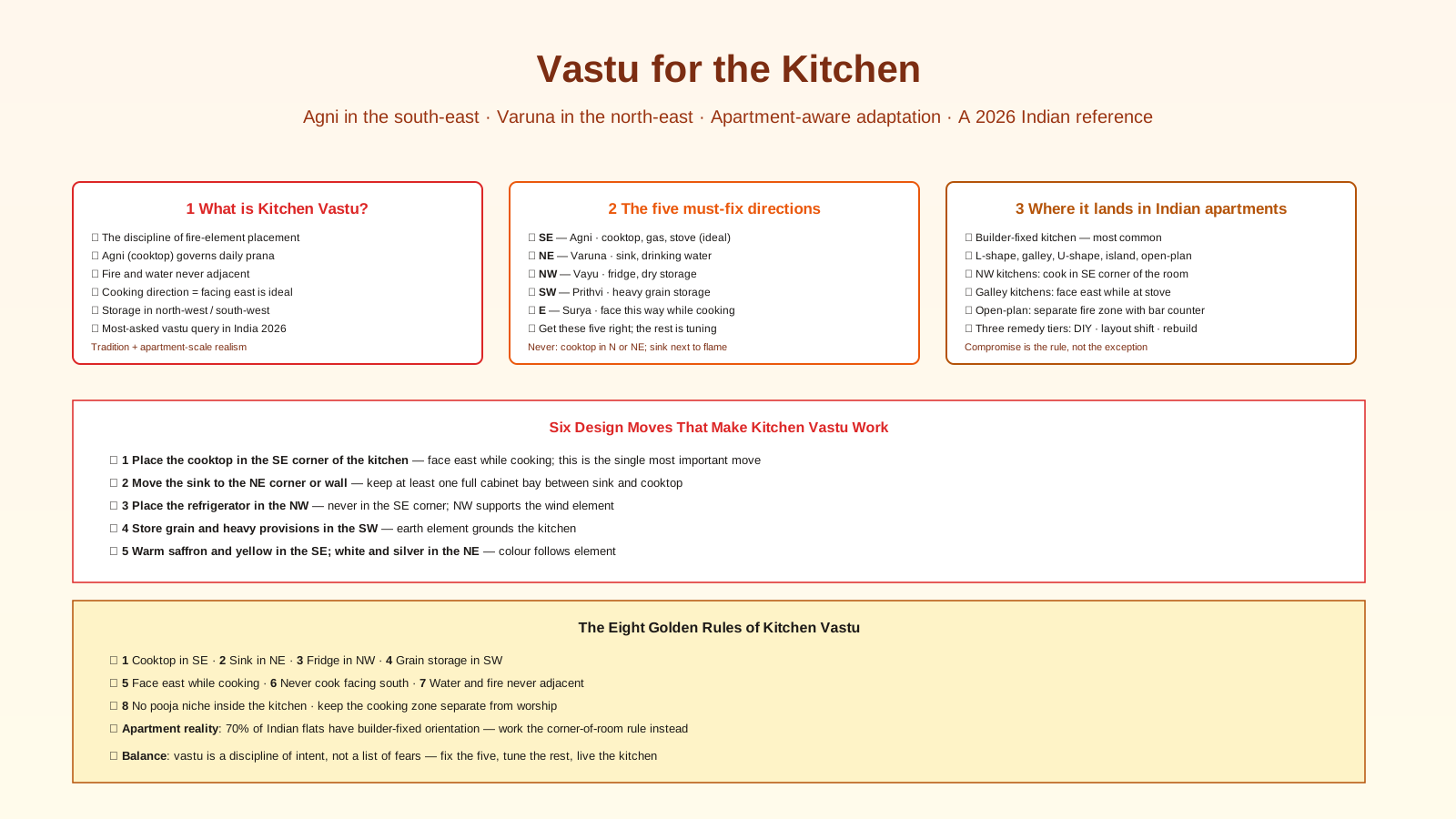
Kitchen vastu is the discipline — drawn from the Vishwakarma Vastu Shastra, the Brihat Samhita of Varahamihira (sixth century CE), the Mayamatam, and the Manasara Shilpa Shastra — of placing the cooking fire, the washing water, the food storage, and the cook's body in alignment with the five elements and the eight directions. It is not superstition. It is a building-design language that predates modern HVAC by two thousand years and still encodes useful instincts about light, airflow, hygiene, and ergonomics.
The core proposition is simple. Fire belongs in the south-east. Water belongs in the north-east. Wind and refrigeration belong in the north-west. Earth and heavy storage belong in the south-west. Fire and water never share a wall. The cook faces east while preparing food. Everything else — the colours, the materials, the layout — flows from this elemental map.
In an Indian apartment in 2026, that map collides with builder-fixed walls, gas-pipeline runs, plumbing risers, and modular-kitchen showroom geometry that pays no attention to direction. The result is that almost every Indian apartment kitchen needs at least one vastu adaptation. This guide is about which adaptations matter most, and which can be set aside.
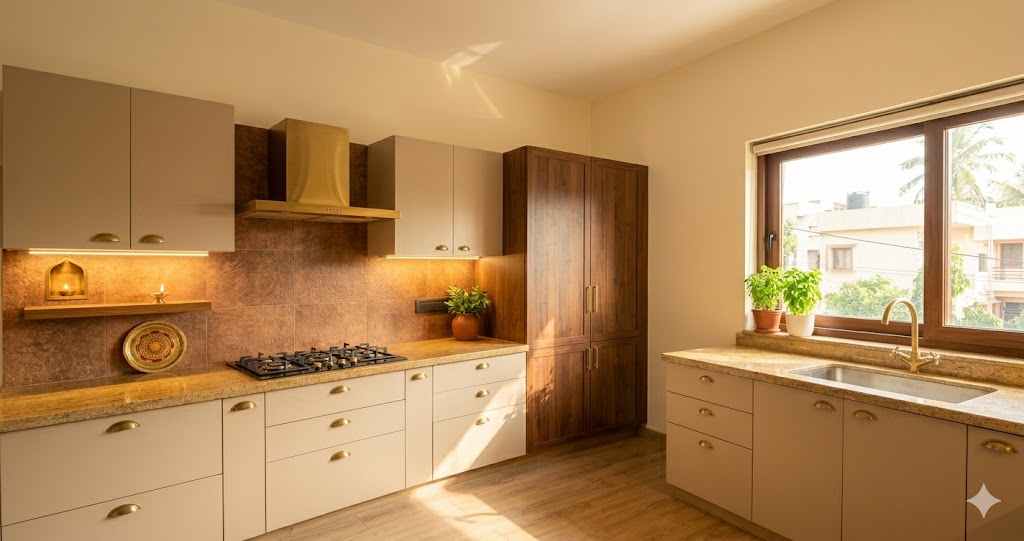
Five things kitchen vastu is NOT
1. Not a fixed religious rule book — kitchen vastu is a building-design discipline rooted in fire safety, food hygiene, ventilation, and ergonomics; the spiritual layer is one interpretation among several.
2. Not all-or-nothing — partial compliance is normal in apartments; fixing the five critical directions resolves 80% of the vastu load. Perfect compliance is rare and unnecessary.
3. Not anti-modern — a vastu-compliant kitchen can be modular, fitted with Hettich and Häfele hardware, served by a chimney and dishwasher, and lit by 2700K LED. Tradition and ergonomics coexist comfortably.
4. Not about remedies alone — yantras, mirrors, and crystal corrections cannot substitute for fixing a fundamentally wrong fire-water adjacency. Remedies are for compromises, not for laziness.
5. Not the same as Feng Shui — Feng Shui is the Chinese tradition; vastu is the older Indian tradition. They share some ideas but the directional assignments and elemental logic differ. Do not mix them.
The Eight Directions — Element by Element
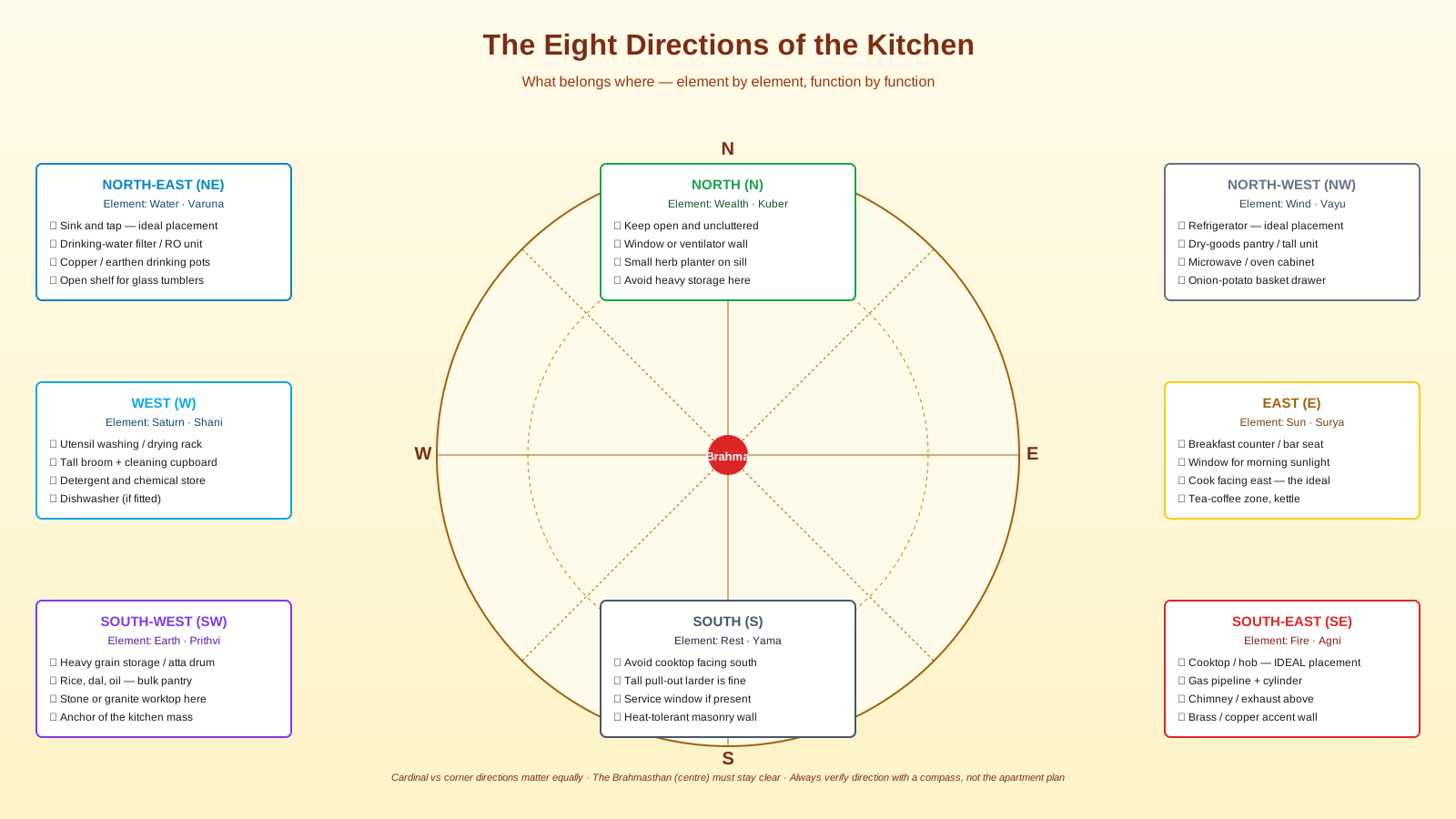
Every direction in a kitchen carries an element, a presiding deity, and a function. The discipline is to match the function to the direction. The table below is the working reference.
| Direction | Element | Deity | Ideal kitchen function | Avoid here |
|---|---|---|---|---|
| South-East (SE) | Fire (Agni) | Agni | Cooktop, hob, gas pipeline, chimney, brass accents | Refrigerator, water filter, drinking pots |
| North-East (NE) | Water (Varuna) | Varuna | Sink, drinking water filter, copper pots, glass tumblers | Cooktop, gas, heavy storage, microwave |
| North-West (NW) | Wind (Vayu) | Vayu | Refrigerator, dry pantry, microwave, oven, onion-potato basket | Cooktop, sink, pooja, heavy grain |
| South-West (SW) | Earth (Prithvi) | Nirriti | Heavy grain storage, atta drum, rice and dal jars, tall larder | Cooktop, sink, refrigerator, glass |
| East (E) | Sun (Surya) | Indra | Breakfast counter, cook-facing direction, herb planter, morning window | Closed solid walls, heavy storage |
| West (W) | Saturn (Shani) | Varuna-secondary | Utensil washing rack, dishwasher, broom store, cleaning supplies | Cooktop, drinking water, pooja |
| South (S) | Rest (Yama) | Yama | Tall pull-out larder, service window, masonry feature wall | Cooktop facing south, cook facing south |
| North (N) | Wealth (Kuber) | Kuber | Open ventilator wall, herb planter, small open shelf | Heavy closed cabinets, cooktop, drainage |
| Centre (Brahmasthan) | Sky (Akasha) | Brahma | Keep absolutely clear — no island, no pillar, no fitted appliance | Anything obstructive |
The cardinal directions (N, S, E, W) and the corner directions (NE, SE, SW, NW) carry equal weight in kitchen vastu. The four corners — especially the SE-fire and NE-water pair — are the most heavily loaded. Get those two corners right and the rest is fine-tuning.
A critical practical note: always verify direction with an actual magnetic compass or the Vastu Compass tool, not with the architect's site plan. Architectural drawings often show "plan north" or "project north" that can differ from magnetic north by 5-35 degrees, and apartment-tower orientation can be deceptive at the floor-plate level. A wrongly-identified north invalidates every vastu decision downstream.
Cooktop Placement Rules
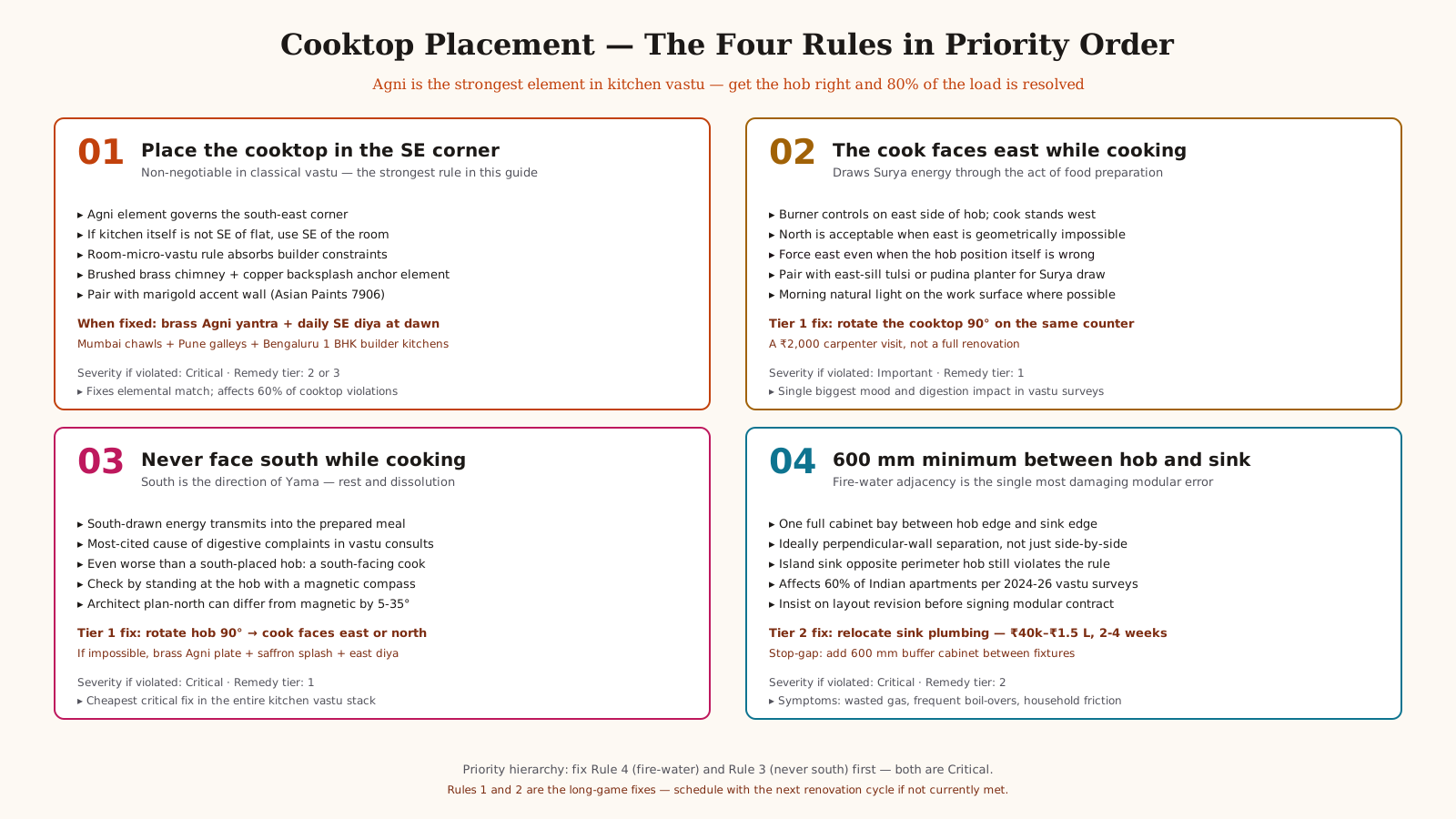
The cooktop is the single most important object in kitchen vastu. It carries the Agni element. Its placement determines the cook's facing direction, the safety of the gas line, and the elemental balance of the entire kitchen.
The four cooktop rules in order of priority
1. Place the cooktop in the south-east corner of the kitchen. This is non-negotiable in classical vastu and the strongest rule in this guide. If the builder layout permits, the cooktop goes in the SE corner. If the kitchen itself is not in the SE of the flat, place the cooktop in the SE corner of the kitchen room.
2. The cook faces east while cooking. A cook standing at an east-facing cooktop draws Surya (sun) energy through the cooking act. This means the hob's burner controls are on the east side; the cook stands on the west side of the hob, facing east into the wall.
3. Never face south while cooking. South is the direction of Yama (rest, dissolution). A cook drawing south energy through food preparation transmits that energy into the meal and into the household. This is the most-cited cause of digestive complaints in vastu consultations.
4. The cooktop and sink must have at least one full cabinet bay (600 mm minimum) between them. Fire and water adjacency is the most damaging single vastu violation a modular kitchen can carry. If the modular-kitchen designer has placed the sink next to the hob — which happens in 60% of Indian apartments — insist on a layout revision before signing off.
What to do when the cooktop cannot move
In around a third of Indian apartments — especially older Mumbai chawls, narrow Pune galley flats, and small Bengaluru 1 BHK builder kitchens — the gas pipeline is fixed in masonry and the cooktop cannot be relocated without a full kitchen rebuild. In those cases:
- Install a brass Agni yantra plate behind the cooktop, kept polished
- Light a small brass diya every morning in the SE corner of the kitchen, even if the hob itself is in N or NE
- Use saffron, marigold, or warm-yellow tile or paint on the wall directly behind the hob
- Add a single copper pot or beaten-copper backsplash strip to anchor the fire element symbolically
- Cook facing east wherever physically possible, even if the hob orientation forces otherwise
These are corrective Tier-1 remedies — they soften a compromise but do not erase it. They are appropriate for rental flats, builder-fixed structures, and homes where renovation is years away. When the next renovation happens, fix the cooktop direction properly.
Sink and Water Placement
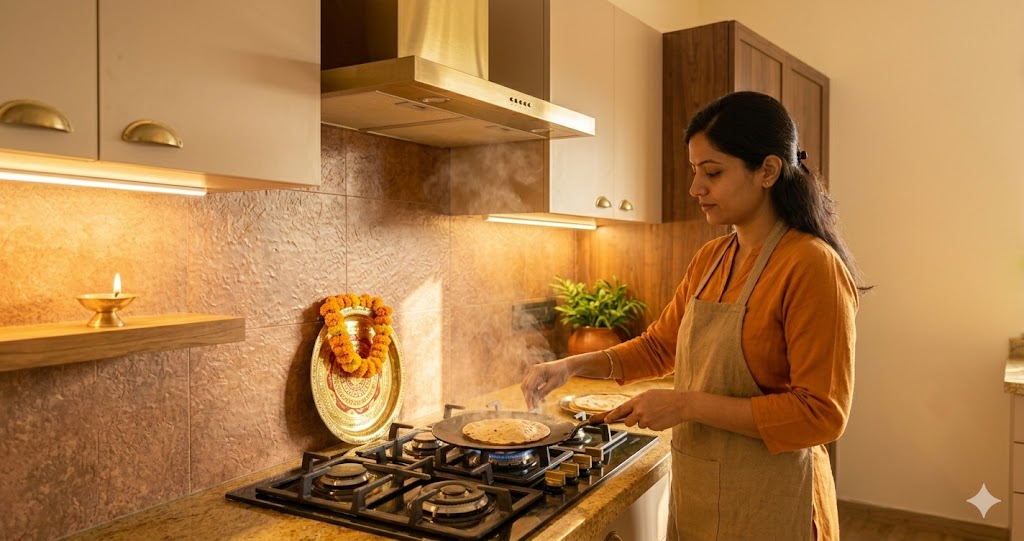
The sink is the second-most-important object in kitchen vastu. It carries the Varuna (water) element.
The four sink rules
1. Place the sink in the north-east corner of the kitchen. The NE is the water-element direction; the sink belongs there. This places the drinking-water filter, the basin, and the tap in their natural elemental zone.
2. If NE is impossible, the north or east wall is the next best choice. Both still belong to the water-friendly half of the compass. Avoid placing the sink on south, south-west, or south-east walls.
3. Never place the sink adjacent to the cooktop. Fire and water adjacency is the single most damaging modular-kitchen layout error. Minimum 600 mm between sink edge and hob edge; ideally one full cabinet bay or a perpendicular wall separation.
4. The drinking-water station belongs in the NE. RO filter, copper drinking-water pot, glass tumblers, and the steel jug used at meals all anchor here. This is the cleanest, most prana-positive water in the home.
A subtle point that modern kitchen designers often miss: the sink and the cooktop should not face each other across an island either. The fire-water adjacency rule applies to face-to-face geometry, not just side-by-side adjacency. An island sink directly opposite a perimeter hob still violates the rule and still causes the symptoms (wasted gas, frequent boil-overs, household friction, money flowing away — these are the traditional vastu phrases, but they map to real psychological friction in a kitchen layout that fights itself).
The drinking water sub-rule
Drinking water is sacred in Indian household tradition. Vastu treats the drinking-water station as a small temple within the kitchen. The water pot — earthen matka, copper kalash, or modern RO filter tap — should be placed in the NE corner, slightly elevated, never on the floor, never near the dustbin, never in shadow. A small fresh tulsi sprig or a single lit incense at the NE counter once a day is the traditional acknowledgement.
Refrigerator and Storage Placement
The refrigerator is a relatively modern object that has no direct mention in any pre-twentieth-century vastu text — the discipline has had to extrapolate. The contemporary vastu consensus, drawn from modern texts by Khushdeep Bansal, Anupama Mohanlal, and the Vastu Bharti school, is as follows.
Refrigerator placement
- Ideal: north-west (NW) corner. The NW is the Vayu (wind) direction; refrigeration is air-cooled storage. The elemental match is clean.
- Acceptable: west or south-west. The west wall and the SW corner are workable secondary choices. The SW placement supports the earth-anchor instinct (heavy appliance, grounding mass).
- Avoid absolutely: south-east corner. The fridge in the SE is the second-most-common Indian kitchen vastu violation after sink-next-to-hob. Cold storage in the fire zone produces direct elemental conflict and — anecdotally — frequent compressor failures.
- Avoid: directly facing the cooktop. Even if the fridge is in NW, do not let the fridge door open straight onto the hob. The cold-air spill into the cooking zone is both vastu and ergonomic poor practice.
- Keep the top of the fridge clear. No piled-up containers, no extra rice tins, no plastic dabbas. The fridge top is a vastu-sensitive surface; clutter here drains the kitchen's prana.
Heavy storage placement
The SW corner of the kitchen carries Prithvi — earth, mass, grounding. This is where the heaviest dry storage belongs: the atta drum, the rice bin, the dal jars, the bulk oil and ghee tins, and ideally a tall pull-out larder unit.
The Häfele Wari magic-corner unit or the Hettich Sensys-mounted tall larder are the contemporary modular solutions; both work cleanly in the SW corner. Solid teak or oak fronts in walnut tone (#78350f or close) are vastu-aligned for the SW direction.
Dry pantry and microwave placement
The NW is the secondary dry-storage zone — for biscuits, snacks, breakfast cereals, packaged spices, and the microwave or oven cabinet. The Vayu (wind) direction is comfortable with appliances that move air or vent heat. A tall NW unit with the microwave at eye level, oven below, and dry-goods pull-out drawers above the appliances is a clean modular layout that respects vastu while serving modern cooking workflows.
Eight Must-Fix Vastu Violations
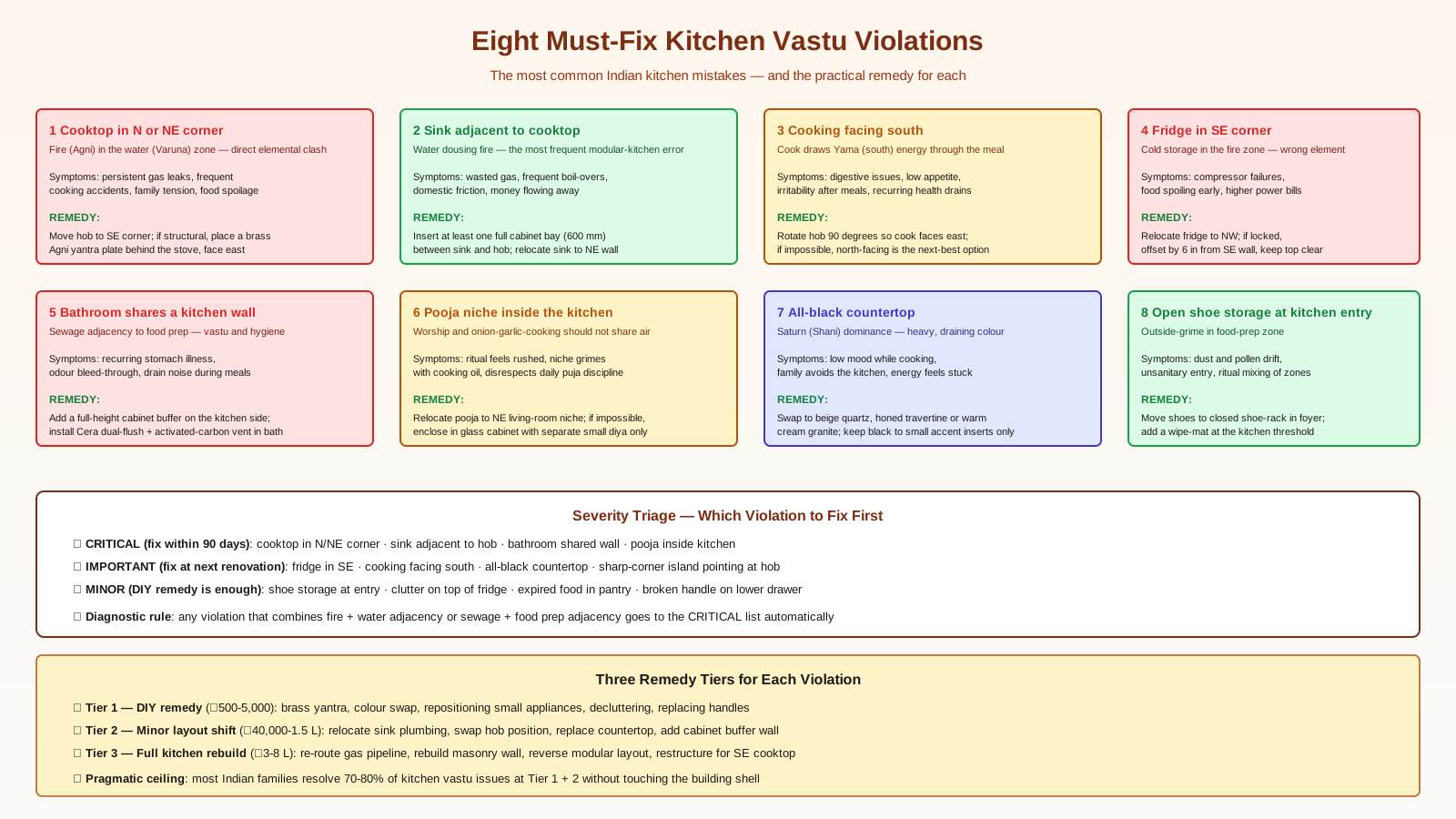
| Violation | Why it matters | Severity | Remedy tier |
|---|---|---|---|
| Cooktop in N or NE corner | Fire in water zone — direct elemental clash | Critical | Tier 2 (layout shift) or Tier 1 brass yantra |
| Sink adjacent to cooktop (under 600 mm) | Fire-water adjacency — the single most damaging error | Critical | Tier 2 plumbing relocation |
| Cooking facing south | Cook draws Yama energy through the meal | Critical | Tier 1 rotate hob 90 degrees |
| Refrigerator in SE corner | Cold storage in fire zone — elemental mismatch | Important | Tier 1 relocate to NW |
| Bathroom shares a wall with the kitchen | Sewage adjacency to food prep | Critical | Tier 2 cabinet buffer + Cera vent |
| Pooja niche inside the kitchen | Worship and cooking should not share air | Important | Tier 1 relocate to NE living-room niche |
| All-black countertop | Saturn dominance — heavy, draining colour | Important | Tier 2 swap to beige quartz |
| Open shoe storage near kitchen entry | Outside-grime in food prep zone | Minor | Tier 1 move to foyer rack |
The diagnostic triage
Walk through your kitchen with a magnetic compass. Note the position of the cooktop, sink, fridge, larder, and any pooja niche. Mark each on a simple plan. Compare against the eight directions table above. Anything that combines fire + water adjacency or sewage + food-prep adjacency goes to the Critical list automatically and should be fixed within ninety days. Anything that involves elemental mismatch (fridge in SE, cooktop facing south) is Important and goes to the next-renovation list. Everything else is Minor and can be resolved with DIY remedies, repositioning, and small colour corrections.
The pragmatic ceiling: most Indian families resolve 70-80% of their kitchen vastu issues at Tier 1 and Tier 2 — without touching the building shell. Full kitchen rebuilds (Tier 3) are reserved for situations where the gas line, plumbing, and load-bearing walls all need to move simultaneously.
Apartment-Specific Adaptations
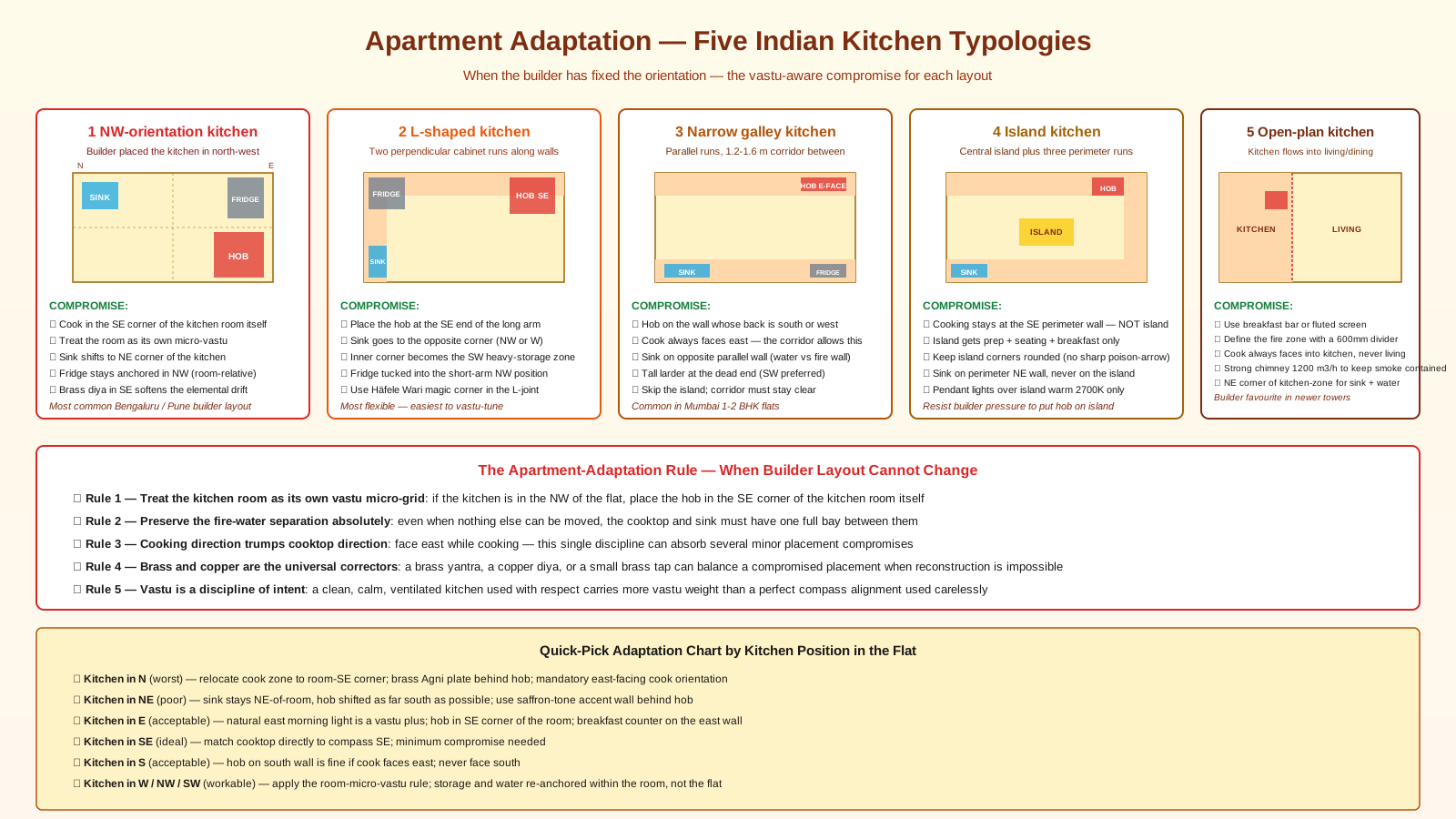
The single biggest mental shift required for kitchen vastu in 2026 India: the kitchen room itself becomes its own vastu micro-grid. If the builder placed the kitchen in the north-west of the flat, you do not throw up your hands and declare the kitchen un-vastu. You treat the kitchen room as a complete eight-direction system in itself, and you place the cooktop in the SE corner of the kitchen room. This single principle resolves the majority of apartment-kitchen vastu anxiety.
| Builder kitchen position in flat | Vastu rating | Primary compromise | Key remedy |
|---|---|---|---|
| South-East of flat | Ideal | None required | Match cooktop directly to SE wall |
| East of flat | Acceptable | Slight elemental drift | Cooktop in SE corner of kitchen room |
| South of flat | Acceptable | Risk of south-facing cook | Force east-facing cook orientation |
| North-West of flat | Workable | Wind zone hosting fire | Cooktop in SE corner of room; brass Agni plate |
| West of flat | Workable | Saturn-zone hosting fire | Apply room-micro-vastu strictly |
| South-West of flat | Poor | Earth zone hosting fire | Heavy structural correction or full Tier-1 remedy stack |
| North-East of flat | Poor | Water zone hosting fire | Major remedy stack; consider Tier 3 rebuild |
| North of flat | Worst | Wealth zone disrupted | Tier 3 rebuild strongly recommended |
Typology-specific adaptations
L-shaped kitchen. The most flexible layout for vastu tuning. Place the cooktop at the SE end of the long arm of the L. Sink goes to the opposite corner (NW or W of the kitchen room). The inner L-corner becomes the SW heavy-storage zone, ideal for a Häfele Wari magic-corner pull-out. The fridge tucks into the short-arm NW position. This is the layout to ask the builder for if you have a choice.
Galley (parallel-run) kitchen. Common in Mumbai 1-2 BHK flats. Place the hob on the wall whose back faces south or west — this ensures the cook faces north or east. Sink on the opposite parallel wall maintains fire-water separation across the corridor. Tall larder at the dead end of the galley (SW preferred). Skip the island absolutely; the corridor must stay clear for ventilation and the Brahmasthan rule.
Island kitchen. Resist builder pressure to put the hob on the island. The cooktop stays at the SE perimeter wall. The island gets prep, seating, and breakfast functions only. Keep island corners rounded — no sharp poison-arrow corners pointing at the cooktop or seating. Pendant lights over the island should be warm 2700K, never the showroom-default 4000K.
Open-plan kitchen (flowing into living/dining). Builder favourite in newer towers. Define the fire zone with a 600 mm fluted oak or microcement divider, a Greenlam SwitchSuede screen, or a breakfast bar. The cook always faces into the kitchen, never out into the living room. Install a strong chimney (1,200 m³/h minimum) to keep cooking smoke contained — the kitchen smoke drift into the living room is both a vastu and an ergonomic problem. NE corner of the kitchen zone holds the sink and drinking water.
NW-orientation builder kitchen. Most common Bengaluru and Pune builder layout. Apply the room-micro-vastu rule: cook in the SE corner of the kitchen room itself, treat the room as its own compass. Sink shifts to the NE corner of the room. Fridge stays in the NW (room-relative — which happens to align with the flat-relative NW too). A brass diya in the room-SE softens the elemental drift between flat-level vastu and room-level vastu.
The apartment-adaptation rule
When the builder layout cannot change, follow this priority order:
1. Preserve the fire-water separation absolutely — one full bay between hob and sink, no exceptions
2. Force east-facing cooking even if the hob's position is wrong
3. Apply the room-micro-vastu rule for the cooktop SE-corner placement
4. Use brass, copper, and saffron tones as universal correctors for compromised placements
5. Treat vastu as a discipline of intent — a clean, calm, ventilated kitchen used with respect carries more vastu weight than a perfect compass alignment used carelessly
Colours and Materials
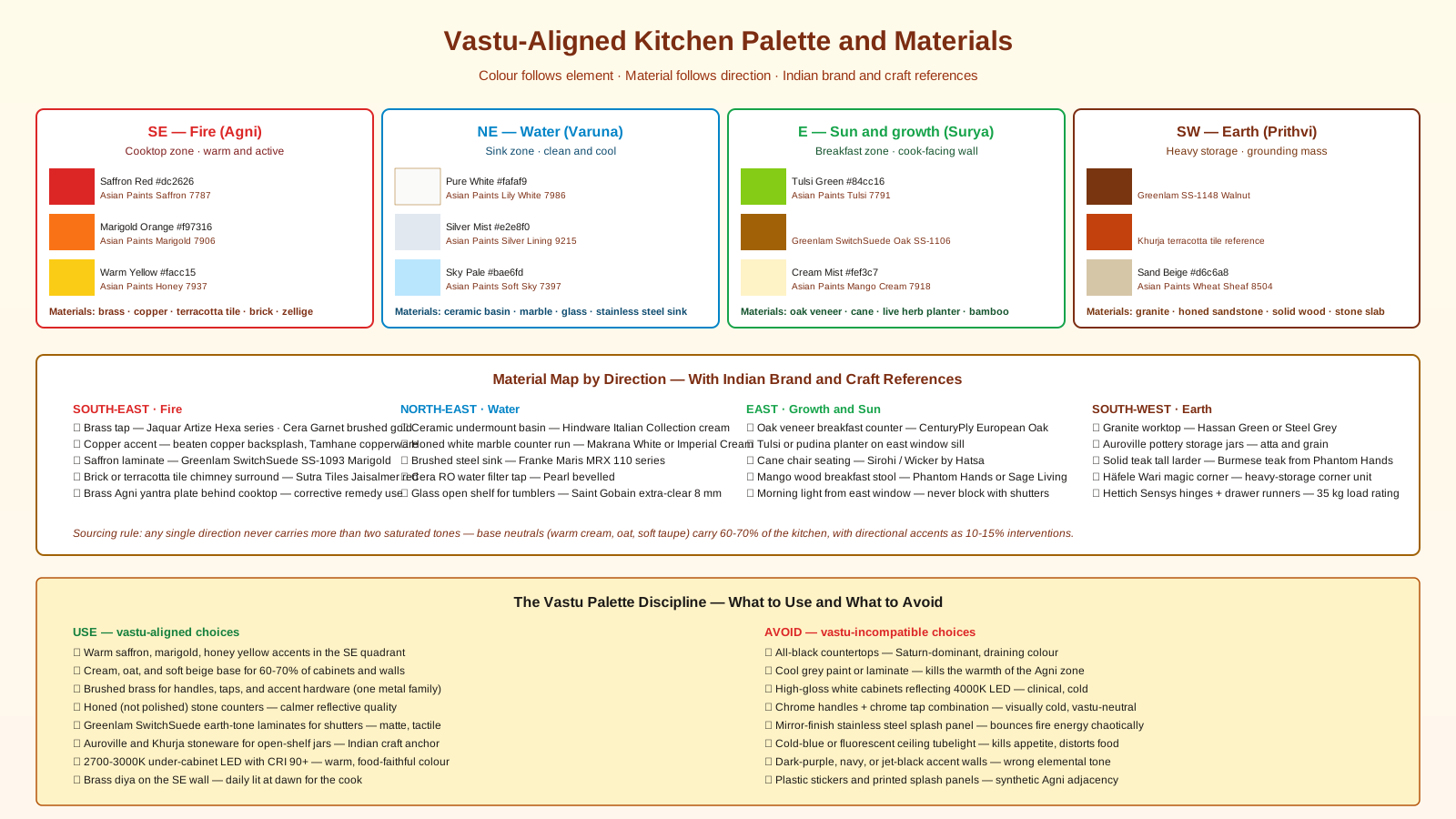
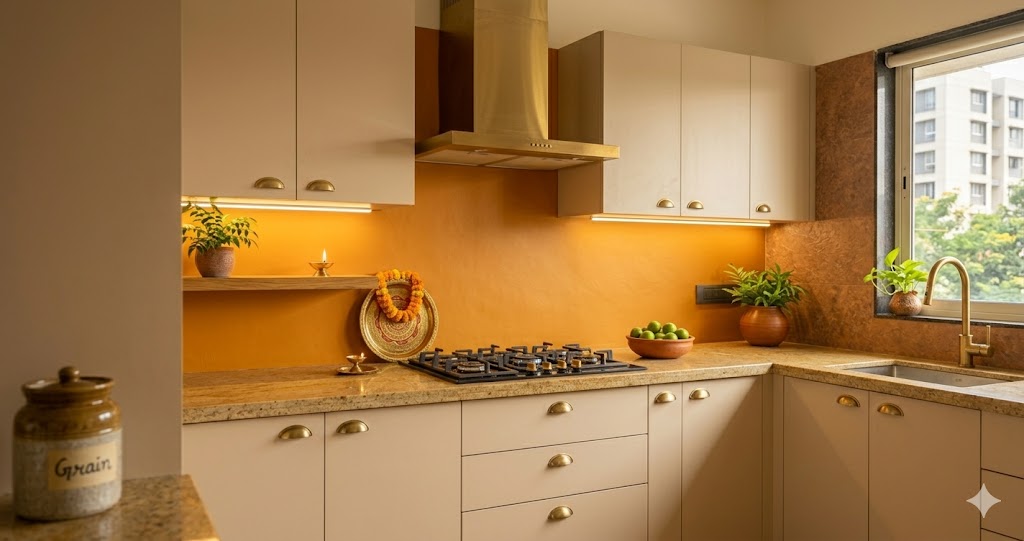
Colour in vastu follows element. The discipline is to let each direction wear its elemental colour — at least as an accent, not necessarily as a full-wall paint. Restraint is important: a kitchen painted in all eight elemental colours simultaneously is a vastu disaster, not a triumph. The base palette stays warm cream or oat (60-70% of cabinets and walls) with directional accents layered in as small interventions.
| Direction | Elemental colours | Hex reference | Indian paint reference |
|---|---|---|---|
| SE — Fire | Saffron, marigold, warm yellow, brick | #dc2626 · #f97316 · #facc15 | Asian Paints Saffron 7787, Marigold 7906, Honey 7937 |
| NE — Water | Pure white, silver, pale sky blue | #fafaf9 · #e2e8f0 · #bae6fd | Asian Paints Lily White 7986, Silver Lining 9215, Soft Sky 7397 |
| NW — Wind | Silver-grey, off-white, pale cream | #f5f5f4 · #e7e5e4 | Asian Paints Pearl White 8062, Cotton 7989 |
| E — Sun and growth | Tulsi green, warm oak, cream | #84cc16 · #a16207 · #fef3c7 | Asian Paints Tulsi 7791, Mango Cream 7918; Greenlam SS-1106 Oak |
| SW — Earth | Walnut, terracotta, sand beige | #78350f · #c2410c · #d6c6a8 | Greenlam SS-1148 Walnut, Asian Paints Wheat Sheaf 8504; Khurja terracotta tile |
| W — Saturn | Soft grey, pale charcoal (accents only) | #94a3b8 · #475569 | Asian Paints Steel Wool 9357 (small accents only) |
| S — Rest | Warm beige, cream | #ede0c8 · #f5ede0 | Asian Paints Warm Beige 8492 |
| N — Wealth | Pale yellow, ivory | #fef3c7 · #fffbeb | Asian Paints Cream Glow 7948 |
Materials by direction
- SE (Agni): brass tap (Jaquar Artize Hexa series, Cera Garnet brushed gold), copper accent backsplash, saffron Greenlam SwitchSuede laminate SS-1093, brick or terracotta tile chimney surround, brass Agni yantra plate
- NE (Varuna): ceramic undermount basin (Hindware Italian Collection cream), honed white marble counter (Makrana White or Imperial Cream), brushed steel sink (Franke Maris MRX 110), Cera RO filter tap, extra-clear glass open shelf
- E (Surya): oak veneer breakfast counter (CenturyPly European Oak), tulsi or pudina planter on east sill, cane chair seating (Sirohi or Wicker by Hatsa), mango wood breakfast stools (Phantom Hands or Sage Living)
- SW (Prithvi): granite worktop (Hassan Green or Steel Grey), Auroville stoneware storage jars, solid teak tall larder (Burmese teak from Phantom Hands), Häfele Wari magic-corner unit, Hettich Sensys hinges and 35 kg drawer runners
- NW (Vayu): silver-grey laminate or pale microcement, microwave and oven cabinet, dry-goods pull-out drawers, onion-potato wire basket (Hettich)
What to avoid completely
- All-black countertops — Saturn-dominant, heavy, draining colour; swap to beige quartz, honed travertine, or warm cream granite
- Cool grey paint or laminate — kills the warmth of the Agni zone; tilts the kitchen cold
- High-gloss white cabinets under 4000K LED — clinical, cold, vastu-neutral at best, vastu-negative at worst
- Chrome handles + chrome tap combination — visually cold, vastu-neutral, defeats the warmth instinct
- Mirror-finish stainless steel splash panel — bounces fire energy chaotically, hard to keep clean
- Cold-blue or fluorescent ceiling tube light — kills appetite, distorts food colour, makes everyone look unwell
- Dark purple, navy, or jet-black accent walls — wrong elemental tone for a kitchen
- Plastic stickers and printed splash panels — synthetic Agni adjacency, off-gases when warm
Three Remedy Tiers
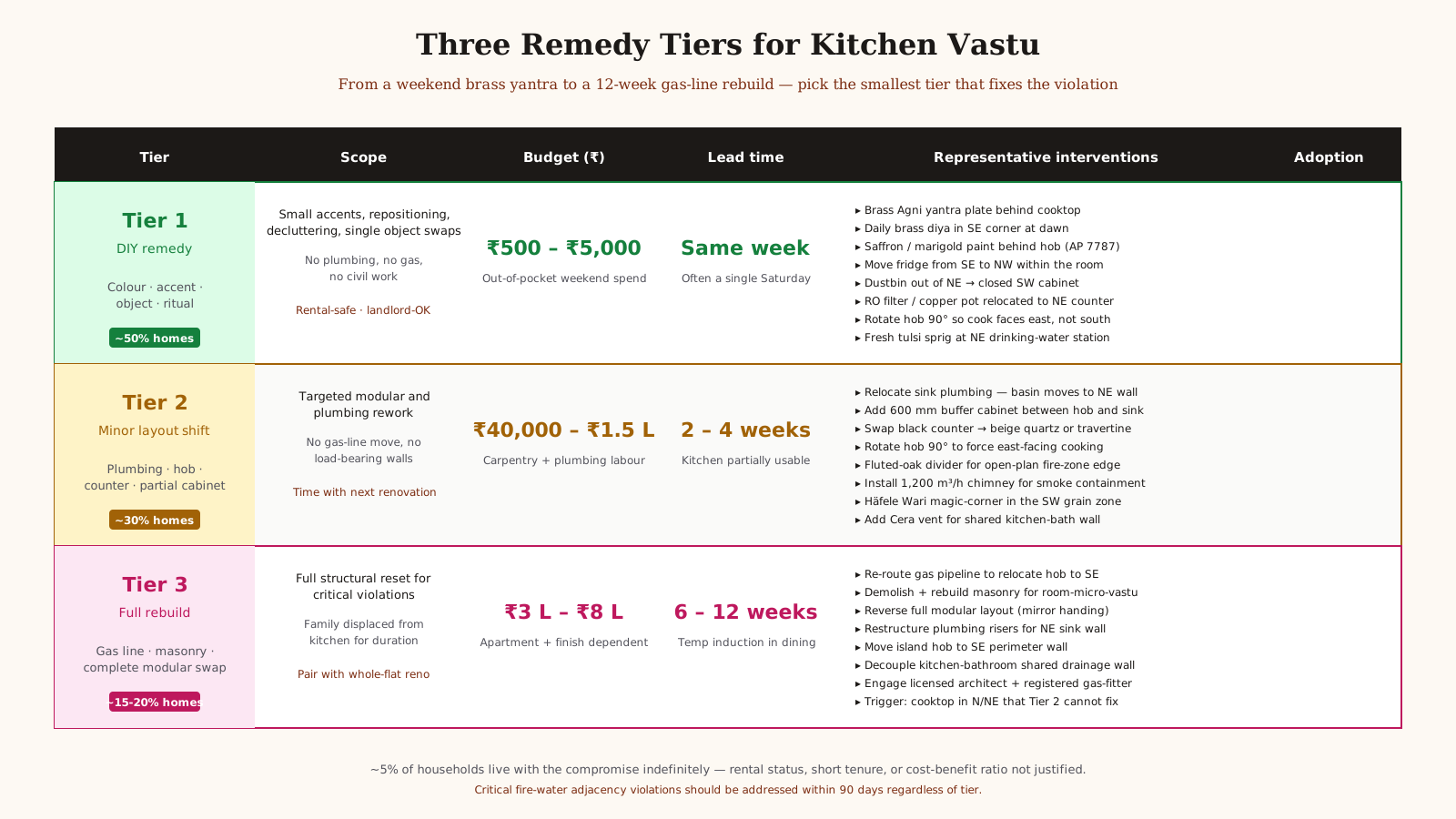
Vastu correction is not all-or-nothing. The three-tier framework lets a homeowner address the most critical issues immediately while budgeting for deeper structural fixes over time.
| Tier | Scope | Budget | Lead time | Examples |
|---|---|---|---|---|
| Tier 1 — DIY remedy | Colour, accent, small object, ritual | ₹500 - ₹5,000 | Same week | Brass yantra, marigold tile sticker, repositioning fridge, decluttering, replacing handle |
| Tier 2 — Minor layout shift | Plumbing, hob position, countertop, partial cabinet | ₹40,000 - ₹1.5 L | 2-4 weeks | Relocate sink plumbing, swap hob position, replace countertop, add buffer cabinet |
| Tier 3 — Full kitchen rebuild | Gas pipeline, masonry walls, complete modular swap | ₹3 - ₹8 L | 6-12 weeks | Re-route gas line, rebuild masonry, reverse modular layout, restructure for SE cooktop |
Tier 1 — DIY remedies you can apply this weekend
Mount a brass Agni yantra plate on the wall behind the cooktop. Place a small brass diya in the SE corner of the kitchen and light it once a day at dawn. Swap the cooktop's burner-control side so the cook stands facing east — sometimes this is a simple re-orientation of the cooktop on the same countertop. Replace any black-laminate splash panel with a saffron or marigold paint colour (Asian Paints Saffron 7787 or Marigold 7906). Move the dustbin out of the NE corner and into a closed cabinet in the SW or W. Place the drinking-water pot or filter in the NE corner, slightly elevated, with a small fresh tulsi sprig daily.
Tier 2 — Minor layout shifts at the next renovation cycle
Relocate the sink plumbing so the basin moves from next-to-hob to a NE wall position. Swap a granite countertop from black or dark-grey to beige quartz or honed travertine. Add a 600 mm cabinet buffer between hob and sink if a full plumbing relocation is not budget-feasible. Replace a south-facing hob with an east-facing hob by rotating the cooktop ninety degrees. Build a small fluted-oak divider screen to separate an open-plan kitchen from the living room. Add a powerful 1,200 m³/h chimney to contain cooking smoke in an open-plan layout.
Tier 3 — Full kitchen rebuild for fundamental vastu correction
This is the reserved option for serious vastu issues where the gas pipeline, the plumbing, and the masonry walls all need to move. Typical triggers: cooktop in N or NE that cannot be Tier-2 remedied; bathroom sharing a kitchen wall with shared drainage; fundamental fire-water adjacency that the kitchen geometry forces; an island kitchen where the hob is locked on the island and the cook is facing the wrong direction with no remedy possible.
A Tier 3 rebuild typically takes 6-12 weeks, displaces the family from the kitchen for the duration (most homeowners arrange for a temporary microwave-and-induction-hob setup in the dining room), and costs ₹3-8 L depending on apartment size, finish level, and the complexity of the gas-pipeline and plumbing work. It is a serious commitment. Reserve it for genuine critical violations and time it with a planned full-apartment renovation rather than a standalone intervention.
The pragmatic budget split
Across the surveyed Indian apartment vastu corrections in 2024-2026, roughly 50% of households resolve their kitchen vastu issues at Tier 1 alone, another 30% at Tier 2, and only 15-20% need to escalate to Tier 3. The remaining 5% live with the compromise indefinitely — either because rental status prevents structural work, or because the cost-benefit ratio of a full rebuild is not justified for the family's planned tenure in the home.
How Vastu Differs from Modern Ergonomic Kitchen Design
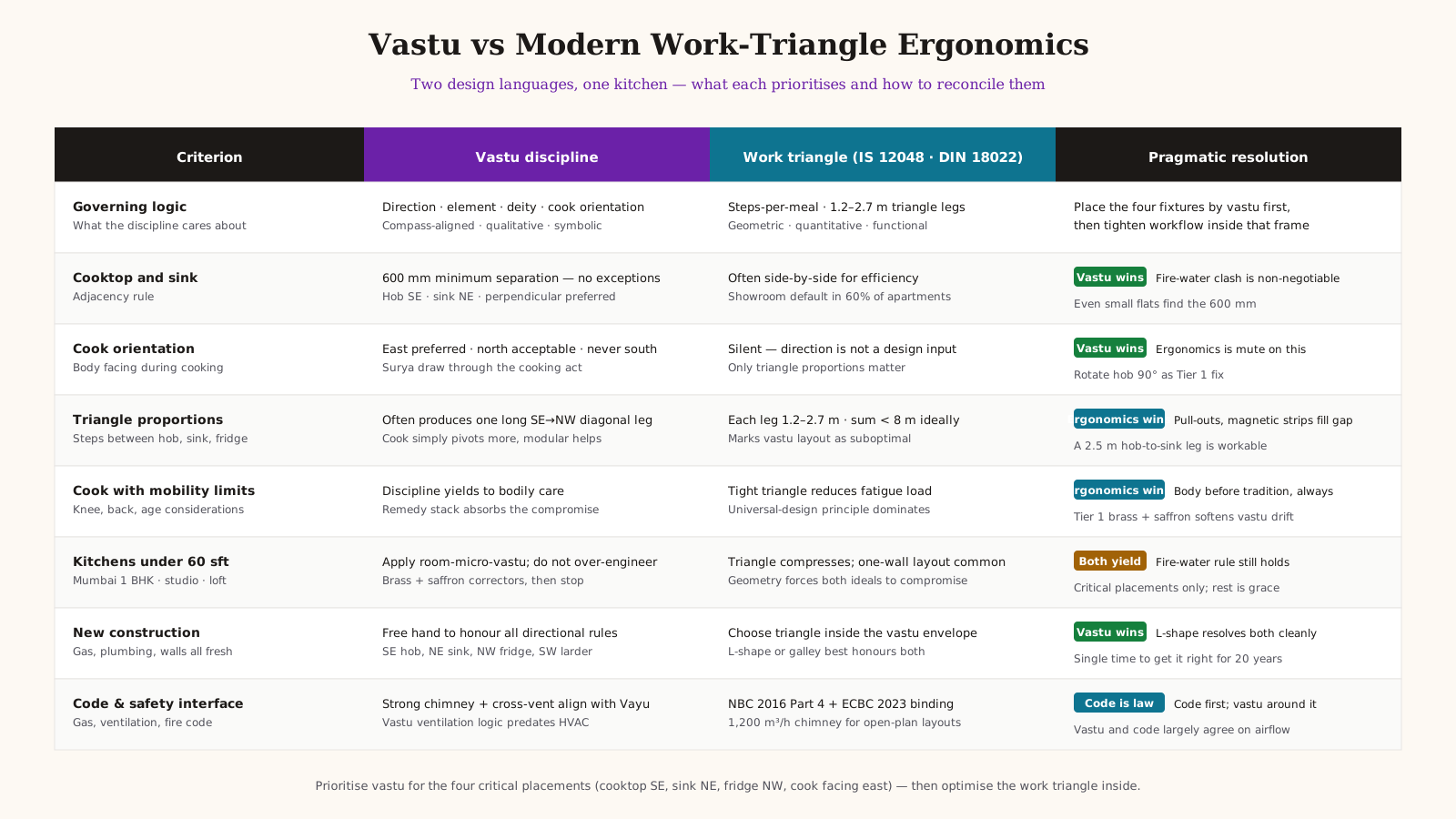
Modern kitchen ergonomics — codified in IS 12048:2018 (the Indian Standard for kitchen-fitting dimensions), the German DIN 18022 standard, and the Bulthaup-Poliform European modular tradition — is built around the kitchen work triangle: the geometric arrangement of cooktop, sink, and refrigerator with each leg of the triangle between 1.2 m and 2.7 m. The work triangle is silent about direction. It cares about steps-per-meal, not about compass alignment.
Vastu and the work triangle do not always agree. A vastu-perfect kitchen with hob in SE, sink in NE, and fridge in NW produces a triangle that may have one long leg (SE to NW diagonal across the kitchen) — which the work-triangle theory would mark as suboptimal. A work-triangle-perfect kitchen with sink right next to hob — which feels efficient — is a vastu disaster.
The practical resolution is to prioritise vastu for the critical four placements (cooktop SE, sink NE, fridge NW, cook facing east), and then optimise the work-triangle within those constraints. The triangle does not need to be perfect; the workflow does need to be smooth. A 2.5 m hob-to-sink leg across a vastu-aligned kitchen is entirely workable; the cook simply pivots more, and modern modular hardware (a roll-out chopping station, an under-counter pull-out spice rack, a magnetic knife strip near the hob) absorbs the rest.
When modern ergonomics should win
- For homes with physical-mobility considerations — a cook with knee or back issues benefits more from a tight work triangle than from a perfect vastu compass alignment
- For professional home-chef kitchens producing multiple meals daily for large gatherings — workflow efficiency dominates
- For very small kitchens under 60 sft — geometric constraint forces compromise on both vastu and ergonomic ideals
- For rental flats where Tier 2 plumbing relocation is not permitted by the landlord
When vastu should win
- For new construction where the kitchen layout is being designed from scratch with full freedom
- For major renovation where the gas line and plumbing are being redone anyway
- For homes where the cook is religiously observant and vastu alignment carries spiritual weight beyond the building-design layer
- For homes that have experienced recurring kitchen problems (gas leaks, frequent appliance failures, recurring family illness) that resist conventional explanations
When Strict Vastu Adherence Does Not Make Sense
Kitchen vastu is a discipline of respect and care, not a rigid orthodoxy. There are situations where strict vastu adherence is genuinely impractical — and where attempting it can introduce more problems than it solves.
- Heritage or rented apartments where structural work is not permitted; Tier 1 remedies are the ceiling, and that is enough
- Compact kitchens under 60 sft where the geometry physically cannot accommodate the eight-direction discipline — apply the room-micro-vastu rule and the brass-and-saffron correctors, then stop worrying
- Apartments shared by tenants with differing beliefs — a vastu intervention should not become a household friction source; agree on the high-priority fixes (fire-water separation, no cooktop facing south) and leave the rest
- Modern induction-and-microwave-only kitchens where there is no open gas flame — the Agni element is symbolically softened, and vastu rules around fire placement can be applied more loosely
- Open-loft or studio apartments with no formally separate kitchen room — the eight-direction discipline applies to the kitchen zone within the larger space, but a small studio cannot be held to a 3 BHK vastu standard
The honest position: vastu is a tool, not a verdict. A clean, well-lit, well-ventilated, well-loved kitchen — even one that violates several vastu rules — is healthier for a family than a vastu-perfect kitchen that the cook resents because the layout fights her workflow. Tradition serves the family. The family does not serve tradition.
This is the balance that classical Indian texts themselves acknowledged. The Mayamatam reminds builders that deshachara (local custom), kulachara (family tradition), and swabhava (the natural disposition of the site) all moderate the application of universal vastu rules. A 2026 Bengaluru apartment is a site with its own swabhava. Respect it.
Where to Go Next
- For whole-home vastu strategy — Vastu for Modern Homes
- For full-house plan vastu — Vastu House Plan India
- For bedroom vastu — Vastu for Bedroom
- For pooja room placement — Pooja Room Design India
- For entrance vastu — Entrance Vastu
- For staircase vastu — Staircase Vastu
- For north-facing house specifics — North-Facing House Vastu
- For colour palette across the home — Vastu Colors for Home
- For modular kitchen design fundamentals — Modular Kitchen Design Guide
- For waterproofing the kitchen-bathroom shared wall — Waterproofing Guide
- For false ceiling planning in the kitchen — False Ceiling Design Guide
- For warm kitchen palette ideas — Warm Minimal Interiors
- For earth-toned kitchen palette — Earthy Interior Palette
- To test your own kitchen — Vastu Compliance Checker and Vastu Compass
References
1. Varahamihira (sixth century CE). Brihat Samhita — Chapters 52-56 on Vastu Vidya, including kitchen and fire placement. Translated edition: M. Ramakrishna Bhat, Motilal Banarsidass, 1981.
2. Mayamuni (estimated ninth century CE). Mayamatam — Treatise of Housing, Architecture and Iconography. Translated by Bruno Dagens, Indira Gandhi National Centre for the Arts, 1995. (Foundational vastu reference.)
3. Manasara (estimated tenth century CE). Manasara Shilpa Shastra. Translated by P. K. Acharya, Manasara Series, 1933. (Classical Sanskrit vastu treatise.)
4. Vishwakarma (compilation). Vishwakarma Vastu Shastra. Multiple traditional editions. (Working text used by traditional Indian sthapatis.)
5. Bansal, Khushdeep (2018). Vastu Sutram — The Cosmic Science of Vastu. MahaVastu Publishing, New Delhi. (Contemporary apartment-vastu reference.)
6. Mohanlal, Anupama (2019). Vastu — The Indian Art of Designing Buildings. HarperCollins India. (Contemporary Indian apartment-scale guide.)
7. Sthapati, V. Ganapati (2002). Indian Sculpture and Iconography — Forms and Measurements. Mapin Publishing. (Traditional sthapati discipline.)
8. Bureau of Indian Standards (2018). IS 12048:2018 Recommendations for the Layout of Modular Kitchens. (Modern ergonomic counterpart.)
9. Bureau of Indian Standards (2016). National Building Code of India 2016 — Part 4 Fire and Life Safety. (Gas pipeline, kitchen fire safety code.)
10. National Housing Bank (2024). NHB Residential Property Standards. (Apartment design baseline for Indian builders.)
11. Bureau of Energy Efficiency (2023). ECBC Residential Code 2023 — Section on kitchen ventilation. (Modern code interface with vastu ventilation logic.)
12. Acharya, Prasanna Kumar (1934). A Dictionary of Hindu Architecture. Oxford University Press. (Vastu terminology reference.)
13. Singh, S. P. (2020). Vastu Shastra for Indian Apartments. Diamond Pocket Books. (Practical Indian flat-scale vastu.)
14. Rao, D. Subba (2015). Vastu Shastra — Ancient Indian Architecture and Its Modern Application. Bharatiya Vidya Bhavan. (Reconciling tradition with modern apartments.)
15. Bauwerk Colour (2024). Limewash Application Guide India Edition. (Kitchen limewash material specification.)
Author's note: Kitchen vastu is the area of vastu where I see the largest gap between what classical texts prescribe and what Indian apartment realities permit. I have written this guide as someone who respects the tradition deeply but also designs kitchens for actual families in actual builder-fixed flats in 2026 Bengaluru, Mumbai, Pune, and Delhi-NCR. The honest position I have arrived at after a hundred kitchen consultations: get the five critical placements right (cooktop SE, sink NE, fridge NW, heavy storage SW, cook facing east), fix any fire-water adjacency violation immediately, apply the apartment-adaptation room-micro-vastu rule where the building shell cannot change, and stop worrying about the rest. A clean kitchen used with intention is more vastu-aligned than a perfect compass map used carelessly. Tradition lives best when it serves the family — not the other way around.
Disclaimer: Vastu Shastra is a traditional Indian discipline of building design with spiritual, ergonomic, and environmental dimensions. The interpretations in this guide reflect mainstream contemporary apartment-vastu practice as documented in the sources above; classical-text interpretations vary across schools (Vishwakarma, Mayamata, Manasara) and across regional traditions (Kerala thachu shastra, Tamil sthapati, North Indian Vastu Bharti). Not all vastu rules are equally critical, and vastu should be balanced with modern ergonomic kitchen design, fire safety code (IS NBC Part 4), gas-pipeline regulations, and household convenience. Material costs, brand sources, paint references, and modular hardware specifications are 2026 indicative and shift with currency, import duties, and supply. Studio Matrx has no commercial relationship with any brand, paint manufacturer, or vastu consultant named in this guide. Studio Matrx, its authors and contributors are not responsible for procurement, installation, vastu-correction, or spiritual outcomes based on this guide. For critical structural vastu corrections involving gas-pipeline relocation or load-bearing wall modification, always engage a licensed Indian architect and a registered gas-fitting contractor.
Export this guide
Related Guides — Deep-dive reading
Pooja Room Design for Indian Homes
Vastu, Layouts, Materials, Lighting & Safety — A Complete Architect's Guide for Apartments, Villas & Compact Homes
Room Planning25 Compact Kitchen Designs for Indian Homes
Straight, parallel, L, U and peninsula layouts — with ergonomics, smart hardware, NBC dimensions and Vastu placement
Room PlanningSmart Storage Interiors — A 2026 Working Reference for Indian Homes
Inventory-driven · Floor-to-ceiling · Hardware-engineered · Zone-mapped
Room PlanningRelated Tools — Try Free
Cross-Ventilation Analyzer
Estimate airflow and air changes per hour (ACH) from room size, window areas, layout, and local wind — with NBC 2016 Part 8 compliance check.
Ventilation CalculatorVastu Shastra Compliance Checker
Score your home across 21 Vastu criteria with a weighted score, compliance band, and remedial guidance.
Vastu ScoringVastu Window Planner
Vastu guidance for window placement and size by wall direction and room — rating and remedies.
Vastu