
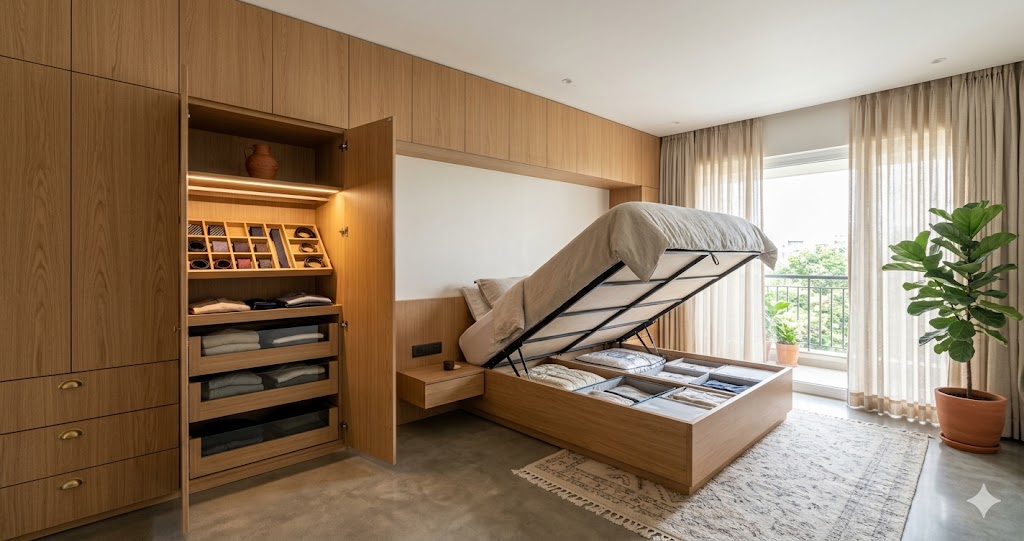
Smart Storage Interiors — A 2026 Working Reference for Indian Homes
Inventory-driven · Floor-to-ceiling · Hardware-engineered · Zone-mapped
Smart storage is the #1 differentiator between premium and ordinary Indian apartment interiors in 2026. Two homes with the same square footage, the same paint scheme, and the same designer can read completely differently — the one with engineered storage feels calm and generous; the one without storage discipline feels cramped and chaotic within twelve months of moving in. Storage is not the romance of interior design — it is the structural engineering that makes the romance possible.
This is a 22-minute working reference for homeowners and interior designers building smart storage into Indian 2-3 BHK apartments. It covers the five structural principles, a room-by-room storage map across eight zones, the full anatomy of a smart wardrobe with capacity benchmarks per linear foot, the hardware brand grid (Hettich vs Häfele vs Blum), three budget tiers from ₹3 L carpenter-led to ₹55 L bespoke, ten common pitfalls, and how smart storage differs from maximalist hoarding, sparse minimalist defaults, and standard modular kitchen briefs.
Storage is the silent infrastructure of a calm home. If every object has a named, reachable, ergonomic home — the surfaces stay clear, the floors stay clear, and the room finally reads as the designer intended. If even one category of object (the keys, the chargers, the festival decor, the shoes) has no engineered home, the entropy starts there and spreads across the apartment in ninety days.
For complementary depth see Warm Minimal Interiors, Compact Luxury Apartment Guide, Space-Efficient Homes Guide, Japandi Apartment Interior Guide, Modular Kitchen Design Guide, Wardrobe Finish Ideas, and False Ceiling Design Guide.
This guide refreshes every 12 months — hardware catalogues and brand SKUs update annually. Last verified: May 2026 · Next verify: May 2027.
What Smart Storage Is
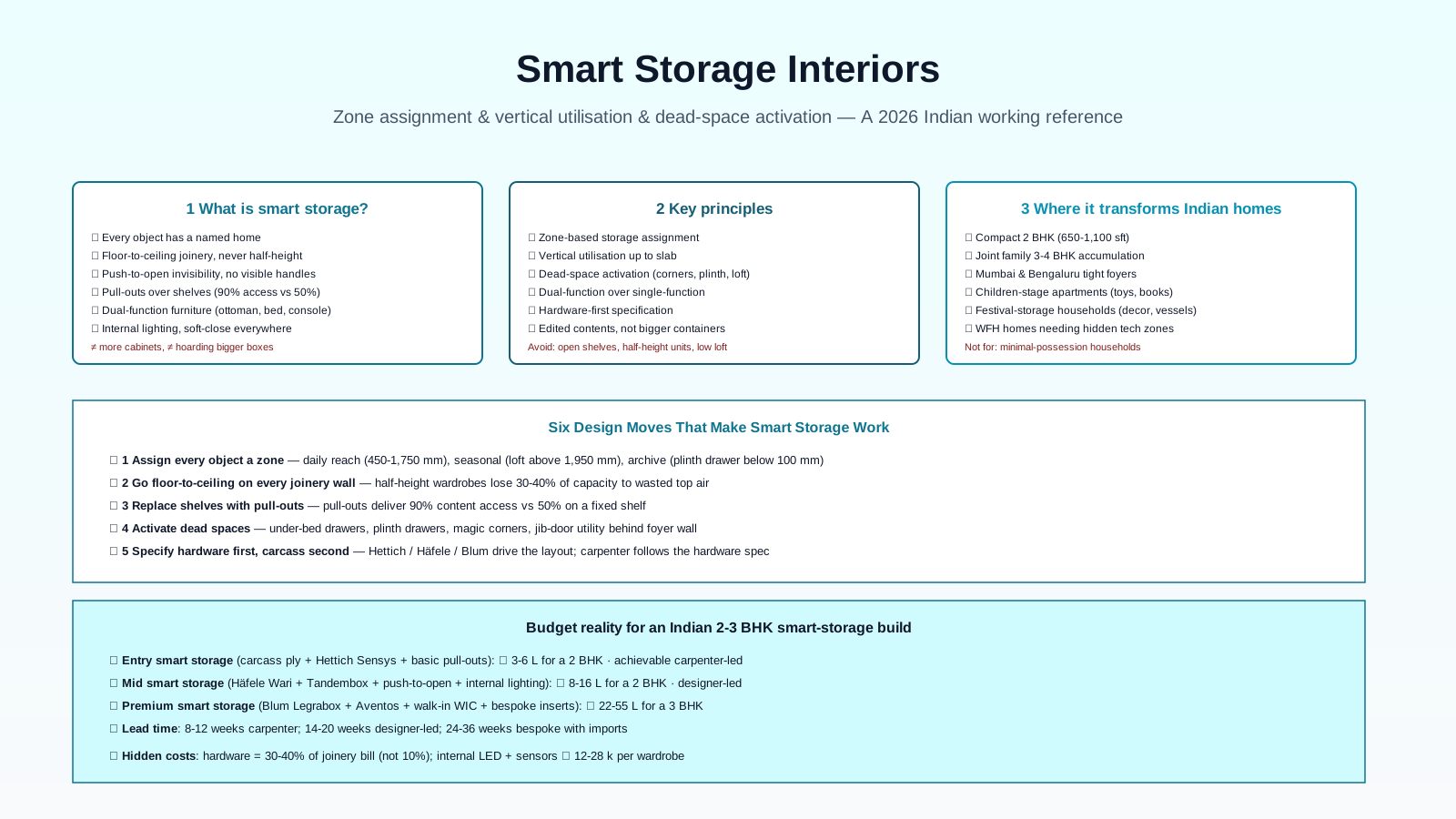
Smart storage is the deliberate, engineered choice to assign every object in the home a named, reachable, ergonomic place — and then build the joinery to deliver that place. It is the opposite of "buy a bigger cupboard." A bigger cupboard with no internal zoning is a deeper pit of confusion; a smaller wardrobe with engineered pull-outs, drawer banks, and accessory inserts holds more usable content with less daily friction.
The core idea: storage is an inventory problem, not a furniture problem. Before you draw the wardrobe carcass, you list the garments, count them, group them by reach frequency, and assign each group a zone height and a hardware type. The joinery is then engineered around that inventory. Carpenters who quote "8 ft x 7 ft sliding wardrobe with one loft" without ever asking what goes inside are not building smart storage — they are building plywood boxes.
Five things smart storage is NOT
1. Not "more cabinets" — Adding capacity without zoning multiplies confusion. Smart storage often replaces three half-used cabinets with one engineered cabinet of equal volume.
2. Not just modular kitchens — Modular kitchens are a subset. Smart storage applies equally to the foyer, living room, bedrooms, bathrooms, utility, and study — every zone of the apartment.
3. Not hoarding-friendly — Smart storage requires content editing. If you genuinely refuse to part with anything, even the best storage system will fail in 24 months. Marie Kondo's spark-joy edit is a prerequisite layer, not an alternative philosophy.
4. Not visible-shelf decor — Open shelves with curated objects are an aesthetic choice; that is decor, not storage. Smart storage prefers concealed, indexed, sealed-against-dust systems for the bulk of content.
5. Not "Pinterest organisation" — Matching glass jars and Instagram drawer dividers are organisation, not storage architecture. Smart storage is the carcass-and-hardware layer beneath the organisation layer.
The Five Principles That Make Smart Storage Work
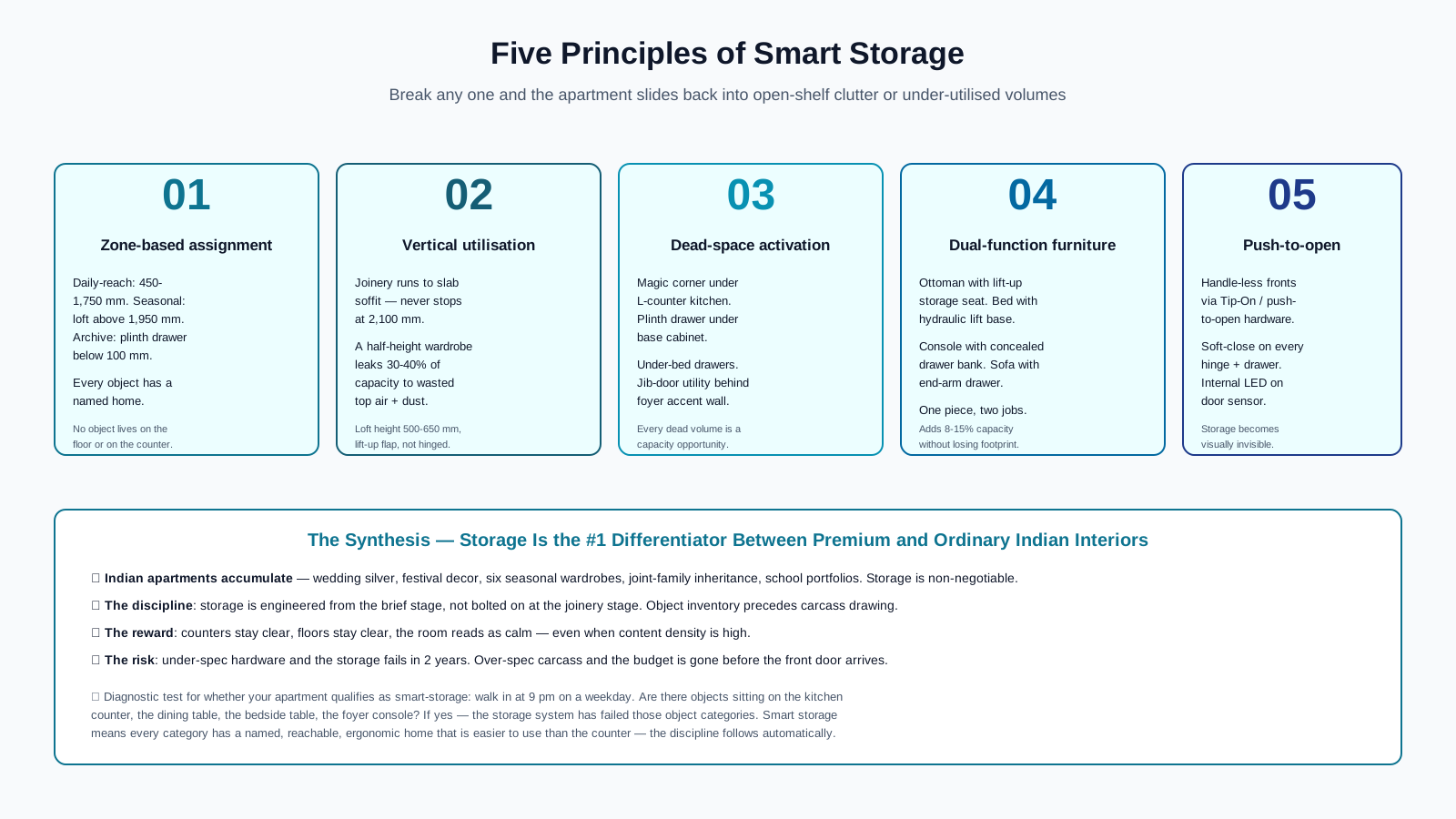
1. Zone-based storage assignment
Every object lives in one of three zones determined by reach frequency. Daily-reach zone (450-1,750 mm above floor) holds objects touched every day — frequent clothing, daily kitchenware, current toiletries. Seasonal zone (above 1,950 mm — wardrobe loft, top-of-cabinet) holds objects touched 2-4 times a year — suitcases, festival decor, winter quilts, off-season clothing. Archive zone (below 100 mm — plinth drawer, under-bed) holds objects touched rarely but kept on purpose — financial records, baby memorabilia, spare linen.
The discipline: every named object category gets a zone before the joinery is drawn. The diagnostic test — open any drawer or cabinet in your home. If the contents are mixed (daily socks next to wedding-trousseau saree next to old tax files), the zoning has failed and the system will degrade further.
2. Vertical utilisation — floor to ceiling, every time
Joinery runs from skirting to slab soffit. A wardrobe that stops at 2,100 mm leaks 30-40% of available volume into wasted top air — which then accumulates dust, becomes the catch-all for "I'll sort this later" objects, and visually shrinks the room. The fix is universal: continue the joinery to the ceiling with a 500-650 mm loft section, accessed by a lift-up flap on a Blum Aventos HK or Häfele Free Up hinge.
The loft holds seasonal content (suitcases, off-season quilts, festival decor) that does not need daily reach. The flap geometry matters — lift-up flaps stay open at any angle (good); hinged half-doors that fall closed under their own weight while you are reaching inside (bad) are the most common loft-hardware mistake in Indian apartments.
3. Dead-space activation
Every apartment has dead volumes that the typical builder-finish brief ignores. Smart storage activates each one. Magic corners recover the L-junction dead space under a corner kitchen counter — typically 0.5-0.8 m³ of unreachable volume that becomes a 35 kg-rated pull-out. Plinth drawers under base cabinets recover the 100 mm skirting void — perfect for baking trays, vacuum-bagged linen, or rarely-used flat appliances. Under-bed drawers on hydraulic lift hinges turn the 200-300 mm bed-base volume into 0.4-0.7 m³ of archive storage. Jib-door utilities behind a foyer accent wall hide a 1.0-1.6 m² cavity for shoes, helmets, or a vertical broom-cupboard.
4. Dual-function furniture
One piece, two jobs. Ottomans with lift-up storage seats (adds 0.08-0.12 m³ of living-room toy or throw storage). Beds with hydraulic-lift bases (adds 0.4-0.7 m³ master-bedroom archive). Consoles with concealed drawer banks (adds entry-foyer or living-room daily storage). Sofa armrests with lift-up storage compartments. Coffee tables with under-shelf or lift-top compartments. Each dual-function piece adds 8-15% to apartment capacity without losing a single square foot of footprint.
5. Push-to-open invisibility
Handle-less fronts via Tip-On or push-to-open hardware (Blum Tip-On Blumotion, Häfele Push-to-Open) achieve two things — visual calm (no handle line breaks the joinery elevation) and child-safety (no protruding handle to hip-bump). Combined with soft-close on every hinge and drawer, and internal LED on a door-edge PIR sensor, the storage system becomes visually invisible when closed and self-illuminating when opened. This is the difference between a wardrobe wall that reads as "storage" and a wardrobe wall that reads as panelled architecture.
Room-by-Room Storage Map
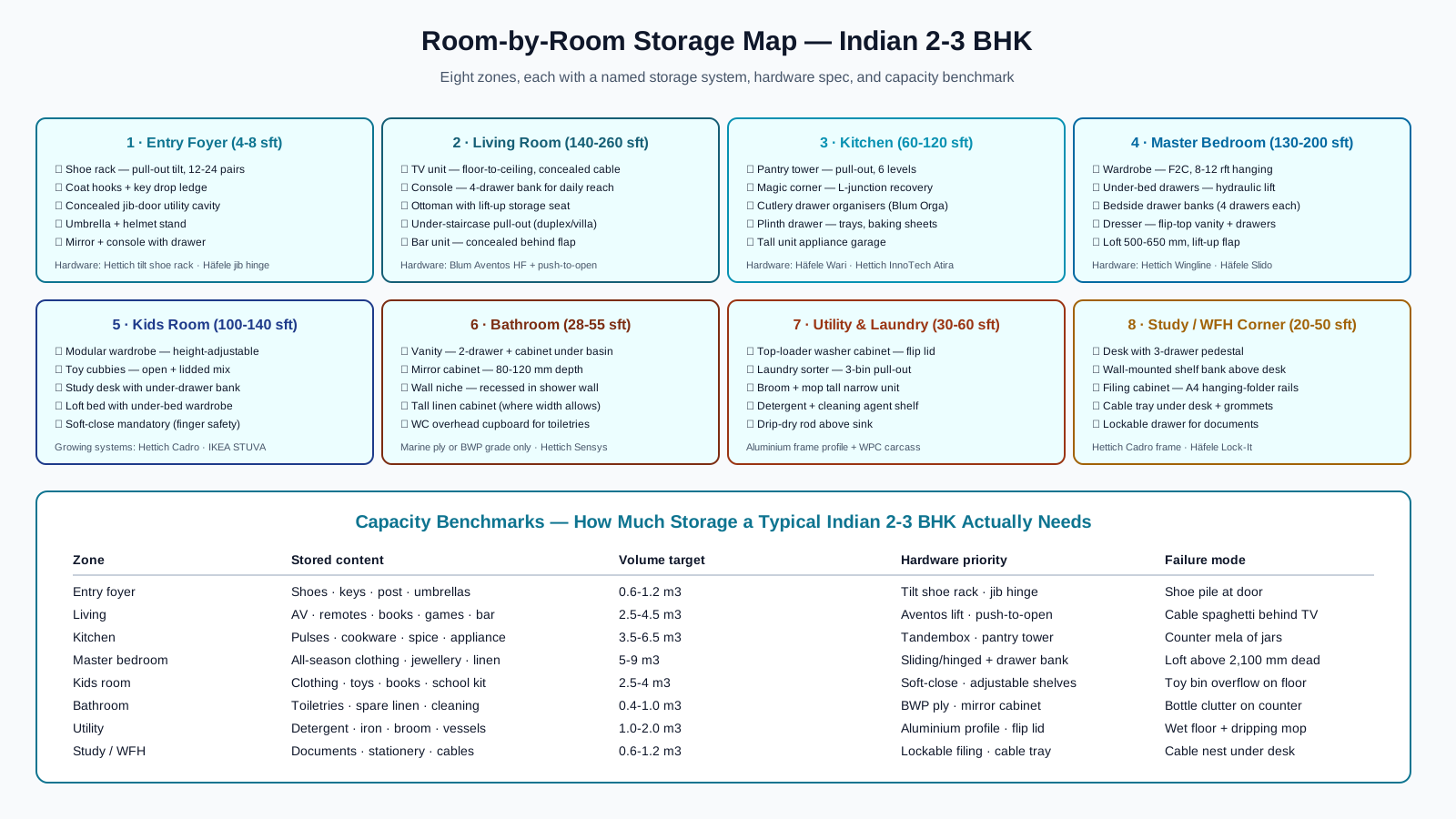
Entry foyer — the first 90 seconds
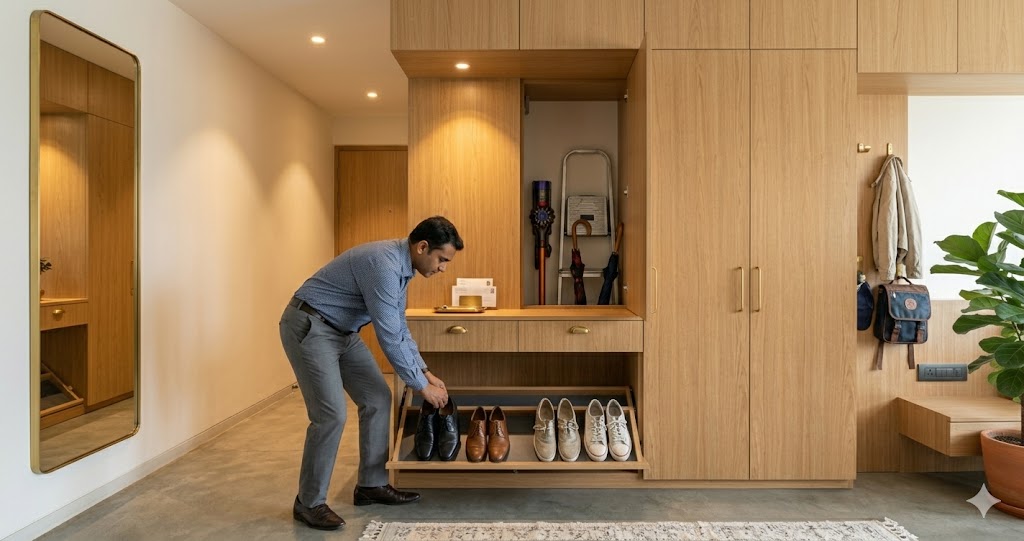
The foyer is the busiest 4-8 sft in an Indian apartment. Six families, ten pairs of shoes, twelve sets of keys, daily post, umbrellas, helmets. The smart-storage foyer has: a pull-out tilt shoe rack (Hettich or Häfele, 12-24 pair capacity), wall-mounted coat hooks at 1,650 mm and 1,200 mm (adult + child reach), a console with a single drawer (keys, sunglasses, post tray), a slim mirror, and — where the apartment plan allows — a concealed jib-door cavity behind a flush accent wall for vacuum cleaners, helmets, or the iron board.
Living room — the most-seen zone
The smart-storage living room hides 90% of its storage. Floor-to-ceiling TV unit in matte oak or warm laminate, with concealed cable management down to the WPC plinth drawer. Console behind or beside the sofa with a 4-drawer bank for remotes, charging cables, table linen, and AV accessories. Ottoman with a lift-up storage seat for blankets and toys. Where the apartment is duplex or villa, the under-stair cavity becomes a 0.8-1.6 m³ pull-out drawer system — one of the most under-utilised storage volumes in Indian homes.
Kitchen — the most-touched zone
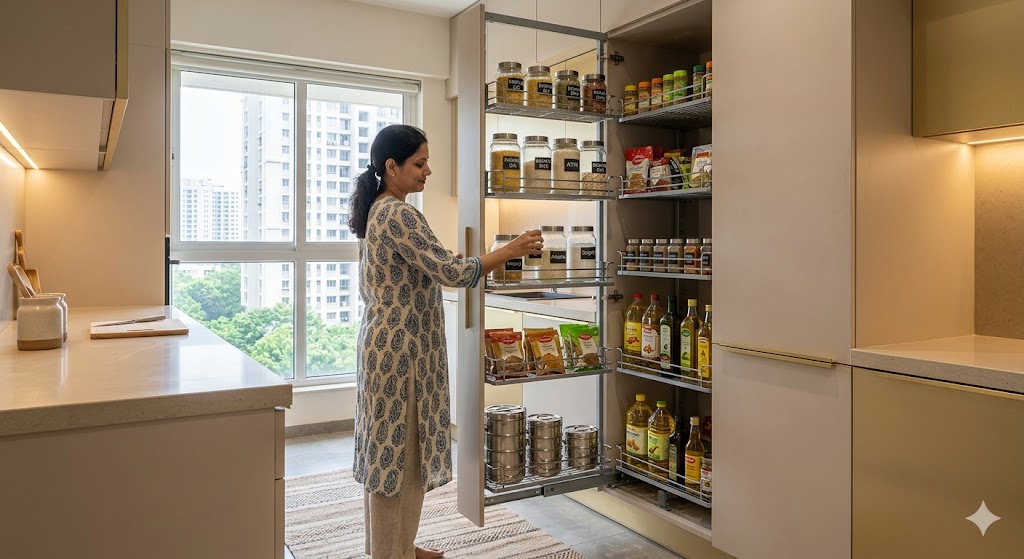
The kitchen is where smart storage either pays back its capex tenfold or fails most visibly. The non-negotiable list: a 6-level pull-out pantry tower (Hettich Comfort or Häfele Tandem larder) for dals, rices, oils, and spice jars; a magic-corner system (Häfele Wari II or Kessebohmer LeMans II) to recover the L-junction; cutlery-drawer organisers (Blum Orga-Line) shaped to your specific cutlery inventory; a plinth drawer under the base cabinets for baking trays and flat appliances; a tall appliance garage with a Häfele Free Fold door to hide the toaster, mixer-grinder, and air fryer behind a flush front.
Master bedroom — the wardrobe zone
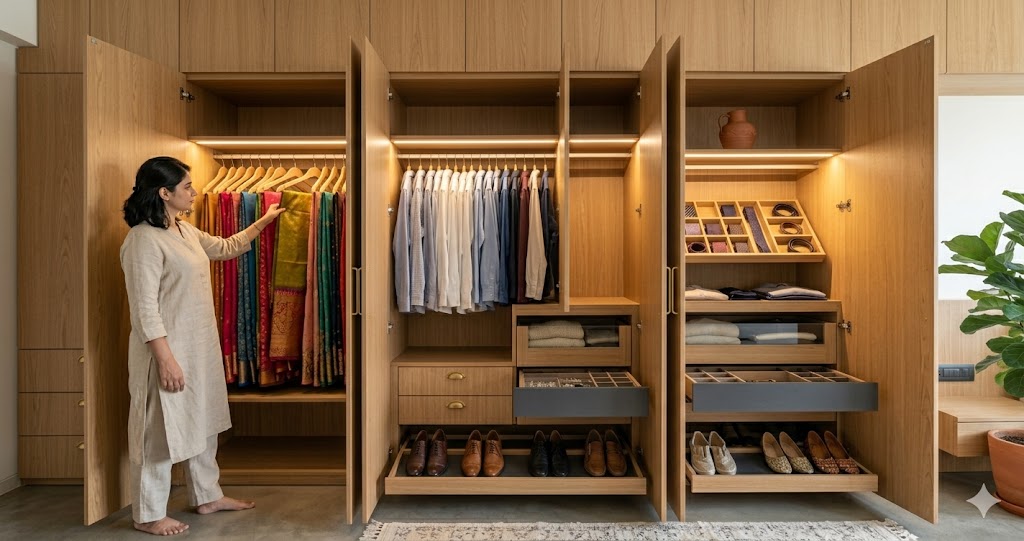
Minimum 10 rft of floor-to-ceiling wardrobe for a couple, configured as the anatomy figure below details. Under-bed hydraulic lift base for archive linen and rarely-worn formalwear (sherwanis, wedding sarees). Bedside drawer banks of 4 drawers each (chargers, books, medications, intimate objects — never the catch-all single-drawer "nothing-fits-here" zone). A dresser unit with flip-top vanity, jewellery insert, and 3-drawer bank under. Loft above the wardrobe (500-650 mm) on lift-up flaps for suitcases and seasonal quilts.
Kids room — the modular zone
Children change scale faster than any other household member. Smart storage in kids rooms means height-adjustable systems (Hettich Cadro frame, IKEA STUVA, Spacewood Kosmos). Toy storage as a mix of open cubbies (daily-reach, easy put-back) and lidded bins (lower-frequency toys). Study desk with an under-drawer bank that grows with the child — stationery now, then textbooks, then laptop accessories. Soft-close on every hinge and drawer is non-negotiable for finger safety. Lower loft heights (1,650 mm vs adult 1,950 mm) so the child can reach their own seasonal storage from age 9 onwards.
Bathroom — the moisture-managed zone
Bathroom storage carcass is BWP-grade marine ply or 100% WPC — never standard BWR ply, which delaminates at the cut edges within 24 months of bathroom humidity. The non-negotiable layer: a vanity with 2-drawer + cabinet bank under the basin, a mirror cabinet (80-120 mm depth) for daily toiletries, a recessed wall niche in the shower for shampoo and shower gel, and where width permits, a tall linen cabinet for spare towels and toilet paper rolls. Hettich Sensys hinges are stainless-steel SUS304 grade only for bathroom installation.
Utility and laundry — the hidden-MVP zone
The utility balcony or laundry bay is the storage zone Indian apartments most consistently neglect. The fix: a top-loader washer cabinet with a flip-up lid (keeps the visual line clean), a 3-bin laundry sorter pull-out (whites, colours, delicates), a tall narrow broom-and-mop unit (650-800 mm wide), an aluminium-frame profile shelving system for detergent and cleaning agents (water-resistant), and a drip-dry rod above the utility sink. WPC carcass throughout — utility humidity is closer to bathroom than to bedroom.
Study or WFH corner — the productivity zone
Post-pandemic Indian homes need engineered WFH storage even in non-dedicated study rooms. Desk with a 3-drawer pedestal (one drawer with hanging-folder rails for A4 files, one for stationery, one lockable for documents and passports). Wall-mounted shelf bank above the desk for books and tech accessories. Cable tray under the desk with grommets through the worktop for monitor cables. A lockable Häfele Lock-It drawer or Hettich filing cabinet for sensitive documents — particularly important in shared-household setups.
Capacity benchmarks at a glance
| Zone | Volume target | Hardware priority | Failure mode |
|---|---|---|---|
| Entry foyer | 0.6-1.2 m³ | Tilt shoe rack · jib hinge | Shoe pile at door |
| Living | 2.5-4.5 m³ | Aventos lift · push-to-open | Cable spaghetti behind TV |
| Kitchen | 3.5-6.5 m³ | Tandembox · pantry tower · magic corner | Counter mela of jars |
| Master bedroom | 5-9 m³ | Sliding/hinged + drawer bank | Loft above 2,100 mm dead |
| Kids room | 2.5-4 m³ | Soft-close · adjustable shelves | Toy bin overflow on floor |
| Bathroom | 0.4-1.0 m³ | BWP ply · mirror cabinet | Bottle clutter on counter |
| Utility | 1.0-2.0 m³ | Aluminium profile · flip lid | Wet floor + dripping mop |
| Study / WFH | 0.6-1.2 m³ | Lockable filing · cable tray | Cable nest under desk |
The Wardrobe Anatomy
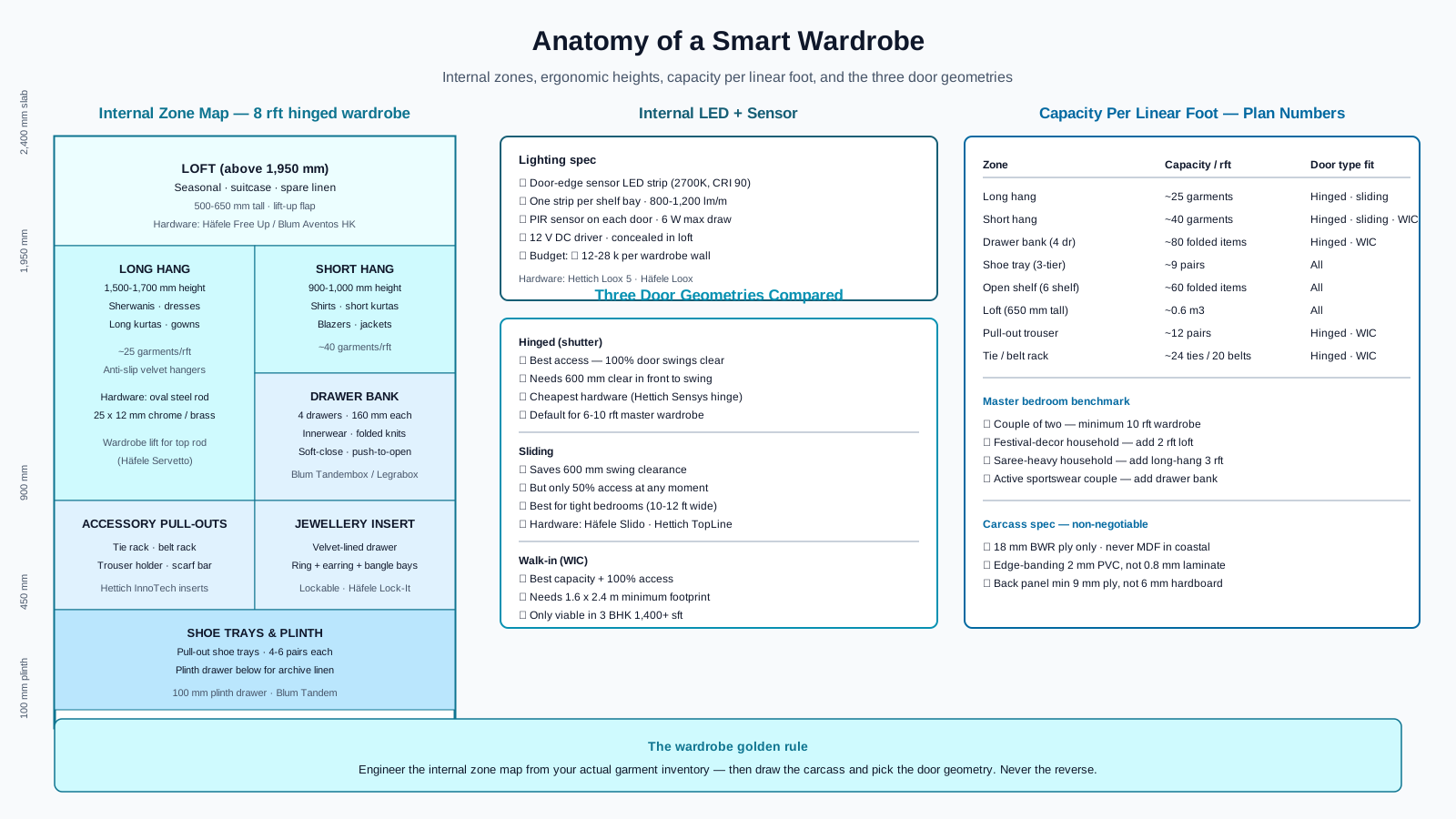
The master bedroom wardrobe is the single most expensive piece of joinery in most Indian apartments, and the one where good and bad design have the largest day-to-day life impact. A well-engineered 10 rft wardrobe stores more, hides more dust, and degrades slower than a poorly-engineered 14 rft wardrobe. The anatomy below is the working template.
Internal zone map for a 10-12 rft hinged wardrobe (couple of two)
| Zone | Height range | Contents | Capacity |
|---|---|---|---|
| Loft | 1,950-2,400 mm | Suitcases, off-season quilts, festival decor | ~0.6 m³ per rft |
| Long hang | 900-1,950 mm | Sherwanis, dresses, long kurtas, gowns | ~25 garments per rft |
| Short hang | 1,000-1,950 mm | Shirts, blazers, short kurtas, jackets | ~40 garments per rft |
| Drawer bank | 450-1,100 mm | Innerwear, folded knits, accessories | ~80 folded items per rft |
| Accessory pull-out | 1,100-1,650 mm | Ties, belts, scarves, trousers | ~24 ties or 20 belts per rft |
| Jewellery insert | 950-1,100 mm | Lockable velvet-lined drawer | ~80-120 pieces |
| Shoe trays | 100-450 mm | Pull-out 3-tier shoe storage | ~9 pairs per rft |
| Plinth drawer | 0-100 mm | Archive linen, vacuum-bagged quilts | ~0.1 m³ per rft |
Internal layout for a 2 BHK master (10 rft hinged wardrobe)
| Section width | Allocation | Notes |
|---|---|---|
| 3 rft | Long hang + loft above | Sarees, dresses, long kurtas |
| 3 rft | Short hang + loft above | Shirts, blazers, daily kurtas |
| 2 rft | Drawer bank (4 drawers) + short hang above + loft above | Folded items + secondary hang |
| 2 rft | Accessory pull-outs + jewellery insert + shoe trays | Daily-reach + lockable + footwear |
Internal layout for a 3 BHK master (14 rft sliding + 2 rft WIC corner)
| Section | Allocation | Notes |
|---|---|---|
| Sliding 4 rft | His long hang + loft + drawer bank | One-side full his |
| Sliding 4 rft | Her long hang + loft + jewellery drawer | One-side full her |
| Sliding 4 rft | Shared short hang + folded shelves + plinth drawer | Mixed daily reach |
| Sliding 2 rft | Footwear + accessory + tall hang | Edge column |
| WIC corner 2 rft | Walk-in dressing nook + mirror + dresser | Where plan allows |
Door geometry — pick by clearance, not aesthetic
Hinged shutters give 100% access (the door swings clear of the carcass) and need 600 mm clear floor in front for the swing. They are the default for any master wardrobe with adequate room depth. Hardware: Hettich Sensys soft-close concealed hinge at ₹ 280-520 per unit; specify SUS304 grade for any coastal city installation.
Sliding doors save the 600 mm swing clearance but give only 50% access at any one moment (one panel always covers half the wardrobe). They are the right answer for narrow bedrooms (10-12 ft wide) where the wardrobe wall is opposite the bed. Hardware: Hettich TopLine (mid-tier) or Häfele Slido D-Line (premium); soft-close braking strip is non-negotiable.
Walk-in (WIC) gives best capacity and 100% access, but requires a minimum 1.6 × 2.4 m footprint that only 3 BHK 1,400+ sft apartments can spare. Where the plan supports it, the WIC is the single biggest upgrade to apartment storage quality available.
Internal LED and sensor spec
A wardrobe without internal lighting forces you to either leave the room light on (waste) or hunt by phone torch (annoying). The spec: 2700K warm LED strip with CRI 90, mounted on the door-leading edge or under each shelf, 800-1,200 lm per metre, controlled by a PIR sensor on each door. Total draw 6 W max per wardrobe. Budget ₹ 12-28 k per wardrobe wall for full LED + sensor install. Hardware: Hettich Loox 5 system or Häfele Loox system — both work on 12 V DC drivers concealed in the loft.
Carcass spec — the non-negotiables
- 18 mm BWR-grade plywood only for the shell; never MDF in coastal cities (Mumbai, Chennai, Kochi)
- 2 mm PVC edge-banding on every cut edge — 0.8 mm laminate edge fails in 18 months from daily friction
- Back panel minimum 9 mm ply (not 6 mm hardboard) — 6 mm warps under loft load over 5 years
- Brand carcass: CenturyPly Sainik or Greenply Greenpanel (mid-tier), Greenply 710-BWP or Archidply (premium)
- Termite + borer treatment on the carcass at factory stage, not site stage
Hardware Systems and Brands
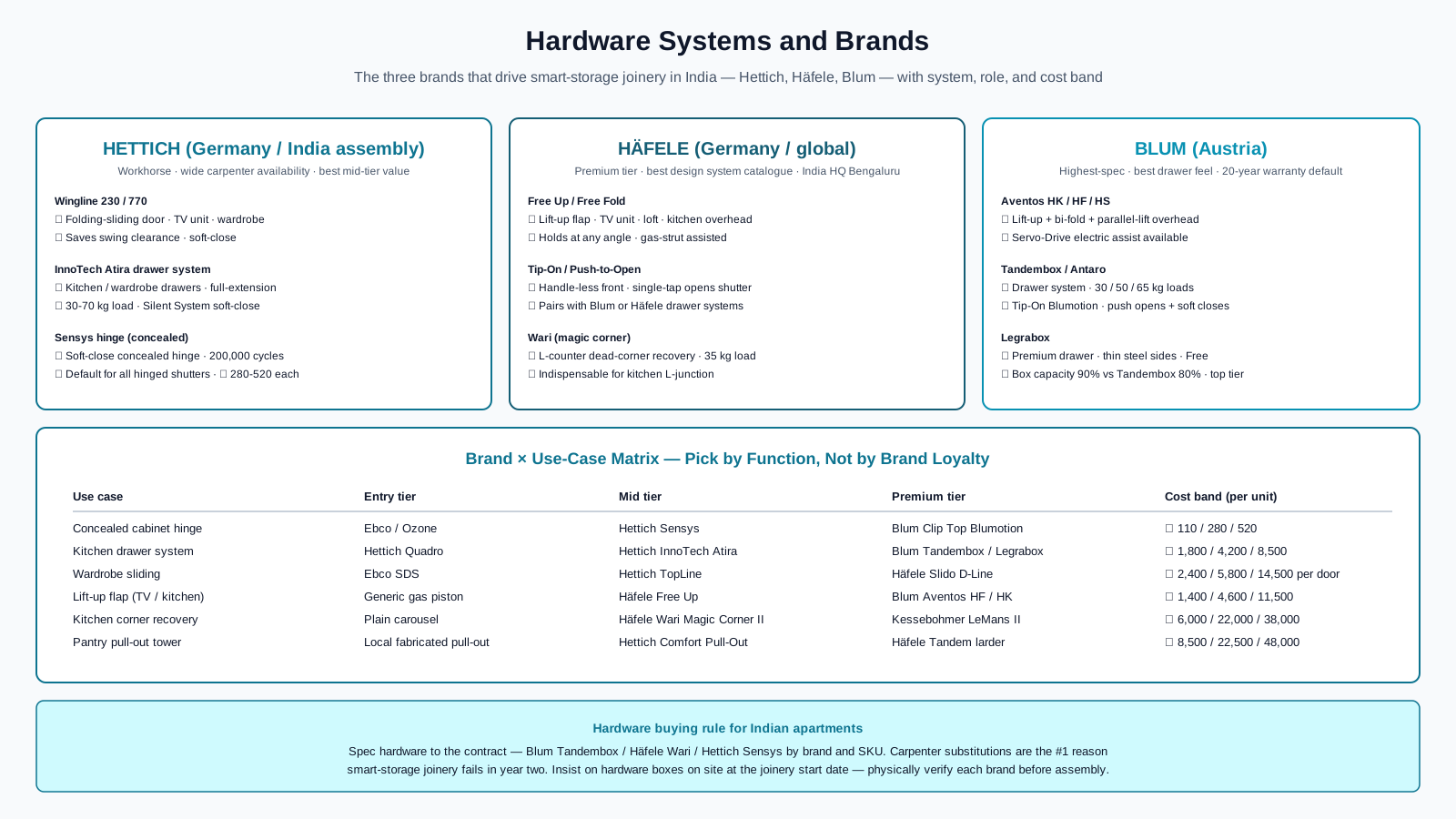
Hardware drives the joinery, not the other way around. The three brands that dominate Indian smart-storage joinery in 2026 — Hettich, Häfele, Blum — each have a distinct positioning. Hettich is the workhorse (best mid-tier value, widest carpenter availability). Häfele is the design-system catalogue leader (most complete product range, best showroom support, Indian HQ Bengaluru). Blum is the premium-feel specialist (best drawer slide action, 20-year warranty default, Austrian-made).
Brand × use-case matrix
| Use case | Entry tier | Mid tier | Premium tier | Cost band (per unit) |
|---|---|---|---|---|
| Concealed cabinet hinge | Ebco / Ozone | Hettich Sensys | Blum Clip Top Blumotion | ₹ 110 / 280 / 520 |
| Kitchen drawer system | Hettich Quadro | Hettich InnoTech Atira | Blum Tandembox / Legrabox | ₹ 1,800 / 4,200 / 8,500 |
| Wardrobe sliding | Ebco SDS | Hettich TopLine | Häfele Slido D-Line | ₹ 2,400 / 5,800 / 14,500 per door |
| Lift-up flap (TV / kitchen) | Generic gas piston | Häfele Free Up | Blum Aventos HF / HK | ₹ 1,400 / 4,600 / 11,500 |
| Kitchen corner recovery | Plain carousel | Häfele Wari Magic Corner II | Kessebohmer LeMans II | ₹ 6,000 / 22,000 / 38,000 |
| Pantry pull-out tower | Local fabricated | Hettich Comfort Pull-Out | Häfele Tandem larder | ₹ 8,500 / 22,500 / 48,000 |
| Push-to-open mechanism | Generic spring catch | Häfele Tip-On | Blum Tip-On Blumotion | ₹ 180 / 480 / 1,100 |
| LED + sensor system | Generic LED strip | Hettich Loox 5 | Häfele Loox | ₹ 1,800 / 4,500 / 12,000 |
Carpenter substitution — the single biggest risk
The most common smart-storage failure in India: the designer specifies Blum Tandembox, the homeowner pays for Blum Tandembox, the carpenter substitutes a no-name Chinese-import drawer system that looks similar at install, and the drawers fail in 18-24 months. The fix:
- Specify hardware by brand + SKU on the contract — not generic ("soft-close drawer")
- Insist that hardware boxes arrive on site at the joinery start date, sealed and brand-stamped
- Physically verify each hardware box against the spec before assembly begins
- Pay the hardware bill directly to the brand authorised dealer where possible (Hettich India, Häfele India, Blum India), not through the contractor margin
- Photograph installed hardware showing brand markings before joinery shutters are closed
Three Budget Tiers — All-In Estimates
Entry tier — ₹ 3-6 L for a 2 BHK (650-1,100 sft)
Carpenter-led with brand hardware. Floor-to-ceiling wardrobes in both bedrooms with basic internal zoning (long hang + short hang + 2-drawer bank + 1 loft), modular kitchen with Hettich Quadro drawers and one Wari-equivalent magic corner, foyer shoe rack, TV unit with concealed cabling, basic vanity in each bathroom. Hardware mostly Hettich Sensys + Ebco for sliding. Lead time 8-12 weeks carpenter-led.
Save on: open kitchen shelving (decorative, low-cost), wardrobe sliding doors (skip if room geometry supports hinged), generic gas-piston flap hardware. Splurge on: Hettich Sensys hinges (₹ 280 each — the daily-touch quality differentiator), kitchen drawer system (Hettich InnoTech Atira if budget stretches).
Mid tier — ₹ 8-16 L for a 2 BHK (1,000-1,400 sft)
Designer-led, full Hettich + Häfele mix with select Blum on critical drawers. Engineered internal wardrobe layouts with accessory pull-outs, jewellery inserts, soft-close throughout, internal LED + PIR sensors. Push-to-open kitchen fronts (Häfele Tip-On), Häfele Wari Magic Corner II, full pantry pull-out tower, plinth drawers under all base cabinets. Lift-up flap on the TV unit (Häfele Free Up). Foyer with concealed jib-door utility cavity. Under-bed hydraulic lift on master bed.
Save on: substitute Hettich InnoTech Atira for Blum Tandembox on standard kitchen drawers (functionally equivalent at 50% cost; reserve Blum for the cutlery drawer where the feel is touched daily). Splurge on: Häfele Wari corner (the L-junction recovery is the single highest ROI hardware spend), internal LED system across all wardrobes.
Premium tier — ₹ 22-55 L for a 3 BHK (1,400-2,200 sft)
Bespoke joinery, full Blum where critical, Häfele design-system across the apartment. Walk-in wardrobe in master with full bespoke insert layout, Blum Legrabox drawers throughout the kitchen, Blum Aventos HF on every overhead, Häfele Slido D-Line on every sliding door, Kessebohmer LeMans II on the kitchen corner, Häfele Tandem larder pantry, lockable Häfele Lock-It on the study filing drawer. Internal Hettich or Häfele Loox LED system with scene control. Bespoke jewellery insert in master with velvet-lined ring + earring + bangle bays. Concealed jib-door utility cavity in foyer with full WPC interior fit-out.
Save on: visible joinery finishes (premium veneer is the visible cost; the hardware is the invisible value — flip the conventional allocation). Splurge on: Blum Legrabox kitchen drawers (the daily-touch quality difference is real and lasting), Häfele Wari + Tandem larder combo (the kitchen is the most-touched zone), internal LED across every wardrobe and tall unit.
Hidden costs to budget for
- Hardware = 30-40% of joinery bill, not 10%. A ₹ 4 L master wardrobe carries ₹ 1.2-1.6 L of hardware alone
- Internal LED + sensor system: ₹ 12-28 k per wardrobe wall, ₹ 18-45 k per kitchen
- Carpenter site supervision: ₹ 2-4 k per day for 8-14 days per major joinery zone
- Polishing and finishing: 8-15% of joinery bill, often quoted separately and missed in budget
- BWP-grade marine ply premium: 22-35% over standard BWR ply (mandatory for bathroom, recommended for kitchen and utility)
- Edge-banding upgrade: 2 mm PVC over 0.8 mm laminate adds ₹ 80-140 per rft of shutter edge, but doubles edge lifespan
Ten Common Pitfalls That Kill Smart Storage
1. Half-height wardrobes that stop at 2,100 mm. Leaks 30-40% of capacity to wasted top air, becomes the dust + chaos collector. Fix: extend joinery to slab soffit with a lift-up loft section.
2. Open shelves instead of pull-outs in the kitchen. Open shelves give 50% access (you can see but can't easily reach the back); pull-outs give 90% access. Fix: replace fixed shelves with Blum Tandembox or Hettich Atira drawers.
3. No magic corner under the L-junction. Loses 0.5-0.8 m³ of unreachable kitchen volume to a single carousel or worse, a dead cavity. Fix: Häfele Wari Magic Corner II or Kessebohmer LeMans II.
4. Single-drawer bedside table. "Nothing-fits-here" zone for charger + book + medication + watch chaos. Fix: 4-drawer bedside bank with named zones per drawer.
5. Generic gas-piston lift-up flap instead of branded hinge. Generic pistons fail in 12-24 months and the flap falls closed on your head while you're reaching inside. Fix: Häfele Free Up or Blum Aventos HF, branded only.
6. Mixed-zone drawers. Daily socks next to wedding saree next to old tax files = system has failed. Fix: assign each drawer one named content category, label inside.
7. Carcass MDF or plain particle board in bathroom or kitchen. Delaminates in 18-24 months from moisture. Fix: BWP marine ply for bathroom, BWR ply for kitchen, WPC for utility.
8. Loft hardware as plain hinged door instead of lift-up flap. Hinged loft doors fall closed under their own weight while you're inside. Fix: Häfele Free Up or Blum Aventos HK with stay-open at any angle.
9. No internal wardrobe lighting. Forces you to either leave the room light on (waste) or use phone torch (friction). Fix: Hettich Loox or Häfele Loox LED + PIR sensor system, 12-28 k per wardrobe.
10. Carpenter hardware substitution after order placement. No-name Chinese drawer system replaces specified Blum Tandembox; fails in 18-24 months. Fix: specify brand + SKU on contract, physically verify hardware on site at joinery start.
How Smart Storage Differs from Maximalist / Minimalist / Modular Defaults
| Philosophy | Storage approach | Visible content | Wardrobe size | Best for |
|---|---|---|---|---|
| Smart storage | Engineered, indexed, concealed, F2C joinery | Counters and floors clear | Right-sized to inventory, internally optimised | Indian premium homes, joint families, accumulating households |
| Maximalist | Display the collection; storage is decor too | High display density everywhere | Whatever fits; often supplemented by armoires | Collector households, heritage homes |
| Minimalist | Store little because you own little | Aggressively curated, mostly empty | Smaller, simpler, less hardware-rich | Solo living, very low-possession households |
| Standard modular | Modular kitchen only; rest of apartment is loose furniture | Mixed; depends on furniture quality | Standard sizes, generic internals | Builder-finish handover, fast-turnaround projects |
Smart storage is closest to standard modular in execution method (factory-finished cabinets + brand hardware) but radically different in scope (every zone of the apartment, not just the kitchen) and in engineering depth (inventory-driven internal layout, not standard catalogue). It is closest to minimalism in visual outcome (clear surfaces) but radically different in capacity (smart storage holds 3-5x more content than minimalist defaults because the storage volume is engineered, not avoided).
When Visible Storage Beats Hidden Storage
Smart storage defaults to concealed — but there are five specific cases where visible, open shelving outperforms hidden storage:
1. The reading library — A 2-3 metre wall of open bookshelves displays the collection, signals intellectual identity, and pulls a book out faster than a closed cabinet. Books are also a decor layer in their own right.
2. The kitchen working ledge — A single 800-1,200 mm open ledge above the counter for 4-6 daily-use ceramic items (the salt jar, the olive oil bottle, two mugs) saves opening a cabinet for every cooking action. The discipline: never more than 6 items.
3. The display of meaningful objects — Travel souvenirs, hand-thrown ceramics, awards, family photographs. These belong on visible shelves in the living room or study, not in closed cabinets where they are never seen.
4. The wardrobe walk-in dressing zone — Inside a WIC, open shelving for shoes and folded sweaters works better than closed cabinets (you see the inventory at a glance, dress faster).
5. The mud-room or utility working zone — Where you need to grab the broom or the iron at speed, open hooks and open shelves win over closed cabinets every time.
The rule: default to concealed storage; deploy visible storage only where the display function or the speed function genuinely earns the visual cost. A house where everything is on visible shelves is hoarding-as-decor; a house where nothing is on visible shelves is sterile and unmemorable. The right ratio in a typical Indian 2-3 BHK is approximately 88-92% concealed, 8-12% visible.
Where to Go Next
- For the dominant 2026 style this storage system serves — Warm Minimal Interiors
- For compact apartment adaptation — Compact Luxury Apartment Guide
- For tight-footprint optimisation — Space-Efficient Homes Guide
- For Japandi storage geometry (lower, darker, wood-led) — Japandi Apartment Interior Guide
- For kitchen scope in depth — Modular Kitchen Design Guide
- For wardrobe shutter finishes — Wardrobe Finish Ideas
- For false ceiling planning alongside joinery — False Ceiling Design Guide
References
1. Dreyfuss, H. (2002). The Measure of Man and Woman — Human Factors in Design. Wiley. (Foundational ergonomics reference for reach zones, drawer heights, wardrobe rod heights.)
2. Panero, J. & Zelnik, M. (1979). Human Dimension and Interior Space. Whitney Library of Design. (Standard Indian designer reference for storage anthropometrics.)
3. Indian Standard IS 1734:1983. Methods of Test for Plywood — Specifications for BWR and BWP Grade Marine Plywood. (Carcass spec.)
4. Indian Standard IS 303:1989. Plywood for General Purposes. (Wardrobe and kitchen carcass.)
5. Indian Standard IS 12049:1987. Dimensions for Kitchen Equipment. (Cabinet height, depth, drawer dimensions.)
6. Indian Standard IS 11096:1984. Code of Practice for Concealed Hinges for Furniture. (Sensys, Blumotion class.)
7. Hettich Technical Catalogue (2024-2026). InnoTech Atira, Sensys, Wingline 230, TopLine, Loox 5 specification sheets. hettich.com/in
8. Häfele Functional Hardware Catalogue (2024-2026). Free Up, Free Fold, Tip-On, Wari Magic Corner II, Slido D-Line, Loox specification sheets. hafele.in
9. Blum Movement Catalogue (2024-2026). Tandembox Antaro, Legrabox, Aventos HF / HK / HS, Tip-On Blumotion, Servo-Drive specifications. blum.com/in
10. Kondo, M. (2014). The Life-Changing Magic of Tidying Up. Ten Speed Press. (Content-editing prerequisite layer for smart storage.)
11. NID Ahmedabad Working Paper (2018). Household Storage Patterns in Indian Urban Apartments — A Field Study Across Mumbai, Bengaluru, and Delhi. National Institute of Design research series.
12. IIM Bangalore Centre for Public Policy (2020). Consumer Durables and Storage Behaviour in Urban Indian Households. Working paper series.
13. Greenply / CenturyPly Technical Bulletin (2025). BWR vs BWP Plywood — Application Guide for Modular Furniture. Greenply Industries.
14. Indian Plywood Industries Research and Training Institute (IPIRTI, 2023). Edge-Banding and Carcass Lifespan — Test Data for Indian Modular Furniture. IPIRTI Bangalore.
Author's note: I have specified smart storage into every premium Indian apartment commission of the last seven years, and the post-handover survey result is consistent — the storage system, more than the paint, the lighting, the sofa, or even the kitchen, is what homeowners remember and recommend. The reason is daily friction. A wardrobe you fight with every morning becomes a slow corrosive on the relationship with your home; a wardrobe that delivers each garment to your hand at the right reach height is an invisible daily kindness. Twelve months in, the paint colour and the sofa fabric have faded into background; the storage either still works perfectly or has started its slow degradation into chaos. Spend on the storage system. It is the longest-life value investment in any Indian apartment interior brief.
Disclaimer: Hardware brand catalogues, SKUs, and indicative costs are 2026 estimates and shift with currency, import duty, and supply. Verify current SKUs and pricing with Hettich India, Häfele India, and Blum India authorised dealers before contract. IS code references are indicative — confirm latest amendments via the Bureau of Indian Standards. Vendor mentions are illustrative; Studio Matrx has no commercial relationship with any brand named. Capacity benchmarks (m³ per zone, garments per rft) are working estimates based on typical Indian household inventory; actual capacity will vary with content type, hanger system, and drawer configuration. Studio Matrx, its authors and contributors are not responsible for procurement, fabrication, or installation outcomes based on this guide.
Export this guide
Related Guides — Deep-dive reading
Space-Efficient Homes — A 2026 Working Reference for Compact Indian Apartments
Five spatial multipliers · Floor plan tricks · Dual-purpose furniture
Room PlanningWardrobe Doors in India: Hinged vs Sliding vs Bi-fold, Finishes & Cost
How to pick the right wardrobe door for your room — hinged for full access, sliding to save floor space, bi-fold for tight corners — and which shutter finish survives Indian humidity.
Home Doors & EntrancesComplete Guide to Interior Hardware
The 8–12% of the interior budget that decides whether everything else works
Materials & FinishesRelated Tools — Try Free
Wardrobe Storage Capacity Calculator
India-specific garment math — sarees, lehengas, kurtas, shirts, shoes. Pick a layout (2-door → walk-in), see live fill and saturation gauges.
Capacity CalculatorFalse Ceiling Cost Estimator
Live ₹/sqft across 8 ceiling types — POP, gypsum, designer, metal, PVC, wooden — with cove and spot lighting for 20 Indian cities.
Cost CalculatorApartment Interior Planning Checklist
51-item checklist across structural, ceiling, lighting, furniture, storage, electrical, kitchen, bathroom.
Checklist