
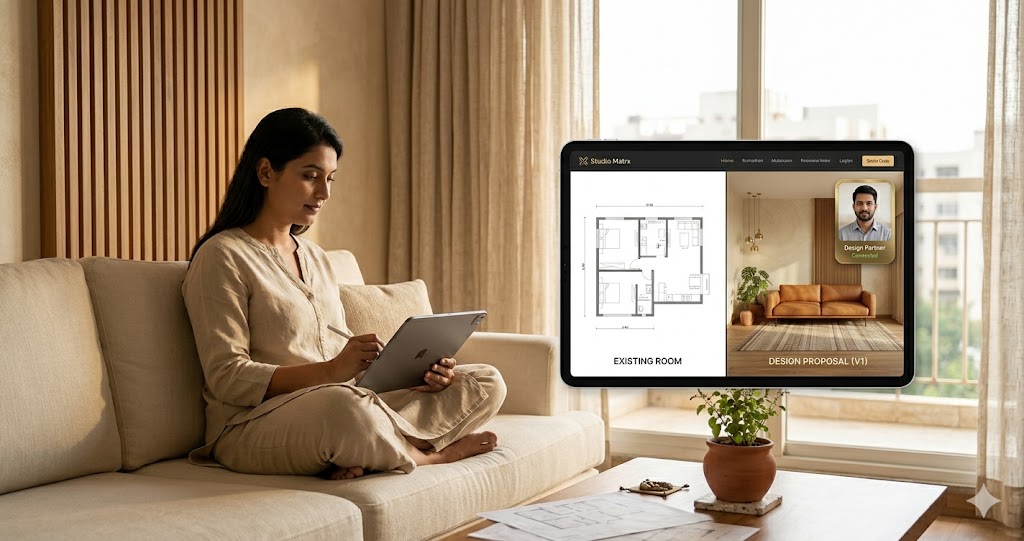
Virtual Interior Design — Human + AI + Hybrid Models for India (2026)
Four delivery models · Indian pricing · Hindi/Tamil/Kannada · Livspace vs Studio Matrx vs Modsy-style
Virtual interior design is not one thing. It is a 12-year-old industry that now contains four distinct delivery models — human virtual designers on Zoom, AI-first platforms like Studio Matrx, hybrid AI+human concierges, and VR walkthrough studios — bundled under one keyword. Anyone shopping the term in India 2026 is comparing apples to oranges to algorithms. Livspace's virtual consultation, HomeLane's Studio Connect, Bonito's online consult, Foyr Neo's 3D builder, Studio Matrx's text-to-render AI, and a VR walkthrough vendor in Whitefield are all "virtual interior design" — and they cost ₹0 to ₹2 lakh respectively for the same 2 BHK.
This guide untangles the four models, prices each honestly for Indian conditions, and tells you which one fits your project — not which one sells the most ads. Studio Matrx is the AI-first answer (free + Pro), but if you want a human designer who happens to work over video, this guide will point you to Livspace or Bonito and explain why. We do not yet ship the human-concierge layer; that is on our Q4 2026 roadmap.
"Virtual" tells you the channel — video, browser, headset. It tells you nothing about whether the design intelligence is a human, an algorithm, or both. Buyers who skip that question end up paying ₹1.5 lakh for what an AI does in 90 seconds, or expecting an AI to do what only a senior designer can.
Pair this with AI interior design for the AI-only slice, AI home design for whole-house planning, AI home visualization for render-first workflows, and choosing an interior designer in India when you decide the human route is right for you.
This guide refreshes every 12 months. Last verified: May 2026 · Next verify: May 2027.
What Virtual Interior Design Actually Means (and What It Doesn't)
Virtual interior design is any interior-design service delivered without the designer (or the design system) physically visiting your site during the design phase. The "virtual" describes the channel — Zoom, browser, web app, mobile camera, VR headset, AI chat — not the intelligence behind the design. That intelligence can be a senior human designer in Gurugram, a 27-year-old junior in a Livspace studio, an AI like Studio Matrx, or a hybrid where AI drafts and a human curates.
The term predates AI by more than a decade. Modsy (US, 2015–2022) and Havenly (US, 2014–present) built the original human-virtual-designer model: you upload photos and measurements, fill a style quiz, get matched with a human designer who works over chat and Zoom, and receive a 3D render plus a shoppable BoQ. Livspace and HomeLane brought localised versions of that model to India around 2017–2019. AI-first virtual designers — Studio Matrx, Foyr Neo, Interior AI, Decormatters — arrived 2020–2024 and compressed the same workflow into minutes. The 2026 frontier is the hybrid: AI does the 80 percent that is mechanical, a human does the 20 percent that is judgement, and the buyer pays a fraction of pure-human pricing.
Five things virtual interior design is NOT:
1. Not always AI. Roughly 70 percent of "virtual interior design" revenue in India 2026 still comes from human designers working over video — Livspace, HomeLane, Bonito, Pepperfry Studio, Decorpot. The AI-first slice is growing fast but is still under 15 percent of the market by revenue (it is closer to 40 percent by user count, because AI tools skew free or low-priced).
2. Not the same as a 3D rendering service. A rendering service takes a finished design (someone else's drawings) and produces photorealistic visuals. Virtual interior design includes the design decision itself — layout, palette, materials, BoQ — not just the picture.
3. Not a substitute for site supervision. Once construction or installation starts, you almost always need someone physically present — a site supervisor, contractor PM, or your own designated person. Virtual design ends at the BoQ and detailed drawings; execution is local-physical by definition.
4. Not always cheaper than in-person design. Livspace's "virtual package" for a 3 BHK still lands in the ₹1.2-1.8 lakh range — comparable to a mid-tier in-person Bengaluru independent designer. The cost saving from "virtual" is largely on the delivery overhead (no site visits during design), not on the design fee itself. AI-first tools are the dramatic price compression — Studio Matrx free + Pro at ₹999/year vs ₹1.5 lakh for a virtual human package.
5. Not appropriate for every project. Heritage restoration, complex structural reworks, very high-budget bespoke (₹1 crore+ interiors), and anything requiring intensive site investigation belongs with an in-person designer or architect. Virtual works best for standard 1-3 BHK apartments where the constraints are well-understood.
Why Virtual Interior Design Matters in 2026 India
Three structural shifts made virtual interior design the dominant channel in urban India by 2024, and the AI-augmented sub-segment the fastest-growing slice in 2025–2026.
First, geography. A senior interior designer based in Bandra cannot economically take a ₹40,000-budget 1 BHK project in Navi Mumbai if it requires four site visits. Virtual collapses the travel cost. The same designer can serve clients across MMR, Pune, Nashik, even Goa without leaving her studio. This expanded the addressable market for mid-tier designers by roughly 5x, and brought design services to tier-2 cities (Coimbatore, Mysuru, Vizag, Lucknow) that historically had thin local design capacity.
Second, COVID-era behaviour change. The 2020–2022 lockdowns forced both designers and homeowners to work over video. Livspace's virtual consult bookings grew 7x between March 2020 and December 2021 per their public statements; HomeLane reported similar numbers. The behaviour stuck — even post-pandemic, the first-contact channel for ~60 percent of urban Indian interior buyers in 2024 was video, not showroom (KPMG India home services tracker, 2024).
Third, the AI wedge. Free-tier AI tools (Interior AI, Decormatters, Studio Matrx free) created a new entry point: a homeowner explores 20 design directions on her phone before she ever speaks to a human designer. By the time she books a virtual consult with Livspace, she has a vocabulary, a palette, a style reference. This shortens the human-designer engagement and creates pressure on incumbent virtual-design players to integrate AI — or get undercut on price.
The seam Studio Matrx fills. Livspace and HomeLane are excellent at the human-virtual-designer model but their pricing assumes you want a full execution package (design + manufacturing + install). If you only want the design intelligence — a moodboard, a layout, a palette, a BoQ you can hand to your local contractor — you are over-paying. Studio Matrx is built for that gap: free for unlimited AI generations, ₹999/year Pro for export-ready BoQs and high-resolution renders. The honest weakness: we do not yet offer a human designer on top of the AI. If you want that, Livspace's virtual consult or a Studio Matrx-augmented independent designer (which several have started doing) is the answer today.
Virtual interior design did not replace in-person interior design. It did something subtler — it unbundled the design decision from the design delivery, and that unbundling is what lets a ₹999/year AI subscription and a ₹2 lakh human package coexist in the same market.
The Four Pillars That Matter
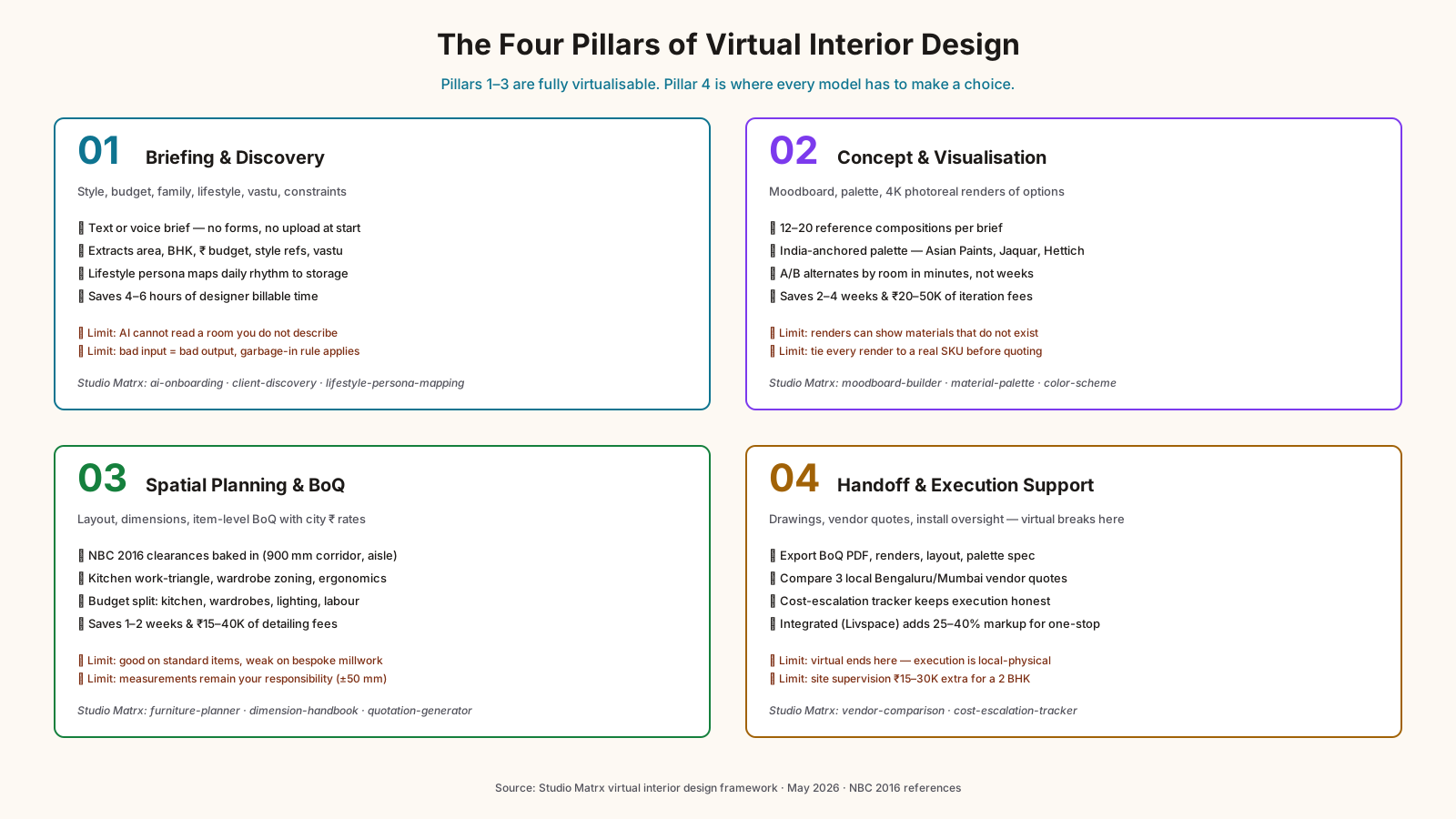
Any virtual interior design service can be measured against four pillars. The weight you give each pillar tells you which provider model fits.
| Pillar | What it does | Time/cost saved vs traditional | Studio Matrx flow that does it |
|---|---|---|---|
| Briefing & Discovery | Captures style, budget, family composition, lifestyle, constraints | 4-6 hours of designer billable time | client-discovery, lifestyle-persona-mapping, ai-onboarding |
| Concept & Visualisation | Moodboard, palette, photoreal renders of options | 2-4 weeks of iteration, ₹20-50K of designer fees | moodboard-builder, material-palette, color-scheme |
| Spatial Planning & BoQ | Furniture layout, dimensions, item-level BoQ with costs | 1-2 weeks, ₹15-40K of detailing fees | furniture-planner, dimension-handbook, budget-allocation, quotation-generator |
| Handoff & Execution Support | Drawings, vendor quotes, installation oversight | Variable — this is where pure-virtual breaks down | vendor-comparison, cost-escalation-tracker; execution itself is local |
Pillars 1-3 are fully virtualisable and AI-augmentable. Pillar 4 is where every virtual interior design service has to make a choice: outsource execution to local contractors (Studio Matrx, independent designers), or vertically integrate manufacturing and install (Livspace, HomeLane, Bonito). The integrated model is more convenient but adds 25-40 percent markup. The unbundled model is cheaper but pushes execution coordination back to you.
How Studio Matrx Does Virtual Interior Design — End-to-End Walkthrough
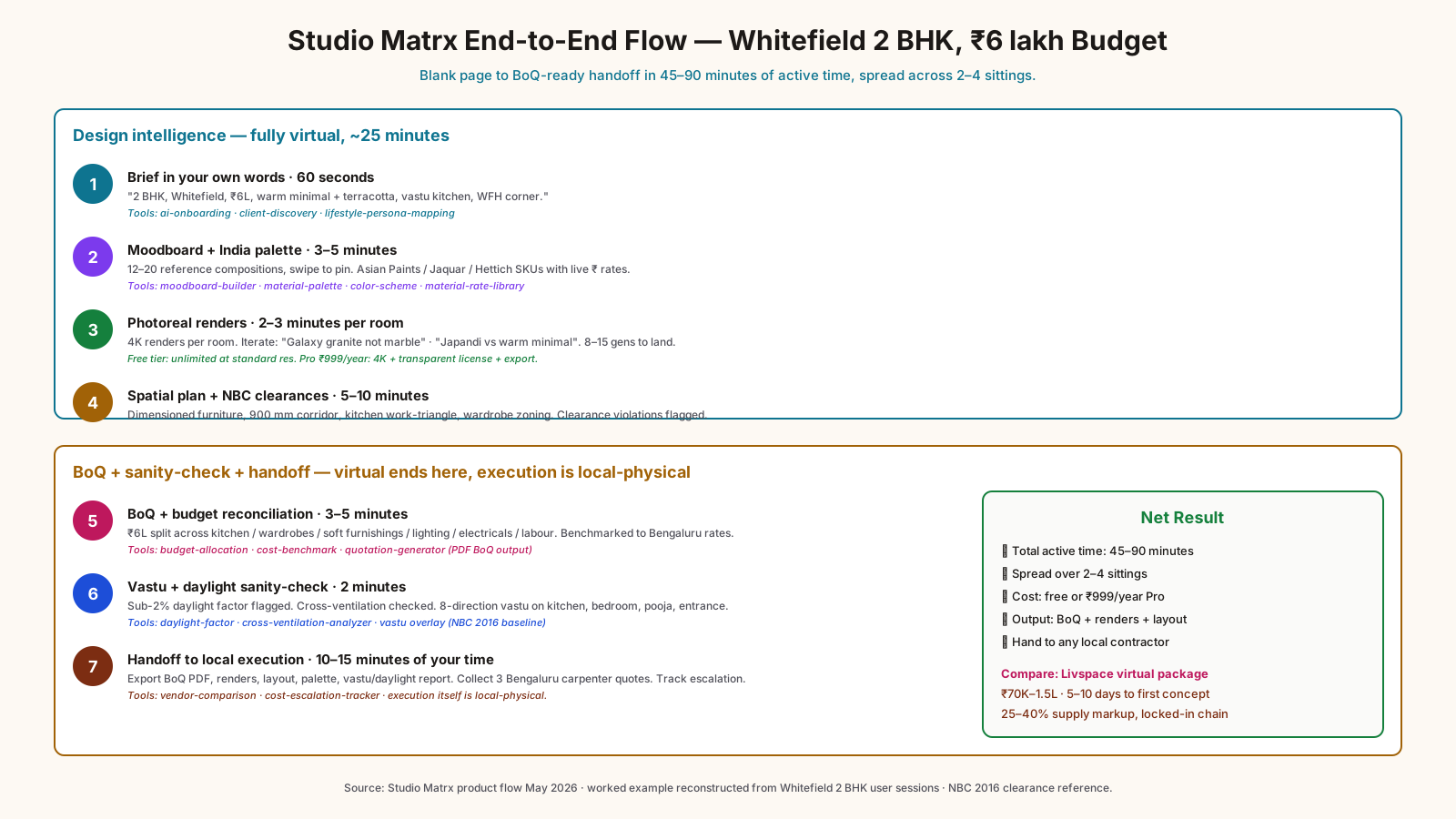
Here is the actual flow when an urban Indian homeowner — say, a Whitefield 2 BHK buyer with a ₹6 lakh interiors budget — uses Studio Matrx to do their virtual interior design end-to-end. No site visit, no human designer, no showroom.
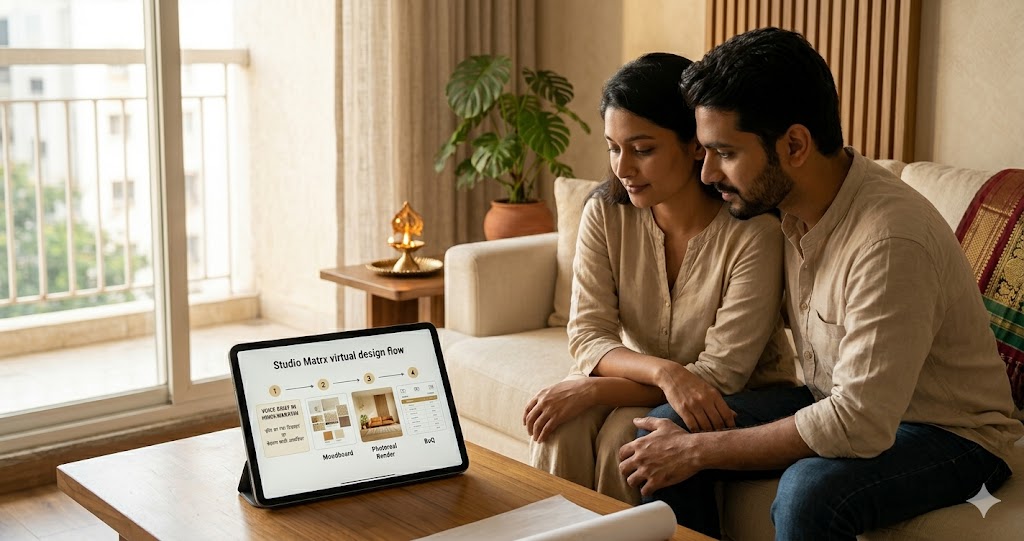
Step 1 — Brief in your own words (60 seconds). You land on studiomatrx.org. No login wall. You describe what you want in plain text or voice: "2 BHK, Whitefield, ₹6 lakh budget, warm minimal but with some terracotta, family of three, work-from-home corner needed, vastu-aware kitchen." The ai-onboarding flow extracts structured fields — area, BHK, budget, style references, vastu preferences, lifestyle — and routes you into the design canvas. No upload required at this stage. If you want richer personalisation, client-discovery and lifestyle-persona-mapping add another 3-5 minutes of structured prompts.
Step 2 — Moodboard and palette (3-5 minutes). moodboard-builder generates 12-20 reference compositions tagged to your brief. You swipe or pin. material-palette draws an India-vendor-anchored palette — Asian Paints / Jaquar / Hettich / Greenlam SKUs with current ₹ rates from material-rate-library. color-scheme lets you A/B alternates by room. Output: a moodboard PDF + a palette spec.
Step 3 — Photoreal renders (2-3 minutes per room). The generator produces 4K renders of each named room against your brief and pinned moodboard. You iterate — "make the kitchen counter Indian Granite Galaxy instead of marble", "show the same living room in earthy warm minimal vs Japandi". Most users land their preferred direction within 8-15 generations. Free tier supports unlimited generations at standard resolution; Pro (₹999/year) unlocks 4K, transparent licensing, and export to detailed drawings.
Step 4 — Spatial plan and furniture layout (5-10 minutes). furniture-planner drops dimensioned furniture into your floor plan with NBC 2016 / IS code clearances baked in (corridor widths, kitchen aisle, bedroom turning radius). dimension-handbook and ergonomics-guide flag any clearance violations. If the kitchen layout matters, kitchen-rulebook checks the work triangle and wardrobe-planning does the closet detailing.
Step 5 — BoQ and budget reconciliation (3-5 minutes). budget-allocation breaks your ₹6 lakh across kitchen / wardrobes / soft furnishings / lighting / electricals / labour with India-typical splits. cost-benchmark compares your line items to current Bengaluru/Mumbai/Delhi rates. quotation-generator produces a PDF BoQ you can email to three contractors for competitive quotes.
Step 6 — Vastu and daylight sanity-check (2 minutes). daylight-factor flags rooms with sub-2 percent daylight factor (NBC 2016 baseline). cross-ventilation-analyzer checks the cross-flow. The vastu overlay runs the kitchen, master bedroom, pooja room, and entrance against eight-direction rules — see vastu for kitchen, vastu for bedroom, and entrance vastu for the underlying logic. If you have a deeper vastu sensitivity, vastu modern homes explains how to reconcile the two.
Step 7 — Handoff to execution (10-15 minutes of your time). You export: the BoQ PDF, the room renders, the furniture layout with dimensions, the palette spec sheet, and the vastu / daylight report. vendor-comparison helps you collect three quotes from local Bengaluru carpenters / modular kitchen vendors. cost-escalation-tracker keeps execution honest once work starts. This is where Studio Matrx hands off — execution itself is local-physical. We do not (yet) provide a turnkey installation service; we are an AI design intelligence layer, not a contractor.
Total time from blank page to BoQ-ready package: typically 45-90 minutes of active homeowner time, spread over 2-4 sittings. Total cost: free if you stay on the free tier, ₹999/year for Pro export quality. Compare to the next section.
Virtual Interior Design vs Traditional In-Person Design
| Criterion | AI-first virtual (Studio Matrx) | Human virtual (Livspace, HomeLane) | Traditional in-person designer | Winner |
|---|---|---|---|---|
| Time to first concept | 5-15 minutes | 5-10 days (after consult) | 2-4 weeks | AI-first by 100x |
| Cost for a 2 BHK | Free or ₹999/year | ₹70K-1.5L design + execution markup | ₹40K-2L design fee (excl. execution) | AI-first |
| Iteration cost | Free, unlimited | 2-3 revisions included, extra at ₹3-5K each | 1-2 revisions, extra billed hourly | AI-first |
| Style range explored | 20-50 directions easy | 2-4 directions typical | 1-3 directions | AI-first |
| Senior-designer judgement | None (algorithm) | Variable — senior or junior depending on package | Yes (the whole point) | In-person, with caveat |
| Site investigation | None | Photo-based, sometimes 1 visit | 2-5 visits | In-person |
| BoQ accuracy | Good for standard items, weak on custom millwork | Excellent — tied to integrated supply | Excellent if designer is experienced | Tie (in-person / human virtual) |
| Execution oversight | None — you coordinate | Included in package | Negotiable, usually billed extra | Human virtual (if integrated) |
| Cultural/Vastu fluency for India | Built-in (Studio Matrx) | Variable by designer assigned | Strong if local designer | Tie |
| Best for | Tight budget, exploratory, fast | Mid-budget, want one-stop | Premium, custom, complex | Depends on project |
The honest verdict: virtual AI (Studio Matrx) wins on speed, cost, and exploration. Virtual human (Livspace, HomeLane, Bonito) wins on convenience and execution integration. In-person wins on judgement, site work, and bespoke complexity. The 2026 hybrid model — AI drafts, human curates, local contractor executes — is the most cost-effective for projects in the ₹4-15 lakh range. See budget luxury interiors for how this hybrid plays out when the budget is tight but the ambition is not.
Tool Landscape 2026
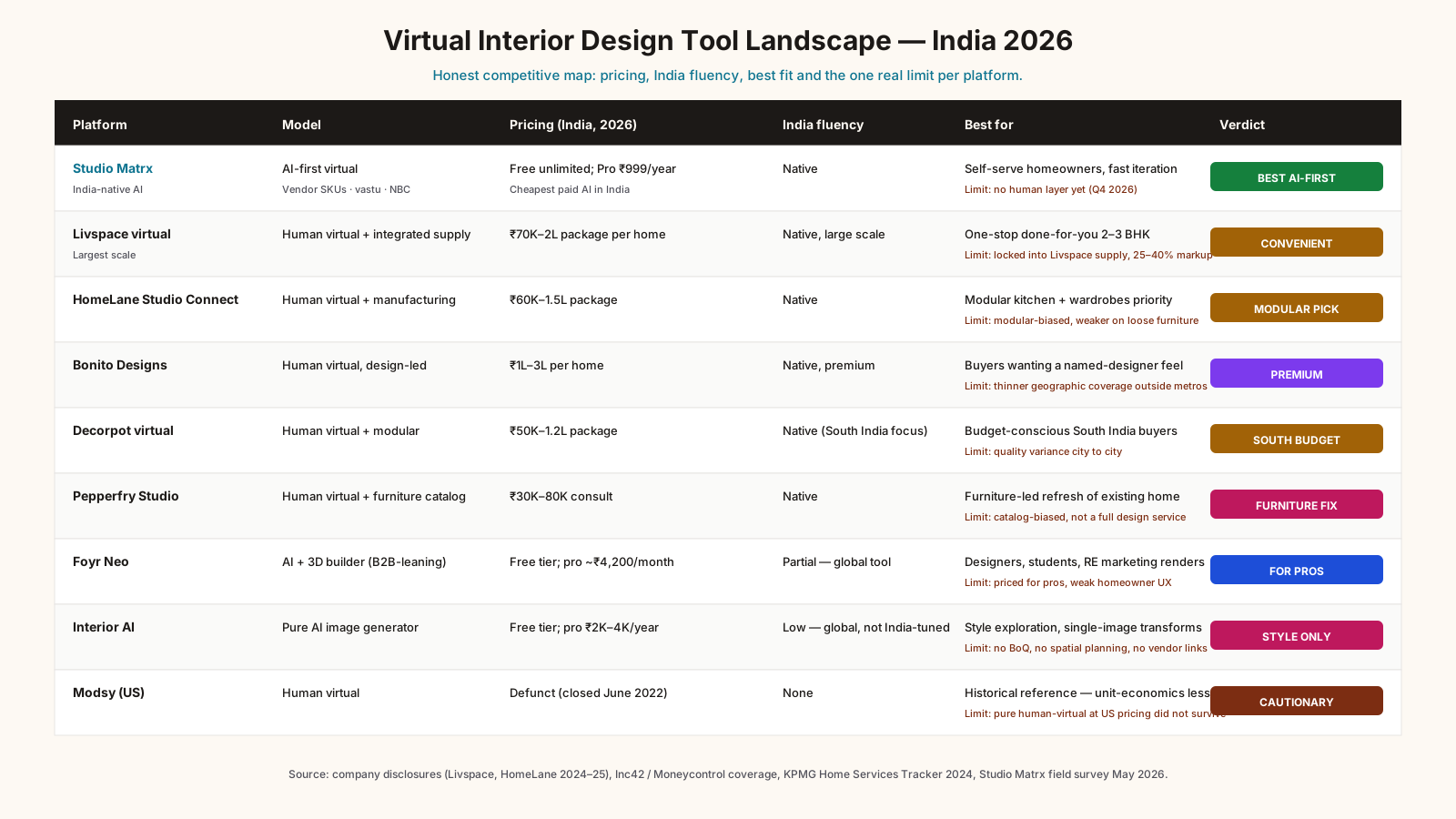
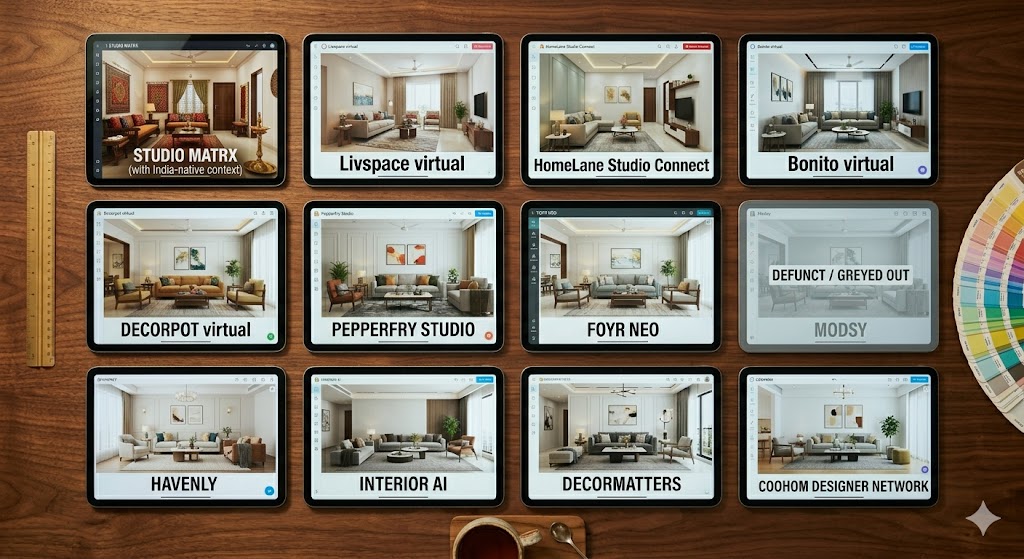
The 12-row map below is the honest competitive picture as of May 2026. Pricing is current; capabilities are based on what each platform actually ships, not marketing copy.
| Platform | Model | Pricing (India, 2026) | India fluency | Best for | Honest limit |
|---|---|---|---|---|---|
| Studio Matrx | AI-first virtual | Free unlimited; Pro ₹999/year | Native — vendor SKUs, vastu, NBC | Self-serve homeowners, designers wanting fast iteration | No human designer layer yet; Q4 2026 roadmap |
| Livspace virtual | Human virtual + integrated supply | ₹70K-2L package per home | Native, large scale | One-stop done-for-you 2-3 BHK | Locked-in to Livspace supply chain; pricier per sq ft than independents |
| HomeLane Studio Connect | Human virtual + manufacturing | ₹60K-1.5L package | Native | Modular kitchen + wardrobes priority | Heavily modular-furniture-biased; weaker on loose furniture and styling |
| Bonito Designs | Human virtual, design-led | ₹1L-3L per home | Native, premium positioning | Buyers who want a "named" designer feel | Smaller scale; geographic coverage thinner outside metros |
| Decorpot virtual | Human virtual + modular | ₹50K-1.2L package | Native | Budget-conscious South India buyers | Quality variance city to city |
| Pepperfry Studio | Human virtual + furniture catalog | ₹30K-80K consult | Native | Furniture-led refresh of existing home | Catalog-biased; not a full design service |
| Foyr Neo | AI + 3D builder, B2B-leaning | Free tier; pro $50/month (~₹4,200) | Partial — global tool, India SKUs limited | Designers, students, real estate marketing renders | Pricing geared to professionals; weak homeowner UX |
| Modsy | Human virtual (US) | Defunct (closed June 2022) | None | Historical reference only | Closed — proves the unit economics of pure-human virtual are hard |
| Havenly | Human virtual (US) | $79-$499 per room | None | US market | Not available in India |
| Interior AI | Pure AI image generator | Free tier; ₹2K-4K/year pro | Low — global, not India-tuned | Style exploration, single-image transforms | No BoQ, no spatial planning, no vendor links |
| Decormatters | AI + community + AR | Free; in-app purchases | Low | Casual styling, mobile-first | Game-like; not production-ready for execution |
| Coohom Designer Network | Human virtual marketplace | ₹15K-1L per project | Variable — depends on designer assigned | Buyers comfortable picking from a designer panel | Quality wildly variable; QA depends on you |
A few things this table makes visible. The Indian human-virtual market is dominated by four players (Livspace, HomeLane, Bonito, Decorpot) who collectively serve roughly 70 percent of urban package buyers. The AI-first market is fragmented, with Studio Matrx as the India-native answer, Foyr Neo as the prosumer 3D builder, and Interior AI / Decormatters as the casual generators. Modsy's 2022 collapse is the most important data point for buyers and competitors alike — pure human-virtual at US pricing did not survive the unit-economics test, and India players have responded by integrating supply (Livspace, HomeLane) or going AI-first (Studio Matrx).
Eight Risks, Pitfalls and Honest Limits
1. The "virtual designer" you talk to may be a junior. Livspace, HomeLane, and Bonito all run a senior-designer-pitch / junior-designer-execution model on packages below ₹1.5 lakh. The senior you meet on the sales call is rarely the one who detail-designs your home. Mitigation: ask explicitly who will be your project lead, request their portfolio, and ask to see two previously delivered homes from the same designer.
2. AI renders mislead on materials. A photoreal AI render can show a marble that does not exist in any Indian quarry at any reasonable price. Mitigation: tie every render to a specific SKU via material-palette. On Studio Matrx, the palette is anchored to Indian vendors — if it shows the material, it exists and is sourceable.
3. Measurements are your responsibility. Virtual design (any provider) starts from your measurements. A 50 mm error on a wardrobe niche means a custom remake. Mitigation: use a laser distance meter, double-measure, and have a local carpenter validate critical dimensions before manufacture. AI cannot fix bad input.
4. Vendor lock-in on integrated packages. Livspace / HomeLane / Bonito packages route you to their supply chain. The convenience is real; the markup is also real — typically 25-40 percent over equivalent local-vendor pricing. Mitigation: get one independent quote on the BoQ before committing. If your design intelligence is virtual (Studio Matrx or independent designer) and your execution is local, you avoid the markup but absorb coordination effort.
5. No site supervision is the silent killer. Virtual design ends at handoff. If nobody is on site during execution, expect 15-30 percent of details to drift from the design. Mitigation: either pay for a local site supervisor (₹15-30K for a 2 BHK), make weekend site visits yourself, or pick an integrated provider where supervision is bundled.
6. AI hallucinations on India-specific rules. Generic global AI tools (Interior AI, midjourney) do not know NBC 2016 corridor widths, kitchen ventilation requirements, or vastu directional rules. They will produce plans that violate code or culture. Mitigation: use India-native AI (Studio Matrx) or have a local designer review the plan before execution. Don't ship a foreign-AI plan to your contractor unreviewed.
7. DPDP Act 2023 compliance on photo uploads. Every virtual design service asks for photos of your home. Many do not have a clean DPDP-compliant retention and deletion policy. Mitigation: read the privacy policy. Studio Matrx commits to user-controlled deletion of generated artefacts and source images; check the equivalent commitment on any service you use.
8. The "one-room test" trap. Several services offer cheap or free one-room design to hook you into a whole-home package. The one-room output may be excellent precisely because the senior designer worked it. Whole-home output regresses to package quality. Mitigation: judge the service on a whole-home test, not a single hero room.
India-Specific Considerations
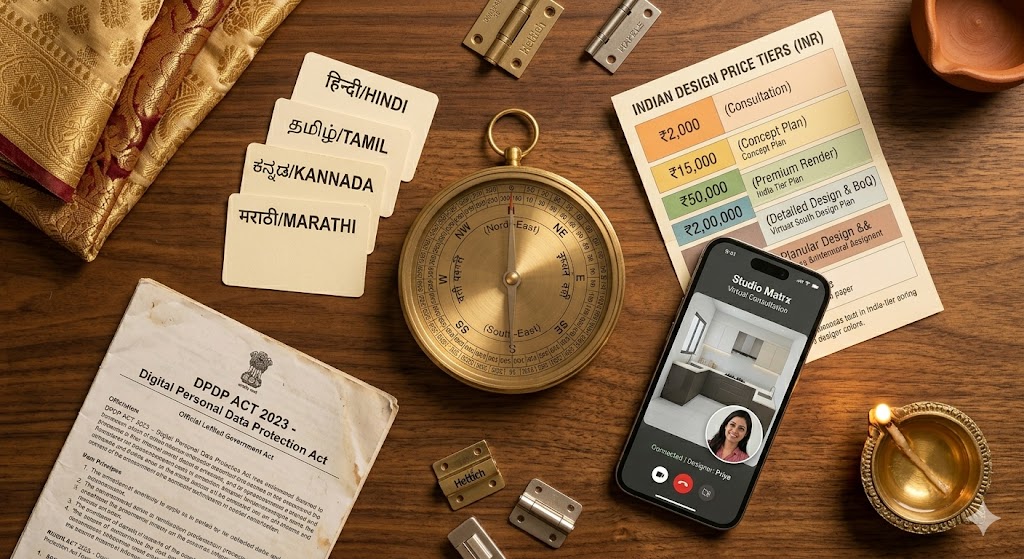
Virtual interior design built for the US or EU does not survive contact with Indian conditions. Six factors define the India context.
NBC 2016 compliance. The National Building Code mandates minimum corridor widths (900 mm in residential), kitchen ventilation provisions, daylight factors (2 percent for habitable rooms), and staircase rise/tread ratios. Any virtual design service that does not validate against NBC will produce plans that fail occupancy or just live uncomfortably. Studio Matrx's furniture-planner, daylight-factor, and cross-ventilation-analyzer bake NBC checks into the flow.
IS codes for materials and finishes. IS 14837 (plywood), IS 2202 (wooden doors), IS 1726 (steel), IS 13164 (modular kitchens — partial). Your BoQ should reference IS-graded materials; if it does not, you cannot enforce quality at delivery. Studio Matrx's material-rate-library tags items to IS grades where applicable.
DPDP Act 2023. The Digital Personal Data Protection Act regulates how interior design platforms collect, store, and share your home photos, floor plans, contact details, and biometric data. Lawful basis, retention period, deletion right, and grievance officer must all be exposed in the privacy policy. Most India-launched virtual design platforms have updated; some smaller players have not.
Vastu compatibility. Roughly 55-70 percent of urban Indian homeowners apply some vastu lens to interior decisions — kitchen direction, master bedroom orientation, pooja room placement, entrance treatment. A virtual design service that does not handle vastu inputs forces you into a parallel manual checklist. Studio Matrx integrates the eight-direction vastu overlay across kitchen, bedroom, entrance, and pooja room — see pooja room design India and the broader vastu suite.
Regional vendor reality. Bengaluru, Mumbai, Pune, Hyderabad, Delhi NCR, Chennai, Kolkata, Ahmedabad, Coimbatore — each has a different vendor ecosystem, rate card, and lead time. A virtual design BoQ that quotes Mumbai marble rates for a Coimbatore project is useless. Studio Matrx's cost-benchmark and material-rate-library are city-tagged.
Language. Hindi, Tamil, Kannada, Telugu, Marathi, Bengali, Gujarati, Malayalam — at least 6 of these matter for serving the urban interior design market. Livspace and HomeLane run multi-lingual consultants. Studio Matrx's AI handles Hindi and Tamil briefs well in May 2026; Kannada, Telugu, Marathi, and Bengali are usable but less polished — full Indian-language parity is on the H2 2026 roadmap.
Climate zones. Hot-dry (Jodhpur, Ahmedabad), warm-humid (Mumbai, Chennai, Kochi), composite (Delhi, Bengaluru), cold (Shimla, Srinagar), temperate (Pune, parts of Karnataka). Material selection, ventilation, daylighting, and even palette psychology change with climate zone. A generic "minimal beige" works for Bengaluru and dies in Chennai humidity (mould risk on certain finishes). India-tuned virtual design respects this; global tools usually don't.
The Studio Matrx Stack for Virtual Interior Design
The following tools and flows are the spine of Studio Matrx's virtual interior design offering. Each is free on the standard tier; export and 4K render quality are Pro.
- ai-onboarding — Text or voice brief; extracts structured fields without making you fill a form.
- client-discovery — Deeper structured brief for designers serving a client.
- lifestyle-persona-mapping — Translates a family's daily rhythm into spatial and storage requirements.
- moodboard-builder — Generates 12-20 visual directions per brief; swipe to refine.
- material-palette — India-vendor-anchored palette (Asian Paints, Jaquar, Hettich, Greenlam, Centuryply).
- color-scheme — Room-by-room palette permutations.
- furniture-planner — NBC-clearance-aware spatial layout.
- kitchen-rulebook — Work-triangle validation, India kitchen ergonomics.
- wardrobe-planning — Closet zoning and shutter detailing.
- daylight-factor and cross-ventilation-analyzer — NBC daylight and ventilation checks.
- budget-allocation and cost-benchmark — India-rate-card budget split and benchmarking.
- quotation-generator — BoQ PDF for contractor handoff.
- vendor-comparison — Side-by-side quote comparison across local vendors.
- cost-escalation-tracker — Keeps execution costs honest after handoff.
When NOT to Use Virtual Interior Design
Virtual interior design is the right answer for the majority of urban 1-3 BHK projects in India. It is the wrong answer in five clear cases.
Heritage restoration. A 1920s Mumbai chawl, a Pondicherry French-quarter house, a Goa Indo-Portuguese villa — these need an architect or conservator who can read the existing fabric. Virtual does not substitute for the trained eye on site.
Structural reworks. Removing a wall, adding a mezzanine, opening a stair core — anything that touches the load path needs a structural engineer's physical site assessment. Virtual interior design must explicitly stop at the structural envelope.
Very high-budget bespoke (₹1 crore+ interiors). At this budget, the design value is in the bespoke detail — joinery you have never seen, materials you specify by hand from a quarry, lighting layered by a senior consultant. Virtual platforms scale by standardising; the bespoke premium loses that standardisation. Use a senior in-person designer.
Complex site investigations. Acoustically problematic site (next to a flyover), severe damp, structural settlement, leaking neighbours — anything that demands forensic site investigation. A photo-based virtual brief misses what a physical walk-through catches in five minutes.
Buyers who genuinely cannot evaluate visual options. A small fraction of homeowners find it genuinely hard to make decisions from images and renders; they need to touch the marble, sit on the sofa, walk the showroom. Virtual asks the buyer to do most of the decision work in their head. If that is not your strength, a showroom-led in-person designer will serve you better.
The 5-Year Trajectory: Virtual Interior Design in 2030
By 2030, three shifts will reshape what "virtual interior design" means.
First, the AI-human hybrid becomes the default mid-market model. AI handles concept, palette, BoQ, and 80 percent of detailing. A human senior reviews, curates, and resolves the 20 percent that needs judgement. Pricing for a full 2 BHK virtual design lands around ₹15-30K for the design-only layer (not including execution), down from the ₹70K-1.5L package pricing of 2026. Studio Matrx is building toward this hybrid via the Pro Member layer and the Q4 2026 concierge tier.
Second, VR walkthroughs go mainstream. Apple Vision Pro and successor devices, plus Meta Quest 4/5 generation, make a one-hour VR walkthrough of your future home a normal purchase decision. Pre-construction VR experiences become a standard upsell — bundled into virtual design packages by 2028, table-stakes by 2030. Studio Matrx's VR walkthrough capability is on the 2026 H2 roadmap; full immersive walkthrough is targeted for 2027.
Third, the BoQ becomes machine-readable and quote-comparable. Today, every contractor in Bengaluru produces a different BoQ format, making comparison painful. By 2030, India-native virtual design platforms will publish a standardised BoQ schema (likely industry-led, possibly BIS-supported) that contractors quote against directly. This collapses the vendor-comparison effort from days to minutes. Studio Matrx's quotation-generator and vendor-comparison are early movers on this standardisation.
The deeper trajectory: virtual interior design stops being a channel and becomes the medium. The default starting point for an Indian homeowner planning a 2 BHK refresh in 2030 is not "find a designer" — it is "open the AI", iterate for an hour, then decide whether you want a human in the loop. Studio Matrx is building for that default future.
Frequently Asked Questions
Is virtual interior design the same as AI interior design?
No. Virtual interior design is the broader category — any design service delivered without site visits during design. AI interior design is a sub-segment of virtual where the design intelligence is an algorithm rather than a human. Livspace's video consultation with a human designer is virtual but not AI. Studio Matrx is virtual and AI. The terms overlap but are not synonymous. See AI interior design for the AI-only view.
Studio Matrx vs Livspace virtual — which fits a Mumbai 2 BHK?
It depends on your budget and how much execution help you want. A Mumbai 2 BHK with ₹4-7 lakh interiors budget, where you have a local contractor you trust (or can pick one), is served best by Studio Matrx Pro (₹999/year) — you'll spend roughly 6-10 hours total on design and save the ₹70K-1.5L Livspace would charge for the design + supply package. A Mumbai 2 BHK with ₹8-15 lakh budget and zero contractor relationships is often better served by Livspace's full package — convenience is real, and the supply integration removes coordination headache. Many sophisticated buyers in 2026 do both: design on Studio Matrx, then engage Livspace or a local independent for execution.
How much does virtual interior design cost in India?
The honest answer: anywhere from free to ₹2 lakh, depending on model. Pure AI (Studio Matrx free, Interior AI free, Decormatters free) is ₹0. AI Pro tiers are ₹500-5,000 per year. Human virtual single-room consults are ₹2,000-5,000. Human virtual whole-home packages range ₹50,000-2 lakh (Livspace, HomeLane, Bonito, Decorpot). The hybrid AI+human concierge tier emerging in 2026 sits at ₹15,000-30,000 for design-only. Add execution on top — typically 4-7 times the design fee for a standard 2 BHK in metros.
Can I get a virtual consultation in Hindi/Tamil/Kannada?
Yes for human-virtual services — Livspace, HomeLane, Bonito all run multi-lingual consultants on request; the booking flow lets you specify language. For AI tools, language support varies. Studio Matrx handles Hindi and Tamil briefs well as of May 2026; Kannada, Telugu, Marathi, and Bengali are usable but less polished — full parity is targeted for H2 2026. Foyr Neo and Interior AI are English-primary. If language is a hard constraint, human-virtual is the safer pick today; AI is closing the gap fast.
Does virtual interior design include site supervision?
Mostly no. Virtual design ends at the BoQ and detailed drawings handoff. Integrated packages (Livspace, HomeLane, Bonito) bundle install supervision but only for their own manufactured items; loose furniture, painting, and electrical typically still need separate oversight. AI-first tools (Studio Matrx) do not include site supervision at all — you either supervise yourself, hire a local site supervisor (₹15-30K for a 2 BHK), or accept some execution drift. This is the single most under-communicated limit of the virtual model.
Is virtual interior design refundable if I don't like the output?
For AI tools on free tiers (Studio Matrx free, Interior AI free), there is nothing to refund — you used the free generation. For paid AI subscriptions (Studio Matrx Pro ₹999/year), refund policies vary; Studio Matrx offers a 7-day refund on annual subscriptions. For human-virtual packages (Livspace, HomeLane), refund terms are weak after the second revision — most retain 30-50 percent of design fees as the design has been delivered. Always read the refund clause before paying a human-virtual package fee.
Can virtual interior design handle a full villa or duplex, not just a 2 BHK?
Yes for human-virtual at the higher pricing tiers (Bonito Designs, premium Livspace tiers, independent designers running virtual). For AI-first tools, the practical complexity ceiling in May 2026 is around 4 BHK / 2,500 sq ft — beyond that, you start hitting the limits of what AI can spatially reason about coherently across many rooms. For villas, duplexes, and 4,000+ sq ft homes, a human designer (in-person or virtual) is still the right answer, with AI used as an accelerator.
Do virtual interior designers do vastu?
Some yes, some no. Most India-based human-virtual services will accommodate vastu requirements if you ask (Livspace, HomeLane, Bonito, Decorpot). Most India-native AI tools include vastu overlays (Studio Matrx is built-in). Global AI tools (Interior AI, Decormatters) typically do not. If vastu compliance is non-negotiable, screen for it explicitly at the consult or tool-selection stage. See vastu modern homes for how vastu and modern design coexist.
Does Studio Matrx have a human designer option?
Not in May 2026. Studio Matrx is currently a pure AI-first virtual platform — no human design layer included. A concierge tier with human design review and project management is on the Q4 2026 roadmap. If you want a human in the loop today, the most common path is: design on Studio Matrx for free, then engage a local independent designer to review and execute against the BoQ. Several Bengaluru, Mumbai, and Delhi NCR designers actively use Studio Matrx output as a starting point — this is the emergent hybrid model.
How do I pick between AI-first and human-virtual?
A simple rule: if your budget is under ₹6 lakh and you have or can get a local contractor, AI-first (Studio Matrx) is almost always the right answer — the cost saving on design is meaningful and the AI is good enough. If your budget is ₹6-15 lakh and you have no contractor relationships and value convenience, human-virtual integrated packages (Livspace, HomeLane) are worth the premium. If your budget is ₹15 lakh+ or the project is complex, in-person or premium human-virtual with a senior designer wins. AI tools also work as a pre-step before any of the other paths — exploring directions for free before paying anyone.
References
1. KPMG India. Home Services Tracker — Interior Design and Renovation Segment. 2024. https://kpmg.com/in/en.html
2. IBEF. Indian Real Estate Industry Report. 2025 update. https://www.ibef.org/industry/real-estate-india
3. Statista. Online Furniture and Home Decor Market — India. 2025. https://www.statista.com/outlook/cmo/furniture/india
4. Bureau of Indian Standards. National Building Code of India 2016. Part 3 (Development Control Rules and General Building Requirements), Part 4 (Fire and Life Safety), Part 8 (Building Services). https://www.bis.gov.in/
5. Ministry of Electronics and Information Technology, Government of India. Digital Personal Data Protection Act, 2023. https://www.meity.gov.in/data-protection-framework
6. Bureau of Indian Standards. IS 14837 (Plywood for general purposes), IS 2202 (Wooden flush door shutters), IS 1726 (Cast iron manhole covers and frames). https://www.bis.gov.in/
7. Houzz. India Renovation Trends Study. 2023. https://www.houzz.in/
8. Livspace. Annual Report and Public Disclosures. 2024-2025. https://www.livspace.com/
9. HomeLane. Company Disclosures and Industry Briefings. 2024-2025. https://www.homelane.com/
10. The Ken / Inc42 / Moneycontrol coverage of Modsy closure. June 2022. https://inc42.com/ (representative archive of virtual design unit economics commentary)
11. RICS India. Construction Cost Indices for Indian Metros. 2025. https://www.rics.org/india
12. Council of Architecture (CoA), India. Practice Standards and Scope of Service. 2023 revision. https://www.coa.gov.in/
13. Ministry of Housing and Urban Affairs, Government of India. Smart Cities Mission and Urban Housing Updates. 2024-2025. https://mohua.gov.in/
14. NASSCOM. AI Adoption in Indian Consumer Internet — Sector Report. 2024. https://nasscom.in/
15. Bain & Company. India Consumer Outlook 2025: Home and Lifestyle. 2025. https://www.bain.com/insights/
Related Guides
- AI interior design — the AI-only sub-segment of virtual design, deep dive.
- AI home design — whole-home planning with AI from layout to BoQ.
- AI room planner — focused look at AI-driven spatial planning per room.
- AI home visualization — render-first workflows and the visualization stack.
- Choosing an interior designer in India — when you decide the human route is right.
- Budget luxury interiors — making the AI-design + local-execute hybrid look high-end at ₹6-12 lakh.
Export this guide
Related Guides — Deep-dive reading
AI Home Visualization — Decision-Maker Lens for Indian Homeowners (2026)
Compare 3 wall colors · A/B sofa options · Phone AR · Studio Matrx walkthrough · Render-to-reality fidelity
Design StylesAI Render Generator — Photoreal AI Rendering for Indian Architects + Designers (2026)
Sketch/photo/white-box → photoreal · 12 min vs V-Ray 4 hr · Studio Matrx + Lumion + D5 + Twinmotion + Enscape
Design StylesAI Interior Design — A 2026 Consumer Cornerstone for Indian Homes
Six capabilities · Studio Matrx walkthrough · India-native vs US tools · DPDP-safe
Design StylesRelated Tools — Try Free
Cross-Ventilation Analyzer
Estimate airflow and air changes per hour (ACH) from room size, window areas, layout, and local wind — with NBC 2016 Part 8 compliance check.
Ventilation CalculatorApartment Interior Planning Checklist
51-item checklist across structural, ceiling, lighting, furniture, storage, electrical, kitchen, bathroom.
ChecklistApartment vs Villa Interior Planning Guide
Compare ceiling height, structural flexibility, lighting, storage, and services between apartments and villas.
Planning Guide