
What Is Critical Regionalism?
Modern architecture rooted in place — resisting the placeless global box while embracing the present
Stand in the courtyard of a Charles Correa house on a Mumbai afternoon and you feel two things at once. There is the cool, abstract clarity of modern architecture — a clean concrete frame, an honest plan, no fuss, no fake cornices. And there is something the international glass tower can never give you: a slot of sky overhead, a draught of monsoon-heavy air pulled up through the section, the deep shade of a verandah, the particular ochre of local plaster catching low evening light. The building is modern. It is also, unmistakably, of this place and no other.
That doubleness is the whole idea. Critical Regionalism is the architecture that refuses to choose between the global and the local — that takes the power of modern construction and the wisdom of a specific place, and holds them in deliberate tension.
At its core, Critical Regionalism mediates between universal modern civilisation and the irreducible specifics of a place — its climate, light, topography, culture and craft — without ever lapsing into sentimental, costume-drama revivalism. It is "critical" precisely because it filters both sides: it strips modernism of its placeless uniformity, and it strips the local of its kitsch nostalgia, keeping only what genuinely serves the building and the people who live in it.
What Critical Regionalism actually is
By the 1970s, modern architecture had won — and that was the problem. The same curtain-walled office block could be dropped into Frankfurt, Lagos, Singapore or Chandigarh with barely a tweak. The philosopher Paul Ricoeur named the anxiety: how does a culture "become modern and return to sources" at the same time? How do you join the great rationalist project of "universal civilisation" without dissolving your own identity into it?
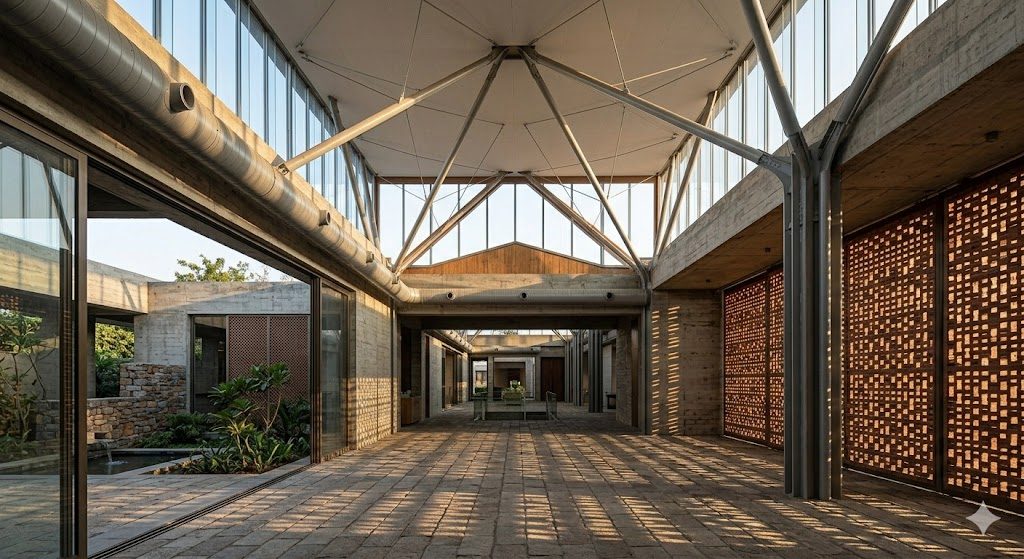
Critical Regionalism is one of the most intelligent answers ever offered to that question. It is not a style you can copy from a pattern book. It is a strategy — an attitude toward design that says: begin with the universal tools of modernity (reinforced concrete, the free plan, structural honesty, the discipline of abstraction), and then bend, filter and ground them through everything that makes a particular site particular.
The word "critical" is doing real work. A naive regionalism just imitates the old local buildings — slap a sloping tile roof and a few carved brackets on a concrete box and call it "traditional." Critical Regionalism rejects that as theatre. It is equally suspicious of the universal box. It interrogates both, and admits only what passes the test of place and use. As the figure below shows, the movement lives in the filter between two extremes.
The result is an architecture that feels both contemporary and deeply settled — a building you could not lift and set down anywhere else.
Where the idea came from
The term was coined in 1981 by the architectural theorists Alexander Tzonis and Liane Lefaivre, who used "critical regionalism" to describe work that drew on regional identity but held it at a self-aware, critical distance — regionalism that knew it could not simply return to a pre-modern past.
But the idea found its manifesto two years later. In 1983, the British-American critic Kenneth Frampton published the essay that defined the movement: "Towards a Critical Regionalism: Six Points for an Architecture of Resistance," in Hal Foster's anthology The Anti-Aesthetic. Frampton, drawing on Ricoeur and on the Frankfurt School, framed it as resistance — resistance to the "placeless" universalism of late-capitalist building, and equally to the empty image-making of early postmodernism, which he dismissed as "scenographic," a stage-set of borrowed historical signs.
Crucially, Frampton did not invent the buildings. He was reading backward from architects already working this way — figures who had quietly fused modernism with their own climates and cultures for decades. The essay gave a scattered instinct a name and an argument.
"Critical regionalism... has to be understood as a marginal practice, one which... reflects and serves the limited constituencies in which it is grounded." — Kenneth Frampton, 1983
The lineage runs straight through the heroes of mid-century modernism who never accepted the placeless box: Alvar Aalto in Finland, whose Säynätsalo Town Hall and Villa Mairea wrapped brick, timber and forest light around a modern plan; Jørn Utzon of Denmark, whose work fused the structural daring of the Sydney Opera House with a deep reading of platforms and landscape; Luis Barragán in Mexico, who married modern geometry to the colour, water and burning light of his country; Álvaro Siza and the Porto School in Portugal, threading lean modern forms through awkward, specific sites; Rafael Moneo in Spain; Tadao Ando in Japan, with his silent concrete chambers tuned to a single shaft of light; and Glenn Murcutt in Australia, who took the Aboriginal maxim "touch the earth lightly" as a design ethic, building featherweight steel-and-corrugated-iron pavilions exquisitely tuned to sun, wind and rain.
Frampton's six points, in plain language
The six points are often quoted and rarely explained. Stripped of the theory, here is what each one asks a building to do.

| # | Point | What it means in practice |
|---|---|---|
| 1 | Culture and civilisation | Hold the universal (technology, reason) and the rooted (a specific culture) in tension. Don't pick a side; mediate. |
| 2 | The rise and fall of the avant-garde | A "self-conscious" regionalism that comes after the heroic avant-garde — not utopian, not nostalgic, but critical and aware. |
| 3 | Place-form over endless space | Make a bounded domain — a place with an edge, a threshold, a room — instead of the boundless, placeless flow of sprawl. |
| 4 | The tectonic, not the scenographic | Architecture is a constructed fact: joint, beam, span and load, honestly expressed — not a flat "scenery" of applied images. |
| 5 | Climate, light and topography | Let the sun, the wind, the rain and the slope of the land shape the building. Local light is design data, not a problem to seal out. |
| 6 | The visual versus the tactile | Engage the whole body — texture, temperature, the sound of a step, the weight of a door — not just the eye behind a camera. |
Two of these matter most for everyday building. Point five is the one a homeowner feels every day: a Critical-Regionalist house responds to your climate, not a generic one. Point six is its soul — Frampton insisted that the deepest architecture is tactile, known through the body, resisting our culture's reduction of buildings to flattering photographs. A jali screen is not just a pattern in a picture; it is a thing that breaks the heat, dapples the floor and breathes.
Materials, form and light: how it is made
Critical Regionalism has no single look — that is the point. But across continents, certain moves recur because they are how you actually anchor a modern building in a place:
- Local material, modern technique. Stone, brick, rammed earth, timber and lime quarried or made nearby — but used with modern engineering and a modern eye, not as folklore.
- The tectonic joint, expressed. You can read how the building stands up. A beam looks like a beam; a column carries; the way a wall meets the ground is considered, not hidden behind cladding.
- Climate as form-giver. Deep overhangs, brises-soleil, jali and lattice screens, courtyards, verandahs, thick mass walls, cross-ventilation slots, the building oriented to sun and prevailing wind.
- The bounded place. A clear threshold and a made "room" — a courtyard, a platform, a wall that says here begins the place — rather than free-flowing, edgeless space.
- Modulated light. Light is filtered, slotted, bounced — never simply flooded through plate glass. Shadow is treated as a material in its own right.
Form, in this architecture, is not arbitrary. It is the visible residue of an argument between a modern programme and a real site. You can apply the same reasoning to your own plot with a sun-path analyzer to see exactly where the heat and shade will fall before you draw a wall.
In the Indian context: a global heartland
If Critical Regionalism has a spiritual home outside the West, it is India. No country has practised the philosophy more profoundly — often before Frampton gave it a name. The reason is partly historical: Le Corbusier's Chandigarh and Louis Kahn's IIM Ahmedabad planted high modernism directly in the Indian soil in the 1950s and 60s, and a generation of brilliant Indian architects spent the next decades arguing with that inheritance — keeping its rigour, rejecting its indifference to a ferocious, monsoonal, sun-drenched climate and a deep, living culture.
Charles Correa is the towering figure. His credo, "form follows climate," is the Indian counter-statement to "form follows function." Correa developed the idea of open-to-sky space — that in a warm country, the outdoor room, the terrace, the verandah and the courtyard are as important as the enclosed ones, and that the section of a building is a climate instrument. His Kanchanjunga Apartments in Mumbai (1983) lift double-height, garden-cornered verandahs into a high-rise tower, turning the colonial bungalow's shaded veranda into a vertical idea. His Jawahar Kala Kendra in Jaipur (1992) maps the nine-square mandala of the navagraha onto a modern arts centre — culture and cosmology grafted onto a contemporary plan.
Balkrishna Doshi, who worked with both Le Corbusier and Kahn and won the Pritzker Prize in 2018, is the other pillar. At Sangath, his own Ahmedabad studio, vaulted forms half-buried in the earth, clad in broken china mosaic and threaded with water channels, make a cool, contemplative landscape from modern means. At Aranya low-cost housing in Indore, he designed not finished houses but a framework — plots, party walls and starter cores that families complete incrementally, exactly as Indian neighbourhoods actually grow. Doshi described architecture as an extension of Indian life, not an imposition on it.
Raj Rewal read the desert cities of Rajasthan — Jaisalmer, Fatehpur Sikri — and rebuilt their lessons in modern concrete and sandstone. His Asian Games Village and parliamentary library in Delhi cluster dense, shaded, human-scaled courts and lanes that self-shade against the brutal north-Indian sun, proving a modern complex could behave like an old hill town.
Laurie Baker, the British-born architect who settled in Kerala, is Critical Regionalism at its most ethical. He fused three constraints into one method — cost, climate and local craft — using exposed brick, perforated jali walls for ventilation, filler-slab roofs that save concrete and steel, curved walls and salvaged material, all built by local masons. Often called the "Gandhi of architecture," Baker showed that the philosophy was not a luxury for cultural institutions but a tool for dignified, affordable housing.
And next door in Sri Lanka, Geoffrey Bawa invented what is now called Tropical Modernism — the verandah-wrapped, courtyard-centred, garden-dissolving house, where the line between inside and outside simply disappears. Bawa's Kandalama hotel and the Sri Lankan Parliament at Kotte gave the whole region a template for living lightly in the tropics.
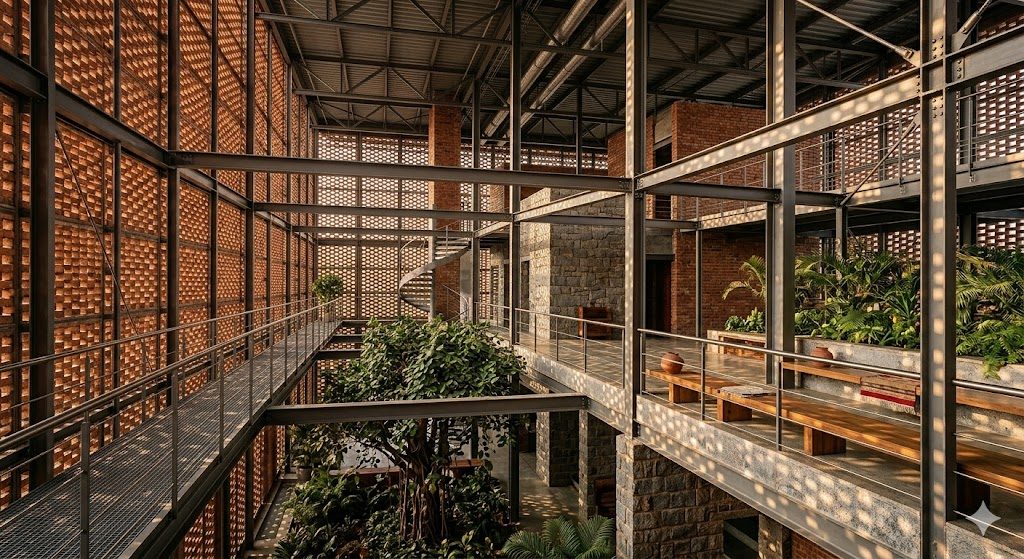
What unites them is an instinct rather than a style: take modern thinking, then filter it through Indian sun, courtyard, craft and the texture of Indian life. This is the same lineage that today's contemporary Indian architecture draws on, and it overlaps deeply with the revival of vernacular wisdom in modern homes and the principles of tropical architecture in India.
How to bring it into your home
You do not need to be building an arts centre to think like a critical regionalist. The philosophy scales down to a single house beautifully — and in the Indian climate it produces homes that are cheaper to run, cooler, and far more characterful than the imported glass box.
The key is to design outward from your specific site and inward from modern construction, and let the two meet. Respond honestly to your climate zone — a Jaisalmer house and a Kochi house should not look the same, and a climate-responsive courtyard home is one of the most reliable starting points. Use what your region makes well, whether that is Jaisalmer stone, Athangudi tiles, Mangalore tile, Kota stone or local lime plaster, and use it honestly. Keep the structure legible and the detailing tactile. And resist the two temptations on either side: the sealed, air-conditioned glass façade that fights the climate, and the bolted-on "heritage" costume that fakes a past.
Bring it home, in order
1. Map your site and climate first. Find true north, the path of the sun, and the prevailing monsoon wind before you fix a single wall. Run your plot through a sun-path analyzer so the design answers to real conditions.
2. Make a bounded place. Give the home an edge — a courtyard, a walled garden, a deep verandah threshold — instead of edgeless, free-flowing space. This is Frampton's "place-form."
3. Let climate shape the form. Deep overhangs, jali screens, cross-ventilation slots, mass walls and an open-to-sky pocket should be load-bearing design decisions, not afterthoughts.
4. Choose local materials, used honestly. Pick stone, brick, timber or tile your region makes well — and let them read as themselves, not as veneer over a hidden frame.
5. Express the structure. Keep beams, columns and junctions legible and well-detailed. Honesty of construction is the antidote to the scenographic fake.
6. Design for the body, not the camera. Choose materials for how they feel, sound and hold temperature underfoot and underhand — the tactile over the merely photogenic.
7. Filter the heritage. Borrow a principle from the local tradition (the courtyard, the jali, the verandah) — never a costume. If it only works as decoration, cut it.
Not sure which strand of this fits your taste and plot? Our style-finder helps you locate where you sit between modern, vernacular and regional — a useful first map.
When you are ready to test these moves on your own plan, DesignAI lets you generate and compare climate-responsive, materially-rooted design directions for your exact site in minutes — so you can see a Critical-Regionalist home for your plot, not a generic render, before you commit a rupee to construction.
Misconceptions: where it goes wrong
The most common failure is the one Frampton warned about: the "Rajasthani-hotel" pastiche. A concrete-frame building wears a sloping tiled roof, some applied jharokhas and carved brackets, and markets itself as "traditional." This is exactly what Critical Regionalism opposes — it is scenography, a stage-set of historical signs with no structural or climatic truth behind it. Borrowing the look of a tradition without its logic is the kitsch the movement was invented to resist.
The opposite failure is just as common in Indian cities: the placeless glass tower that could be in Dubai or Dallas, sealed against a climate it pretends does not exist, hemorrhaging energy into air conditioning. That is the universal civilisation Frampton resisted from the other direction.
A subtler misreading is to treat Critical Regionalism as anti-modern or anti-technology. It is neither. It loves modern construction; it simply refuses to let technique flatten place. Nor is it a fixed "style" — there is no checklist of features that makes a building critically regionalist, which is exactly why it remains alive while postmodern pastiche has dated badly. It is a way of thinking, and it survives because thinking does not go out of fashion.
If you love this attentiveness to place and the senses, you will find its cousins worth exploring — the body-and-craft sensibility of Wabi-Sabi architecture and Japanese architecture, the structural honesty of Brutalism and High-Tech architecture, and the landscape-rootedness of organic architecture.
References
1. Kenneth Frampton, "Towards a Critical Regionalism: Six Points for an Architecture of Resistance," in Hal Foster (ed.), The Anti-Aesthetic: Essays on Postmodern Culture (Bay Press, 1983).
2. Alexander Tzonis & Liane Lefaivre, Critical Regionalism: Architecture and Identity in a Globalized World (Prestel, 2003).
3. Kenneth Frampton, Modern Architecture: A Critical History (Thames & Hudson, 4th ed., 2007) — chapter on critical regionalism.
4. Charles Correa, The New Landscape: Urbanisation in the Third World and A Place in the Shade: The New Landscape & Other Essays (Penguin / Hatje Cantz).
5. William J. R. Curtis, Modern Architecture Since 1900 (Phaidon, 3rd ed., 1996) — chapters on Aalto, Barragán, Correa, Doshi and the regional traditions.
6. Balkrishna Doshi, Paths Uncharted (Vastushilpa Foundation) and the 2018 Pritzker Architecture Prize jury citation.
7. Gautam Bhatia, Laurie Baker: Life, Work & Writings (Penguin India, 1991).
Explore the rest of the Architecture Philosophy series — from Brutalism and High-Tech architecture to organic architecture — and see how each one, in its own way, asks the same question: what should a building be true to?
Export this guide
Related Guides — Deep-dive reading
Charles Correa's Façade Signature: How India's Master Made the Climate-Correct Wall
How Charles Correa eroded the flat sealed wall into deep, shaded, porous layers — verandahs, terraces, pergolas and open-to-sky courts — so the Indian façade filters sun and drives air instead of sealing it out.
Building FacadesJawahar Kala Kendra: How Charles Correa Turned a City's Horoscope into a Building
In Jaipur, Charles Correa organised a national arts centre as nine squares of the navagraha mandala — the same cosmic diagram that laid out the eighteenth-century city around it — then prised one square loose and hollowed out the centre. A study of the plan as argument: how an 'archaic notion of the Cosmos' became a working piece of contemporary civic architecture, and what its inward, fortress-walled world tells us about where architecture goes when it stops copying tradition and starts thinking with it.
The Future of ArchitectureKanchanjunga Apartments, Mumbai — Charles Correa's Verandah in the Sky
How Correa carved interlocking double-height garden terraces into a concrete tower to give every flat the shaded, breezy verandah of the old bungalow — thirty storeys up.
Design StylesRelated Tools — Try Free
Brise-Soleil Visualizer
Interactive horizontal-louvre cut-off angle calculator — sun altitude, louvre depth, and spacing inputs with a live shadow preview. Computes θ = arctan(spacing/depth) for façade shading, ECBC envelope compliance, hospital daylight design, and tropical sun-control detailing.
Sun Shading ToolCross-Ventilation Analyzer
Estimate airflow and air changes per hour (ACH) from room size, window areas, layout, and local wind — with NBC 2016 Part 8 compliance check.
Ventilation CalculatorConcept Generator
Get 3 AI-generated design concepts for any room with style, materials, and cost estimate.
DesignAI