
Luis Barragán
The engineer who taught modern architecture how to feel — colour, light, water and the wall
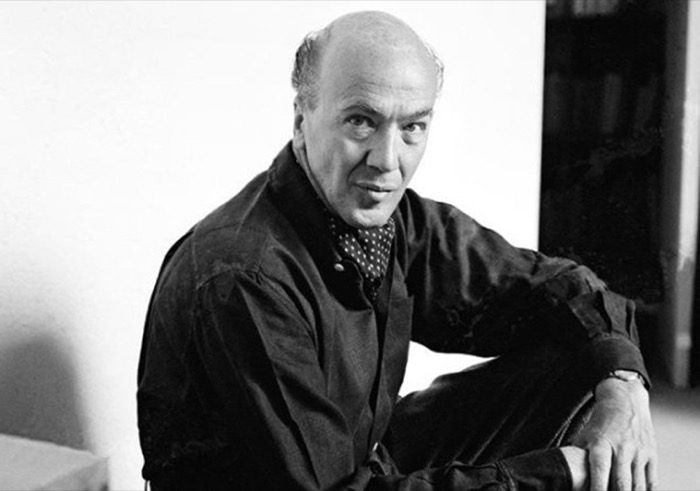
Photo: Tomjc.55, CC BY-SA 4.0, via Wikimedia Commons
Movements
Signature works
- Casa Estudio Luis Barragán, Mexico City (1948)
- Torres de Satélite, with Mathias Goeritz (1958)
- Capilla de las Capuchinas Sacramentarias, Tlalpan
- Cuadra San Cristóbal & Fuente de los Amantes, Los Clubes (1968)
- Casa Gilardi, Mexico City (1976)
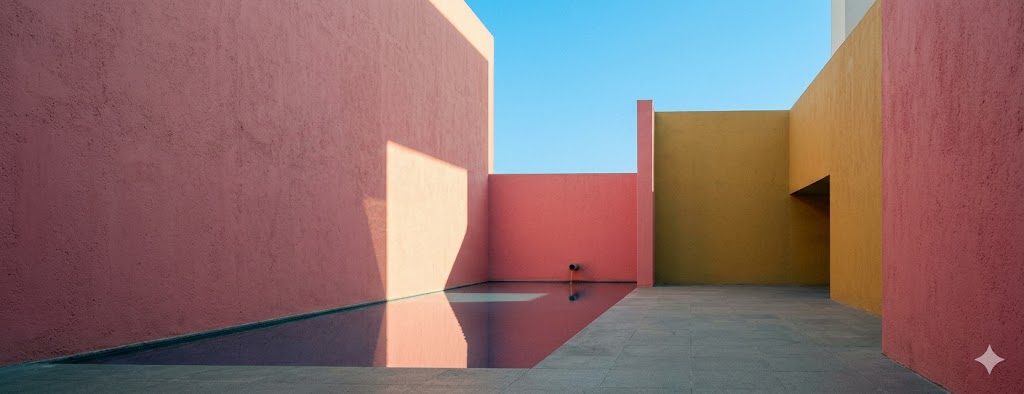
Walk through a quiet street in the Tacubaya district of Mexico City and you would pass his house without a second look. There is almost nothing to see — a tall, plain rendered front, the colour of stone, with a door and a few small openings set without ceremony. It refuses you. It gives the street nothing. But step through that door, climb the stair, and the world reverses. A wall of warm rose glows where the morning sun strikes it. A shaft of light falls down a hidden slot and pools, gold, on a bare floor. A window the size of a painting frames a garden gone deliberately wild. The house has turned its back on the city and opened, instead, onto silence. You have walked from noise into prayer.
This is the Casa Estudio Luis Barragan, the home and studio of the Mexican architect who, more than anyone, taught modern architecture how to feel. Trained as a civil engineer and largely self-taught as a designer, Luis Barragan (1902–1988) built relatively little, mostly houses and gardens, almost all of it in and around his home city — and yet he changed how architects everywhere think about colour, light and emotion.
Barragan's contribution was to insist that architecture's true subject is not function, structure or style, but feeling — serenity, solitude, memory, astonishment. His materials were colour, light, water and the wall: thick rendered planes washed in pink, ochre, violet, red and white; shafts of captured sunlight; still reflecting pools and fountains; and high, blank walls that seal a place off from the world and turn it inward. He took the universal techniques of modern building and bent them toward the deep wells of Mexican memory — the hacienda, the convent, the village, the pueblo — to make what he and his friends called "emotional architecture."
The idea: an architecture of emotion
Most of the twentieth century's great modern architects asked how a building should work. Barragan asked how it should make you feel. That is the whole of him, and it is why he stands a little apart from his famous contemporaries.
He did not reject the modern movement; he absorbed it and then quarrelled with its coldness. The glass-and-steel orthodoxy of mid-century modernism prized transparency, openness, the dissolving of walls, the flow of universal space. Barragan did almost the opposite. He loved the wall — solid, thick, opaque — precisely because it could enclose, protect and console. A blank wall, to him, was not a failure of openness but the very instrument of peace: it shuts out the street, the neighbour, the rush, and leaves you alone with light and sky. His houses are not transparent boxes that expose you to the world; they are sanctuaries that hide you from it.
Into these enclosures he admitted his real cast of characters. Light, first — not the flat, even daylight of the office, but light caught, slowed and coloured: a beam dropped through a high slot so that it lands as a glowing rectangle on a wall; sun bounced off a pink plane so that it arrives warm and tinted. Then water, almost always still — a low trough, a black pool, a shallow sheet that doubles the colour above it and adds the faint sound of a single jet to the silence. And colour, used not as decoration but as substance: a wall is not painted pink, it is pink, the way a flower is, so that the colour seems to carry its own weight and temperature.
The aim of all this is a particular emotional register. Barragan spoke openly, even defiantly, of values that most modernists had grown embarrassed to name — beauty, serenity, silence, intimacy, solitude, wonder. He wanted his houses to be, in his own word, refuges. In an age that worshipped the machine, he built for the soul.
Life and path: the engineer who became a poet
Luis Barragan was born on 9 March 1902 in Guadalajara, in the western Mexican state of Jalisco, into a comfortable landowning family. His childhood reached into the countryside of his family's holdings, and that memory — of village streets, thick adobe walls, fountains, horses, the deep shade of a verandah, the rose and earth colours of rural Mexico — never left him. It became the well he drew from for the rest of his life. When, decades later, he made a horse ranch glow pink and filled it with water, he was in part rebuilding a remembered world.
He did not study architecture. He trained as a civil engineer at the Escuela Libre de Ingenieros in Guadalajara, qualifying around 1923. The discipline of architecture he taught himself — by reading, by looking, and above all by travelling. In the mid-1920s he went to Europe, and two encounters there set the course of his work. He saw the gardens and courts of the Alhambra in Granada and the Mediterranean gardens of southern Spain and North Africa, with their water channels, enclosing walls, shade and stillness — and recognised in them something close to home. And he discovered the work and writings of Ferdinand Bac, the French artist and garden-maker whose romantic, enclosed Mediterranean gardens spoke directly to Barragan's longing for places of repose. He met Bac, and the influence was lasting.
On a second European stay he absorbed the new architecture too — the work and ideas of Le Corbusier and the modern movement then transforming the continent. So Barragan came home holding two things at once: the rigour and abstraction of European modernism, and a romantic, garden-loving, Mediterranean-and-Mexican sense of enclosure and feeling. His whole career is the slow fusing of those two.
His early buildings in Guadalajara, through the late 1920s and 1930s, were regionalist houses drawing on this Mediterranean vocabulary. After he moved to Mexico City in 1936 he passed through a more orthodox functionalist phase, designing apartment buildings in the international manner. But this left him cold, and by the 1940s he had largely stepped back from conventional commercial practice. He turned to land — developing and landscaping the volcanic lava-rock district of El Pedregal in southern Mexico City — and to a more personal, slower kind of work. The breakthrough was his own house.
Crucial to his mature voice were the artists around him. The painter Jesus "Chucho" Reyes Ferreira, a Guadalajara colourist, helped Barragan find and trust the vivid pinks, magentas and ochres of Mexican folk art and turn them into architecture. The German-Mexican sculptor Mathias Goeritz, with whom Barragan was close, pushed him toward bold abstraction and what the two of them, in a famous 1950s manifesto, called arquitectura emocional — emotional architecture. The lessons of colour theory associated with Josef Albers and Goeritz sharpened how Barragan made colours vibrate against one another. He was an architect who thought like a painter.
The signature works
Barragan's output is small and concentrated, and almost every important piece is a place you experience rather than a facade you photograph. A handful of works carry his whole idea.
| Work | Place & year | Why it matters |
|---|---|---|
| Casa Estudio Luis Barragan | Mexico City, 1948 | His own house and studio, and his masterpiece. Blank to the street, inward and luminous within — rose, gold and white walls, captured light, a roof terrace open only to the sky. A UNESCO World Heritage Site, the only individual house in Latin America to hold that status. |
| Torres de Satelite (Towers of Satelite) | Mexico City, 1958 | Five tall triangular concrete towers, painted in bold colours, rising from a motorway median — designed with Mathias Goeritz. A piece of pure urban emotion and abstraction, a landmark with no function but feeling. |
| Capilla de las Capuchinas Sacramentarias | Tlalpan, Mexico City, 1950s–60s | A convent chapel of extraordinary restraint: a golden screen, a cross of light, walls washed in warm tones, every surface tuned to devotion. His most concentrated essay in light as the material of the sacred. |
| Las Arboledas / Los Clubes | Mexico City, 1960s | Equestrian estates where Barragan worked at the scale of landscape — long coloured walls, water troughs, rows of trees, and the famous Fuente de los Amantes, the Fountain of the Lovers. |
| Cuadra San Cristobal | Los Clubes, Mexico City, 1968 | A horse ranch and house where pink and earth-red walls, a still pool and a broad water trough turn the everyday business of horses into something ceremonial and serene. |
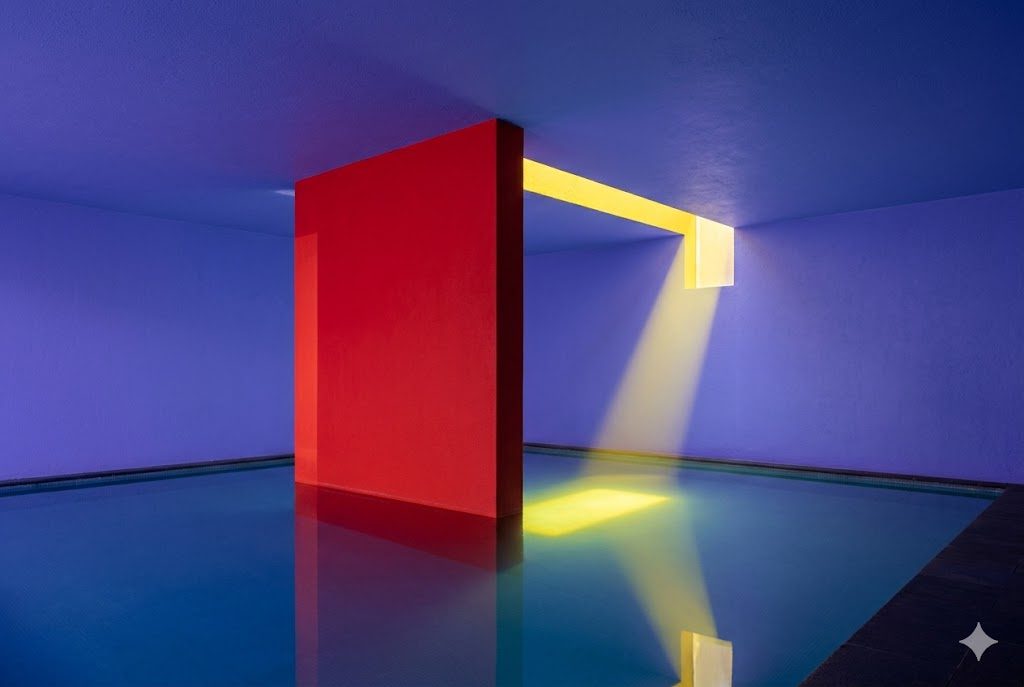
| Casa Gilardi | Mexico City, 1976 | One of his last works and one of his most beloved: a corridor washed in yellow light leading to a startling room where a slender red column stands in a shallow indoor pool, beneath blue and pink walls. Light, water and colour brought indoors and held. |
What unites these very different things — a house, a roadside monument, a chapel, a ranch — is a single sensibility. Barragan never lets you take a place in at one glance. At the Casa Estudio he makes you move from a low, dim entrance hall up into the tall, light-filled living room; at Cuadra San Cristobal the walls and water are arranged so that horse, rider and reflection compose and recompose as you move. He works by enclosure and reveal, by the slow turning of sun across a coloured wall through the day, by the sound of one thread of water in a silent court. The drama is real, but it is built from almost nothing you can touch: colour, light, water, shadow and the passing of time.
His scale, too, is deliberate. Barragan rarely built tall or large. The Towers of Satelite are his one great vertical gesture, and even they are abstract sculpture more than building. His genius lived in the room, the wall, the court, the garden — the human-sized places where a person is actually alone with a feeling.

The philosophy: a profoundly regional modernism
It is tempting to file Barragan under minimalism, and the label is not wholly wrong — his surfaces are bare, his geometry is clean, he removes far more than he adds. But minimalism, as usually understood, is cool and reductive, and Barragan is warm and laden with memory. The better frame for his work is critical regionalism: the conviction that the finest modern architecture refuses to become a placeless, international product and instead binds the universal techniques of modern building to the light, climate, colour, culture and feeling of one specific place.

Barragan is one of the clearest cases of this idea in the entire canon. He used the modern architect's freedoms — the free plan, the abstract plane, exposed structure, the great unframed window — but he charged them with things modernism had tried to discard: folk colour, the enclosing wall of the convent and the hacienda, the water court of the Moorish and Mediterranean garden, the silence of the village church. The result could only have come from Mexico, and yet it is unmistakably modern. It is not nostalgia and it is not a copy of any old building; it is the spirit of a place rebuilt in a new language.
This is why his thought matters far beyond Mexico. When he accepted the Pritzker Architecture Prize in 1980 — only the second person ever to receive the field's highest honour — he used the moment to scold his own profession for forgetting the words that mattered most to him. He named the qualities he had spent his life pursuing: Beauty, Inspiration, Magic, Serenity, Silence, Intimacy, Astonishment. He worried aloud that these had nearly vanished from architecture's vocabulary, crowded out by efficiency and publicity. It remains one of the most quietly radical speeches in the history of the prize: a master telling the modern world that the point of a building is to move the human heart.
Barragan held that serenity is the great and true antidote against anguish and fear, and that the architect's duty is to make of it a constant guest in the home — a sentiment at the heart of his Pritzker acceptance.
India: courtyards, colour and captured light
Barragan never built in India, and it would be false to pretend he did. But few foreign architects speak more directly to the Indian way of making a house, because the things he prized — the enclosing wall, the inward court, captured light, water and unashamed colour — are exactly the instruments of the Indian tradition.
Consider the courtyard home, which for centuries has organised the Indian house around an open square of light and air. The haveli of Rajasthan, the wada of Maharashtra, the nalukettu of Kerala, the courtyard houses of Gujarat and Tamil Nadu — all turn their backs on the harsh street and open inward onto a protected void where the family lives. This is precisely Barragan's move: the blank outer wall, the rich inner court. What he did consciously, as an aesthetic and emotional choice, Indian builders did for centuries as climate sense and culture. Reading Barragan, an Indian architect recognises a cousin.
The parallel runs deepest in colour. The pinks, ochres, deep reds, indigos and saffrons that Barragan drew from Mexican folk culture have an uncanny twin in Rajasthan — the blue city of Jodhpur, the pink city of Jaipur, the rose and earth walls of countless desert towns. Both Mexico and northwestern India are hot, dry, sun-drenched lands where strong colour reads beautifully under fierce light and a thick rendered wall gives shade and mass. The kinship is not imitation; it is convergence — two traditions arriving by their own paths at the same truth that intense sun and bold colour belong together. For any Indian practice nervous about colour, Barragan is permission and proof: colour, used with conviction on a plain plane, is not gaudy. It is architecture.
His handling of light translates just as well. India is a land of abundant, often punishing sun, and the long instinct of its architecture — through the jali screen, the deep verandah, the shaded court — is not to fight that sun but to filter, soften and compose it. Barragan's captured shaft of warm light is the same instinct raised to drama. His lesson sits naturally beside the wider project of passive design across India's climate zones and the revival of vernacular architecture in modern Indian homes: you do not switch the sun off, you shape it. And for the growing Indian taste for calm, uncluttered interiors, Barragan offers a vital correction to imported minimalism in the Indian context — minimal need not mean white, cold and empty; it can be bare, warm and full of feeling, a single coloured wall doing the work of a hundred ornaments.
The honest caution is the same one his Mexican work carries. Barragan's serenity was expensive in care, if not always in money: it took a painter's eye for exactly the right pink, fanatical attention to where one shaft of light would fall, and the discipline to leave a wall empty. The takeaway for an Indian home is not to copy Mexican pink but to concentrate effort the way he did — decide the one unforgettable moment of the house, a court that glows at dusk, a pool that doubles the sky, a wall that catches the morning, and spend your care there.
Legacy and what we can learn
Barragan's influence has only grown since his death. For decades he was a near-secret known mainly to other architects; today his Casa Estudio is a place of pilgrimage, his pink walls are among the most photographed surfaces in architecture, and a global generation of designers — working in concrete, plaster and colour from Lisbon to Marrakech to Ahmedabad — owes him a debt, whether they name it or not. The contemporary appetite for the warm, tactile, coloured, light-filled interior, as against the cold white box, is in large part his legacy.
For anyone designing today, in India or anywhere, his work offers a few durable lessons. The wall is a friend, not a failure — enclosure can console, and a house that hides from the street can open more freely to the sky. Colour is structural, not cosmetic — chosen with conviction and laid on a plain plane, it carries feeling that no ornament can. Light is a material to be caught and shaped, not merely let in. Water and silence are luxuries available to the smallest budget. And above all: a building should be measured by what it makes a person feel — serene, safe, astonished, at peace — and not only by what it costs or how it performs.
Perhaps the deepest lesson is his courage to say so. In a century that prized the rational and the efficient, an engineer from Guadalajara built small houses washed in pink and dared to call beauty, magic and serenity the real business of architecture. He was right, and the world has slowly come round to him.
These principles — colour with conviction, captured light, the consoling wall, serenity as the goal — live on in how we approach space at DesignAI, where the aim is rooms that feel calm, warm and quietly moving rather than merely furnished.
References
- The Pritzker Architecture Prize, 1980 Laureate citation, jury statement and Luis Barragan's acceptance speech.
- Emilio Ambasz, "The Architecture of Luis Barragan" (The Museum of Modern Art, New York, 1976) — the catalogue of the MoMA exhibition that brought him to wide attention.
- Antonio Riggen Martinez, "Luis Barragan: Mexico's Modern Master" — survey monograph of the life and works.
- Federica Zanco (ed.), "Luis Barragan: The Quiet Revolution" (Barragan Foundation / Vitra) — archival study of the projects and drawings.
- William J. R. Curtis, "Modern Architecture Since 1900" — context for Barragan within twentieth-century and regionalist currents.
- Kenneth Frampton, "Modern Architecture: A Critical History" — on critical regionalism and Barragan's place within it.
To continue: read the philosophy Barragan carried forward in critical regionalism; meet the kindred regional masters Geoffrey Bawa and Charles Correa, who bound modern architecture to the light and culture of monsoon Asia and India; and see how his lessons live in the courtyard homes of India and in minimalist architecture in the Indian context.
Philosophies they championed