
Organic Architecture Explained
Buildings that grow from their site — the philosophy of Frank Lloyd Wright and its living legacy
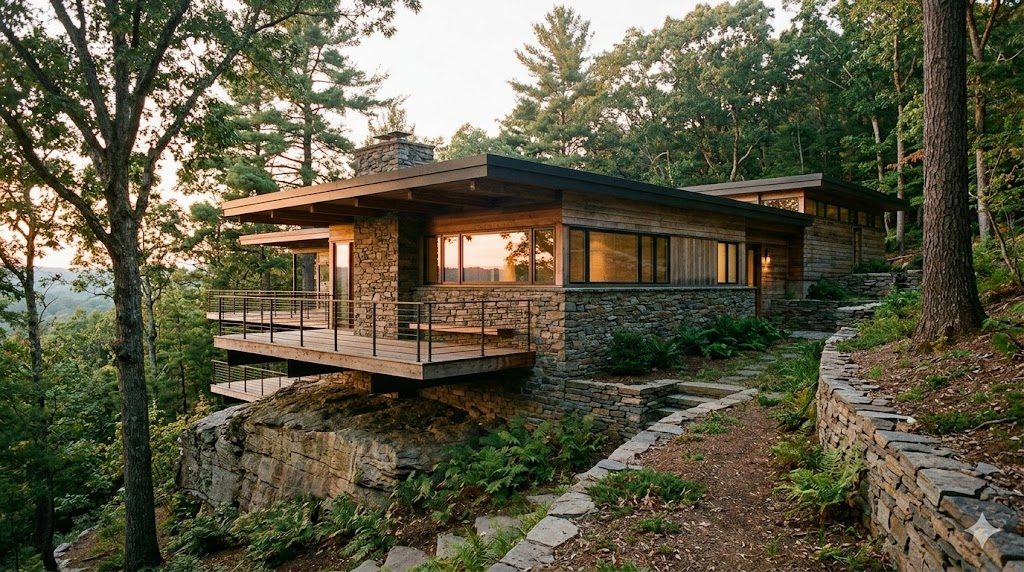
Stand inside a true organic house and the first thing you notice is that you cannot find where it begins. The floor is the same stone as the ledge it sits on. A low ceiling presses you gently down, then releases you toward a wall of glass and a terrace that reaches out over the trees. There is no clear line between the room and the garden, between the made and the grown. The fire is lit at the centre, and everything — the long horizontal lines, the warm timber, the band of windows following the light around — seems to have arrived here naturally, the way a tree arrives in a clearing.
Organic architecture is the philosophy that a building should be in harmony with humanity and with its site — a single living thing in which form and function are one, grown from the inside out and up from the land.
It is not a style you bolt on, and not a shape borrowed from nature. It is a way of designing in which the site, the materials, the human being who lives there and the structure itself are treated as one continuous, growing whole — so the finished house feels less built than cultivated.
What organic architecture really is
The word "organic" here does not mean curvy, or green, or covered in plants — though organic buildings are often all three. It is a deeper claim. Frank Lloyd Wright, who gave the idea its name and its grammar, meant that a building should have the same integrity as a living organism: every part related to every other part and to the whole, nothing arbitrary, nothing applied. A leaf is not decoration stuck onto a tree; it is the tree, expressing itself. Wright wanted a house to be like that.
This produces a handful of intertwined commitments. The building grows from the inside out — you design the way a family actually lives, room by room, and the exterior is simply the honest result, not a mask. The building grows from its site — the slope, the rock, the prevailing wind, the path of the sun and the best view are not constraints to fight but the very things that generate the plan. The materials are allowed to be themselves — stone reads as stone, brick as brick, wood as wood, concrete as concrete, none of them painted over to imitate something richer. And the whole thing is scaled to the human body, gathered around a hearth or a core that acts as its heart.
The result is an architecture of continuity rather than of boxes. Where classical and much modern building sets up a clear opposition — inside versus outside, building versus ground, structure versus ornament — organic architecture dissolves those oppositions. It is closely related in spirit to several of its philosophical neighbours, including biophilic architecture, which formalises our innate pull toward living systems, and the Japanese-rooted reverence for imperfection and natural material in wabi-sabi architecture. Organic architecture is the broad parent idea; those are some of its children.
Where it came from
The lineage begins in the steel-and-glass Chicago of the 1880s and 90s, with Louis Sullivan — the "father of the skyscraper" and one of the most poetic minds American building has produced. In an 1896 essay on the tall office building, Sullivan wrote the line that became modern architecture's most quoted four words: "form ever follows function." He meant it almost as a law of nature, citing the eagle and the apple-blossom: how a thing works should generate how it looks. Sullivan also believed in ornament that grew organically out of structure, and his own buildings — the Wainwright Building in St. Louis, the Carson Pirie Scott store in Chicago — are wrapped in foliate iron and terracotta that seems to bud directly from the frame.
Working at Sullivan's drafting tables was a brilliant young man Sullivan called his "pencil": Frank Lloyd Wright. Wright took "form follows function" and pushed it further, eventually insisting that "form and function are one" — that the distinction itself dissolved in a properly conceived building. Over a career of some seventy years he gave organic architecture its vocabulary.
His Prairie houses of the 1900s — the Robie House in Chicago is the masterpiece — pressed themselves to the flat Midwestern landscape with long horizontal roof planes, broad sheltering eaves, ribbon windows and a great central chimney mass. His own home and studio, Taliesin in Wisconsin and Taliesin West in the Arizona desert, were built of the stone and timber of their sites and rebuilt continuously over decades, almost like living things. In 1935, deep in the Depression, he designed Fallingwater for the Kaufmann family in rural Pennsylvania, cantilevering its concrete terraces straight out over a waterfall so the house and the cascade became one event. And in his last years he completed the Solomon R. Guggenheim Museum in New York (opened 1959), a single continuous spiral ramp — a building conceived as one unbroken plastic form, grown from the inside out.
"No house should ever be on a hill or on anything. It should be of the hill, belonging to it, so hill and house could live together each the happier for the other." — Frank Lloyd Wright
Organic architecture was never Wright's private possession. Other strands grew in parallel and after him. In Finland, Alvar Aalto brought a humane, sensuous organic modernism — undulating timber ceilings, free-form pools of space, the famous bent-plywood furniture, all tuned to the northern light and forest. In Oklahoma, the gloriously unclassifiable Bruce Goff built houses out of coal, glass cullet and aircraft parts that seem to have crystallised rather than been drawn. In Germany, Hans Scharoun's Berlin Philharmonie wrapped its concert hall in terraced "vineyard" seating, the building shaped from the music outward. In Hungary, Imre Makovecz raised timber buildings that look like living creatures rising from the Magyar earth. And standing slightly apart as an older cousin is Antoni Gaudi in Barcelona, whose Sagrada Familia, Casa Batllo and Park Guell treated stone and tile as if they were bone, branch and shell — structure and ornament fused into one flowing organism.
The defining principles
Organic architecture has no rulebook — Wright distrusted rules — but across his writing and the work of those who followed, a consistent set of signatures emerges. They are best read as a single attitude expressed in seven ways.
| Principle | What it means | How you recognise it |
|---|---|---|
| The site generates the design | Slope, rock, water, wind and sun shape the plan before any aesthetic does | A plan that could not be lifted and dropped on another plot |
| Grown from the inside out | Spaces are arranged from how life is lived; the facade follows | No symmetrical front "elevation" imposed for show |
| Continuity of inside and outside | Walls dissolve into glass, terraces, courts; the garden enters | Ribbon windows, sliding walls, deep verandahs, courts |
| Materials true to themselves | Each material expresses its own nature and is sourced locally | Exposed stone, unpainted brick, honest timber and concrete |
| Horizontal lines and the ground | Low, ground-hugging masses that belong to the earth | Long eaves, banded floors, a building that lies down |
| Integral ornament | Pattern emerges from structure and material, never applied | Geometry that is also the window, the screen, the joint |
| Human scale and the hearth | Sized to the body; gathered around a fire or living core | Compressed entries opening to release; a central heart |
Two of these deserve a word more. "Integral ornament" is the antidote to both bare minimalism and applied decoration: Wright's art-glass windows, his patterned concrete "textile blocks", Sullivan's budding terracotta — in each case the ornament is the structure, expressing itself, not a layer added afterwards. And the manipulation of scale — Wright's trick of squeezing you through a low, dim entry so that the main living space then feels vast and luminous — is what gives organic houses their distinctive emotional rhythm of compression and release.
Materials, form and light
Because honesty of material is central, organic architecture tends to be built of whatever the place offers: the desert masonry of Taliesin West, the Pennsylvania sandstone of Fallingwater quarried on site, Aalto's Finnish birch and copper, Baker's Kerala laterite and brick. Local material is not nostalgia; it is logic. It weathers correctly in that climate, it carries the colour of the ground, and it ties the building to its region — the same instinct that drives critical regionalism and India's living vernacular tradition.
Form follows from structure honestly expressed. The cantilever is the great organic gesture — a floor reaching out into the air, unsupported at its edge, defying the box. The ribbon window, a continuous horizontal band of glass uninterrupted by structure at the corners, dissolves the wall and lets the eye run out to the landscape. Roofs are low and broad, eaves deep, the whole composition pressed toward the horizontal so it settles into the ground rather than standing on it. And where the organic instinct turns toward the curve — Aalto, Goff, Gaudi, the Guggenheim — the geometry comes from nature's own logic of shells, spirals and branching, not from a designer's whim.
Light is handled as a material in its own right. Ribbon windows wash a room sideways; clerestories and skylights bring it down from above; deep eaves and screens filter it so it never glares. The same daylight that an organic architect choreographed by intuition, a homeowner today can study precisely with a sun-path analyzer before deciding where the glass should go.

In the Indian context
Here is the quiet truth: India was building organically for centuries before anyone in Chicago wrote it down. The vernacular house of almost every Indian region is, by Wright's own definition, organic — generated by site and climate, built of local material, grown from the way the family lives, and inseparable from its courtyard and threshold. The Kerala nalukettu organised around its central court, the Rajasthani haveli of carved local sandstone with its self-shading well of a courtyard, the Chettinad mansion, the Kashmiri timber-and-brick house that flexes in earthquakes, the Himalayan kath-kuni of stone and deodar — each is a building of its hill, belonging to it. The courtyard itself, that uniquely Indian indoor-outdoor heart, is organic architecture in its purest form, as our guide to courtyard homes explores.
When Wright's specific philosophy reached India, it found a willing soil. The most remarkable figure is Nari Gandhi (1934–1993), the great Indian organic architect, who travelled to the United States and apprenticed under Frank Lloyd Wright at Taliesin in the 1950s. He returned and spent his life building astonishing, hand-made houses along the Konkan coast and around Maharashtra — free-flowing structures of local stone, exposed brick, timber, ceramic tile and even broken pottery, shaped on site without conventional drawings, each one growing organically from its plot. Gandhi worked like a craftsman-sculptor, often living at the site, and left almost no two buildings alike. He is India's purest inheritor of the Wrightian line and one of its most under-celebrated masters.
Alongside him stands Laurie Baker (1917–2007), the British-born architect who settled in Kerala and became the conscience of cost-effective Indian building. Baker's homes and institutions — built of exposed local brick, perforated jaali walls that breathe, recycled material, rubble masonry and curving, low-cost forms hugging their hillside sites — are organic in the deepest sense: form generated by climate, by cost, by the soil itself, and by deep respect for the mason's craft. He proved that organic architecture in India need not be expensive; it could be the cheapest and the most humane way to build at once.
The lineage runs wider. Gira Sarabhai, of the great Ahmedabad family, actually worked with Wright at Taliesin and brought that sensibility home, helping shape institutions like the National Institute of Design and, with her brother, the textile museum at the Calico Mills — an intensely material, craft-rooted modernism. And the broader generation of Indian modern masters — Charles Correa with his "open-to-sky" spaces and climate-driven sections, B.V. Doshi with his earth-hugging, light-carved buildings — share organic architecture's core conviction that the building must answer to its place.
The climate logic is what makes all of this more than borrowed style. Organic principles — orienting to the sun, opening to the prevailing breeze, deep shading eaves, dissolving the wall between cool interior and shaded court, building in heavy local stone that holds the night's coolness — are precisely the strategies that India's heat needs. Organic architecture and good passive climate design turn out to be the same wisdom described in two vocabularies.
How to bring it into your home
You do not need a waterfall or a Wright budget to live organically. The philosophy scales down to a single plot and a sensible budget, because at heart it is about attention — to your site, your materials and the people who will live there — rather than about spectacle.
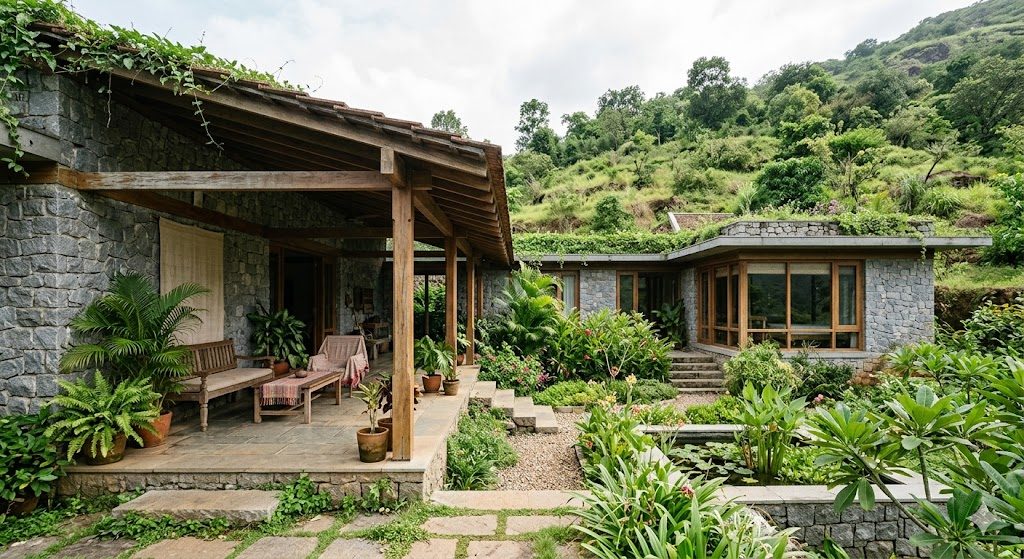
Start by letting the site lead. Walk your plot at different hours. Notice where the morning light falls, where the breeze comes from, where the best tree or view sits, where the ground slopes. Place the living spaces to catch the good light and the breeze, and let the plan bend to keep the tree rather than felling it. Choose local, honest materials — the grey stone or laterite of your region, exposed brick, lime plaster, local timber — and resist the urge to clad them in something pretending to be marble. Pull the building low and horizontal, with deep eaves and shaded verandahs, so it sits into the land and stays cool. Dissolve the wall between inside and out with a courtyard, a deep verandah and large openings onto a garden. Gather the home around a heart — a hearth, a stair, a central court, a family room — that everything else relates to. And let any ornament come from the structure itself: the pattern of the brick, a carved screen that is also the window, the grain of the wood.
Bring it home, in order
1. Read the site first. Spend time on the plot across a full day; map sun, wind, slope, trees and views before you draw a single line.
2. Plan from the inside out. Arrange rooms around how your family actually lives and moves; let the exterior be the honest result.
3. Hug the ground. Keep the massing low and horizontal, with broad eaves and a sheltering roof, so the house belongs to the land.
4. Choose local, honest materials. Use your region's stone, brick, lime and timber, left to be themselves — never faux finishes.
5. Open the wall. Add a courtyard, a deep verandah and ribbon-like openings so inside and outside flow into one another.
6. Find the heart. Anchor the home around a hearth, a stair or a central court that the whole plan gathers toward.
7. Let ornament grow from structure. Make the screen, the joint, the brick pattern do the decorating — nothing applied for its own sake.
Designing this way rewards iteration — testing how a plan sits on its slope, how the light moves through it across the seasons, how the courtyard cools the rooms. DesignAI lets you generate and refine those site-responsive, material-honest options in minutes, so you can find the version that truly grows from your land before you build it. You can also run your scheme against our biophilic score to see how strongly it connects to nature.
Where it goes wrong
The commonest misconception is that "organic" means curvy, blobby or simply natural-looking — that a wavy roof or a green wall makes a building organic. It does not. A free-form shape that ignores its site, fakes its materials and is imposed from the outside is the opposite of organic, however leafy it looks. Conversely a plain, low, rectilinear house of honest local stone, grown from its plot, is deeply organic. The idea lives in the relationships, not the silhouette.
A second trap is sentimentality — treating organic architecture as a rustic, anti-technology nostalgia. Wright loved the cantilever precisely because reinforced concrete made it possible; Aalto and Goff were relentless experimenters. Organic architecture has always used the best available technology in the service of place, and there is no contradiction between site-rooted building and digital design tools, AI-assisted workflows or modern engineering. The third failure is the most expensive: ignoring the very thing the philosophy exists to honour — the site. A beautiful organic gesture placed without regard to sun, drainage, soil or neighbour fails on its own terms. The land always gets the last word, which is rather the point.
References
1. Frank Lloyd Wright, An Organic Architecture: The Architecture of Democracy (1939) and The Natural House (1954).
2. Louis H. Sullivan, "The Tall Office Building Artistically Considered," Lippincott's Magazine (1896).
3. Kenneth Frampton, Modern Architecture: A Critical History (Thames & Hudson) — chapters on Wright, Aalto and the organic tradition.
4. Bruce Brooks Pfeiffer, Frank Lloyd Wright (Taschen) and the Fallingwater and Taliesin scholarship of the Frank Lloyd Wright Foundation.
5. Gautam Bhatia, Laurie Baker: Life, Work, Writings (Penguin) — the definitive account of Baker's cost-effective, site-rooted practice.
6. Kaiwan Mehta and contemporary monographs on Nari Gandhi; archival features in Architectural Digest India and Domus India on his hand-built houses.
7. Jon Lang, A Concise History of Modern Architecture in India — on Correa, Doshi, the Sarabhais and the climate-responsive Indian modern tradition.
Explore the related philosophies in this series — biophilic architecture, wabi-sabi architecture and critical regionalism — and see how organic ideas live on in India's climate-responsive courtyard homes and its enduring vernacular architecture.
Export this guide
Related Guides — Deep-dive reading
Brick House, Wada: How iSTUDIO Bent an Ancient Craft into a Curve
A 2,500-square-foot farmhouse in rural Maharashtra bends the poorest, most ordinary building material — the fired clay brick — into free-flowing curved walls, and proves that low-cost, low-carbon, hand-built architecture can be as spatially ambitious as anything made of steel and glass. A close reading of its rat-trap-bond masonry, earthen-pot filler slabs, ferrocement roofs, and the Laurie Baker lineage it carries forward.
The Future of ArchitectureGandhi Smarak Sangrahalaya: How Charles Correa Built a Museum Out of One Small Room
At Sabarmati Ashram in Ahmedabad, Charles Correa took a single 6-by-6-metre bay of brick piers, wooden louvres and tiled roof and repeated it into a whole institution — a modest, open-to-sky memorial that quietly argues architecture's future lies in the module, the courtyard and the human scale, not the monument.
The Future of ArchitectureVernacular Architecture — Lessons for Modern Homes
Regional Building Traditions of India and Their Architectural Logic — A Reference for Contemporary Practice
Design StylesRelated Tools — Try Free
Cross-Ventilation Analyzer
Estimate airflow and air changes per hour (ACH) from room size, window areas, layout, and local wind — with NBC 2016 Part 8 compliance check.
Ventilation CalculatorBrise-Soleil Visualizer
Interactive horizontal-louvre cut-off angle calculator — sun altitude, louvre depth, and spacing inputs with a live shadow preview. Computes θ = arctan(spacing/depth) for façade shading, ECBC envelope compliance, hospital daylight design, and tropical sun-control detailing.
Sun Shading ToolHealing View Impact Calculator
Evidence-Based Design dashboard quantifying the recovery impact of nature view + daylight factor on analgesic use, length of stay, and HCAHPS patient-experience uplift. Calibrated against Ulrich 1984 (Science), Park & Mattson 2008, and the CHD EBD evidence base.
EBD Calculator