

Laurie Baker
The Gandhi of architecture — beauty and dignity for the poor, built from local brick
Movements
Signature works
- Centre for Development Studies, Trivandrum (1971)
- Indian Coffee House, Trivandrum
- Loyola Chapel and campus, Trivandrum
- The Hamlet (his own home), Trivandrum
- Thousands of low-cost homes across Kerala (COSTFORD)
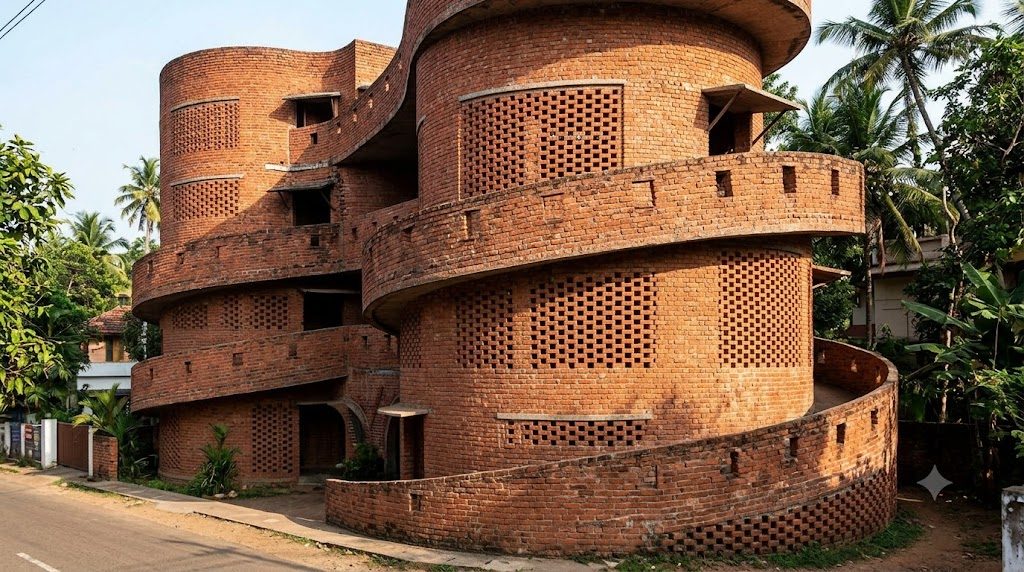
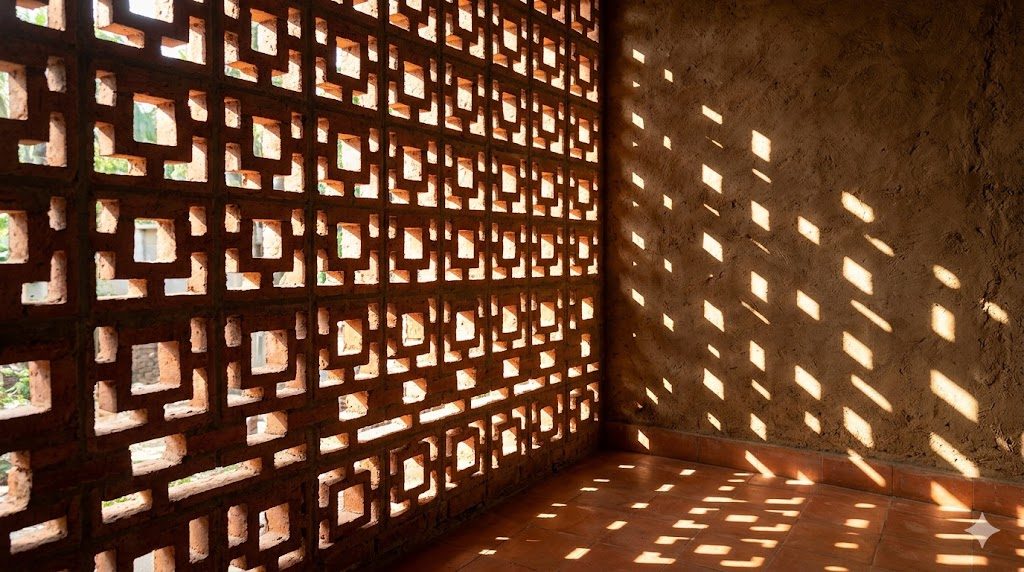
Walk into the Indian Coffee House near the central bus station in Thiruvananthapuram and the building turns you in a slow spiral. A ramp of exposed red brick winds upward like a snail shell, tables tucked along its inner curve, sunlight falling in soft squares through perforated brick screens. There is no marble, no glass curtain, no air-conditioning roar — only brick, breeze, and the smell of filter coffee. It cost almost nothing to build, and it has become one of the most loved rooms in Kerala. That, in a single building, is Laurie Baker.
He was a British-born architect who became an Indian citizen and spent half a century proving that beautiful, durable, dignified buildings could be made for a fraction of the going rate — using local brick, local hands, and almost no cement or steel. People called him the Gandhi of architecture, and the architect of the poor.
Baker's central conviction was that good architecture is not a matter of money but of intelligence, honesty, and respect — for the climate, for the material, for the craftsman, and for the person who will live in the house. He cut cost by cutting waste, and in doing so he made buildings that breathe, that age gracefully, and that belong utterly to their place. (For a close reading of his building skins — the brick jaali, rat-trap bond, curved walls and honest exposed brick — see our Laurie Baker facade signature guide.)
The idea
Most architecture starts with a vision and then asks what it will cost. Laurie Baker reversed the order. He started with the budget of an ordinary family — often a very small one — and asked what could be made beautiful and lasting within it. The answer, again and again, was: a great deal, if you stop wasting.
His method was almost forensic. Where did the money in a conventional building go? Into cement and steel, into plaster that hid the wall, into glass and aluminium, into materials hauled across the country, into ornament that served no purpose. Baker attacked each one. He used brick on edge to build hollow walls that needed fewer bricks. He left brick exposed so it needed no plaster and no paint, ever. He filled his concrete roofs with old clay tiles and pots so they used less cement and less steel. He replaced glass windows with jali — perforated brick screens that let in light and air while keeping out sun and rain. He reused doors, tiles, and stone that others threw away. He built curved walls because a curve is stronger than a straight run and uses less material to enclose the same space.
None of this was a gimmick. Every cost-cutting move was also a climate move. The hollow wall insulated against Kerala's heat. The jali ventilated and shaded at once. The exposed brick weathered instead of peeling. Frugality, climate-sense, and honesty turned out to be the same discipline wearing three names.
There was a moral dimension too, inseparable from the technical one. Baker disliked the way conventional building treated the labourer as an anonymous cost and the material as something to be hidden under plaster and paint. He wanted the mason's skill to show in the finished wall, the joint to be legible, the brick to remain a brick. A building, in his view, should not lie about what it is or how it was made. This is why his work feels so unforced even today: nothing is dressed up, and nothing pretends. The poverty of means becomes a kind of richness of meaning, because every surface tells you the truth about itself.
Life and path
Laurence Wilfred Baker was born in Birmingham, England, in 1917, into a Quaker family — and the Quaker temperament of plainness, conscience, and service stayed with him for the rest of his life. He trained at the Birmingham School of Architecture in the 1930s, emerging as a young modernist at exactly the moment the world tipped into war.
Two encounters then redirected everything. As a conscientious objector, Baker served in the war as part of a medical and relief effort that took him to China and, on the journey home, briefly stranded him in India. There he met Mahatma Gandhi. Gandhi's questions about why an architect would import materials when local ones lay all around, and his insistence on self-reliance and the dignity of village labour, lodged permanently in Baker's thinking. The second encounter was India itself — its craftsmen, its clays, its sun.
He returned to India to work, first in the Himalayas, where he spent years building and running hospitals and homes connected with leprosy mission work. In the mountains he learned by necessity what would become his philosophy: you build with what the place gives you, you work with the people who live there, and you respect the ground you are building on. There was no question of importing steel and cement up impossible mountain roads; he had to make do with local stone, local timber, and local hands, and the lesson never left him. The remoteness that looked like a limitation became his education. He married Elizabeth, an Indian doctor and his lifelong partner, and the two worked side by side in the hills for years, her medical work and his building work braided into a single life of service.
In time the Bakers moved south and settled in Kerala, in and around Thiruvananthapuram (Trivandrum). It was here, on the warm humid coast with its abundant clay and its skilled masons, that Baker's mature work flowered. He eventually took Indian citizenship — India was, by every measure that mattered, his home. He helped found COSTFORD, the Centre of Science and Technology for Rural Development, an organisation that carried his cost-effective methods into thousands of homes, schools, and community buildings across the state. He kept building, drawing, and writing — often answering clients by hand-drawn letter — until his death in Thiruvananthapuram in 2007.
The signature works
Baker built thousands of structures, most of them modest homes for people who will never appear in an architecture book. But a handful of larger works show the full range of his thinking.
| Work | Place & date | Why it matters |
|---|---|---|
| Centre for Development Studies (CDS) | Trivandrum, 1971 | His best-known campus — a hillside of brick buildings stitched with jali screens, curved walls, and shaded courts; proof that institutional architecture could be low-cost and climate-tuned. |
| Indian Coffee House | Trivandrum | A spiralling tube of exposed brick wrapped around a central ramp; lit and cooled entirely by jali, it is his most photographed and most beloved public room. |
| Loyola Chapel and campus | Trivandrum | Sacred space made of the same honest brick and filtered light, showing his vocabulary could carry quiet grandeur. |
| The Hamlet (his own home) | Trivandrum | Built into the contours of a rocky slope, full of reused materials, curved walls, and ad-hoc invention — his living laboratory and clearest self-portrait. |
| Thousands of low-cost homes | Across Kerala | Through COSTFORD and his own practice, the work that mattered most to him: dignified houses built within a poor family's means. |
What unites them is restraint, not style. Baker had no signature shape he imposed on every site. The signature is the attitude: read the land, use the local brick, leave it exposed, screen the sun, waste nothing, and let the craftsman's hand show.
The Centre for Development Studies deserves a closer look, because it answered a charge often levelled at low-cost building — that it can only ever produce small, humble things. The CDS campus is neither small nor humble in ambition. Set across a sloping site, it is a layered composition of brick towers, ramps, courtyards, and screen walls that climb and turn with the contours rather than flattening them. Light filters everywhere through jali; breezes move through the buildings without mechanical help. It demonstrated that an entire institution — offices, library, residences, lecture halls — could be built at a fraction of conventional cost while feeling generous, cool, and quietly monumental. For a young Indian architect, walking the CDS campus is still an argument that economy and ambition are not enemies.
The Hamlet, his own house, is the most personal of these works and perhaps the most instructive. Baker built it incrementally over years, on a rocky outcrop he refused to blast flat. Rooms follow the rock; walls curve to dodge a boulder or hug a tree; reused materials turn up everywhere, repurposed with evident delight. It is a house that was thought through with the hands, on site, rather than fully drawn in advance — and it captures something the polished projects cannot: the improvisatory, problem-solving joy that drove him.
The philosophy
Baker is the great Indian exemplar of two ideas that the wider architectural world spent the twentieth century rediscovering.
The first is critical regionalism — the conviction that architecture should resist the flattening sameness of the international glass-and-concrete box and instead root itself in local climate, materials, light, and craft, without lapsing into mere nostalgia. Baker did not copy old Kerala buildings; he extracted their intelligence — the jali, the deep verandah, the response to monsoon and heat — and rebuilt it in brick for modern life. To understand why this matters far beyond Kerala, read Critical Regionalism explained.
The second is organic architecture — the idea, most associated with Frank Lloyd Wright but lived out by Baker in his own frugal key, that a building should grow from its site as naturally as a plant: following the contours, using the materials at hand, and forming an honest whole rather than an imposed shape. Baker's homes step down rocky slopes, curve around existing trees, and reuse what the ground already holds. Our guide to organic architecture explained traces the lineage Baker belongs to.
The technical heart of his philosophy was the wall and the roof. The rat-trap bond lays bricks on edge to form a continuous cavity inside the wall: it uses roughly a quarter fewer bricks and the trapped air insulates the interior against heat. The filler slab replaces much of the concrete in a roof slab with reused clay tiles or pots placed in the zone that carries little load — cutting cement and steel while lightening the structure. The jali turns a wall into a screen that ventilates, shades, and lights all at once. None of these were Baker's invention from nothing, but he refined them, taught them, and made them ordinary.
Cost reduction is not the same as cheapness; the cheapest building is often the most wasteful, and the most thoughtful is often the most economical.
That sentiment — paraphrasing Baker rather than quoting him verbatim — is the hinge of his whole practice. He did not build cheap buildings. He built economical ones, which is the opposite thing.
India
For an Indian reader, Baker is not a foreign master who passed through. He is one of us — a citizen who lived, married, built, and died here, and who gave the country a working answer to a question it still faces: how do you house people well without bankrupting them or the planet?
His answer was profoundly Indian in spirit and method. He used the brick that Kerala's earth gives freely. He employed local masons and trusted their hands, refusing to reduce them to anonymous labour. He drew on the climate wisdom embedded in traditional Indian building — the courtyard, the screen, the verandah, the response to monsoon — the same wisdom explored in our guide to vernacular architecture in modern Indian homes. And he proved at scale, through COSTFORD, that this could be replicated across a whole state.
He sits in a remarkable generation of post-Independence Indian architects who each sought an authentic modern Indian language. Charles Correa found it in the open-to-sky space and the climate-shaped section; Balkrishna Doshi found it in low-rise human-scaled community. Baker found it lower still — in the budget of the poorest client, and in the brick under his feet. Where some of his peers built museums and institutions, Baker built homes by the thousand. India recognised the contribution with the Padma Shri in 1990, and his methods remain a cornerstone of any honest conversation about sustainable home design in India.
Legacy and what we can learn
Long before "sustainability" became a marketing word, Laurie Baker was building net-frugal, low-energy, climate-responsive houses out of necessity and conviction. The architecture world that now prizes embodied carbon, local sourcing, passive cooling, and material honesty is, in many ways, catching up to a man who was quietly doing all of it in Kerala decades ago. His ideas live on through COSTFORD, through the books and films that documented him — Gautam Bhatia's "Laurie Baker: Life, Work, Writings" chief among them — and through a generation of Indian architects who treat brick, screen, and slab as a serious modern vocabulary rather than a poverty fallback.
His influence is also a corrective. In a country racing to build, where glass towers and air-conditioned boxes have become shorthand for progress, Baker is the steady reminder that progress can run the other way — toward less energy, less import, less waste, and more comfort drawn straight from climate and craft. Architecture students across India still study his details because they work: a rat-trap wall really is cooler, a filler slab really does use less cement, a jali really does ventilate a room. The proof is not in a manifesto but in tens of thousands of inhabited buildings that have stood for decades. That is the rarest kind of legacy — not an idea that persuades, but a body of work that simply keeps performing.
The practical lesson is bracingly simple, and it applies to anyone building a home today. Before you spend, ask what each rupee is buying. Does the plaster earn its keep, or could the brick stand honest and exposed? Does the slab need all that concrete, or could a filler lighten it? Does that window need glass, or would a screen cool the room better? Does the wall need to be straight? Baker's genius was to make those questions feel not like sacrifices but like opportunities — every cut in cost an opening for craft, climate-sense, and grace. Pair that mindset with a climate read of your own site — our sun-path analyzer shows where the heat and light will fall — and you are designing the Baker way.
The principles Laurie Baker lived by — honest materials, climate-first design, dignity at every budget — are the same ones that guide how we help you design your home with DesignAI.
References
- Gautam Bhatia, Laurie Baker: Life, Work, Writings (Penguin Books India).
- Laurie Baker, Houses: How to Reduce Building Costs and other COSTFORD pamphlets and writings.
- Centre of Science and Technology for Rural Development (COSTFORD), archives and publications, Thiruvananthapuram.
- Indian Institute of Architects and Padma Shri citation records (Government of India, 1990).
- William J. R. Curtis, Modern Architecture Since 1900 (Phaidon) — context on regional modernism in India.
- "Uncle Laurie" and other documentary profiles on Baker's life and work in Kerala.
Explore the philosophies Baker embodied in Critical Regionalism and organic architecture, and the kindred Indian masters Charles Correa and Balkrishna Doshi.
Philosophies they championed