
What Is Brutalism?
Raw concrete, honest structure, and the most misunderstood movement in modern architecture
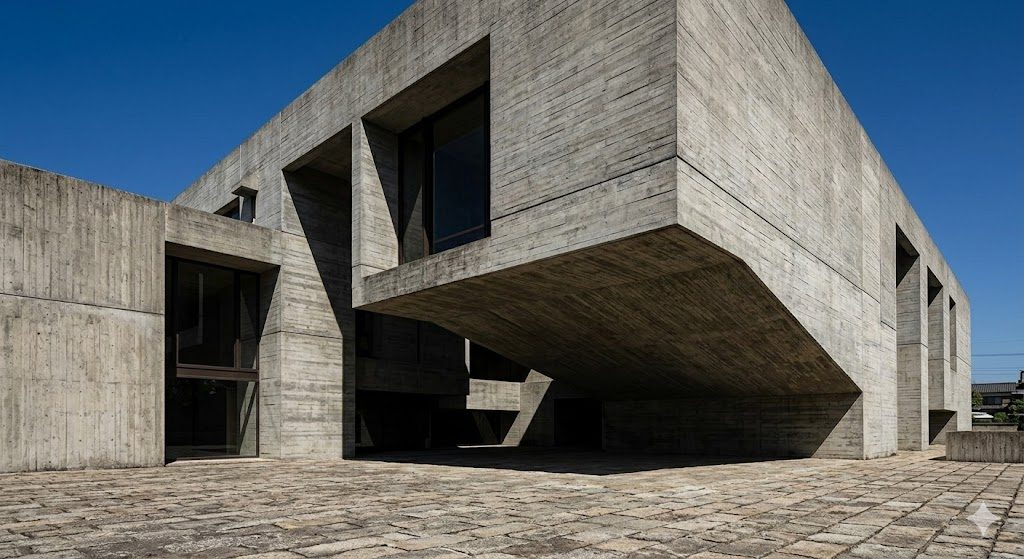
Stand at the foot of a Brutalist building and you feel it before you understand it. The wall in front of you is concrete, but not the smooth, painted concrete of a parking garage — it carries the grain of the timber boards it was poured against, a texture like petrified wood, warm-grey and slightly rough to the touch. The mass above you is heavy, monumental, immovable. Light rakes across the deep recesses and throws hard shadows; a cantilever hangs overhead with the confidence of something that has decided gravity is a detail. Nothing is hidden. The columns that hold the building up are right there, doing their work in the open. It is austere, and it is unexpectedly moving.
Brutalism is the mid-twentieth-century architecture of raw, honest, monumental form — built mostly in exposed concrete and named for it.
Its single governing idea is truth: truth to the material, truth to the structure, truth to how a building is actually made — shown plainly, never dressed up, never apologised for.
What Brutalism actually is
Brutalism is a movement in architecture that flourished roughly from the early 1950s to the late 1970s, defined by raw exposed concrete, boldly expressed structure, and a sculptural, monumental sense of mass. Its buildings tend to be large, frank and unornamented — civic halls, university campuses, housing blocks, libraries, theatres — and they wear their construction on the outside.
The word people fixate on is "brutal", and they assume it means harsh or cruel. It does not. The name comes from the French beton brut, meaning "raw concrete" — the term Le Corbusier used for the rough, board-marked concrete he poured in his post-war work. "Brut" is the same word you see on a bottle of dry champagne: raw, unsweetened, undisguised. The movement is about rawness, not cruelty.
What unites Brutalist buildings is an ethic rather than a single look. The architects believed that a building should be honest about three things: what it is made of, how it stands up, and what goes on inside it. If a beam carries load, show the beam. If concrete is the structure, let it be the finish too — do not clad it in marble or plaster to pretend it is something more genteel. If a stairwell or a ventilation shaft shapes the building, let it bulge out and announce itself. This is "truth to materials" taken to its most uncompromising conclusion, and it produces architecture of unusual force.
It also produces architecture of unusual feeling. Because nothing is smoothed over, a Brutalist building reads as a single, massive, hand-made object. The concrete records the act of its own making — every board, every form-tie, every pour line. To stand inside one is to feel the weight and the labour of it. At its best, that frankness becomes a kind of grandeur.
Where it came from
The roots are in the rubble of the Second World War. Europe needed to rebuild fast and cheap, and reinforced concrete — strong, plastic, pourable into almost any shape, and not dependent on scarce steel or skilled bricklayers — was the obvious material. But Brutalism was never merely thrift. It was a moral position dressed in grey.
The pivotal building is Le Corbusier's Unite d'Habitation in Marseille, completed in 1952 — a vast slab of housing raised on muscular sculptural legs ("pilotis"), its concrete left rough and board-marked, with a rooftop turned into a communal landscape. Corbusier had spent his early career chasing the white, smooth, machine-pure architecture of the 1920s. After the war he reversed course and embraced the raw, the textured, the hand-cast. Beton brut became a deliberate aesthetic, and the Unite became the template the whole movement would argue with for the next thirty years.
The naming and the theory came from Britain. The critic Reyner Banham crystallised it in a 1955 essay and later a 1966 book both titled "The New Brutalism", giving the tendency a banner. The young English architects Alison and Peter Smithson championed it — their Hunstanton School and later Robin Hood Gardens housing made the ideas concrete, in every sense. From there it spread across the world as the default language of ambitious public building.
The roll-call of icons is long and global. Paul Rudolph in the United States produced the corduroy-textured Yale Art and Architecture Building. Ernő Goldfinger gave London its Trellick and Balfron towers. Boston City Hall (Kallmann, McKinnell and Knowles, 1968) became America's most argued-over civic building. London's Barbican Estate (Chamberlin, Powell and Bon, built 1965–1976) wove apartments, an arts centre and lakes into a single concrete megastructure. And though he sat slightly apart from the movement's slogans, Louis Kahn — with his monumental masses, his reverence for raw material and his pursuit of weight and silence — is its great kindred spirit, a parallel monumentality built in brick and concrete.
"What does the brick want to be? Brick says, I like an arch." — Louis Kahn, on letting materials speak for themselves, the same instinct that drove Brutalism's honesty.
The defining principles
Brutalism is recognisable. Once you can read its signatures you will spot them across continents.
| Signature | What it means | How to spot it |
|---|---|---|
| Beton brut | Raw, exposed concrete as both structure and finish | Board-marked surface; visible timber grain and form-tie holes |
| Honesty of materials | No cladding, veneer or paint hiding the real substance | What you see is what holds the building up |
| Expressed structure | Beams, columns, frames and services shown, not concealed | Frame reads on the facade; ducts and stairs bulge out |
| Monumental mass | Heavy, sculptural, immovable forms | The building feels carved rather than assembled |
| Repetition & modularity | A repeated structural cell, honestly stacked | Grids of identical bays, balconies, windows |
| Deep shadow | Form modelled by the play of mass and recess | Hard light, dark voids, strong relief on the facade |
Underneath the checklist sits the ethos. Brutalism distrusts decoration and prettiness; it values directness. It treats a building as a tectonic fact — an arrangement of weight and support — and finds beauty in expressing that fact clearly. Where earlier modernism could feel thin and abstract, all white planes and floating glass, Brutalism is emphatically present: rough, weighty, and made by human hands pouring concrete into wooden moulds.
Materials, form and light
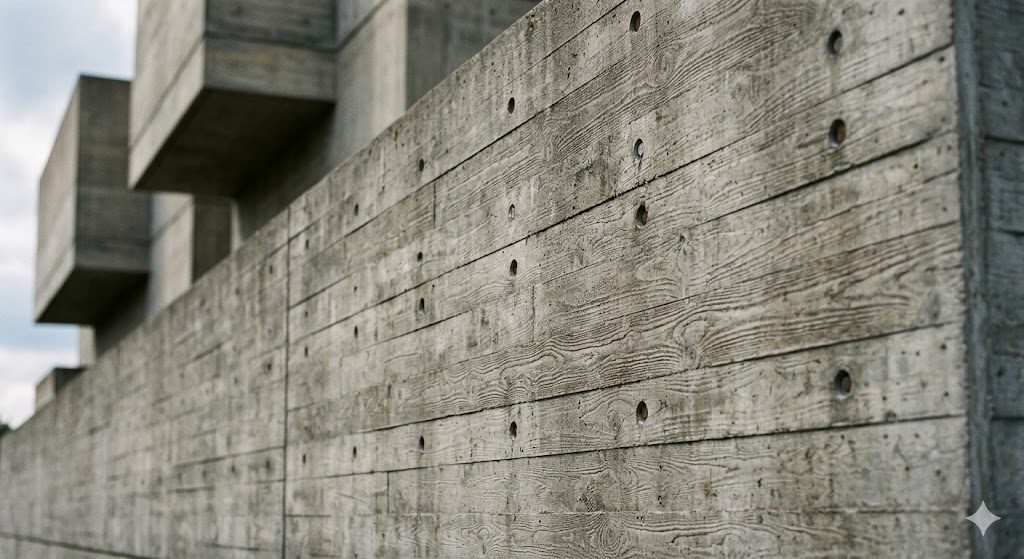
The defining material is reinforced concrete, but the magic is in how it is finished — or rather, not finished. Wet concrete is poured into "formwork", a temporary mould usually built of timber boards. When the boards are stripped away, the concrete carries their imprint: the grain of the wood, the lines between planks, the small recesses where the form-ties held the mould together. Brutalist architects chose to keep this record rather than grind it smooth. The wall becomes a kind of fossil of its own construction.
Form follows a logic of mass and cantilever. Because concrete can be poured into almost any shape and reinforced to span and overhang, Brutalist buildings indulge in dramatic projections — floors that step out over the street, theatres slung over open ground, towers that taper or flare. The plasticity of the material invites sculpture. But this is heavy sculpture; the pleasure is in the sense of vast weight held in balance.
Light is the quiet third material. A flat concrete plane is dull; a deeply modelled one is alive. So Brutalist facades are full of relief — recessed windows, projecting fins, hooded openings, scooped balconies — all of which catch the sun and cast deep shadows that change through the day. A brise-soleil, a screen of horizontal or vertical concrete fins, both shades the glass behind it and turns the whole wall into a slow sundial. In strong, clear light, these buildings come into their own.
In the Indian context
Here is the surprise that even many design students miss: India has one of the richest Brutalist legacies on Earth. The reason is historical. Independent India after 1947 set out to build its institutions — capitols, universities, research centres, public housing — quickly, cheaply, and in a forward-looking language untainted by colonial revivalism. Reinforced concrete answered all three demands, and Nehru's government invited the era's greatest architects to wield it.
The keystone is Chandigarh. From the early 1950s, Le Corbusier master-planned an entire new capital for Punjab and designed its civic heart, the Capitol Complex — the High Court, the Secretariat and the Assembly (Palace of Assembly). These are beton brut at full monumental volume: the great curving portico of the High Court, the upturned-funnel chamber of the Assembly, vast brise-soleil screens calibrated against the fierce north-Indian sun. The Capitol Complex is a UNESCO World Heritage Site, and it is arguably the single most important concentration of mid-century concrete monumentality anywhere.
In Ahmedabad, Corbusier built two further masterworks in the same years: the Mill Owners' Association Building, a concrete box wrapped in a sculptural brise-soleil and ramp, and the Villa Sarabhai, a private house exploring vaulted concrete and shade. Ahmedabad then drew Corbusier's American counterpart. Louis Kahn designed the campus of the Indian Institute of Management Ahmedabad through the 1960s — and although Kahn built it in load-bearing brick rather than concrete, its monumental geometry, its huge circular and arched openings cut for both light and shade, and its uncompromising honesty make it the spiritual sibling of Indian Brutalism. To walk IIM-A's corridors is to feel the same weight and silence as any concrete monument.
What makes India's story singular is that the foreign masters trained a generation of Indians who carried the language forward and made it their own. Foremost among them is Balkrishna V. Doshi, who worked with both Corbusier and Kahn before building a remarkable body of concrete work: the CEPT campus in Ahmedabad (the school he founded, all raw concrete and stepped section), the Indian Institute of Management Bangalore with its shaded concrete pergola-streets, and the Ahmedabad School of Architecture. Doshi became, in 2018, the first Indian to win the Pritzker Prize. Alongside him, Raj Rewal and Kuldip Singh gave New Delhi its monumental concrete civic and institutional architecture in the 1970s and 1980s — Rewal's Hall of Nations (now demolished, and much mourned) and his Asian Games Village, Singh's NDMC and Palika buildings. Across the country, the post-independence state university, the government office, the research laboratory and the public auditorium were very often raw concrete. It is the architecture of the Nehruvian republic.
The Indian climate, though, is both Brutalism's friend and its test. The friend: India's strong, clear sunlight is exactly what concrete relief and brise-soleil screens were made for — deep shade, sharp shadow, and self-shading facades that keep interiors cooler without machinery. This overlaps closely with the logic of tropical architecture in India and the broader discipline of passive design across India's climate zones. The test: raw concrete weathers hard here. The monsoon streaks it; algae and damp blacken north-facing surfaces; heat and humidity stress the material and the people inside. Corbusier and Doshi understood this, which is why their best Indian work leans so heavily on deep overhangs, generous shade, and rain-throwing drip details. Concrete that ages gracefully in dry Marseille can look grim and stained in coastal Mumbai within a few monsoons unless it is detailed for the weather. You can study how raw, shaded facades behave through the year with our sun-path analyzer.
This Indian translation — a global modern idiom bent to local sun, monsoon and material — is exactly the conversation explored in contemporary Indian architecture and what defines it and in the wider tension of modern versus traditional Indian house architecture.
How to bring it into your home
You do not need a civic-scale budget or a megastructure to live with Brutalism's ideas. The movement scales down to a home surprisingly well, because at heart it is about restraint and honesty — letting a few real materials do the work.
The most accessible move is exposed concrete used with intent: a board-formed concrete feature wall, an IPS (Indian Patent Stone) floor polished to a soft sheen, a cast-concrete kitchen counter or basin, a bare concrete ceiling with the slab and beams left frankly visible. Pair the grey with honest companions — natural timber, raw or oiled, lots of it for warmth; black metal; jute, cane and handloom textiles; and plants, which look extraordinary against concrete. The palette stays narrow and earthy, which is why Brutalism sits comfortably alongside warm minimal interiors and a deliberately earthy interior palette.
Light matters even at domestic scale. Let a single shaft of sun rake across a concrete wall and the room acquires drama for free. Keep ornament out; let texture and shadow be the decoration. And honour the structure — if a beam crosses the ceiling, expose it rather than boxing it in.
A caution worth saying plainly: in the Indian home, concrete needs help. Seal exposed concrete and IPS against staining; detail overhangs and drips so the monsoon does not streak your facade; mind heat gain on west walls; and watch for damp where concrete meets the ground. Done carelessly, raw concrete reads as "unfinished builder's shell". Done deliberately — sealed, shaded, paired with warmth — it reads as quiet, grounded luxury.
Bring it home, in order
1. Pick one honest surface to celebrate — a board-formed concrete wall, an IPS floor, or an exposed slab ceiling — rather than scattering concrete everywhere.
2. Keep the palette narrow: warm grey, natural timber, black metal, one earthy textile. Restraint is the whole point.
3. Seal it. Treat exposed concrete and IPS with a penetrating sealer against stains, oil and damp — non-negotiable in the Indian home.
4. Detail for the monsoon: overhangs, drip grooves and shade on exposed external concrete, so it weathers with grace, not grime.
5. Use light deliberately — position the surface where raking sun will model its texture and throw shadow.
6. Express, do not hide — leave a beam, a duct or a stair frankly visible if it is doing real work.
7. Warm it up — timber, plants, soft lighting and tactile textiles keep the rawness human, not cold.
8. Visit the real thing — Chandigarh's Capitol, IIM-A, or CEPT — to feel the weight and shadow no photograph conveys.
Want to test whether raw, honest, monumental materials suit your home — and see a board-formed wall or IPS floor rendered in your own space before you commit? DesignAI lets you visualise concrete, timber and shade in your room, and our style-finder helps you place yourself on the spectrum from Brutalist rawness to warm minimalism.
Misconceptions, and where it goes wrong
The biggest misconception is the name. Brutalism is not "brutal" — it is "raw", from beton brut. The hostility the word invites has done the movement real damage in the public mind.
The second is that Brutalism is inherently ugly or inhuman. Much of its bad reputation came from how it weathered and how it was used, not from the idea itself. The social-housing idealism of the 1950s and 60s put thousands of families into concrete megastructures; when councils starved those estates of maintenance, the concrete stained, lifts failed, and decay set in. Brutalism became the visual shorthand for urban neglect — unfairly blamed for failures of upkeep and social policy rather than design. Many fine examples were demolished in a wave of distaste.
The third misconception is that it is dead. It is emphatically not. A vigorous revival is underway: monographs, exhibitions, "SOS Brutalism" preservation campaigns, listed-building protection for once-doomed estates, and a younger generation that finds the honesty and weight of the work deeply appealing. Chandigarh and IIM-A are now revered. The aesthetic has even returned in homes and interiors as a counter to glossy, disposable finishes.
Where Brutalism genuinely goes wrong is in execution. Concrete left unsealed and undetailed in a wet climate ages badly. A monumental scale that ignores the human at the doorstep can feel oppressive. And rawness without warmth — concrete with nothing soft, green or timber to answer it — reads as a building site, not a home. The discipline is in the doing: honest, yes, but considered. Get the detailing and the warmth right, and Brutalism delivers something almost no other style can — architecture that feels true.
References
1. Reyner Banham, "The New Brutalism: Ethic or Aesthetic?" (1966).
2. Le Corbusier, "Towards a New Architecture" and the Oeuvre Complete (on beton brut and the Unite d'Habitation).
3. William J. R. Curtis, "Modern Architecture Since 1900" (Le Corbusier, Kahn, Chandigarh and Ahmedabad).
4. Kenneth Frampton, "Modern Architecture: A Critical History" (Brutalism, Kahn, and the Indian work).
5. Balkrishna V. Doshi / Vastushilpa Foundation monographs (CEPT, IIM Bangalore, Pritzker 2018).
6. UNESCO World Heritage Centre, "The Architectural Work of Le Corbusier" (Capitol Complex, Chandigarh).
7. Oliver Elser, Philip Kurz and Peter Cachola Schmal (eds.), "SOS Brutalism: A Global Survey" (2017).
If this movement speaks to you, follow the thread: read What Is High-Tech Architecture? for structure expressed in steel and glass rather than concrete, What Is Critical Regionalism? for how modern form is grounded in place and climate, and Organic Architecture, Explained for a softer, nature-led path to the same honesty of material.
Export this guide
Related Guides — Deep-dive reading
The Capitol Complex, Chandigarh: Le Corbusier's Concrete City for a New Nation
How a free India handed a Swiss-French modernist a blank plain in Punjab, and got back a landscape of raw concrete, upturned roofs and sun-breakers that argued a newly independent country need not build like its past
Architectural WondersLouis Kahn's Façade Signature: Wrapping Ruins, Brick Arches, and Monumental Light
How Louis Kahn shaded the glass behind giant geometric screen walls, asked the brick to be an arch, and built monumental façades of fair-faced concrete and light — and what that hot-climate logic teaches Indian builders today.
Building FacadesQuinta Monroy: How ELEMENTAL Built Half a Good House and Let the Residents Finish It
In Iquique, Chile, Alejandro Aravena and ELEMENTAL answered an impossible social-housing budget by building only the half of each dwelling that families could never build themselves — the structure, kitchen, bathroom and stair — and leaving a deliberate void for the other half. This is the case study in incremental housing, participatory design, and why the future of shelter may lie in the unfinished.
The Future of ArchitectureRelated Tools — Try Free
Brise-Soleil Visualizer
Interactive horizontal-louvre cut-off angle calculator — sun altitude, louvre depth, and spacing inputs with a live shadow preview. Computes θ = arctan(spacing/depth) for façade shading, ECBC envelope compliance, hospital daylight design, and tropical sun-control detailing.
Sun Shading ToolCross-Ventilation Analyzer
Estimate airflow and air changes per hour (ACH) from room size, window areas, layout, and local wind — with NBC 2016 Part 8 compliance check.
Ventilation CalculatorConcept Generator
Get 3 AI-generated design concepts for any room with style, materials, and cost estimate.
DesignAI