
What Is Wabi-Sabi Architecture?
The beauty of imperfection, impermanence and the incomplete — design that ages with grace
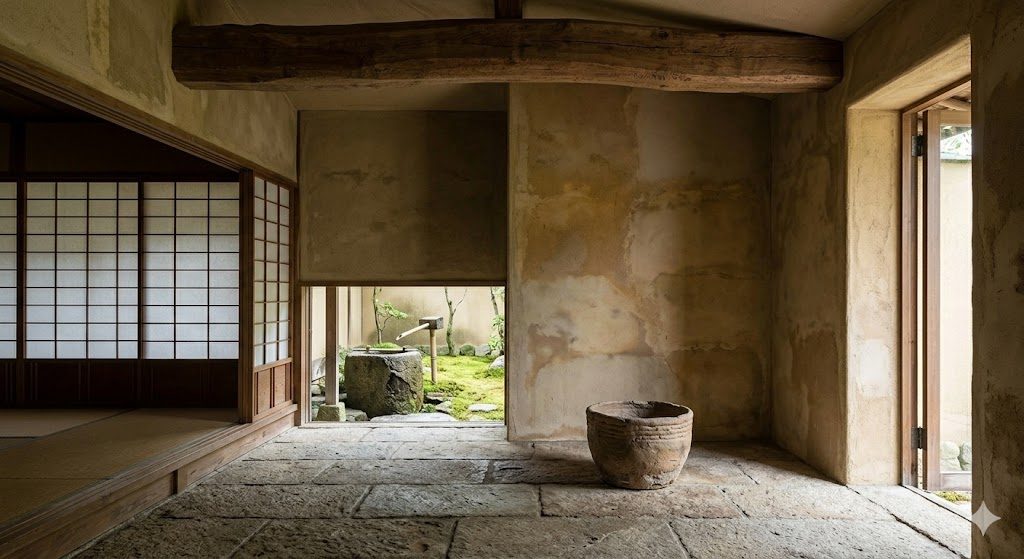
Step into a true wabi-sabi room and the first thing you notice is what is missing. There is no gloss to bounce the light, no chrome edge to catch your eye, no surface pretending to be something it is not. The lime-plastered wall is soft and slightly uneven, cool to the palm, holding the day's warmth like skin. A single timber beam shows the grain it grew with. A clay bowl on a low shelf is not quite round. The light comes in sideways and low, and the shadows it casts are treated as furniture — as something the room owns and arranges. You exhale without deciding to.
Wabi-sabi is the Japanese aesthetic and worldview that finds beauty in imperfection, impermanence and incompleteness — in the modest, the weathered and the unfinished rather than the grand, the new and the flawless.
It is not a style you apply to a building. It is a way of seeing that decides which materials you trust, how much you leave out, and — most radically — that a surface is allowed to age, wear and be repaired in front of you, and is more beautiful for it.
What wabi-sabi is
The word is two ideas married together. Wabi once meant the loneliness of living apart from society; over centuries it softened into something positive — the quiet, understated, austere beauty of the modest and unadorned, the richness found in simplicity and humility. Sabi meant the chill and withering of age; it too turned, into the beauty that time confers — the patina, the rust-bloom, the polish that hands and feet rub into a surface over decades. Put them together and you have a single instinct: the deepest beauty is rustic, transient and worn, not perfect and permanent.
The American writer Leonard Koren, whose slim 1994 book "Wabi-Sabi for Artists, Designers, Poets & Philosophers" introduced the idea to the design West, distilled it to a sentence worth keeping: wabi-sabi is "the beauty of things imperfect, impermanent, and incomplete." Three words do the work. Imperfect — the bowl is lopsided, the wall undulates, and these are not failures to be sanded out. Impermanent — everything is in flux; the building, like the cherry blossom, is admired partly because it will not last. Incomplete — the work is deliberately left open, a little unfinished, so the eye and mind have somewhere to go.
This is a worldview before it is a look. It carries a quiet metaphysics, drawn from Zen Buddhism, that nothing is finished, nothing is perfect, and nothing lasts — and that accepting this is not melancholy but a kind of freedom. A wabi-sabi home does not ask to be kept pristine. It asks to be lived in until it shows that it has been.

Where it came from
Wabi-sabi grew in the soil of Zen Buddhism and flowered, most decisively, in the Japanese tea ceremony. To understand it you have to picture the thing it rebelled against. By the fifteenth and sixteenth centuries the tea gatherings of the Japanese elite had become displays of imported Chinese luxury — flawless celadon, gold, lacquer, the costly and the perfect. Tea was a way of showing wealth.
Against that grain came a lineage of tea masters who turned the ceremony inward and downward, toward poverty, plainness and the handmade. Murata Juko in the late fifteenth century began admitting rough, irregular, local utensils. His successor Takeno Joo pushed further. And then Sen no Rikyu (1522–1591), the most revered figure in the history of tea, made the austere, rustic ideal absolute. Rikyu prized the misshapen native bowl over the perfect imported one, the bamboo scoop over the bronze, the cracked over the flawless. He shrank the teahouse to a tiny rustic hut — the famous Tai-an at Myoki-an, with its low crawl-through entrance, the nijiriguchi, that forced even a lord to bow and leave his sword and rank outside. Rough mud walls, a single flower, a kettle, shadow. Out of that deliberate poverty he made one of the most refined aesthetics on earth. The legend that he once swept a garden path spotless, then shook a maple so a scatter of leaves fell across it, captures the whole philosophy: perfection completed by a controlled imperfection.
There is a deep literary companion to all this. In 1933 the novelist Junichiro Tanizaki published "In Praise of Shadows," a short essay mourning the way electric light and Western gloss were erasing the Japanese love of dimness, patina and the tarnished. Tanizaki wrote that the Japanese found beauty not in the object itself but in the shadows and the sheen of age upon it — "the glow of grime," the dull lustre that handling leaves on silver, wood and lacquer. He preferred a tarnished thing to a polished one. Read him alongside Koren and you have wabi-sabi's two scriptures: one ancient and lived, one modern and articulated.
"Wabi-sabi is the beauty of things imperfect, impermanent, and incomplete." — Leonard Koren, "Wabi-Sabi for Artists, Designers, Poets & Philosophers"
The defining principles in a space
Translate the philosophy into walls, light and objects and a consistent set of signatures appears. None is decorative; each follows from the worldview.
| Principle | What it looks like in a room | Why it matters |
|---|---|---|
| Imperfection | Undulating plaster, a hand-thrown bowl, an off-true joint | The flaw is the fingerprint of the human or the natural; it is honoured, not hidden |
| Impermanence | Surfaces that visibly age; seasonal change brought indoors | The room is understood as in flux, never a finished, frozen object |
| Incompleteness | Restraint; a deliberately bare wall; a corner left open | The unfinished invites the eye and mind to complete it |
| Natural materials | Lime, clay, raw timber, stone, brass, linen | Only living materials patina; they connect the room to time and earth |
| Asymmetry & irregularity | Off-centre composition, no rigid grid | The natural world is irregular; symmetry reads as machine-made |
| Texture over polish | Matte, tactile, slightly rough surfaces | Light is absorbed, not bounced; the hand wants to touch |
| Muted earthy palette | Greys, clays, ochres, charcoals, undyed naturals | Quietness; nothing shouts, everything settles |
| Patina & repair | Worn thresholds, tarnished brass, mended cracks | Age is ornament; kintsugi makes the break the most beautiful part |
| Emptiness & quietness | Generous negative space, low light, silence | Restraint lets the few present things breathe and be felt |
Two of these deserve a line more. Patina is the whole reason wabi-sabi cares so much about materials: it wants surfaces that arrive at their beauty slowly. And repair has its own emblem — kintsugi, the Japanese art of mending broken pottery with lacquer and powdered gold so the seam becomes a vein of light. Kintsugi is wabi-sabi's perfect metaphor: the object is not restored to pretend it never broke; the break is made the most valuable thing about it. A wabi-sabi house treats its own cracks, wear and scars the same way.
Materials, form and light
Wabi-sabi is built, not decorated, and the building blocks are nearly always the same: materials that breathe and age.
The walls are lime plaster — chunam, tadelakt, undulating and matte — that softens into a chalky, cloud-like depth over years. The floors and beams are raw or oiled timber, left unsealed so the grain darkens and the touched edges polish themselves. There is clay and terracotta, unglazed and mellowing; natural stone — Kota, Kadappa, rough granite — that wears a low sheen into the paths people walk; unlacquered brass that tarnishes to deep antique gold but stays bright where hands fall; and hand-loomed cloth — linen, khadi, undyed cotton — that softens and crumples into character with every wash.
The single test that selects them all: a wabi-sabi material is one that looks better in year ten than in year one. That rule quietly disqualifies the entire vocabulary of the modern builder finish — laminate, PU gloss, vitrified tile, powder-coated aluminium — surfaces engineered to never change and therefore able only to degrade.
The form is asymmetric and restrained: off-centre, irregular, generous with empty space, suspicious of the rigid grid. And the light is everything. Following Tanizaki, wabi-sabi prefers the low, the side-lit, the dim. It treats shadow as a material. Bright, flat, even illumination is the enemy — it flattens texture and makes patina invisible. Soft directional light raking across a rough plaster wall, by contrast, makes the surface come alive and the room feel deep.

It is worth saying plainly how this differs from minimalism, because the two are constantly confused. Both can share a bare floor and a quiet palette, but they feel like opposites to stand inside. Minimalism, at its coldest, is machine-perfect — symmetrical, white, precise, its surfaces engineered to never change, a flaw read as a defect to be replaced. Wabi-sabi is warm, irregular, aged and handmade — its surfaces chosen precisely to change, a flaw read as character. Minimalism empties a room to achieve perfection; wabi-sabi empties it to let a few imperfect things breathe. If you have ever found a beautiful minimalist interior strangely unrestful, this is why — and why the hybrid Japandi style, which weds Japanese warmth to Scandinavian calm, has become so loved. For more on the warm end of that spectrum, see our notes on warm minimal interiors and minimalist architecture in the Indian context.
In the Indian context
Here is the surprise India holds for anyone who falls for wabi-sabi: the country has been building this way for a thousand years, and never needed a Japanese word for it.
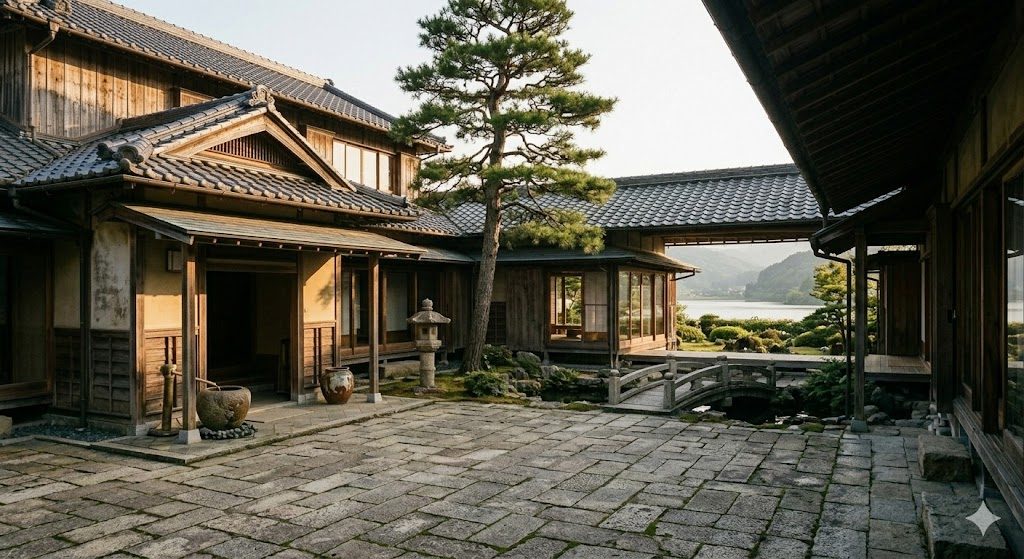
Walk through an old Rajasthani haveli, a Chettinad mansion, a Goan-Portuguese home, a Kerala tharavadu, and you are walking through wabi-sabi made of Indian matter. The walls are lime and chunam plaster, sometimes polished to the glassy depth of araish — a technique whose cousin in Morocco is celebrated as tadelakt — and they have aged into soft, cloudy, hand-touched surfaces no factory could fake. The floors are Kota and Kadappa stone, worn to a low gleam along the routes generations have walked, and red oxide, that deep oxblood floor of the South that only deepens with decades of bare feet and coconut oil. There is terracotta — Mangalore tiles, Athangudi tiles, unglazed pots — and brass lamps and vessels gone dark with age and prayer-smoke, and hand-loomed cloth from Kutch to Kanchipuram. There is the weathered courtyard, open to monsoon and sun, its stone speckled and stained by rain. India did not import the patina of age; it lives surrounded by it.
This affinity runs deeper than materials, into climate and craft. The same lime plaster and stone and shaded courtyard that wabi-sabi loves are also exactly what works in the Indian climate — breathable, thermally massive, cooling, durable. (Our guides on vernacular architecture in modern Indian homes, tropical architecture in India and climate-responsive courtyard homes trace that overlap in detail.) And India still has what most of the world has lost — living artisans: the chunam and araish masters of Rajasthan, the Athangudi tile-makers of Chettinad, the red-oxide floor layers of the South, the brass-beaters of Moradabad, the weavers of Kutch. Wabi-sabi needs the handmade and the one-of-a-kind; India can still supply it from a workshop down the road.
What it stands against, in India, is specific and worth naming: the glossy builder finish. The aspirational default of the past two decades — wall-to-wall vitrified tile, high-gloss laminate, PU-coated everything, chrome, faux marble, flat tube-light — is the precise opposite of wabi-sabi. It is a culture that reads age as decay and the handmade as cheap, that wants every surface to look factory-new forever and replaces it the moment it does not. Wabi-sabi, in the Indian setting, is partly a quiet act of resistance: a return to the lime wall and the red-oxide floor and the brass lamp your grandparents knew were beautiful, and a refusal of the idea that newer and shinier is better. It belongs in the same conversation as our contemporary Indian architecture and earthy interior palette notes.
You can see the instinct, if not the label, in the work of India's greatest modern architects. Geoffrey Bawa in neighbouring Sri Lanka and Laurie Baker in Kerala built with raw brick, lime, stone, shadow and the weathered, honest surface — Baker famously leaving brick exposed and celebrating the imperfection of the handmade and the local. B.V. Doshi's raw, textured, light-carved interiors and Charles Correa's open-to-sky courtyards share the same regard for material truth, age and the play of shadow. India arrived at wabi-sabi's conclusions by its own long road.
How to bring it into your home
You do not renovate your way to wabi-sabi; you subtract and you wait. A few moves carry most of the feeling.
Start with the walls — the biggest surface and the fastest transformation. Trade flat plastic emulsion for lime plaster, araish, or at minimum a deep matte mineral paint, and let it be a little uneven. Bring in raw or oiled wood — a timber that is sealed in oil, not lacquer, so it can darken and wear. Choose one flawed, beautiful, handmade thing and give it room — a hand-thrown bowl, an old brass lamp, a slubby hand-loomed throw — rather than ten perfect catalogue objects. Restrain ruthlessly: the emptiness is the design, not a gap waiting to be filled. Pull the palette down to muted earths — clay, charcoal, ochre, undyed natural. Soften the light: warm, low, directional, with lamps and shade rather than a ceiling grid of cool white. And most importantly, let things age. Do not lacquer the brass. Do not seal the stone to a permanent shine. When something cracks, consider mending it visibly, kintsugi-style, instead of replacing it.
Bring it home, in order
1. Re-do one wall in lime or araish plaster — or a deep matte mineral paint — and accept a little unevenness. This single move resets the whole room's light and touch.
2. Switch the floor or a feature surface to something that patinas — red oxide, Kota, Kadappa, terracotta — anywhere you were about to lay vitrified tile.
3. Strip the lacquer from your metals. Choose unsealed brass and copper and let them tarnish; the dark bloom is the point.
4. Subtract until it feels almost too bare, then stop. Keep the negative space as a deliberate element.
5. Add one imperfect, handmade hero object with space around it, and resist the urge to add a second.
6. Pull the palette and the lighting down — muted earth tones, warm low directional light, shadow allowed back into the corners.
7. Choose oiled, unsealed timber for at least one piece so the grain and the touch can deepen over years.
8. Adopt a no-replace rule for small damage. Mend the cracked bowl, keep the worn threshold. Let the house earn its face.
If you want help finding where your taste actually sits before you commit — wabi-sabi, warm minimal, Japandi or earthy — our style finder maps it in a few minutes, and the paint visualiser lets you test those muted, chalky earth tones on your own walls before a brush goes near them.
Misconceptions — and where it goes wrong
The most common mistake is to confuse wabi-sabi with shabbiness or neglect. It is not. A genuinely wabi-sabi space is intensely curated and intentional — every imperfect thing is chosen, every empty space is decided. The difference between wabi-sabi and a messy, run-down room is the difference between a swept garden with leaves arranged across it and a garden that was simply never swept. Restraint, editing and quality of material are doing constant invisible work. Tatty MDF and a dusty corner are not wabi-sabi; they are just neglect.
The second mistake is to treat it as a decorating theme to be bought — to order a set of distressed, factory-aged props and call it done. Manufactured imperfection is a contradiction; the whole value of the wabi-sabi flaw is that it is real, made by a hand or by time. The third is to mistake it for cold minimalism and end up with a hard, empty, perfect white box — losing exactly the warmth and the welcome of age that make wabi-sabi what it is.
And the last, subtlest error is impatience. Wabi-sabi cannot be finished on handover day, because half its beauty has not happened yet — it lives in the years of weathering, polishing, tarnishing and mending to come. To build a wabi-sabi home is to begin something and then, deliberately, leave it incomplete, and let your own life finish it.
That patience is also why wabi-sabi sits so naturally beside the broader movements we explore elsewhere — the borrowed calm of Japanese architecture, the material honesty of organic architecture, and the deep human need for nature and texture that biophilic architecture is built around. All four ask the same thing of a building: that it be alive, honest, and on the side of time rather than against it.
Designing a wabi-sabi home — choosing where to be empty, which materials will age well, how light should fall — is exactly the kind of quiet, material-led thinking that rewards seeing it before you build it. DesignAI lets you visualise muted palettes, lime-plastered walls, raw timber and low directional light in your own rooms, so you can feel the restraint and the warmth on screen before a single surface is committed.
References
1. Koren, Leonard. "Wabi-Sabi for Artists, Designers, Poets & Philosophers." Imperfect Publishing, 1994.
2. Tanizaki, Junichiro. "In Praise of Shadows" (In'ei Raisan). 1933; English translation, Leete's Island Books, 1977.
3. Juniper, Andrew. "Wabi Sabi: The Japanese Art of Impermanence." Tuttle Publishing, 2003.
4. Sen, Soshitsu XV. "Tea Life, Tea Mind" and writings on Sen no Rikyu and the way of tea. Urasenke Foundation.
5. Crowley, James & Sandra. "Wabi Sabi Style." Gibbs Smith, 2001.
6. Robson, David. "Geoffrey Bawa: The Complete Works." Thames & Hudson, 2002.
7. Bhatia, Gautam. "Laurie Baker: Life, Work, Writings." Penguin India, 1991.
Keep exploring the philosophies that prize calm, material truth and the handmade: What Is Japanese Architecture?, Organic Architecture, Explained, What Is Biophilic Architecture?, and the everyday craft of warm minimal interiors, minimalist architecture in the Indian context and the earthy interior palette.
Export this guide
Related Guides — Deep-dive reading
Defining Luxury in Residential Architecture
Quality, Materiality, Craftsmanship, and Restraint — Beyond the Cost-Per-Square-Foot Fallacy
Design StylesEarthy Interior Palette — A 2026 Style Guide for Indian Homes
Rooted · Regional · Biophilic · Indian craft-anchored
Design StylesWarm Minimal Interiors — A 2026 Style Guide for Indian Homes
Restraint with warmth · Oat & oak & linen · Curated negative space
Design StylesRelated Tools — Try Free
Cross-Ventilation Analyzer
Estimate airflow and air changes per hour (ACH) from room size, window areas, layout, and local wind — with NBC 2016 Part 8 compliance check.
Ventilation CalculatorCircadian Light Meter
Patient-centric circadian lighting visualizer for Indian healthcare design — time-of-day × intensity → CCT, melanopic lux (EML / mEDI), melatonin suppression, and an alertness curve. Calibrated against WELL v2 L03 Circadian Lighting Design, CIE S 026:2018, Brainard 2001, and Lucas et al. 2014.
Circadian ToolConcept Generator
Get 3 AI-generated design concepts for any room with style, materials, and cost estimate.
DesignAI