
Charles Correa
India's architect of the open-to-sky
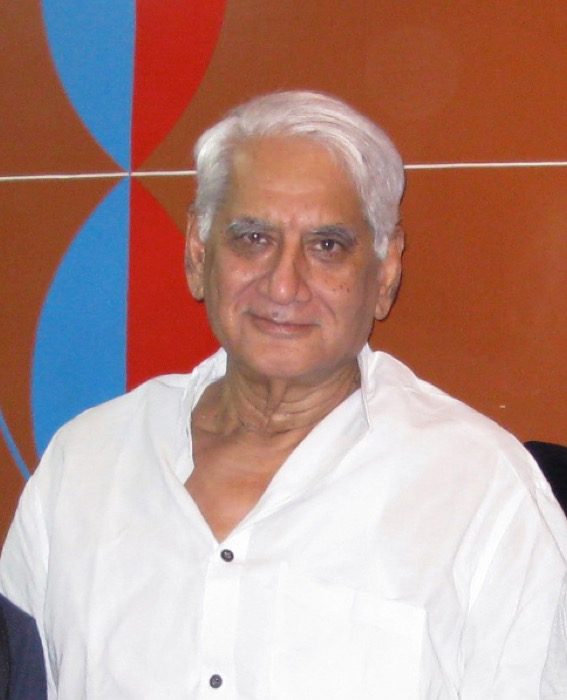
Photo: Dipz99, CC BY-SA 3.0, via Wikimedia Commons
Movements
Signature works
- Gandhi Smarak Sangrahalaya, Ahmedabad
- Kanchanjunga Apartments, Mumbai
- Belapur / Artists' Village, Navi Mumbai
- Jawahar Kala Kendra, Jaipur
- Vidhan Bhavan, Bhopal
Step out of the heat of an Ahmedabad afternoon into the Gandhi Smarak Sangrahalaya and the building seems to dissolve. There is no grand portico, no air-conditioned hush — only a low grid of tiled pyramidal roofs on slender brick piers, water channels glinting between them, and courts open to the sky where light pools and a breeze moves through. You are never quite sure whether you are inside or outside. That ambiguity is the whole point. It is the most Gandhian building imaginable, and it announced, in 1963, that Indian modern architecture had found its own voice.
The man who designed it was Charles Mark Correa, born in Secunderabad in 1930 and, by the time of his death in 2015, the most influential modern architect India has produced. Trained in the United States, he came home to spend a lifetime arguing — in buildings, in housing, in city plans and in prose — that the architecture India needed could not be imported. It had to grow from the country's climate, its culture and its crushing inequalities.
Correa's central idea was that in a hot land the building should be shaped by the sun and the breeze rather than fight them — "form follows climate" — and that the most generous room of all is often the open sky itself. Around that conviction he built a humane, climate-responsive, culturally rooted architecture that made him a leading figure of critical regionalism and a conscience for Indian city-building. For a close reading of how this shaped his building skins — the open-to-sky room, the deep layered verandah façade and the tube house's stack-ventilated section — see our Charles Correa facade signature guide.
The idea: form follows climate, and the sky is a room
Correa inverted a famous modernist slogan. Where Louis Sullivan had said form follows function, Correa insisted that in the Indian subcontinent form follows climate. A building in Mumbai or Jaipur does not need to be a sealed glass box kept alive by machines; it needs shade, cross-ventilation, the right orientation, and the intelligence to use the open air as architecture.
From this came his signature move: the open-to-sky space. In a temperate country a courtyard is a luxury; in a warm one it is a working room. The verandah, the terrace, the planted court, the stepped roof — these were not leftover spaces for Correa but the heart of the plan, places where people actually live for much of the year. His early tube house in Ahmedabad packed this logic into a narrow, deep section: a high vent at the ridge let hot air rise and escape, while a sloping roof and an open court pulled a cross breeze through. The house cooled itself by its shape.
This was never mere technique. The open-to-sky space was also cultural — it answered the way Indians have always lived between inside and outside, on the chabutara and the terrace, under the sky. Climate and culture, for Correa, were the same argument made twice.
It also reframed what comfort means. The sealed, conditioned interior treats the outside as an enemy to be excluded; Correa's section treats it as a partner. Air is invited to move; the sun is shaded but its warmth on a winter terrace is welcomed; rain is celebrated from a deep verandah rather than barred. Comfort, in this reading, comes not from an even, machine-held temperature but from choice — a hierarchy of spaces, from cool court to shaded room to open terrace, that lets a family follow the climate through the day and the seasons. It is a far older idea than air-conditioning, and a far more sustainable one.
Life and path
Correa was born into a Goan Catholic family in Secunderabad in 1930 and grew up across India. After early studies in Bombay he left for the United States, taking a degree at the University of Michigan before completing his master's at the Massachusetts Institute of Technology, where he absorbed the rigour of high modernism at first hand.
But the decisive influences were closer to home. He returned to India in the late 1950s into a country remaking itself — Nehru's India, where Le Corbusier was building Chandigarh and Louis Kahn would soon begin the Indian Institute of Management in Ahmedabad. Correa learned from both these giants, yet refused to copy them. Where Corbusier imposed a heroic concrete order and Kahn pursued monumental geometry, Correa kept asking a quieter question: what does this place, this heat, this society actually need?
The American training mattered, but so did the unlearning that followed it. At MIT in the early 1950s Correa had absorbed a modernism that assumed temperate climates, abundant energy and the sealed, serviced interior. Back in Bombay he discovered that almost none of those assumptions held. Glass curtain walls turned ovens; mechanical cooling was a luxury few could afford; and the deepest comforts of Indian life — sitting out at dusk, sleeping on the terrace, gathering in the shaded court — belonged to the very in-between spaces that the imported style had no use for. His career can be read as a long, patient correction of that mismatch, turning the supposed deficiencies of a poor, hot country into the generative logic of an architecture.
He set up practice in Bombay and almost immediately produced a masterpiece. The Gandhi Smarak Sangrahalaya (the Mahatma Gandhi Memorial Museum) at Ahmedabad's Sabarmati Ashram, completed in 1963, was a building of extraordinary modesty — a modular field of tiled roofs and open courts that refused monumentality in honour of a man who had refused it too. Over the next five decades Correa would move fluidly between the intimate house, the climate-tuned high-rise, vast low-income housing, civic monuments and city planning, and would teach at MIT and elsewhere while building on three continents.
The signature works
Correa's range is unusual. The same mind that perfected a low-cost incremental house also sculpted one of Mumbai's most admired towers and laid out a city for two million people. A few works carry the argument.
| Work | Place & dates | Why it matters |
|---|---|---|
| Gandhi Smarak Sangrahalaya | Ahmedabad, 1963 | A modular grid of pyramidal-roofed pavilions and open-to-sky courts — Indian modernism reconciled with Gandhian humility. |
| Tube House | Ahmedabad | A narrow, deep, self-cooling section; the laboratory for "form follows climate." |
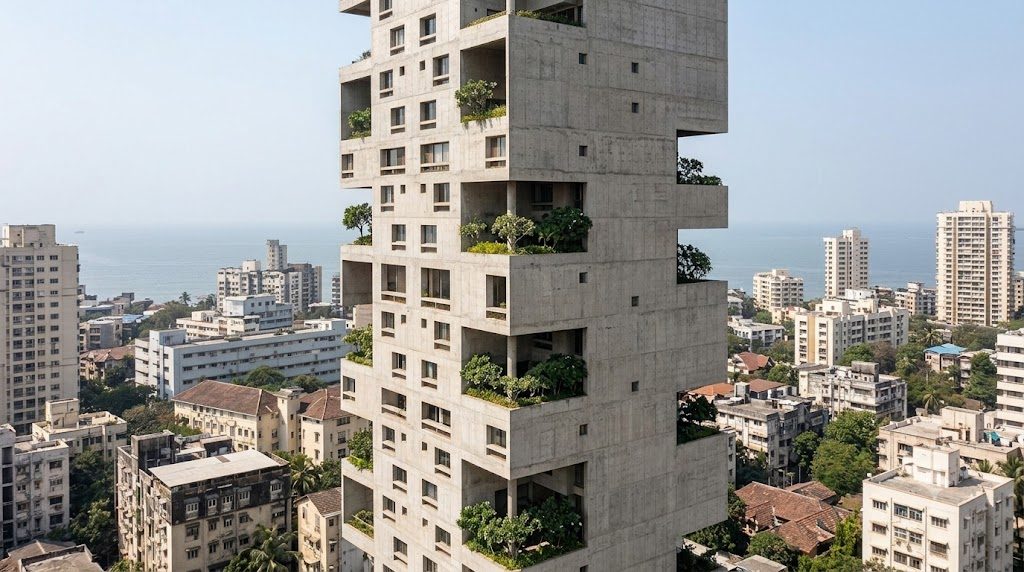
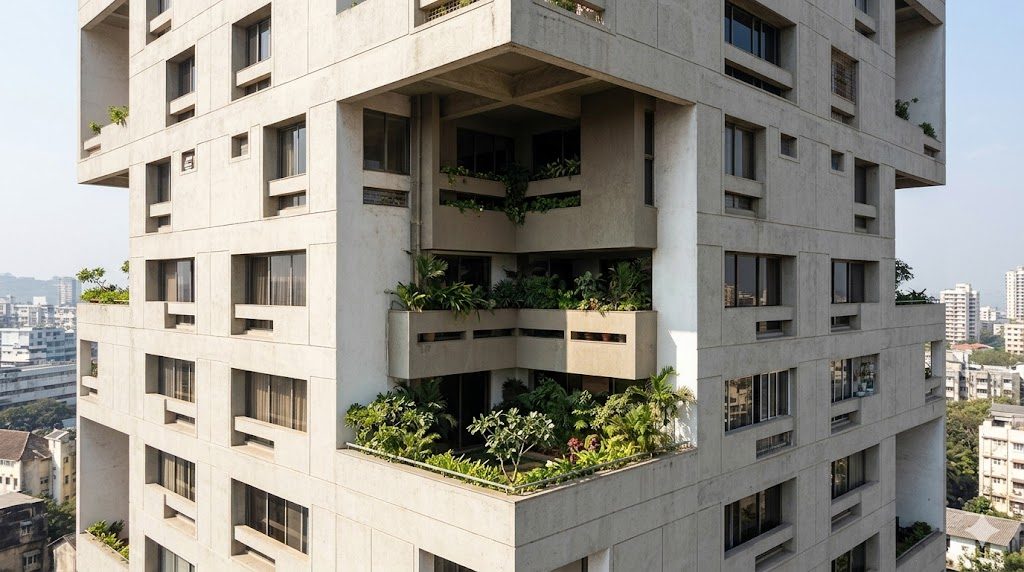
| Kanchanjunga Apartments | Mumbai, 1970–1983 | A 28-storey tower whose corners are carved into deep, double-height garden terraces — the open-to-sky verandah lifted into the high-rise to shade interiors from sun and monsoon. |
| Belapur / Artists' Village | Navi Mumbai, 1980s | Low-rise, high-density, incremental housing: serviced plots and starter cores around shared courts, designed to be finished and grown by the families themselves. |
| Jawahar Kala Kendra | Jaipur, 1986–1992 | An arts centre planned on the navagraha nine-square mandala — modern building, ancient cosmology, each square a gallery of the planets. |
| Vidhan Bhavan | Bhopal | A great civic monument for the Madhya Pradesh assembly, ordered by mandala geometry and crowned with courts and a dome. |
Kanchanjunga is the most photographed, and rightly so. Faced with a long, narrow Mumbai plot oriented to catch the best views east and west — but also the worst of the sun and the driving monsoon — Correa cut deep, two-storey-high terraces into the building's corners. The flats wrap around these sheltered "verandahs in the sky," so that every apartment has shade, a breeze and a garden hundreds of feet up. It is the bungalow verandah reinvented for the tower, climate logic at altitude.
Belapur is the most radical. As chief architect and planner of New Bombay (Navi Mumbai), Correa was confronting the central problem of Indian cities — how to house the poor with dignity at the densities a city demands. His answer at Belapur was to reject the slab block entirely. He laid out clusters of small plots around intimate shared courts, gave each family a serviced site and the beginnings of a house, and let them build the rest over time. No two homes would end up alike; the settlement would grow the way a real Indian neighbourhood grows. It remains a touchstone for incremental, low-rise high-density housing worldwide.
Jawahar Kala Kendra shows the third strand. Here Correa took the navagraha — the nine-square mandala of Indian cosmology, with its nine planets — and made it the plan. Nine squares, one displaced as the city of Jaipur itself was displaced from its ideal grid, each becoming a gallery or court dedicated to a planet. It is unmistakably modern and unmistakably Indian, a building that thinks in Sanskrit and concrete at once.
The civic monuments deepen the picture. At Bhopal, the Vidhan Bhavan houses the Madhya Pradesh state assembly inside a great circular wall, its interior organised by mandala geometry around courts and culminating in a dome — democracy given an Indian cosmological order rather than a borrowed neo-classical one. These public buildings show Correa working at the scale of the state without ever abandoning the open court, the procession through light and shade, the rootedness in Indian symbol.
His reach extended far beyond India: the British Council in Delhi, the Champalimaud Centre for the Unknown in Lisbon, and the MIT Brain and Cognitive Sciences building in Cambridge all carry his thumbprint. That a building for a major Western research university should come from the hand of a Bombay architect was, in its own quiet way, a reversal of the colonial direction of influence that ran through Correa's whole life.
The philosophy
Correa is one of the architects most often named when people explain critical regionalism — the conviction that good architecture must resist a placeless international style and root itself in local climate, culture, light and craft, without retreating into nostalgia. He never copied the past; he abstracted from it. The mandala, the courtyard, the verandah, the stepped roof entered his work as living principles, not decoration.
That same instinct made him a natural exponent of human-centred design. Whether shaping a sky terrace for a Mumbai family or a serviced plot for a labourer, Correa always began with how people actually live, sit, gather and grow — the body in the heat, the family on the terrace, the community around the court. His housing in particular reads as an argument that the poor deserve design intelligence, not just shelter.
His open-to-sky courts, water channels and planted terraces also make him a forerunner of biophilic architecture. For Correa, bringing sky, air, sun and greenery into the heart of a building was not an amenity bolted on at the end; it was the structure of the plan and the source of its comfort.
In a warm climate, Correa liked to say, the sky itself can be the most important room in the house.
India
For Correa, India was not a chapter — it was the whole book. He spent his career insisting that the country could not borrow its way to a modern architecture; it had to build one out of its own heat, its own rituals and its own poverty.
Nowhere was this more consequential than in housing and city-building. As chief architect and planner of New Bombay (Navi Mumbai) in the 1970s and 80s, he helped conceive an entire counter-city across the harbour from Mumbai, meant to relieve the unbearable pressure on the island. He chaired the National Commission on Urbanisation, advised governments, and argued relentlessly that Indian planning had to start from the realities of how the poor live and migrate. His Belapur housing turned that argument into walls and courts.
He also founded the Urban Design Research Institute in Mumbai to study and defend the Indian city, and he wrote with rare clarity — "The New Landscape," on the urban crisis of the developing world, and "A Place in the Shade," a collection of essays whose very title distils his climate philosophy. His thinking is the intellectual bedrock under much of the work explored in Studio Matrx's guides to courtyard homes and climate-responsive design in India and to passive design across India's climate zones.
The honours followed: the Padma Shri and then the Padma Vibhushan (1972), the Aga Khan Award, and in 1984 the RIBA Royal Gold Medal, one of the highest in world architecture. His archive now resides at the Royal Institute of British Architects in London — a global institution holding the papers of an architect who never stopped insisting on the local.
Legacy and what we can learn
Correa's influence runs through nearly every serious Indian architect who came after him, and alongside that of his great contemporary Balkrishna Doshi he defined what a confident, climate-literate, culturally grounded Indian modernism could be. The open-to-sky terrace, the deeply shaded section, the courtyard as a working room, the housing that respects the poor enough to let them finish it themselves — these have become part of the vocabulary of contemporary practice in the subcontinent.
There is a second, harder lesson in his housing. Correa refused to believe that density meant towers or that affordability meant indignity. Belapur and his other settlements argue that you can pack many families onto an acre, give each of them sky, ground and a share in a court, and trust them to grow their own homes over time. As Indian cities reach again for the tower as the default answer to land scarcity, his low-rise high-density alternative — humane, incremental, finishable — has never felt more relevant. He extended this thinking to the city itself, alongside contemporaries like Raj Rewal who were also searching for a dense, courtyard-based urbanism rooted in Indian patterns rather than imported slabs.
The first practical lesson, though, is bracingly simple and still under-applied. Before you reach for glass and machines, look at the sun and the wind. Orient the plan, deepen the shade, open a court to the sky, lift a verandah where people will actually sit. Correa proved that a building tuned to its climate is not a compromise but a richer, cooler, more human place — and that doing this well is an act of cultural and social intelligence, not just engineering.
His principles are exactly the ones we encode in DesignAI — letting climate, orientation and the open sky shape a home before anything else does.
References
- Charles Correa, A Place in the Shade: New Landscapes & Other Essays (Penguin / Hatje Cantz).
- Charles Correa, The New Landscape: Urbanisation in the Third World.
- Kenneth Frampton (ed.), Charles Correa (Thames & Hudson / Perennial Press).
- William J. R. Curtis, Modern Architecture Since 1900 and his monographic writing on Correa.
- Royal Institute of British Architects — RIBA Royal Gold Medal 1984 citation and the Charles Correa archive.
- Hatje Cantz / RIBA, Charles Correa: India's Greatest Architect (exhibition catalogue).
Explore the philosophies Correa championed — critical regionalism, human-centred design and biophilic architecture — alongside his contemporaries Balkrishna Doshi, Le Corbusier and Raj Rewal, and test the climate logic of your own site with the sun-path analyzer.
Philosophies they championed