
What Is High-Tech Architecture?
Structure and services worn on the outside — the machine aesthetic of Rogers, Foster and Piano
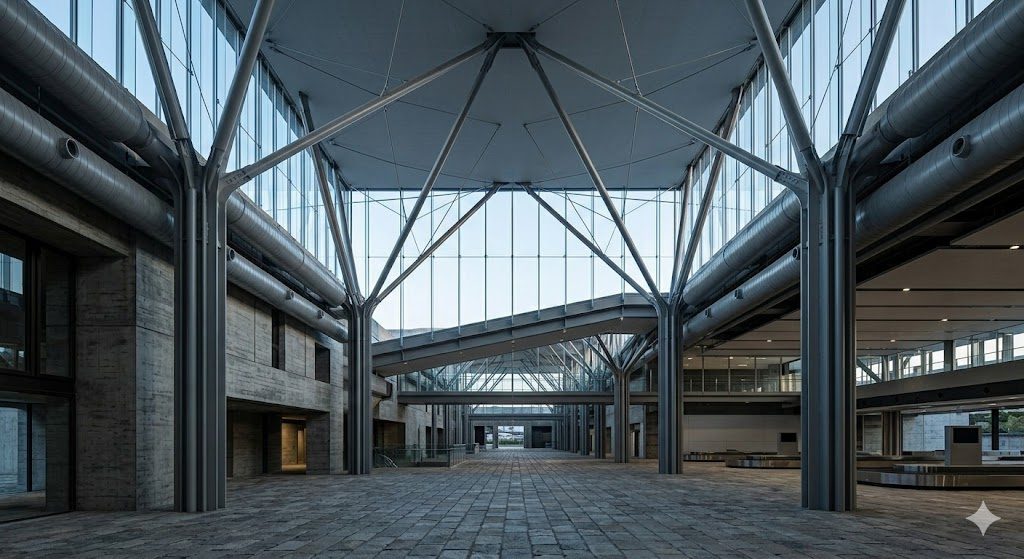
Stand in the great glazed hall of an airport terminal at first light. Above you, a forest of tapered steel masts splays into branching arms, each one cradling a roof that seems to float rather than press down. Tension cables thin as a finger run taut between nodes machined to a jeweller's tolerance. The light pours in through a skin of glass; the ducts and the cable trays are not hidden in a ceiling void but slung in the open, painted, proud, legible. Nothing pretends to be other than what it is. You can read the building the way you read a diagram — and somehow that honesty is thrilling rather than cold.
That feeling is the essence of High-Tech architecture: a building that wears its structure and its services on the outside, and asks you to admire the engineering rather than disguise it.
High-Tech architecture — also called Structural Expressionism or Late Modernism — celebrates technology, structure and the building's services by exposing them. It favours lightweight steel-and-glass over masonry mass, prefabricated components over wet site-work, long-span flexible floors over fixed rooms, and the refined, maintainable machine over the monument. Its deepest belief is that the truth of how a building is made and serviced is itself the most beautiful thing about it.
What it is
High-Tech is the architecture of the visible machine. Where most buildings tuck their guts away — the beams behind plaster, the ducts above a false ceiling, the lifts inside a discreet core — a High-Tech building turns the logic inside out and puts all of it on show. The structural steel becomes the ornament. The air-handling ducts, painted in primary colours, crawl across the facade. The lift you ride glides up the outside of the building in a glass tube. The result is a building you can read like an exploded engineering drawing.
The movement crystallised in Britain and continental Europe through the 1970s and 1980s, carrying a quietly radical idea. Modernism had long preached "truth to materials" and "form follows function." High-Tech took that to its limit: if structure and services are functional, then let them be the architecture — not hidden behind it, but celebrated in front of it. Critics reached for the term Structural Expressionism, because the expressive content of these buildings is precisely the structure and the services. Others filed it under Late Modernism, the last confident flowering of the modern faith in technology before Postmodernism turned ironic.
There is a second, deeper ethos beneath the spectacle: flexibility. By moving structure and services to the edges, High-Tech frees the centre. The floors become vast, column-free, endlessly re-plannable spaces — a factory shed refined into civic architecture. A building made this way can change use across its lifetime without being gutted, because nothing fixed clogs the middle. The building is conceived not as a finished sculpture but as a serviceable, upgradeable, almost living machine.

Where it came from
High-Tech did not appear from nowhere. Its DNA runs back to the Crystal Palace of 1851 — Joseph Paxton's vast prefabricated iron-and-glass exhibition hall, assembled from mass-produced parts in a matter of months. Here, more than a century early, was the whole creed: industrial components, a transparent skin, structure left frankly visible, a building as a kit. The nineteenth-century train sheds and the great iron market halls belong to the same lineage.
The mid-twentieth century supplied the philosophical engine. In California, Charles and Ray Eames built their own house (Case Study House No. 8, 1949) out of off-the-shelf industrial steel sections and standard glazing ordered from catalogues — proof that the language of the factory could make a delicate, joyful home. Buckminster Fuller preached the building as a maximally efficient machine, coined "doing more with less," and gave the world the geodesic dome — structure as pure, lightweight, repeatable geometry. In the 1960s the British collective Archigram drew giddy, comic-strip visions of plug-in cities, walking machines and buildings as serviced, swappable, technological organisms. Few Archigram projects were ever built, but their imagery seeded a generation.
And the movement found its great critic-champion in Reyner Banham, whose writing — especially "The Architecture of the Well-Tempered Environment" (1969) — insisted that the mechanical services, the ducts and the wiring, were not a shameful afterthought but a central fact of modern architecture, as worthy of design attention as any column. When a generation of young British architects took Banham at his word and began designing the services to be seen, High-Tech was born.
The icons and the architects
The movement announced itself to the world in 1977 with a single, electrifying building: the Centre Pompidou in Paris, by Richard Rogers and Renzo Piano (with engineer Peter Rice of Ove Arup). They turned a museum inside out. The structure — a steel exoskeleton with its cast "gerberette" nodes — sits outside the glass. The services are not merely exposed but colour-coded across the facade: blue for air-conditioning, green for water, yellow for electricity, red for movement and circulation. The escalators climb the front of the building in a glazed tube, giving every visitor a free ascending view of Paris. It was loved and loathed in equal measure, and it changed architecture.
Rogers carried the idea to its purest pitch with Lloyd's of London (1986): a building turned literally inside-out, with six service towers — lifts, stairs, toilets, plant — ringing a vast clear central atrium. The "inside-out building" let the trading floor stay open and flexible while every serviceable element hung outside, easy to maintain and replace. His later Millennium Dome and Madrid's Barajas Terminal 4 (with its undulating bamboo soffit and structure painted in a rainbow gradient) extended the language.
Norman Foster became High-Tech's most prolific master, and the one who pushed it furthest toward refinement and, eventually, sustainability. His Sainsbury Centre for Visual Arts (1978) in Norwich is a single, beautifully resolved shed — a clear-span hall wrapped in a smooth aluminium-and-glass skin with the structure and services tucked into the thickness of the walls. His HSBC headquarters in Hong Kong (1985) hung the floors from massive external masts so the banking hall below could be column-free, and bounced daylight deep into the atrium with a computer-controlled "sunscoop" of mirrors. Later, 30 St Mary Axe — the Gherkin (2004) — gave London an instantly iconic aerodynamic tower whose spiralling "light wells" drive natural ventilation: High-Tech maturing visibly into eco-tech.
Around them stand a constellation of others. Michael Hopkins (and Patty Hopkins) refined a quieter, more contextual High-Tech — the fabric-roofed Mound Stand at Lord's — and later fused steel with brick and stone. Nicholas Grimshaw built the great tensile, modular structures — the Waterloo International rail terminal with its overlapping glazed "armadillo" roof, and the Eden Project in Cornwall, whose biomes are vast geodesic bubbles of hexagonal ETFE pillows, a direct descendant of Fuller. Santiago Calatrava, trained as an engineer, took the structural-expressionist impulse toward pure sculpture — white, bone-like, biomorphic skeletons of steel and concrete in bridges, stations and his City of Arts and Sciences in Valencia. Jean Nouvel, adjacent to the movement rather than at its core, brought a High-Tech delight in engineered facades and mechanised skins — most famously the camera-aperture mashrabiya screens of the Institut du Monde Arabe in Paris.

The defining principles and signatures
For all its variety, High-Tech has a recognisable grammar. The deepest organising idea is one it borrowed from Louis Kahn: the distinction between served and servant spaces. The served spaces are where life happens — the gallery, the trading floor, the office. The servant spaces are the machinery that supports them — lifts, stairs, toilets, ducts, plant rooms. High-Tech pushes every servant element to the perimeter, and often right outside the wall, so the served space can stay clear, open and free to change.
| Signature | What you actually see | Why it matters |
|---|---|---|
| Exposed structural steel | Columns, trusses and bracing left visible inside and out | The structure is the architecture; honesty becomes ornament |
| Services on the outside | Ducts, pipes, lifts and stairs worn on the facade, often colour-coded | Frees the interior; makes maintenance and upgrade easy |
| Glass curtain wall | A light, transparent skin hung off the frame | Transparency, daylight, lightness |
| Served vs servant | A clear central floor ringed by edge service zones | Endless flexibility; the building outlives its first use |
| Long-span open floors | Column-free space, sometimes hung from external masts | Re-plannable for any tenant or era |
| Prefabrication & components | Repeated factory-made parts, bolted on site | Speed, precision, a "kit-of-parts" logic |
| The celebrated joint | The node, the bolt, the casting shown off as a detail | Beauty located in the connection itself |
| Lightness & tension | Cables, ties and thin members in place of mass | Doing more with less; the opposite of monumentality |
A High-Tech building therefore reads as a system rather than a solid. You can trace the load path with your eye, follow a duct from intake to outlet, see how the parts were made and joined. The pleasure is the pleasure of legible engineering — and of precision. Where Brutalism revels in the rough board-marked concrete and the trace of the human hand, High-Tech revels in the machined, the bolted, the tolerance measured in millimetres.
"A building is like a soap bubble. This bubble is perfectly uniform if the air within is evenly distributed. The architecture must be visible in the finished work." — a sentiment in the spirit of Buckminster Fuller, whose pursuit of maximum performance from minimum material is the moral engine of the whole movement.
Materials, form and light
High-Tech is, above all, a material culture. Its palette is the palette of the modern engineer:
- Steel — the hero. Rolled sections, tubes, castings and forgings, often left exposed and painted in protective, expressive colour. Tension members and cast nodes are designed to be admired.
- Glass — the skin. Large sheets of float glass, increasingly structural (point-fixed "spider" glazing, glass fins), make the wall disappear and flood the interior with light.
- Aluminium — the lightweight cladding and framing metal, used for smooth, precise, repeatable panels and mullions.
- Tension cables — thin stainless rods and wire ropes that let structure do more with dramatically less, giving the work its characteristic lightness.
- ETFE — a transparent fluoropolymer film, inflated into cushions, that weighs a fraction of glass; Grimshaw's Eden Project biomes are the great example, and ETFE roofs now span stadiums worldwide.
The aesthetic is engineering-led. Form is not imposed as a sculptural gesture and then made to stand up; instead the form emerges from the most efficient way to span, hang, brace and service the space. Calatrava's bone-white skeletons, Foster's tapered masts, Grimshaw's tessellated geodesics — each looks the way it does because the structure wanted to be that shape. Light, meanwhile, is treated as a fluid to be channelled: bounced off Foster's mirrored sunscoop, diffused through ETFE, raked across a glazed concourse. The building is designed to be a fine instrument for admitting and managing daylight.
How it relates to Brutalism — and reacts against it
High-Tech and Brutalism are siblings who took opposite sides of the same family argument. Both are children of late Modernism, and both are deeply committed to honesty — the refusal to disguise what a building is made of. But they could not be more different in temperament.
Brutalism is heavy, raw, monolithic, hand-made: poured concrete bearing the imprint of its timber shuttering, mass as the source of presence and permanence. High-Tech is light, precise, assembled, machined: steel and glass bolted together to a fine tolerance, lightness as the source of grace. Brutalism trusts the weight of matter; High-Tech trusts the intelligence of the joint. One is a fortress; the other is an instrument. If you love the honesty but find the concrete oppressive, High-Tech is Brutalism's lighter, more optimistic cousin — and you can read more about the heavy side in our companion guide to what is Brutalism.
It is also worth setting High-Tech against the movement that would, in turn, react against it. Where High-Tech is universal, abstract and technological — a language that looks the same in Paris, London or Hong Kong — Critical Regionalism insists that architecture answer to a specific place, climate and culture. For India especially, that tension is the whole game, and we return to it below; our guide to critical regionalism traces how that grounding argument unfolds.
From High-Tech to Eco-Tech
The most important thing that happened to High-Tech is that it grew up. The early icons were sometimes profligate — vast single-skin glass facades, heroic structures, energy budgets to match. But the same architects who had learned to make the machine visible were uniquely placed to make it efficient, and from the 1990s onward the movement evolved into what is often called eco-tech or sustainable High-Tech.
The shift in slogan is exact: from "show the technology" to "use the technology to use less energy." Exposed steel and glass remain, but now they serve passive ventilation, daylighting and shading rather than spectacle alone. Foster's Gherkin uses its spiral form to drive natural ventilation through stacked atria. Renzo Piano's California Academy of Sciences wears a living, undulating green roof. Double-skin facades — two layers of glass with a ventilated cavity between — let buildings be transparent without cooking. Brise-soleil, external louvres and computer-tuned shading manage the sun. The High-Tech faith in technology turned, naturally, toward the technology of environmental performance. This is the bridge from the movement to today's sustainable home design in India, and to the data-driven, performance-modelled methods of parametric architecture in India.
In the Indian context
High-Tech is, in a real sense, the architecture of liberalised India. Before 1991 the Indian city was built largely in concrete and load-bearing masonry; the steel-and-glass tower was rare. Liberalisation, the IT boom and a flood of multinational capital arrived needing a particular kind of building — large, fast, flexible, air-conditioned, and unmistakably "global." High-Tech's language of curtain-wall glass, steel frames and serviced floor-plates was the off-the-shelf answer, and through the 1990s and 2000s it transformed the skyline.
You see it most clearly in the IT campuses and tech parks of Bengaluru, Hyderabad, Gurugram and Pune — the gridded glass blocks of Electronic City and Whitefield, HITEC City and Gachibowli, Cyber City. You see it in the corporate towers of the Hafeez Contractor era, whose practice came to define the aspirational Indian high-rise. You see it most genuinely — and most successfully — in infrastructure: the new generation of Indian airports (Bengaluru's Kempegowda, Hyderabad's Rajiv Gandhi, the soaring lotus-petal canopies of Mumbai's T2 and the great tensile roofs of Delhi's T3) and the steel-and-glass metro systems of Delhi, Bengaluru, Hyderabad and Kochi. These are precisely the long-span, serviced, prefabricated, daylit structures High-Tech does best. The country's most audacious feat of structural engineering, the Statue of Unity in Gujarat — at 182 metres the world's tallest statue, a bronze-clad skin over a steel-framed core with internal lifts and a viewing gallery — is High-Tech logic at monumental scale.
But India also exposes High-Tech's great weakness, and it is a serious one: glass and the Indian sun do not mix carelessly. A sealed, single-skin glass tower that flatters cool, grey London becomes a solar oven in Hyderabad or Chennai. Direct gain through unshaded glazing drives up cooling loads, sends the air-conditioning bill soaring, and quietly makes a "modern" building one of the least sustainable on its street. The naive import of the all-glass box is the single most common — and most damaging — mistake in contemporary Indian commercial architecture.
The honest answer is the eco-tech one. High-Tech in India must be Eco-Tech from the start: external shading — fins, louvres and deep brise-soleil — to keep the sun off the glass; double-skin and ventilated facades; high-performance, low-SHGC (low solar-heat-gain) glazing rather than ordinary clear glass; deep overhangs; and orientation tuned to the sun's path so the worst-hit facades are protected. Test those moves before you build: our sun-path analyzer shows exactly where and when each facade is hit, so shading is designed rather than guessed. The lesson is simple — borrow High-Tech's frame, its lightness and its honesty; do not borrow the unshaded glass. This is the same grounding instinct that animates tropical architecture in India and the whole tradition of critical regionalism: a global technology answering to a specific sky.
How to bring it into your home
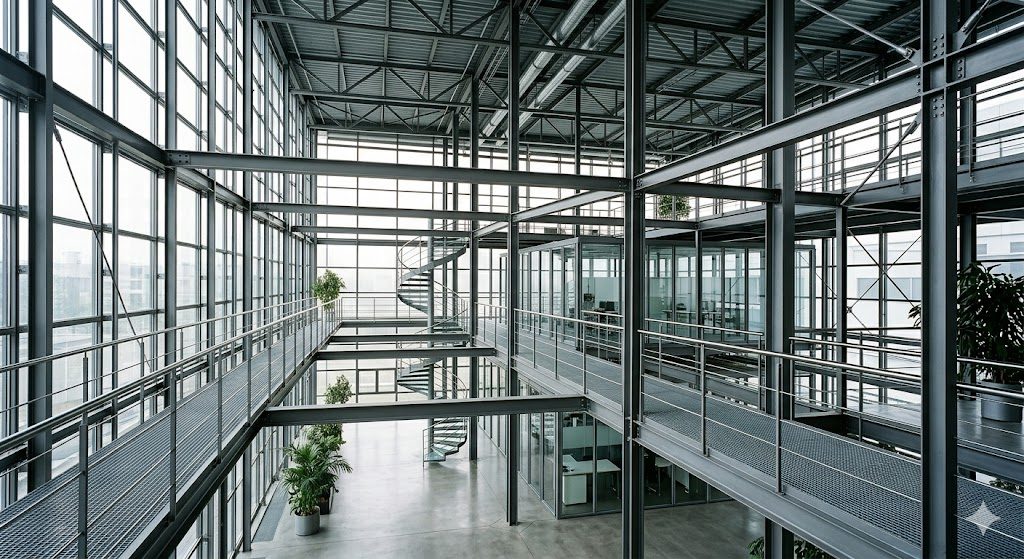
You do not need a 30-storey tower to live with High-Tech ideas. The movement translates beautifully to the industrial-loft home, and many of its moves scale down to an apartment or villa:
- Expose the structure. Leave a steel beam, a column or a concrete-and-steel composite frame frankly on show, painted in a clean protective colour. Let people read how the space stands up.
- Celebrate the joint. Specify visible bolted connections, exposed brackets, steel stair stringers and balustrades with their fixings shown. The detail is the decoration.
- Embrace the industrial palette. Mild and stainless steel, aluminium, large sheets of glass, exposed services (track lighting, surface conduit, a frank duct) and an open, column-free living volume.
- Build in flexibility. Treat partitions as moveable, not load-bearing; keep the main volume open and re-plannable, exactly as the served-versus-servant logic intends.
- Go modular. Prefabricated components — a steel mezzanine, system furniture, a kit staircase — bring the factory-precision spirit home and speed the build.
The cautions are the Indian ones. Glass is gorgeous and treacherous: shade every west and south-facing pane, use insulated or low-SHGC glass, and never make a sealed glass box you then have to refrigerate. Detail steel against corrosion, especially in coastal and humid cities. And remember that exposed services demand a discipline of neatness — a frankly shown duct is only beautiful if it is laid out beautifully.
Misconceptions and where it goes wrong
The first misconception is that High-Tech means "lots of gadgets" or "smart-home technology." It does not. The "tech" is structural and constructional — the engineering of steel, glass and services — not the wiring of automation. A house full of smart switches is not High-Tech architecture.
The second is that exposing the services is merely a style you can paste on. It is a discipline. Pompidou and Lloyd's work because the services were designed, from the first sketch, to be seen, reached and replaced. A duct left carelessly visible to look "industrial" is just an unfinished ceiling.
The third, and most consequential in India, is the belief that a glass curtain wall equals modernity and progress. Unshaded glass in a hot climate is not progressive; it is an environmental liability, and it is why so many "iconic" Indian glass towers are quietly miserable to occupy and ruinous to run. The movement's own evolution into eco-tech is the rebuke to that error. Done right — as engineering answering to climate, with shading, double skins and intelligent glazing — High-Tech in India can be both spectacular and responsible. Done as a thoughtless glass box, it is the opposite of everything the movement actually stands for.
Bring it home, in order
1. Decide what you want to show — a beam, a stair, a frame — and design it from the start to be seen, not merely left bare.
2. Choose your structural language: a visible steel frame, an exposed composite slab, or a celebrated stair and mezzanine.
3. Keep the main living volume open and column-free; make partitions light and moveable so the plan can change.
4. Run a sun-path analyzer study on every glazed facade before you size a single window, and shade the west and south.
5. Specify climate-appropriate glass — insulated, low-SHGC — and add external shading: fins, louvres or deep overhangs.
6. Detail the joints and services with care; exposed only earns its keep when it is laid out cleanly.
7. Protect your steel against humidity and salt, especially in coastal cities.
8. Borrow the eco-tech mindset: let the visible technology do environmental work, not just look impressive.
Not sure whether the machined clarity of High-Tech is your language, or whether you lean toward something warmer or more regional? Try our style finder to locate your taste — and then design with it. DesignAI lets you generate and test High-Tech and eco-tech ideas for your own home in minutes, shading and glazing included, so you can see the steel-and-glass dream before you commit a rupee to it. The same intelligence powers our work on AI architecture in India, turning the movement's engineering faith into something you can actually build.
References
1. Reyner Banham, The Architecture of the Well-Tempered Environment (1969) — the argument that services and environmental systems are central to architecture.
2. Colin Davies, High Tech Architecture (1988) — the foundational survey of the movement.
3. Kenneth Frampton, Modern Architecture: A Critical History — situates High-Tech within late Modernism and against Critical Regionalism.
4. Richard Rogers, Architecture: A Modern View (1990) — the architect of Pompidou and Lloyd's on the inside-out building.
5. Reyner Banham (and the Archigram archive) on Buckminster Fuller, Archigram and the prehistory of the machine aesthetic.
6. National Building Code of India (NBC 2016) — energy and envelope provisions relevant to glazing and solar heat gain in Indian climates.
7. Energy Conservation Building Code (ECBC), Bureau of Energy Efficiency — the Indian framework governing glass, shading and cooling loads in commercial buildings.
If this way of thinking moves you, follow it sideways: read what is Brutalism for the heavy, raw cousin of the same honesty, and what is critical regionalism for the argument that grounds global technology in a specific Indian sky. Then ground it at home with sustainable home design in India.
Export this guide
Related Guides — Deep-dive reading
Norman Foster's Façade Signature: The High-Tech Glass Diagrid and the Engineered Skin
How Norman Foster turned the building envelope into structure, climate machine and civic statement — the diagrid crystal, the breathing double-skin, the glazed gridshell — and what his glass towers really demand in Indian heat.
Building FacadesLouis Kahn's Façade Signature: Wrapping Ruins, Brick Arches, and Monumental Light
How Louis Kahn shaded the glass behind giant geometric screen walls, asked the brick to be an arch, and built monumental façades of fair-faced concrete and light — and what that hot-climate logic teaches Indian builders today.
Building FacadesDesigning a Naturally Energy-Efficient Indian Home
Comfort first, gadgets last — passive design, orientation, insulation, ventilation and the climate wisdom that cuts Indian energy bills
SustainabilityRelated Tools — Try Free
Brise-Soleil Visualizer
Interactive horizontal-louvre cut-off angle calculator — sun altitude, louvre depth, and spacing inputs with a live shadow preview. Computes θ = arctan(spacing/depth) for façade shading, ECBC envelope compliance, hospital daylight design, and tropical sun-control detailing.
Sun Shading ToolCross-Ventilation Analyzer
Estimate airflow and air changes per hour (ACH) from room size, window areas, layout, and local wind — with NBC 2016 Part 8 compliance check.
Ventilation CalculatorWindow Heat Gain Calculator
Estimate solar heat gain in watts, daily kWh and AC tonnage by window area, orientation, SHGC and shading.
Window Calculator