
Glenn Murcutt
The sole practitioner who taught architecture to touch this earth lightly
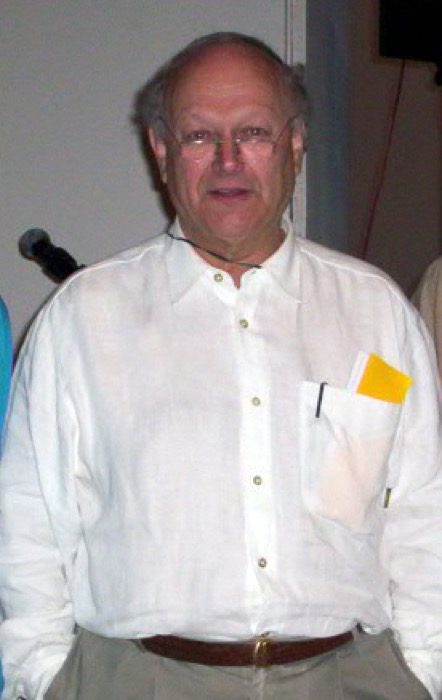
Photo: ArquiWHAT, Public Domain, via Wikimedia Commons
Movements
Signature works
- Marie Short House, Kempsey (1975)
- Magney House, Bingie Point (1984)
- Simpson–Lee House, Mount Wilson (1994)
- Arthur & Yvonne Boyd Education Centre, Riversdale (1999)
- Australian Islamic Centre, Newport (2016)
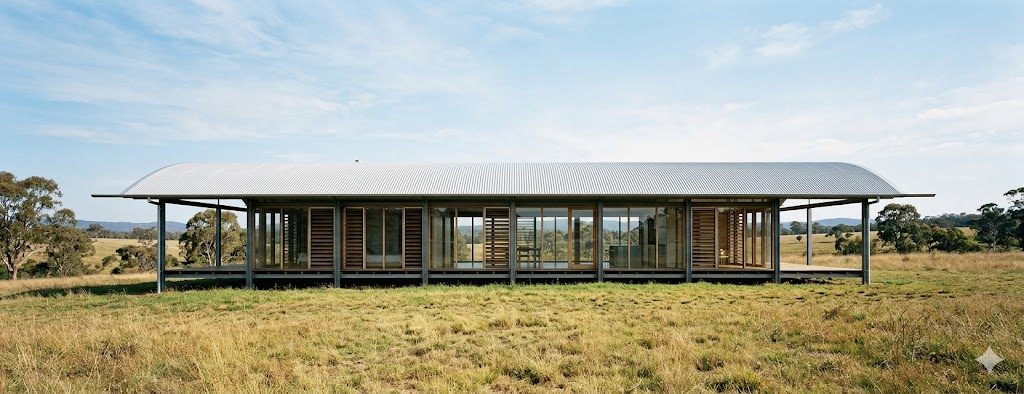
Stand on the verandah of the Marie Short House in the green river country around Kempsey, in rural New South Wales, and the building barely registers as a building at all. It is a long, low, silvery shed, lifted clear of the wet ground on slender posts, its corrugated-metal roof curving gently against a vast Australian sky. The walls dissolve into rows of timber-framed glass and adjustable louvres. Push them open and the whole house breathes — the river breeze runs straight through one room and out the other side, the eaves throw a band of shade across the floor, and somewhere off the roof the rain is being gathered into a tank. Nothing hums. Nothing is sealed. The house is an instrument for living inside the weather rather than shutting it out.
The man who drew it — and who drew every line of it himself, alone, by hand — is Glenn Murcutt, born in London in 1936 and shaped by the Australian bush, the world's most celebrated sole practitioner.
His contribution can be put in a single Aboriginal phrase he adopted as his creed: "touch this earth lightly". Murcutt built an entire body of work, almost all of it modest houses, out of the conviction that architecture should be read from the land — from the sun, the wind, the water and the seasons — and set down so gently that the ground beneath could recover if the building ever vanished. Lightweight, climate-responsive, made of corrugated metal and slender steel and broad verandahs and tunable louvres, his houses are among the clearest demonstrations anywhere that the most advanced architecture can also be the most passive.
The idea
Most modern architecture begins with a programme and a plot ratio. Murcutt begins with the place itself. Before a line is drawn he wants to know where the sun rises and sets across the year, where the prevailing wind comes from, how the rain falls and the water runs, which trees grow on the site and how the seasons move through it. The building, when it comes, is the instrument that tunes all of these — admitting the low winter sun and shading the high summer one, opening to the cooling breeze and closing against the cold, catching the rain off its roof. It is architecture as a response, not an imposition.
The phrase he made famous for this is borrowed, and he is scrupulous about its origin: "touch this earth lightly" is, he has said, an Aboriginal Australian idea — a way of dwelling on land without scarring it. In practice it means the long thin plan lifted on slim posts rather than bulldozed into a cut-and-fill platform; the lightweight skin of metal and glass rather than heavy masonry; the building that could be removed and leave the paddock much as it was. It is an ethic of reversibility and restraint, unusual in a discipline that mostly measures itself by permanence and mass.
From this flow the recurring moves that make a Murcutt house recognisable at a glance. The plan is almost always long, thin and a single room deep, so that every space opens to two sides and can be cross-ventilated and daylit without machinery. The roof is lightweight corrugated metal, often curved, shedding and harvesting rain and casting almost no heat load. The skin is not a wall but a system of adjustable layers — glass, fly-screen, timber blades, banks of operable louvres — that the inhabitant works like the rigging of a boat, opening the house in the heat and battening it down in the cold. And the verandah, that great Australian threshold, does the work of an air-conditioner: it shades, it shelters, it extends the living space into the landscape.
There is one more thing that is impossible to separate from the work: the way it is made. Murcutt has no office, no staff, no partners and famously no website. He designs every project entirely alone, drawing by hand, taking on only the small number of commissions one person can fully resolve. This is not eccentricity for its own sake. It is the discipline that makes the architecture possible — a refusal to grow, to delegate, to chase scale, so that every detail of every house passes through one pair of hands and one act of attention.
Life and path
Glenn Marcus Murcutt was born on 25 July 1936 in London, to Australian parents who happened to be abroad. His earliest childhood was spent far from any city, in the Morobe highlands of Papua New Guinea, where his father had interests — an upbringing in heat, rain and wild country that left a permanent mark on a boy learning to read landscape. The family later settled in Sydney, where he grew up.
His most important teacher was his father. A man of strong and idiosyncratic convictions, the elder Murcutt put two things into his son's hands that would shape the whole career: the writings of Henry David Thoreau, with their gospel of self-reliance and of living simply and deliberately in nature; and the architecture of the European moderns, above all Ludwig Mies van der Rohe and Alvar Aalto. From Thoreau came the ethic — economy, attention, life lived close to the natural world. From Mies came the discipline of structure and the beauty of a clear, minimal frame; from Aalto, the warmth, the humanism and the sensitivity to climate and material that keep Murcutt's minimalism from ever turning cold.
He trained in Sydney, at the institution then known as the New South Wales University of Technology and the Sydney Technical College, qualifying as an architect at the end of the 1950s. He travelled, looked hard at the modern masters in Europe and America, and then did something quietly radical: he came home to Australia and decided to work, on his own, on the ordinary problem of the house in the Australian landscape — and to do it so well that the ordinary became extraordinary.
The decision to remain a sole practitioner was the decision that defined him. While his international peers built firms of hundreds and chased towers across the globe, Murcutt stayed in Sydney, kept his practice to one person, and accepted that this meant clients sometimes waited years for him to be free. The result is a small, dense, almost handmade body of work — perhaps a few dozen completed buildings across half a century — every one of which he could hold entirely in his own head. When the world's great prizes finally came, they came not to a brand or a studio but to a man and his pencil.
The signature works
Murcutt's oeuvre is overwhelmingly domestic and rural — houses in the paddocks, bush and coastline of New South Wales, each a fresh reading of its particular patch of ground. A handful stand as the canonical texts.
| Work | Where / when | Why it matters |
|---|---|---|
| Marie Short House | Kempsey, NSW, 1975 | The breakthrough: two long timber pavilions, one room deep, raised on posts, skinned in louvres and metal — the long thin breathing plan made manifest. He later bought and adapted it as his own. |
| Ball–Eastaway House | NSW | An artists' house as a long lightweight metal shed in the bush, refining the curved-roof, louvred, elevated language. |
| Magney House | Bingie Point, NSW, 1984 | Perhaps his most iconic image: a single sweeping curved metal roof over a glass-and-louvre pavilion facing the sea, shaped entirely by sun, wind and the run of rainwater. |
| Simpson–Lee House | Mount Wilson, NSW, 1994 | A pair of pavilions among the gum trees, with adjustable blades and louvres tuned to a fire-prone mountain landscape and a small ornamental water body. |
| Marika–Alderton House | Northern Territory | A climate-and-culture response: an open, demountable tropical house for an Aboriginal family, designed in close dialogue with their way of living. |
| Arthur & Yvonne Boyd Education Centre | Riversdale, NSW, 1999 | His major public building, a riverside education centre done with Wendy Lewin and Reg Lark — the domestic language scaled up to a shared institution. |
| Australian Islamic Centre | Newport, Melbourne, 2016 | A community mosque, with Hakan Elevli, where coloured roof lanterns flood the prayer hall with shifting daylight — climate and light applied to sacred space. |
The Marie Short House of 1975 is where the language crystallised. Two simple timber pavilions, raised off the damp ground, run long and thin so that the river breeze sweeps through; the roof is corrugated metal, the walls are louvres and glass that the inhabitant adjusts with the day. It looks, at first glance, like the humble rural shed any Australian farmer would recognise — and that vernacular memory is deliberate. Murcutt took the cheapest, most ordinary building type in the country and refined it into architecture of the highest order. He loved the house so much he eventually bought it himself.
The Magney House at Bingie Point (1984) is the work most people picture when they think of him: a long pavilion under one continuous, gently curved metal roof, the curve itself a diagram of the climate — generous eaves to the harsh side, the roof falling to gather rainwater, the glass and louvred wall opening to sea and breeze. It is minimal, almost austere, and yet completely alive to its coast.
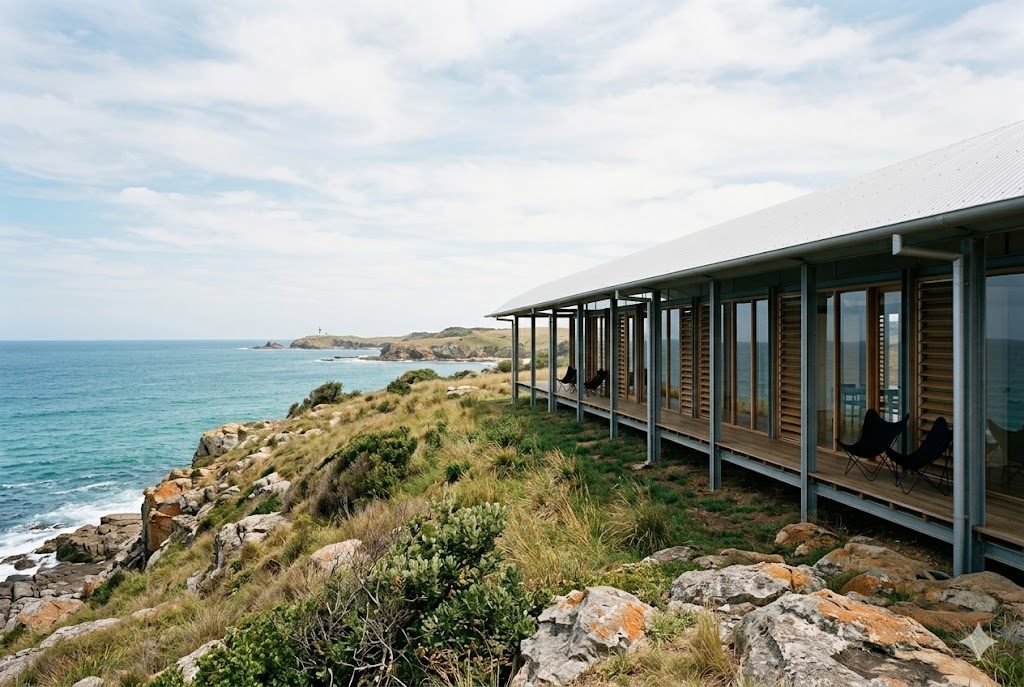
The Simpson–Lee House at Mount Wilson (1994) shows the system at its most refined: layered, adjustable skins of glass, screen and blade that let the occupants dial the building open or shut as a mountain day swings from cold morning to hot afternoon, all set lightly among the eucalypts.
The Marika–Alderton House in the Northern Territory marks an important widening of his world: a tropical, demountable, breeze-driven house designed with and for an Aboriginal family, where "touch this earth lightly" met the culture that gave the phrase its meaning. And in his two major non-domestic works — the Boyd Education Centre at Riversdale and, late in his career, the Australian Islamic Centre in Melbourne — he proved that the same passive, light-filled, climate-read principles could carry a public institution and even a place of worship.
The philosophy
The movement Murcutt's work most completely embodies is critical regionalism — the idea, named by the critic Kenneth Frampton, that good modern architecture should resist the placeless, air-conditioned International Style by drawing critically and selectively on the climate, light, topography and culture of its actual place. Frampton wrote about Murcutt directly; the Australian is one of the canonical figures of the whole argument. You can read the full account in our guide to critical regionalism, the philosophy his houses helped define.
What makes Murcutt a critical regionalist and not a nostalgist is the same thing that made his great kindred spirits one. He never copies the past. He abstracts it. The corrugated-iron farm shed, the wide colonial verandah, the water tank, the Aboriginal idea of light dwelling — all are raw material, distilled through a modernist's love of structure and clarity into something entirely new that nonetheless belongs completely to its place. The result is neither imported International Style nor sentimental revival, but a third thing: a modern architecture that is unmistakably of the Australian land.
Since "touch this earth lightly" is an Aboriginal principle he has openly credited as borrowed, it is given here as the idea he adopted rather than a phrase he coined — a way of building that lets the ground recover when the house is gone.
This climate-first method is why a Murcutt plan can look so plain on paper and feel so intelligent in the body. The architecture is in the section — in the way the roof, the eave and the louvre choreograph sun, shade, breeze and water through the long thin volume — far more than in any elevation or facade.
India
Murcutt has built nothing in India, and it would be false to suggest otherwise. His relevance to India is not a building but a method — and on that level the kinship is unusually close.
India's own building traditions, long before air-conditioning, solved exactly the problems Murcutt solves: how to live comfortably in a demanding climate using shade, mass or lightness, cross-ventilation, water and the seasons rather than machinery. The deep verandah that wraps a South Indian or Goan house; the jali screen that filters sun while admitting breeze; the courtyard that pulls cool air down and lets hot air rise; the broad shading eaves and the rainwater tank — these are the same instruments Murcutt rediscovered in the Australian shed and the colonial verandah. His architecture is, in effect, a parallel answer to a shared question. That is why he reads so naturally to Indian eyes.
The mapping is almost one to one with India's climate-responsive thinking. His insistence on reading the sun, wind and seasons before drawing is precisely the logic set out in our guide to passive design across India's climate zones, where the same building — verandah, louvre, eave, cross-ventilated thin plan — is tuned differently for hot-dry Rajasthan, warm-humid Kerala or composite Delhi. His ethic of low-energy, low-impact, lightweight construction is the heart of our guide to sustainable home design in India: comfort sought first through shade, breeze and orientation, and only last through equipment.
His affinities with the masters who carried this thinking through South Asia are strong. He shares with Geoffrey Bawa, the father of Tropical Modernism, a conviction that the threshold — the verandah, the open-sided room — is the most valuable space in a hot climate, and that a building should be experienced as a journey through layers open to the air. He shares with Laurie Baker, the Englishman who became Kerala's conscience, a faith in economy, in local material and craft, and in the quiet wisdom of vernacular building over imported fashion. Read alongside one another, the three describe a single great idea practised on three coasts: a modernity at home in its own heat, light and rain.
For an Indian student or practitioner, then, Murcutt is not a foreign curiosity but a near-relative — proof from the other side of the Indian Ocean that the verandah, the louvre and the long thin plan are not nostalgia but the most economical climate engineering there is.
Legacy and what we can learn
The recognition, when it came, was emphatic. In 2002 Murcutt received the Pritzker Prize, architecture's highest honour — awarded, remarkably, to a man who had built almost nothing but houses, ran no office and employed no one. He also holds the Alvar Aalto Medal and, in 2009, the RIBA Royal Gold Medal. For decades he has taught the renowned annual master classes of Architecture Foundation Australia, where architects from around the world come to learn his method of reading a site — making him, despite the solitary practice, one of the most widely transmitted teachers of his generation.
But his deepest legacy is an argument, and it is portable to any climate. Murcutt teaches the designer to begin not with the floor plan or the facade but with the place: to find the sun, the wind, the water and the seasons, and to let the building grow as their instrument. He teaches that lightness — of structure, of footprint, of energy — can be a virtue rather than a compromise. He teaches that the adjustable, operable building, worked by its inhabitants like a boat in changing weather, is more humane and more efficient than the sealed glass box on its thermostat. And he teaches, by his whole way of working, that doing less, slowly and entirely by hand, can produce more.
For an India building furiously and warming fast, that lesson is not romance but engineering of the cheapest kind. Before reaching for the air-conditioner, reach for the eave, the louvre, the cross-breeze and the tank — and touch the earth lightly.
The principles Murcutt distilled — climate-led siting, the breathing section, comfort from shade and breeze before machinery — are exactly the ones we encode when you design a home with DesignAI, so that a house begins with the sun and the wind rather than with a thermostat.
References
- Glenn Murcutt and Maryam Gusheh and others, The Architecture of Glenn Murcutt (TOTO, 2008) — comprehensive survey of the work.
- Francoise Fromonot, Glenn Murcutt: Buildings + Projects (Thames & Hudson) — the standard monograph.
- Haig Beck and Jackie Cooper, Glenn Murcutt: A Singular Architectural Practice — on the sole-practitioner method.
- The Pritzker Architecture Prize — 2002 jury citation for Glenn Murcutt.
- Kenneth Frampton, writings on critical regionalism, including discussion of Murcutt.
- William J. R. Curtis, Modern Architecture Since 1900 (Phaidon, 3rd ed., 1996) — on regionalism and climate-responsive modernism.
- Philip Drew, Touch This Earth Lightly: Glenn Murcutt in His Own Words.
To follow the thread of his thinking, read our guide to critical regionalism, and meet his climate-minded kin Geoffrey Bawa and Laurie Baker. To put his ideas to work in the Indian climate, explore passive design across India's climate zones and sustainable home design in India.
Philosophies they championed