
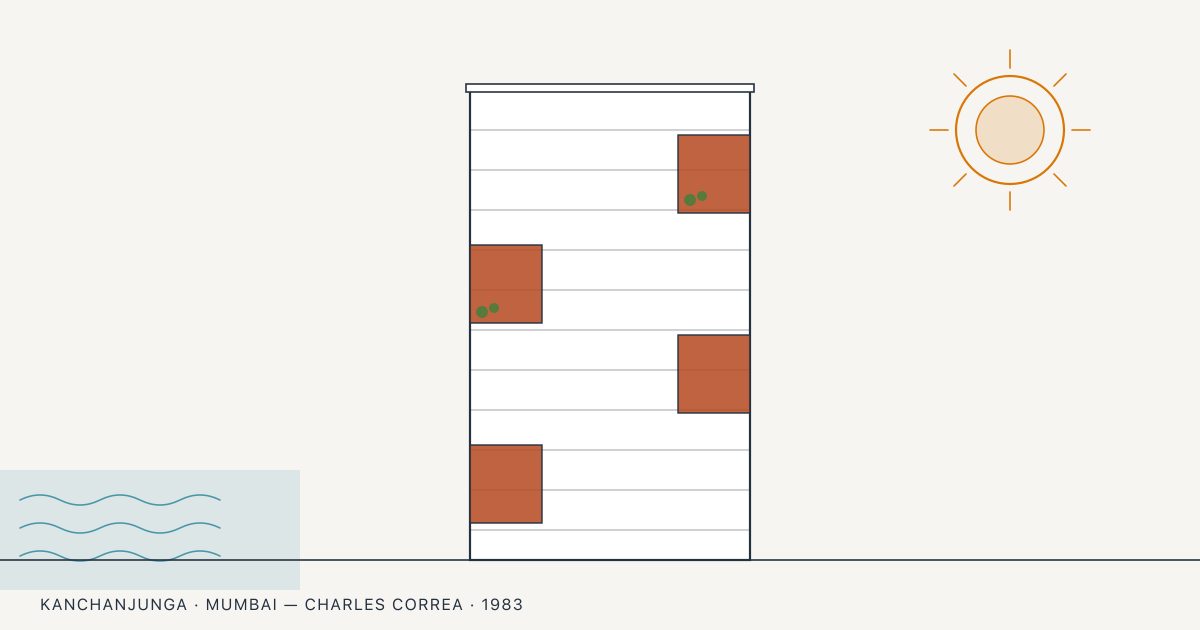
Kanchanjunga Apartments, Mumbai — Charles Correa's Verandah in the Sky
How Correa carved interlocking double-height garden terraces into a concrete tower to give every flat the shaded, breezy verandah of the old bungalow — thirty storeys up.
On the ridge of Cumballa Hill, where south Mumbai climbs toward the Arabian Sea, stands a tower that has been photographed, drawn, and argued over more than almost any other apartment building in India. Kanchanjunga Apartments, designed by Charles Correa over the course of the 1970s and completed in 1983, looks at first like a sober white slab of reinforced concrete. Then you notice the bites taken out of it: deep, double-height voids gouged into the corners, some open to the sky, painted in flashes of ochre and earth-red where the rest of the facade is white. Those voids are the whole argument of the building. They are Correa's answer to a question every Mumbai high-rise has to confront and most ignore: how do you live well in a vertical city where the best views and the worst weather arrive from exactly the same direction?
The tower on the hill
Kanchanjunga is a single freestanding tower of roughly 28 to 32 storeys, rising about 84 metres, containing just 32 apartments. That low count is the first clue that this is not an ordinary developer block. These are large luxury homes — interlocking duplexes that come in several types, ranging from three-bedroom units up to sprawling six-bedroom ones. The building sits on a central core that carries the services and the structure, with the floor plates cantilevering outward from it. For India in the late 1970s and early 1980s, that cantilevered, central-core concrete frame was itself a structural landmark, an early demonstration that an Indian residential tower could be both technically ambitious and architecturally serious rather than merely tall.
But the structure was always in service of an idea about climate and dwelling, not the other way around. To understand the tower, you have to start with the paradox of its site.
The paradox of the Mumbai high-rise
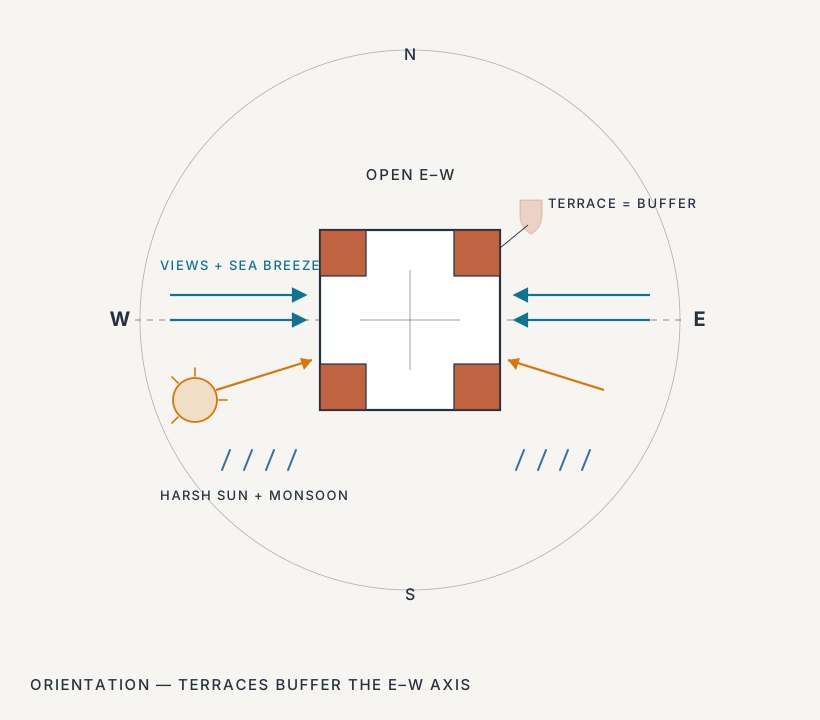
Mumbai is a warm-humid coastal city. For most of the year, comfort depends less on heating or cooling than on moving air — on catching the sea breeze and letting it sweep through the rooms to carry away heat and humidity. On Cumballa Hill, the prevailing breezes and the finest views, out toward the sea and back toward the harbour, run along the east–west axis.
Here is the cruelty of it: the sun and the monsoon come from those same east and west directions. Orient your big windows to grab the view and the breeze, and you also invite in the low, raking afternoon sun and, for months on end, the driving horizontal rain of the southwest monsoon. A naive high-rise solves this with sealed glass and air-conditioning, turning its back on the very climate it sits in. Correa refused that bargain. He wanted the views and the breeze without the glare and the deluge — and to get it, he reached back to a building India had been refining for centuries.
The verandah, re-imagined
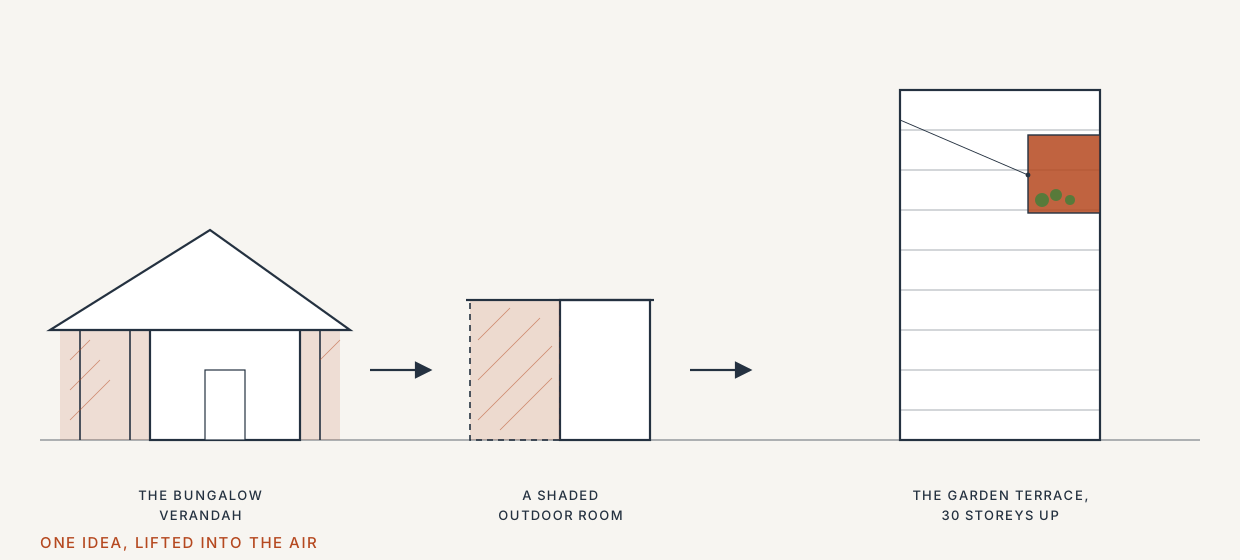
The old colonial bungalow — itself an adaptation of much older Indian courtyard and pavilion ideas — solved the warm-humid problem with the deep verandah. A verandah is a shaded, often open-to-sky transition zone wrapped around the living rooms. It is neither fully inside nor fully outside. It catches the breeze and lets it filter indoors; it throws the rooms into shade so the walls never bake; it keeps the rain off the openings while still letting air pass. It is a buffer, a filter, and an outdoor room all at once.
That typology works beautifully on a bungalow, where it can spread horizontally across the ground. The problem Correa set himself was how to carry it up into a tower without losing it to the logic of the stacked, sealed floor plate. His move was to take the verandah and fold it into the section of the building as a two-storey, recessed garden terrace, carved out of the corners precisely where sun, rain, and view all arrive.
| The verandah problem | Correa's move at Kanchanjunga | The climatic payoff |
|---|---|---|
| Best views and breeze come from the east and west | Open the apartments boldly toward east and west | Cross-ventilation and sea views run right through the home |
| Harsh sun arrives from the same east–west axis | Set the living space behind a deep, two-storey terrace | The terrace shades the interior; walls and glass stay cool |
| Driving monsoon rain comes from the same directions | Recess the terrace into the volume as a covered buffer | Rain is kept off the rooms while air still passes through |
| Towers usually seal up and rely on air-conditioning | Make the buffer an open-to-sky outdoor room | Comfort comes largely from shade and airflow, not machinery |
The result is that each apartment effectively gets its own slice of bungalow verandah, lifted dozens of metres into the air and turned into a private double-height garden in the sky.
How the interlocking duplexes work in section
The genius of Kanchanjunga is not visible in plan alone; you have to read it in section. Because the units are duplexes and because the terraces are two storeys tall, the apartments interlock like pieces of three-dimensional joinery. One unit's double-height terrace sits above another unit's enclosed rooms; living spaces and open voids dovetail so that the building's full height is shared cleverly between neighbours rather than wasted in uniform single-storey slabs.
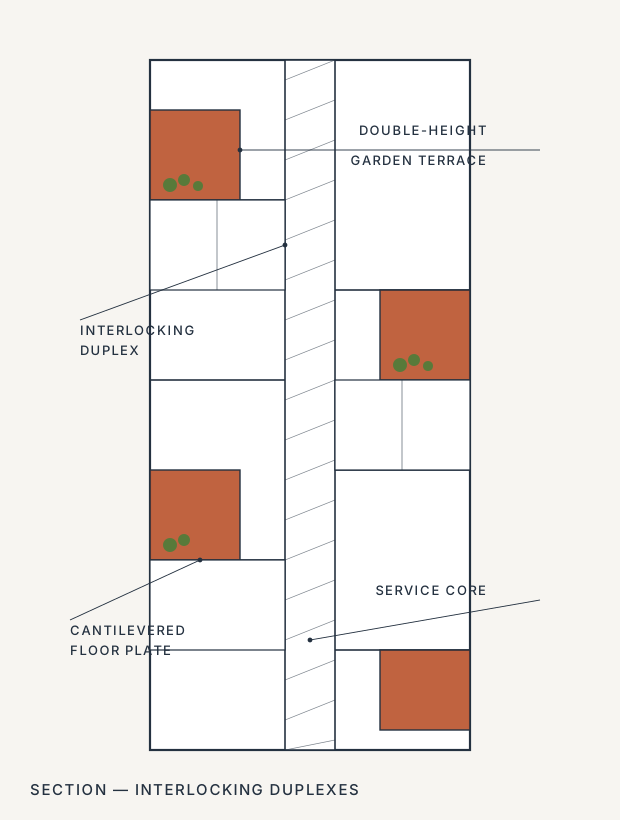
This interlocking does several things at once. It gives each home generous double-height drama in its main living volume without that volume claiming two full floors of the tower's footprint. It lets the garden terraces reach the corners — the most exposed, most valuable, view-rich positions — for many units rather than just the few at the top. And it produces the building's famously irregular, syncopated facade: the voids do not line up in tidy rows because the sections behind them are puzzle-pieced together. What reads from the street as a sculptor's whim is in fact the honest outward expression of a sectional strategy for light, air, and shade.
The terraces are not balconies bolted onto a slab. They are rooms of air, carved out of the building's mass, where the verandah of the old bungalow is reborn at the scale of the tower.
How it breathes
Strip away the formal vocabulary and Kanchanjunga is, at heart, a machine for moving air without machinery. Each apartment is conceived to be ventilated across its width: openings on the windward side admit the sea breeze, the air flows through the living spaces, and it exits on the leeward side. The double-height terraces are central to this. As buffers, they do three jobs simultaneously — they shade the glazing so radiant heat never builds up against the rooms, they shelter the openings from monsoon rain so windows can stay open in the wet months, and they act as deep porches that scoop and funnel the prevailing wind into the heart of the home.
The thermal logic is the same one that keeps a deep verandah cool on a sweltering afternoon, only stacked and multiplied. A room set behind a two-storey shaded void simply never receives the direct sun that would otherwise turn it into an oven. With the sun handled by shade and the heat handled by airflow, the dependence on heavy air-conditioning drops sharply. In a city as hot and humid as Mumbai, that is not a minor refinement; it is the difference between a home that works with its climate and one that wages a losing, energy-hungry war against it.
Open-to-sky space, and why it matters
Behind the specific terraces lies one of Correa's lifelong obsessions: what he called open-to-sky space. In his thinking, the warm Indian climate makes the open sky a usable, almost sacred part of the dwelling — a courtyard, a terrace, a verandah is not leftover outdoor area but a genuine room whose ceiling happens to be the sky. Much of traditional Indian architecture, from havelis to temple courtyards to the humble village house, is organised around exactly this kind of open void.
The radical claim of Kanchanjunga is that this idea need not die when you build vertically. The standard high-rise treats the ground as the only place open space can exist, then seals every floor above it. Correa insisted that each home in the sky could keep its own piece of open-to-sky space, its own outdoor room, its own slice of the climate. The double-height garden terraces are that conviction made concrete. They are the reason the building feels, paradoxically, generous and rooted even as it climbs.
For Correa, climate was not a constraint to engineer around but a form-giver. Sun, wind, and rain were the true clients, and the verandah was their gift to Indian architecture.
Lessons for apartment design today
Kanchanjunga is one of the most celebrated and most published residential towers in India, and it has aged into something more useful than an icon: a casebook. As Indian cities densify into ever taller, ever more sealed glass blocks, the building quietly insists that there was — and is — another way. Its lessons translate directly into questions any apartment designer or discerning homeowner can ask today.
| What apartment designers can borrow today | How Kanchanjunga does it | Why it still works |
|---|---|---|
| Let climate, not just the view, drive the plan | Opens to the breeze axis but buffers the same axis from sun and rain | Comfort and views stop competing and start cooperating |
| Treat outdoor space as a real room, not a token balcony | Double-height garden terraces carved into the mass | The home gains a usable, shaded, all-weather outdoor space |
| Design in section, not only in plan | Interlocking duplexes that share the tower's height | More volume, more drama, more corners per home |
| Shade the glass before you cool the room | Deep recessed terraces shield the interior from direct sun | Cuts heat gain at source and reduces cooling loads |
| Keep windows usable in the monsoon | Covered terraces keep rain off openings | Natural ventilation continues even in the wet season |
None of these moves requires exotic technology. They require designing with the sun, the wind, and the rain in mind from the first sketch — exactly the discipline that climate-responsive Indian planning has always rewarded, and that a glance through any thoughtful set of house plans will reinforce.
A closing reflection
What makes Kanchanjunga endure is that it is not a stylistic statement dressed up as a sustainability story, nor a sustainability story with no architectural pleasure. It is both at once. The same voids that cool the rooms and keep out the rain are the voids that give the tower its arresting, off-kilter beauty. Form, climate, and dwelling are not balanced against each other; they are the same decision seen from different angles.
More than four decades after its completion, the building still poses its quiet challenge to every sealed glass tower going up around it. Correa took the deep shaded verandah of the bungalow — a piece of ordinary Indian domestic wisdom — and proved it could live thirty storeys in the air. In doing so he showed that the high-rise need not be a betrayal of climate and culture, but could be their continuation by other means. That is why students still draw its section, why architects still cite it, and why anyone serious about how Indians might live well in tall buildings still has to begin here.
References & further reading
- Charles Correa, A Place in the Shade: New Landscapes for a Changing World — Correa's own essays, including his arguments about open-to-sky space and climate as form.
- Charles Correa (monograph), with introductory essays by Kenneth Frampton — the major published survey of Correa's work, which features Kanchanjunga in detail.
- The Charles Correa Foundation — the architect's foundation, which documents and discusses his projects and ideas.
- ArchDaily and other architecture press features on Kanchanjunga Apartments — long-read profiles with drawings, sections, and photographs of the tower.
- Hasan-Uddin Khan, Charles Correa: Architect in India — an early critical study placing the building in the arc of Correa's career and of modern Indian architecture.
Export this guide
Related Guides — Deep-dive reading
Kanchanjunga Apartments: How Charles Correa Stacked the Indian Bungalow into the Sky
Charles Correa's 1983 tower on Cumballa Hill lifts the wrap-around verandah of the old Bombay bungalow twenty-eight storeys into the Mumbai air — a slender concrete shaft of interlocking split-level flats and double-height corner gardens that argues density and the private house were never enemies. A study of its central core, its cantilevered terraces, its climate logic, and the luxury critique the form invites.
The Future of ArchitectureUnderstanding Wind Analysis for a Comfortable Home
How to read your site's breeze and design openings that keep an Indian home naturally cool — long before you switch on an air-conditioner.
Site PlanningDesigning a Naturally Energy-Efficient Indian Home
Comfort first, gadgets last — passive design, orientation, insulation, ventilation and the climate wisdom that cuts Indian energy bills
SustainabilityRelated Tools — Try Free
Cross-Ventilation Analyzer
Estimate airflow and air changes per hour (ACH) from room size, window areas, layout, and local wind — with NBC 2016 Part 8 compliance check.
Ventilation CalculatorBrise-Soleil Visualizer
Interactive horizontal-louvre cut-off angle calculator — sun altitude, louvre depth, and spacing inputs with a live shadow preview. Computes θ = arctan(spacing/depth) for façade shading, ECBC envelope compliance, hospital daylight design, and tropical sun-control detailing.
Sun Shading ToolHealing View Impact Calculator
Evidence-Based Design dashboard quantifying the recovery impact of nature view + daylight factor on analgesic use, length of stay, and HCAHPS patient-experience uplift. Calibrated against Ulrich 1984 (Science), Park & Mattson 2008, and the CHD EBD evidence base.
EBD Calculator