

Geoffrey Bawa
The barrister who became the father of Tropical Modernism
Movements
Signature works
- Lunuganga (Bentota, 1948 onward)
- Ena de Silva House (Colombo, 1960–62)
- Bentota Beach Hotel
- Sri Lankan Parliament (Kotte, 1979–82)
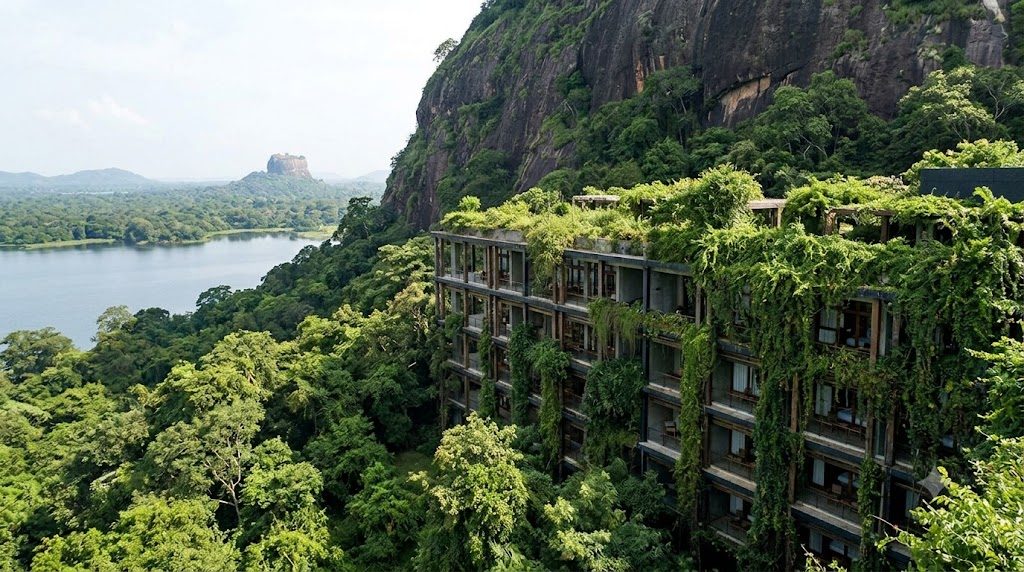
- Heritance Kandalama (1991–94)
Step off the road at Lunuganga, near Bentota on Sri Lanka's south-west coast, and the building never quite announces itself. You arrive instead through a garden — a flight of steps, a turn beneath frangipani, a sudden clearing where the land falls away to a lake and a far hill that someone, generations ago, decided should look like the tip of a temple. Only slowly do you realise that the terraces, the loggias, the cool plastered rooms open on two sides to the breeze, the urns and the pavilions, are all one continuous work, half house and half landscape, made over a lifetime by a man who could not say where his garden ended and his architecture began. That ambiguity was the point.
The man was Geoffrey Bawa (1919–2003), trained first as a barrister and only later as an architect, and by the time he died he was without serious rival the greatest architect Sri Lanka has produced — and one of the most quietly influential anywhere in the tropics.
His contribution can be put in a single phrase: he showed how to be modern in a hot, wet, green place without pretending you were in Europe. Bawa took the clarity of the modern movement — open plans, honest structure, an unsentimental eye — and wedded it to the courtyards, verandahs, tiled roofs, water and craft of monsoon Asia. The result, which the world came to call Tropical Modernism, was an architecture of dissolved thresholds and framed views, where rooms breathe into gardens and a building is experienced as a journey rather than a facade. (For a close reading of his building skins — the dissolved façade, the verandah-as-façade, the deep shading roof and the courtyard — see our Geoffrey Bawa facade signature guide.)
The idea
Most architecture begins with a wall — a clear line between the conditioned inside and the wild outside. Bawa's begins with the dissolving of that wall. In his buildings the boundary between room and landscape is deliberately blurred: a living space gives onto a deep verandah, the verandah onto an open courtyard with a pool, the courtyard onto a garden, and you pass through these layers without ever being quite sure when you left the house.
This was not a stylistic tic. It was a climate strategy and a way of life. In a place of heavy heat, monsoon rain and constant green, the most pleasant place to be is often neither fully inside nor fully outside, but in the shaded, ventilated in-between: under a roof, open to the breeze, looking at a tree. Bawa made that in-between the principal room of the building.
It is worth pausing on how radical this was at the time. The dominant model Bawa inherited was the colonial bungalow — a sealed European box, set in the middle of a lawn, defended against the climate by thick walls, small windows and the labour of servants. Across the wider modern world, meanwhile, the International Style was teaching architects everywhere to build the same crisp, glazed, abstract object whether the site was Helsinki or Singapore. Bawa rejected both. The box ignored the breeze; the glass curtain wall, in the tropics, was an oven with a thermostat bolted on. His answer was to open the plan to the air and let the climate become an ally rather than an enemy.
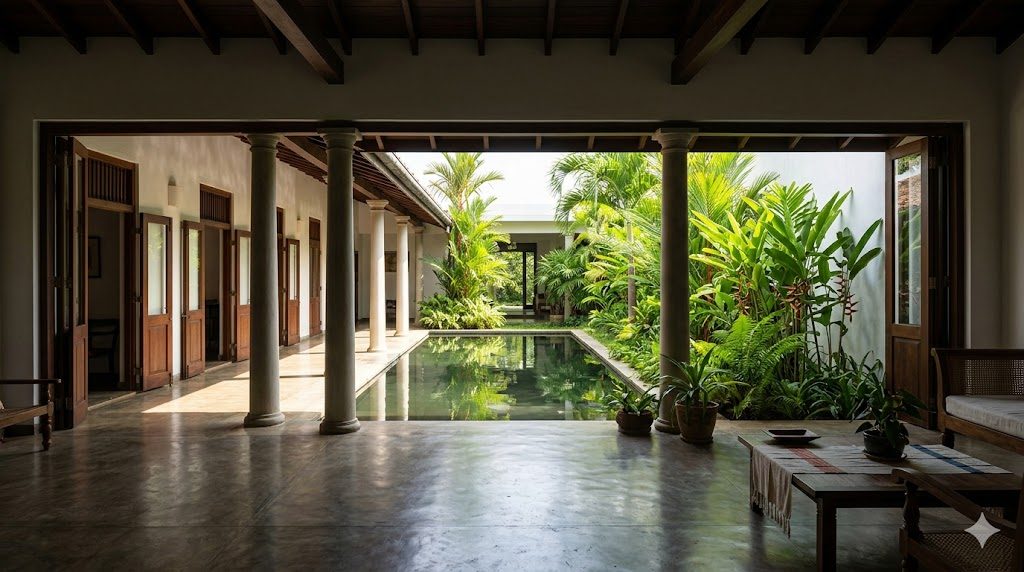
Three further ideas follow from it. First, the framed view: Bawa composed his plans so that, again and again, a doorway or a gap between columns captures a precise picture — a single tree, a slice of the sea, the far temple-hill at Lunuganga. Second, the journey: you do not simply enter a Bawa building, you are led through it, by steps and turns and changes of light, with compression and release borrowed from the experience of walking a garden. Third, craft and climate: tiled roofs that shed the monsoon, timber and local stone, batik and brass made by Sri Lankan hands — tradition reworked, never copied.
Life and path
Geoffrey Manning Bawa was born in Colombo in 1919, into a wealthy, cosmopolitan and mixed family — a background that made him at once an insider and an outsider on the island, fluent in the European world yet rooted in Ceylon. He was sent to England to be educated, read English at Cambridge, then trained in the law and was called to the bar. For a time he practised, half-heartedly, as a barrister.
What he really wanted was harder to name. In the years after the Second World War he travelled — restlessly, expensively, looking for a place and a vocation that would hold him. At one point he is said to have dreamed of buying an Italian villa with a great garden. Failing that, in 1948 he bought instead a neglected rubber estate on a low hill between two arms of a lake near Bentota, and called it Lunuganga. He intended to make an Italian garden in the tropics. The garden, in the end, made him an architect.
Discovering that he did not have the technical knowledge to build what he was imagining, Bawa enrolled — already in his late thirties — at the Architectural Association in London, the crucible of British modernism, and qualified as an architect around 1957. He returned to Ceylon and joined the Colombo practice that would become known, after his partner's death, simply by his own name. His career, in other words, began absurdly late, and lasted with extraordinary productivity for the next four decades.
He never married, lived between Lunuganga and a famous house assembled from four small dwellings on a Colombo lane, surrounded by a devoted studio of younger collaborators, and worked until a stroke in the late 1990s ended his practice. He died in 2003.
His late start was, paradoxically, a source of strength. Bawa came to architecture without the dogmas drilled into those who train young; he arrived already widely travelled, steeped in painting, gardens and the law, with an eye trained to composition and a temperament that trusted instinct over theory. He worked, by all accounts, more like an artist arranging a landscape than like a technician resolving a brief — sketching loosely, deciding on site, revising endlessly. The barrister's career was not wasted either: it left him precise, persuasive and entirely unintimidated by clients, governments or the conventions of his profession.
The signature works
| Work | Where / when | Why it matters |
|---|---|---|
| Lunuganga | Bentota, 1948 onward | His lifelong garden-house; the laboratory where every idea was first tested. The framed view and the dissolved threshold begin here. |
| Ena de Silva House | Colombo, 1960–62 | An inward-looking courtyard house that broke with the colonial bungalow and reset modern Sri Lankan domestic architecture. |
| Bentota Beach Hotel | Bentota, late 1960s | An early, hugely influential model for the tropical resort — open, breezy, landscape-led rather than tower-led. |
| Sri Lankan Parliament | Sri Jayawardenepura Kotte, 1979–82 | A nation's legislature as a cluster of copper-roofed pavilions on an artificial lake; monumental yet rooted in island tradition. |
| Heritance Kandalama | near Dambulla, 1991–94 | A long, low hotel built into a forest cliff above an ancient reservoir, its structure almost vanishing beneath draped vegetation. |
| University of Ruhuna | Matara, 1980s | A hillside campus that reads as terraces and courts following the land rather than imposing on it. |
Lunuganga is the key to all the rest. Bought as a ruin and shaped over more than fifty years, it is less a building than a sequence of outdoor rooms, terraces and pavilions, with views composed like paintings and a temple-hill borrowed on the far horizon. Everything Bawa later did at scale he rehearsed here at the scale of a garden.
The Ena de Silva House of 1960–62 was, by contrast, an urban manifesto. Rather than a freestanding bungalow surrounded by lawn — the colonial default — Bawa turned the house inward around a central courtyard open to the sky, ancient in principle yet wholly modern in handling. It became one of the most studied houses in South Asia and a template for the courtyard revival across the region.
His hotels carried these ideas to the wider world. Bentota Beach Hotel and its successors taught a generation how a tropical resort might feel — low, shaded, porous to the breeze, organised around courts and water rather than corridors. Heritance Kandalama is the masterpiece of this strand: approached through a cave-like entrance, it stretches for hundreds of metres along a cliff above a centuries-old irrigation tank, its concrete frame deliberately left to be colonised by the surrounding jungle until the architecture and the forest become one continuous skin.
And in the Sri Lankan Parliament (1979–82), set on an island in a man-made lake at the new capital of Kotte, Bawa proved that his pavilion language could carry national monumentality without resorting to imported classicism — a parliament that looks, and cools, like the island it governs.
The philosophy
The label that stuck to Bawa was Tropical Modernism, but the deeper category his work belongs to is critical regionalism — the idea that good architecture should resist the placeless, air-conditioned International Style by drawing, critically and selectively, on the climate, materials, light and culture of its actual place. Bawa never theorised much; he was famously reluctant to explain himself in words. Yet his buildings are perhaps the most complete demonstration anywhere of what critical regionalism means in practice. You can read the philosophy in full in our guide to critical regionalism, the movement his work helped define for the tropics.
What separates Bawa's regionalism from mere nostalgia is that he never copied the past. He abstracted it. A traditional Kandyan tiled roof, a Dutch colonial verandah, a temple court, a Mediterranean loggia — all were raw material, recombined with a modernist's freedom into something that had never existed before but belonged completely to its place.
He worked less by drawing than by walking the site — placing a chair here, an opening there, asking what you would see when you turned the corner, and only then committing it to a wall.
This site-led, view-led, journey-led method is why his plans can look almost casual on paper and feel inevitable in the body. The architecture is in the movement and the air, not only in the lines.
India
Bawa was Sri Lankan, not Indian — and that distinction matters; he belonged to his island and its particular history. But few foreign architects have shaped the way India builds in the tropics more profoundly, because the problem he solved is precisely India's problem: how to live well, modernly and comfortably in a hot, humid, monsoon-soaked climate without simply sealing yourself into a glass box and running the air-conditioning.
His influence on Indian practice flows along several channels. The courtyard house he reinvented at Ena de Silva runs straight into the contemporary Indian rediscovery of the court as a climate device and a social heart — the subject of our guide to courtyard homes for India's climate. His indoor-outdoor living, deep verandahs and shaded thresholds are now part of the vocabulary of serious residential and resort work across South India, the Konkan coast, Goa and Kerala — the territory mapped in our guide to tropical architecture in India.
Bawa's affinities with India's own modern masters are strong and mutual. He shares with Charles Correa a conviction that climate, not style, should generate form — Correa's "form follows climate", his open-to-sky spaces and tube houses are first cousins to Bawa's courts and verandahs. He shares with Laurie Baker, the Englishman who became Kerala's conscience, a faith in local craft, local material and the wisdom embedded in vernacular building. Read alongside one another, the three describe a single great South Asian project: a modernity that is at home in its own heat and light.
For Indian students and practitioners, Bawa is therefore not a foreign curiosity but a near-neighbour and a constant reference — the architect you study to learn how a verandah can do the work of an air-conditioner, and how a doorway can be aimed at a tree.
Legacy and what we can learn
Bawa's influence radiated outward through the resorts, houses and institutions that copied his moves, and through the many architects who passed through his studio and carried his sensibility across Asia. The recognition came late but emphatically: in 2001 he received the Aga Khan Chairman's Award, a rare honour reserved for a lifetime of work, two years before his death.
But his real legacy is a method, and it is portable. Bawa teaches the designer to begin not with the elevation but with the experience: to walk the site, to find where the breeze comes from and where the best view lies, to ask what the visitor will see at each turn, and to let the building grow from those answers. He teaches that the threshold — the verandah, the court, the loggia — is not a leftover space but the most valuable room you have. He teaches that comfort in the tropics is mostly a question of shade, cross-ventilation and water, and only lastly a question of machinery.
For an India building furiously and warming fast, that lesson is not nostalgia but engineering of the most economical kind. Before reaching for the air-conditioner, reach for the verandah, the court and the tree.
The principles Bawa pioneered — climate-led siting, dissolved thresholds, the journey through a building — are exactly the ones we encode when you design a home with DesignAI, so that comfort starts with sun, breeze and shade rather than with a thermostat.
References
- David Robson, Geoffrey Bawa: The Complete Works (Thames & Hudson, 2002) — the definitive monograph.
- David Robson, Beyond Bawa: Modern Masterworks of Monsoon Asia (Thames & Hudson, 2007).
- Brian Brace Taylor, Geoffrey Bawa (Concept Media / Mimar, 1986).
- Lunuganga and the Geoffrey Bawa Trust — published material on the architect's house and garden.
- Aga Khan Award for Architecture — 2001 Chairman's Award citation for Geoffrey Bawa.
- William J. R. Curtis, Modern Architecture Since 1900 (Phaidon, 3rd ed., 1996) — on regionalism and the tropics.
- Kenneth Frampton, writings on critical regionalism.
To follow the thread of his thinking, read our guide to critical regionalism, and meet his South Asian kin Charles Correa and Laurie Baker. To put his ideas to work, explore tropical architecture in India and test your own site with the sun-path analyzer.
Philosophies they championed